As small businesses disappear into the black hole of “pandemic restrictions,” major international corporations devour what is left of the market. Those institutions, which Carroll Quigley referred to as future “corporate overlords,” are rolling out new technologies just in time for the “Great Reset.”
Just when you think technology couldn’t get any more invasive
There’s nothing angelic about Amazon’s new wearable technology.
Halo, Amazon’s new AI health bracelet, offers body composition analysis, tone of voice analysis, sleep & activity tracking. Presumably, this new tech is another convenient application to bring awareness to users of such things as too much body fat or if their tone is a bit too abrasive or “condescending.”
While some individuals may benefit from both of these nudges, a recent review of Halo by the Washington Post (the unabashed purveyor of the loss of civil liberties) forcibly admits that Halo is the “most invasive tech we’ve ever tested.”
Authors Geoffrey Fowler and Heather Kelly wrote:
Hope our tone is clear here: We don’t need this kind of criticism from a computer. The Halo collects the most intimate information we’ve seen from a consumer health gadget – and makes the absolute least use of it. This wearable is much better at helping Amazon gather data than at helping you get healthy and happy.
Incidentally, Amazon’s CEO Jeff Bezos owns The Washington Post.
So, we could reasonably expect the authors of this review, Fowler and Kelly, to soon have to look for other employment avenues. Either that or the review was a cleverly placed advertisement, designed to draw controversy to an app that could use some in house advertisement. And to target those readers who don’t seem to care much about their own privacy.
AI now informs people they are condescending, opinionated, and fat
Halo collects more invasive information than FitBit or Apple Watch. With no screen, sounds, vibrations, or any striking design, Halo uses sensors to monitor physical activity, sleep, skin temperature, and heart rate. The only way to read that data is through a companion phone app.
The wearable device collects new information like body photos (of a scantily clad user) and voice recordings, feeding the data into Amazon’s AI software for analysis.
Amazon says HALO requires users to be nearly naked for the complete body scan to calculate body fat percentage. This scan requires users to stand in front of their phone’s camera in their underwear for a 360-degree scan.
The shots then go to Amazon’s cloud for analysis.
Remember when people scoffed at the phrase, “Big Brother is always listening?”
This new device is. And it tells you when you are being condescending or sound opinionated. Although, supposedly, you can push a button and cut off the microphone. Temporarily…sure you can.
The WaPo writers seemed considerably more concerned with the device’s voice analysis, focused on the fact that it is not as accurate as they would like. No mention of the frightening reality that Halo possibly represents the last vestiges of privacy and personal data.
The Halo’s voice tone analysis is questionable on a whole other level. You train the device to recognize your voice by reading sample phrases, and then it listens out constantly for moments in conversation that go beyond your neutral tone. (There is a button you can press to temporarily turn off the microphone.) The Halo plots these moments as positive vs. negative and high vs. low energy, and then applies more nuanced descriptors to them – for example, a voice that registers as negative and low energy might be classified as “discouraged.” You can review a dozen, or more, of these per day in the Halo app.
“For the most part, people are relatively unaware of how they sound to others and the impact that may have on their personal and professional relationships,” said Amazon’s medical officer Maulik Majumudar.
Do we want another product designed to mine for personal data?
The Halo is designed to mine your data. As with all devices like this one, the privacy policy states Amazon won’t sell or share your data without your explicit permission and that you are in control of it. The writer’s of the WaPo article had this to say:
But that still leaves open plenty of other ways for Amazon to profit from your information. In an anonymized way, it can data mine the heart rate, activity, sleep and tone patterns of Halo owners, using it to tailor its health algorithms and learn about human bodies. Make no mistake: disrupting medicine is the next goal for big tech.
Medical industries are attempting to push digestible microchips to monitor patients’ intake of medicine from afar by their doctor. Halo is just one more step in that direction. First, there were the handhelds. Now we are in the age of wearables. “Ingestibles” are next in line on our way to merging man and machine.
Undoubtedly, those concerned with the direction in which humanity is heading will be labeled as Luddites and conspiracy theorists. We won’t be vindicated when we are proven right, either. It hasn’t happened any other time. One must wonder what kind of person would welcome such invasive technology. And could THEIR wearable technology eventually invade OUR privacy?
Override Early Access
On
via ZeroHedge News https://ift.tt/3hah1VD Tyler Durden
Atlantic City Auctions Chance To Blow Up Trump Casino Tyler Durden Thu, 12/17/2020 – 19:40
The Atlantic City government thought it would be a great idea to auction off the chance to press a virtual button to blow up President Trump’s former casino and hotel next month.
According to AP News, the demolition of the former Trump Plaza Hotel and Casino building has been transformed into a fundraiser for the Boys & Girls Club of Atlantic City. The mayor hopes the auction will raise hundreds of thousands of dollars to benefit the local community.
“Some of Atlantic City’s iconic moments happened there, but on his way out, Donald Trump openly mocked Atlantic City, saying he made a lot of money and then got out,” said Mayor Marty Small.
Small continued: “I wanted to use the demolition of this place to raise money for charity.”
Trump’s casino shuttered operations in 2014 and has fallen into a disrepair state that demolition was the only solution.
The demolition is scheduled for Jan. 29, just nine days after the presidential inauguration.
The winner of the online auction, listed at Live Auctioneers, currently with ten bids at a price of around $7k, will have the ability to push a virtual button that starts the building’s implosion.
The auction’s website says the Boys & Girls Club has “stood at the forefront of the city’s future for nearly 50 years.” Donations from the fundraiser “will help to sustain programs that serve over 2,500 youth in Atlantic City including Academic Enrichment, Arts, & Recreational ProgramsSTEAM Education – new STEAM lab praised by Apple CEO Tim Cook.”
It wouldn’t shock us if some prominent liberal wins the auction; it would be a liberal’s wet dream to blow up a former Trump building.
Override Early Access
On
via ZeroHedge News https://ift.tt/2WpIWHh Tyler Durden
What was the basis of panic that led the lights to darken on civilization?
The most important date here might be March 11, 2020. That’s when Congress itself flew into an unwarranted panic, and acquiesced to a lockdown at the urging of the “experts.”
State governors followed one by one, with few exceptions, and the rest of the world joined the lockdown frenzy.
In February, people were aching to know the answer to the following.
Would this “novel virus” have familiar patterns we associate with the flu, seasonal colds, and other predictable and manageable pathogens? Or would this be something entirely different, unprecedented in our lifetimes, terrifying, and universally deadly?
Crucial in this stage was public-health messaging. In previous pandemics from post-1918 throughout the 20th century, the central messaging was to stay calm, go to the doctor if you feel sick, avoid deliberately infecting others, and otherwise trust the systems in place and keep society functioning. This was long considered responsible public-health messaging, and this was pretty much where we stood throughout most of January and February, when publications regardless of their political outlook maintained sobriety and rationality.
Something dramatically changed this time. They pushed panic, tapping into a primal fear of disease. The reality of pandemic, as it turns out, has been familiar. The severity of its impact has been radically disparate across demographics, hitting mainly the elderly and infirm with 40% of deaths tracing to long-term care facilities with an average age of death nearly equal to the average lifespan. It is regionally migratory. It follows a seasonal pattern from pandemic to its endemic equilibrium.
What has been different has been the messaging that has almost universally been structured to create public frenzy, from the New York Times’s February 28 urge to “go medieval” to Salon’s latest demand that we panic even more.
My own sense of impending doom began on March 6 with the cancellation of South by Southwest in Austin, Texas, an action of the mayor alone, and completely without modern precedent. I wrote about it on March 8. Four days later, President Trump gave a nationwide address that ended with a shocking announcement that all flights from Europe would be stopped to keep the coronavirus out even though the virus had been here since January. The next day, on March 13, the administration issued what amounted to a shutdown plan for the nation.
Our author’s thesis was that the wild overreaction and unprecedented lockdowns of life began with what was a terminological mixup that led to a misplacement of a decimal point in a report from the National Institutes of Health.
It was a seemingly small error but it provided the basis on which Anthony Fauci testified at the House Oversight and Reform Committee about the seriousness of novel coronavirus spreading across the globe.
Here is the video in question. As you watch, you will note the seeming precision of data that actually masks a huge problem. He obscures the huge difference between the infection fatality rate, the case fatality rate, and the overall death rate. Nowhere does he mention survival rates. Not one person present pushed back on his claims. In the blizzard of data, he finally summarizes in a way that terrified everyone. Covid, he said, is “10 times more lethal than the seasonal flu.”
Even apart from that prediction, his entire demeanor was: this is entirely new, very deadly, and unbearably unmanageable without extreme measures. Fauci’s implicit message to Congress and the American people was that it is time to panic.
Fauci was claiming what in fact he could not know, conflating two distinct data sets, and extrapolating in ways that allowed him to make a completely unsupported claim that very obviously turned out to be false. Two years ago, 61,000 Americans of all ages died of flu, exclusive of other ailments.
If you incorrectly impose on that a “case fatality rate” of 0.1% and extrapolate to Covid infections, you end up with at least 800,000 deaths from Covid alone – not “with” or “involving” Covid as the CDC classifies deaths today (that alone represents a big change). This is a scary prediction at the time; it seemed to add weight to the estimates out of the Imperial College of London that 2.2 million people would die without locking down. This testimony led a whole generation of lawmakers to believe that none of the traditional medical measures could or would work. There is no comparing this with the flu or any respiratory illness. This was the Other that justified a once-in-many-generations national emergency that required an end to our way of life.
The trouble is that the whole claim was based on a terminological misstatement that fed a basic math error. As Brown explains:
Sampling bias in coronavirus mortality calculations led to a 10-fold increased mortality overestimation in March 11, 2020, US Congressional testimony. This bias most likely followed from information bias due to misclassifying a seasonal influenza IFR as a CFR, evident in a NEJM.org editorial. Evidence from the WHO confirmed that the approximate CFR of the coronavirus is generally no higher than that of seasonal influenza. By early May 2020, mortality levels from COVID-19 were considerably below predicted overestimations, a result that the public attributed to successful mitigating measures to contain the spread of the novel coronavirus.
Let’s follow Brown here as he takes the reader through the crucial differences between the IFR and the CFR. IFRs from samples across the population “include undiagnosed, asymptomatic, and mild infections.” To calculate the average IFR across the population, you do randomized samples to judge its prevalence. The results are inclusive of cases – what we used to call actual “sick” people – but extend to people who merely carry traces of the dead virus but are in no substantial danger of passing it onward or experiencing any severe outcomes. Cases, on the other hand, “are based exclusively on relatively smaller groups of moderately to severely ill diagnosed cases at the beginning of an outbreak.” The CFR is a smaller group. Brown provides the following graphic to show how epidemiology has long considered the difference.
Based on this graphic alone, you can see why it becomes crucial to keep these terms straight.
The CFR is higher; IFR is lower; the crude mortality rate is lower still.
The CFR measures severity; the IFR measures prevalence.
Those are the two general issues one needs to know to assess whether and to what extent a virus outbreak is mild, moderate, serious, or severe. This matters due to the long-observed evolved reality of respiratory viruses: there is a trade off between the forces. The more severe the virus, the quicker it burns itself out. The milder (and “smarter”) it is, the more it can spread. To mix up severity and prevalence is to make a mess of all the important categories that infectious disease specialists use to assess the social impact of a new virus.
Moreover, if you are going to compare how severe a pandemic is, you have to compare apples to apples, which means at the very minimum that we must be careful to distinguish apples from oranges from pears. That is precisely what the early messaging surrounding the coronavirus did not do.
Cases are not deaths; even more crucially, cases in a traditional sense mean that people are actually sick, not merely that they have been tested positive by a PCR test. Adding to the confusion, most data sources on Covid today use the term “cases” to identify any positive test, with or without symptoms, when the correct word would be “infections.” Further, the PCR test itself presents its own problems. As Brown notes, “A serious limitation of RT-PCR testing is that nucleic acid detection is not capable of determining the difference between infective and noninfective viruses.” The widespread use of the PCR test has made its own contribution to blurring all these crucial distinctions.
Now consider an extraordinary article from the New England Journal of Medicine that appeared on February 28, with Anthony Fauci as the co-author. The import of the piece was to claim that Covid and flu are quite similar in severity.
“The overall clinical consequences of Covid-19 may ultimately be more akin to those of a severe seasonal influenza (which has a case fatality rate of approximately 0.1%) or a pandemic influenza (similar to those in 1957 and 1968) rather than a disease similar to SARS or MERS, which have had case fatality rates of 9 to 10% and 36%, respectively.”
What matters here is not the prediction as such but the switching of the word infection with case: the flu has “a case fatality rate of approximately 0.1%.” This was incorrect even at the time of writing. You can call it a misprint or sloppy or downright duplicitous. Regardless, even the World Health Organization had identified the 0.1% figure as the flu’s infection fatality rate. If you assume one symptomatic confirmed case for every infection (or what is now confusingly called “cumulative cases”), the error could be a misplace decimal: 0.01% not 0.1%. Regardless, Fauci’s article directly contradicted the WHO, and ran counter to everything that was already then known. But his CFR claim about flu is precisely what led him to claim in front of the Congressional committee that Covid would be deadly in ways that defy all experience of this generation.
Brown further explains:
As the campaign to mitigate coronavirus transmission was implemented from March into May, 2020, expected coronavirus mortality totals in the United States appeared much lower than the overestimation reported in Congressional testimony on March 11. Compared with the most recent season of severe influenza A (H3N2) in 2017-2018,with 80,000 US deaths reported by CDC officials, US coronavirus mortality totals had just reached 80,000 on May 9, 2020. By then, relative to the 2017-2018 influenza, it was clear that the coronavirus mortality total for the season would be nowhere near 800,000 deaths inferred from the 10-fold mortality overestimation reported to Congress. Even after adjusting for the effect of successful mitigation measures that may have slowed down the rate of coronavirus transmission, it seems unlikely that so many deaths were completely eliminated by a nonpharmaceutical intervention such as social distancing, which was only intended to contain infection transmission, not suppress infections and related fatalities. Also in early May, 2020, a New York State survey of 1,269 COVID-19 patients recently admitted to 113 hospitals found that most of the patients had been following shelter-in-place orders for 6 wk, which raised state officials’ suspicions about social distancing effectiveness. Still, polls showed the public credited social distancing and other mitigation measures for reducing predicted COVID-19 deaths, and for keeping people safe from the coronavirus.
As of this writing, however, deaths “involving” or “with” Covid has passed 300,000, which while less than half as high as what Congress heard they would be on March 11, is still quite high, provided these deaths have not been broadly misclassified. However, on March 24, the CDC made an announcement of serious significance. It would now calculate coronavirus mortality by including “probable” and “likely” deaths in the International Classification of Diseases code (ICD).
This became an invitation to misclassification. People who otherwise would have previously been classified as having heart disease or some other comorbidity could now be classified as Covid. This also included a financial incentive to do just that. For this reason, when the CDC announced that “for 6% of the deaths, Covid-19 was the only cause mentioned,” it came as a shock to people. What that means is that 94% of the deaths attributed to Covid were associated with additional comorbidities that prevented the immune system from fighting off the virus.
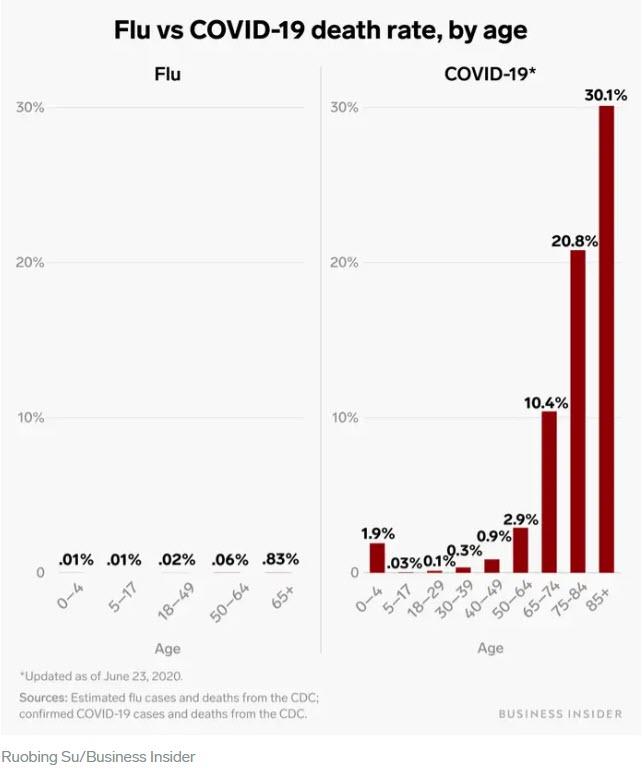
Following the March 11 Fauci testimony, in which he conflated IFR and CFR, the national media went wild with Covid and flu comparison. The following article, for example, blew up from BusinessInsider in June: “The coronavirus death rate in the US is almost 50 times higher than that of the flu. See how they compare by age bracket.” If you look carefully at the charts, you can see something fishy: they calculated infection fatality rate for flu against the case fatality rate for Covid. That necessarily generates a wild overestimate for Covid deaths. The charts are terrifying – and have nothing to do with reality.
Let’s hop forward from the testimony days to one month later when full-scale panic had already hit the U.S. Speaking at a White House press conference, Fauci then made a claim that strains credulity at every level. He said at a White House press briefing that the stringencies and “social distancing” could not and would not be relaxed until there are no “no new cases, no deaths.” Such a thing has happened only once in the history of viruses: smallpox. From the first experiments with inoculation to the final eradication took some 250 years. And yet here we have Fauci explaining that life could not be normal and functioning again until this widespread virus, relatively mild for 95% of the population, was completely eradicated from the planet!
And now we have the vaccine, and plenty of questions remaining about it, such as why non-vulnerable populations would prefer to take it over gaining the exposure necessary for naturally acquired immunity. Asking such a basic question is very close to being tabooed, even as lawmakers and other institutions are toying with the idea of making it mandatory. Even then, many of the lockdown advocates from earlier this year are saying that it will not enable us to go back to normal, to take off the masks, to go to the movies, or travel again. This is precisely the belief you might expect from a crowd that participated in what John Iaonnidis called a “one-in-a-century evidence fiasco” and are desperately trying to dig themselves out of losing every bit of scientific credibility.
Whether Brown is correct that the whole panic truly does trace to a brain flakeout on the part of Fauci – or even perhaps a deliberate “noble lie” to deceive the public into accepting the unacceptable – it hardly matters. The problem we face now is a huge tangle over terminology such that “infections” that could include as many as 90% false positives (according to the NYT) are called cases, while the once-distinct condition called cases which used to indicate actually being sick no longer has any precise meaning. The cacophony of statistical confusion here truly boggles the mind.
In the midst of all of this, the CDC itself finally updated its own estimates of the infection fatality rate of Covid-19. The CDC wisely took account of the huge demographic stratification of severe outcomes. There is not one rate that applies to the whole population or to any particular individual. There are only backward looking estimates of outcomes. They are all follows:
0.003% for 0-19 years
0.02% for 20-49 years
0.5% for 50-69 years
5.4% for 70+ years
Flipping the data to state it by survival rate by age:
99.997% for 0-19 years
99.98% for 20-49 years
99.5% for 50-69 years
94.6% for 70+ years
John Ioannidis sums up the disparity by age with the following infection fatality rate for people under the age of 70: 0.05%. This conclusion has been peer-reviewed and published by the World Health Organization.
How does this compare with the flu? We do not really know. As science journalist Shin Jie Yong has written, “There seems to be no data on age-specific IFR of the seasonal flu.” What this means is that crucial testimony of Fauci from March 11, in which he casually predicted based on bad numbers, that Covid would be ten times worse than the flu, can neither be confirmed or denied based on age-specific severe outcomes.
However, we can assemble the data based on years of lost life. Consider the long-term view over the future course of existing lifetimes. JusttheFacts reports:
If 500,000 Covid-19 deaths ultimately [in the future] occur in the United States—or more than twice the level of a prominent projection—the disease will rob about 6.8 million years of life from all Americans who were alive at the outset of 2020.
In contrast:
* the flu will rob them of about 35 million years.
* suicides will rob them of 132 million years.
* accidents will rob them of 409 million years.
As testing has expanded dramatically throughout the population, the estimated infection fatality rate of Covid will fall further. Thus can we observe a chart of “cases” (actually positive tests) all over the world and compare it with severe outcomes and see something remarkable that should make every living person fundamentally question why they decided to shut down the world and wreck billions of lives.
Another statistic that bears repeating, Covid – based on infections vs deaths – has close to a 99.9% survival rate. Imagine how the world would have been different had Fauci told that to the Congress on that fateful day of March 11. Or what if Fauci had revealed that the average age of death from Covid would almost equal the average lifespan in the US and exceed it in most parts of the world? People present might have wondered why they were holding hearings at all.
All these categories of data placement carry with them the danger of creating an illusion of control. Viruses do not come with little gears inside them with these rates. Human beings collect data and create them, and not one of them (whether IFR, CFR, infection rates, mortality rates, survival rates) pertains infallibly to any single individual. Our response to a virus is contingent on our own health, age, cross immunities, T cell memory, and a thousand other factors that no politician controls.
What we know is that a terminological confusion, a misplaced decimal point, a one-word error in data description, and a massive amount of arrogant presumptions about how to control a virus set in motion a series of events that turned our great and prosperous country into a disaster of confusion, demoralization, foregone medical services, closed businesses, wrecked arts and education, and long bread lines. The lockdowners who created this appalling disaster, the people who turned our trust into betrayal and a blizzard of statistical baloney, need to look at the science and data as they stand and come clean.
Override Early Access
On
via ZeroHedge News https://ift.tt/34lGeaa Tyler Durden
Thanks to Andrew Cuomo’s decision to once again shut down indoor dining in New York on Monday, these patrons had to eat outside in the middle of a freakin’ snowstorm.
As the wind blew, the propane heaters appeared worthless as a few of the patrons were sipping on soup and have likely downed a liquor shot or two to stay warm.
Perhaps the patrons on Wednesday night were devoted customers supporting their local restaurants, rain or shine, considering a record number of eateries across the country can’t pay December rent.
As we’ve mentioned before, Goldman Sachs has noted that if daily average temperatures slide below 40°F – then it would be associated with a steep drop off in consumer activity at eateries.
So back to the picture – patrons can thank the government for why they had to eat a nice meal outside in the middle of a major snowstorm.
Override Early Access
On
via ZeroHedge News https://ift.tt/2KiG7W1 Tyler Durden
Three bills prefiled in the South Carolina House would cut taxes on precious metals and take important steps toward treating gold and silver as money instead of as commodities. Passage of these bills would also set the stage to undermine the Federal Reserve’s monopoly on money.
Even though state action can’t end the Fed, there are steps states can take that will undermine the Federal Reserve’s monopoly on money. By passing laws that encourage and incentivize the use of gold and silver in daily transactions by the general public, state action such as the passage of these bills in South Carolina has the potential to create a wide-reaching impact and set the foundation to nullify the Fed’s monopoly power over the monetary system.
Rep. Stewart Jones (R-Laurens) filed all three bills.
House Bill 3377 (H3377) would make gold and silver coins legal tender in the state. Under the proposed law, “gold and silver coins minted foreign or domestic shall be legal tender in the State of South Carolina under the laws of this State. No person or other entity may compel another person or other entity to tender or accept gold or silver coin unless agreed upon by the parties.”
Practically speaking, this would allow South Carolina residents to use gold or silver coins to pay taxes and other debts owed to the state. In effect, it would put gold and silver on the same footing as Federal Reserve notes.
The phrase, “unless agreed upon by the parties” has important legal ramifications. This wording reaffirms the court’s ability, and constitutional responsibility according to Article I, Section 10, to require specific performance when enforcing such contracts. If voluntary parties agree to be paid, or to pay, in gold and silver coin, South Carolina courts could not substitute any other thing, e.g. Federal Reserve Notes, as payment.
South Carolina could become the fourth state to recognize gold and silver as legal tender. Utah led the way, reestablishing constitutional money in 2011. Wyoming and Oklahoma have since joined.
KNOCKING DOWN BARRIERS
Taxes on gold and silver erect barriers to using gold and silver as money by raising transaction costs. House Bill 3378 (H3378) would effectively exempt gold, silver and platinum bullion from state capital gains taxes. Passage of this legislation would eliminate a barrier to investing in gold and silver. It would also make it more practical to gold and silver in everyday transactions, a foundational step for people to undermine the Federal Reserve’s monopoly on money.
South Carolina has already repealed the sales tax on gold and silver. That removed one barrier to buying gold and silver. Passage of H3378 would remove another.
In effect, “states that collect taxes on purchases of precious metals act as if gold and silver aren’t money at all.”
Imagine if you asked a grocery clerk to break a $5 bill and he charged you a 35 cent tax. Silly, right? After all, you were only exchanging one form of money for another. But that’s essentially what South Carolina’s capital gains tax on gold and silver bullion does. By eliminating this tax on the exchange of gold and silver, South Carolina would treat specie as money instead of a commodity. This represents a small step toward reestablishing gold and silver as legal tender and breaking down the Fed’s monopoly on money.
“We ought not to tax money – and that’s a good idea. It makes no sense to tax money,” former U.S. Rep. Ron Paul said during testimony in support an Arizona bill that repealed capital gains taxes on gold and silver in that state. “Paper is not money, it’s fraud,” he continued.
GOLD BULLION DEPOSITORY
Stewart also prefiled House Bill 3379 (H3379). This joint resolution would create a study committee to determine the feasibility and efficacy of the establishment of a bullion repository in this state to store gold, silver, and other metals for the state’s reserves and for investments. The committee would be required to issue a report of its findings to the General Assembly by January 15, 2022.
South Carolina has a model it could follow. In the summer of 2015, Texas Gov. Doug Abbot signed a law creating a state gold bullion and precious metal depository in his state. The depository received its first deposits in the summer of 2018. The facility will not only provide a secure place for individuals, businesses, cities, counties, government agencies and even other countries to store gold and other precious metals, the law also creates a mechanism to facilitate the everyday use of gold and silver in transactions. In short, a person will eventually be able to deposit gold or silver – and pay other people through electronic means or checks – in sound money.
A state gold repository also creates an avenue toward financial independence. Countries around the world, including China, Russia and Turkey, have been buying gold to limit their dependence on the US dollar. University of Houston political science professor Brandon Rottinghaus said a state depository can serve a similar function for Texas.
“This is another in a long line of ways to make Texas more self-reliant and less tethered to the federal government. The financial impact is small but the political impact is telling, Many conservatives are interested in returning to the gold standard and circumvent the Federal reserve in whatever small way they can.”
The Tennessee legislature passed a resolution declaring support for the creation of a gold bullion depository in the Volunteer State back in 2016, but never followed up with any legislation. If South Carolina does create a study committee, it will be imperative to follow up with further legislation to actually establish a repository once the report is issued.
BACKGROUND
The United States Constitution states in Article I, Section 10, “No State shall…make any Thing but gold and silver Coin a Tender in Payment of Debts.” Currently, all debts and taxes in South Carolina are either paid with Federal Reserve Notes (dollars) which were authorized as legal tender by Congress or with coins issued by the U.S. Treasury — very few of which have gold or silver in them.
The Federal Reserve destroys this constitutional monetary system by creating a monopoly based on its fiat currency. Without the backing of gold or silver, the central bank can easily create money out of thin air. This not only devalues your purchasing power over time; it also allows the federal government to borrow and spend far beyond what would be possible in a sound money system. Without the Fed, the US government wouldn’t be able to maintain all of its unconstitutional wars and programs.
Passage of H3377 would reestablish gold and silver as legal tender in the state and take a step toward that constitutional requirement, ignored for decades in every state. Passing H3378 would remove one of the tax barriers that hinder the use of gold and silver as money.
Passage of both bills would also begin the process of abolishing the Federal Reserve system by attacking it from the bottom up – pulling the rug out from under it by working to make its functions irrelevant at the state and local levels, and setting the stage to undermine the Federal Reserve monopoly by introducing competition into the monetary system.
Constitutional tender expert Professor William Greene said when people in multiple states actually start using gold and silver instead of Federal Reserve Notes, it would effectively nullify the Federal Reserve and end the federal government’s monopoly on money.
“Over time, as residents of the state use both Federal Reserve notes and silver and gold coins, the fact that the coins hold their value more than Federal Reserve notes do will lead to a “reverse Gresham’s Law” effect, where good money (gold and silver coins) will drive out bad money (Federal Reserve notes). As this happens, a cascade of events can begin to occur, including the flow of real wealth toward the state’s treasury, an influx of banking business from outside of the state – as people in other states carry out their desire to bank with sound money – and an eventual outcry against the use of Federal Reserve notes for any transactions.”
Once things get to that point, Federal Reserve notes would become largely unwanted and irrelevant for ordinary people. Nullifying the Fed on a state by state level is what will get us there.
Override Early Access
On
via ZeroHedge News https://ift.tt/2K8mJLA Tyler Durden
I am, admittedly, very tough on the Chief Justice. Not because I disagree with his decisions. I routinely disagree with decisions from all nine Justices. No. I am tough on Roberts because of his arrogance. He entered this position fifteen years ago with a master plan: if there were fewer 5-4 right-left decisions, the Court will function better as an institution. And Roberts would cast decisive votes to reduce the number of right-left 5-4 decisions. Congratulations. But the means he chose to accomplish those ends have broken the Court, and the way it is perceived.
Shortly after Blue June, I wrote “Roberts’s self-professed humility depends on everyone being too dumb to see what he is really doing.” I firmly believe Robert’s transparent Machiavellianism has done far more damage to the Court than Scalia’s acerbic barbs or Kennedy’s vapid prose. I can firmly disagree with a Ginsburg or Sotomayor opinion, but I know, and respect, why they reached the result they reached. For Roberts, every decision has to refracted through some bizarre political lens. His jurisprudential lodestar is the Gallup poll.
Chief Justice Rehnquist accurately characterized this dilemma in his handdown of Planned Parenthood v. Casey. This passage, regrettably does not appear in the published dissent. But it is worth listening to. We include the audio in our 100 Cases series.
The joint opinion’s insistence on preserving the form, if not the substance of the rule, can just as easily be viewed as a surrender to those who have brought political pressure in favor of that decision. Once the Court starts looking to the currents of public opinion regarding a particular judgment, it enters a truly bottomless pit from which there is simply no extracting itself.
The Chief’s arrogance prevents him from recognizing the depth of this bottomless pit. He keeps digging, year after year. He is so locked into his ways that he cannot escape. He decided his gameplan in 2005, and absolutely nothing can make him change course.
“The highest art is artlessness,” observed Francis Alexander Durivage, a now largely forgotten 19th-century American author: The appearance of acting naturally, without calculation, wins trust and admiration. In contrast, strategic behavior flagrantly intended to advance an agenda often creates public suspicion — which may undermine the aims for which the strategy is undertaken.
Chief Justice John G. Roberts Jr. might consider the Durivage Principle. In a number of important cases in recent years, observers on both left and right have concluded that Roberts has engaged in strategic maneuvering: His goal appears to be to preserve what he takes to be the legitimacy of the Supreme Court, by disproving any suspicion that the justices vote ideologically or otherwise engage in political behavior. Yet because it is so clear that he is crafting opinions with this end in mind, the chief justice defeats his own aims. Roberts famously said at his confirmation hearing that the role of the justices is just to “call balls and strikes.” No one thinks that is an apt description of his judging. By striving so conspicuously to depoliticize the Supreme Court, he has brought about the very thing he hoped to prevent: No one has done more to politicize the court than the chief justice.
Mehta and Vermeuele walk through Roberts’s greatest hits, including NFIB v. Sebelius, Department of Commerce v. New York, June Medical v. Russo, DHS v. Regents, South Bay v. Newsom. There is one prominent Roberts 5-4 decision that doesn’t fit the mold: Shelby County v. Holder. Only his longstanding, Reaganesque grievance against the Voting Rights Act allowed him to deviate from his master plan. And then, he gave the government one, last meaningless chance to repair the statute. (See pp. 88-90 of my article, SCOTUS after Scalia). I doubt Shelby County would come out the same way today.
Mehta and Vermeule conclude:
As chief justice of the United States, Roberts’s solicitude for the reputation of both the court he leads and the entire branch of government of which he is the figurative head is understandable. Ultimately, however, his efforts to show that the court is not a partisan institution have provoked the right as much as the left. Two of Roberts’s consequential legacies will probably be the very politicization of the Supreme Court he sought to prevent, and a Republican Party that is likely to turn “No more Robertses!” into a mantra — as it did “No more Souters!” The chief will have no one to blame but himself.
There is still a way for Roberts to escape this bottomless pit.
from Latest – Reason.com https://ift.tt/3msk0cY
via IFTTT
I am, admittedly, very tough on the Chief Justice. Not because I disagree with his decisions. I routinely disagree with decisions from all nine Justices. No. I am tough on Roberts because of his arrogance. He entered this position fifteen years ago with a master plan: if there were fewer 5-4 right-left decisions, the Court will function better as an institution. And Roberts would cast decisive votes to reduce the number of right-left 5-4 decisions. Congratulations. But the means he chose to accomplish those ends have broken the Court, and the way it is perceived.
Shortly after Blue June, I wrote “Roberts’s self-professed humility depends on everyone being too dumb to see what he is really doing.” I firmly believe Robert’s transparent Machiavellianism has done far more damage to the Court than Scalia’s acerbic barbs or Kennedy’s vapid prose. I can firmly disagree with a Ginsburg or Sotomayor opinion, but I know, and respect, why they reached the result they reached. For Roberts, every decision has to refracted through some bizarre political lens. His jurisprudential lodestar is the Gallup poll.
Chief Justice Rehnquist accurately characterized this dilemma in his handdown of Planned Parenthood v. Casey. This passage, regrettably does not appear in the published dissent. But it is worth listening to. We include the audio in our 100 Cases series.
The joint opinion’s insistence on preserving the form, if not the substance of the rule, can just as easily be viewed as a surrender to those who have brought political pressure in favor of that decision. Once the Court starts looking to the currents of public opinion regarding a particular judgment, it enters a truly bottomless pit from which there is simply no extracting itself.
The Chief’s arrogance prevents him from recognizing the depth of this bottomless pit. He keeps digging, year after year. He is so locked into his ways that he cannot escape. He decided his gameplan in 2005, and absolutely nothing can make him change course.
“The highest art is artlessness,” observed Francis Alexander Durivage, a now largely forgotten 19th-century American author: The appearance of acting naturally, without calculation, wins trust and admiration. In contrast, strategic behavior flagrantly intended to advance an agenda often creates public suspicion — which may undermine the aims for which the strategy is undertaken.
Chief Justice John G. Roberts Jr. might consider the Durivage Principle. In a number of important cases in recent years, observers on both left and right have concluded that Roberts has engaged in strategic maneuvering: His goal appears to be to preserve what he takes to be the legitimacy of the Supreme Court, by disproving any suspicion that the justices vote ideologically or otherwise engage in political behavior. Yet because it is so clear that he is crafting opinions with this end in mind, the chief justice defeats his own aims. Roberts famously said at his confirmation hearing that the role of the justices is just to “call balls and strikes.” No one thinks that is an apt description of his judging. By striving so conspicuously to depoliticize the Supreme Court, he has brought about the very thing he hoped to prevent: No one has done more to politicize the court than the chief justice.
Mehta and Vermeuele walk through Roberts’s greatest hits, including NFIB v. Sebelius, Department of Commerce v. New York, June Medical v. Russo, DHS v. Regents, South Bay v. Newsom. There is one prominent Roberts 5-4 decision that doesn’t fit the mold: Shelby County v. Holder. Only his longstanding, Reaganesque grievance against the Voting Rights Act allowed him to deviate from his master plan. And then, he gave the government one, last meaningless chance to repair the statute. (See pp. 88-90 of my article, SCOTUS after Scalia). I doubt Shelby County would come out the same way if it was decided post-NFIB.
Mehta and Vermeule conclude:
As chief justice of the United States, Roberts’s solicitude for the reputation of both the court he leads and the entire branch of government of which he is the figurative head is understandable. Ultimately, however, his efforts to show that the court is not a partisan institution have provoked the right as much as the left. Two of Roberts’s consequential legacies will probably be the very politicization of the Supreme Court he sought to prevent, and a Republican Party that is likely to turn “No more Robertses!” into a mantra — as it did “No more Souters!” The chief will have no one to blame but himself.
There is still a way for Roberts to escape this bottomless pit.
from Latest – Reason.com https://ift.tt/3msk0cY
via IFTTT
FX Strategist Explains Why This Time Bitcoinmania “May Be Different” Tyler Durden Thu, 12/17/2020 – 18:20
Now that bitcoin is once again all the rage among investors, both retail and institutional, opinions on its future prices follow a bimodal distribution with a concentration at either extreme and few moderate view inbetween. Which is why this morning’s note from SocGen FX strategist Kit Juckes with interest as it presents one of the more nuanced takes on what may happen next, and if nothing else, we believe he hammers the point with the following observation on how “bitmania” is different from tulipmania:
“Bitcoin is different because even now, most activity is ‘buy to hold’; by people who believe it is the natural competitor to gold as a store of value in a time when central banks are playing footloose and fancy free with fiat money.”
Of course, the real reason behind bitmania – and why it may persist – is simple: it’s all in response to brrrr (which is why we find all the Fed fanboys bashing bitcoin so hilariously absurd).
As to why bitmania will likely have staying power, well, as Juckes concludes, “aAficionados believe that central banks who have turned the monetary tap wide open at the back end of a historic era when a surge in the global labor force, and huge technological change have kept inflation at bay, will be too slow to rein in inflation when these forces fade.”
He is, of course, right with one minor edit: not only will central banks not be able to rein in inflation, but they will welcome it which is also why the world is on the verge of a digital currency revolution where central banks will finally be able to literally print digital money which they can distribute, at their discretion, among the population.
We excerpt from his full note titled “Jay Powell is feeding the (dollar) bears again” below:
Between August and November 1636, just as what is now the Netherlands emerged from a long recession due to the resumption of the country’s war with Spain, an outbreak of the bubonic plague killed an eighth of the population of Haarlem. The boost that gave to incomes is cited as one of the reasons, along with the availability of credit in the country which invented fractional reserve banking, for the madness described as Tulipomania in Mike Dash’s excellent (short) book on the subject.
There will no doubt be comparisons of tulips and Bitcoin in the days/weeks/months ahead. In my mind the tulip mania became a speculative bubble, rather than an odd but harmless pastime for rich lovers of flowers, when people were buying in the hope of making a quick profit, and were mostly buying on credit. In this regard at least, Bitcoin is different because even now, most activity is “buy to hold” by people who believe it is the natural competitor to gold as a store of value in a time when central banks are playing footloose and fancy free with fiat money. Aficionados believe that central banks who have turned the monetary tap wide open at the back end of a historic era when a surge in the global labor force, and huge technological change have kept inflation at bay, will be too slow to rein in inflation when these forces fade.
I have a lot of sympathy for that view, and therefore for the idea that gold will remain in demand as long as policy rates remain very low. By the same token, Bitcoin has been around long enough that it probably isn’t going away. I certainly don’t however, have any desire to try to construct a fancy model to predict how high bitcoin prices might go. I’ll just make the point that if this does become a speculative bubble, it can get pretty wild before it bursts.
Of course, if there are bubbles around, they are being helped by Fed Chairman Jay Powell. The FOMC’s ‘dot-plot’, which I glanced at during half-time yesterday, looked hawkish. Mr Powell’s comments were anything but. Money’s staying way. Throw in hope that a fiscal package will be forthcoming, that an EU/UK trade deal can be struck now that fish, rather than the level playing field is the main obstacle, that the recovery Fund is up and running and of course, that vaccine deployment will continue, and the stage is set for the dollar to go on falling. The only problem is that it’s falling too fast. The last Bloomberg FX poll has a high forecast for Q4 2021 of 1.28. Our forecast is 1.27; that’s a 4% move, compared to the 3% the euro has risen in the last month alone.
All of that ensures that bitcoin – and gold – will go much higher, albeit with occasional bloodcurdling crashes.
Override Early Access
On
via ZeroHedge News https://ift.tt/2KArVaK Tyler Durden
Mike Green of Logica Capital Advisors joins Real Vision senior editor, Ash Bennington, to share his market outlook as U.S. equities yet again reach all-time highs. Green breaks down the current market structure, looking at how changes to order book depth and inter-asset correlations present investment risks. Green and Bennington discuss commodities, passive investing, and the Fed’s latest FOMC meeting, with Green sharing his outlook on inflation and interest rates. Lastly, Bennington asks Green his views on crypto-assets and particularly Bitcoin, which continues to surge immensely. In the intro, editor Jack Farley jobless reports on today’s jobless claims, the status of U.S. fiscal stimulus, and Tesla’s looming entry into the S&P 500. The paper by Rob Arnott on Tesla, which Jack mentions, can be found here: https://www.researchaffiliates.com/en_us/publications/articles/819-tesl….
Override Early Access
On
via ZeroHedge News https://ift.tt/2LMX4bG Tyler Durden
After a day spent analyzing the safety and efficacy data for Moderna’s COVID-19 vaccine, the Vaccines and Related Biological Products Advisory Committee (VRBPAC) was asked: Based on the totality of scientific evidence available, do the benefits of the Moderna COVID-19 vaccine outweigh its risks for use in individuals 18 years of age and older? The panel voted 20 in favor, with 1 abstention.
Now that the VRBPAC has voted in favor, the question goes tomorrow to regulators at the Food and Drug Administration (FDA) who will decide whether to issue an emergency use authorization (EUA) for the vaccine. Considering that the FDA issued an EUA for the Pfizer/BioNTech COVID-19 vaccine the day after the VRBPAC voted in favor of that vaccine last week, there is little doubt that the Moderna vaccine will also be granted authorization. Assuming that there are no delivery snafus, the company says that it can make available 20 million doses of its vaccine before the end of the year.
from Latest – Reason.com https://ift.tt/3akXccx
via IFTTT