The Government Says These Men Have No Recourse Against FBI Agents Who Used the ‘No Fly’ List To Punish Them

The FBI first approached Muhammad Tanvir, a permanent U.S. resident who was born in Pakistan, in February 2007, and asked him to inform on fellow Muslims in Queens. Tanvir declined, but the agents persisted for years, dangling promises, threatening him with arrest and deportation, and at one point confiscating his passport for six months.

In October 2010, Tanvir discovered that he had been added to the federal government’s “no fly” list, which prevented him from visiting his family in Pakistan, forced him to quit his job as a long-haul trucker, and cost him the money he spent on airline tickets he was not allowed to use. His freedom to fly was not restored until March 2013, after he repeatedly challenged his inclusion on the list and hired a lawyer to negotiate with the FBI.

That October, Tanvir, joined by two other Muslim men who had similar experiences, initiated a case that the U.S. Supreme Court is scheduled to hear next month. They argued that the FBI violated their religious freedom when it punished them for refusing to become informants by preventing them from flying.

In 2018, the U.S. Court of Appeals for the 2nd Circuit agreed that Tanvir et al. could use the Religious Freedom Restoration Act (RFRA) to sue the FBI agents who had harassed them for monetary damages. The federal government is asking the Supreme Court to reverse that decision, arguing that RFRA authorizes only injunctive relief. Since Tanvir is no longer on the no-fly list, the government says, there is no legal remedy for the harm he suffered.

In an amicus brief filed today, the Institute for Justice highlights the broader implications of that position, which it says contradicts a long legal tradition of allowing people to recover damages when government officials violate their rights. “In the 19th century, when federal agents violated plaintiffs’ constitutional rights, they could bring a damages claim,” says I.J. attorney Anya Bidwell. “Unfortunately, those rights eroded over the past century. To argue that damages are not ‘appropriate relief’ for the violation of individual rights ignores hundreds of years of American legal history and requires the courts to create policy-based exceptions to the law, invading the constitutional role of Congress.”

RFRA says the government may not “substantially burden a person’s exercise of religion” unless it can show that the burden is the “least restrictive means” of serving a “compelling governmental interest.” The law allows “a person whose religious exercise has been burdened in violation of this section” to “assert that violation as a claim or defense in a judicial proceeding and obtain appropriate relief against a government.”

The federal government argues that monetary damages do not qualify as “appropriate relief” under RFRA. It says allowing such lawsuits would increase the burden of litigation on agencies and their employees, and it warns that the threat of damages would “deter employees from carrying out their duties” by encouraging them to “second-guess difficult but necessary decisions.”

The Institute for Justice brief questions both of those claims. It notes that “federal officers sued for damages do not bear their own litigation costs,” since “they are almost always represented by government attorneys.” Furthermore, “the government offers no reason why the ‘burdens of discovery’ somehow weigh more heavily in cases for personal damages, which it argues RFRA forbids, than in cases for injunctive relief, which it admits RFRA allows.” I.J. adds that “there is no foundation for the government’s cries of chilled behavior,” citing research indicating that the prospect of civil liability does not loom large for police officers as they carry out their duties.

More fundamentally, I.J. argues, it is not the job of the judicial branch to weigh such policy concerns:

Courts do the legal work by deciding whether the government conduct was unlawful and, if so, awarding appropriate relief; Congress does the policy work by determining whether indemnification [or immunity] is warranted….

The system advocated for by the government in this case inverts this historical practice, making courts do policy—by weighing impacts and other policy concerns that holding government officials accountable may have—and restricting the power of Congressional lawmaking by applying a presumption against enforcement of statutory prohibitions.

That inversion is inconsistent with American constitutional design and runs against more than a century of legal tradition in this country. Where there is a legal right, it is for the courts to order appropriate relief; it is for Congress to consider the policy implications and determine whether that relief should be mitigated by immunity or indemnification.

That history illuminates the intent of Congress in authorizing “appropriate relief” under RFRA, the brief argues. “By the time Congress passed RFRA in 1993, all three branches of government were in agreement that individuals could bring claims for damages against federal officials for constitutional violations,” it says. “Thus, when Congress included ‘appropriate relief’ for violations of religious exercise under RFRA,” it “understood that relief to include damages.”

Although this case hinges on statutory interpretation, the deeper issue is whether government officials will be held accountable when they abuse their power. “Since the founding of this country, the role of our courts has been to decide whether a person’s rights were violated and, if so, award appropriate relief, which historically includes money damages,” says I.J. attorney Patrick Jaicomo. “If the Supreme Court adopts the government’s position, government officials can violate the Constitution without consequence. They are effectively above the law.”

from Latest – Reason.com https://ift.tt/2SpxjPu
via IFTTT
Judge Blocks JEDI Cloud Contract Amid Bezos Backlash

Judge Blocks JEDI Cloud Contract Amid Bezos Backlash

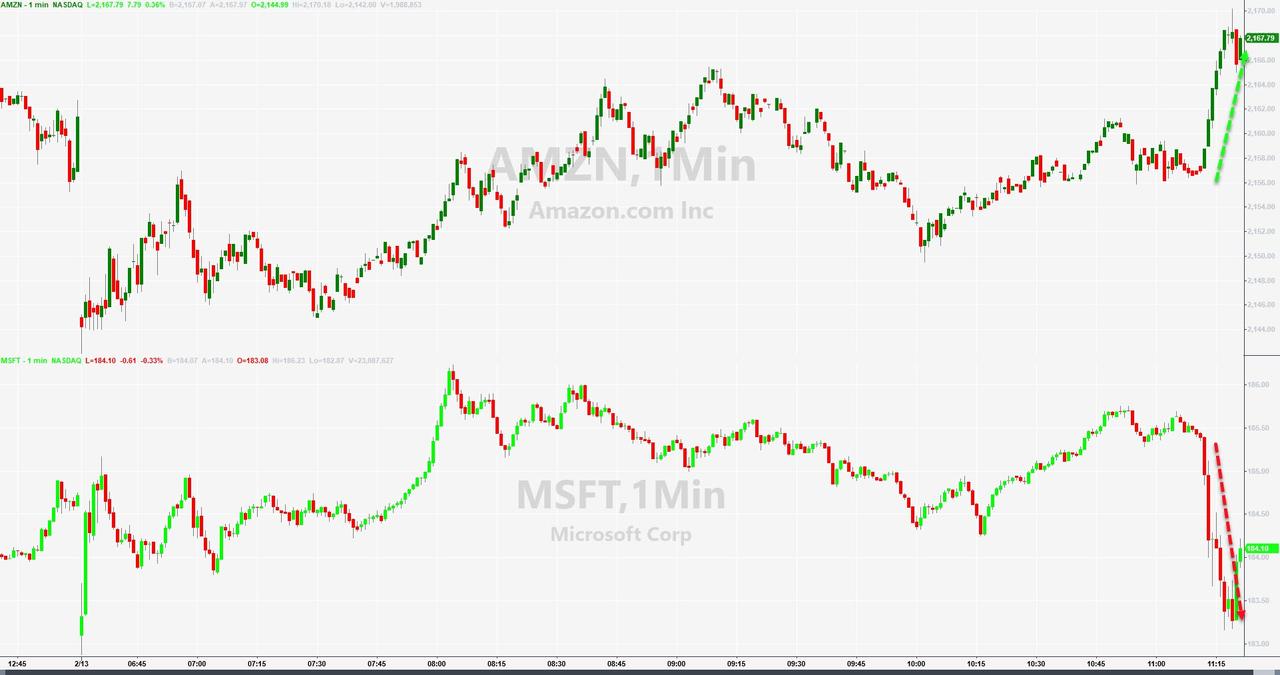
Just a day after buying the most expensive home in America, Jeff Bezos had another win today as a judge just ordered a temporary block on the JEDI cloud contract in response to a suit filed by Amazon. 

After losing The Joint Enterprise Defense Infrastructure, or JEDI, cloud contract to Microsoft last October, Amazon has been protesting the move, saying that it was driven in part by President Trump’s bias against the company.

As CNBC reports, last month, Amazon’s cloud-computing arm AWS filed a formal motion asking the court to pause Microsoft’s work on the JEDI cloud contract, claiming the evaluation process included “clear deficiencies, errors and unmistakable bias.” The court granted that motion on Thursday.

Amazon’s top spokesperson Jay Carney (yes that Jay Carney), told CNBC on Wednesday that the company is protesting the decision to make sure the award process was “free of political interference.”

After the ruling, MSFT shares are down and AMZN up…


Tyler Durden

Thu, 02/13/2020 – 14:21

via ZeroHedge News https://ift.tt/2uM1l6S Tyler Durden

The Supreme Court Tackles Police Shootings, Excessive Force, and the Fourth Amendment

The U.S. Supreme Court has long recognized that the Fourth Amendment right to be free from “unreasonable…seizure” includes the right to be free from unreasonable “seizure of the person,” meaning detainment or arrest. What is more, as the Court held in California v. Hodari D. (1991), “the mere grasping or application of physical force with lawful authority, whether or not it succeeded in subduing the arrestee,” qualifies as a seizure for Fourth Amendment purposes.

The U.S. Court of Appeals for the 10th Circuit, however, apparently never got the memo. In Torres v. Madrid (2019), that court held that no seizure occurred when officers with the New Mexico State Police shot Roxanne Torres twice in the back, because their bullets did not actually stop her from getting away. According to the 10th Circuit, “an officer’s intentional shooting of a suspect does not effect a seizure unless the ‘gunshot…terminate[s] [the suspect’s] movement or otherwise cause[s] the government to have physical control over him.'”

It gets worse. The police shot Torres while she was in her car in the parking lot of her apartment building. The officers were there to arrest somebody else but claimed that they saw Torres acting in a suspicious manner. Torres thought she was being carjacked, later testifying that the officers, who were wearing tactical vests, never identified themselves when they approached her. What she saw were threatening figures standing at her car windows. So she drove away and was shot twice while fleeing for her life. Torres only learned that she had been shot by the cops when she was arrested a day later at the hospital. The excessive force complaint that Torres filed against those officers was killed off by the 10th Circuit’s ruling.

The U.S. Supreme Court is scheduled to hear oral arguments in Torres’s case on March 30. She deserves to prevail. There is no question that the officers engaged in the “application of physical force…whether or not it succeeded in subduing the arrestee.” As Torres and her lawyers point out in their brief, when the officers “shot at Ms. Torres with the intent to stop her from leaving and two of the bullets struck her body, she was in that moment seized within the meaning of the Fourth Amendment, regardless of what happened next.”

Precisely. The 10th Circuit’s decision should be overruled.

from Latest – Reason.com https://ift.tt/38o93mk
via IFTTT

The Supreme Court Tackles Police Shootings, Excessive Force, and the Fourth Amendment

The U.S. Supreme Court has long recognized that the Fourth Amendment right to be free from “unreasonable…seizure” includes the right to be free from unreasonable “seizure of the person,” meaning detainment or arrest. What is more, as the Court held in California v. Hodari D. (1991), “the mere grasping or application of physical force with lawful authority, whether or not it succeeded in subduing the arrestee,” qualifies as a seizure for Fourth Amendment purposes.

The U.S. Court of Appeals for the 10th Circuit, however, apparently never got the memo. In Torres v. Madrid (2019), that court held that no seizure occurred when officers with the New Mexico State Police shot Roxanne Torres twice in the back, because their bullets did not actually stop her from getting away. According to the 10th Circuit, “an officer’s intentional shooting of a suspect does not effect a seizure unless the ‘gunshot…terminate[s] [the suspect’s] movement or otherwise cause[s] the government to have physical control over him.'”

It gets worse. The police shot Torres while she was in her car in the parking lot of her apartment building. The officers were there to arrest somebody else but claimed that they saw Torres acting in a suspicious manner. Torres thought she was being carjacked, later testifying that the officers, who were wearing tactical vests, never identified themselves when they approached her. What she saw were threatening figures standing at her car windows. So she drove away and was shot twice while fleeing for her life. Torres only learned that she had been shot by the cops when she was arrested a day later at the hospital. The excessive force complaint that Torres filed against those officers was killed off by the 10th Circuit’s ruling.

The U.S. Supreme Court is scheduled to hear oral arguments in Torres’s case on March 30. She deserves to prevail. There is no question that the officers engaged in the “application of physical force…whether or not it succeeded in subduing the arrestee.” As Torres and her lawyers point out in their brief, when the officers “shot at Ms. Torres with the intent to stop her from leaving and two of the bullets struck her body, she was in that moment seized within the meaning of the Fourth Amendment, regardless of what happened next.”

Precisely. The 10th Circuit’s decision should be overruled.

from Latest – Reason.com https://ift.tt/38o93mk
via IFTTT

U.K. ‘Celebrates’ Its New Freedom From the E.U. by Pushing Massive Online Censorship Orders

A new policy will require online platforms to eliminate content the U.K. government decides is harmful, or face massive fines and possibly even criminal sanctions.

Lest anybody think Brexit was truly about freeing the United Kingdom from burdensome European regulations, this week the government announced that it was putting its Office of Communications (known as Ofcom) in charge of developing a massive regulatory framework to require further online moderation of content and communications online.

The United Kingdom wants to force online platforms like Facebook, YouTube, and others to have a “duty of care” for their users’ safety, a legal term that obligates the companies to protect its users from certain harms.

Ofcom and the U.K. government are selling this new regulatory regime as a way to both protect children from sex trafficking and abuse and stop terrorist organizations from recruiting online. But what they’re actually proposing is a much broader plan to shape social media communications to their liking. The new policy would also force platforms to tackle online “bullying,” prevent their users from encouraging suicide, and prevent the spread of what the U.K. government deems “disinformation.”

The Online Harms White Paper released last summer is being used as a framework. Here’s what it suggests:

Companies must fulfill their new legal duties. The regulator will set out how to do this in codes of practice. The codes will outline the systems, procedures, technologies and investment, including in staffing, training and support of human moderators, that companies need to adopt to help demonstrate that they have fulfilled their duty of care to their users.

Companies will still need to be compliant with the overarching duty of care even where a specific code does not exist, for example assessing and responding to the risk associated with emerging harms or technology.

There are so many potential problems with this plan that it’s hard to pick a point of entry. The first and most obvious issue is that there is no global consensus as to what constitutes a “harm,” especially when it comes to speech. The U.K. has hate speech laws that wouldn’t fly here in the United States—and a chunk of the organizing paper here discusses what sort of “duty of care” will be involved in monitoring and removing hate speech online.

As part of its so-called “war on obesity,” the U.K. has implemented policies that censor advertisements of what it deems “junk food” (often inaccurately) in the media. This effort is referenced in the white paper in a section discussing online advertising and ethical practices. Fortunately, there’s nothing listed in the “duty of care” demands that indicates Facebook will have to start censoring pictures of your home-baked cookies, but the inclusion of junk food advertisement bans in the context of a paper about “preventing harms” certainly does raise the specter of something focused on user content down the line.

The paper states that regulatory policies will be based on empirical data, and yet it also cites public polling results and contains fact-free, irresponsible, fear-mongering statements like this one: “Sexual exploitation can happen to any young person—whatever their background, age, gender, race or sexuality or wherever they live.” While this is true on the most abstract of levels, the paper’s reluctance to narrow the focus of a sexual exploitation policy casts doubt on the entire process: Are white, wealthy, legal-age males facing the same risk of sexual exploitation as every other demographic? Of course not. Saying that it can happen to everyone is not necessarily untrue, but it is a uselessly broad statement. We don’t need more panicked Facebook posts from moms who think various strangers at the grocery store are plotting to snatch their children.

The paper also considers justifications for social media platforms’ duty of care when it comes to stopping online advertisements for opioids, not just because people may be deceived by those ads, but also because there could be second- and third-order effects for first responders who “will continue to be exposed to potentially harmful environments” when they respond to emergency calls. Leaving aside the fact that first responders are not actually at risk of accidentally consuming illicit opioids when responding to emergency calls, is censoring social media really the best route to reduce what little exposure they do face?

Then there’s the self-serving goals and rent-seeking of media outlets. The U.K. government wants social media platforms to play more of a role in moderating and fighting the spread of “disinformation,” particularly as it involves the government and elections. The white paper declares:

Companies will need to take proportionate and proactive measures to help users understand the nature and reliability of the information they are receiving, to minimise the spread of misleading and harmful disinformation and to increase the accessibility of trustworthy and varied news content.

This includes potentially requiring that platforms partner with independent fact-checking organizations and “promoting authoritative news sources.” Traditional media outlets in the U.K., like The Telegraph, have endorsed new laws controlling social media platform content, and it’s easy to see why. With the government’s help, these outlets can require social media platforms to promote their stories and suppress or remove those of alternative media outlets and independent journalists, all under the guise of fighting “disinformation” and protecting social media users. This is pure protectionism.

We’ve seen what happens in other countries when the government decides to play a role in declaring what is and isn’t “fake news.” In Singapore, the government is attempting to force Facebook to censor its critics. Part of the “duty of care” framework involves protecting public figures (like politicians) from online harassment, so watch what you say about woodchippers.

The U.K.-based Index on Censorship warns against the potential harms of implementing regulations based on this white paper. The vagueness of the proposals combined with the possibility of fines (and even possible jail time) all but guarantees that platforms will feel the pressure to err on the side of censorship of content. The Index on Censorship concludes that even though the white paper invokes “freedom of expression,” it shows no intent to actually protect it:

The white paper gives far too little attention to freedom of expression. The proposed regulator would have a specific legal obligation to pay due regard to innovation. When it comes to freedom of expression the paper only refers to an obligation to protect users’ rights “particularly rights to privacy and freedom of expression.”

It is surprising and disappointing that the white paper, which sets out measures with far-reaching potential to interfere with freedom of expression, does not contain a strong and unambiguous commitment to safeguarding this right.

Whatever good it might possibly do for vulnerable social media users, this “duty of care” policy poses an even bigger threat to their free speech.

from Latest – Reason.com https://ift.tt/2vwDurQ
via IFTTT

U.K. ‘Celebrates’ Its New Freedom From the E.U. by Pushing Massive Online Censorship Orders

A new policy will require online platforms to eliminate content the U.K. government decides is harmful, or face massive fines and possibly even criminal sanctions.

Lest anybody think Brexit was truly about freeing the United Kingdom from burdensome European regulations, this week the government announced that it was putting its Office of Communications (known as Ofcom) in charge of developing a massive regulatory framework to require further online moderation of content and communications online.

The United Kingdom wants to force online platforms like Facebook, YouTube, and others to have a “duty of care” for their users’ safety, a legal term that obligates the companies to protect its users from certain harms.

Ofcom and the U.K. government are selling this new regulatory regime as a way to both protect children from sex trafficking and abuse and stop terrorist organizations from recruiting online. But what they’re actually proposing is a much broader plan to shape social media communications to their liking. The new policy would also force platforms to tackle online “bullying,” prevent their users from encouraging suicide, and prevent the spread of what the U.K. government deems “disinformation.”

The Online Harms White Paper released last summer is being used as a framework. Here’s what it suggests:

Companies must fulfill their new legal duties. The regulator will set out how to do this in codes of practice. The codes will outline the systems, procedures, technologies and investment, including in staffing, training and support of human moderators, that companies need to adopt to help demonstrate that they have fulfilled their duty of care to their users.

Companies will still need to be compliant with the overarching duty of care even where a specific code does not exist, for example assessing and responding to the risk associated with emerging harms or technology.

There are so many potential problems with this plan that it’s hard to pick a point of entry. The first and most obvious issue is that there is no global consensus as to what constitutes a “harm,” especially when it comes to speech. The U.K. has hate speech laws that wouldn’t fly here in the United States—and a chunk of the organizing paper here discusses what sort of “duty of care” will be involved in monitoring and removing hate speech online.

As part of its so-called “war on obesity,” the U.K. has implemented policies that censor advertisements of what it deems “junk food” (often inaccurately) in the media. This effort is referenced in the white paper in a section discussing online advertising and ethical practices. Fortunately, there’s nothing listed in the “duty of care” demands that indicates Facebook will have to start censoring pictures of your home-baked cookies, but the inclusion of junk food advertisement bans in the context of a paper about “preventing harms” certainly does raise the specter of something focused on user content down the line.

The paper states that regulatory policies will be based on empirical data, and yet it also cites public polling results and contains fact-free, irresponsible, fear-mongering statements like this one: “Sexual exploitation can happen to any young person—whatever their background, age, gender, race or sexuality or wherever they live.” While this is true on the most abstract of levels, the paper’s reluctance to narrow the focus of a sexual exploitation policy casts doubt on the entire process: Are white, wealthy, legal-age males facing the same risk of sexual exploitation as every other demographic? Of course not. Saying that it can happen to everyone is not necessarily untrue, but it is a uselessly broad statement. We don’t need more panicked Facebook posts from moms who think various strangers at the grocery store are plotting to snatch their children.

The paper also considers justifications for social media platforms’ duty of care when it comes to stopping online advertisements for opioids, not just because people may be deceived by those ads, but also because there could be second- and third-order effects for first responders who “will continue to be exposed to potentially harmful environments” when they respond to emergency calls. Leaving aside the fact that first responders are not actually at risk of accidentally consuming illicit opioids when responding to emergency calls, is censoring social media really the best route to reduce what little exposure they do face?

Then there’s the self-serving goals and rent-seeking of media outlets. The U.K. government wants social media platforms to play more of a role in moderating and fighting the spread of “disinformation,” particularly as it involves the government and elections. The white paper declares:

Companies will need to take proportionate and proactive measures to help users understand the nature and reliability of the information they are receiving, to minimise the spread of misleading and harmful disinformation and to increase the accessibility of trustworthy and varied news content.

This includes potentially requiring that platforms partner with independent fact-checking organizations and “promoting authoritative news sources.” Traditional media outlets in the U.K., like The Telegraph, have endorsed new laws controlling social media platform content, and it’s easy to see why. With the government’s help, these outlets can require social media platforms to promote their stories and suppress or remove those of alternative media outlets and independent journalists, all under the guise of fighting “disinformation” and protecting social media users. This is pure protectionism.

We’ve seen what happens in other countries when the government decides to play a role in declaring what is and isn’t “fake news.” In Singapore, the government is attempting to force Facebook to censor its critics. Part of the “duty of care” framework involves protecting public figures (like politicians) from online harassment, so watch what you say about woodchippers.

The U.K.-based Index on Censorship warns against the potential harms of implementing regulations based on this white paper. The vagueness of the proposals combined with the possibility of fines (and even possible jail time) all but guarantees that platforms will feel the pressure to err on the side of censorship of content. The Index on Censorship concludes that even though the white paper invokes “freedom of expression,” it shows no intent to actually protect it:

The white paper gives far too little attention to freedom of expression. The proposed regulator would have a specific legal obligation to pay due regard to innovation. When it comes to freedom of expression the paper only refers to an obligation to protect users’ rights “particularly rights to privacy and freedom of expression.”

It is surprising and disappointing that the white paper, which sets out measures with far-reaching potential to interfere with freedom of expression, does not contain a strong and unambiguous commitment to safeguarding this right.

Whatever good it might possibly do for vulnerable social media users, this “duty of care” policy poses an even bigger threat to their free speech.

from Latest – Reason.com https://ift.tt/2vwDurQ
via IFTTT

Our “Come To Mao” Reckoning And The Next Cultural Revolution

Our “Come To Mao” Reckoning And The Next Cultural Revolution

Authored by Charles Hugh Smith viua OfTwoMinds blog,

Only fools are blind to the potential for this uprising to extend to Apple and the rest of Corporate America’s greedy exploiters who’ve been delighted to profit from the protection of the CCP.

Let’s start our “Come to Mao” reckoning with the obvious:

To the U.S. stock market:

The coronavirus ravaging China doesn’t matter.

China doesn’t matter.

1,500 deaths don’t matter, 5,000 deaths don’t matter, 50,000 deaths don’t matter, 500,000 deaths don’t matter.

10,000 coronavirus cases don’t matter,100,000 cases don’t matter, 1,000,000 cases don’t matter.

All that matters is that exploited Chinese workers get back to assembling iPhones for Apple and all the landfill economy stuff that generates billions in profits for Amazon and the rest of Corporate America.

Nothing else matters. Even coronavirus cases and deaths outside China don’t matter. All that matters is that Apple and the rest of Corporate America continue reaping billions in profits off exploited workforces.

Like every other venal, exploitive Empire in history, Apple relies on rapacious, ruthless local elites to enforce its exploitation–in this case, Foxconn and the Communist Party elites who’ve gorged at the Apple/Foxconn trough. Thus Apple claims that when Foxconn re-opens production is up to Foxconn while Apple execs hound Foxconn to start production no matter how many workers might become ill and die.

Apple has always bought the best PR cover for its exploitation and greed that money can buy, starting with the famous 1984 commercial during the 1984 Super Bowl. That Apple ruthlessly exploits workers and the planet and pays essentially zero federal taxes–those don’t fit its bogus but oh-so-glossy PR image.

Apple insists on $5 for you, Chinese workforce, and $500 for us. The greed of Apple is only surpassed by the greed of the elite fund managers who depend on Apple’s ruthlessness to fatten their own gains.

Those are the most obvious realities of our “Come to Mao” reckoning, but there’s more– much more.

Thanks to the official mishandling of the coronavirus, the Chinese people are awakening anew to the grim reality that the only thing that matters to the Chinese Communist Party (CCP)– the CCP leadership and cadres–is maintaining the wealth and power of the CCP. The Chinese people don’t matter except as exploited workers generating the profits for Apple et al. and for corrupt and venal Party elites.

Nothing else matters–except enforcing the exploitation of Chinese workers by Apple and the rest of Corporate America, because the CCP and Apple are best buddies: each equally rapacious, greedy and exploitive of those under their power.

The righteous anger of the people, currently directed at the CCP, is only a millimeter away from widening to include Foxconn, Apple and the rest of the elites exploiting the Chinese workforce. Where the workers responded to inhuman conditions at Foxconn a few year ago by killing themselves, the next time around they may choose to administer some rough justice to the elites in the CCP, Foxconn and Apple, their tormentors and exploiters.

We can hazard a guess that Mao would heartily approve of hacking U.S. corporations and agencies, and selling Huawei equipment with backdoors and taps, but the CCP’s enforcement of American corporate profits might not have won Mao’s approval.

As the exploitation and oppression in China has ramped steadily higher, the Revolutionary Mao has been making a come-back. Not every Chinese citizen is thrilled that the CCP destroyed the environment and ransacked the nation’s resources and workforce for the elites’ personal aggrandizement. Since speaking openly about this will quickly draw a prison sentence or worse, the only sanctioned way to express one’s rejection of the CCP’s self-serving leadership is to harken back to Mao.

The implicit topic here that cannot be spoken about directly in China is the Cultural Revolution of 1966 – 1976, which Mao unleashed to cleanse the Party of potential rivals, under the PR banner of “eliminating Counter-Revolutionaries,” i.e. anyone who questioned the supremacy of Mao’s clique.

This campaign quickly got out of hand, and millions of innocents and loyal Army and Party cadres were beaten, imprisoned, exiled or killed. In effect the Monster Id of all China’s suffering from Mao’s ill-conceived policies–The Great Leap Forward, etc.–was unleashed on the Party and anyone who had any ties to pre-Revolutionary elites, regardless of their blameless service to the revolution.

Young cadres switched alliance between local groups seemingly at random, destroying cultural treasures one month and then gutting the educational system the next.

Only fools are blind to the potential for a bottom-up Cultural Revolution that cleanses the CCP of its corrupt, self-serving, greedy elites, and only greater fools are blind to the potential for this uprising to extend to Apple and the rest of Corporate America’s greedy exploiters who’ve been delighted to profit from the protection of the CCP.

Put another way: just as the amoral greed of Corporate America knows no bounds, Divine Retribution will also know no bounds.

*  *  *

My recent books:

Audiobook edition now available:
Will You Be Richer or Poorer?: Profit, Power, and AI in a Traumatized World ($13)
(Kindle $6.95, print $11.95) Read the first section for free (PDF).

Pathfinding our Destiny: Preventing the Final Fall of Our Democratic Republic ($6.95 (Kindle), $12 (print), $13.08 ( audiobook): Read the first section for free (PDF).

The Adventures of the Consulting Philosopher: The Disappearance of Drake $1.29 (Kindle), $8.95 (print); read the first chapters for free (PDF)

Money and Work Unchained $6.95 (Kindle), $15 (print) Read the first section for free (PDF).

*  *  *

If you found value in this content, please join me in seeking solutions by becoming a $1/month patron of my work via patreon.com.


Tyler Durden

Thu, 02/13/2020 – 14:00

via ZeroHedge News https://ift.tt/2SMfWHs Tyler Durden

JPMorgan Admits “Without A Historical Daily Breakdown” Its Virus Model Is Worthless

JPMorgan Admits “Without A Historical Daily Breakdown” Its Virus Model Is Worthless

When confronted with the unprecedented “one-time” revision in infected Covid cases, which added a whopping 15,000 infections to the Chinese disease total, Wall Street has responded in one of two ways. The first, as exhibited by the vast majority of sellside analysts who refuse to admit they are wrong, such as Goldman (described earlier), simply ignored the new data, treating thousands of infected people as if they are somehow a different group, and instead focused on the genetic tests which continue to decline – which somehow magically “confirms” that the pandemic is contained – even as a giant backlog of symptomatic, and potentially terminal, patients, who get CAT screens, has built up simply because China does not have the capacity to test more than 2-3,000 per day.

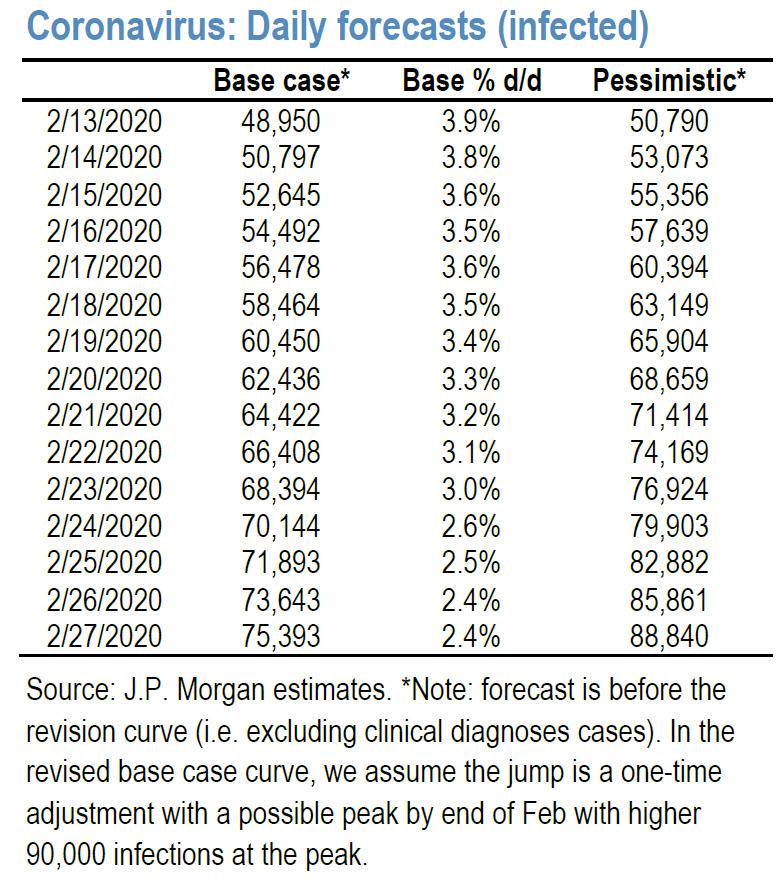
The second response, far more rare due to its honesty, was demonstrated by JPMorgan this morning when the strategist keeping tabs on China’s pandemic, MW Kim, admitted that following the latest update, his model no longer makes sense. Until last night, JPMorgan was perhaps best known for having extrapolated a base and pessimistic case scenario, and providing daily “beats” and “misses” when the official numbers were reported.  The problem is that while until recently most of the reported cases “beat” JPM’s forecast, which heading into today had a pessimistic case of 50,790 cases…

…the latest data which pushed the total number of cases above 60,000 has thrown the company’s forecast into a tailspin, and Kim concedes that his model is no longer appropriate.

This is what JPM said this morning:

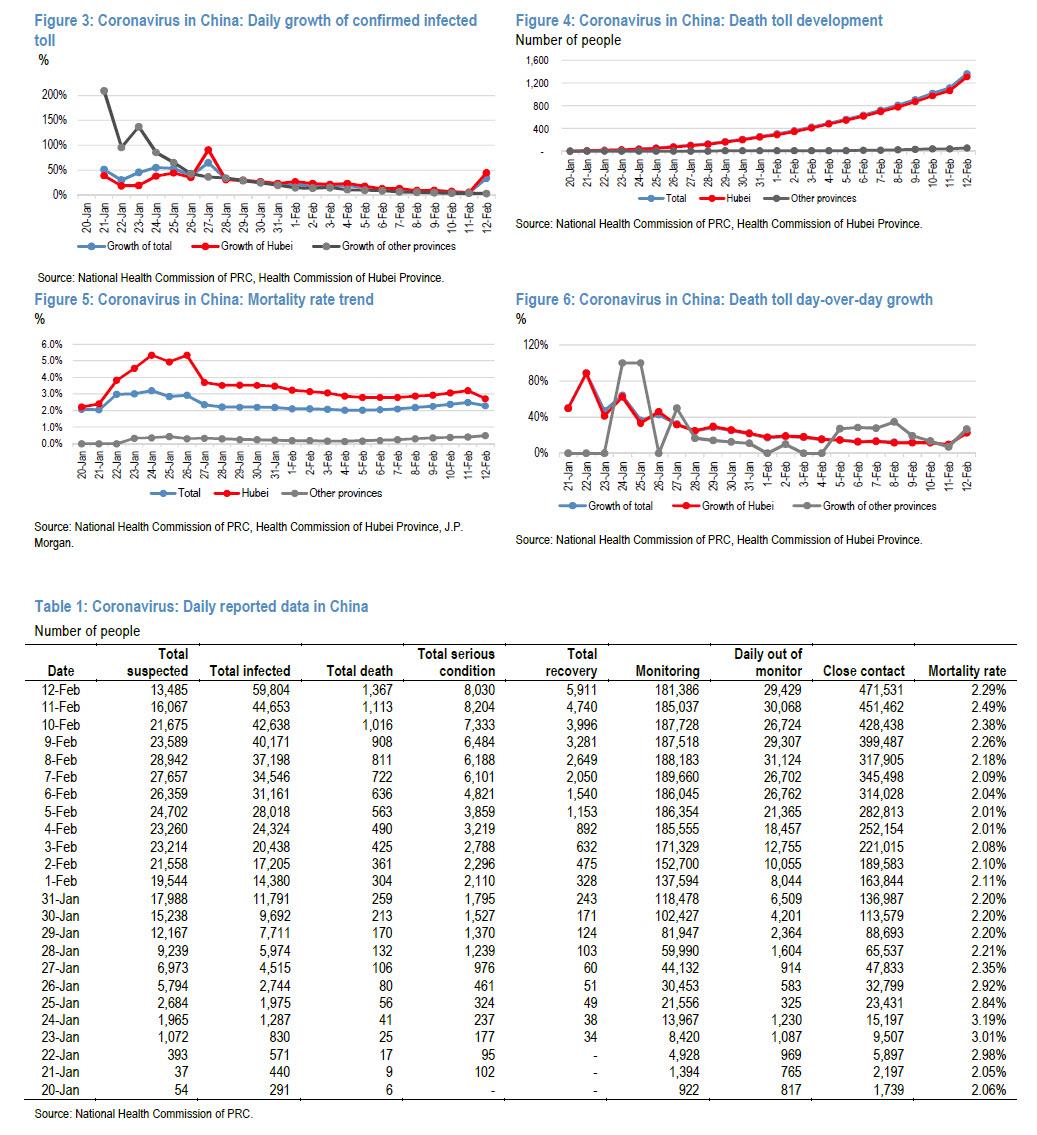
China’s total infected toll increased by 15,152 cases and reached 59,804 (including 13,332 clinically diagnosed cases in Hubei) on 12-Feb-20, with 1,367 deaths (96%, or 1,310, deaths are from Hubei province), according to the National Health Commission. The jump in infections today was mainly due to the revision of the diagnosis guidelines in Hubei province. Under the previous method, i.e. excluding clinically diagnosed cases, the total infected toll would be 46,472 (vs. JPMe: 47,102), largely in line with the shape of our base-case epidemiology model.

Under the revised method, however, the reported infected toll of 60k is one week ahead of our curve. The old series still tracks our model scenario, leading us to assume that the 14,840 new reports are a cumulative adjustment. However, without a historical daily breakdown, the jump distorts our infection forecast and shape.

This means that as of this moment, even the brightest “epidemiologists” on Wall Street, those had goalseeked the previous data series and fitted it to give them some forecast capabilities, have no idea what is going on.

As such, JPM is “currently considering three possible adjustments to the infection curve – new shape, smoothing, and scale-up (without Ro adjustment). We will revisit model variables after monitoring Friday’s reported numbers.”

What this means for JPM’s infection curve adjustment is the following:

A one-time rebase in infection data as the infected toll growth curve is decelerating, potentially diluting the curves strength in forecasting a trend. Consequently, we think a change in the curve may be required. This is complicated by the change which applies only to Hubei. Hubei accounting for ~80%+ of the post-adjustment infected total limits the extent of the distortion. As monitor next time series, our options include

  1. infection rate assumption changes (curve shift),
  2. smoothing (amortising the jump impact to previous days), and
  3. scale-up (using the current curve, but scaling it up assuming the same infection rate).We will revisit our model assumptions after Friday’s reported numbers.

And visually:

And since JPM has to justify why it didn’t account for this change in definition of a “confirmed case” even though fringe blogs such as this one warned it was coming, this is what the bank said:

The new fifth edition “Guideline of new coronavirus pneumonia diagnosis and treatment” added that suspected cases in Hubei Province will be considered as confirmed ones when there are obvious pneumonia characteristics after clinical diagnosis, even without the nucleic acid test.

We believe the change in definition is necessary given that COVID-19 is a new disease and its diagnostic standards needs to be optimized as knowledge increases. Hubei province is a severely affected area and may not have enough diagnostic capacity to carry out nucleic acid tests for every suspected case. Nucleic acid test accuracy is also not guaranteed, and false negatives may exists. The change in the definition could lead to better control of the infection and block the route of transmission.

It certainly could lead to that, which also explains why no other province besides Hubei has decided to adopt it as the rest of China is still under the impression that it will boost public confidence if it keeps underrepresenting the full severity of the pandemic, when in reality just the opposite is happening as China’s population watches surreal social media images and videos showing a government response as if a viral plague has been unleashed on the nation where people just randomly fall dead in most major cities.

In other words, whereas JPMorgan would like to give an “adjusted infection” number, just as Goldman did when it dismissed the overnight case surge, the bank refuses to do so until it has some credible justification behind it. Which also means that it is now up to Beijing to provide a new set of data that actually allows banks to goalseek the Thursday surge in a way that allows them to once again ease client nerves by repeating daily that the number of new cases is declining and the pandemic is contained. Of course, if China fails to co-operate, not even Wall Street’s biggest bulls will be able to (mis)represent the official data in a bullish light, as it emerges soon that the reality on the ground is far, far worse than anyone had expected as what now almost certainly appears to be a leaked bio-engineered virus continues to crippled both China’s economy and global supply chains.

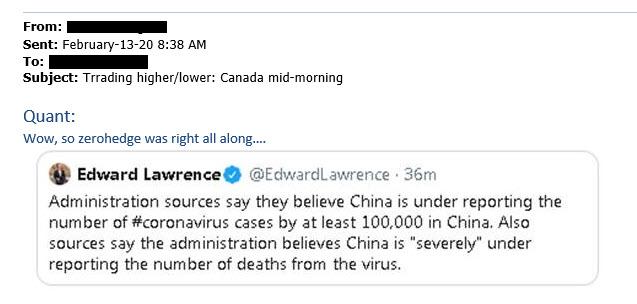
Finally, for the TL/DR version of what all of the above really means, we leave it to an email blasted to all of BMO capital market traders this morning.

* * *

As an appendix, here is some additional data on how the latest “official” numbers stack up, courtesy of JPM:

  • Infection rate: Total infected toll jumped by 34% on 12-Feb, reflecting the revised diagnosis guidelines in Hubei province, which include the clinically diagnosed cases in the Confirmed Cases category. Excluding Hubei province, the growth in the infected toll decelerated for the 9th consecutive day to 2.8% d/d.
  • Mortality rate (total): Due to the jump in total infected toll, the nationwide mortality rate decreased to 2.29% from 2.49% after the upward trend in the previous six days.
  • Mortality rate (Hubei province): As a result of the large increase in the infection toll, the mortality rate came down to 2.72% on 12 February from 3.20% on the previous day.
  • Mortality rate (ex-Hubei province): The mortality rate slightly increased to 0.49% from 0.40% on the previous day, extending the overall upward trend to the 8th consecutive day.
  • Recovery rate (= recovered/infected): The overall recovery rate declined by 1%p to 10% on 12-Feb, led by a sharp increase in the infected toll. In Hubei province, the recovery rate moderated to 7% from 8% on the previous day as well. However, excluding Hubei, the recovery rate grew to 21% from 19% on the previous day.


Tyler Durden

Thu, 02/13/2020 – 13:45

via ZeroHedge News https://ift.tt/37mhZXZ Tyler Durden

US, Taliban Negotiate Short-Term Deal To Reduce Violence

US, Taliban Negotiate Short-Term Deal To Reduce Violence

Authored by Jennie Taer via SaraACarter.com,

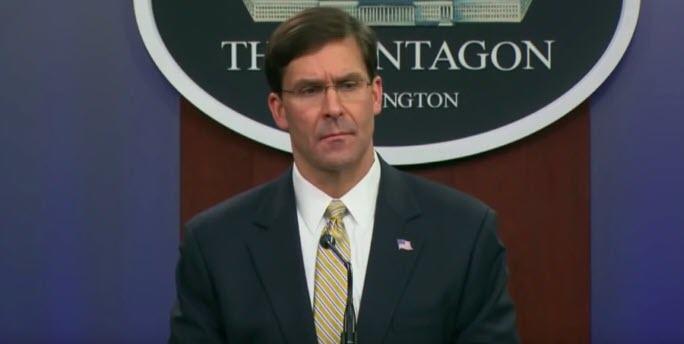
U.S. Defense Secretary Mark Esper revealed Thursday that the U.S. and Taliban reached a deal “for a seven-day reduction in violence,” he told reporters during a visit to Brussels where he’s meeting with North Atlantic Treaty Organization defense ministers.

The United States and the Taliban have negotiated a proposal for a seven-day reduction in violence. I am here today consulting with allies about this proposal and we’ve had a series of productive bilateral and collective meetings about the path forward,” Sec. Esper said during a news conference.

He continued, “We’ve said all along that the best if not only solution in Afghanistan is a political agreement. Progress has been made on this front and I will have more to report on that soon, I hope.”

President Donald Trump is committed to downsizing the number of U.S. troops remaining in Afghanistan and establishing peace with the Taliban. Afghan President Ashraf Ghani spoke this week with Secretary of State Mike Pompeo, who reported “notable progress” in the bilateral peace talks.

“This is a welcoming development and I am pleased that our principal position on peace thus far has begun to yield fruitful results. Our primary objective is to end the senseless bloodshed,” Pres. Ghani wrote on Twitter Tuesday.


Tyler Durden

Thu, 02/13/2020 – 13:30

via ZeroHedge News https://ift.tt/3byAdJf Tyler Durden

US Continues Crackdown On Huawei, Adds Racketeering Conspiracy Charge

US Continues Crackdown On Huawei, Adds Racketeering Conspiracy Charge

One would think that with the US and China now in a trade war truce, tensions over the key pawn in the global tech war, China’s telecom giant Huawei would finally be easing. One would be wrong.

According to Bloomberg, as part of the ongoing crackdown on Huawei, the US has now added a RICO charge, or “racketeering conspiracy”, against the Chinese telecom provider – which in the past was reserved largely for criminal mob cases –  tripling the penalties the Chinese company would face if convicted.

Huawei was already facing a series of criminal charges for allegedly violating U.S. sanctions against Iran and North Korea.
The new charge steps up U.S. pressure on Huawei. The government already had banned the company’s technology and accused Huawei of aiding Beijing in espionage. Now the company faces even more significant criminal penalties, which could be up to 3x the sought damages, if prosecutors win a conviction in federal court in Brooklyn, New York.

In return, Huawei has accused the U.S. government of orchestrating a campaign to intimidate its employees and launching cyberattacks to infiltrate its internal network. The accusations have ratcheted up tensions between Huawei and the Trump administration.

Meanwhile, as Bloomberg reminds us, as the criminal case against Huawei moves forward, the prosecution of its chief financial officer, Meng Wanzhou, remains on hold. She is fighting extradition from Vancouver, Canada, after being arrested at the request of the U.S. last year. She was accused by the US of defrauding banks when she made a presentation to one of its major banking partners and lied about by lying Huawei’s business dealings in Iran, in violation of U.S. sanctions.


Tyler Durden

Thu, 02/13/2020 – 13:15

via ZeroHedge News https://ift.tt/2UZZ0QP Tyler Durden