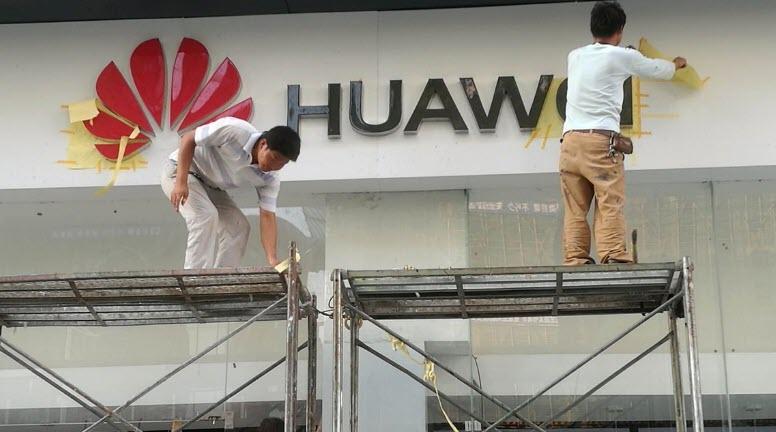
Just when you thought it was safe to buy buy buy because of ‘odd’ headlines from both US and China about “talks,” The Wall Street Journal reports that, according to people familiar with the matter, U.S. prosecutors are looking into additional instances of alleged technology theft by Huawei.
The Journal reports that among the situations being examined are episodes in which Huawei was accused of stealing intellectual property from multiple people and companies over several years, as well as how the company went about recruiting employees from competitors.
The move is an escalation as the inquiries, which include a subpoena for documents from Huawei by federal prosecutors from the Eastern District of New York in Brooklyn, suggest that the government is investigating aspects of Huawei’s business practices that weren’t covered in indictments of Huawei issued earlier this year.
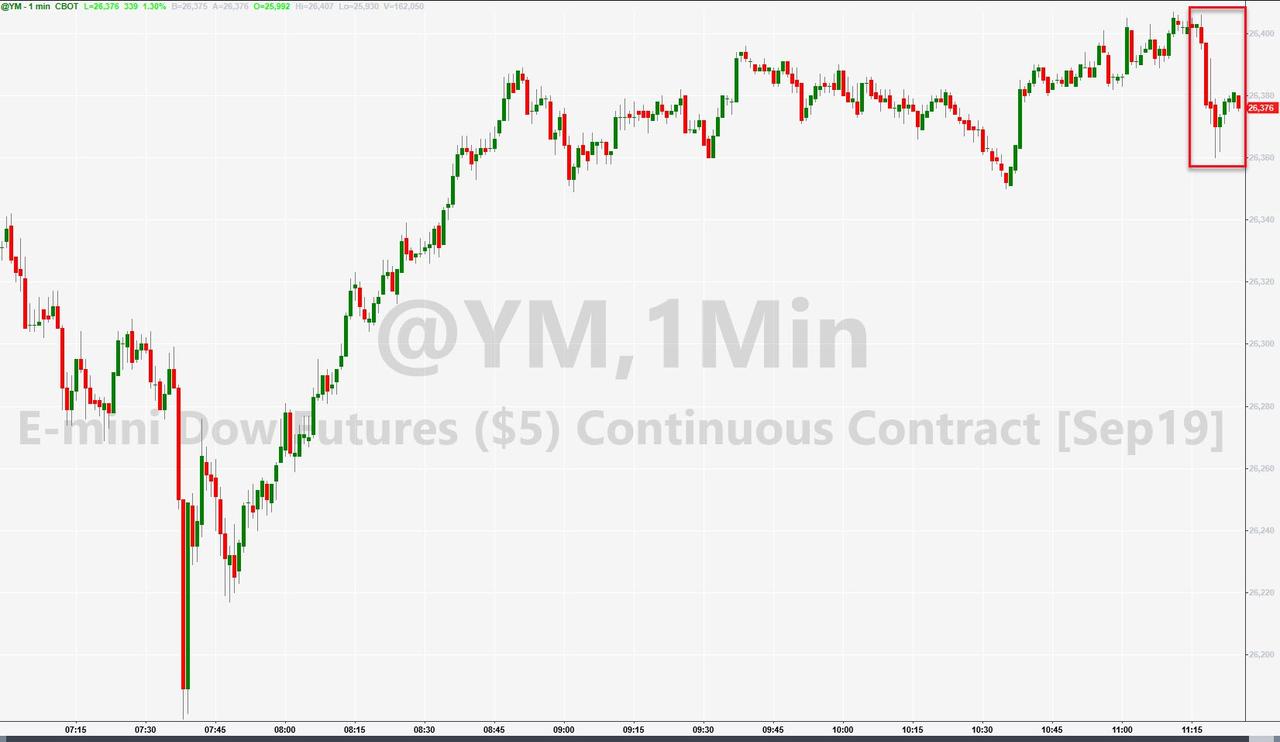
The algos did react very modestly to this headline but it’s coming back relatively quickly…
Will we get another tweet from the President proclaiming how well talks are going?
via ZeroHedge News https://ift.tt/2Pmp9YM Tyler Durden
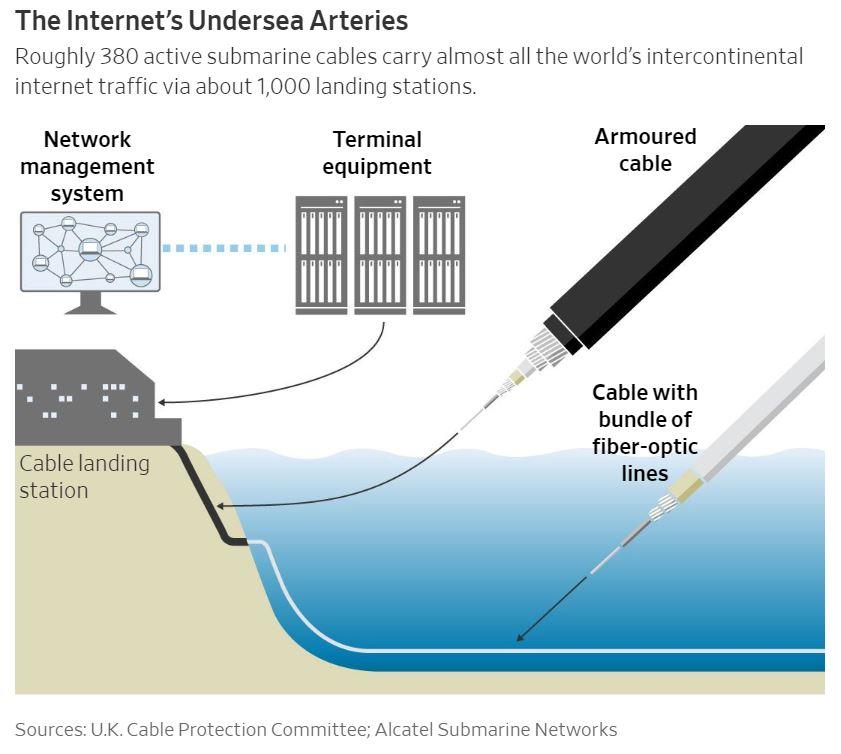
Offering a glimpse of complications that are arising from Washington’s campaign to stamp out ‘national security’-related issues emanating from the Chinese telecom sector, WSJ reported on Wednesday about a major project to lay high-speed fiber-optic cable across the Pacific that would increase the Internet connectivity between China and the US. The project, known as the Pacific Light Cable Network, involved laying 8,000 miles of undersea fiber-optic cable between Los Angeles and Hong Kong, creating a new link between the US and Hong Kong.
The project, which is already in its final stages, with most of the cable having already been laid, is being financed by Facebook, Google-parent Alphabet and a major Chinese telecoms company.
But now, a committee of US officials responsible for granting the project final approval are getting cold feet, and the project’s backers are worried it might not pass its final ‘national security’ review led by the DoJ, DHS and other US federal agencies. These agencies make a recommendation to the FCC, which makes the final decision whether to allow the project will receive a license to operate.
Years ago, when the project started, the feeling was that increasing connectivity between Hong Kong and the US wasn’t controversial. But now, with Beijing seeking to exert more control over the territory as pro-democracy protests rage, officials at the DoJ have changed how they feel about this distinction. Moreover, although the project is being managed by a Hong Kong company, one of its backers is Dr. Peng Telecom & Media Group, mainland China’s fourth-largest broadband provider. The company faces scrutiny in the US because it participates in the Chinese government-mandated censorship and surveillance of the Chinese population.
Right now, the project is operating under a temporary license. But that license expires in September, and although Washington could extend that temporary permit, that outcome is seen as unlikely. If the FCC refuses to grant a permanent license because of national security concerns raised by the DoJ-led committee, it’s unclear what would happen.
Right now, the cable is one of roughly 380 submarine cables that transmit nearly all of the world’s intercontinental Internet traffic.
But the possibility that Washington could withhold a permanent operating license highlights the fact that American tech giants have been helping Asian firms lay thousands of miles of fiber optic cable to improve connectivity between Asia and North America, and haven’t exactly thought through how the changing political landscape might impact some of these projects.
Contacted by WSJ, the company managing the project, which affirmed that it has already installed nearly 7,000 miles of fiber optic cable, said it hasn’t heard about any opposition from Washington. Google, meanwhile, gave a comment that made it sound like the company knows the project is doomed.
Pacific Light Data Communication Co., the Hong Kong company managing the cable project, said it has already installed more than 6,800 miles of the cable system, which will be ready for service by December or January. Senior Vice President Winston Qiu said he hadn’t heard of any U.S. regulatory problems. “We didn’t hear any opposition,” he said.
A Google spokeswoman said the company has “been working through established channels for many years in order to obtain U.S. cable landing licenses for various undersea cables. We are currently engaged in active and productive conversations with U.S. government agencies about satisfying their requirements specifically for the PLCN cable.” A Facebook spokeswoman declined to comment.
So, what might happen if the FCC doesn’t grant the license? Would all that cable go to waste? Probably not. Presumably, just like Chinese owner of Grindr was forced to do after CFIUS raised issues about the sale of the LGBTQ-focused hookup app, the Chinese owners would presumably be forced to divest their stake.
But that would leave the project vulnerable to the whims of the market. And if the Chinese telecoms giant is forced to brook a significant loss, it could have a chilling effect on future projects like this one.
via ZeroHedge News https://ift.tt/2L2ElG9 Tyler Durden
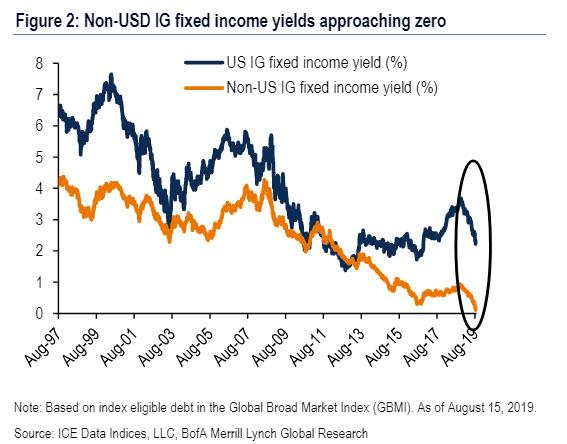
… it’s not surprising that foreigners have found US Treasury paper especially attractive. But that’s not all: apparently foreigners have been attracted to all kinds US “paper” especially America’s currency.
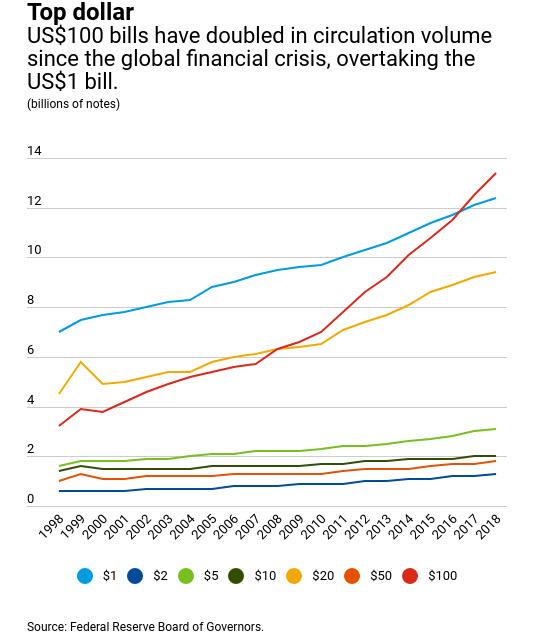
As the IMF’s blog points out, a curious thing has happened in US currency: the $100 bill recently overtook the ubiquitous $1 bill in circulation volume, for the first time in history. In other words, the most valuable banknote in the United States has also become the most widely circulated.
As shown in the next chart based on the latest Fed data, there are now more $100 bills circulating now than ever before, roughly doubling in volume since the global financial crisis.
The $100 bill became the most circulated currency in the world in 2017, overtaking the $1 bill for the first time ever.
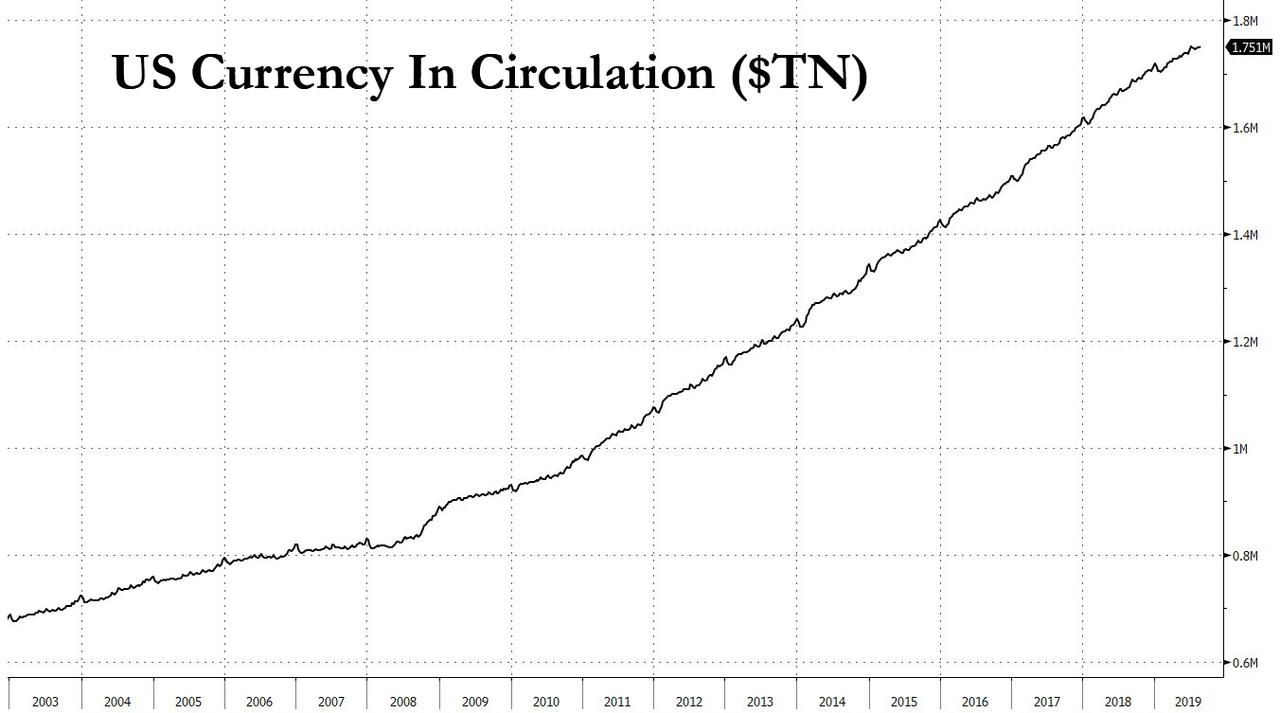
Looking at broader aggregates reveals that while the amount of total currency in circulation – the value of all dollar bills outstanding – had plateaued around $800BN heading into the Global Financial Crisis, since then the pace of currency growth has almost doubled, and as of today there is roughly 1.75 trillion dollars in the form of various banknotes.
What explains this boom in Benjamins, as the bills are known, especially when considering the establishment’s push to herd as many people as possible into cashless and other electronic “options”? Or, as the IMF asks, “in this age of digital everything, are Americans suddenly growing nostalgic for greenbacks in high denominations?”
The answer is two fold: i) no, it is not Americans who are nostaglic for cash, in fact it is not Americans who are behind this surge in currency demand; and ii) the real reason why the world is suddenly drowning in hundred dollar bills is the desire to evade punitive, negative interest rates.
Indeed, while overall demand for US currency is indeed on the rise, most $100 bills are held abroad. According to the Federal Reserve Bank of Chicago, nearly 80% of $100 bills—and more than 60% of all US bills—are overseas, up from roughly 30% in 1980.
Besides drug money – by one estimate in the early 1980s, several percent of all outstanding US currency was to be found in the estate of one Pablo Escobar – geopolitical instability could be a reason behind the surge in $100 bills, according to Fed economist Ruth Judson. “Overseas demand for US dollars is likely driven by its status as a safe asset,” Judson told the Richmond Fed’s Econ Focus in 2018.
According to a 2017 paper by Judson, international demand for US dollars increased over the 1990s and into the early 2000s, and then stabilized or declined after the 2002 debut of the cash euro. This decline in demand continued until late 2008, when the global financial crisis triggered renewed demand for US banknotes.
Of course, that doesn’t mean that all this cash demand is strictly legal: Harvard University’s Kenneth Rogoff says big banknotes and illicit activity are closely linked. “Worldwide, high-value currency notes are mainly used to avoid taxes and regulation, and for illegal activity,” he observes. “Apartments and houses in major cities all over the world are paid for with suitcases of cash every day, and it is not because the buyers are afraid of bank failures.”
One other reason for suitcases of cash: to avoid parking your money in a bank that will impose negative interest rates on it and lead to the total amount shrink year after year. As such, foreigners are simply parking their money in US bank notes to avoid NIRP, which is nothing but legal wealth confiscation. Rogoff agrees: “Underground demand for paper currency has been surely rising in part because interest rates and inflation are exceptionally low.”
But why the dollar? Its role as the dominant international reserve currency may be the key, according to Rogoff. Of course, if Mark Carney (and Donald Trump) gets his way, that won’t last very long…
via ZeroHedge News https://ift.tt/32cN2mW Tyler Durden
Does Warren Buffett believe that a major financial crisis is coming? In life, what people do is far more important than what they say, and what Warren Buffett is doing with his money right now speaks volumes. During the second half of 2019, a lot of the “experts” are warning about the possibility of a market crash, and corporate insiders have been selling stocks at a rate that we haven’t seen since the last financial crisis. There appears to be a widespread belief that the market is about to take a really negative turn, and we haven’t seen this sort of a “race for the exits” in a very long time. But when there is a lot of fear on Wall Street, that can sometimes be an opportunity to make a lot of money.
Warren Buffett certainly hasn’t been afraid to “zig” when others are “zagging” over the years, and if he believed that there were great opportunities in the marketplace right now he would not hesitate to strike.
But as you will see below, he’s not doing that.
Warren Buffett is the most famous investor in America today, but if you are not familiar with him, the following is a pretty good introduction from Wikipedia…
Warren Edward Buffett (/ˈbʌfɪt/; born August 30, 1930)[2] is an American business magnate, investor, speaker and philanthropist who serves as the chairman and CEO of Berkshire Hathaway. He is considered one of the most successful investors in the world[3][4]and has a net worth of US$82 billion as of July 18, 2019, making him the third-wealthiest person in the world.[5]
Buffett was born in Omaha, Nebraska. He developed an interest in business and investing in his youth, eventually entering the Wharton School of the University of Pennsylvania in 1947 before transferring and graduating from the University of Nebraska at the age of 19. He went on to graduate from Columbia Business School, where he molded his investment philosophy around the concept of value investing that was pioneered by Benjamin Graham. He attended New York Institute of Finance to focus his economics background and soon after began various business partnerships, including one with Graham. He created Buffett Partnership, Ltd in 1956 and his firm eventually acquired a textile manufacturing firm called Berkshire Hathaway, assuming its name to create a diversified holding company. In 1978, Charlie Munger joined Buffett and became vice chairman of the company.[6][7]
Buffett became one of the wealthiest people in the entire country by aggressively investing his money. His keen instincts have enabled him to make the right move far more often than not, and that is why what he is doing with his money right now has so many people concerned.
Instead of pumping his company’s cash into the stock market, Buffett has decided to hoard it. In fact, Berkshire Hathaway currently has 122 billion dollars that is just sitting there and doing nothing at all…
Warren Buffett, known for being one of the world’s most prescient investors, has kept quiet on whether U.S. equities are too expensive at a time when the global economy is slowing, Bloomberg reports. But he’s reportedly hoarding a record $122 billion in cash at Berkshire Hathaway Inc., leading to some speculation that he sees a recession on the horizon, or at least is sending some sort of warning. The cash pile is more than half the value of Berkshire’s $208 billion portfolio of public companies, and the only time that percentage has reportedly been higher since 1987 was in the years leading up to the 2008 financial crisis.
Yet again, we are talking about something that hasn’t happened since the last financial crisis.
Red flags are popping up all around us, and yet most people are choosing not to pay attention.
If Buffett believed that an “economic boom” was coming and that stock prices were going to go higher, sitting on a giant mountain of cash wouldn’t make any sense at all.
But if he believed that the market was about to crash and that stock prices would soon be far cheaper than they are now, having a mammoth cash hoard would make all of the sense in the world.
Of course Buffett is not the only one that can see what is coming. Earlier today, a CNBC article lamented the fact that there has been a “sudden pullback” in spending among wealthy individuals all over America…
From real estate and retail stores to classic cars and art, the weakest segment of the American economy right now is the very top. While the middle class and broader consumer sections continue to spend, economists say the sudden pullback among the wealthy could cascade down to the rest of the economy and create a further drag on growth.
Luxury real estate is having its worst year since the financial crisis, with pricey markets like Manhattan seeing six straight quarters of sales declines. According to Redfin, sales of homes priced at $1.5 million or more fell 5% in the U.S. in the second quarter. Unsold mansions and penthouses are piling up across the country, especially in ritzy resort towns, with a nearly three-year supply of luxury listings in Aspen, Colorado, and the Hamptons in New York.
When an economic crisis is ahead, the correct thing to do is to reduce spending, and obviously that is precisely what many at the top of the economic pyramid have decided to do.
Meanwhile, millions of other Americans do not understand what is happening, and they just assume that everything is going to be just fine somehow.
A lot of people out there seem to believe that the problems that caused the last financial crisis were “fixed” and that the good times will just keep on rolling for many years to come.
Perhaps the blind optimists will be proven right and Warren Buffett will be proven wrong this time.
It is theoretically possible that this could happen, but I certainly wouldn’t bet on it.
via ZeroHedge News https://ift.tt/2LjDD6x Tyler Durden
Former FBI Director James Comey broke FBI rules and improperly shared classified information with his attorneys in his efforts to keep track of—and alert the public about—President Donald Trump’s alleged attempts to influence the investigations against his administration. But Comey did not leak classified information to the media.
Those are the conclusions of a report released today by the Department of Justice Office of Inspector General (OIG), which is the department’s independent watchdog.
Comey believed that Trump’s attempts to discourage the investigation of former National Security Adviser Michael Flynn were inappropriate, and he kept a series of memos documenting his encounters and conversations with the president. When Trump fired Comey in May 2017, the ex-FBI director kept the memos believing they were his own personal recollections and not the property of the FBI. He also arranged for some of the contents to be passed along to the press.
A massive media blitz followed, with Comey’s observations playing an influential role in the debate over whether Trump’s actions were worthy of impeachment. The OIG has determined that some of Comey’s behavior here was improper.
The eight memos that Comey wrote about his interactions with Trump were FBI records, not personal recollections, as Comey claimed. The OIG notes that the statutory definition of FBI records includes any “creating and recording information by agency personnel in the course of their official duties, regardless of the method(s) or the medium involved.”
Comey violated FBI policies in how he handled these memos and by keeping four of them locked in a safe at home after he had been fired. Under Comey’s employment agreement with the FBI, those memos should have been returned.
He improperly disclosed the contents of a memo by asking his lawyer to share it with a New York Times reporter without authorization, thus making public some sensitive details of an ongoing investigation. He reportedly did so for the expressed purpose of forcing the Justice Department to appoint a special counsel to investigate Trump’s campaign (Robert Mueller was appointed to do so two weeks after Comey was fired).
Comey improperly disclosed the contents of the four memos he had brought home with him by sharing them with his attorneys without FBI authorization. He also failed to tell the FBI he had shared the memos with his attorneys, even after the FBI reviewed the memos and determined that one of them contained a small amount of classified information pertaining to Flynn’s interactions with representatives of other countries.
Though Comey handled these memos improperly and disclosed the contents without FBI authorization, the OIG did not find any evidence that Comey or his lawyers shared any classified information with media.
In the end, the OIG concludes that:
In a country built on the rule of law, it is of utmost importance that all FBI employees adhere to Department and FBI policies, particularly when confronted by what appear to be extraordinary circumstances or compelling personal convictions. Comey had several other lawful options available to him to advocate for the appointment of a Special Counsel, which he told us was his goal in making the disclosure. What was not permitted was the unauthorized disclosure of sensitive investigative information, obtained during the course of FBI employment, in order to achieve a personally desired outcome.
While the report is very critical of Comey, the former FBI director believes he has been vindicated:
DOJ IG "found no evidence that Comey or his attorneys released any of the classified information contained in any of the memos to members of the media." I don’t need a public apology from those who defamed me, but a quick message with a “sorry we lied about you” would be nice.
Trump insisted that Comey leaked classified information to the press, but it is now clear that the OIG found no evidence to support that allegation. Trump is unlikely to apologize, just as Comey defenders are unlikely to walk back their support based on his actual missteps. Jennifer Rubin of TheWashington Post has already dismissed the problems the OIG did find as procedural complaints.
As an unabashed supporter of government whistleblowers and leakers, I am glad Comey leaked his own memos. He was a lousyFBI director who seems to have convinced himself that he’s a hero, but I believe we have a right to know about and judge both his behavior and Trump’s.
That Comey insists he’s been vindicated and remained a free man throughout this entire affair should serve as a reminder that other whistleblowers much lower in the federal food chain—like Reality Winner (who exposed a report showing Russia’s attempts to hack into American voting systems) and Daniel Everette Hale (who exposed serious flaws with the CIA’s drone assassinations overseas)—received much different treatment. Winner is in prison and Hale has been arrested and charged.
If Comey’s looking for another way to stay relevant now that he’s been somewhat absolved, he should consider helping his fellow whistleblowers.
Former FBI Director James Comey broke FBI rules and improperly shared classified information with his attorneys in his efforts to keep track of—and alert the public about—President Donald Trump’s alleged attempts to influence the investigations against his administration. But Comey did not leak classified information to the media.
Those are the conclusions of a report released today by the Department of Justice Office of Inspector General (OIG), which is the department’s independent watchdog.
Comey believed that Trump’s attempts to discourage the investigation of former National Security Adviser Michael Flynn were inappropriate, and he kept a series of memos documenting his encounters and conversations with the president. When Trump fired Comey in May 2017, the ex-FBI director kept the memos believing they were his own personal recollections and not the property of the FBI. He also arranged for some of the contents to be passed along to the press.
A massive media blitz followed, with Comey’s observations playing an influential role in the debate over whether Trump’s actions were worthy of impeachment. The OIG has determined that some of Comey’s behavior here was improper.
The eight memos that Comey wrote about his interactions with Trump were FBI records, not personal recollections, as Comey claimed. The OIG notes that the statutory definition of FBI records includes any “creating and recording information by agency personnel in the course of their official duties, regardless of the method(s) or the medium involved.”
Comey violated FBI policies in how he handled these memos and by keeping four of them locked in a safe at home after he had been fired. Under Comey’s employment agreement with the FBI, those memos should have been returned.
He improperly disclosed the contents of a memo by asking his lawyer to share it with a New York Times reporter without authorization, thus making public some sensitive details of an ongoing investigation. He reportedly did so for the expressed purpose of forcing the Justice Department to appoint a special counsel to investigate Trump’s campaign (Robert Mueller was appointed to do so two weeks after Comey was fired).
Comey improperly disclosed the contents of the four memos he had brought home with him by sharing them with his attorneys without FBI authorization. He also failed to tell the FBI he had shared the memos with his attorneys, even after the FBI reviewed the memos and determined that one of them contained a small amount of classified information pertaining to Flynn’s interactions with representatives of other countries.
Though Comey handled these memos improperly and disclosed the contents without FBI authorization, the OIG did not find any evidence that Comey or his lawyers shared any classified information with media.
In the end, the OIG concludes that:
In a country built on the rule of law, it is of utmost importance that all FBI employees adhere to Department and FBI policies, particularly when confronted by what appear to be extraordinary circumstances or compelling personal convictions. Comey had several other lawful options available to him to advocate for the appointment of a Special Counsel, which he told us was his goal in making the disclosure. What was not permitted was the unauthorized disclosure of sensitive investigative information, obtained during the course of FBI employment, in order to achieve a personally desired outcome.
While the report is very critical of Comey, the former FBI director believes he has been vindicated:
DOJ IG "found no evidence that Comey or his attorneys released any of the classified information contained in any of the memos to members of the media." I don’t need a public apology from those who defamed me, but a quick message with a “sorry we lied about you” would be nice.
Trump insisted that Comey leaked classified information to the press, but it is now clear that the OIG found no evidence to support that allegation. Trump is unlikely to apologize, just as Comey defenders are unlikely to walk back their support based on his actual missteps. Jennifer Rubin of TheWashington Post has already dismissed the problems the OIG did find as procedural complaints.
As an unabashed supporter of government whistleblowers and leakers, I am glad Comey leaked his own memos. He was a lousyFBI director who seems to have convinced himself that he’s a hero, but I believe we have a right to know about and judge both his behavior and Trump’s.
That Comey insists he’s been vindicated and remained a free man throughout this entire affair should serve as a reminder that other whistleblowers much lower in the federal food chain—like Reality Winner (who exposed a report showing Russia’s attempts to hack into American voting systems) and Daniel Everette Hale (who exposed serious flaws with the CIA’s drone assassinations overseas)—received much different treatment. Winner is in prison and Hale has been arrested and charged.
If Comey’s looking for another way to stay relevant now that he’s been somewhat absolved, he should consider helping his fellow whistleblowers.
It was just about a week and a half ago that we reported on Walmart suing Tesla for defective solar panels that it alleges caused fires at seven of its locations. A few days later, Amazon joined the fray. The retail giant also claimed that its Tesla solar panels spontaneously ignited and said Tesla solar energy systems went up in flames at an Amazon warehouse in Redlands, California last June. Now, Amazon has stated that it has no further plans to buy solar energy systems from Tesla.
This has predictably led to a deluge of homeowners filing lawsuits and questioning the safety of their installation, according to Bloomberg.
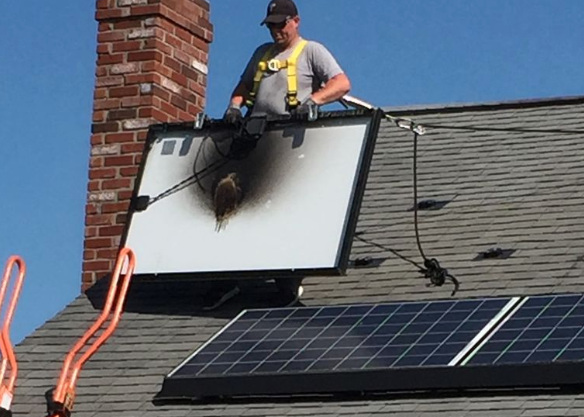
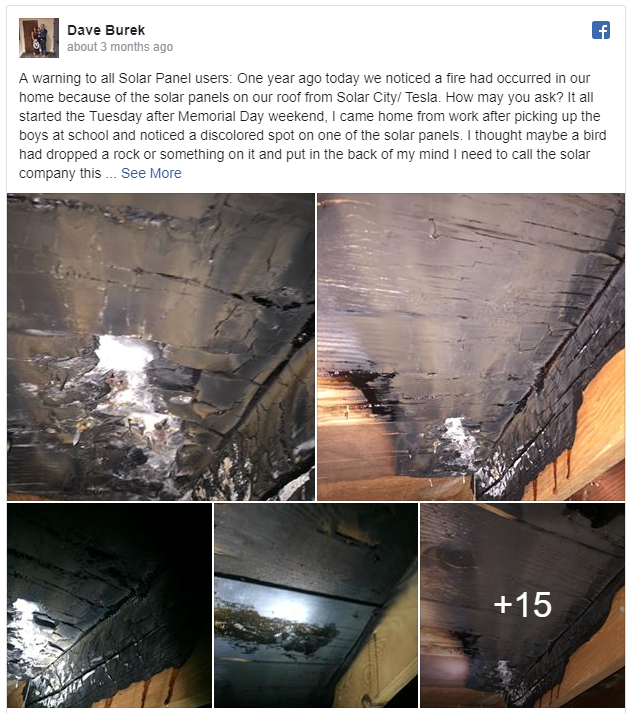
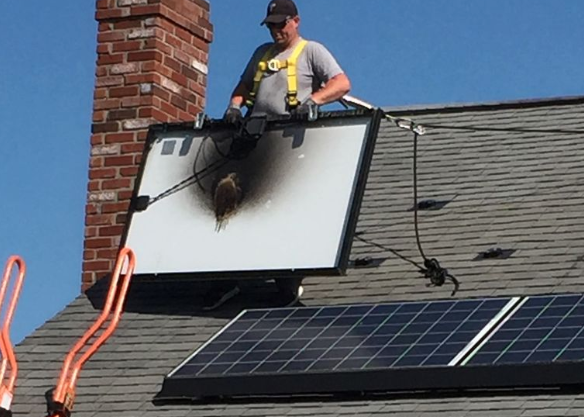
It has also highlighted stories like David Burek’s, who noticed “charred wood and a burning smell in his attic, near his young sons’ bedroom” last year. After he went up on his roof, he noticed a “melted connector wire” from the solar panels installed on his house. Firefighters would later tell him that flames had burned through his shingles, the roof and a support beam. Burek got lucky when rain put the fire out for him.
Burek’s charred panel being removed from his house
Then, a month later, a fire broke out at the home of Ken Tomasello, in Maryland. The fire sent a section of the ceiling crashing onto a bed and caused so much damage that Tomasello and his wife had to live in a hotel for more than a year.
Both homes had SolarCity panels installed on their roofs.
And while this represents a small cross section of Solar City’s 400,000 customers, it adds concern about the safety of Tesla’s systems, as now publicly called out by both Walmart and Amazon. It also shows that the same issues with Solar City’s corporate systems may cross over into their residential installations.
Now, in addition to the internal cover up (“Project Titan”) that we reported on here, it’s being reported that Tesla is reaching out to its customers and telling them that they need to perform preventative maintenance on their solar panels.
Burek, for instance, said he heard from Tesla in October 2018, five months after his panels had been removed.
Burek said:
“When I called Tesla back, they said our system had been flagged for bad connectors. I told them there was no system to maintain because they’d already caused a fire on my roof.”
Other examples of fire complaints haven’t exactly been hard to find, either.
Took me one minute on Google (personal information obscured to protect the victim). This review site only had 321 reviews, so I guess that is 31% of 1%…$TLSAQpic.twitter.com/AHVU645VgC
“In the past year, less than 1% of 1% of sites have experienced any type of thermal event necessitating any form of emergency response, and there have been no injuries. While we strive for zero risks across all of our products, this rate of risk presents less of a household danger than a home washer or dryer.”
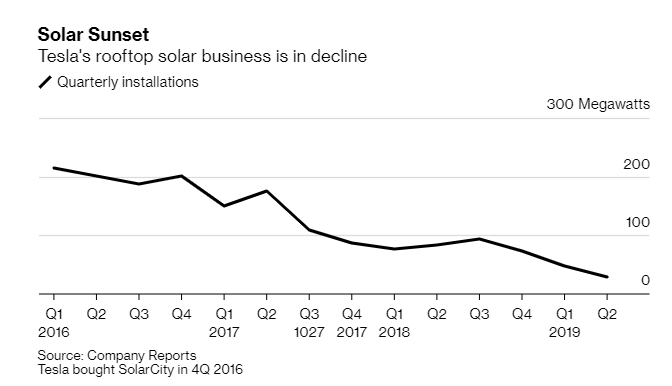
But this hasn’t stopped Tesla’s solar business from being in steep decline. And now, with seasoned skeptics like Bethany McLean taking notice, things look like they could be getting worse before they get better for Tesla.
In Tesla’s case, the fires are “sparking” both finger-pointing and lawsuits. As a result of the Burek and Tomasello fires, two homeowners insurers, Citation Insurance Co. and Allstate Corp., accused Tesla of negligence and breach of contract. Tomasello’s insurer is trying to recoup at least $300,000 in fire-related losses and Burek’s insurer is seeking to recover the $12,000 it had to pay out to the couple.
Sarah Wilder, director of curriculum development and instruction at Solar Energy International, a nonprofit focusing on technical training said: “A shortage of under-qualified workers can lead to a decline in system quality. Faulty components, shoddy workmanship or wiring, or a combination, can cause fires. So can poor maintenance.”
Joe Osha, an equity analyst at JMP Securities, a San Francisco investment-banking firm said: “There’s a lot of emphasis by solar companies on getting that installation but insufficient emphasis on making sure that the system is rigorously operated and maintained. These are not install-and-forget assets.”
Tomasello concluded: “When I heard about the Walmart fires, I wasn’t surprised at all. I’m sure there are other homes that have had experiences similar to ours.”
via ZeroHedge News https://ift.tt/348caNz Tyler Durden
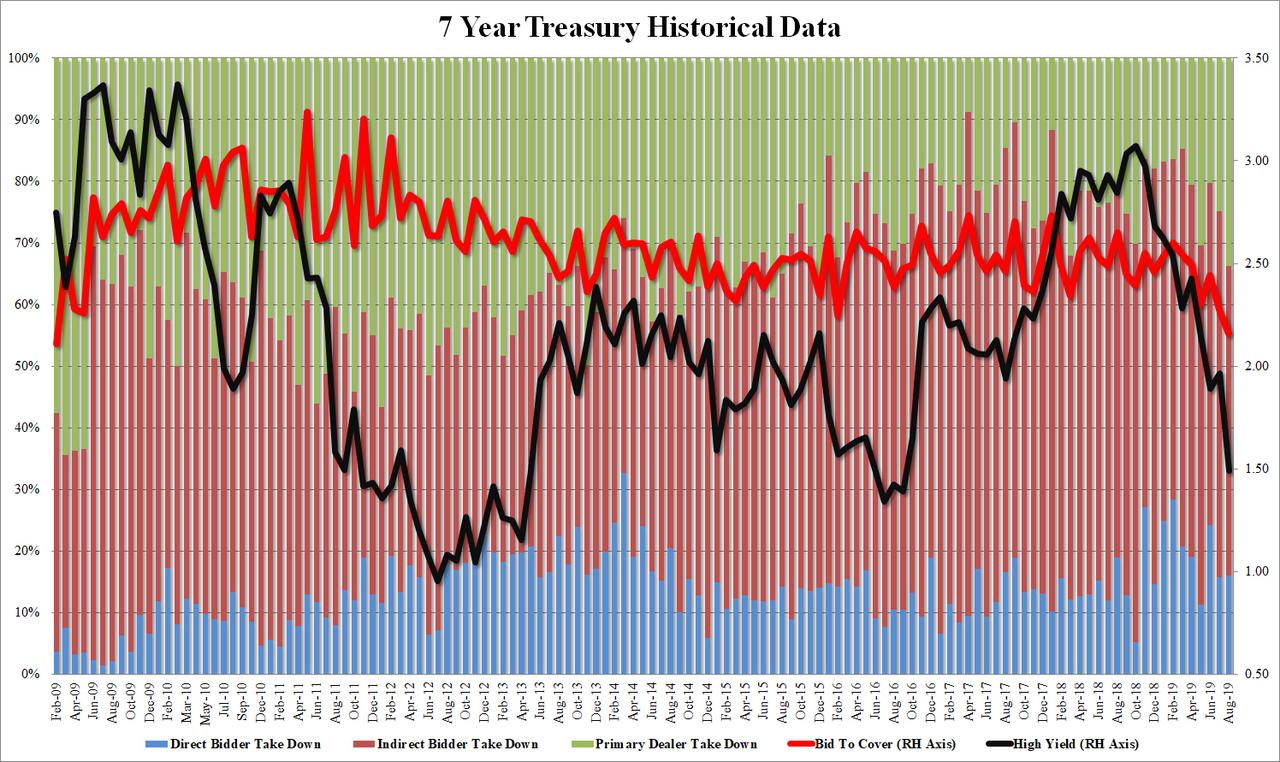
After two surprisingly strong 2 and 5-Year auctions, the bond market tantrumed on Thursday when today’s sale of $32 billion in 7Y notes was met with absolutely dismal demand.
Printing at a high yield of 1.489%, this was the lowest 7Y auction yield since October 2016, but more importantly tailed the When Issued 1.468% by 2.1bps, the widest tail in at least two years.
The demand was, in a word, deplorable: the bid to cover slumped from an already low 2.274 to just 2.159, the lowest in over ten years, going back to February 2009, and far below the 2.44 six auction average. The internals were ugly as well, with Indirects barely taking down a majority of the auction, or 50.2%, down from 59.4% in July, and the lowest since December 2015. And with Directs allotted 16.1%, or also below the 19.9% recent average, it left Dealers holding 33.8%, the highest since December 2015.
Overall, a very ugly auction, and one which has sent the 10Y yield to session highs, and the 30Y back over 2.0% (and now far above the matched maturity Italian bond).
via ZeroHedge News https://ift.tt/2PnCW1g Tyler Durden
Earlier this week, Spencer Schiff wrote an article noting the importance of consumer spending to the US economy and the consequences that will follow if Americans suddenly tighten up their wallets. Schiff isn’t alone in his concern. A mainstream economist sounded a similar warning during a recent CNBC interview.
In his article, Spencer pointed out the US economy’s dependence on consumer spending.
The recent emergence of widespread economic weakness leaves consumer spending, which makes up approximately 70% of our GDP, as a crucial pillar supporting the current expansion. In fact, besides government outlays, it was the only major GDP component that contributed positively to growth in Q2. Clearly, any shift in consumer psychology/behavior could knock a critical support out from under our economy.”
In fact, there are already signs that this could be happening. Consumer sentiment is falling, as Schiff noted.
Now it appears the mainstream has picked up on the risk involved in basing an economy on consumer spending and consumption. During a CNBC interview, economist Jim O’Neill said the US economy is becoming “riskily dependent” on the “overleveraged consumer.”
The economy’s strength … depends so much on consumption, which is fine unless financial conditions tighten unexpectedly when a lot of indebted US consumers won’t be able to afford to keep up the consumption they’re doing.”
O’Neill said in some ways, it’s a lot like 2008.
His comments become more poignant when you realize that much of the consumption over the last several months has been charged to credit cards. In effect, US consumers are propping up the US economy with money they don’t have. Total outstanding consumer debt surged over $4.1 trillion in the second quarter of 2019. Over the last 12 months alone, American consumers have piled on an additional $208 billion of debt.
Revolving credit – primarily credit card debt – increased at an annual rate of 5.3% in Q2. Americans currently owe $1.07 trillion on their plastic. This was a record for a second quarter and was only topped by the “holiday shop-and-borrow” season in Q4 2018.
Yes – Americans have been spending money, but they’ve been spending borrowed money. That’s all well and good until the credit cards become maxed out. This is the epitome of “unsustainable.”
Spencer wrote that deteriorating consumer sentiment could lead Americans to begin saving in order to prepare for an economic downturn.
Between blaring headlines on cable TV banners, newspaper articles, and social media posts, Americans are being inundated with dire economic warnings. With the horrors of the Great Recession still fresh in their memories, they’ll likely begin to prepare by reducing their discretionary spending in order to accumulate savings.”
And of course, they’ll want to start paying down some of that $4.1 trillion on debt.
This may already be happening among the rich. According to a CNBC report, “The rich have cut their spending on everything from homes to jewelry, sparking fears of a trickle-down recession that starts at the top.”
Luxury real estate is having its worst year since the financial crisis. Sales at art auctions are down for the first time in years. Retailers that cater to the wealthy are also struggling. Barney’s has filed for bankruptcy and Nordstrom has posted three quarterly revenue declines.
According to CNBC, “recent data suggest that the US wealthy are beginning to shut their wallets.” Meanwhile, “savings of the rich has also exploded, more than doubling over the past two years, suggesting that the wealthy are hoarding cash.”
This is exactly the scenario Spencer describes. And it would make sense that it would start with the wealthy since they tend to be more attuned to what’s going on in the economy. They didn’t get rich by being dumb with their money. The fact that the rich have shifted from spending to saving could be a canary in the coal mine.
As Spencer wrote, “It may soon become apparent that consumer spending, currently our primary recession deterrent, has ground to a halt. If so, a serious economic downturn awaits.”
via ZeroHedge News https://ift.tt/2L9o0OE Tyler Durden
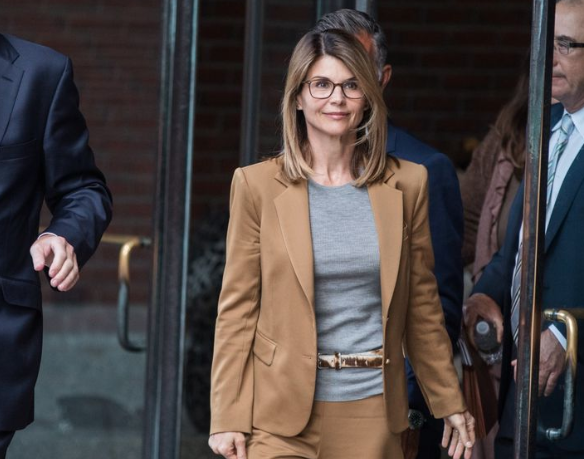
Lori Loughlin’s defense in the college admissions scandal has started to leak out. Loughlin is the highest profile defendant in the scandal to not settle with the government or agree to a plea deal, instead choosing to stand her ground and fight the charges leveled against her.
And now, Bloomberg reports that the actress and her husband, designer Mossimo Giannulli, will argue that they gave donations, not bribes, to the University of Southern California. The couple’s lawyer, William Trach of Latham & Watkins argued that there is “zero evidence” of bribery at a hearing in federal court in Boston on Tuesday.
Despite this, prosecutors maintain that Loughlin and her husband bribed former assistant athletics director Donna Heinel through payments to funds that she controlled and paid bribes that were funneled through a charity set up by William “Rick” Singer, the admission scandal’s mastermind, in order to get their daughters into USC.
Like Loughlin, Heinel has also pleaded not guilty. The defense will maintain that the couple was merely supporting the charity, called the Key Worldwide Foundation, which is a registered non-profit group that gave “legitimate donations” to support opportunities for underprivileged students.
The couple’s lawyer told the court: “The evidence in this case is there were checks made out to USC Athletics and to a fund at USC. Those checks were cashed by USC, and there were payments to Key Worldwide Foundation.”
Prosecutors countered on Tuesday that both spouses knew about the $500,000 scheme to bribe USC employees and implied that the evidence was stronger against Giannulli, raising questions about the soundness of a joint defense. Assistant U.S. Attorney Eric Rosen told the judge: “In this case I do think the evidence here is a bit more challenging than some of the other husband-and-wife defendants we’ve dealt with.”
Rosen alluded to a confrontation between Giannulli and a California high school guidance counselor who said he was suspicious after learning that both daughters, who weren’t rowers, had won admission to USC as recruits for the crew team. “Obviously that is going to be an important event in the government’s case,” Rosen said.
When asked if they understood the risks involved in dual representation, both Loughlin and Giannulli said that they did, and waived their rights to separate attorneys. Loughlin and Giannulli’s lawyer said it’s “a question of what it is they knew about what it is Mr. Singer may or may not have been doing with Key Worldwide Foundation and in respect to the employees at USC.”
The government has already charged 34 parents in the scandal, 15 of which have already pleaded guilty to fraud. Mastermind William “Rick” Singer has admitted to leading the ring and has pleaded guilty to racketeering charges, in addition to cooperating with the prosecution.
via ZeroHedge News https://ift.tt/32a7DIG Tyler Durden