Wait Until All These New Homebuyers See Their Property Taxes Go Up Next Year

Wait Until All These New Homebuyers See Their Property Taxes Go Up Next Year

To add another chapter to the “our economy is a ponzi scheme bubble that is bound to eventually burst” argument, those who went out and overpaid for property this year may wind up with a hangover in the form up skyrocketing property taxes.

We all know that higher real estate prices (hereinafter referred to as “a real estate bubble”) are often praised by government and Fed officials as signs of progress for the economy. They’re great news for those who already own property and terrible news for those looking to enter the market for the first time.

But buyers in 2021 may face even more buyers remorse, on top of overpaying for property: they may soon find out that property taxes are going to increase, an article from The Motley Fool astutely noted this summer

This once again makes an already-expensive house an additional burden by levying more costs in the form of taxes.

Property taxes are determined by the assessed value of a home and multiplying it by your local municipality’s tax rate. 

Assessments can obviously rise in price as homes do, driving taxes higher. 

Homeowners in 2021 are already starting to see these effects, the Fool article writes. An average property tax bill for a single family home went up from $3,561 to $3,719 in 2020, the report noted. Property taxes rose $323 billion, or 5.4%, in 2020, the report notes. It’s not unreasonable to assume these taxes will continue to rise at this alarming clip for 2021, as the real estate market continued its “recovery” this year.

While homeowners can appeal property tax assessments, the process “isn’t easy”. 

“It’s for this reason that homeowners are advised not to max out their budgets when purchasing property,” the Fool article hilariously ends by saying. Perhaps someone can inform them that tapping out all lines of credit and maxing out one’s budget is the American way…  

Tyler Durden
Wed, 10/27/2021 – 19:10

via ZeroHedge News https://ift.tt/DRZjVp Tyler Durden

Fifth Circuit Rebukes FDA for Regulatory “Switcheroo” in Denying Vaping Product Applications


15818510247_cf49a3e470_k

In 2016 the Food & Drug Administration “deemed” electronic cigarettes, vaping pens, and other electronic Nicotine delivery systems (“ENDS”) to be “tobacco products” under the Family Smoking Prevention and Tobacco Control Act. As a consequence, all ENDS manufacturers were required to submit premarket tobacco applications (PMTAs) in order to continue selling their wares. Under the Tobacco Act, the FDA is only to approve a PMTA if it concludes approval is “appropriate for the protection of public health,” taking into account “the risks and benefits to the population as a whole.” Without a PMTA, a deemed tobacco product cannot be sold.

PMTAs are supposed to be submitted before a new tobacco product is sold, but this was impossible since the FDA’s rule applied to products already on the market. Accordingly, the FDA announced that ENDS manufacturers would have two years to prepare and submit the lengthy and detailed materials necessary for their applications before they would face the prospect of FDA enforcement. The FDA soon realized that the material and information necessary for PMTAs would be substantial, particularly because a separate PMTA is required for each product, defined quite capaciously (i.e. each package size, each flavor, each nicotine level, each delivery system, etc.). So the FDA tried to extend the enforcement deadline until 2022, but anti-smoking groups sued, and they settled on a 2020 deadline.

The FDA ultimately received applications for over 4.8 million ENDS products from 230 companies. Needless to say, this is a bit more than the agency anticipated, and it has been working to process the applications, denying most of them. Because a PMTA denial is a death sentence, some disappointed ENDS producers have filed suit, challenging the denials and seeking judicial orders blocking FDA enforcement in the meantime.

Yesterday, the U.S. Court of Appeals for the Fifth Circuit ruled on one company’s application for a stay pending resolution of its petition challenging the FDA’s denial of its PMTAs. The court’s opinion in Wages and White Lion Investments LLC v. USFDA (WWLI) is a blistering indictment of the agency’s decision-making and evaluation of ENDS PMTAs.

In WWLI a unanimous panel granted Triton Distribution’s application for a stay, concluding that  it had demonstrated not only a strong likelihood of success on the merits, but also that it would suffer irreparable injury without a stay, and the government would not.

A key problem with the way that the FDA handled the PMTAs filed by Triton (and other ENDS manufacturers) is that the FDA based its denial of their applications on a different standard than it had told companies they have to meet. This sort of action is at the heart of arbitrary agency action, and is antithetical to principles of due process.

For years, the FDA had informed ENDS manufacturers that they would not need to conduct long-term health studies on their individual products for their applications. This only makes sense, as ENDS manufacturers only had a limited period of time to prepare their materials. Yet, on August 26 when the FDA announced it was denying PMTAs for 55,000 flavored e-cigarette products, it claimed that such studies were “likely” necessary for approval. A few weeks later, the FDA denied Triton’s applications, explaining that the key basis” for the denial, was the lack of “robust and reliable evidence” from long-term studies of the sort FDA had previously told manufacturers were unnecessary. (Triton had nonetheless committed to conduct such studies, but the FDA refused to consider that assurance.)

As Judge Oldham’s opinion makes clear, the FDA’s decision-making in denying Triton’s application is an almost textbook example of what agencies are not supposed to do. It both changed course without adequate explanation or consideration of serious reliance interests while simultaneously refusing to consider multiple relevant factors and information submitted by Triton.

Here are a few examples from Oldham’s opinion:

The FDA failed to reasonably consider Triton’s proposed marketing plan. The FDA repeatedly stated that a marketing plan is “a critical factor in[] FDA’s statutorily required determination.” Premarket Tobacco Product Applications and Recordkeeping Requirements, 86 Fed. Reg. 55,300, 55,324 (Oct. 5, 2021) (“Final Rule”); see also 84 Fed. Reg. 50,566, 50,581 (Sept. 25, 2019) (“Proposed Rule”) (“The applicant’s marketing plans . . . will provide input that is critical to FDA’s determination of the likelihood of changes in tobacco product use behavior, especially when considered in conjunction with other information contained in the application.” (emphasis added)); A.45 n.xix (“Limiting youth access and exposure to marketing is a critical aspect of product regulation.” (emphasis added)); A.45 (Premarket “assessment includes evaluating the appropriateness of the proposed marketing plan.”). Here, however, the FDA simply ignored Triton’s plan. It stated: “[F]or the sake of efficiency, the evaluation of the marketing plan in applications will not occur at this stage of review, and we have not evaluated any marketing plans submitted with these applications.”

The FDA’s excuses for ignoring the “critical factor” of Triton’s marketing plan are unpersuasive. First, the FDA says it didn’t evaluate Triton’s plan for “the sake of efficiency.” Ibid. But “efficiency” is no substitute for “reasoned decisionmaking.” Michigan, 576 U.S. at 750; see also Judulang v. Holder, 565 U.S. 42, 64 (2011) (emphasizing that “cheapness alone cannot save an arbitrary agency policy”). . . .

In a footnote Judge Oldham notes that the FDA’s failure to consider Triton’s marketing plan, and how it would control youth access, was particularly striking given that then-FDA Commissioner Scott Gottleib had identified Triton’s approach as “best practices.”

And then there are Trtiton’s reliance interests, which the FDA disregarded in the course of its regulatory “switcheroo.”

Between the Deeming Rule’s effective date and the deadline for PMTAs, the FDA held public meetings and issued guidance on how e-cigarette manufacturers could get premarket authorization. In its “final guidance,” the FDA stated that it did not “expect” that tobacco manufacturers would need to conduct long-term studies to support their PMTA. See, e.g., A.73–74; A.92; see also Nicopure Labs, LLC v. FDA, 944 F.3d 267, 282 (D.C. Cir. 2019) (“The FDA has expressed willingness to accept scientific literature reviews instead of commissioned studies in support of e-cigarette applications in appropriate circumstances.”). The FDA’s expectation did not deviate in its Proposed Rule issued before the Order or the Final Rule issued a couple weeks after the Order. See Final Rule, 86 Fed. Reg. at 55,387 (“FDA does not expect that long-term clinical studies will need to be conducted for each PMTA; instead, it expects that it should be able to rely on other valid scientific evidence to evaluate some PMTAs.”); Proposed Rule, 84 Fed. Reg. at 50,619 (similar). Many e-cigarette companies relied on the FDA’s repeated insistence that it did “not expect that applicants will have to conduct long-term studies to support an application” and did not perform or submit such evidence.

Then the FDA “pull[ed] a surprise switcheroo on regulated entities.” Env’t Integrity Project v. EPA, 425 F.3d 992, 996 (D.C. Cir. 2005) (Sentelle, J.); accord Azar v. Allina Health Servs., 139 S. Ct. 1804, 1810 (2019) (citing the “surprise switcheroo” doctrine). Almost a year after the PMTA deadline, the FDA issued its first marketing denial orders for various flavored e-cigarettes and announced that it required the very studies it originally expected it didn’t need. . . . Despite the radical difference, the FDA never mentioned, let alone reasonably considered, whether e-cigarette manufacturers, like Triton, could’ve reasonably relied on the FDA’s prior meetings and guidance.

The law requires more. “When an agency changes course, . . . it must be cognizant that longstanding policies may have engendered serious reliance interests that must be taken into account.” Regents, 140 S. Ct. at 1913 (quotation omitted). This does not mean that the FDA could not have “determine[d], in the particular context before it, that other interests and policy concerns outweigh any reliance interests. Making that difficult decision was the agency’s job, but the agency failed to do it.” Id. at 1914. This reinforces that the Order was likely arbitrary, capricious, or otherwise unlawful.

The FDA further failed to consider Triton’s reliance interests, whether there were alternatives to denial on this basis, and other evidence submitted by Triton. As Judge Oldham noted, the FDA responded more to some of Triton’s claims before the Fifth Circuit than it had when rejecting Triton’s PMTA. The court also found that that, on balance, a majority of the other relevant factors favored granting Triton’s request for a stay

The opinion also rejected the government’s (in my view, borderline frivolous) argument that the Triton sought relief — a stay of FDA enforcement action — that the court could not give. Yet just as a court could issue a stay barring the deportation of an unlawfully present alien pending review of the alien’s claim for asylum or lawful presence, a court may order an administrative agency defendant to preserve the status quo pending the outcome of the litigation. How a government attorney argued the alternative is beyond me, particularly given the innovative arguments in favor of expansive judicial authority to enter stays the federal government is currently making in the S.B. 8 litigation (something which I doubt was lost on this panel).

The Fifth Circuit’s WWLI decision indicates the FDA faces a tough road ahead defending many of its PMTA denials–and it appears the FDA knows it. Other manufacturers have also sought relief in court, and even before the Fifth Circuit’s decision issued the FDA was already beginning to back down. For instance, on October 11, in the face of a pending stay request before the U.S. Court of Appeals for the Sixth Circuit, the FDA agreed to rescind its denial of PMTAs submitted by Turning Point Brands.

What is particularly galling about the FDA’s treatment of ENDS manufacturers is that the FDA is well-aware that ENDS products pose far less risk to users than traditional, combustible cigarettes, and has acknowledged that ENDS can help some smokers quit. Further, there is substantial evidence that limitations on ENDS products will increase smoking, particularly among youth (as has been well-documented). Thus the FDA’s cavalier rejection of PMTAs is not only arbitrary and capricious, it is contrary to the FDA’s underlying public health mission (and may also be unconstitutional).

from Latest – Reason.com https://ift.tt/3pNl7Jo
via IFTTT

The Spirituality Behind Bitcoin

The Spirituality Behind Bitcoin

Authored by Mark Jeftovic via Bombthrower.com,

“they worshiped the dragon because he gave his authority to the beast; and they worshiped the beast, saying ‘Who is like the Beast, and able to wage war against it?'”

If ‘The Beast’ is CCP-style social credit, the answer is Bitcoin

Something I’ve been thinking about more often lately is the almost otherworldly timing of the appearance of Bitcoin on the world stage.

Right at the crescendo of the Global Financial Crisis, as world leaders and central banks were showing that they would never willingly allow consequences to unfold, even worse, they would reward moral hazard and bail out the banks, a mysterious white paper dropped on a cypherpunks mailing list:

Subject: Bitcoin P2P e-cash paper

Satoshi Nakamoto satoshi at vistomail.com Fri Oct 31 14:10:00 EDT 2008

I’ve been working on a new electronic cash system that’s fully peer-to-peer, with no trusted third party.

The paper is available at: http://www.bitcoin.org/bitcoin.pdf

The main properties:

  • Double-spending is prevented with a peer-to-peer network.

  • No mint or other trusted parties.

  • Participants can be anonymous.

  • New coins are made from Hashcash style proof-of-work.

  • The proof-of-work for new coin generation also powers the network to prevent double-spending.

Bitcoin: A Peer-to-Peer Electronic Cash System

Abstract. A purely peer-to-peer version of electronic cash would allow online payments to be sent directly from one party to another without the burdens of going through a financial institution. Digital signatures provide part of the solution, but the main benefits are lost if a trusted party is still required to prevent double-spending. We propose a solution to the double-spending problem using a peer-to-peer network. The network timestamps transactions by hashing them into an ongoing chain of hash-based proof-of-work, forming a record that cannot be changed without redoing the proof-of-work. The longest chain not only serves as proof of the sequence of events witnessed, but proof that it came from the largest pool of CPU power. As long as honest nodes control the most CPU power on the network, they can generate the longest chain and outpace any attackers. The network itself requires minimal structure. Messages are broadcasted on a best effort basis, and nodes can leave and rejoin the network at will, accepting the longest proof-of-work chain as proof of what happened while they were gone.

Full paper at: http://www.bitcoin.org/bitcoin.pdf

Satoshi Nakamoto

…and the world changed.

When an idea whose time has come arrives, nothing can stop it. It may take generations to play out and the transition may be tumultuous, but no human agency can resist it. Fire, self-awareness, language, human rights, increasingly higher levels of mental abstraction, energy density and systems of organization. Something is impelling this relentless progression, and since everything born of human activity had to start as an idea, that something has to be thought.

Yet, we live in a world of radical material reductionism. Conventional canon holds that thought is simply a by-product of brain activity. At its most reductive level, thought, and consciousness itself are just accidents of innumerable material processes randomly iterating over billions of years until one day, some apes suddenly became aware of themselves. “The rest is history”, goes the logic.

Contrary to this, we have multiple streams of philosophy, mythology, certain currents of depth psychology and over the last hundred years even science, namely quantum mechanics, that takes a completely different position. The material world is a consequence of non-material reality, not the precursor to it, and that non-material reality is self-aware and conscious:

“I regard consciousness as fundamental. I regard matter as as derivative from consciousness. We cannot get behind consciousness. Everything that we talk about, everything that we talk about as existing, postulates consciousness.”

– Max Planck, emphasis added.    

Which is preeminent, consciousness or matter, is the modern day analog of the battle between the Ptolemaic and the heliocentric cosmologies.

I think in the fullness of time, after enough people have been burned at the stake for saying it, we’ll accept that everything occurring in the material world  has its origin in a non-material realm. One whose dynamics shape the events of this one. It has a directionality to it that is taking events in a certain direction. Also, to one degree or another, there may be some oppositional forces aligned against it.

On my latest appearance on Steve Bannon’s Warroom I made the point that “Bitcoin is resistance to financial repression”. Bannon had declared previously that “the government is forcing you into crypto and gold”, and before my segment, Congressman Gaetz, speaking on the new IRS regulations to surveil the populace, said that the government was “weaponizing” its bureaucratic apparatus against its own citizenry.

Where I might politely differ from Bannon and Congressman Gaetz is in the idea that this war against the middle class, against the people, isn’t peculiar to the Biden administration. This has been going on for generations, across both parties. It’s the architecture of the modern welfare state. However contrary to what many think, the welfare state isn’t all powerful, it’s fighting for its own survival.

One of the core battlegrounds in this struggle, perhaps the most important one, is around the nature and mechanics of money. The reason why is because the advent of honest money enabled the exchange of value. It meant people could come together and peacefully trade in a way that resulted in mutual benefit. It was a kind of alchemy. Without honest money we are left with force and coercion. Either subtly or overtly.

The book that probably went the furthest in initially “red-pilling” me about the nature of money, how sound money fostered peace and prosperity, while fiat money (“false” money) enabled division, corruption and war, was Ferdinand Lips’ “Gold Wars”. Lips posited that “The Gold War is nothing else than a Third World War. The demise of the classic gold standard would pit the central bankers and political class against the people, ushering in a “monetary dark age”.

What may be unique to the Biden administration, and incumbent politicians across liberal democracies is the quickening. How in the wake of this (likely lab originated) pandemic it all seems to be headed for a blow off top in tyranny, the world over.

Gold has had near mystical connotations for millennia.

Lips, citing the legendary Harry Shultz unpacks the societal detriment that is caused by unsound money:

Money sets a standard that spreads into every area of human activity. No paper money backing, no morality….Layer by layer we are corrupted when money loses certainty… Big Brother was made possible through the absence of automatic controls and loss of individual freedom via non-convertible currency. So, pass the word. Fight for gold. Not for profits, though they are helpful and help us fight for individual freedom, but for a future that returns to sanity in various standards. If we have a gold standard we get golden human standard! The two are intertwined. They are the ultimate cause and effect. Gold blesses.

One wonders what the late Ferdinand Lips would have thought of the situation today. Shultz wrote the last edition of his newsletter in 2011, warning us then that:

“Roughly speaking, the mess we are in is the worst since 17th century financial collapse. Comparisons with the 1930’s are ludicrous. We’ve gone far beyond that. And, alas, the courage & political will to recognize the mess & act wisely to reverse gears, is absent in U.S. leadership, where the problems were hatched & where the rot is by far the deepest.”

But despite the recorded experience over the entire course of monetary history, how fiat currencies always go to zero, every time, no exceptions, the established elites will not return to a sound money standard of their own free will. Doing so would relinquish their own hold on power, and politics today attracts (almost exclusively)  disordered, sociopathic personalties.

Enter, digital currencies

In the early 00’s, there was an abortive attempt to fuse sound money with emerging digital payments in systems like e-gold, Pecunix, and Goldmoney (which is still going today). They were centralized and corporate entities, which meant they had definable attack surfaces that prevented them from posing any serious threat to the status quo.

Recently Peter Thiel mused that the mysterious Satoshi Nakamoto, be it a person or a group, probably cut their teeth in that first attempt at a new era sound money in these digital gold currencies.

Today, people just look at “digital money”, whether it’s crypto-currencies like Bitcoin, digital stablecoins like Facebook’s Diem, or the impending Fedcoin and they put it all into the same bucket. This is mistake.

Digital money is just a medium. Just as the internet is a medium. And where the internet can be used to promote repressive, anti-human ideologies like collectivism, woke-ism and transhumanism, and can be the facilitator for surveillance capitalism, it is also an enabler and empowering mechanism for the underdogs.

For alternative press, independent journalism and open discourse, the internet is the great equalizer. It provides the tools for small, medium  and home businesses to compete against the 800lb gorillas in their space (the topic of yet another one of my still-in-progress books that got pushed to the back burner). The advent of the internet was a Promethean event. Cooked up in the bowels of the military-industrial complex it was loosed into the world, perhaps with the intent of further enslaving the masses, but it was designed almost too well.

The internet opened the door to emancipation of information.

So to are digital currencies the new medium for value exchange in an emerging networked world. I never tire of citing the late Stephen Zarlenga and his exhaustive study of history showing how control over the monetary system amounts to control over society.

In a networked world, the battle for monetary morality will be played out in cyberspace. Gold will always be an immutable, ageless anchor for value, but on this battlefield, sound money needed ally. This is guerrilla warfare and something truly asymmetric was required.

What the world neededwas Bitcoin. Digital gold.

Where Central Bank Digital Currencies (CBDCs) are the emerging digital cash platforms of indebtedness and servitude, Bitcoin and (real) cryptos are the liberators. They are not the same, they are antipodes, playing out a timeless struggle in a new terrain.  (How can you tell the difference between an oppressive and a liberating digital currency? If you hold your own private keys, it’s an emancipatory crypto, if you can’t self-custody, opt-out, or fork-off, it’s EvilCoin).

This battle is ultimately, a spiritual one

Over the years, as much as I tried to ignore it, I finally had to acknowledge my belief that the ultimate impetus to create emancipatory monetary technologies originate from another plane. By that I don’t mean ethnocentrically modelled deities plotting earthly intrigue from Mount Olympus. I mean more along the lines of impulses and dynamics that we can barely understand from our limited vantage point, ultimately originate from a non-material realm from where they project a kind of morphogenic field into the material world, where these tensions play out.

There are various models for this, David Bohm’s Implicate / Explicate Orders, Karl Pribam’s Holoflux Theory – these models are synthesized coherently in the work of Dr. Shelli Renee Joye..
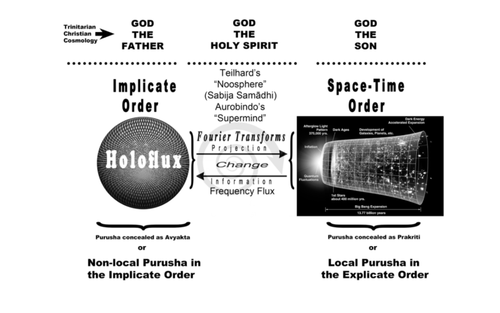
Why believe any of this New Age woo-woo when the material reductionists would tell me that my belief is simply a side effect of an electro-chemical storm in my brain? Mere “qualia”?

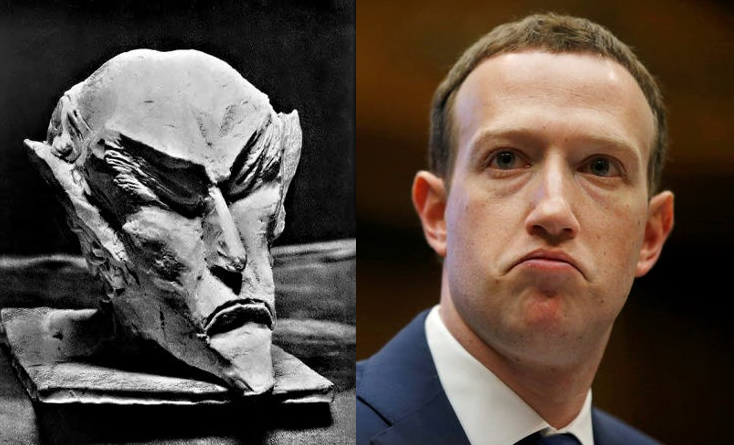
After my Bannon appearance I ended up speaking with Joe Allen, who covers transhumanism for the Warroom. He also writes the Singularity Weekly Substack. We talked for over an hour and we discussed atheism vs radical material reductionism. We discussed the difference between the scientific method and Scientism. We talked about Rudolf Steiner, who posited a coming Age of Ahriman, a period in which humanity would become enamoured with materialism and forget its own soul, an era wherein Ahriman himself would incarnate physically in the West. Steiner, who died in 1925, put it as occurring sometime in the late 20th century, someplace in the US or Canada (if I had to bet, my money would be on Mark Zuckerberg).
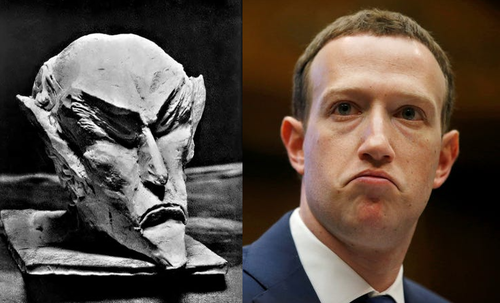
Left: Rudolf Steiner’s sculpture of Ahriman, circa 1914. Right: Mark Zuckerberg, b. 1984

For anybody who’s ever attempted to read Steiner, it’s mostly impenetrable. My personal theory is that Steiner spent abnormally large swaths of his life in a hypnogogic state. Perhaps without fully realizing it himself. Nonetheless, he pretty much invented bio-organic farming and Waldorf Schools, among other things.

I ended up telling Joe a true story, one that happened to me nearly 30 years ago, but I remember it like it was yesterday. When the material reductionists tell you that everything you think, feel and decide are simply the outcomes of a billiard ball universe: atoms and molecules colliding while neurons and synapses are firing in your brain, they have to admit when pressed; they can’t actually tell you what consciousness really is. Nor how life emerged from inert matter, or how a brain somehow secretes sentience.

And they cannot explain how something like this happens:

The time: 1992-ish, I’m a bohemian, long haired dude going to college in London, Ontario, playing in a metal band, studying computer programming at Fanshawe College, living in a rooming house / hovel: a mattress on a pair of skids on the floor of a small room in a basement (because the basement flooded every time it rained).

Me, with hair. Circa 1992, covering then Ontario Premier Bob Rae’s song “Same Boat Now”

I had just finished an essay for school, about smart card technology and I closed the assignment with some speculation that eventually smart cards could morph into bar codes and implants.  I went on to describe how some religious types (I wasn’t one) thought this would play out along biblical lines, as per the Book of Revelations. On a lark, I close out the essay with Revelations 13:17:

“And that no man might buy or sell, save he that had the mark, or the name of the beast, or the number of his name on his hand or his forehead”

At this point, one of my roommates in the hovel, he was a drug dealer who scared the hell out of me, and some of his even scarier friends show up and they were cooking something up that I didn’t want to be a witness to. So I got the hell out of there.

Very agitated and restless at this point I’m trying to figure out where to go, I decide on the University of Western Ontario’s D. B. Weldon Library, a short bus ride up road. “Nobody will know me there, and I can just disappear in there with a book” I think to myself.

On my way I hit the ATM to get my last $5 out of my bank account. I remember thinking about my essay and giving my bank card some  extra scrutiny as I pondered those last paragraphs. Number of the Beast, implants, all that stuff.

I’m still nervous and pumped full of anxiety (my living situation wasn’t the greatest in those days). But I remember what happened distinctly:

Once the bus let out on campus, I felt almost trance-like. “In the zone”. I walked into the library cognizant that I had not brought anything with me to read, but the plan was to simply walk in there and pick a ‘random’ book off the shelves, then flop into a chair and read it for the next few hours.

I jump into the elevator. Get off on the 3rd or 4th floor (D. B. Weldon is 5 stories high), and then, again, trancelike – turn walk, turn, walk, turn walk – stop. Reach out to one side and pluck a book off the shelf then flip it open….

“And that no man might buy or sell, save he that had the mark, or the name of the beast, or the number of his name on his hand or his forehead.”

The book was Swedenborg’s “Revelations Explained”.

Suffice it to say, if it were in a movie this would be the scene where the violins are doing those short, sharp Psycho-style stabbing notes in the background.  I’d experienced synchronicities before, but this one was off the charts.

Until now, I haven’t  told too many people about that event. My wife thinks that it wasn’t a synchronicity as much as a demonstration of the power of mind, that on a subconscious level I had memorized the titles and order of everything in the library on previous visits and that somehow I had managed to retrieve that needle from the haystack because of the mental priming of the morning’s events (I guess my wife is somewhat of a “Scully” to my “Mulder”). But that doesn’t explain picking out a book I had never read by an author I had never heard of and flipping it open to the exact page that happened to also quote Revelations 13:17.

When the Internet hit and there were these head fakes toward micropayments and digital cash I would think about this event. Then crypto-currencies came along I started thinking about it more often. My intuition was telling me that Bitcoin wasn’t a “Mark of the Beast” style technology as foretold in prophecy. If anything, Bitcoin, being a liberating and empowering technology would be the opposite of that. An antidote.

Once the pandemic hit, and vax passports went from conspiracy theory to reality in about 18 months I became quite alarmed about the means, motive and opportunity to fuse the impending CBDCs with health passports and China-style social credit systems. Suddenly implants and chips didn’t seem so far-fetched anymore.

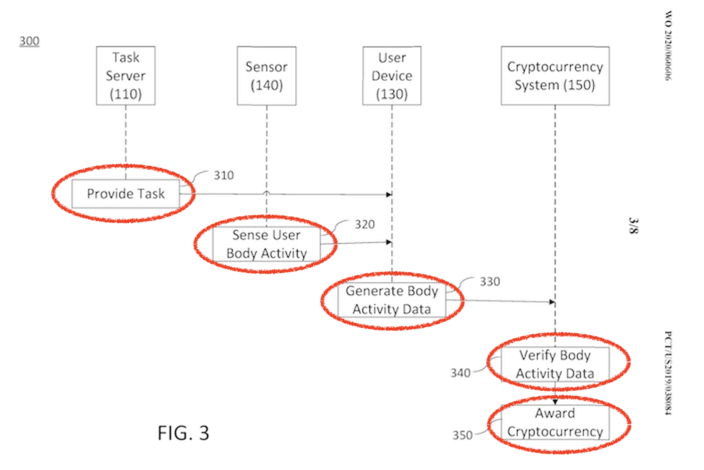
When I told Joe Allen this story, he said it reminded him of the wildly memetic Microsoft 2020-06/06/06 patent. It purportedly described a system for human implants that would turn people into crypto-currency miners and reward them with tokens for completing assigned tasks. Best Matrix flick ever.

When I first heard about this one, it was on Facebook and I nearly ripped into the original poster because it was so obviously an unhinged conspiracy theory that could easily be debunked by simply looking up the damn patent number in the bloody  database.  I mean people …get a grip.

The only problem is that the 2020/060606 patent turns out to be real, it is listed in the WIPO database (not USPTO), and it describes (get this), “A Crypto-Currency System Using Body Activity Data”.

Human body activity associated with a task provided to a user may be used in a mining process of a cryptocurrency system. A server may provide a task to a device of a user which is communicatively coupled to the server. A sensor communicatively coupled to or comprised in the device of the user may sense body activity of the user. Body activity data may be generated based on the sensed body activity of the user. The cryptocurrency system communicatively coupled to the device of the user may verify if the body activity data satisfies one or more conditions set by the cryptocurrency system, and award cryptocurrency to the user whose body activity data is verified.
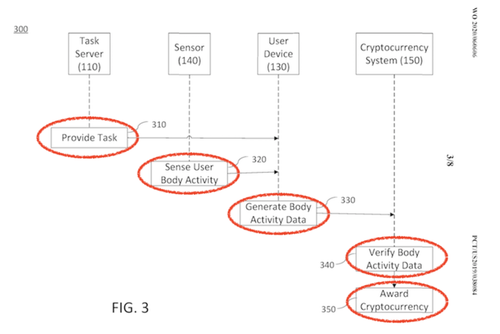
Jesus Christ. Make it stop.

The WIPO assigned patent filing numbers, as far as I can tell, are simply assigned serially by year. 2019/060606 is Hydrated Caruon Material Powder and Use of it for Preparation of an Electrode for an Electrical Storage Device. 2021/060606 is Nuclear Fuel Uranium Dioxide Pellets Having Improved Fission Gas Capturing Capability.

What were the odds that Microsoft, a global quasi-monopoly, co-founded by Epstein bro and elite-level globalist Bill Gates, would file a patent on a human implantable task/reward system and wind up with this number in it?

Here is wisdom. Let him that hath understanding count the number of the beast: for it is the number of a man; and his number is Six hundred and sixty-six.”

I’m not saying that we are dealing with actual, literal Biblical prophecy playing out in our time. Because frankly, there are people who think that at every point throughout history.

The timing of the arrival of Bitcoin, the Promethean dynamic behind both it and the Internet, the “signs and wonders” of the quickening, and the rhyming of ultra-long historical cycles, not to mention the unsustainability of the current status quo; this is all building toward some kind of self-organizing criticality. A global Minsky Moment. What I do think is that whatever is driving it all is not originating from a linear, material universe that just so happened to belch out consciousness along the way.

It could be as explainable as our own collective subconsciousness willing or fearing certain dynamics into material reality. It could be larger, extra-dimensional forces that super-sensibly atuned people like Steiner or Swedenborg glimpsed over a century ago and could barely unpack what they experienced into linear terms.

Whatever is happening, it has been unfolding for a long, long time…

It was not precisely a memory. You have already had proof that time is more complex than your science ever imagined. For that memory was not of the past, but of the future -of those years when your race knew that everything was finished. We did what we could, but it was not an easy end. And because we were there, we became identified with your race’s death.

Yes, even while it was still ten thousand years in the future!

It was as if a distorted echo had reverberated round the closed circle of time, from the future to the past. Call it not a memory, but a premonition.

The idea was hard to grasp, and for a moment Jan wrestled with it in silence.

Yet he should have been prepared; he had already received proof enough that cause and event could reverse their normal sequence.  There must be such a thing as racial memory, and that memory was somehow independent of time.

To it, the future and the past were one. That was why, thousands of years ago, men had already glimpsed a distorted image of the Overlords, through a mist of fear and terror.

“Now I understand,” said the last man.

–  Arthur C Clarke, Childhood’s End

When I confront the spectre of  widespread social credit systems, technocratic collectivism or transhumanist ideations of digital immortality, I get a palpable anti-human vibe from them. When I meditate on empowering technologies like cryptography, on structures of decentralization and on the ideals of self-sovereignty it feels just so much more life affirming.

Alas, the zeitgeist today is dominated with the mindset of the former, but fortunately, Prometheus has already made his rounds.  If you value freedom, autonomy, universal human rights and believe we are all ‘the offspring of a deathless soul’, then Bitcoin isn’t your enemy, it’s your ally.

“For we wrestle not against flesh and blood, but against principalities, against powers, against the rulers of the darkness of this world, against spiritual wickedness in high places.”

*  *  *

I cover macro tensions between the globalists and sovereign-individual extensively in The Crypto Capitalist Letter, along with a tactical focus on publicly traded crypto stocks. Get the overall investment / macro thesis free when you subscribe to the Bombthrower mailing list, or try the premium service for a month with our fully refundable trial offer.

Tyler Durden
Wed, 10/27/2021 – 18:50

via ZeroHedge News https://ift.tt/3bivoVC Tyler Durden

US Coal Stockpiles Slump To Two Decade Low As Power Plant Demand Surges 

US Coal Stockpiles Slump To Two Decade Low As Power Plant Demand Surges 

One of the biggest ironies this year is the transition from fossil fuel generation to green energy has created a global energy crisis that is forcing the U.S., among many other countries, to restart coal-fired power plants ahead of the Northern Hemisphere winter. Coal is roaring back this fall but supplies are not catching up with demand. 

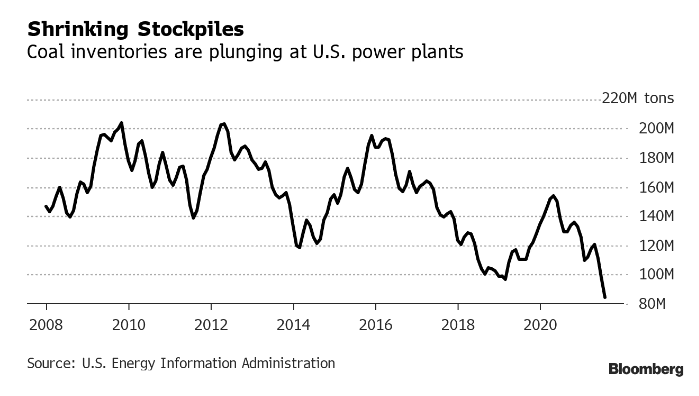
According to Bloomberg, US coal supplies dropped to 84.3 million tons in August, the lowest level since 1997. 

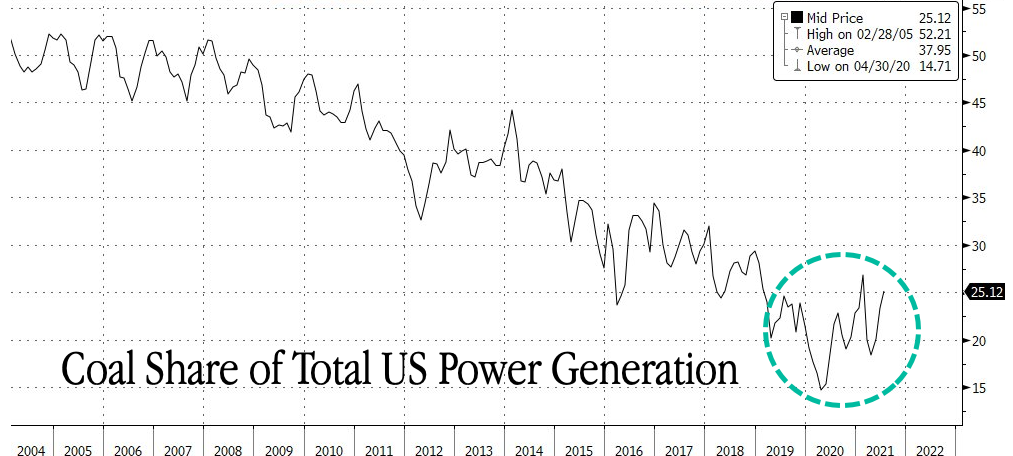
As of August, about a quarter of all US power generation was derived from coal. As winter approaches, coal-fired power plants will become a more significant percentage of all U.S. power generation. 

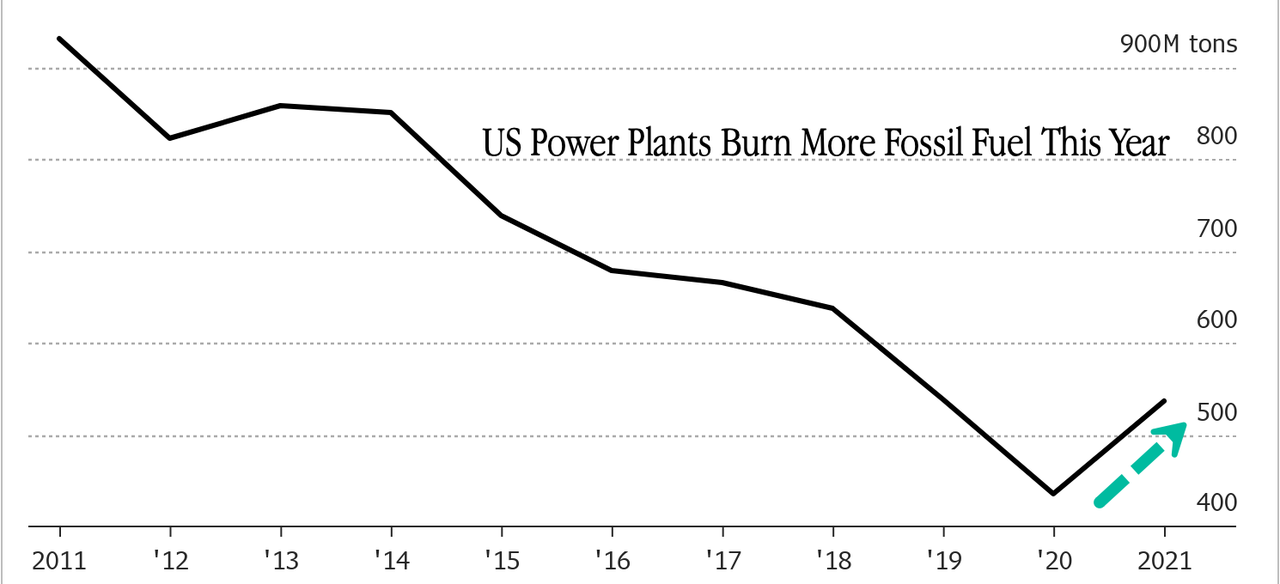
Power plants are expected to burn 19% more coal this year because soaring natural gas prices have made it uneconomical to produce power. In return, this is forcing generators to burn through coal reserves much quicker and has caught coal producers off guard who cannot bring new coal to the market. 

“The ability for the producers to respond is not what the utilities thought it was,” Paul Lang, CEO at Arch Resources Inc., said during a conference call Tuesday. “It just doesn’t exist anymore.”

Weeks ago, Ernie Thrasher, CEO of Xcoal Energy & Resources, the largest U.S. exporter of fuel, said demand for coal will remain robust well into 2022. He warned about domestic supply constraints and power companies already “discussing possible grid blackouts this winter.” 

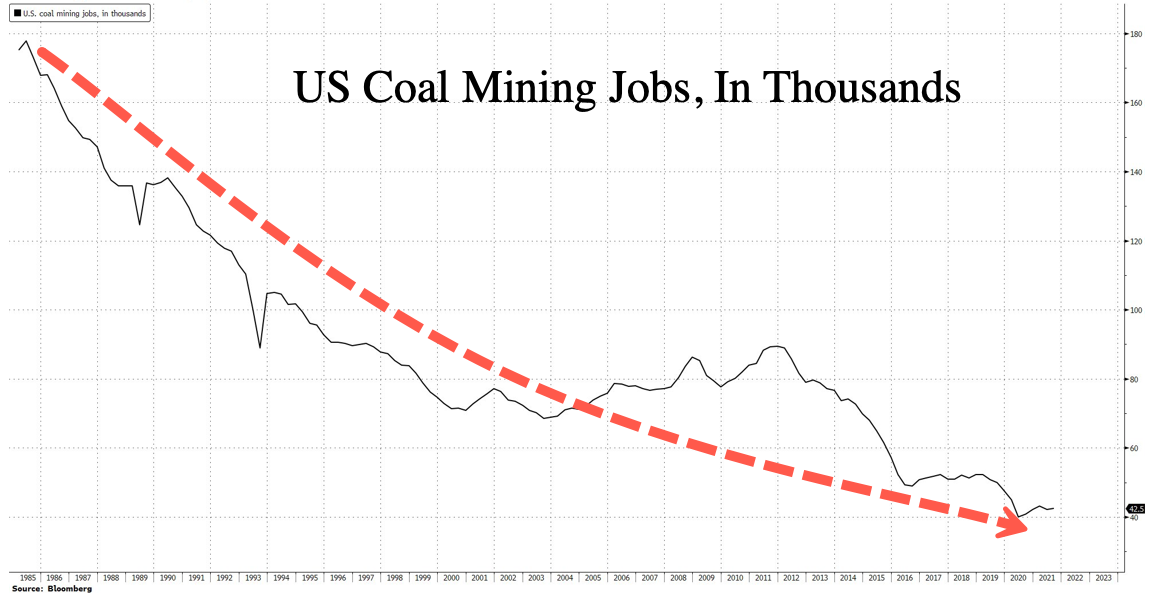
He said, “They don’t see where the fuel is coming from to meet demand,” adding that 23% of utilities are switching away from gas to burn more coal. There are not enough coal miners to rapidly increase mining output. 

Joe Craft, CEO for Oklahoma-based miner Alliance Resource Partners L.P., warned Monday, “coal stocks for customers are at critically low levels.” 

Inventory declines came on very quickly as the global energy crisis emerged this year. Stockpile trends were well in line for the first half of the year, but stockpiles began to drop as soon as July rolled around. 

S&P Global Market Intelligence data shows Central Appalachia coal prices have surged 39% since the start of the year to $75.50 a ton due to supply constraints. 

Matt Preston, director of North American coal markets research for Wood Mackenzie Ltd., said total U.S. inventories could slump by 50 million tons by the end of the year:

“Stockpiles are coming down very rapidly,” Preston said. “If we have a cold winter, and there has been lots of talk that there could be a cold winter, we could see some issues.”

With natgas, coal, and oil prices all soaring is a clear signal the green energy transition will take decades, not years. Walking back fossil fuels for unreliable clean energy has been a disaster in Asia and Europe. It could soon cause trouble in the U.S. These power-hungry continents are scrambling to source fossil fuel supplies as stockpiles are well below seasonal trends ahead of cooler weather. 

Suppose La Niña conditions produce cooler weather trends in certain parts of the world. In that case, especially, Asia, Europe, and the U.S., coal demand could continue to increase, which would benefit Peabody Energy Corporation’s share price. 

So far, Peabody’s earnings have tripled as coal roars back under a Biden administration. 

Tyler Durden
Wed, 10/27/2021 – 18:30

via ZeroHedge News https://ift.tt/2XPQCqE Tyler Durden

NASA Facing Massive $2.7 Billion Cost Overruns At Its Facilities

NASA Facing Massive $2.7 Billion Cost Overruns At Its Facilities

Authored by Adam Andrzejewski via RealClearPolicy.com,

The space race between private companies continues with actor William Shatner flying to the edge of space on Blue Origin’s New Shepard 4 vehicle and  SpaceX recently sending a civilian crew to space. While the competition between Blue Origin and SpaceX heats up, NASA is taking a back seat as it faces billions of dollars in project overruns.

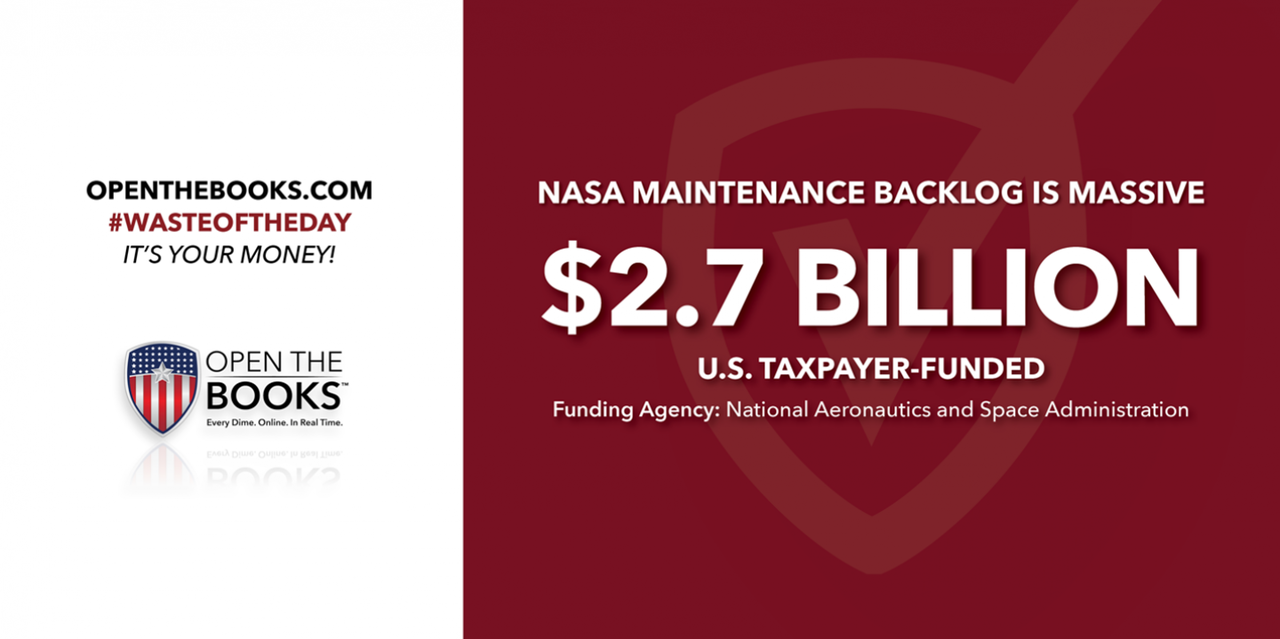
While the National Aeronautics and Space Administration manages $40 billion in facility assets, more than 75 percent of it is beyond its design life and NASA faces a deferred maintenance backlog of $2.7 billion as of 2020, according to a recent report on cost overruns from NASA Office of Inspector General.

The IG reviewed 20 construction projects and found that six had “significant cost overruns” and 16 took or will take longer to complete than initially planned.

It looked at six projects at Glenn Research Center, Kennedy Space Center and Langley Research Center “that were significantly over budget as of June 2021.”

Cost increases ranged from $2.2 million for upgrades at Glenn to $36.6 million for repairs and modifications at Kennedy, the report found.

The increased costs for two of the projects were attributed to changing requirements, while contract prices for four others were either higher than originally estimated or resulted from disagreements between NASA and the contractor, the IG report found.

NASA didn’t provide effective oversight to determine whether the projects met cost, schedule and performance goals, the report found.

second NASA IG report estimated that delays from the Covid-19 pandemic cost nearly $3 billion.

Pandemic delays aside, NASA’s cost overruns can’t be accepted as the norm when private industry is passing up our taxpayer-funded space program almost daily.

*  *  *

The #WasteOfTheDay is presented by the forensic auditors at OpenTheBooks.com.

Tyler Durden
Wed, 10/27/2021 – 18:10

via ZeroHedge News https://ift.tt/312cq3v Tyler Durden

China Urges US To Immediately Lift Sanctions On Taliban As “Economic Chaos” Looms

China Urges US To Immediately Lift Sanctions On Taliban As “Economic Chaos” Looms

China is now urging the United States to immediately lift sanctions against the Taliban and unfreeze all of Afghanistan’s assets abroad. As part of its appeal, Beijing is offering assurances to Washington that the hardline Islamist group will “effectively” protect the rights of women and minorities. 

Beijing is further warning the West of looming “economic chaos” in the war-torn central Asian country if more is not urgently done to relieve the economic pressure and allow for greater stability. “China urges the Western countries, led by the United States as a whole, to lift sanctions, and calls on all parties to engage with the Afghan Taliban in a rational and pragmatic manner,” Chinese Foreign Minister Wang Yi said this week following two days of talks with the Taliban which concluded Tuesday in Doha. 

Via China state media

“China hopes that the Taliban can further demonstrate openness and inclusiveness, unite all ethnic groups and factions in Afghanistan to work together for peaceful reconstruction,” Wang added. “[The Taliban] should effectively protect the rights and interests of women and children … and build a modern country that conforms to the wishes of the people and the trend of the times,” the top Chinese diplomat added.

He further explained that Afghanistan could be put on the path of “sound” development but only if there’s international support for “the humanitarian crisis, economic chaos, terrorist threats and governance difficulties.” Since early September, China has already pledged multiple tens of millions of dollars in humanitarian aid to Taliban-controlled Afghanistan, while hailing the “end of anarchy” in the country.

It must be recalled that this past summer as the US military was initiating its withdrawal after two decades of war and occupation, the very first foreign country to host Taliban leadership for “recognition” talks was China. It’s also since been made clear that China is eyeing major investment and infrastructure projects in Afghanistan as part of Xi’s long-running Belt and Road Initiative (BRI) across Asia. 

China is especially said to be eyeing Afghanistan’s untapped rare earth mineral deposits…

There have even been rumors and rampant speculation of Chinese troops moving in to the abandoned Bagram Airbase, or other former US military facilities; however, these reports have not been confirmed, and are denied by Beijing officials. 

Meanwhile, Chinese state media from the start of the US evacuation fiasco in Kabul – which tragically resulted in dozens of deaths, including US troops and Afghan civilians – has routinely mocked the major blow to American military might and capabilities, calling it a humiliating retreat.

Tyler Durden
Wed, 10/27/2021 – 17:50

via ZeroHedge News https://ift.tt/3bjDGfL Tyler Durden

“Is He a Criminal Lawyer? Yes, Very”

From the Plea Agreement filed last week in U.S. v. Elstein (C.D. Cal.):

Beginning in or around September 2014, MATTHEW CHARLES ELSTEIN (“defendant”) engaged in a scheme to defraud defendant’s legal clients by claiming that he filed, on the client’s behalf, complaints, motions and other pleadings in court when, in fact, defendant knew no such complaints, motions and pleadings had been filed.

Defendant also claimed he had obtained favorable legal resolutions for his clients when, in fact, defendant had not obtained favorable resolutions and, in many cases, had never initiated a legal action….

Victims S.F., C.S.S., and Company A

In or around June 2015, Company A retained defendant to file a lawsuit against Company B regarding a contract dispute. S.F. and C.S.S. were the principals of Company A….

[D]efendant agreed to pursue Company A’s … substantive claims against Company B by filing a federal action on their behalf in the Northern District of California. Defendant, however, never filed such a lawsuit. Instead, he misled Company A into believing he had filed such a case, and billed Company A for work he did not perform.

On July 6, 2015, defendant emailed Company A falsely stating that he filed the case against Company B in the Northern District … prior to the Fourth of July holiday. Defendant communicated several lies to Company A about why the Northern District Case could not be found on Pacer, including that the case was under seal because the United States Department of Justice … was investigating the owner of Company B.

From then on, defendant continued to make false representations to induce payment from Company A regarding the fake Northern District case. For example, on October 10, 2015, defendant told Company A that he had filed a Second Amended Complaint in the Northern District Case. In an attempt to cover for his misrepresentation, on March 16, 2018, defendant emailed C.S.S. a fraudulent second amended complaint with a ficti[ti]ous case number and forged Pacer information.

On December 22, 2015 and March 10, 2016, defendant requested a total of $6,700 for “process server costs and document costs” related to a motion for summary judgment as well as “filing and copying expenses” in the Northern District Case. On June 7, 2016, defendant, for the purpose of executing his scheme to defraud, transmitted and caused the transmission of a wire communication in interstate and foreign commerce, namely, defendant used his email account … to instruct C.S.S. to wire $3,500 to defendant for “deposition related expenses.” Since the Northern District Case was fabricated by defendant, there was no motion for summary judgment, defendant did not incur filing and copying expenses, and there were no depositions or deposition related expenses. Based on defendant’s representations, however, Company A wired the money to defendant’s personal bank account.

In addition, defendant charged Company A for travel related to other clients/matters and had S.F. and C.S.S. travel to depositions that defendant had fabricated to carry out his scheme.

During the course of the fraudulent scheme, defendant communicated to Company A that the defendants in the Northern District Case defaulted on the suit against them and that Company A had won a $52 million judgment. According to defendant, Company A had to wait for the case to be unsealed for the judgment to be released.

On June 17, 2016, defendant emailed Company A a forged court order purportedly signed by the Honorable Richard Seeborg, United States District Court Judge for the Northern District of California. The order was titled, “Order Re: Hearing on Plaintiff’s Motion for Entry of Judgment Against All Defendants.” The fake order noted that it was “sealed” and contained a false case name, docket number, and Pacer markings. The order stated that, “given the complexity of the claims for relief asserted by Plaintiffs, the number of parties, and what appear to be overlapping claims of damages, the Court is required to ‘conduct an accounting’ and make specific factual findings in support of the judgment.” The order went on to order Plaintiffs to file “a detailed accounting of all damages” by July 1, 2016.

On October 3, 2016, defendant emailed Company A a second falsified court order titled, “Interim Partial Judgment.” Again, the order purported to be signed by Judge Seeborg, noted that it was “sealed,” and contained a fake case number and false Pacer markings. The order stated that the “Plaintiff shall take judgement against all Defendants, jointly and severally, in the amount of $2.5 million ($2,500,000).”

Because defendant’s scheme involved the Northern District Case being improperly under seal due to DOJ’s supposed investigation of the owner of Company B, defendant informed Company A that it could collect money controlled by DOJ. On August 22, 2017, defendant emailed Company A two forged documents: (1) a “Process Receipt and Return” form with the United States Marshals Service (“USMS”), which defendant claimed to be necessary as part of the process to collect on the “Interim Judgment/Enforcement of Temporary Restraining Order”; and (2) a “Record of Collections” from the USMS demonstrating the USMS had collected $638,884.17 from parties in the Northern District Case.

On September 21, 2017, defendant sent Company A a fake settlement agreement between Company A and the United States Attorney’s Office for the Eastern District of California (the “U.S. Attorney’s Office”), with the forged signatures of the then Interim United States Attorney for the Eastern District of California and the then Acting Assistant Attorney General of DOJ’s Criminal Division. Under the agreement, the government agreed (1) it would not object to the unsealing of the Northern District Case; (2) pay Company A $4 million from the “Court of Claims Recovery Fund” in settlement of all claims and potential claims by Company A; (3) cease all action which may interfere with Company A’s prosecution and collection of sum in the interpleader case and the Northern District Case; and (4) disgorge all sums held by the USMS (no less than $630,000) collected as part of the sealed judgment in the Northern District Case.

Defendant continued to charge Company A for his fraudulent efforts to obtain the funds from the government. In November 2017, defendant charged Company A to prepare and file a Supreme Court petition. On December 28, 2017, defendant purported to follow up by sending a demand letter requesting the government unseal the case and pay his clients the amount due.

In January 2018, Company A reached out to the U.S. Attorney’s Office to authenticate the settlement agreement and discovered that the agreement was a forgery.

Throughout the course of defendant’s misrepresentations, Company A paid $234,000 in fraudulently procured legal fees and expenses.

Victims I.F. and J.F.

In or around 2012, a law firm, Firm A, filed two lawsuits in the state of Washington (the “Washington Lawsuits”) against I.F., J.F., and two of their companies that provide debt settlement services (the “Debt Settlement Companies”). I.F., J.F., and the Debt Settlement Companies later hired defendant to substitute into the actions. During defendant’s representation of I.F., J.F., and the Debt Settlement Companies, defendant communicated with them using wire communications, namely, phone calls and email.

On September 30, 2014, defendant sent a retainer agreement to I.F. noting that he had been formally retained by I.F., J.F., and the Debt Settlement Companies to represent them in the Washington Lawsuits. The agreement noted that I.F. needed to pay an advance of $10,000. Defendant provided I.F. with the information for defendant’s personal bank account, but falsely represented that it was the trust account for his law firm.

In 2015, Defendant told I.F. that he would file a federal case against Firm A in the Western District of Washington. On April 13, 2015, defendant prepared a purported application to appear pro hac vice in United States District Court for the Western District of Washington. The caption contained the fake case name for the lawsuit that defendant represented to I.F. he would file, but never did. On April 23, 2015, defendant sent a revised retainer agreement to I.F., which they both signed.

This revised retainer agreement specifically listed the fake federal case … along with the Washington Lawsuits as the basis for the representation. It added that defendant’s representation in the Washington Federal Case would not begin until I.F. paid a “further advance in the amount of $3,500 … deposited in [defendant’s law firm] Client Trust Account[.],” which was actually defendant’s personal bank account.

On May 15, 2015, defendant represented to I.F. that defendant filed a 24-page, 10-count complaint in the Washington Federal Case. He later provided I.F. with a fraudulent face page and the second page of the complaint. The document looked like it had been filed, but, in actuality, contained fake Pacer markings with a fraudulent case number.

Defendant also fabricated depositions in the Washington Federal Case. Specifically, he told I.F. that he noticed two depositions on September 21, 2015 and a third deposition on September 22, 2015 in Seattle, Washington. I.F. and J.F traveled to Seattle for the depositions. Because these depositions were fake, no one appeared for the deposition. Nonetheless, defendant had a court reporter present and made a formal record of the nonappearances. Defendant also billed I.F. for attending the fake depositions and his travel expenses.

When defendant changed law firms in approximately November 2015, he represented to I.F. that he was working on the Federal Case and continued to bill I.F. for work he was not doing.

On or about March 2016, defendant represented to I.F. that the defendants in the Washington Federal Case were in default of their discovery obligations and that the court ultimately would enter a default judgment. Defendant’s billing entries during that time demonstrate that he was billing I.F. for work on motions for default and sanctions, when, in fact, he was not working on those motions.

On June 12, 2016, when I.F. questioned why there was an issue in locating the Washington Federal Case on Pacer, defendant emailed I.F. to tell him that (1) the case had been docketed by the district court in May 2015; (2) he had no information as to why it did not appear on Pacer; (3) the complaint was filed and contained an electronic watermark; (4) “I have done everything you instructed and as I represented”; and (5) that he would call the court the next day and speak directly to the ECF docketing clerk.

On August 8, 2016, defendant forwarded to I.F. a fake email communication between defendant and a person he claimed to be a clerk at the United States District Court for the Western District of Washington. The subject contained the fake case name and number for the Washington Federal Case. The email had a fake name and email address for the clerk. In the fake email, the clerk said that the “Court intends to grant the requests for entry of default without the need for a hearing[.]”

While defendant was misleading I.F. and the Debt Settlement Companies about the existence of the Washington Federal Case, he also misrepresented to his law firm that he was withdrawing from representation in the Washington Lawsuits. In November of 2016, defendant provided his law firm with fake emails to I.F., J.F. and the Debt Settlement Companies. In the emails, defendant noted defendant’s intent to withdraw from the Washington Lawsuits and demanded that they pay outstanding court reporter fees. The emails, however, were sent to fake email addresses created by defendant. Defendant also provided his law firm with a fraudulent substitution of attorney form, purportedly filed and signed by I.F. However, I.F. had never seen the document.

By March of 2017, defendant had begun working at his third law firm since agreeing to represent I.F., J.F. and the Debt Settlement Companies.

Defendant continued to bill I.F. for work he was not actually doing on the fake Washington Federal Case well into October of 2017. On October 12, 2017, defendant emailed I.F. to inform him that the final briefing for the judgment in the Washington Federal Case was due on October 20, 2017.

In January 2018, defendant falsely represented to I.F. that he had obtained a $4,250,000 judgment in favor of I.F. and the Debt Settlement Companies in the Washington Federal Case.

Around July 2018, I.F. wanted to personally travel to Seattle to collect on this judgment. In advance of that trip, defendant handed I.F. a copy of what defendant represented to be the judgment in the Washington Federal Case. The fraudulent order contained a forged electronic signature of the Honorable James

  1. Robart of the United States District Court, Western District of Washington.

On July 11, 2018, I.F. traveled to the district court to collect his judgment. On that day, I.F. realized defendant’s deceit. The clerk could not find the case number. A Senior Inspector from the USMS’s office confirmed it looked suspicious and then checked with Judge Robart who confirmed that he had never heard of the Federal Case.

Throughout the course of defendant’s misrepresentations, I.F. paid $20,354.30 in fraudulent retainer and legal fees directly into defendant’s personal bank account.

Victim Company D

Company D consists of three insurance companies. In or around December 2015, Company E sued Company D in United States District Court for the Southern District of California. Shortly thereafter, Company D retained defendant to represent it. During defendant’s representation of Company D, defendant communicated with Company D’s representatives using wire communications, namely, phone calls and email.

During a call on December 17, 2015, with representatives of Company D, defendant discussed with representatives of Company D drafting a motion to dismiss. Defendant subsequently misled Company D about the deadline for filing the motion, his filing of the motion, and the events that were transpiring in the case.

On May 26, 2016, defendant lied to Company D in an email, conveying that the court clerk wanted to have oral argument on the motion to dismiss and that the court set a filing deadline of June 3, 2016 and a hearing date of July 11, 2016. Defendant added that he would draft the motion over the Memorial Day weekend.

Between June 2016 and August 2016, defendant and Company D exchanged numerous emails in which defendant claimed that the judge continued to move the filing deadline and the hearing date for the motion to dismiss. By email on August 16, 2016, defendant represented that the motion would be filed by the new deadline of August 18, 2016, and that plaintiffs in the case would be served personally. Later that day, defendant sent a draft of the motion to Company D. The draft was approved with changes and sent to defendant. Defendant told Company D that he would file it “ASAP.” Defendant never did. Billing records demonstrate that defendant claimed to have worked on the motion to dismiss that was never filed between June 2016 and August 2016.

On February 28, 2017, a representative of Company D emailed defendant to ask if the motion to dismiss was filed in August. Defendant responded that the court had converted the motion to dismiss into a motion for summary judgment. Meanwhile, in emails on February 28, 2017 and March 1, 2017, defendant represented to a different Company D employee that he was working on a draft motion for summary judgment.

In reality, the court was not continuously moving the motion deadline, considering a motion to dismiss, or continuing the hearing on the motion. The court never converted a motion to dismiss into a motion for summary judgment. Instead, defendant missed discovery deadlines, failed to timely designate an expert on behalf of Company D, and never filed a motion to dismiss.

On November 22, 2016, Company E filed its motion for summary judgment. Defendant never told Company D about the filing. Instead, in order to have Company E agree to an extension on Company D’s opposition in order to accommodate defendant’s vacation in France, defendant agreed that Company D would not file a cross motion. Defendant then entered into settlement negotiations with Company E for $275,000, without receiving prior authorization from Company D to do so. Defendant billed Company D a total of $104,500.50 throughout defendant’s representation of Company D.

In total, defendant’s fraudulent conduct resulted in losses of at least $358,855 by his victims.


from Latest – Reason.com https://ift.tt/3jGDwDK
via IFTTT

“Is He a Criminal Lawyer? Yes, Very”

From the Plea Agreement filed last week in U.S. v. Elstein (C.D. Cal.):

Beginning in or around September 2014, MATTHEW CHARLES ELSTEIN (“defendant”) engaged in a scheme to defraud defendant’s legal clients by claiming that he filed, on the client’s behalf, complaints, motions and other pleadings in court when, in fact, defendant knew no such complaints, motions and pleadings had been filed.

Defendant also claimed he had obtained favorable legal resolutions for his clients when, in fact, defendant had not obtained favorable resolutions and, in many cases, had never initiated a legal action….

Victims S.F., C.S.S., and Company A

In or around June 2015, Company A retained defendant to file a lawsuit against Company B regarding a contract dispute. S.F. and C.S.S. were the principals of Company A….

[D]efendant agreed to pursue Company A’s … substantive claims against Company B by filing a federal action on their behalf in the Northern District of California. Defendant, however, never filed such a lawsuit. Instead, he misled Company A into believing he had filed such a case, and billed Company A for work he did not perform.

On July 6, 2015, defendant emailed Company A falsely stating that he filed the case against Company B in the Northern District … prior to the Fourth of July holiday. Defendant communicated several lies to Company A about why the Northern District Case could not be found on Pacer, including that the case was under seal because the United States Department of Justice … was investigating the owner of Company B.

From then on, defendant continued to make false representations to induce payment from Company A regarding the fake Northern District case. For example, on October 10, 2015, defendant told Company A that he had filed a Second Amended Complaint in the Northern District Case. In an attempt to cover for his misrepresentation, on March 16, 2018, defendant emailed C.S.S. a fraudulent second amended complaint with a ficti[ti]ous case number and forged Pacer information.

On December 22, 2015 and March 10, 2016, defendant requested a total of $6,700 for “process server costs and document costs” related to a motion for summary judgment as well as “filing and copying expenses” in the Northern District Case. On June 7, 2016, defendant, for the purpose of executing his scheme to defraud, transmitted and caused the transmission of a wire communication in interstate and foreign commerce, namely, defendant used his email account … to instruct C.S.S. to wire $3,500 to defendant for “deposition related expenses.” Since the Northern District Case was fabricated by defendant, there was no motion for summary judgment, defendant did not incur filing and copying expenses, and there were no depositions or deposition related expenses. Based on defendant’s representations, however, Company A wired the money to defendant’s personal bank account.

In addition, defendant charged Company A for travel related to other clients/matters and had S.F. and C.S.S. travel to depositions that defendant had fabricated to carry out his scheme.

During the course of the fraudulent scheme, defendant communicated to Company A that the defendants in the Northern District Case defaulted on the suit against them and that Company A had won a $52 million judgment. According to defendant, Company A had to wait for the case to be unsealed for the judgment to be released.

On June 17, 2016, defendant emailed Company A a forged court order purportedly signed by the Honorable Richard Seeborg, United States District Court Judge for the Northern District of California. The order was titled, “Order Re: Hearing on Plaintiff’s Motion for Entry of Judgment Against All Defendants.” The fake order noted that it was “sealed” and contained a false case name, docket number, and Pacer markings. The order stated that, “given the complexity of the claims for relief asserted by Plaintiffs, the number of parties, and what appear to be overlapping claims of damages, the Court is required to ‘conduct an accounting’ and make specific factual findings in support of the judgment.” The order went on to order Plaintiffs to file “a detailed accounting of all damages” by July 1, 2016.

On October 3, 2016, defendant emailed Company A a second falsified court order titled, “Interim Partial Judgment.” Again, the order purported to be signed by Judge Seeborg, noted that it was “sealed,” and contained a fake case number and false Pacer markings. The order stated that the “Plaintiff shall take judgement against all Defendants, jointly and severally, in the amount of $2.5 million ($2,500,000).”

Because defendant’s scheme involved the Northern District Case being improperly under seal due to DOJ’s supposed investigation of the owner of Company B, defendant informed Company A that it could collect money controlled by DOJ. On August 22, 2017, defendant emailed Company A two forged documents: (1) a “Process Receipt and Return” form with the United States Marshals Service (“USMS”), which defendant claimed to be necessary as part of the process to collect on the “Interim Judgment/Enforcement of Temporary Restraining Order”; and (2) a “Record of Collections” from the USMS demonstrating the USMS had collected $638,884.17 from parties in the Northern District Case.

On September 21, 2017, defendant sent Company A a fake settlement agreement between Company A and the United States Attorney’s Office for the Eastern District of California (the “U.S. Attorney’s Office”), with the forged signatures of the then Interim United States Attorney for the Eastern District of California and the then Acting Assistant Attorney General of DOJ’s Criminal Division. Under the agreement, the government agreed (1) it would not object to the unsealing of the Northern District Case; (2) pay Company A $4 million from the “Court of Claims Recovery Fund” in settlement of all claims and potential claims by Company A; (3) cease all action which may interfere with Company A’s prosecution and collection of sum in the interpleader case and the Northern District Case; and (4) disgorge all sums held by the USMS (no less than $630,000) collected as part of the sealed judgment in the Northern District Case.

Defendant continued to charge Company A for his fraudulent efforts to obtain the funds from the government. In November 2017, defendant charged Company A to prepare and file a Supreme Court petition. On December 28, 2017, defendant purported to follow up by sending a demand letter requesting the government unseal the case and pay his clients the amount due.

In January 2018, Company A reached out to the U.S. Attorney’s Office to authenticate the settlement agreement and discovered that the agreement was a forgery.

Throughout the course of defendant’s misrepresentations, Company A paid $234,000 in fraudulently procured legal fees and expenses.

Victims I.F. and J.F.

In or around 2012, a law firm, Firm A, filed two lawsuits in the state of Washington (the “Washington Lawsuits”) against I.F., J.F., and two of their companies that provide debt settlement services (the “Debt Settlement Companies”). I.F., J.F., and the Debt Settlement Companies later hired defendant to substitute into the actions. During defendant’s representation of I.F., J.F., and the Debt Settlement Companies, defendant communicated with them using wire communications, namely, phone calls and email.

On September 30, 2014, defendant sent a retainer agreement to I.F. noting that he had been formally retained by I.F., J.F., and the Debt Settlement Companies to represent them in the Washington Lawsuits. The agreement noted that I.F. needed to pay an advance of $10,000. Defendant provided I.F. with the information for defendant’s personal bank account, but falsely represented that it was the trust account for his law firm.

In 2015, Defendant told I.F. that he would file a federal case against Firm A in the Western District of Washington. On April 13, 2015, defendant prepared a purported application to appear pro hac vice in United States District Court for the Western District of Washington. The caption contained the fake case name for the lawsuit that defendant represented to I.F. he would file, but never did. On April 23, 2015, defendant sent a revised retainer agreement to I.F., which they both signed.

This revised retainer agreement specifically listed the fake federal case … along with the Washington Lawsuits as the basis for the representation. It added that defendant’s representation in the Washington Federal Case would not begin until I.F. paid a “further advance in the amount of $3,500 … deposited in [defendant’s law firm] Client Trust Account[.],” which was actually defendant’s personal bank account.

On May 15, 2015, defendant represented to I.F. that defendant filed a 24-page, 10-count complaint in the Washington Federal Case. He later provided I.F. with a fraudulent face page and the second page of the complaint. The document looked like it had been filed, but, in actuality, contained fake Pacer markings with a fraudulent case number.

Defendant also fabricated depositions in the Washington Federal Case. Specifically, he told I.F. that he noticed two depositions on September 21, 2015 and a third deposition on September 22, 2015 in Seattle, Washington. I.F. and J.F traveled to Seattle for the depositions. Because these depositions were fake, no one appeared for the deposition. Nonetheless, defendant had a court reporter present and made a formal record of the nonappearances. Defendant also billed I.F. for attending the fake depositions and his travel expenses.

When defendant changed law firms in approximately November 2015, he represented to I.F. that he was working on the Federal Case and continued to bill I.F. for work he was not doing.

On or about March 2016, defendant represented to I.F. that the defendants in the Washington Federal Case were in default of their discovery obligations and that the court ultimately would enter a default judgment. Defendant’s billing entries during that time demonstrate that he was billing I.F. for work on motions for default and sanctions, when, in fact, he was not working on those motions.

On June 12, 2016, when I.F. questioned why there was an issue in locating the Washington Federal Case on Pacer, defendant emailed I.F. to tell him that (1) the case had been docketed by the district court in May 2015; (2) he had no information as to why it did not appear on Pacer; (3) the complaint was filed and contained an electronic watermark; (4) “I have done everything you instructed and as I represented”; and (5) that he would call the court the next day and speak directly to the ECF docketing clerk.

On August 8, 2016, defendant forwarded to I.F. a fake email communication between defendant and a person he claimed to be a clerk at the United States District Court for the Western District of Washington. The subject contained the fake case name and number for the Washington Federal Case. The email had a fake name and email address for the clerk. In the fake email, the clerk said that the “Court intends to grant the requests for entry of default without the need for a hearing[.]”

While defendant was misleading I.F. and the Debt Settlement Companies about the existence of the Washington Federal Case, he also misrepresented to his law firm that he was withdrawing from representation in the Washington Lawsuits. In November of 2016, defendant provided his law firm with fake emails to I.F., J.F. and the Debt Settlement Companies. In the emails, defendant noted defendant’s intent to withdraw from the Washington Lawsuits and demanded that they pay outstanding court reporter fees. The emails, however, were sent to fake email addresses created by defendant. Defendant also provided his law firm with a fraudulent substitution of attorney form, purportedly filed and signed by I.F. However, I.F. had never seen the document.

By March of 2017, defendant had begun working at his third law firm since agreeing to represent I.F., J.F. and the Debt Settlement Companies.

Defendant continued to bill I.F. for work he was not actually doing on the fake Washington Federal Case well into October of 2017. On October 12, 2017, defendant emailed I.F. to inform him that the final briefing for the judgment in the Washington Federal Case was due on October 20, 2017.

In January 2018, defendant falsely represented to I.F. that he had obtained a $4,250,000 judgment in favor of I.F. and the Debt Settlement Companies in the Washington Federal Case.

Around July 2018, I.F. wanted to personally travel to Seattle to collect on this judgment. In advance of that trip, defendant handed I.F. a copy of what defendant represented to be the judgment in the Washington Federal Case. The fraudulent order contained a forged electronic signature of the Honorable James

  1. Robart of the United States District Court, Western District of Washington.

On July 11, 2018, I.F. traveled to the district court to collect his judgment. On that day, I.F. realized defendant’s deceit. The clerk could not find the case number. A Senior Inspector from the USMS’s office confirmed it looked suspicious and then checked with Judge Robart who confirmed that he had never heard of the Federal Case.

Throughout the course of defendant’s misrepresentations, I.F. paid $20,354.30 in fraudulent retainer and legal fees directly into defendant’s personal bank account.

Victim Company D

Company D consists of three insurance companies. In or around December 2015, Company E sued Company D in United States District Court for the Southern District of California. Shortly thereafter, Company D retained defendant to represent it. During defendant’s representation of Company D, defendant communicated with Company D’s representatives using wire communications, namely, phone calls and email.

During a call on December 17, 2015, with representatives of Company D, defendant discussed with representatives of Company D drafting a motion to dismiss. Defendant subsequently misled Company D about the deadline for filing the motion, his filing of the motion, and the events that were transpiring in the case.

On May 26, 2016, defendant lied to Company D in an email, conveying that the court clerk wanted to have oral argument on the motion to dismiss and that the court set a filing deadline of June 3, 2016 and a hearing date of July 11, 2016. Defendant added that he would draft the motion over the Memorial Day weekend.

Between June 2016 and August 2016, defendant and Company D exchanged numerous emails in which defendant claimed that the judge continued to move the filing deadline and the hearing date for the motion to dismiss. By email on August 16, 2016, defendant represented that the motion would be filed by the new deadline of August 18, 2016, and that plaintiffs in the case would be served personally. Later that day, defendant sent a draft of the motion to Company D. The draft was approved with changes and sent to defendant. Defendant told Company D that he would file it “ASAP.” Defendant never did. Billing records demonstrate that defendant claimed to have worked on the motion to dismiss that was never filed between June 2016 and August 2016.

On February 28, 2017, a representative of Company D emailed defendant to ask if the motion to dismiss was filed in August. Defendant responded that the court had converted the motion to dismiss into a motion for summary judgment. Meanwhile, in emails on February 28, 2017 and March 1, 2017, defendant represented to a different Company D employee that he was working on a draft motion for summary judgment.

In reality, the court was not continuously moving the motion deadline, considering a motion to dismiss, or continuing the hearing on the motion. The court never converted a motion to dismiss into a motion for summary judgment. Instead, defendant missed discovery deadlines, failed to timely designate an expert on behalf of Company D, and never filed a motion to dismiss.

On November 22, 2016, Company E filed its motion for summary judgment. Defendant never told Company D about the filing. Instead, in order to have Company E agree to an extension on Company D’s opposition in order to accommodate defendant’s vacation in France, defendant agreed that Company D would not file a cross motion. Defendant then entered into settlement negotiations with Company E for $275,000, without receiving prior authorization from Company D to do so. Defendant billed Company D a total of $104,500.50 throughout defendant’s representation of Company D.

In total, defendant’s fraudulent conduct resulted in losses of at least $358,855 by his victims.


from Latest – Reason.com https://ift.tt/3jGDwDK
via IFTTT

A Study of What Police Know About Court Decisions Exposes ‘Qualified Immunity’s Boldest Lie’


Supreme-Court-building-Joe-Ravi-Wikimedia

In two cases it decided last fall and last winter, the U.S. Supreme Court suggested that it might be prepared to limit the scope of qualified immunity, a doctrine that shields police officers and other government officials from federal liability for violating people’s constitutional rights unless the alleged misconduct ran afoul of “clearly established” law. In two decisions issued last week, by contrast, the Court complicated the puzzle of how plaintiffs can hope to satisfy that test.

The Court reaffirmed its prior statement that qualified immunity protects “all but the plainly incompetent or those who knowingly violate the law”—a standard that excludes all manner of outrageous abuses. Worse, the justices twice suggested, in a decision from which none of them dissented, that lawsuits under 42 USC 1983, which allows people to seek damages for violations of their rights, may be barred even when the appeals court for the circuit in which a case is filed has previously concluded that conduct very similar to the defendant’s was unconstitutional.

“Even assuming that controlling Circuit precedent clearly establishes law for purposes of §1983,” the Court said in Rivas-Villegas v. Cortesluna, the 9th Circuit decision cited by the plaintiff “did not give fair notice” to the officer he sued. “Even assuming that Circuit precedent can clearly establish law for purposes of §1983,” the Court reiterated later in the same opinion, the earlier case “is materially distinguishable and thus does not govern the facts of this case.” Those opening clauses imply that “fair notice” might require a decision in which the Supreme Court itself addressed nearly identical facts, which would make an already formidable obstacle nearly impossible to overcome.

Whether or not the Court follows through on that alarming implication, the very notion of “fair notice” to police officers is based on what UCLA law professor Joanna Schwartz calls “qualified immunity’s boldest lie”: the assumption that cops keep abreast of relevant case law, such that they would know when their actions closely resemble conduct that was previously deemed unconstitutional. Schwartz’s research, which she reported last May in The University of Chicago Law Review, documents a yawning gap between that implausible assumption and the reality of how cops are actually trained.

“Nowhere in the Court’s decisions is consideration given to how, exactly, police officers are expected to learn about the facts and holdings of the hundreds—if not thousands—of Supreme Court, circuit court, and district court opinions that could be used to clearly establish the law for qualified immunity purposes,” Schwartz notes. “Nor has much consideration been given to the likelihood that police officers recall the facts and holdings of these hundreds or thousands of cases as they are making split-second decisions about whether to stop and frisk someone, search a car, or shoot their gun.”

Schwartz examined “hundreds of use-of-force policies, trainings, and other educational materials received by California law enforcement officers.” She found that the information in these materials was generally limited to the broad principles laid out in major Supreme Court rulings—principles that the Court has said are not sufficient to show that an officer’s alleged conduct violated “clearly established” law.

In the 1985 case Tennessee v. Garner, for example, the Court held that police may use deadly force against a fleeing suspect only if it is necessary to prevent his escape and there is probable cause to believe he poses a significant threat of violence to officers or the general public. In the 1989 case Graham v. Connor, the Court said the use of force by police must be “objectively reasonable,” a determination that “requires careful attention to the facts and circumstances of each particular case, including the severity of the crime at issue, whether the suspect poses an immediate threat to the safety of the officers or others, and whether he is actively resisting arrest or attempting to evade arrest by flight.”

While “police departments regularly inform their officers about watershed decisions like Graham and Garner,” Schwartz found,officers are not regularly or reliably informed about court decisions interpreting those decisions in different factual scenarios—the very types of decisions that are necessary to clearly establish the law about the constitutionality of uses of force.” That conclusion is based partly on Schwartz’s examination of California police department policy manuals, which “reference or incorporate the constitutional standards from Graham and Garner,
but rarely reference any cases in which Graham and Garner were applied.”

Schwartz also read 329 police “training outlines” and found that more than three-quarters “referenced no court decision applying Graham and/or Garner.” Even when such decisions were mentioned, “the outlines suggest that trainers do not educate officers about their facts and holdings.” And while police training does “incorporate hypotheticals as a way to help officers develop an understanding about whether force is appropriate in various scenarios,” the outlines “offer no indication that these scenarios are drawn from court cases.” Schwartz found little evidence that prosecutors or newsletters were filling this gap in police knowledge.

“Even if law enforcement relied more heavily on court decisions to educate their officers about the constitutional limits of force, the expectations of notice and reliance baked into qualified immunity doctrine would still be unrealistic,” Schwartz writes. “There could never be sufficient time to train officers about the hundreds—
if not thousands—of court cases that could clearly establish the law for qualified immunity purposes. Moreover, even if an officer did somehow come to learn about the facts and holdings of court decisions applying Graham and Garner, there is no reason to believe that an officer would think about those cases during the types of high-speed, high-stress interactions that often lead to uses of force.”

Given this reality, Schwartz says, it “makes no sense to require plaintiffs to plumb the depths of Westlaw for factually similar lower court decisions as proof that officers were on notice of the unconstitutionality of their conduct.” Because that requirement is based on a plainly erroneous premise, she says, it “does not advance the stated goals of qualified immunity.”

If police cannot reasonably be expected to absorb the information that the Supreme Court has said is necessary for “fair notice,” defenders of qualified immunity might conclude, maybe they need even more protection from liability. But if this kind of detailed knowledge really is necessary to prevent officers from violating people’s rights, shouldn’t the police departments that routinely fail to impart it be liable for the resulting abuses? And if their current approach is sound, what does that say about the Court’s insistence on highly specific precedents as a condition for suing police under 42 USC 1983?

Without qualified immunity, courts would be free to decide whether an officer’s conduct violated the principles established by cases like Graham and Garner, even if no one had previously been held to account for doing exactly the same thing. That approach would not result in ruinous personal liability for police officers, because (as Schwartz also has shown) cops are routinely indemnified even when they lose civil rights cases. But letting such cases proceed would improve accountability, allow victims of police abuse to seek compensation, and help clarify constitutional issues that currently go unresolved.

“Because courts can grant officers qualified immunity simply because plaintiffs cannot find a prior similar case, qualified immunity can deny relief to plaintiffs whose constitutional rights have been violated and can shield officers from liability even when they have behaved maliciously or recklessly,” Schwartz notes. She concludes that courts should stop “sending the message to officers that they can ‘shoot first and think later’ and sending the message to people that their rights do not matter.”

from Latest – Reason.com https://ift.tt/3mlIfwx
via IFTTT

Taiwan Is A ‘Number One Issue’ For The CIA’s New China Center

Taiwan Is A ‘Number One Issue’ For The CIA’s New China Center

Authored by Dave DeCamp via AntiWar.com, 

Now that the CIA has established a new mission that will exclusively focus on China, CIA Deputy Director David Cohen said that Taiwan will be one of the “number-one issues” for the new spy center.

“There’s a series of number-one issues with China,” Cohen said at an intelligence conference on Sunday. “Taiwan is definitely one of the number one issues with China we are focused on.”

Cohen’s comments came after President Biden said the US has a “commitment” to defend Taiwan in the event of a Chinese invasion. Although US officials were quick to clarify that Biden’s statement was not a change in policy, hawks in Congress are ready to give the president war powers to fight China over Taiwan.

Biden’s comments came against the backdrop of media hysteria over Chinese flights in Taiwan’s air defense identification zone (ADIZ). The ADIZ concept is not covered by any international laws or treaties, and the Chinese warplanes usually enter the southwest corner of the ADIZ, nowhere near the island of Taiwan. But some Western media outlets falsely portrayed these flights as violations of Taiwan’s airspace.

The hype over the ADIZ flights has filled Western media with articles predicting an imminent Chinese invasion of Taiwan.

Cohen said that the CIA’s job is to find out how Chinese President Xi Jinping is “thinking about Taiwan” and to provide policy makers in Washington with “indicators” of a potential invasion.

When announcing the new spy center, CIA Director William Burns called China the “most important geopolitical threat” facing the US. In response to the announcement, China’s ambassador to the US said Washington should drop its “James Bond” theatrics and work towards better relations with Beijing.

Tyler Durden
Wed, 10/27/2021 – 17:30

via ZeroHedge News https://ift.tt/3mlKShT Tyler Durden