Fentanyl Flowing Into United States At Record Volume

Fentanyl Flowing Into United States At Record Volume

Authored by Charlotte Cuthbertson via The Epoch Times,

The amount of fentanyl seized while coming through the southern border during the first 5 months of fiscal year 2021 is already higher than all of fiscal year 2020, according to the latest statistics from Customs and Border Protection (CBP).

CBP has seized more than 5,000 pounds of fentanyl since Oct. 1, 2020, said acting CBP Commissioner Troy Miller during a March 10 media call.

“We are seeing a dramatic increase in fentanyl seizures this fiscal year, more than 360 percent higher than this time last year,” Miller said.

“Nationwide drug seizures increased 50 percent in February from January. Cocaine interceptions increased 13 percent, seizures of methamphetamine increased 40 percent, seizures of heroin went up 48 percent.”

Fentanyl is the synthetic opioid attributed to the escalating overdose death rate in the United States. It is most often manufactured in Mexico using chemicals supplied by China. It’s mixed with other narcotics to increase potency as well as pressed into counterfeit pain pills commonly known as “Mexican oxys.”

“The cartels are dominating the distribution of this poison and it’s really, really alarming,” Derek Maltz, former head of the DEA’s special operations division, told The Epoch Times.

“I do anticipate the crisis continuing on this escalating path. And to be honest with you, it’s really sad, because I’ve been communicating with a lot of parents who have lost their young kids, especially to the counterfeit pills. And it’s all coming from Mexico.”
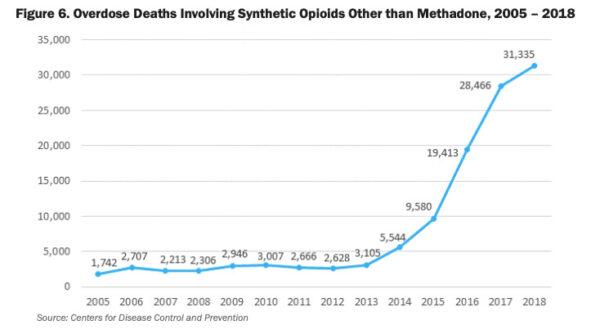
Overdose deaths involving synthetic opioids (other than methadone) between 2005 and 2018. (DEA 2021 report)

The Rio Grande City Border Patrol station takes care of a 68-mile strip of international border in south Texas. It sits within the Rio Grande Valley Sector and in 2019 was the busiest of the nation’s 135 stations for drug seizures and the second busiest for illegal alien apprehensions.

Then-deputy chief Border Patrol agent for the Rio Grande Valley sector Raul Ortiz, said in March 2019 “we’re not even probably catching about 10 percent of it [drugs].”

Border experts have said it’s likely Border Patrol drug seizures will decrease as illegal immigration surges—agents will be tied up with large groups of people rather than interdicting drugs. Border Patrol highway checkpoints are also closing in many areas as agents are sent to the border to help with processing the increased numbers.

The Biden administration has said there’s no crisis on the border and urges potential migrants not to come in illegally. But the latest illegal crossing numbers show that February hit a 14-month high with more than 100,000 Border Patrol apprehensions.

Mexico’s president has expressed concern that President Joe Biden’s policies are encouraging illegal immigration and human trafficking along the border with the United States.

“They see him as the migrant president, and so many feel they’re going to reach the United States,” Mexican President Andres Manuel Lopez Obrador said of Biden the morning after a virtual meeting with his U.S. counterpart on March 1, according to Reuters.

Maltz said, “perception is reality. People around the world look at Biden as a softie on immigration.”

“The open border is a disaster. It just increases the [cartels’] ability to move drugs freely into America,” he said.

“Also, most importantly, it allows them to get their command and control operatives in the [United States] to establish the stash houses, the distribution outlets, the money collection points, so they have lots of people in America who are able to operate freely around the country.”
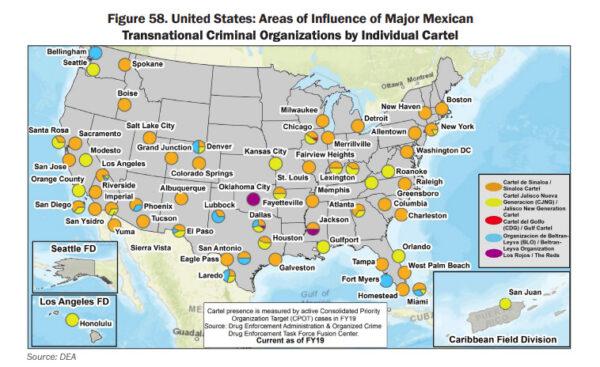
Areas of influence of major Mexican cartel within the United States. (DEA report 2021)

The cartels control the south side of the U.S.–Mexico border and anyone who crosses illegally has to pay them. Many can’t afford the smuggling fees and become indentured to the cartels once they reach the United States. Others realize it’s more lucrative to become involved in transnational crime rather than get a job at a fast food restaurant, for example, Maltz said.

“This didn’t start under Donald Trump. It didn’t start under Barack Obama. It didn’t start under George Bush. This drug crisis has been escalating for years,” he said.

“But they’re doing it at levels that we’ve never seen in the history of the country.”

Tyler Durden
Sat, 03/13/2021 – 14:30

via ZeroHedge News https://ift.tt/3vjfbrT Tyler Durden

WHO Says COVID Origins Will Be Found “Within A Few Years”

WHO Says COVID Origins Will Be Found “Within A Few Years”

In continuing the 12 month long stand up comedy act that the World Health Organization has been putting on (this is the organization who first told us there was no human to human Covid transmission, before then telling us we didn’t need to use masks, before taking a year to investigate Covid’s origins in China, all the while licking China’s boots), the organization is now pushing back finding the origin of Covid for “a few years”.

A member of an international team of investigators led by the World Health Organization said that, after focusing in on an animal source, we could know the origins “within the next few years,” according to the Wall Street Journal. Peter Daszak, a member of the WHO-led team, said: “I’m convinced we’re going to find out fairly soon. Within the next few years we’ll have real significant data on where this came from and how it emerged.”

Sigh.

Daszak was one of three team members who spoke on a webinar about his recent trip to Wuhan. Daszak said he learned that “meat from animals known to carry coronaviruses belonging to the same family as the pandemic virus were sold in the Huanan market”.

We also wonder if he happened to see this building off in the distance at any point during his “investigation”:

Regardless, the WHO team has “expressed frustration” with the lack of information China is giving them – as WSJ notes – “particularly regarding early Covid-19 cases that could help determine whether the virus was circulating before the first cases were confirmed.”

Sigh.

The team is expected to release a report next week that will talk about its findings and offer up recommendations for an investigation for further study. Daszak said the team’s “leading hypothesis” is that a “a bat or other wildlife species carrying a progenitor, or closely related virus, infected a farm animal or a person, who then carried it to the Huanan market.”

“I believe that’s the most likely scenario, and I think most people on both sides of the mission felt the same way,” he commented.

Dutch virologist Marion Koopmans said it was “extremely unlikely” that the virus escaped from a lab. And while committing to investigate any such links, she also said scientists were put on restriction during their visit to Wuhan: “The second phase of our trip after the hotel quarantine, we still could not freely go about. That was a disappointment for all of us.”

Daszak concluded: “There was a conduit from Wuhan to the provinces in South China, where the closest relative viruses to SARS-CoV-2 are found in bats. That’s a really important clue.”

Tyler Durden
Sat, 03/13/2021 – 14:00

via ZeroHedge News https://ift.tt/3bHUCO4 Tyler Durden

Georgetown Law Journal Author Diversity Policy: At least 25% “of the Total Articles the Senior Articles Editor Assigns Shall be Written by Diverse Authors”

I recently came across the Georgetown Law Journal’s author diversity amendment. It was ratified in the spring of 2020. (I am not certain the date). The policy creates an express quota for reviewed articles:

During each articles-assignment period (usually each week), at least 25 percent of the total articles the Senior Articles Editor assigns shall be written by diverse authors as defined by (i).

The policy offers this definition of diversity:

Disability, race, ethnicity, underrepresented religions, sexual orientation, gender identity (i.e. non-cisgender/non-binary), and socioeconomic status.

By my read, white cisgender women are not considered diverse. And I doubt Judaism and LDS are “underrepresented” religions for legal academia.

What happens if the Senior Article Editor cannot meet this quota:

In cases where the Senior Articles Editor is unable to meet the percentage agreed upon in accordance with (1)(a), they shall approach the EIC and the Board to discuss the reasons why they were unable to fulfill the mandate. Select members of the Senior Board will then take steps to remedy the Senior Article Editor’s concerns and increase author diversity.

The policy acknowledges that the quota can be lowered, but never below 10%:

After the EIC and Senior Board members’ review, these members will vote to provide a new percentage, never to be lower than 10 percent, to set as a floor requirement for the amount of articles by diverse authors assigned by the Senior Articles Editor in each assignment period.

And, if there are still not enough submissions from diverse authors, the journal can solicit articles from specific diverse authors:

In cases where the Senior Articles Editor does not have enough articles from diverse authors to meet the requirements established in this Amendment, the Senior Articles Editor, the EIC, the Senior Notes Editor, the Senior Online Editor, and the Development Committee will establish outreach initiatives targeted at academic institutions and diverse academics to increase the amount of articles submitted from diverse authors.

The journal adopted another policy in Spring 2021 with respect to the publication of student notes. (There are other adopted policies as well). Specifically, there is a requirement to publish at least one note focusing on “social justice.”

Every volume of the Journal shall select for publication at least one student Note submission addressing an issue of social justice.

What is social justice?

Themes on social justice reform include but are not limited to gender identity, ethnicity, race, sexual orientation, physical and mental ability, immigration status, national origin/indigeneity, prison and criminal justice reform, and socioeconomic status. On

And what happens if the Notes Committee fails to select a social justice note?

In volumes where the Notes Committee fails to select a Note addressing an issue of social justice, the Senior Notes Editor shall approach the EIC and the Board to discuss the reasons they were unable to fulfill the requirement. The Editor-in-Chief shall have discretion to take appropriate measures to remedy the Senior Notes Editor’s concerns and ensure compliance in future volumes.

Moreover, 25% of all note submissions must be from diverse students:

In addition to the Spring 2020 GLJ Author Diversity Constitutional Amendment requirement that 25% of articles screened by the Articles Committee be written by diverse authors, the Notes Committee and GLJ Online shall ensure at least 25% of their submissions sent to their respective selection committees are written by diverse authors as defined in Section (i) of the Spring 2020 GLJ Author Diversity Constitutional Amendment.

Let me try to break down the author policy with simple numbers. Assume in a given week, a journal receives 1,000 submissions. And the journal receives 500 submissions from diverse authors. In that scenario, the Senior Articles Editor can forward 50% of the diverse submissions for review. And the Editor can forward 75% of the remaining submissions from non-diverse authors. What if the journal only receives 250 submissions from diverse authors. With these numbers, the Senior Articles Editor will likely forward 100% of the submissions. If the Editor fails to forward on a submission from a diverse author, he or she may be subject to remedial action. What if the journal only receives 100 submissions from diverse authors. Under the policy, the Editor would likely forward 100% of those submissions. But he would also have to decrease the number of submissions from non-diverse authors. Here, the Editor would only be able to forward submissions from 300 non-diverse authors for a total of 400 submissions. That allocation would generate a 25/75 split. Again, if we start with 1,000 submissions, 100% of the diverse submissions would be forwarded. And 30% of the non-diverse submissions would be forwarded. Journals can always increase the denominator, as a way to increase the numerator. That is, recruit more submissions from diverse authors. But in the absence of more submissions from diverse authors, then the selection rate for non-diverse authors will have to decrease.

One final point: how do expedites work? If the journal had already met its weekly quota of non-diverse authors, will an expedite from a non-diverse author be rejected out of hand? Often, expedite requests have very short time horizons, so it would not be feasible to hold onto an article till the next week comes in. Or, are expedites requests exempt from this policy?

Now the policy does not impose any quotas on what articles are published. But the policy imposes very stringent “tracking” protocols:

The Senior Articles Editor & the Development Committee shall track the number of articles from diverse authors considered at both the screening and full-committee stages of the Articles Committee selection process, and the number of articles published from diverse authors per issue before the printing of each issue.

I suspect the pressure will be large on the various committees to publish the submissions from diverse authors. This pressure is a feature, and not a bug of the policy. At some point, once the pipeline is established, the journal will likely impose publication requirements as well.

I have not kept close track of how many elite journals have adopted such policies, but I suspect it is widespread. Journals are now imposing specific quotas on the representation of authors, and even the subject matters of note topics.

from Latest – Reason.com https://ift.tt/2PZXxtc
via IFTTT

Kentucky Bill Would Ban “Fighting Words” Aimed at Police Officers

From SB211, which just passed the Kentucky Senate:

(1) A person is guilty of disorderly conduct in the second degree when in a public place and with intent to cause public inconvenience, annoyance, or alarm, or wantonly creating a risk thereof, he: …

(e) Accosts, insults, taunts, or challenges a law enforcement officer with offensive or derisive words, or by gestures or other physical contact, that would have a direct tendency to provoke a violent response from the perspective of a reasonable and prudent person.

Let’s assume that courts read subsection (1)(e) as limited to speech that fits within the First Amendment exception for so-called “fighting words“—”those personally abusive epithets which, when addressed to the ordinary citizen, are, as a matter of common knowledge, inherently likely to provoke violent reaction.” A total ban on all fighting words, whether said to a law enforcement officer or anyone else, would be constitutional. (I set aside here whether this exception ought to exist; rightly or wrongly, the Court has recognized it.)

Is it constitutional for Kentucky to specially punish such fighting words when said to law enforcement officers? That, it turns out, is a surprisingly complicated question, because of two decisions the Supreme Court has rendered:

  1. In R.A.V. v. City of St. Paul (1992), the Supreme Court held that a state can’t specially target fighting words that “arouse[] anger, alarm or resentment … on the basis of race, color, creed, religion or gender.” Such targeting was a content-based, and indeed a viewpoint-based, distinction between bigoted fighting words and other fighting words.
  2. But in Wisconsin v. Mitchell (1993), the Supreme Court unanimously upheld a “hate crime” statute that imposed extra punishment on defendants who chose their targets based on race, religion, or the like. The law, the Court held, punished conduct (there, aggravated battery) coupled with discriminatory victim selection: “whereas the ordinance struck down in R.A.V. was explicitly directed at expression …, the statute in this case [Mitchell] is aimed at conduct unprotected by the First Amendment.”

Likewise, specially targeting fighting words that are insulting to police officers would be unconstitutional. But imposing extra punishment on defendants who commit crimes against police officers, or who target police officers for crimes, is constitutional. (Indeed, historically murder of police officers has often been seen as an especially serious crime in many states, and indeed one that is particularly eligible for the death penalty.)

This, of course, raises the question: What if a statute imposes special penalties not on violence against police officers, but on fighting words (or threats) directed at police officers—or on fighting words (or threats) directed at people because of their race, religion, and the like? Do we treat such statutes as impermissible content-/viewpoint-based regulations of speech, under R.A.V., or as permissible bans on targeting victims based on a particular attribute (police officer status or race/religion/etc.)?

Some passages in Mitchell suggest that it applies only to laws that target nonspeech crimes (such as battery):

[W]hereas the ordinance struck down in R.A.V. was explicitly directed at expression (i. e., ‘speech’ or ‘messages’), the statute in this case is aimed at conduct unprotected by the First Amendment.

(In context, the Court seemed to be distinguishing speech crimes from nonspeech conduct crimes, and not crimes that involve constitutionally protected speech from constitutionally unprotected speech; the R.A.V. ordinance, after all, had also been interpreted as targeting only constitutionally unprotected fighting words.)

On the other hand, another passage suggest that victim selection is just different from content discrimination:

[T]he Wisconsin statute singles out for enhancement bias-inspired conduct because this conduct is thought to inflict greater individual and societal harm. For example, according to the State and its amici, bias-motivated crimes are more likely to provoke retaliatory crimes, inflict distinct emotional harms on their victims, and incite community unrest. The State’s desire to redress these perceived harms provides an adequate explanation for its penalty-enhancement provision over and above mere disagreement with offenders’ beliefs or biases.

Speech that tends to cause race-based fights is especially likely to cause such fights, and thus provoke retaliatory crimes and incite community unrest. (Even though with fighting words, targets are supposed to resist the provocation, in fact they sometimes are provoked to violence, human nature being what it is; fighting words doctrine recognizes that.) Likewise, speech that tends to cause a violent reaction by a police officer is also especially likely to cause such reactions, and thus provoke retaliatory crimes and incite community unrest.

And just a few months ago and right across the river from Kentucky, the Ohio Court of Appeals resolved this in favor of applying Mitchell and upholding a fighting words enhancement for speech targeted at a person based on race. The case is City of Columbus v. Fabich, which is worth excerpting here (see also People v. Nitz (Ill. Ct. App. 1996)):

In this case, the City has convicted Fabich of ethnic intimidation based on his having uttered racially charged fighting words to a black person. Hypothetically, had Fabich confronted Brown with different fighting words that disclosed no racial bias, he might have instead been found guilty only of disorderly conduct, not ethnic intimidation. That juxtaposition seems, at first, to place this situation squarely within the reach of R.A.V.‘s prohibition on regulating the content of fighting words.

However, another hypothetical leads us in a different direction: What if Fabich had confronted Brown with fighting words that were not racially charged but then, after the fact, confessed that his motive for verbally attacking Brown had been racial? In that case, despite having uttered no biased fighting words, could he still have been found guilty of ethnic intimidation based on the unbiased fighting words in conjunction with his confessedly biased motive for having uttered them? This hypothetical line of reasoning highlights the fact that the triggering culpability element in the ethnic intimidation ordinance is not the content of the fighting words, but rather, it is the “motives, reasons or purposes for” which the fighting words were uttered.

In other words, assuming arguendo that the City successfully proved a bigoted motive for [Fabich] directing fighting words toward Brown, then the ordinance is constitutional as applied to him. The ordinance does not seek to punish his use of the n-word more severely compared to other fighting words. It punishes a bigoted motive for employing fighting words against Brown, without regard to what those words were. Mitchell … inform[s] that it is permissible for a government to add to the punishment of crimes where the criminal acts were committed due to a repugnant or socially destabilizing (for example, racist) motive. Thus, even as applied to Fabich (assuming a bigoted motive), we find that the City’s ethnic intimidation ordinance is constitutional….

And the court held there was adequate evidence that (1) Fabich’s speech was indeed “fighting words” and (2) “one of the motives, reasons or purposes for the commission of the offense [was] the victim’s race,” concluding:

The evidence in this case showed that Fabich used racially charged fighting words in combination with other racially derogatory statements. Though the content of these words is not (and cannot constitutionally be) the target of the ethnic intimidation ordinance, the lack of other explanation for the conflict between Fabich and Brown permits those words to serve as evidence of Fabich’s motivation for the conflict and the use of fighting words. We therefore affirm Fabich’s convictions for disorderly conduct and ethnic intimidation….

So that’s what makes the case more difficult than it might appear. It might at first seem unconstitutional because it’s a speech restriction. But then it might seem constitutional because it appears to be focused on the “fighting words” exception. But then it might seem unconstitutional because it violates the R.A.V. principle by specially targeting a certain content or viewpoint expressed by a particular subset of fighting words. But then it might seem constitutional because it’s consistent with Mitchell. I leave this issue without a prediction, but just highlighting the possible legal arguments.

from Latest – Reason.com https://ift.tt/3th1GY1
via IFTTT

Georgetown Law Journal Author Diversity Policy: At least 25% “of the Total Articles the Senior Articles Editor Assigns Shall be Written by Diverse Authors”

I recently came across the Georgetown Law Journal’s author diversity amendment. It was ratified in the spring of 2020. (I am not certain the date). The policy creates an express quota for reviewed articles:

During each articles-assignment period (usually each week), at least 25 percent of the total articles the Senior Articles Editor assigns shall be written by diverse authors as defined by (i).

The policy offers this definition of diversity:

Disability, race, ethnicity, underrepresented religions, sexual orientation, gender identity (i.e. non-cisgender/non-binary), and socioeconomic status.

By my read, white cisgender women are not considered diverse. And I doubt Judaism and LDS are “underrepresented” religions for legal academia.

What happens if the Senior Article Editor cannot meet this quota:

In cases where the Senior Articles Editor is unable to meet the percentage agreed upon in accordance with (1)(a), they shall approach the EIC and the Board to discuss the reasons why they were unable to fulfill the mandate. Select members of the Senior Board will then take steps to remedy the Senior Article Editor’s concerns and increase author diversity.

The policy acknowledges that the quota can be lowered, but never below 10%:

After the EIC and Senior Board members’ review, these members will vote to provide a new percentage, never to be lower than 10 percent, to set as a floor requirement for the amount of articles by diverse authors assigned by the Senior Articles Editor in each assignment period.

And, if there are still not enough submissions from diverse authors, the journal can solicit articles from specific diverse authors:

In cases where the Senior Articles Editor does not have enough articles from diverse authors to meet the requirements established in this Amendment, the Senior Articles Editor, the EIC, the Senior Notes Editor, the Senior Online Editor, and the Development Committee will establish outreach initiatives targeted at academic institutions and diverse academics to increase the amount of articles submitted from diverse authors.

The journal adopted another policy in Spring 2021 with respect to the publication of student notes. (There are other adopted policies as well). Specifically, there is a requirement to publish at least one note focusing on “social justice.”

Every volume of the Journal shall select for publication at least one student Note submission addressing an issue of social justice.

What is social justice?

Themes on social justice reform include but are not limited to gender identity, ethnicity, race, sexual orientation, physical and mental ability, immigration status, national origin/indigeneity, prison and criminal justice reform, and socioeconomic status. On

And what happens if the Notes Committee fails to select a social justice note?

In volumes where the Notes Committee fails to select a Note addressing an issue of social justice, the Senior Notes Editor shall approach the EIC and the Board to discuss the reasons they were unable to fulfill the requirement. The Editor-in-Chief shall have discretion to take appropriate measures to remedy the Senior Notes Editor’s concerns and ensure compliance in future volumes.

Moreover, 25% of all note submissions must be from diverse students:

In addition to the Spring 2020 GLJ Author Diversity Constitutional Amendment requirement that 25% of articles screened by the Articles Committee be written by diverse authors, the Notes Committee and GLJ Online shall ensure at least 25% of their submissions sent to their respective selection committees are written by diverse authors as defined in Section (i) of the Spring 2020 GLJ Author Diversity Constitutional Amendment.

Let me try to break down the author policy with simple numbers. Assume in a given week, a journal receives 1,000 submissions. And the journal receives 500 submissions from diverse authors. In that scenario, the Senior Articles Editor can forward 50% of the diverse submissions for review. And the Editor can forward 75% of the remaining submissions from non-diverse authors. What if the journal only receives 250 submissions from diverse authors. With these numbers, the Senior Articles Editor will likely forward 100% of the submissions. If the Editor fails to forward on a submission from a diverse author, he or she may be subject to remedial action. What if the journal only receives 100 submissions from diverse authors. Under the policy, the Editor would likely forward 100% of those submissions. But he would also have to decrease the number of submissions from non-diverse authors. Here, the Editor would only be able to forward submissions from 300 non-diverse authors for a total of 400 submissions. That allocation would generate a 25/75 split. Again, if we start with 1,000 submissions, 100% of the diverse submissions would be forwarded. And 30% of the non-diverse submissions would be forwarded. Journals can always increase the denominator, as a way to increase the numerator. That is, recruit more submissions from diverse authors. But in the absence of more submissions from diverse authors, then the selection rate for non-diverse authors will have to decrease.

One final point: how do expedites work? If the journal had already met its weekly quota of non-diverse authors, will an expedite from a non-diverse author be rejected out of hand? Often, expedite requests have very short time horizons, so it would not be feasible to hold onto an article till the next week comes in. Or, are expedites requests exempt from this policy?

Now the policy does not impose any quotas on what articles are published. But the policy imposes very stringent “tracking” protocols:

The Senior Articles Editor & the Development Committee shall track the number of articles from diverse authors considered at both the screening and full-committee stages of the Articles Committee selection process, and the number of articles published from diverse authors per issue before the printing of each issue.

I suspect the pressure will be large on the various committees to publish the submissions from diverse authors. This pressure is a feature, and not a bug of the policy. At some point, once the pipeline is established, the journal will likely impose publication requirements as well.

I have not kept close track of how many elite journals have adopted such policies, but I suspect it is widespread. Journals are now imposing specific quotas on the representation of authors, and even the subject matters of note topics.

from Latest – Reason.com https://ift.tt/2PZXxtc
via IFTTT

Kentucky Bill Would Ban “Fighting Words” Aimed at Police Officers

From SB211, which just passed the Kentucky Senate:

(1) A person is guilty of disorderly conduct in the second degree when in a public place and with intent to cause public inconvenience, annoyance, or alarm, or wantonly creating a risk thereof, he: …

(e) Accosts, insults, taunts, or challenges a law enforcement officer with offensive or derisive words, or by gestures or other physical contact, that would have a direct tendency to provoke a violent response from the perspective of a reasonable and prudent person.

Let’s assume that courts read subsection (1)(e) as limited to speech that fits within the First Amendment exception for so-called “fighting words“—”those personally abusive epithets which, when addressed to the ordinary citizen, are, as a matter of common knowledge, inherently likely to provoke violent reaction.” A total ban on all fighting words, whether said to a law enforcement officer or anyone else, would be constitutional. (I set aside here whether this exception ought to exist; rightly or wrongly, the Court has recognized it.)

Is it constitutional for Kentucky to specially punish such fighting words when said to law enforcement officers? That, it turns out, is a surprisingly complicated question, because of two decisions the Supreme Court has rendered:

  1. In R.A.V. v. City of St. Paul (1992), the Supreme Court held that a state can’t specially target fighting words that “arouse[] anger, alarm or resentment … on the basis of race, color, creed, religion or gender.” Such targeting was a content-based, and indeed a viewpoint-based, distinction between bigoted fighting words and other fighting words.
  2. But in Wisconsin v. Mitchell (1993), the Supreme Court unanimously upheld a “hate crime” statute that imposed extra punishment on defendants who chose their targets based on race, religion, or the like. The law, the Court held, punished conduct (there, aggravated battery) coupled with discriminatory victim selection: “whereas the ordinance struck down in R.A.V. was explicitly directed at expression …, the statute in this case [Mitchell] is aimed at conduct unprotected by the First Amendment.”

Likewise, specially targeting fighting words that are insulting to police officers would be unconstitutional. But imposing extra punishment on defendants who commit crimes against police officers, or who target police officers for crimes, is constitutional. (Indeed, historically murder of police officers has often been seen as an especially serious crime in many states, and indeed one that is particularly eligible for the death penalty.)

This, of course, raises the question: What if a statute imposes special penalties not on violence against police officers, but on fighting words (or threats) directed at police officers—or on fighting words (or threats) directed at people because of their race, religion, and the like? Do we treat such statutes as impermissible content-/viewpoint-based regulations of speech, under R.A.V., or as permissible bans on targeting victims based on a particular attribute (police officer status or race/religion/etc.)?

Some passages in Mitchell suggest that it applies only to laws that target nonspeech crimes (such as battery):

[W]hereas the ordinance struck down in R.A.V. was explicitly directed at expression (i. e., ‘speech’ or ‘messages’), the statute in this case is aimed at conduct unprotected by the First Amendment.

(In context, the Court seemed to be distinguishing speech crimes from nonspeech conduct crimes, and not crimes that involve constitutionally protected speech from constitutionally unprotected speech; the R.A.V. ordinance, after all, had also been interpreted as targeting only constitutionally unprotected fighting words.)

On the other hand, another passage suggest that victim selection is just different from content discrimination:

[T]he Wisconsin statute singles out for enhancement bias-inspired conduct because this conduct is thought to inflict greater individual and societal harm. For example, according to the State and its amici, bias-motivated crimes are more likely to provoke retaliatory crimes, inflict distinct emotional harms on their victims, and incite community unrest. The State’s desire to redress these perceived harms provides an adequate explanation for its penalty-enhancement provision over and above mere disagreement with offenders’ beliefs or biases.

Speech that tends to cause race-based fights is especially likely to cause such fights, and thus provoke retaliatory crimes and incite community unrest. (Even though with fighting words, targets are supposed to resist the provocation, in fact they sometimes are provoked to violence, human nature being what it is; fighting words doctrine recognizes that.) Likewise, speech that tends to cause a violent reaction by a police officer is also especially likely to cause such reactions, and thus provoke retaliatory crimes and incite community unrest.

And just a few months ago and right across the river from Kentucky, the Ohio Court of Appeals resolved this in favor of applying Mitchell and upholding a fighting words enhancement for speech targeted at a person based on race. The case is City of Columbus v. Fabich, which is worth excerpting here (see also People v. Nitz (Ill. Ct. App. 1996)):

In this case, the City has convicted Fabich of ethnic intimidation based on his having uttered racially charged fighting words to a black person. Hypothetically, had Fabich confronted Brown with different fighting words that disclosed no racial bias, he might have instead been found guilty only of disorderly conduct, not ethnic intimidation. That juxtaposition seems, at first, to place this situation squarely within the reach of R.A.V.‘s prohibition on regulating the content of fighting words.

However, another hypothetical leads us in a different direction: What if Fabich had confronted Brown with fighting words that were not racially charged but then, after the fact, confessed that his motive for verbally attacking Brown had been racial? In that case, despite having uttered no biased fighting words, could he still have been found guilty of ethnic intimidation based on the unbiased fighting words in conjunction with his confessedly biased motive for having uttered them? This hypothetical line of reasoning highlights the fact that the triggering culpability element in the ethnic intimidation ordinance is not the content of the fighting words, but rather, it is the “motives, reasons or purposes for” which the fighting words were uttered.

In other words, assuming arguendo that the City successfully proved a bigoted motive for [Fabich] directing fighting words toward Brown, then the ordinance is constitutional as applied to him. The ordinance does not seek to punish his use of the n-word more severely compared to other fighting words. It punishes a bigoted motive for employing fighting words against Brown, without regard to what those words were. Mitchell … inform[s] that it is permissible for a government to add to the punishment of crimes where the criminal acts were committed due to a repugnant or socially destabilizing (for example, racist) motive. Thus, even as applied to Fabich (assuming a bigoted motive), we find that the City’s ethnic intimidation ordinance is constitutional….

And the court held there was adequate evidence that (1) Fabich’s speech was indeed “fighting words” and (2) “one of the motives, reasons or purposes for the commission of the offense [was] the victim’s race,” concluding:

The evidence in this case showed that Fabich used racially charged fighting words in combination with other racially derogatory statements. Though the content of these words is not (and cannot constitutionally be) the target of the ethnic intimidation ordinance, the lack of other explanation for the conflict between Fabich and Brown permits those words to serve as evidence of Fabich’s motivation for the conflict and the use of fighting words. We therefore affirm Fabich’s convictions for disorderly conduct and ethnic intimidation….

So that’s what makes the case more difficult than it might appear. It might at first seem unconstitutional because it’s a speech restriction. But then it might seem constitutional because it appears to be focused on the “fighting words” exception. But then it might seem unconstitutional because it violates the R.A.V. principle by specially targeting a certain content or viewpoint expressed by a particular subset of fighting words. But then it might seem constitutional because it’s consistent with Mitchell. I leave this issue without a prediction, but just highlighting the possible legal arguments.

from Latest – Reason.com https://ift.tt/3th1GY1
via IFTTT

The Bubble Of Everything: How A Debt-Driven Economy Creates More Frequent Crises

The Bubble Of Everything: How A Debt-Driven Economy Creates More Frequent Crises

Authored by Daniel Lacalle,

The pace of global recoveries since 1975 has been slower and weaker, consistently evey time, according to the OECD. Recoveries take longer and happen slower. At the same time, periods of crisis are less aggressive albeit more frequent than prior to 1975.  Another interesting evidence of the crises and recoveries since 1975 is that almost all economies end the recession period with more debt than before.

Global debt has ballooned to all-time highs, more than three times the world GDP. For the economy to really recover, we must stop the race of perverse incentives created by the wrong analysis of the origin of crises and the solutions that are often proposed in mainstream economics and politics.  I agree with Johan Norberg that the two main factors that have driven the phenomenal progress we have seen are free markets and openness. The freedom to innovate, experiment, create and share must come with the right incentives.

For decades, governments and central banks have always identified the problems of the economy as demand problems, even if it was not the case. If there was a crisis or a recession, governments immediately believed that it must be due to lack of demand, and subsequently decide that the private sector is not willing or able to fulfill the real demand needs of the economy, even if there was no real evidence that companies or citizens were investing or consuming less than what they needed. The entire premise was that companies were not investing “enough”. Compared to what and decide by whom? Obviously by central planners who benefit from bubbles and overcapacity but never suffer the consequences.

Governments and central banks never perceive risks of excess supply and even less predict a bubble. Why? Because most central planners see debt, oversupply, and bubbles as small collateral damages of a greater good: recover growth at any cost.

Behind the mistake in diagnosis is the obsession to maintain or grow Gross Domestic Product (GDP) at any cost regardless of the quality of its components. GDP is relatively easy to inflate. I always explain to my students that GDP is the only economic calculation in which you add what you spend with what you earn. GDP can be inflated through government spending and with higher debt-fueled expenditures. Debt is not a problem when it serves its purpose, which is to finance productive investment and allow the economy to grow, while efficiency, innovation, and technology allow us to be more productive and receive more and better goods and services at cheaper prices. It is a virtuous cycle.

The virtuous cycle of credit turns into a vicious cycle of unproductive debt when we incentivize malinvestment and prevent technology substitution by implementing massive government stimuli and liquidity injections.

Central banks justify their actions saying they do not cut rates, it is a market and private sector demand. Really? How and when did they survey that? What private sector? Crony or obsolescent companies? Highly indebted ones? Furthermore, if low rates and liquidity injections are a market demand, why not let the market set rates and liquidity instead of central banks?

Those same governments that feel the need to “increase inflation”, something that no consumer has demanded ever anywhere, do so because they benefit as the first recipients of newly created money and the only sector that truly benefits from inflation. Not even crony sectors fully benefit from inflation, the tax of the poor. Those suffer higher costs and import expenses.

By always making the same diagnosis, mistakes are repeated and accumulated. No wonder the pace of recoveries is slower, weaker and more indebted.

First, governments believe the problem is lack of demand and name themselves as the solution, using savers to finance it, via taxes and inflation. The best way to boost GDP? Massive white elephants, enormous infrastructure projects that generate a short-term boost to the spending side of GDP. Infrastructure is needed, of course, but the difference is when countries decide to use it as a subterfuge to disguise growth. Build anything at any cost. This leaves behind massive debt and a less dynamic, not stronger economy.

Second, demand-side policies perpetuate those sectors that are in process of obsolescence at the expense of savers, salaries and productive sectors. Governments will always subsidize and support the inefficient at the expense of the efficient because their objective is to maintain what they believe works and keeps jobs. It is not due to bad intentions or evil objectives, it is simply to perpetuate the past that they live off.

Third, massive liquidity injections and low rates are exactly the equivalents of indirect subsidies to the inefficient. The earliest recipients and most benefitted  from “unconventional monetary policies” will, by definition, be the most indebted and least productive. This is why productivity growth and money velocity stall during periods of government-led monetary and fiscal excess.

Fourth, the benefits of the short and long-term credit cycle are broken. Creative destruction is all but eliminated, malinvestment is promoted via unsustainably low rates and liquidity is absorbed by financial assets and unproductive sectors.

Inflation does not rise as much as central planners want because technology and efficiency are unstoppable even if they try, and because overcapacity is perpetuated through constant re-financing. Massive liquidity and low rates make zombie companies soar. The percentage of companies that cannot pay interest expenses with operating profits balloons despite ultra-low rates and alleged “growth-boosting” plans.

For decades, demand-side policies showed diminishing but not lethal results, but now the world has repeated the same policies so many times that there is simply exhaustion. Rates are unsustainably low, liquidity is excessive and there is no real fiscal space in governments that have all but consumed their ability to extract wealth from savers.

The more we hear from governments that we need to spend more and save less, the weaker the response from economic agents.

Governments and central banks create a crisis from a moderate and completely healthy slowdown by denying economic cycles and, even worse, presenting themselves as the ones that will revert them.

Promoting a debt-driven economy leads to more frequent crises, shorter economic cycles and abrupt recessions.

Tyler Durden
Sat, 03/13/2021 – 13:30

via ZeroHedge News https://ift.tt/3qK1Vcq Tyler Durden

Cash-Out Home Refinancings Hit Highest Level Since Global Financial Crisis

Cash-Out Home Refinancings Hit Highest Level Since Global Financial Crisis

The rigging of interest rates by hapless central banks continues to do its job in distorting the market. In addition to boosting both bonds and stocks, it also has homeowners drawing on cash out refinancings at the quickest clip since the global financial crisis. 

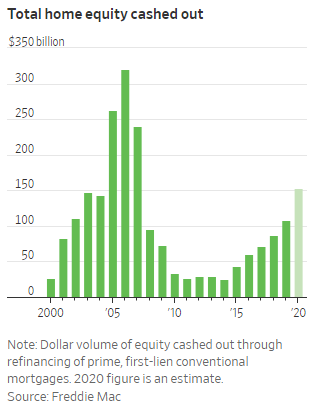
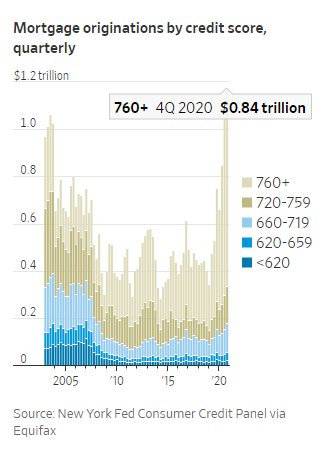
$152.7 billion was cashed out in home equity last year, up 42% from 2019 and the most since 2007, according to the Wall Street Journal. At the same time, lenders originated more mortgages than ever in 2020, helped along by $2.8 trillion in refinancings. 

Some home owners chose to use the cash to re-do their homes, since they would be spending more time in them. Others just wanted the cash as a war chest against the uncertainty of Covid. 

Susan Wachter, an economist and professor at the University of Pennsylvania, told the Journal: “The support coming from home equity is unparalleled in helping smooth out the degradations from Covid. For those who are in the position to refinance, it’s a major source of support.”

In 2008, cash out refis became the enemy, since they left many people owing more than what their house was ultimately worth. Today, economists believe housing prices will continue to rise and support the idea of cashing out. Low rates also make it an obvious decision; the average rate on a 30 year fixed mortgage fell below 3% for the first time last year. 

Daryl Fairweather, chief economist at real-estate brokerage Redfin Corp., said: “There are genuinely a lot of people who want to buy homes to live in. They’re not just buying them to buy them or speculating that home prices will continue to rise. People are buying because they want them and they’re not trying to sell again the next year.”

Median home prices rose to $310,000 in December, up almost 13% from December 2019. The price increases have been felt the most in suburban and rural areas, as an exodus from cities continues. Meanwhile, the median credit score for those who refinanced has approached 800. 

Todd Kennedy of North Texas refinanced and lowered his rate by almost 100 bps. He cashed out $30,000 in the interim to help pay for some home improvements and said he considered a refi when it mortgage company reached out with an offer. His credit score is about 780.

“They said, ‘Hey, you’ve already got equity. We can do a lower rate and get cash back,’” he said.

St. Louis’ Wendi Comello also closed on a cash out refi. Her home, purchased at $95,000 in 2014, appraised for $150,000. She’s going to use the proceeds to pay off credit card debt and renovate her kitchen. Because she had a credit score in the 600s, she wasn’t able to lock in a lower rate. 

Mortgage loan officer Eric Henning said many customers have taken out “larger than usual” sums of cash for major renovations or additions: “They can’t find a house to move into, so they’ve basically decided to make their homes work long term.”

Tyler Durden
Sat, 03/13/2021 – 13:05

via ZeroHedge News https://ift.tt/2OTXPB2 Tyler Durden

Being A Passive Investor Has Never Been So Risky

Being A Passive Investor Has Never Been So Risky

Authored by Bryce Coward via Knowledge Leaders Capital blog,

It’s no secret that money has poured into passive equity vehicles as investors seek low fees above all else. To date, that has worked out just fine since equity indexes have compounded their returns at acceptable, if not above average, rates of returns. But, the world is different now than it was 10 years ago, and the low-cost advantage of passive investing may now be outweighed by its risks.

In this quick post we’ll address three risks to passive investing that together suggest the riskiness of this strategy may well be the highest it has ever been.

1. Taking the S&P 500 as an example, the weighting toward tech-like stocks introduces significant concentration risk.

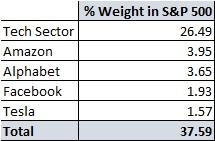
Indeed, the weighting of the technology sector + Alphabet, Amazon, Facebook, & Tesla is a whopping 38% of the total S&P 500. In other words, 38% of passive investors’ exposure is to one risk factor.

That’s a lot of chips to put on one bet.

2. The valuation for the tech-like stocks is out of control.

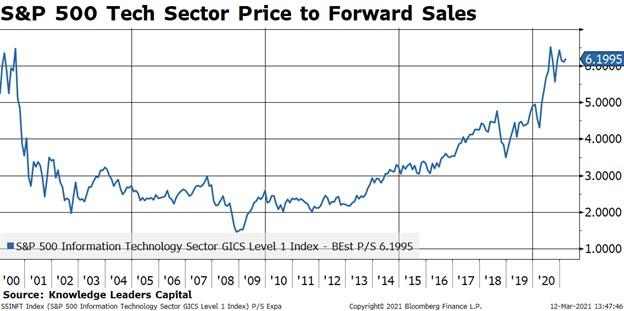
Taking just the tech sector as an example, it’s trading at 6.2x next year’s sales. This valuation extreme was only eclipsed (barely) in the late stages of the tech bubble.

Since valuations inform prospective returns, passive investors in the S&P 500 are basically locking in a below average rate of return since 38% of their portfolio is invested in highly valued stocks. But…the growth. Yes, valuations always need to be calibrated against prospective growth rates. However, tech sector growth rates have been trending down since 2006.

For the first time in a very long while, S&P 500 long-term growth is expected to be on par with tech sector growth.

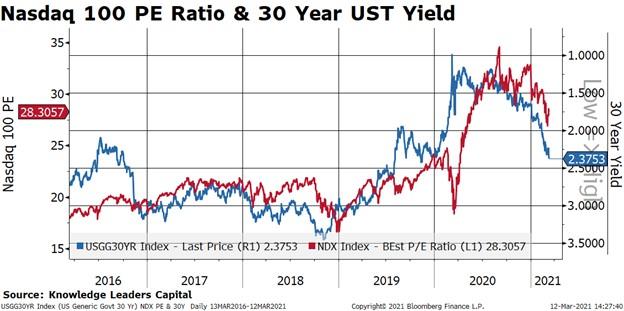
3. Tech valuations are highly related the level of long-term interest rates.

Much of the “value” in tech stocks is the stream of cash flows that is expected many years from now, which is similar to the payoff profile of a long-term bond. When interest rates rise, the present value of those future cash flows (for bonds and high growth stocks) goes down. Since we’re in an environment in which very long-term interest rates are more likely to rise than fall, this will generally put pressure on tech valuations.

This is kind of hat trick for passive investors. Passive portfolios are highly concentrated in stocks with overlapping risk exposures, the valuation of those stocks is in the 99th percentile, and there is a catalyst for those valuations to compress. Combined, these things add up to a below average rate of return for passive portfolios, even if the average stock does just fine. But the fees are low…

As of 12/31/2021, Alphabet, Amazon and Facebook were held in a Knowledge Leaders Strategy. Tesla was not.

Tyler Durden
Sat, 03/13/2021 – 12:40

via ZeroHedge News https://ift.tt/3ct7x5F Tyler Durden

There Is A Huge Quant Rebalance Next Friday: Here’s Who Wins And Who Loses

There Is A Huge Quant Rebalance Next Friday: Here’s Who Wins And Who Loses

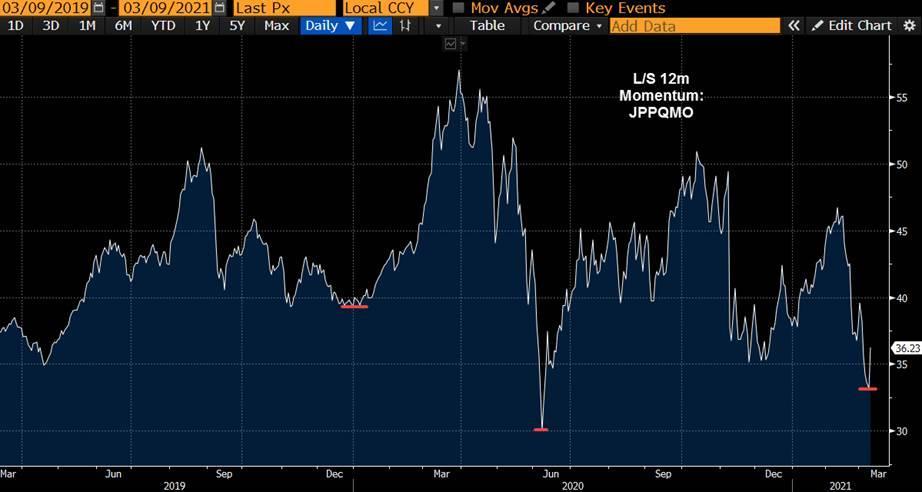
Over the past month, market volatility has been driven by a strong rotation out of Momentum and Growth stocks as inflation/growth expectations have soared higher. Remarkably, JPMorgan’s Delta One desk writes that its 12 month L/S Momentum index has more than given back all of its 2020 outperformance:

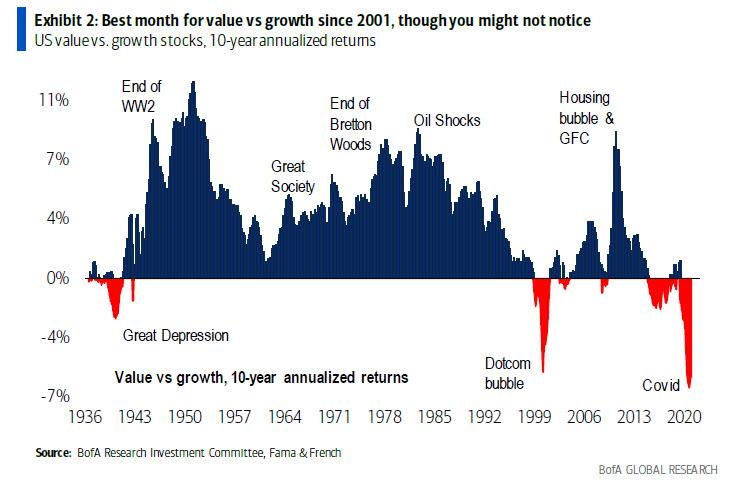
The February rout, which resulted in the biggest outperformance of value stocks over growth since the bursting of the dotcom bubble

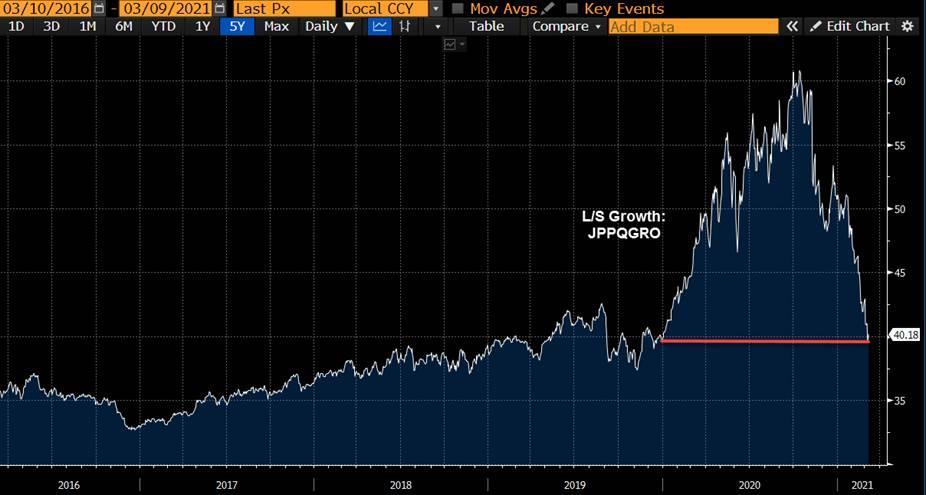
… has also hammered L/S Growth hedge funds back to Pre-Covid levels, a dramatic roundtrip as if the past 12 months never happened.

Which brings us to an interesting tangent: what exactly is momentum in this day and age?

According to JPM’s Delta One desk, for the past year, Long Momentum has been characterized by Growth, Covid/WFH beneficiaries and, more recently, some idiosyncratic themes (Crypto, Renewables, SPACs, Reddit favs etc.). As a result, some have characterized the “winners” as simply high Beta.

Short Momentum, often closely aligned with Value, has been defined by Covid Underperformers and Pro-Cyclical/Re-opening plays. However, due to the recent rotation, the definition of Momentum is evolving, and JPM now finds that 12m L/S Momentum is becoming less aligned with Growth and more aligned with Pro-Cyclical, Value. This change is also catalyzed by the fact that the Feb ’20 Covid sell-off is dropping out of rolling 12m Momentum signals.

This brings up another point: one month ago we brought you a note from JPM’s Marko Kolanovic who previewed the 1 year anniversary of the covid crash – which hits next week for most vol control funds –  and predicted that as a result of the Feb/early March 2020 VIX surge dropping out of the 12 month lookback window, we would see a major short squeeze among systematic investors in energy names, which have been the most hated sector for much of the past year, and where shorts will not only cover but turn aggressively long to keep up with the remarkable rally in crude oil.

As Kolanovic said “a further decline in volatility will likely result in larger and more stable cross-asset quant allocations. A larger momentum impact may affect Energy equities, which is the only sector that still has a strongly negative momentum signal and is hence heavily shorted in the context of factor investing.”  Indeed, until recently, oil was the only asset that was still below its covid pandemic highs. But, not any more with Brent having finally risen above its pre-pandemic highs.

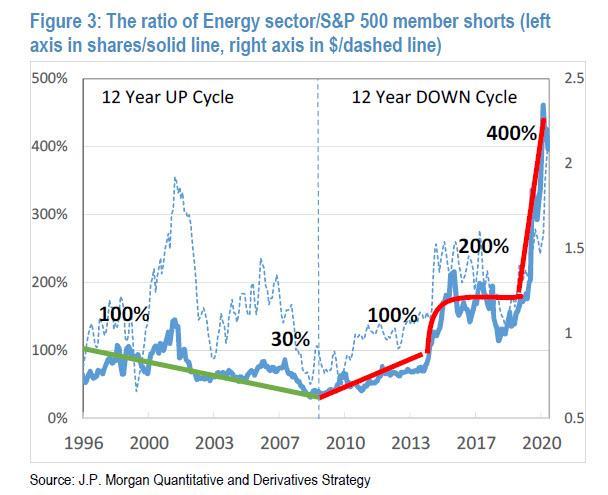
That – and this was the punchline of Kolanovic’s thesis  –  will “change in mid-March, when the momentum signal for energy equities turns positive.” The Croatian quant then calculated that if one roughly assumes that there is about ~$1Tr in equity long-short quant funds and that half of these funds are not sector neutralized, “the flows could be quite significant, roughly $20-$30bn.” As shown in the chart below, the ratio of energy shares shorted vs all other S&P 500 shares shorted, closely followed the commodity supercycle. And, remarkably, the most recent number of shares shorted for energy was 4 times the S&P 500 average. This is where the systematic covering will be most acute.

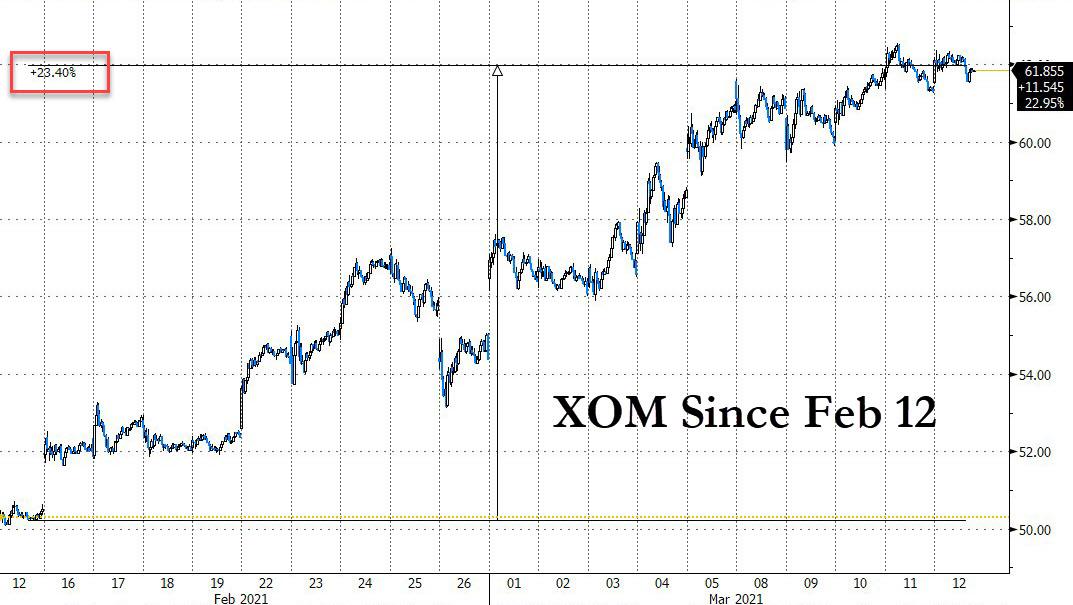
To be sure, judging by the dramatic surge in energy names like Exxon which have soared 25% since the February “squeeze preview” post, many have frontrun just this upcoming quant rebalance.

One can argue that almost everyone, and certainly fast-money accounts have already jumped on board of this trade to frontrun the coming rebalance…. everyone except the quants, whose very tight vol control limits, prevent them from putting the trade on until they get the explicit green light based on historical vol metrics.

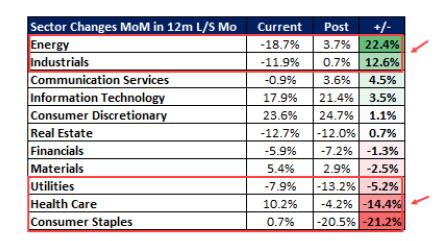
So with that in mind, and to see how these all these various momentum definition changes play out, JPM’s Delta One desk dissected the upcoming rebalance of its 12m L/S Momentum indices, which will take place exactly one week from today, on March 19th. Due to the fact that the lookback window is 12m-1m, one can very accurately forecast the changes. Here’s what will happen:

  • Energy is the largest gainer in 12m L/S Momentum. This is because it moved out of the short leg, where it has been a top weight for several years. However, Energy’s representation in Long Momentum remains small, meaning there is far more upside as quants – who have by now covered shorts – now turn outright long.
  • Industrials were the 2nd largest gainer, also driven by their decrease in Short Momentum.
  • Staples, Health Care and Utilities were the largest decliners. This reflects the underperformance of Bond Proxies and increased risk appetite.
  • Tech did not move significantly. This is due mostly to its large outperformance in ‘20 and early ‘21.
  • Discretionary is now the top OW while Staples is the largest UW.

Finally, according to JPM’s Positioning Intelligence team, as the new definition of 12m L/S Momentum is OW Cons Disc and Tech and UW Defensives, it will be more correlated to broader market moves. For example, if the market sells off, assuming defensives outperform, Momentum will go down. This would be a shift from the typical behavior of Momentum being somewhat negatively correlated to broader market moves.

Going forward, JPM’s Strategy team expects that Pro-Cyclical stocks will continue to lead the market higher as the business cycle strengthens. If this occurs, these segments will continue to become a larger representation in Momentum. This broadening out of market participation and Momentum representation should make the Factor – and the broader market – less vulnerable to any tech-led selloffs as yields continue to rise in the next 12 months.

Tyler Durden
Sat, 03/13/2021 – 06:11

via ZeroHedge News https://ift.tt/30H8n9C Tyler Durden