Here Are The “Fascinating Scenarios” For Markets: Wall Street Responds To RBG’s Death Tyler Durden
Mon, 09/21/2020 – 09:38
Over the weekend, in looking at the political and market chaos unleashed by the passing of SCOTUS Justice Ruth Bader Ginsburg, we said markets are now facing a “nuclear scenario” and summarized the lay of the land by as follows:
Simply put, the political quagmire unleashed by the passing of Ruth Bader Ginsburg leaves the market in an even more precarious position since if a contested election was a source of great uncertainty before, a 4-4 SCOTUS extends that uncertainty even further as we already know there will be no concessions for weeks, and the extensions of mail-in ballots will merely add fuel to the fire of what is shaping up as the most contested election in US history.
In short, this is the “worst case scenario” – that JPMorgan just warned about last week when envisioning a contested election’s impact on markets – on steroids, since The Fed has nothing new to offer and fiscal stimulus will definitely be off the table now until an election decision is made, a decision that may not comes for months without a SCOTUS tiebreaker vote.
Sure enough, this morning a plethora of Wall Street analysts took the stage to confirm our initial take, and explaining in their own words, why the death of RBG is sending futures sharply lower this morning, starting with Rabobank’s Michael Every who had this to say:
The death of US Supreme Court justice Ruth Bader Ginsburg … makes the US election even more important and heated than it already was – and harder to call. Listen to US commentators and all other topics are now secondary, including both the economy (bad for Trump) and Covid-19 (good for Trump). Republicans and Democrats are incredibly fired up given the outcome of the election could shift the balance of the court for a generation. Imagine if it shifted to 6-3 conservative; also imagine if no judge is appointed and it is then tied 4-4 when having to rule on a key element of what is widely expected to be a legally contested election; imagine the court being increased to 11 by Biden if he were to win; and imagine it going up to 15 or 17 if a Republican wins in 2024. This election was already seen as a potential risk event: arguably far more so now.
Next we go to DB’s Jim Reid who summarizes the outcome of RBG’s death as unveiling “lots of fascinating scenarios” to the table.
President Trump said that he would put forth a nominee to fill the seat and Senate Majority Leader McConnell said “President Trump’s nominee will receive a vote on the floor of the United States Senate,” indicating that Republican leadership will try to fill the seat ahead of the election.This represents a turn in the Majority leader’s thinking from 2016, where he did not allow a floor vote for then-President Obama’s nominee in an election year. The nomination and confirmation process will introduce a new element to an election not least because the court can hold sway over highly contentious issues like healthcare, abortion rights and gun law.
It brings lots of fascinating scenarios to the table. If Trump succeeds at getting his nomination through before the election there will be a 6-3 Republican bias to the Supreme Court which as discussed could have policy ramifications for the US for a generation. Democrats are up in arms that the Republicans won’t wait until after the election and are suggesting that may do extraordinary things to address the balance (like adding new judges to the bench) if they gain control of both the Senate and the White House. Congress altered the size of the bench seven times in the first eighty years of the republic (ranging from 5 to 10 justices) but this has not changed since the Judiciary Act of 1869. However getting the current Senate to confirm a nominee won’t be straight forward for Mr Trump as the GOP only hold a 53-47 majority in the Senate (with Vice President Pence serving as the tie-breaker) and a few members have already made noises that they don’t think a new judge should be added this close to the election. So even more drama added to an election campaign.
Finally, we present the Monday morning thoughts from Morgan Stanley analyst Michael Wilson who now expects a second leg of a market correction as a result of the mounting Fiscal Cliff concerns (which we have been discussing for the past month), coupled with the “Peak Fed” (as pointed out last night), with RBG’s death serving as the nail in the coffin of any hopes of an immediate rebound: “Fiscal negotiations have made little progress and the Fed failed to appease the doves on QE. The combination means lower equity prices before the correction, led by the Nasdaq, is over.”
He explains further:
We think the market is now faced with the following two potential outcomes:
Congress fails to pass the bill and the recovery stalls or
Congress does pass CARES 2, which is good for the recovery but is also bad for the long-end of the bond market.
In our view, the second outcome is more likely, while the first outcome would be a much greater threat to the bull market. Markets will be forced to watch and wait. At the end of the day, markets wobbling will be part of the pressure required to get a deal done. The question is how much pressure will be necessary.
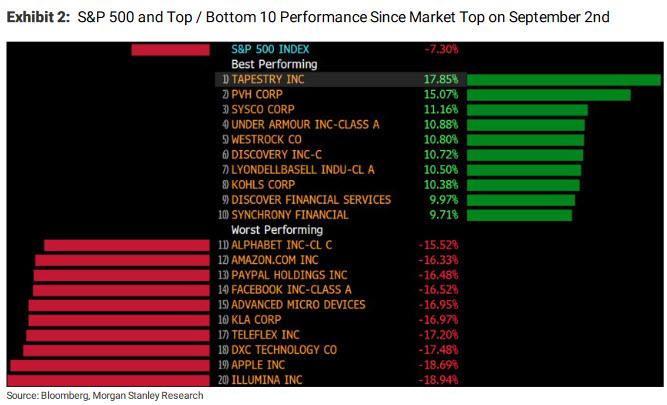
This correction began on September 2, when equity markets failed to break through formidable longer-term resistance. The reasons are often unimportant at such junctures as the technicals simply take over, much like in August when markets went seemingly parabolic for “no reason.” Speaking of August, at this point, we think everyone understands the speculative drivers from both retail and certain institutional buyer(s) of call options in large cap technology stocks. The subsequent reversal of that speculation was naturally concentrated in those stocks too (Exhibit 2).
Perhaps even more interesting is the fact that the best performers this month have been stocks most levered to a continued economic recovery. In other words, the market does seem to be looking through the near-term risk of congressional legislative wrangling and expects something to get done. This means sustainable growth but higher back end rates – i.e. cyclicals over growth and defensives. Implicit in such a conclusion is our view that higher back end rates due to better growth and higher inflation should dissuade the Fed’s decision to engage in yield curve control.
Finally, the unexpected death of Supreme Court Justice Ruth Bader Ginsburg could stall passage of CARES2 in the near term as Democrats may back away from the bill if the President nominates his Supreme Court choice prior to the election.
In short, we believe the odds of scenario 1 may have just gone up, at least with respect to the timing of the next stimulus, and that could weigh on all equities and rates in the near term.
In conclusion, as the fog of political war lifts and as more clarity about the process of RBG’s replacement emerges, expect to see even more violent reactions in the market as the cascading consequences of the vacant SCOTUS seat flow through both the upcoming highly contested presidential elections, which as JPM already said is the “worst case scenario” for the market, and investor sentiment which is finally realizing that the record post-March rally is finally coming to an end.
via ZeroHedge News https://ift.tt/2Hc4brI Tyler Durden
Over the last several months, we have discussed the remarkable underperformance of value versus growth. While many investors quickly dismiss the performance gap under the guise of “this time is different,” it has important longer-term implications. In today’s missive, we want to discuss value, the margin of safety, and the real art of “doing nothing.”
This Time Is Different
A recent MarketWatch articlemade an argument for why this time is different than previous cycles.
“Investors seem to want to embrace a value tilt – stocks that will do well as the economic recovery gathers steam. However, they continue to fall back on the tried-and-true growth stocks that have done well so far, through more uncertain times. But what if those old ‘value’ and ‘growth’ frameworks are the wrong way to measure market moves?”
If you re-read the statement closely, there are a couple of issues that stand out.
If “individuals” continue to “fall back” into the stocks that are rising with the market, then they are “speculating” by chasing prices rather than “buying value.”
There is nothing wrong with the “growth” and “value” frameworks, expect in periods where they don’t fit the speculative fervor of the market.
Investing Versus Speculation
Currently, the majority of investors are simply chasing performance. However, why would you NOT expect this to be the case. On a daily basis the media, and WallStreet, continually press investors to chase prices higher by deeming “this time to be different.”
However, this is where we can begin to understand the difference between investing based on value versus speculating for short-term gains.
Let me give you an example:
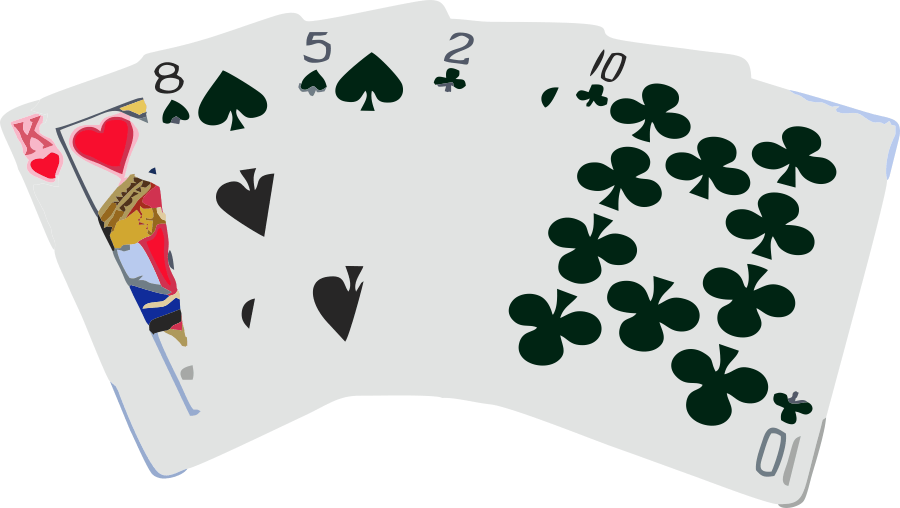
You are playing a hand of stud poker, and the dealer deals you this hand:
How would you bet? A lot, a little, or would you fold?
Even a cursory understanding of the game of poker suggests other players are probably holding better hands than you. Instinctively, you know this and you would tend to “fold” and wait for the next hand.
Now, is this operation “investing” or “speculation?”
The answer should be obvious. When you engage in an operation where the outcome is primarily derived from “luck,” more than “skill,” it is speculation.
Phillip Carret, who wrote The Art of Speculation (1930), defined this more elegantly:
“Speculation, may be defined as the purchase or sale of securities or commodities in expectation of profiting by fluctuations in their prices.”
Chasing markets is the purest form of speculation. It is merely a bet on prices going higher rather than determining if the price paid for those assets is at a discount to fair value.
The Discounting Of Value
What the quote from MarketWatch espouses is that of the “Greater Fool Theory.”
“The greater fool theory states that it is possible to make money buying securities, whether or not they are overvalued, and sell them for a profit at a later date. Such is because there will always be someone (i.e. a bigger or greater fool) else willing to pay a higher price.”
Such is also the purest definition of market speculation.
Benjamin Graham, along with David Dodd, attempted a precise definition of investing and speculation in their seminal work Security Analysis (1934).
“An investment operation is one which, upon thorough analysis, promises safety of principal and a satisfactory return. Operations not meeting these requirements are speculative.”
Graham also noted why individuals should be concerned when they read articles espousing “this time is different.”
“The distinction between investment and speculation in common stocks has always been a useful one and its disappearance is a cause for concern.” – The Intelligent Investor
Given the sharp rise in markets since March, it is not surprising the media pushes a host of excuses to justify overpaying for assets. However, as Graham goes on to note, the media should take a different track.
We have often said that Wall Street as an institution would be well advised to reinstate this distinction and to emphasize it in all its dealings with the public. Otherwise the stock exchanges may some day be blamed for heavy speculative losses, which those who suffered them had not been properly warned against.” – Ben Graham, The Intelligent Investor
Why Value Investing Wins The Long-Game
Throughout market history, investors repeatedly abandon the principles of value investing and maintaining a “margin of safety” during periods of exuberance. Ultimately, those investors paid a dear price for their speculation. “Overpaying for value” has repeatedly led to poor financial outcomes.
What Is A “Margin Of Safety”
Ben Graham heavily espoused the importance of a “margin of safety” in the investment operation. The margin of safety suggests an investor only purchases securities when their market price is significantly below their intrinsic value.
“Confronted with a challenge to distill the secret of sound investment into three words, we venture the motto, Margin of Safety” – Ben Graham
Followers of Ben Graham’s teachings have a deep history of long-term investing success from Warren Buffett to Seth Klarman:
“The best investments have a considerable margin of safety. This is Benjamin Graham’s concept of buying at a sufficient discount that even bad luck or the vicissitudes of the business cycle won’t derail an investment. As when you build a bridge that can hold 30-ton trucks but only drive ten-ton trucks across it, you would never want your investment fortunes to be dependent on everything going perfectly, every assumption proving accurate, every break going your way.” – Seth Klarman
The reality of investing is that rarely does everything “break” the right way. Having a “margin of safety” provides a cushion against the unexpected when it occurs.
An Example Of Intrinsic Value
Investing using a “margin of safety” is not as easy as it sounds. The vast majority of retail investors today do “no research” on the companies in which they invest. They look to the financial media, websites, and tweets to tell them what to buy. Or worse yet, they just buy what is “winning” in the short-term.
The reality is that the concept of a margin of safety is found only by researching to discover the company’s qualitative and quantitative factors. Such work includes understanding the firm’s management, governance, industry performance, assets, and earnings. From there, the investor must derive the security’s intrinsic value.
The following is a report on CVS Health. We regularly provide such reports to our RIAPRO Subscribers (30-day Risk-Free Trial). The report is a condensed version of analysis we use to determine the intrinsic value of a potential investment opportunity.
Once you have done your homework, the market price is then used as the point of comparison to calculate the margin of safety. As noted in the CVS report:
“CVS is currently priced at a deep discount to its intrinsic value. We forecast that roughly 47.1% of upside remains on the stock.”
Such is why Warren Buffett declares the “margin of safety” as one of his “cornerstones of investing.” He, like us, applies as much as a 50% discount to the intrinsic value of a stock to determine price targets.
However, in a market that is overvalued on many metrics, finding value becomes difficult. Furthermore, holding value when it is underperforming the “hot stocks” in the market, is even more challenging.
Art Of Doing Nothing
Currently, value investing is clearly out of favor. It hasn’t worked well for so long it is not surprising the media has declared “value investing dead.” As we showed in that article:
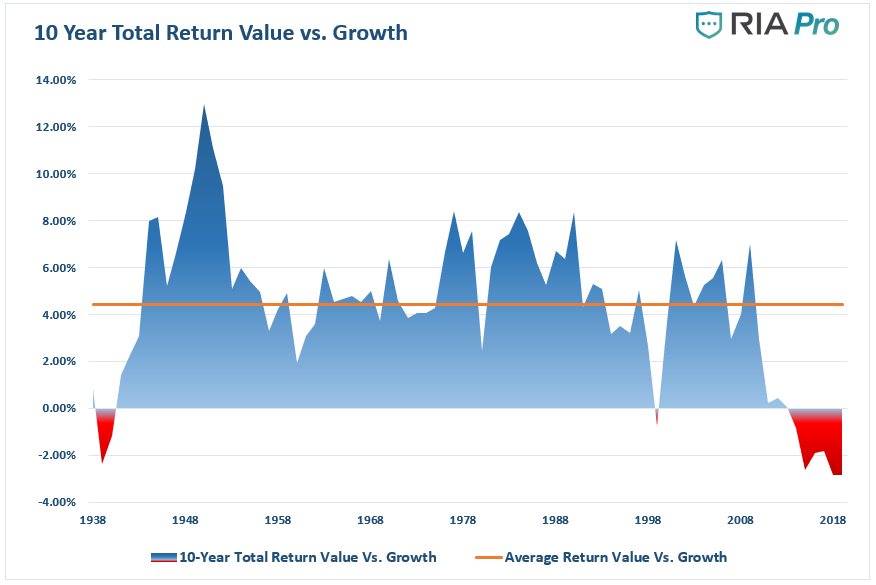
“The graph below charts ten-year annualized total returns (dividends included) for value stocks versus growth stocks. The most recent data point representing 2019, covering the years 2009 through 201-, stands at negative 2.86%. Suchindicates value stocks have underperformed growth stocks by 2.86% on average in each of the last ten years.”
There are two critical takeaways from the graph above:
Over the last 90 years, value stocks have outperformed growth stocks by an average of 4.44% per year (orange line).
There have only been eight ten-year periods over the last 90 years (total of 90 ten-year periods) when value stocks underperformed growth stocks. Two of these occurred during the Great Depression, and one spanned the 1990s leading into the Tech bust of 2001. The other five are recent, representing the years 2014 through 2019.
Mirror Opposites
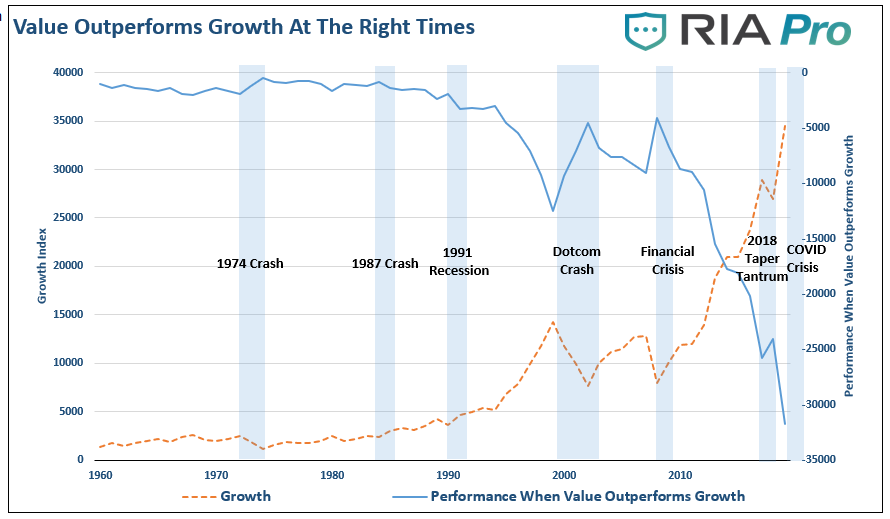
“The chart shows the difference in the performance of the “value vs growth” index. That index is compared to a pure growth index with each based on a $100 investment. While value investing has always provided consistent returns, there are times when growth outperforms value. The periods when “value investing” has the greatest outperformance, as noted by the “blue shaded” areas, are notable.”
So, what should investors do when they can’t find real value in which to invest? While the media says you must always remain invested regardless of the outcome, there is an option. Do nothing.
Perhaps the most important lesson about investing I’ve learned is when there is nothing to do, do nothing. The problem is nothing may actually be the hardest thing to do. We all want to feel like we are being proactive and that requires doing something even when there’s nothing to be done. So it takes a great deal of discipline to resist the urge to do something and commit to doing nothing. In that way, however, committing to doing nothing is probably the most proactive thing to do.
His comment defines “investment” versus “speculation.”
When investing, we seek to deploy capital in an operation with potential to deliver a high return on that investment. Therefore, logically, if no such opportunity with the required “margin of safety” exists, then the best operation is to “do nothing.”
You wouldn’t overpay for a piece of real estate. You shop for the best price on everything from televisions to autos. Yet, when it comes to investing, why would you pay any price for a future stream of cashflows?
Conclusion
Another way to think about this is to realize that the vast majority of mistakes investors make come out of a feeling of needing to do something, of being proactive, rather than simply waiting patiently to react to a truly fantastic opportunity. Rather than react only to true opportunity, they react to social pressure or envy when they see their neighbor making a “killing” in dot-com stocks, ala 2000, or residential real estate, ala 2005, or in call options today.” – Jesse Felder
As is always the case, it may seem for a while that investors are making money “hand over fist” while the market is rising. However, the stories are just as plentiful about what happens as the inevitable downturn vaporizes capital in an instant.
I agree with Jesse’s conclusion:
Right now, due to the extraordinary circumstances in the world, politics, the economy, monetary policy, and more, the urge to do something is greater than normal. However, the opportunity to put money to work is simply not there. At least not yet. But it’s coming. And until it does, the most proactive thing an investor can do is simply commit to doing nothing. Understanding that that is not a passive decision, but a very proactive one, indeed.
via ZeroHedge News https://ift.tt/3iPiwsh Tyler Durden
Senate Report On Biden-Ukraine Accusations To Drop Within Days Tyler Durden
Mon, 09/21/2020 – 09:09
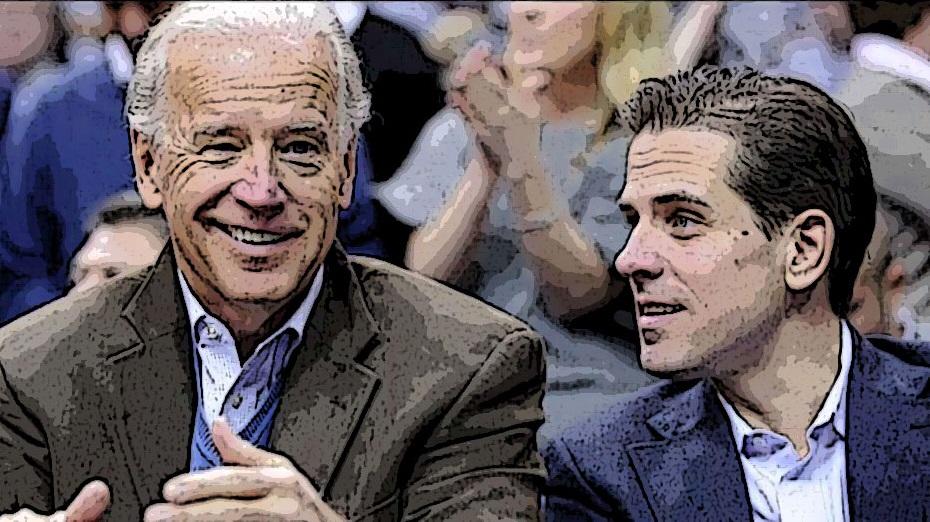
Senate Republicans are set to release their long-awaited report on Joe and Hunter Biden’s activities in Ukraine, and is expected to conclude that Hunter Biden’s lucrative seat the board of Ukrainian energy giant Burisma impacted Obama-era Ukraine policy, which was led by Joe Biden at the time, according to The Hill.
Joe Biden has been accused of abusing his position in a quid-pro-quo arrangement whereby he admitted he withheld $1 billion in US loan guarantees if the country’s lead prosecutor investigating Burisma was fired.
The Bidens have denied any wrongdoing, however depositions from former Ukrainian officials who were directly involved, as well as leaked recordings between Joe Biden and former Ukrainian President Petro Proroshenko have painted a picture of textbook corruption. Notably, Ukrainian parliamentarian Andriy Derkach was sanctioned by the Treasury Department for “spreading disinformation to ‘undermine’ the former vice president” when he leaked several recordings of “voices similar to Poroshenko and Biden” discussing the quid-pro-quo, which Derkach says a journalist gave to him.
The Senate report follows a probe spearheaded by Sens. Ron Johnson (R-WI) and Chuck Grassley (R-IA), and is expected to be released this week.
“I think it’s time for the American people to see what we’ve got,” said Johnson, chairman of the Senate Homeland Security and Governmental Affairs Committee. “What our investigations are uncovering, I think, will reveal this is not somebody we should be electing president of the United States,” he added.
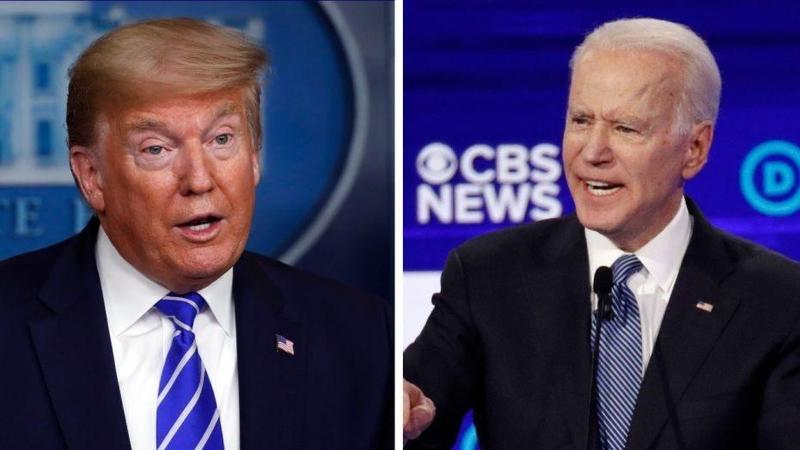
The report will come days before the first presidential debate between President Trump and Joe Biden, and will likely provide Trump with plenty of fresh ammunition. Biden, meanwhile, will be able to trot out Trump’s latest sexual assault accusation, to which Trump will be able to trot out Biden’s.
Sen. Mitt Romney (R-UT) predictably downplayed the report – warning that the Biden-Burisma probe was nothing more than a “political exercise,” adding “It’s not the legitimate role of government for Congress or for taxpayer expense to be used in an effort to damage political opponents.”
The Biden campaign responded – telling The Hill: “It is disgraceful enough for the chair of the Homeland Security & Governmental Affairs Committee to dismiss the worst public health crisis in generations and abandon oversight of the failed federal response to the pandemic. But to instead subsidize a foreign influence operation against the sovereignty of our elections with American taxpayer dollars, all in a vain attempt to resuscitate a conspiracy theory that hinges on Senator Johnson himself being corrupt, is tragic malfeasance.“
That’s quite the statement – and telegraphs Biden’s likely bullet points for the debate. Whether he can effectively convey them is anyone’s guess.
Senate Minority Leader Chuck Schumer (D-NY) and Sen. Ron Wyden (D-OR) attempted to pass a resolution condemning the GOP’s Burisma probe, while The Hill also reports that Democrats may claim that the probe violates the Senate’s Rule 19 – which states that “no Senator in debate shall, directly or indirectly, by any form of words impute to another Senator or to other Senators any conduct or motive unworthy or unbecoming a Senator.”
“President Trump’s Department of the Treasury sanctions Derkach, and the chairman of the committee repeats the same kind of discredited allegations that Derkach propagates. It is outrageous. It is a disgrace,” Schumer added. Johnson, meanwhile, has denied any contact with Derkach during the investigation.
In other words, it doesn’t matter what the GOP probe concludes about the Bidens and Ukraine – it’s ‘unbecoming of a Senator’ to investigate at all.
According to Sen. Johnson, “I saw their resolution … so I was going to enter my own,” adding “When I came on the floor, I was basically warned, ‘We are concerned about what’s going to happen here on the floor.’ … We were all warned.“
via ZeroHedge News https://ift.tt/3cjle6X Tyler Durden
Key Events This Week: Powell Speaks Not Once, Not Twice, But Three Times Tyler Durden
Mon, 09/21/2020 – 08:55
Looking at the week ahead, the highlight will be Fed Chair Powell who after last week’s disappointing FOMC meeting will be speaking not once, not twice, but three times before congressional committees (just in case anyone thinks he will let this market aggression stand). First, he will appear tomorrow before the House Financial Services Panel about the CARES Act. Then on Wednesday he’ll be appearing on the House Select Subcommittee on the Coronavirus Crisis, before Thursday sees him speak before the Senate Banking Committee on the CARES Act once again. Additionally, there’ll be remarks from Fed Vice Chair Quarles on the economic outlook, and a total of 13 other FOMC members will be speaking this week. Bank of England Governor Bailey will be speaking twice this week.
Aside from central banks, the flash PMIs on Wednesday will probably get the most attention as it is one of the first glimpses of September economic performance around the world. Meanwhile, as Deutsche Bank notes, economic and social restrictions are mounting again in various places due to the virus but it may be a bit too early to see their impact in these numbers.
In the US, the key economic data releases this week are the jobless claims report on Thursday and the durable goods report on Friday.
It’ll also be worth keeping an eye on Germany’s Ifo survey on Thursday, which has so far been rising each month since its April low, even as it remains below its pre-pandemic level. The consensus is looking for a further increase to 93.8, which would be just 2 points below its level in February.
There’ll also a special European Council summit on Thursday and Friday. As well as taking stock of the Covid-19 pandemic, the agenda includes a discussion of the single market, industrial policy and digital transformation, along with the EU’s external relations. Brexit may get a small mention as relationships between the EU and the U.K. are just about hanging by enough of a thread enough to merit it. The day by day calendar of the week ahead is at the end.
Courtesy of Deutsche Bank, here is a day-by-day calendar of events:
Monday
Data: US August Chicago Fed National Activity Index
Central Banks: ECB’s Holzmann and Fed’s Brainard speak
Politics: Voting continues in Italian constitutional referendum and regional elections
Tuesday
Data: UK August public finances, Euro Area advance September consumer confidence, US August existing home sales, September Richmond Fed manufacturing index
Central Banks: Fed Chair Powell speaks before the House Financial Services Committee on the CARES Act, Fed’s Evans and BoE Governor Bailey speaks
Wednesday
Data: September flash manufacturing, services and composite PMIs from Australia, Japan, France, Germany, Euro Area, UK and US, Japan July all industry activity index, Germany October GfK consumer confidence, US weekly MBA mortgage applications, July FHFA house price index
Central Banks: Fed Chair Powell speaks before the House Select Subcommittee on the Coronavirus Crisis, Fed Vice Chair Quarles speaks on the economic outlook, Fed’s Mester, Evans, Rosengren and Daly speak
Thursday
Data: France September business confidence, Germany September Ifo business climate indicator, US weekly initial jobless claims, August new home sales, September Kansas City Fed manufacturing activity index
Central Banks: ECB publishes Economic Bulletin, Central Bank of Turkey and Bank of Mexico monetary policy decision, Bank of Japan publish minutes of July meeting, Fed Chair Powell testifies before Senate Banking Committee on the CARES Act, Boe Governor Bailey and Fed’s Bullard and Evans speak
Politics: Special European Council summit begins
Friday
Data: Euro Area August M3 money supply, Italy September consumer confidence index, US preliminary August durable goods orders, nondefence capital goods orders ex air
Central Banks: Fed’s Williams speaks
Politics: Special European Council summit concludes
Finally, looking at just the US, here is a breakdown of the key US events via Goldman Sachs:
Monday, September 21
There are no major economic data releases scheduled.
12:00 PM Fed Governor Brainard (FOMC voter) speaks; Fed Governor Lael Brainard will discuss the Community Reinvestment Act at a virtual event hosted by the Urban Institute. Prepared text and moderated Q&A are expected.
Tuesday, September 22
10:00 AM Existing home sales, August (GS +2.0%, consensus +2.6%, last +24.7%); After surging by 24.7% in July, we estimate that existing home sales increased 2.0% further in August. Existing home sales are an input into the brokers’ commissions component of residential investment in the GDP report.
10:00 AM Richmond Fed manufacturing index, September (consensus 12, last 18)
10:00 AM Chicago Fed President Evans (FOMC non-voter) speaks; Chicago Fed President Charles Evans will discuss the economy and monetary policy at a virtual event hosted by OMFIF.
10:30 AM Fed Chair Powell appears before the House Financial Services Committee; Fed Chair Jerome Powell and Treasury Secretary Steven Mnuchin will testify on the CARES Act before the House Financial Services Committee. Prepared text and questions from legislators are expected.
12:00 PM Richmond Fed President Barkin (FOMC non-voter) speaks; Richmond Fed President Thomas Barkin will take part in a virtual discussion hosted by the Greenville S.C. Chamber of Commerce.
Wednesday, September 23
09:00 AM FHFA house price index, July (consensus +0.4%, last +0.9%)
09:00 AM Cleveland Fed President Mester (FOMC voter) speaks; Cleveland Fed President Loretta Mester will discuss payments and the pandemic at the Chicago Payments Symposium. Prepared text and audience Q&A are expected.
09:45 AM Markit Flash US manufacturing PMI, September preliminary (consensus 53.3, last 53.1)
09:45 AM Markit Flash US services PMI, September preliminary (consensus 54.5, last 55.0)
10:00 AM Fed Chair Powell appears before House panel on Covid-19; Fed Chair Jerome Powell will appear before the House Select Committee on the Coronavirus Crisis. Prepared text is expected.
11:00 AM Chicago Fed President Evans (FOMC non-voter) speaks; Chicago Fed President Charles Evans will discuss the economic outlook in an MNI moderated discussion. Media Q&A is expected.
12:00 PM Boston Fed President Rosengren (FOMC non-voter) speaks; Boston Fed President Eric Rosengren will discuss the U.S. economy at a virtual event hosted by the Boston Economic Club. Text and audience Q&A are expected.
02:00 PM Fed Governor Quarles (FOMC voter) speaks; Fed Vice Chair for Supervision Randal Quarles will give a virtual speech on the economic outlook to the Institute of International Bankers. Text and Q&A are expected.
03:00 PM San Francisco Fed President Daly (FOMC non-voter) speaks; San Francisco Fed President Mary Daly will take part in a Fed-hosted virtual discussion on the impact of the coronavirus pandemic on the labor force.
Thursday, September 24
08:30 AM Initial jobless claims, week ended September 19 (GS 875k, consensus 840k, last 860k); Continuing jobless claims, week ended September 12 (consensus 12,450k, last 12,628k); We estimate initial jobless claims increased to 875k in the week ended September 19.;
10:00 AM New home sales, August (GS -2.0%, consensus -1.2%, last +13.9%); We estimate that new home sales declined by 2.0% in August, partly reflecting a drag from less mortgage applications.
10:00 AM Fed Chair Powell appears before the Senate Banking Committee; Fed Chair Jerome Powell and Treasury Secretary Steven Mnuchin will deliver their quarterly CARES Act report to the Senate Banking Committee.
11:00 AM Kansas City Fed manufacturing index, September (consensus 14, last 14)
12:00 PM St. Louis Fed President Bullard (FOMC non-voter) speaks; St. Louis Fed President James Bullard will discuss the economy and monetary policy in a webinar hosted by the Global Interdependence Center.
01:00 PM Chicago Fed President Evans (FOMC non-voter) speaks; Chicago Fed President Charles Evans will discuss the economic outlook in a virtual event hosted by the Illinois Chamber of Commerce.
01:00 PM Richmond Fed President Barkin (FOMC non-voter) speaks; Richmond Fed President Thomas Barkin will give a speech on inflation and the economy to the Money Marketeers of NYU. Prepared text is expected.
02:00 PM Richmond Fed President Barkin (FOMC non-voter) speaks; Richmond Fed President Thomas Barkin will take part in a virtual discussion hosted by the Baltimore City Chamber of Commerce.
Friday, September 25
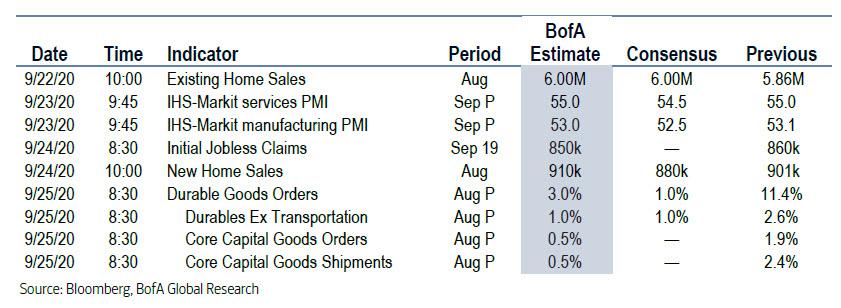
08:30 AM Durable goods orders, August preliminary (GS +2.0%, consensus +1.1%, last +11.4%); Durable goods orders ex-transportation, August preliminary (GS +1.5%, consensus +1.0%, last +2.6%); Core capital goods orders, August preliminary (GS +1.3%, consensus +0.8%, last +1.9%); Core capital goods shipments, August preliminary (GS +1.0%, consensus +0.5%, last +2.4%): We expect durable goods orders to increase 2.0% in the preliminary August report, reflecting improvement in net aircraft orders but a pullback in the defense category. We expect a 1.3% increase in core capital goods orders, reflecting the continued industrial rebound.
09:00 AM New York Fed President Williams (FOMC voter) speaks; New York Fed President John Williams will participate in a conference call with community development and nonprofit leaders from the greater Rochester area.
03:10 PM New York Fed President Williams (FOMC voter) speaks; New York Fed President John Williams will take part in a virtual discussion on the Covid-19 job market with young adults in the greater Rochester area.
Source: DB, Goldman, Bank of America
via ZeroHedge News https://ift.tt/3iQKDHv Tyler Durden
Stocks, Gold, & Crypto Crushed As Dollar Spikes Tyler Durden
Mon, 09/21/2020 – 08:45
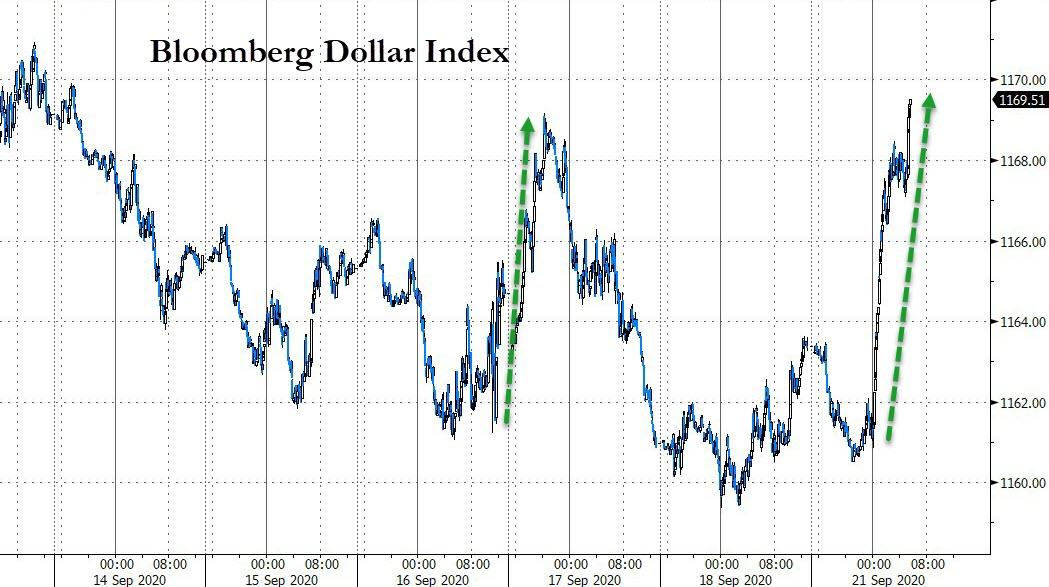
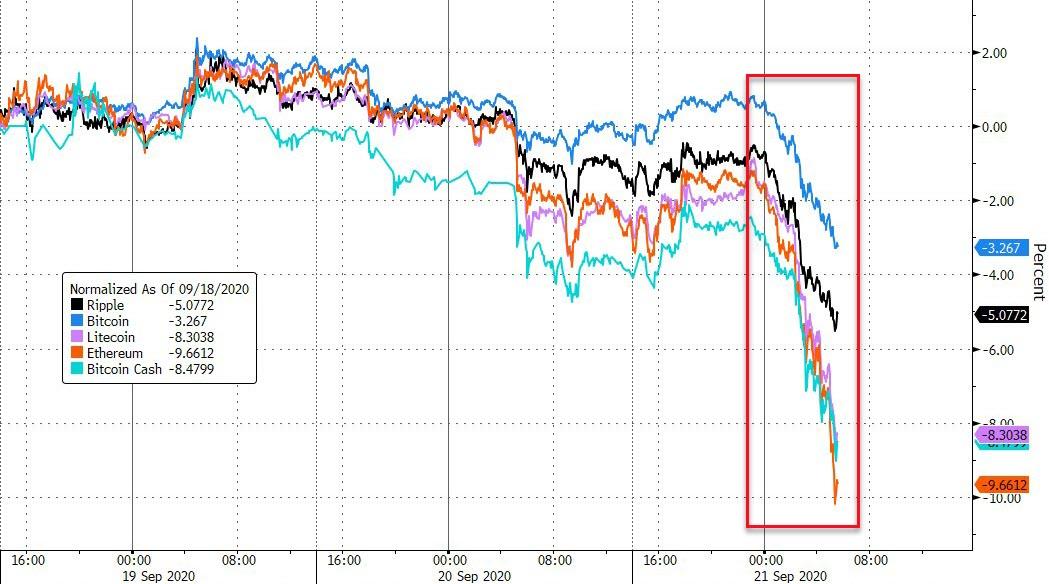
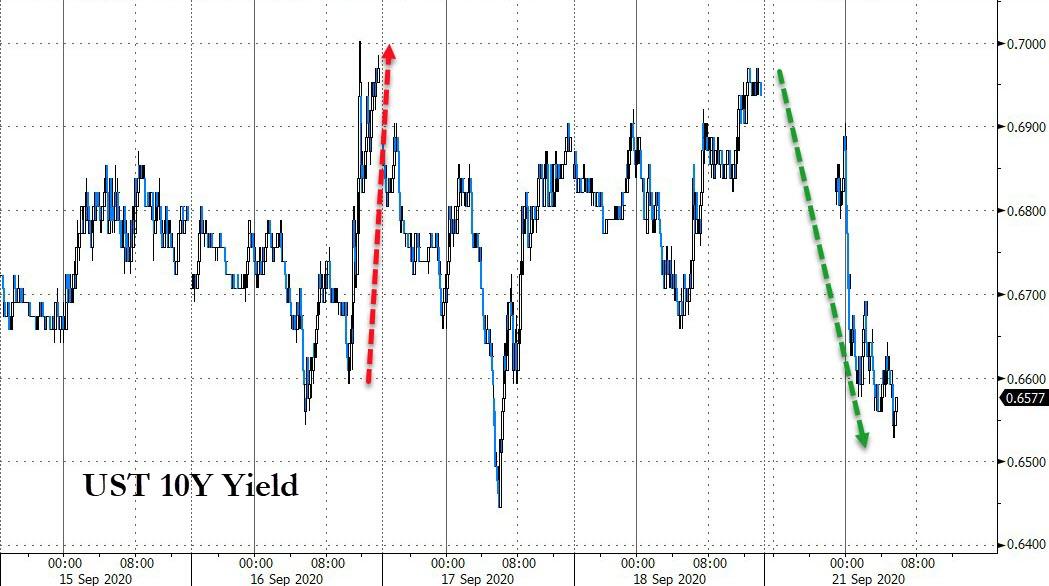
Between bad banks behavior, COVID second-wave concerns, and political chaos; it appears markets (particularly stock markets) are waking up from their fiscal and monetary policy inspired dream-state.
Stocks are getting spanked…
The dollar is spiking…
Sending gold notably lower…
And Cryptos…
But bonds are bid…
Fed Chair Powell is on deck three times this week – seems like he needs to do so ‘splaining!
via ZeroHedge News https://ift.tt/361X7bs Tyler Durden
Rabobank: Is The Era Of American Global Hegemony Coming To An End Tyler Durden
Mon, 09/21/2020 – 08:36
By Michael Every of Rabobank
Friday saw the death of US Supreme Court justice Ruth Bader Ginsburg at 87. She was a true titan of the law, and leaves a critical (until now very liberal) Supreme Court seat vacant at a time when the US is bitterly divided on all issues. President Trump insists on pressing ahead with a hearing on a new appointment before the election – just as President Obama did before him when the (very conservative) justice Scalia died; Senate Republicans are saying they will proceed, which they wouldn’t in 2016; and the Democrats insist on not proceeding until after the election, which they didn’t in 2016. So business as usual.
However, this makes the US election even more important and heated than it already was – and harder to call. Listen to US commentators and all other topics are now secondary, including both the economy (bad for Trump) and Covid-19 (good for Trump). Republicans and Democrats are incredibly fired up given the outcome of the election could shift the balance of the court for a generation. Imagine if it shifted to 6-3 conservative; also imagine if no judge is appointed and it is then tied 4-4 when having to rule on a key element of what is widely expected to be a legally contested election; imagine the court being increased to 11 by Biden if he were to win; and imagine it going up to 15 or 17 if a Republican wins in 2024. This election was already seen as a potential risk event: arguably far more so now.
Meanwhile, on both Friday and Saturday, over a dozen Chinese fighter jets and bombers breached Taiwanese airspace, forcing defensive scrambles in response, and the Global Times has since threatened Taiwan’s president will be “wiped out” if she makes a misstep. That paper’s editor added on Weibo: “If we have no choice but war, we should avoid direct conflict with the US. We can (instead) severely beat up a US running dog that always crosses our bottom line….to send a warning.” It’s been a while since I’ve heard “running dog of US imperialism”: it isn’t very Davos.
As military strategists note, Taiwan must now allow Chinese military jets to fly unimpeded, not knowing if an attack might come; scramble its jets all the time, and see its far smaller forces become worn down; or respond militarily and provoke a terrible response. At which point the question of the US again enters the picture – unless it is too tied up in its own internal conflicts to focus on the outside world. However, legislation is currently being put forward forcing the US to defend Taiwan if it is attacked. Articles about TWD strength are justified on the macro level, but not so much at the meta level. Meanwhile, on the China-India border forces continue to build, and infrastructure building to allow rapid deployment continues apace even if the financial press has lost interest. The voluble Indian press, however, talk of fears of a surprise attack on US election day, or Xmas.
Against this backdrop, the US has reimposed full sanctions on Iran, which nobody else accepts the validity of – yet US secondary sanctions await anyone who breaks them;and the US reports Iran could have enough fissile material for a nuclear bomb by the end of the year; and that it is cooperating with North Korea to build an ICBM delivery system.
Echoing the hypothetical scenario we put forward in 2018, Iran is arguably happy to escalate this crisis because it believes with Russia, China, and even Europe and the UK unwilling to stand behind the US, the era of American global hegemony is close to a humiliating end, akin to the British at Suez. The bitterly divided US ‘will have to blink’.
And once it has blinked once, it will have to blink again and again, in Asia, in the Middle East, in Europe, etc., etc. One can imagine the kind of consequences that would flow: we might even talking about a new Potsdam and Yalta, even as we are would also be talking about whether the USD could remain top dog.
At the very least, Iran hope a change of president might see a new deal offered to them in January. [Ironically, as the hawkish US Foundation for the Defence of Democracy (FDD) notes, Iran is meantime relying on asset inflation until the US election is out of the way: despite “…recession, currency depreciation, and high inflation, [it is] showing all the signs of a state-initiated, state-sustained bubble.” Who knew the US and Iran had something in common?]
Relatedly, the latest financial scandal –where leaked documents show an alleged USD2 trillion of suspicious/illegal banking transactions– is news today. However, all previous scandals have had no market or political impact, and ‘the system is corrupt’ is hardly man bites dog, sadly. Perhaps the news can even be seen as bullish in that is shows some banks allegedly just ignore the kind of sanctions now back in place on Iran anyway.
Let’s be clear, however: US hegemony is extremely unlikely to go quietly into that good night. Like RBG, it is a fighter to the end. The US can still overcome internal divisions; its military prowess is still unmatched; and its financial architecture is the one in which we all work. True, the gloves may have to come off and sticks replace carrots, but a hegemon it is likely to remain. Such tail risks, the kind the likes of Bloomberg only refer to obliquely because it almost religiously inconvenient for them, are still very USD bullish should they transpire – which we all fervently hope they do not.
Yet we are proceeding down that same path at a more market-friendly pace anyway. TikTok might be saved, but as a de facto US entity, a mirror of how China’s critics say it treats Western tech firms there. However, a certain bank is reportedly going to be first on the newly defined China Unreliable Entity List, entry to which will mean loss of access to the Chinese market. The same bank is ironically also rumoured to be at risk of potential US sanctions for its actions supporting China. Moreover, Beijing is pressing ahead with reforms that mean Communist Party members must now enter into senior positions in all private companies, presumably including foreign firms. Again, this is likely to close off the current market ‘middle way’ of being in China but not ‘of China’, just as one could be in the US but not ‘of the US’ until TikTok.
As all this unfolds, Europe keeps on Europe-ing. The FT reports the EU wants new powers to break up tech giants, which means a head-on clash with the US unless the US comes to the same conclusion independently; the EU has to decide if it will follow US sanctions on Iran or not; it also has to try to decide today on its own sanctions on Belarus and for breaches of the Libyan arms embargo, including on Turkish firms; the EU is considering its own Magnitsky Act; and the ECB is considering reviewing its Covid-related bond buying program next month just as more and more countries see actions resembling a second lockdown more and more.
It’s hard work being a hegemon. Imagine if Europe were one again.
via ZeroHedge News https://ift.tt/2RJdzoH Tyler Durden
After remaining conspicuously silent during most of the negotiations, ByteDance spoke up Monday morning to declare that the TikTok-Oracle deal would result in an independent US-based company that would nevertheless be established as a ‘subsidiary’ of ByteDance.
However, according to Reuters, Oracle, Wal-Mart and other US investors are claiming that the deal would leave them with majority control.
Clearly, both can’t be true, especially with ByteDance claiming on Monday that it will own 80% of TikTok, and that reports to the contrary were merely “rumors”.
Accounts of the deal differ. ByteDance said on Monday that it will own 80% of TikTok Global, a newly created U.S. company that will own most of the app’s operations worldwide. Oracle and Walmart, which have agreed to take stakes in TikTok Global of 12.5% and 7.5% respectively, had said on Saturday that majority ownership of TikTok would be in American hands.
ByteDance in its statement on Monday said it was a “rumor” that U.S. investors would be TikTok Global’s majority owners and that ByteDance would lose control over TikTok. Oracle declined to comment on ByteDance’s statement, while Walmart did not respond to a request for comment.
Other sources tried to reconcile this discrepancy to Reuters, saying that 41% of ByteDance is owned by investors, including Sequoia, General Atlantic and other VC funds.
Some sources close to the deal have sought to reconcile the discrepancy by pointing out that 41% of ByteDance is owned by U.S. investors, so by counting this indirect ownership TikTok Global would be majority owned by U.S. parties. One of the sources said the deal with Oracle and Walmart values TikTok Global at more than $50 billion.
Not all of the deal details were contested. ByteDance also confirmed plans for an IPO next year – plans that were first reported last week. And also left the door open for TikTok’s reconstituted board to include a majority of Americans.
TikTok also confirmed plans for an initial public offering of TikTok Global. The Beijing-based firm said TikTok Global’s board of directors will include ByteDance founder Zhang Yiming as well as Walmart’s chief executive Doug McMillon and current directors of ByteDance. The company declined to further comment on who else would be among the directors.
But the most important details from the ByteDance announcement concerned the TikTok algorithm, and the app’s source code. Following reports yesterday that Trump had agreed to allow ByteDance to keep the algorithm, the company affirmed that the deal “does not involve any transfer of algorithms or technologies, and Oralce will be able to inspect TikTok US’s source code”. The division is “akin to US companies such as Microsoft Corp sharing their source code with Chinese technology experts”.
What’s more, after denying Trump’s claims about a plan to seed a $5 billion fund to finance the education of American children, ByteDance on Monday said that it would be paying $5 billion in taxes for TikTok global, which is based on “estimated income and other taxes the company will need to pay over the next few years and has nothing to do with the deal reached with Oracle and Walmart.”
China’s state-run newspaper the Global Times claimed that ByteDance retaining majority ownership of TikTok means it’s “not out of the game” and has “avoided the worst-case scenario” in the US. Another GT article cited a “concerted effort” between the Trump Administration, ByteDance and Beijing came together to hash out a deal that would work for all parties.
Shen Yi, a Fudan University professor, told the GT that if the Trump Administration tried to kill the deal, that it would “encounter direct checks and balances form interest groups of Wall Street”.
Anybody trying to follow the “head-spinning” deal terms could by forgiven for feeling lost. The New York Times pointed out in a story published last night that the TikTok deal has left investors and the general public wondering: What was that all for? Well, Oracle scored a major cloud computing contract, Wal-Mart scored a licensing deal and President Trump can still claim a “victory”, however meager. According to terms revealed yesterday, Oracle and Wal-Mart would own a 20% stake in the new company, which is expected to create 25,000 new US jobs, according to Trump.
TikTok US CEO greeted the news with a tweet proclaiming that TikTok was “here to stay”.
However, one cybersecurity expert quoted by the NYT claimed the deal raises new questions about security threats posed by the company.
Security experts said the national security threat posed by TikTok and other Chinese tech companies was certainly worthy of examination. Chinese law forces companies to cooperate with the government on national intelligence work, and officials from both parties in the United States said there was a risk that Beijing could access Americans’ sensitive data.
Yet the lack of specifics on how the new TikTok Global would handle national security concerns raised new questions on Sunday. “The premise was national security but where is the national security in this quote-unquote deal?” Professor Tobias said.
While the deal has averted what would have been a major crisis for millions of American teens and millennials (who would have been forced to make due with Instagram’s ripoff “reels” feature), the hectic negotiations have definitely taken a toll on the parties. In a humorous example of just how confusing the negotiations became, Wal-Mart published a news release on its website on Saturday that – according to the NYT – “perfectly captured the chaos”.
“This unique technology eliminates the risk of foreign governments spying on American users or trying to influence them with disinformation,” the company said. “Ekejechb ecehggedkrrnikldebgtkjkddhfdenbhbkuk.”
The battle to claw back a significant percentage of the $50 trillion is just beginning.
Do you hear the pathetic bleating of America’s billionaires and their army of toadies? If not, you soon will, for a remarkable report has been released that documents the $50 trillion in earnings that’s been transferred to the Financial Aristocracy from the bottom 90% of American households in the past 45 years.
The report was prepared by the RAND Corporation, and has a suitably neutral title: Trends in Income From 1975 to 2018. (The full report can be downloaded for free.)
Longtime readers know I’ve reported on the astounding increase in America’s economic inequality for the past 15 years, and addressed the eventual banquet of consequences this imbalanced, destabilizing state of affairs will serve up.
But with few exceptions, the corporate media has ignored this fundamental reality of American life, and blown off the consequences as easily ignored speculation by marginalized bloggers and commentators. (“Would somebody please shadow-ban these sites going on and on about soaring inequality? Thank you, Facebook, Google and Twitter–we’ll return the favor directly.”)
The extreme rarity of paragraphs like these in the corporate media cannot be over-emphasized. The corporate media has carried water for the billionaires and America’s Financial Aristocracy for decades. (No surprise, given that the vast majority of America’s media / social media is owned by the billionaires and Financial Aristocracy. Why bite the hand that feeds you, especially when the risk of losing your career is so high?)
Excerpted from the time.com article linked above:
There are some who blame the current plight of working Americans on structural changes in the underlying economy–on automation, and especially on globalization. According to this popular narrative, the lower wages of the past 40 years were the unfortunate but necessary price of keeping American businesses competitive in an increasingly cutthroat global market. But in fact, the $50 trillion transfer of wealth the RAND report documents has occurred entirely within the American economy, not between it and its trading partners. No, this upward redistribution of income, wealth, and power wasn’t inevitable; it was a choice–a direct result of the trickle-down policies we chose to implement since 1975.
We chose to cut taxes on billionaires and to deregulate the financial industry. We chose to allow CEOs to manipulate share prices through stock buybacks, and to lavishly reward themselves with the proceeds. We chose to permit giant corporations, through mergers and acquisitions, to accumulate the vast monopoly power necessary to dictate both prices charged and wages paid. We chose to erode the minimum wage and the overtime threshold and the bargaining power of labor. For four decades, we chose to elect political leaders who put the material interests of the rich and powerful above those of the American people.
That this level of incendiary outrage is now seeping into the mainstream media tells us that the bill for America’s $50 Trillion gluttony of inequality is long overdue and the pendulum of reckoning will swing to political, social and economic extremes equal to the extremes of wealth and income inequality engineered by America’s Financial Aristocracy and their toadies / lackeys in government, the Federal Reserve, Wall Street, Silicon Valley and the media.
The rallying cry to claw back a significant percentage of the $50 trillion is just beginning. The billionaires have the money and power, of course, and the best government that money can buy plus the loyalty of a vast army of well-paid toadies, lackeys, factotums and apparatchiks.
But once the citizens no longer accept their servitude, the pendulum will gather momentum. America’s Financial Aristocracy has reached extremes not just of wealth-income-power inequality, but extremes of hubris. Their faith in luxury bug-out estates / private islands is evidence that even if the way of the Tao is reversal, they’ll have their private bodyguards and stashes of fuel and other essentials.
The clawback might not be as easy to rebuff as they anticipate, nor will the pendulum swing that’s just starting necessarily arrive at the opposite extreme in the orderly, predictable fashion they’re accustomed to controlling.
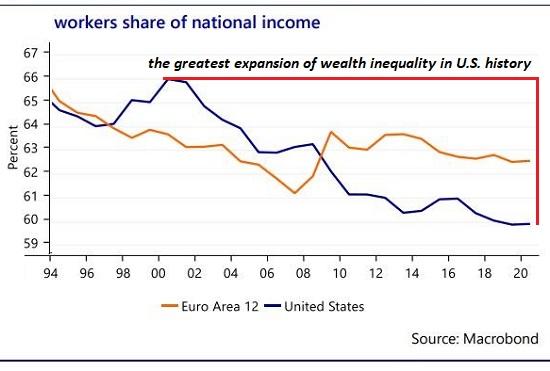
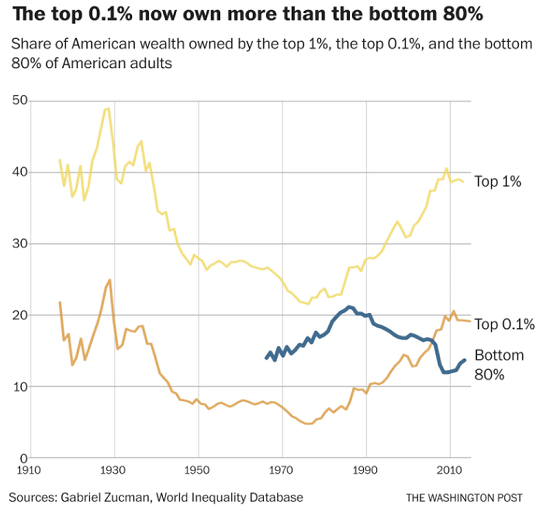
Here’s a few of the many charts you’ve seen over the years here that illustrate rising inequality:
Global Stocks Plunge On Bank, Election, Virus Fears; Treasuries, Dollar Spike Tyler Durden
Mon, 09/21/2020 – 07:50
We said that futures trading ahead of the Monday open would be “fun“, and sure enough they did not disappoint.
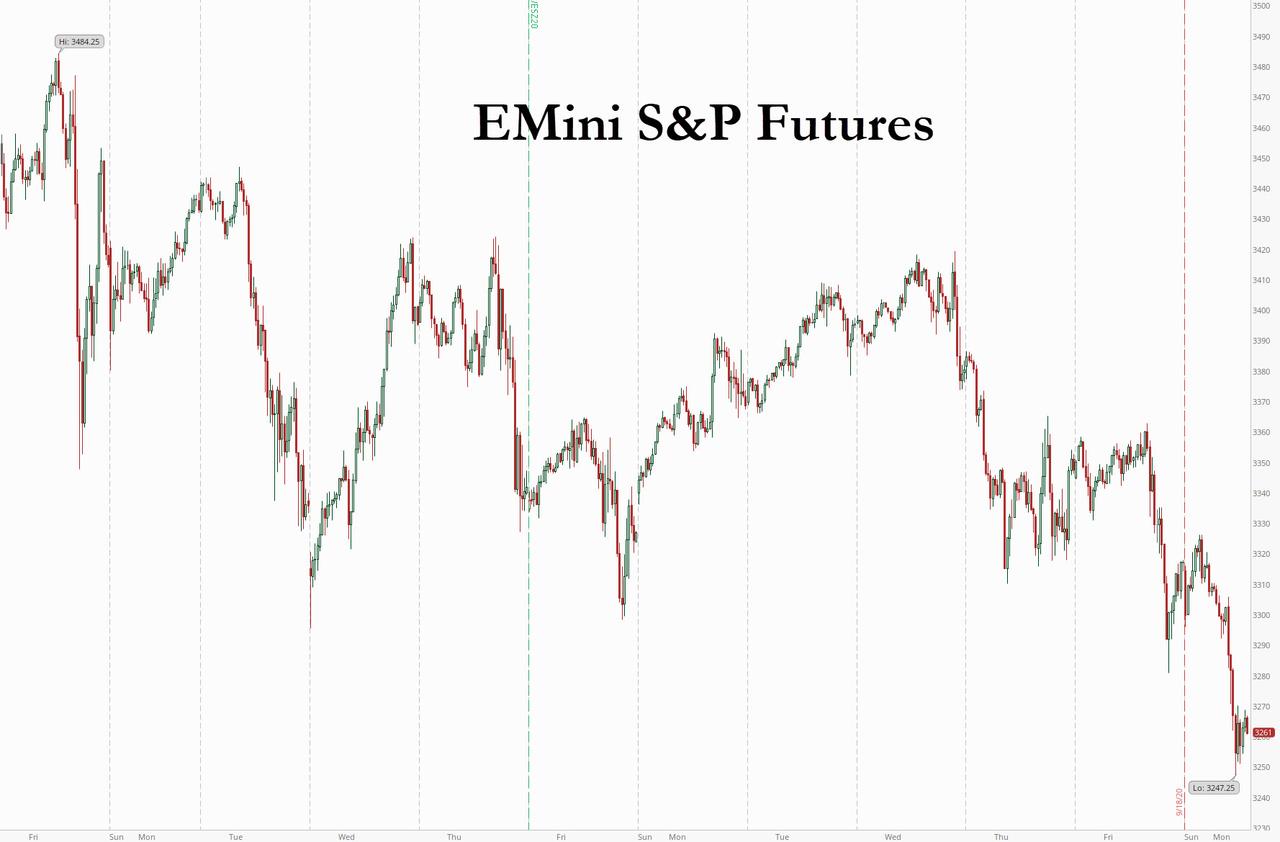
Global markets tumbled on Monday, as S&P futures slid below 3,300 after failing to hold 50DMA support on Friday, and with European stocks falling the most since July as investors worried about renewed covid lockdowns across European countries and a report detailing suspicious transactions at international banks, with a lack of U.S. stimulus and concerns about how the death of Ruth Bader Ginsburg would impact what are already set to be extremely contested elections also hit sentiment.
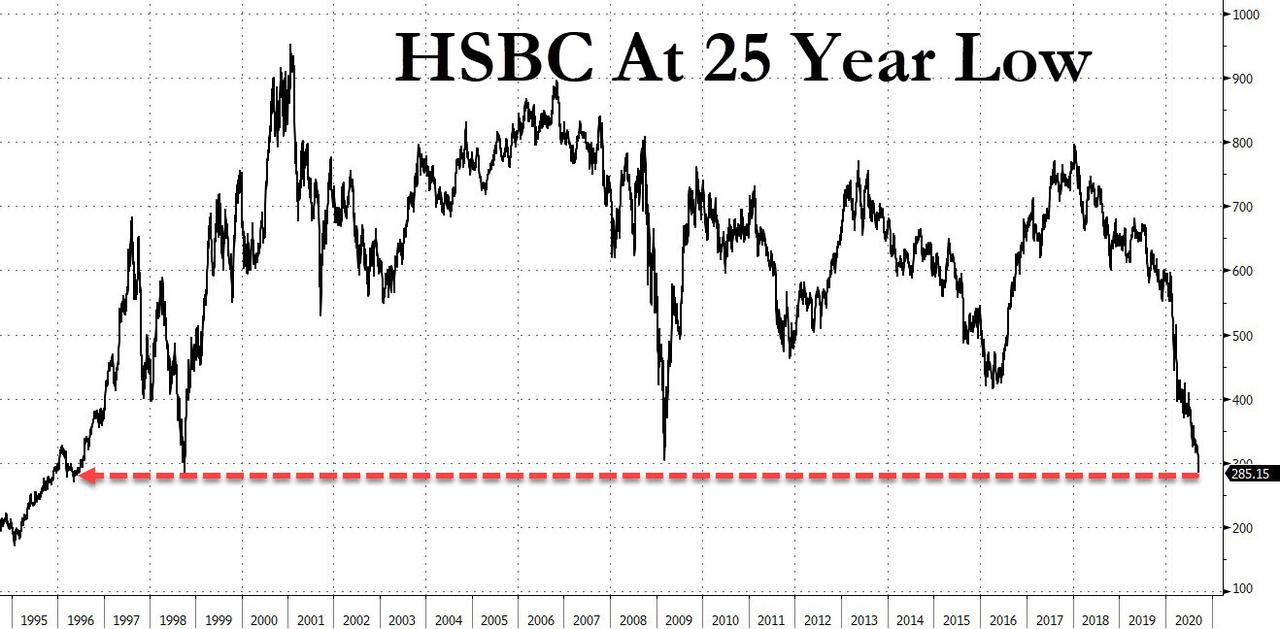
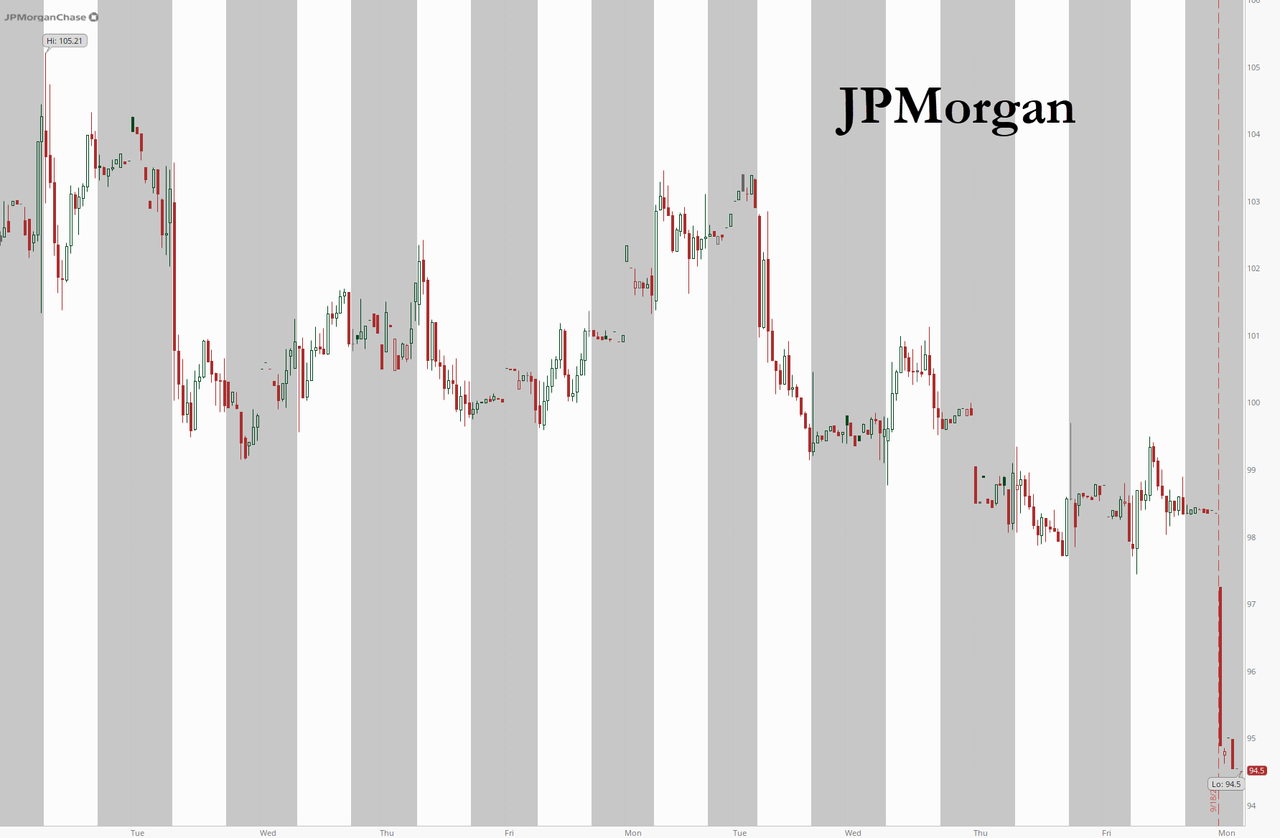
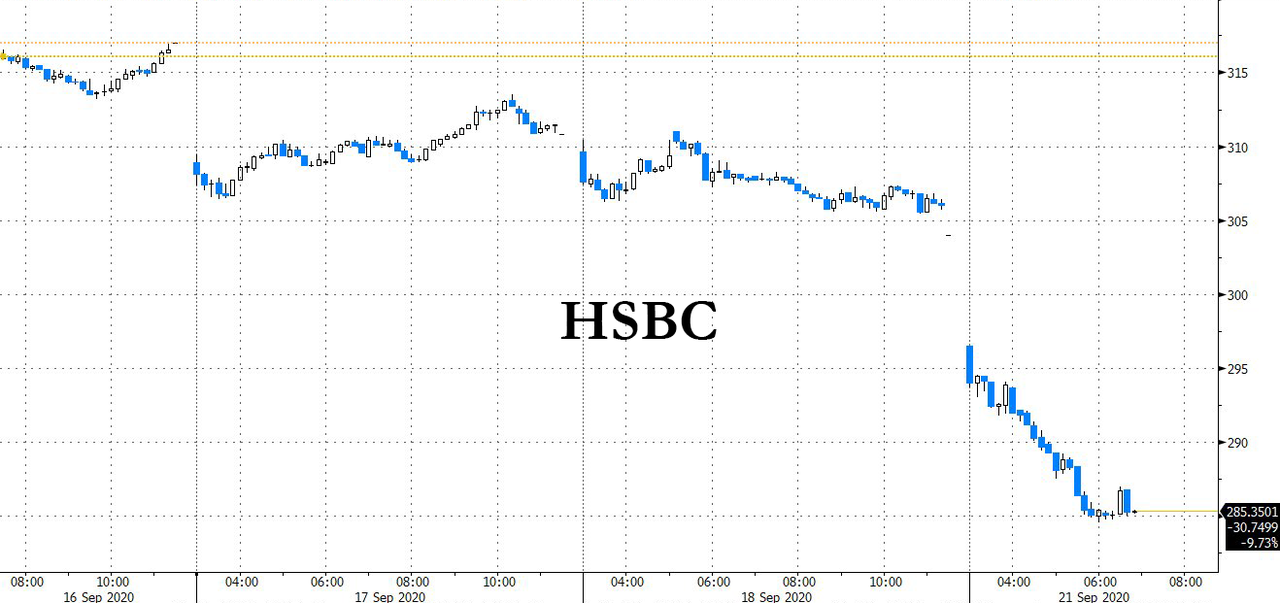
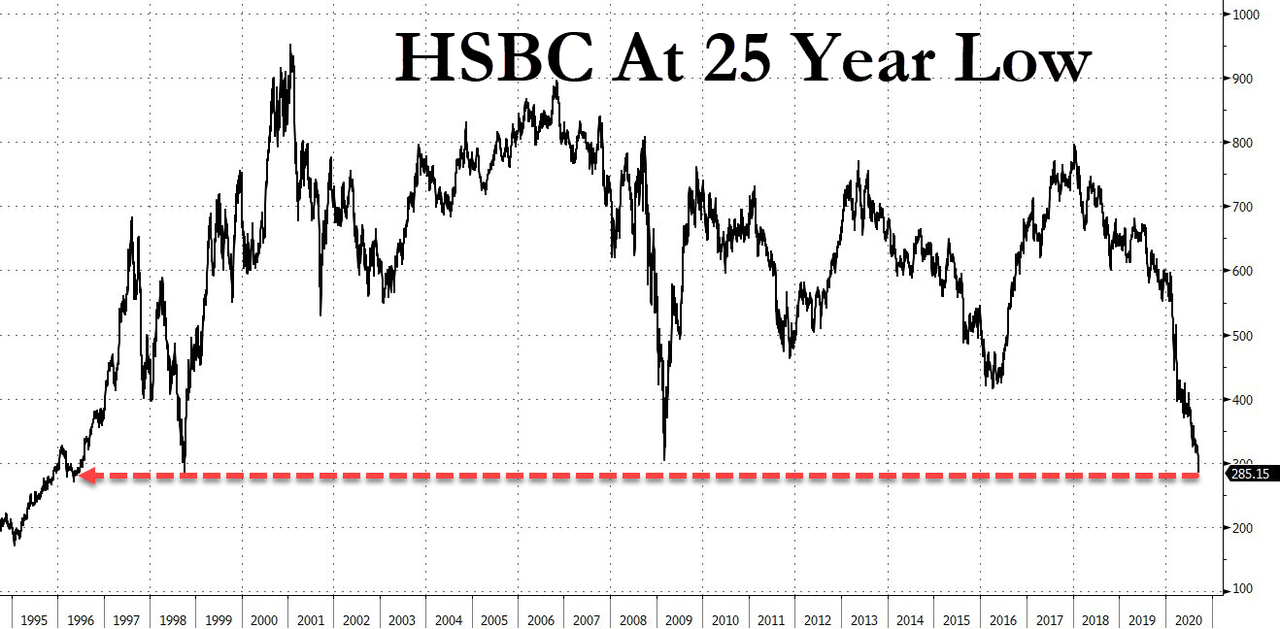
U.S. stock index futures dropped 1.8% on Monday hit by bank stocks following media reports that several global banks moved sums of allegedly illicit funds over nearly two decades. Shares in JPMorgan Chase and Bank of New York Mellon Corp fell 4% and 3.3%, respectively, after a after a report by the International Consortium of Investigative Journalists that said lenders “kept profiting from powerful and dangerous players” in the past two decades even after the U.S. imposed penalties. HSBC Holdings Plc fell to the lowest since 1995 and European bank shares slumped (more here).
Shares of airlines, hotels and cruise operators led declines in premarket trading, tracking their European peers as the UK signaled the possibility of a second national lockdown. Marriott International, Hilton Worldwide and Hyatt Hotels Corp dropped between 1.5% and 3.6%, while casino operators Wynn Resorts, MGM Resorts International and Las Vegas Sands Corp shed between 2.7% and 6.0%. Tech giants including Apple, Facebook and Amazon.com which had dominated Wall Street’s rally since April, slid between 1.5% and 2.6% in early deals.
Nikola crashed 27.9% after its founder Trevor Milton stepped down as executive chairman, as the U.S. electric-truck maker battles allegations from a short-seller that it misled investors and automakers. General Motors which took an 11% stake in Nikola for about $2 billion earlier this month, slipped 3.7%.
Another round of business restrictions would also threaten a nascent recovery in the wider economy, analysts said, and could spark a flight from equities. The first round of lockdowns in March had led the benchmark S&P 500 to suffer its worst monthly decline since the global financial crisis.
“The market remains concerned about the broader risk emulating from the U.S: Covid, the Supreme Court fight and the upcoming presidential elections,” said Peter Rosenstreich, head of market strategy at Swissquote Bank SA. “With U.S. tech stocks looking weak, the need to jump right into U.S. assets feels less critical.”
The MSCI world equity index was down 0.5%. European indexes opened lower, with the pan-European STOXX 600 down 1.7% at its lowest in nearly two weeks. London’s FTSE 100 was at a two-week low, down 2.4% and Germany’s DAX fell 2%, led by banking shares which slid after a media report on how several global banks moved large sums of allegedly illicit funds over nearly two decades. HSBC shares tumbled to a 25-year low in Hong Kong.
Investors have also turned more cautious about Europe following a sharp uptick in new COVID-19 cases. European countries including Denmark, Greece and Spain have introduced new restrictions on activity. According to Reuters, Britain is considering a second national lockdown as new cases rise by at least 6,000 per day. Germany’s health minister said the rising new infections in countries like France, Austria and the Netherlands is worrying. Investors will be looking ahead to flash PMI data on Wednesday for the first hints of how economies have fared in September.
“Concerns are rising that the summer recovery is probably as good as it gets when it comes to the recent rebound in economic activity,” wrote Michael Hewson, chief market analyst at CMC Markets UK. “This reality combined with the growing realisation that a vaccine remains many months away, despite President (Donald) Trump’s claims to the contrary, has made investors increasingly nervous, as we head into an autumn that could see lockdowns reimposed.”
Earlier in the session, Asian stocks fell, led by materials and finance, after rising in the last session. The Hang Seng Index slid 1.5%, while equities in China and Australia also retreated. Taiwan’s dollar strengthened to a level not seen in seven years.The Shanghai Composite Index retreated 0.6%, with Sanxiang Advanced and Shandong Shida posting the biggest slides.
Emerging-market stocks and currencies headed for their biggest declines this month as surging coronavirus cases and uncertainty about additional US fiscal support dented demand for risky assets. The Mexican peso and South African rand led the retreat among peers as the U.S. political battle over who will be the next Supreme Court justice – following the death of Ruth Bader Ginsburg six weeks before Election Day – also weighed on sentiment. South Africa’s stock market was the worst performer, with the main benchmark headed for its longest losing streak since May 2019. The average spread on developing-nation dollar debt widened by 2 basis points.
Seven members of the Fed will speak this week – including chairman Jerome Powell appearing before Congressional committees – so investors will be looking for hints to determine the dollar’s direction. In a House Financial Services Committee hearing on Tuesday, Federal Reserve Chair Jerome Powell and Treasury Secretary Steven Mnuchin are expected to speak about the need for more stimulus.
“There’re too much expectations about U.S. economic resilience,” said Fabrizio Fiorini, chief investment officer at Pramerica SGR SpA. “There is more selloff to come. Election risk is underestimated.”
In FX, the Bloomberg Dollar Spot Index reversed early losses and extended Friday’s advance to rise against all Group-of-10 peers apart from the safe-haven Japanese yen which was in its sixth consecutive session of gains versus the dollar, up around 0.4% at 104.185. Japan has public holidays on Monday and Tuesday this week, meaning volumes are thin in Asian trading. The euro dipped against the dollar, sliding to $1.1791 while the safe Swiss franc rose against both the dollar and euro.
The yuan headed for a third straight daily drop, the longest slide since July, as the greenback advanced. The onshore yuan slipped 0.14% to 6.7793 a dollar as of 5:53 p.m. in Shanghai after earlier rising as much as 0.2%. A measure of the dollar’s strength rose in the afternoon as risk appetite took a hit on concern that the climbing number of virus cases across Europe could lead to travel restrictions and cripple an economic recovery. Despite the retreat over past few days, the onshore yuan has surged 4.3% in the third quarter, on pace for the best performance on record. The rally has come as the greenback is set for its weakest quarter in a decade and amid investor optimism over China economy.
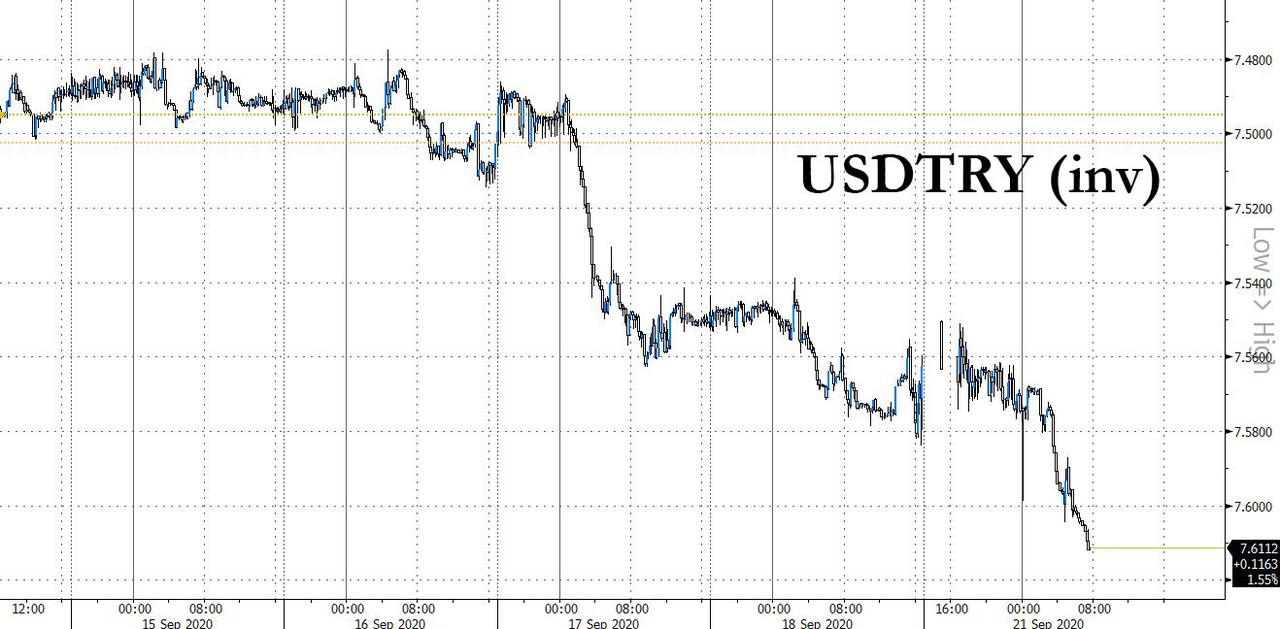
The Turkish lira continued to plumb record lows with Moody’s adding more fuel to the fire warning that the country has almost depleted its buffers against a Balance of Payments crisis.
In rates, Treasuries jumped after risk sentiment deteriorated in global markets. Yields were lower by 5.5bp across long-end of the curve, flattening 2s10s, 5s30s by 3.1bp and 3.5bp; 10-year yields richer by 3.8bp at 0.655%. Treasuries bull flatten from London open after cash markets closed in Asia for Japan holiday. Risk-off backdrop supports long-end of the curve with S&P e-minis lower by 1.6% and Estoxx 50 dropping 3% over European morning session. U.S. 2-, 5-, 7-year sales due this week for comb. $155b, while Fed chair Powell is due to speak three times. In Europe, the benchmark 10-year German bund yield was down 2 basis points at -0.507% with most high-rated euro zone government bond yields down by a similar amount. The European Central Bank will review how long its emergency pandemic bond-purchase scheme should go on, the Financial Times reported. The European Council meets in a summit on Thursday and Friday this week.
Elsewhere, oil prices fell, with Brent crude down 1.8% at $42.39 a barrel while WTI was down 1.9% at $40.34 a barrel. Gold prices slumped, hit by the rising dollar, with spot gold down to $1,931 per ounce at 730am ET>
Data include the Chicago Fed National Activity Index. No major earnings are expected.
Market Snapshot
S&P 500 futures down 1.8% to 3,262.75
STOXX Europe 600 down 2.2% to 360.69
MXAP down 0.6% to 172.88
MXAPJ down 1% to 563.47
Nikkei up 0.2% to 23,360.30
Topix up 0.5% to 1,646.42
Hang Seng Index down 2.1% to 23,950.69
Shanghai Composite down 0.6% to 3,316.94
Sensex down 0.9% to 38,482.09
Australia S&P/ASX 200 down 0.7% to 5,822.62
Kospi down 1% to 2,389.39
Brent futures down 2% to $42.29/bbl
German 10Y yield fell 2.6 bps to -0.511%
Euro down 0.3% to $1.1807
Italian 10Y yield rose 0.7 bps to 0.756%
Spanish 10Y yield fell 0.2 bps to 0.283%
Gold spot down 0.5% to $1,940.89
U.S. Dollar Index up 0.3% to 93.19
Top Overnight News
U.S. deaths related to Covid-19 approached 200,000 and the nation’s new cases rose in line with a one-week average. Former FDA Commissioner Scott Gottlieb said he expects the U.S. to experience “at least one more cycle” of the virus in the fall and winter
The dollar’s weakest quarter in a decade may get even worse as investors respond to the effects that massive American equity-market gains have had on the composition of their portfolios
The European Union will unleash as many green bonds as the world issued last year, testing the level of investor interest in financing a shift toward cleaner economies
Democratic presidential nominee Joe Biden blasted Republican efforts to speed through a replacement for the late Justice Ruth Bader Ginsburg on the Supreme Court, warning that such a process would “inflict irreversible damage” on the country
Britain is at a “critical point” in the coronavirus pandemic, Prime Minister Boris Johnson will be told on Monday, as concern mounts that a second lockdown may be needed to stop the renewed spread of the disease.
The European Central Bank has launched a review of its pandemic bond-buying program to consider how long it should continue and whether its exceptional flexibility should be extended to older programs, the Financial Times reported, citing two Governing Council members that it didn’t identify
New Zealand cabinet has confirmed that gathering limits in Auckland will ease from Sept 23 while they will be lifted entirely for the rest of the country tonight, Prime Minister Jacinda Ardern said Monday
Oil steadied following its biggest weekly gain since June as a lack of clarity over the global energy demand recovery was balanced by the possibility that Saudi Arabia could press for more OPEC+ output cuts
A quick look at global markets courtesy of NewsSquawk:
Asian equity markets were subdued and US equity futures traded choppy after last Friday’s losses on Wall St amid quadruple witching and continued tech woes, with risk appetite also dampened by holiday conditions as Japanese participants observe a 4-day weekend. ASX 200 (-0.7%) was negative with losses in metal miners and financials underperforming in the broad weakness across its sectors aside from Health Care and Energy, while KOSPI (-1.0%) swung from gains and losses on varied COVID-19 headlines with South Korea to extend level 2 social distancing curbs by an additional week but will also be distributing emergency funds from the 4th extra budget within days. Hang Seng (-2.0%) and Shanghai Composite (-0.6%) were downbeat with HSBC shares slumping to a 25-year low in Hong Kong after a leaked document noted that the bank had permitted GBP 62mln to be moved to Hong Kong in suspicious transactions during 2013-2014 despite being warned by a regulator, while Standard Chartered also declined after being implicated by the ‘FinCEN’ leak, and other reports noted concerns HSBC and Standard Chartered could be frozen out of the US banking system in the event of a further escalation US-China tensions. Elsewhere, Tencent shares were pressured amid uncertainty regarding its US future despite a California judge halting President Trump’s ban on WeChat downloads, while weekend news that President Trump gave his blessing to the TikTok-Oracle-Walmart deal, also did little to spur risk appetite.
Top Asian News
Hedge Funds Raise Long Aussie Bets to 2018 High on China Rebound
Amundi Sanguine on Indonesian Bonds on Attractive Real Yields
China Tried to Dramatize Its Handling of the Virus. It Backfired
SCG Packaging Seeks to Raise Up to $1.27 Billion in Thai IPO
Stocks in Europe see deep losses across the board (Euro Stoxx 50 -3%) as the region coat-tailed on the downbeat APAC handover before extending on losses amid an intensifying risk averse tone and a number of sector-specific factors. Firstly, Travel & Leisure resides as the marked underperformer as the resurging cases across Europe trigger warning bells for the sector, with some of the region’s worst performers including the likes IAG (-12%), Tui (-8.6%), easyJet (-8.4%), Carnival (-8.0%), Lufthansa (-7.7%) and Ryanair (-7.1%). Secondly, the European banking sector plumbs the depths in light of a leaked US government document accused HSBC (-5%), Standard Chartered (-4.4%), Barclays (-6.2%), Deutsche Bank (-5.6%), JPM (-3.6% premkt) and BNY Mellon (-2.5% premkt) of moving large sums of illegal cash for shady characters and criminal networks. The documents center around the number of SAR’s (Suspicious Activity Reports) sent to US authorities between 1999 and 2017. The Basic Resources and Oil & Gas sectors are also among the laggards. As such, the UK’s FTSE 100 (-3.4%) underperforms the region despite a softer Sterling, given its heavy exposure to the aforementioned sectors. In terms of other movers and shakers, United Internet (-24%) and 1&1 Drillisch (-27%) reside as the biggest losers in Europe after cutting their respective FY EBTIDA guidance, whilst their spat with Telefonica (-3.6%) intensified over its subsidiary Telefonica Deutschland (-3.4) being accused of raising user costs significantly from July. Elsewhere, Rolls-Royce (-8.5%) holds onto its losses amid reports that the group is planning to raise as much as GBP 2.5bln to brace itself for another demand decline for aircraft engines. As such, Leonardo (-6.0%) continues falling despite an early halt, whilst Safran (-4.4%) is also pressured in sympathy. Finally, the Norwegian government has proposed that its Sovereign Wealth Fund should invest more within the US stock market and less within Europe.
Top European News
Unilever’s Dutch Investors Said to Approve Single Headquarters
European Stocks Drop Most Since July as HSBC Leads Bank Slump
Sweden Loosens Purse Strings With Virus Stimulus Budget
U.K. House Prices Up Most Since 2016 as Britons Seek More Space
In FX, although the Dollar has regained some poise amidst more pronounced risk aversion at the start of a new week, Usd/Jpy continues to decline alongside Yen crosses in the absence of Japanese market participants for ‘Old Age Day’. The headline pair has now breached another key chart if not major technical level in the form of July 31’s 104.20 low and there is little in the way of 104.00 to stop a 250+ pip cumulative fall from this month’s early peaks, especially given another holiday on Tuesday (Autumnal Equinox). However, it remains to be seen whether a 103.00 print provokes some verbal intervention from the MoF, and for now greater safe-haven demand for the Jpy is keeping the Usd index relatively capped beyond 93.000 within a 93.322-92.746 band.
AUD/CAD/CHF – All succumbing to the increasingly sour tone and deterioration in broad sentiment as the Aussie loses 0.7300+ status vs its US counterpart, the Loonie retreats through 1.3200 with added fuel from a reversal in crude prices and the Franc falls back below 0.9100, albeit holding above 1.0800 against the Euro following latest weekly Swiss bank sight deposit balances showing perhaps surprise declines ahead of the SNB. Question is, are these coincidental or significant in advance of a more official shift in policy to be revealed at Thursday’s quarterly review?
NZD/EUR/GBP – The Kiwi is back-pedalling further from Friday’s near 0.6800 peak vs its US peer and 1.0800+ apex on the Aud/Nzd cross even though NZ PM Adern scaled down the country’s COVID-19 alert level outside of Auckland again, while the Euro is retesting bids/support around 1.1800 and Sterling has recoiled over a big figure to sub-1.2850 on the ongoing rise of the pandemic across Europe.
SCANDI/EM – A sea of red as risk assets tumble, while the aforementioned downturn in oil takes a heavier toll on the Norwegian Crown compared to the Swedish Krona that seems to be deriving some traction from upbeat commentary by the nation’s Finance Minister. Similarly, the Yuan is drawing a degree of comfort from a steady PBoC Cny fixing, net liquidity injection and unchanged loan prime rates to offset other less favourable issues like the ongoing Sino-US spat and reports from China’s top infectious disease expert warning that a 2nd wave is inevitable. Conversely, diplomatic strains and the retracement in Brent are undermining the Lira and Rouble again, while the Rand has unwounded all and more of its post-SARB gains.
In commodities, WTI and Brent front month futures continue to decline with losses driven by the broader risk averse sentiment coupled with a firmer Dollar and the prospect of dwindling demand given the resurgence of COVID-19 prompting talks of renewed lockdown measures. Furthermore, on the supply side of the equation, Libya’s NOC said it will lift the force majeure at ports and facilities that were deemed safe, with the gradual return of Libyan oil raising questions in terms of an OPEC quota for the country. WTI Nov resides around USD 40.50/bbl, having declined from a high ~41.50/bbl, whilst Brent Nov hovers just under USD 42.50/bbl vs. a high of USD 43.30/bbl. Another thing to keep on the radar – unconfirmed twitter reports noted that Saudi King Salman is reportedly in a critical condition, albeit nothing has been seen since on this front, with participants likely to dwell on the future of the Kingdom’s oil policy should he be replaced. Elsewhere, precious metal prices succumb to the Dollar, with spot gold now losing ground below the USD 1950/oz mark having traded on either side of the level in APAC hours. Spot silver meanwhile extends losses below USD 26.50/oz after printing a high just shy of USD 27/oz earlier in the session. In terms of base metals, LME copper is pressured by the broader equity sell-off and the firmer Buck, whilst Dalian iron ore futures slipped over 2% amid the soured risk tone and sluggish downstream demand.
US Event Calendar
8:30am: Chicago Fed Nat Activity Index, est. 1.2, prior 1.2
12pm: Household Change in Net Worth, prior $6.55t deficit
DB’s Jim Reid concludes the overnight wrap
one of the reasons we have a widening bias for credit into year-end ( see our YE outlook here from a couple of weeks back) is that it seemed inevitable to us that we’d see a second wave causing confusion and chaos to many government’s strategies. Well as we sweltered in a pretty hot late September weekend here in the U.K. (and across much of Europe) the fact that the virus is already spreading quite rapidly is a big worry. It doesn’t feel like fatalities are going to be as big as an issue as they were in the first wave but it really is hard to understand what the strategies of governments are at the moment. They pretty much all don’t want a further wide scale lockdown but they also don’t want the virus to spread. Its not going to be easy to solve for both and as such It’s going to be a pretty difficult few months ahead if September is seeing numbers as high as they are already. I personally didn’t think these type of numbers would take place until well into October. Expect lots more restrictions over the days and weeks ahead, especially in Europe.
The latest on virus is that its spread has continued in the Europe with France reporting 37,282 new cases in the last 3 days, the highest since pandemic began. The 7 day average of new cases for France stands at 10,123,versus 8,161 a week ago. Over in the UK, the 3-day number stands at 12,661, the highest since May 9 with Health Secretary Matt Hancock not ruling out that London office employees might have to work from home again this week as Chief Medical Officer Chris Whitty is set to warn on today that the UK is at a “critical point.” Meanwhile, the LBC radio reported yesterday that London Mayor Sadiq Khan will recommend tightened rules for the capital today. Across the other side of world, South Korea reported 70 new cases yesterday, the lowest since the second wave began. However, the country is set to strengthen social distancing rules from September 28 to October 11, which will be designated as special quarantine period as the country celebrates Chuseok holidays from September 30 to October 4. So restrictions are tightening in even successful virus fighting places.
The weekend political press has also been full of news after US Supreme Court Justice Ruth Bader Ginsburg passed away late Friday night following a long battle with cancer. Afterwards, President Trump said that he would put forth a nominee to fill the seat and Senate Majority Leader McConnell said “President Trump’s nominee will receive a vote on the floor of the United States Senate,” indicating that Republican leadership will try to fill the seat ahead of the election.This represents a turn in the Majority leader’s thinking from 2016, where he did not allow a floor vote for then-President Obama’s nominee in an election year. The nomination and confirmation process will introduce a new element to an election not least because the court can hold sway over highly contentious issues like healthcare, abortion rights and gun law.
It brings lots of fascinating scenarios to the table. If Trump succeeds at getting his nomination through before the election there will be a 6-3 Republican bias to the Supreme Court which as discussed could have policy ramifications for the US for a generation. Democrats are up in arms that the Republicans won’t wait until after the election and are suggesting that may do extraordinary things to address the balance (like adding new judges to the bench) if they gain control of both the Senate and the White House. Congress altered the size of the bench seven times in the first eighty years of the republic (ranging from 5 to 10 justices) but this has not changed since the Judiciary Act of 1869. However getting the current Senate to confirm a nominee won’t be straight forward for Mr Trump as the GOP only hold a 53-47 majority in the Senate (with Vice President Pence serving as the tie-breaker) and a few members have already made noises that they don’t think a new judge should be added this close to the election. So even more drama added to an election campaign.
Another interesting weekend story is of China revealing how it will manage its “unreliable entity list” that aims to punish firms, organizations or individuals that pose a threat or potential threat to China’s sovereignty, national security, development and business interests; and those that discriminate against or harm Chinese businesses, organizations or individuals. According to details, penalties will include restrictions on trade, investment and visas of any company, country, group or person that appears on its “unreliable entity list.” The Global Times has carried an article that HSBC is a possible candidate and is down -2.91% to the lowest level it has traded since the 2008 financial crisis.
In overall trading, the Hang Seng (-0.95%) is leading the declines this morning not helped by this. Other Asian markets have also started the week on a weak footing with the Shanghai Comp (-0.41%), Kospi (-0.29%) and Asx (-0.54%) all down along with S&P 500 futures (-0.21%). In fx, all G-10 currencies are trading strong against the greenback with the US dollar index down -0.21%.
In other news, the FT reported that the ECB has launched a review of its pandemic bond-buying program to consider how long it should continue and whether its exceptional flexibility should be extended to older programs. The report added that the review is expected to be discussed by policy makers next month.
Looking to this week now, the flash PMIs on Wednesday will probably get the most attention due to it being one of the first glimpses of September economic performance around the world. Economic and social restrictions are mounting again in various places due to the virus but it may be a bit too early to see their impact in these numbers.
It’ll also be worth keeping an eye on Germany’s Ifo survey on Thursday, which has so far been rising each month since its April low, even as it remains below its pre-pandemic level. The consensus is looking for a further increase to 93.8, which would be just 2 points below its level in February.
Meanwhile Fed Chair Powell will be speaking three times before congressional committees. He’ll be appearing tomorrow before the House Financial Services Panel about the CARES Act. Then on Wednesday he’ll be appearing on the House Select Subcommittee on the Coronavirus Crisis, before Thursday sees him speak before the Senate Banking Committee on the CARES Act once again. Otherwise, there’ll be remarks from Fed Vice Chair Quarles on the economic outlook, while Bank of England Governor Bailey will be speaking twice next week.
There’ll also a special European Council summit on Thursday and Friday. As well as taking stock of the Covid-19 pandemic, the agenda includes a discussion of the single market, industrial policy and digital transformation, along with the EU’s external relations. Brexit may get a small mention as relationships between the EU and the U.K. are just about hanging by enough of a thread enough to merit it. The day by day calendar of the week ahead is at the end.
Recapping last week now and equity markets continued to feel the pullback in mega-cap tech stocks. The S&P 500 dropped -0.64% (-1.12% Friday) to six week lows, having declined for a third straight week for the first time since October 2019. The index is now down -7.30% from 2 Sept highs. The NASDAQ also fell a third week in a row itself, declining -0.56% (-1.07% Friday) and is now down -10.48% from recent highs. Meanwhile European equities edged higher for a second straight week with the Stoxx 600 ending the week +0.22% higher (-0.66% Friday). While the broader index rose on the week, many individual bourses across Europe finished lower with the DAX (-0.66%), FTSE 100 (-0.42%), FTSE MIB (-1.49%), CAC 40 (-1.11%) and IBEX (-0.19%) all posting losses as Covid-19 caseloads continue to rise throughout western Europe, prompting some restrictions to be reinstated. Asian equities were mixed with the CSI 300 up +2.37% on the week, while the Nikkei (-0.20%) and the Kospi (+0.66%) saw smaller weekly moves.
Similar to risk assets, core sovereign bonds were mixed on the week. US 10yr Treasury yields rose +2.8bps (+0.5bps Friday) to finish at 0.694%, while 10yr Bund yields were down -0.4bps (+0.6bps Friday) to -0.49% and gilts were largely unchanged (+0.1bps) at 0.18%. The dollar fell -0.44% on the week after rising in 3 of the previous 4 weeks. This in part supported gold’s +0.53% rise on the week, while copper gained +2.62%. However, the largest move in commodities was in oil. Brent (+8.34%) and WTI (+10.13%) rose in part on news that Russia and Saudi Arabia would push their fellow OPEC+ members on keeping to quotas.
On the data front from Friday, UK August retail sales rose more than expected and up +0.6% MoM (+0.4% expected) and +4.3% YoY (+4.2% expected). In Germany, August PPI was -1.2% YoY, up from last month’s -1.7% reading and slightly higher than expected (-1.4%). While in the US, the preliminary reading of the University of Michigan Sentiment survey showed an +4.9pt increase to 78.9 (75.0 expected), which is the highest since March.
via ZeroHedge News https://ift.tt/2FM9deg Tyler Durden
European Banks See Biggest Drop In Months After Massive FinCEN Leak Tyler Durden
Mon, 09/21/2020 – 07:01
Shares of the world’s biggest banks are tumbling in premarket trade Monday morning after Buzzfeed last night published a lengthy report based on a cache of thousands of leaked SARS – suspicious activity reports – filed by the world’s biggest banks, including JP Morgan, and Deutsche Bank, which were both prominently featured.
JP Morgan shares tumbled 3.5% to their lowest levels since July.
European banks bore the brunt of the selling on Monday, given that many European megabanks featured prominently in the reporting. Deutsche Bank tumbled 8.3% as the report relitigated parts of the Mueller probe and the bank’s involvement with the Trump family, and members of the Trump inner circle. Reports in the files revealed at least $1.3 trillion in suspicious transactions passed through the bank between the late 1990s and late 2010s.
European banks are having their worst session in six months, as HSBC falls 4% to lows unseen in decades. HSBC and Standard Chartered both featured heavily in the report, as transgressions involving both banks from around 2012 were cited as helping spur a massive surge in banks filing SARs.
As a result of dredging up these years-old allegations, HSBC shares – already battered by uncertainty in its biggest market, Hong Kong – have slumped to their lowest level since 1995.
DB, meanwhile, was shown to have processed $1.3 trillion in suspicious transactions between the late 1990s and 2017. All told, the documents obtained by Buzzfeed and shared with the ICIJ showed the banks moving more than $2 trillion in suspicious funds between 1999 and 2017.
The Stoxx Europe 600 banks index dropped 4.6% at its lows, the biggest daily drop in more than 3 months.
European banks are now down roughly 43% so far this year. One banking analyst noted that although the allegations represented in the story are years, even decades, old, the sprawling report is “yet another bad-report card for the banking sector,” wrote Zurcher Kantonalbank analysts in a note to clients.
via ZeroHedge News https://ift.tt/3mB7kln Tyler Durden