Wiping Out $1 Trillion In Student Debt Could Soon Be Government Policy

Wiping Out $1 Trillion In Student Debt Could Soon Be Government Policy

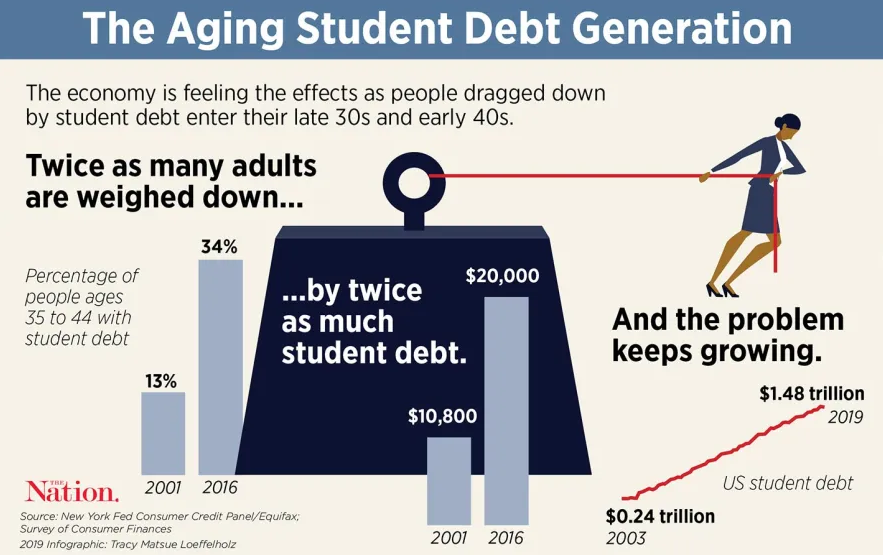
Biden is still under immense pressure within his own Democratic Party to cancel a much bigger portion of student debt via executive order “from day one” than he’s already promised to forgive, namely $10,000 per borrower according to his prior campaign statements.

A new deep dive reviewing the main arguments and counterarguments in Bloomberg Businessweek underscores that “Just a few years ago, writing off large chunks of the U.S.’s $1.7 trillion in student debt seemed like a fringe idea. In a few weeks’ time, it could be government policy.”

Biden’s current plan would cancel about $370 billion in loans, but the much more ambitious Schumer-Warren plan would wipe $1 trillion off the books. Pretty much all agree that the cost of higher education is becoming astronomical, to the point of becoming a crushing burden to middle class families. But the progressives’ plan will likely only exacerbate the crisis while rewarding upper income families.

Biden is also seeking to attach to his plan a mandate making public universities free for all families that earn under $125,000 a year. Below are some of the pros and cons to the competing proposals being battled over internally within the Democratic camp ahead of Biden’s taking office.

* * *

Largest Debt Type for Most Families

Since 2008 student debt has been the largest type of debt to strap families.

Explains Bloomberg: “Borrowing has risen in tandem with college costs, which have outpaced incomes for a generation, and accelerated after the 2008 crash—partly because state governments cut funding for higher education and public colleges covered the shortfall by charging their students more. There’s also been a decades-long expansion of higher education that has drawn in students from lower-income families more likely to depend on loans. And unpaid debts can snowball, because even in an era of ultralow interest rates, student loans are pretty expensive. Interest rates have ranged from 4.5% to 8% in recent years, with graduate students and parents who borrowed on their kids’ behalf generally paying more.”

In recent years there have remained fewer of the well-paying jobs new graduates could in better times more easily find.

Long gone is the boomer generation trend of get a degree = secure a good job right out of college. Bloomberg reviews: “For years now, delinquencies and defaults on student debt have been running much higher than for those on other types of loans. That’s in large part because, even amid the longest expansion in U.S. history, the economy hasn’t been creating enough of the well-paid jobs that all these graduates had counted on. High dropout rates, especially at for-profit colleges, are also a factor. In 2019 only about 40% of borrowers were current on their payments.

Likely Options & Non-solutions

Bloomberg continues: “Biden could just renew the payment freeze. President Trump did that by executive order in August, so it won’t trigger a dispute over presidential powers. But if Biden tries to use the same instrument to cancel student debt, bypassing a Congress where he may not have a Senate majority, some analysts foresee legal challenges.” Of course, progressives are pushing for much more, including the at least $50,000 of individual forgiveness pushed in the Schumer-Warren plan.

It still won’t help those hit hardest by the pandemic, for example in the service industry, but is likely to instead do the opposite: “Critics say debt forgiveness helps college graduates at a time when low-paid service workers, mostly without degrees, have been hit hardest by the pandemic,” Bloomberg notes. 

“It would sow more division in a country where education levels are one of the clearest fault lines. And they say it’s unfair to student borrowers who paid what they owed.”

Wealthier Households will Actually Benefit

As we and others have detailed elsewhere: “Also, some argue that debt forgiveness won’t do much for the economy right now because the extra cash it frees up will be spread over years, will flow disproportionately to wealthier households less likely to spend it, and may incur tax liabilities that cancel out the stimulus effect,” Bloomberg writes.

And further: “Advocates agree that wealthier families tend to have larger student debt totals, so they might get a greater break in simple dollar terms from forgiveness,” and yet they still argue, “But, they say, student debt is even more of a burden for lower-income families, so relief would benefit them more even if the value of loans forgiven is less.”

Read the full Bloomberg analysis here.

Tyler Durden
Sat, 01/09/2021 – 09:55

via ZeroHedge News https://ift.tt/35sMa1Q Tyler Durden

This Is An Obvious Double-Standard

This Is An Obvious Double-Standard

Authored by Simon Black via SovereignMan.com,

I imagine that every single one of us has had a huge argument with a loved one at some point in our lives.

Sometimes it’s because of some issue that’s deeply personal to us. But the other person just doesn’t get it. We’re angry, they’re dismissive.

We’ve probably all been there– upset about something that’s important to us, and our wife/husband/girlfriend/boyfriend just acts as if they don’t care. It’s like they’re not even listening.

And that attitude only escalates the argument.

It makes a lot of people want to scream WHY AREN’T YOU LISTENING?!?!!?

And that’s human nature. People become even angrier when someone pompously waives us off and says, “Oh just calm down.”

When you’re in a relationship, you have a reasonable expectation that, if something is important to you, your loved one will make that issue important to them. Or they’ll at least listen and take you seriously.

But when they just dismiss your anger, it can feel like a betrayal. That’s not how a loved one should be treated. And it’s enraging.

We saw this last year after George Floyd was killed.

Countless people were already angry and disgusted. They felt like no one was listening. They felt like their completely valid and justifiable concerns had been dismissed for years… decades.

And the rage finally exploded.

But remember what happened– the media and political establishment almost immediately extended their support.

Politicians took a knee and raised a fist in solidarity. The boy mayor Minneapolis, Jacob Frey, sobbed about his “brokenness” in front of a crowd of protesters, while mayors across the country began heeding the call to #defundthepolice.

Kamala Harris went on The Late Show while looting, rioting, and arson peaceful protests took place across the country and told the host Stephen Colbert:

They’re not going to stop. And everyone beware. Because they’re not going to stop before Election Day in November, and they’re not going to stop after Election Day . . . they’re not going to let up, and they should not.”

Meanwhile, the media went out of its way to present the protests in the best possible light.

Even if a reporter was literally standing in front of a blazing inferno, they still called the protests “mostly peaceful.” And they applauded vandalism and destruction of public property.

The Associated Press ‘stylebook’, which is sort of the syntactical bible in journalism, told reporters never to use the word “riot”, and instead replace it with “unrest”.

Back in August, a BLM leader stood on a street in Washington DC and said,

“I’m at the point where I want to put these police in a fucking grave. I’m at the point where I’m ready to burn the fucking White House down. I want to take it to the Senators. I want to take it to the Congress. I want to take the fight to them. And at the end of the day, if they ain’t gonna to hear us, we burn them the fuck down.

Another told supporters, “We about to go get that motherfucker,” referring to the President of the United States, and then led the crowd in chanting “It’s time for a revolution!”

But the media and politicians still had nothing but support. The message was clear:

“We hear you, and we understand your anger. We want to help fix it.”

This is what a hurt loved one often needs: Respect. Empathy. Understanding. They need to feel like someone is really listening.

And lately this sort of empathy and understanding is being extended to every possible group or identity that feels oppressed.

We’ve covered so many of these stories– like the child molesters and rapists who have been released from prison or had their sentences reduced simply because they’re trans. Or the masktivists who aren’t charged with a crime when they pepper spray other people who aren’t wearing masks.

If you feel victimized, the media and political establishment now showers you with respect, empathy, and understanding…

…unless, of course, your problem is with the media and political establishment, in which case you are a treasonous conspiracy theorist whose assertions are completely baseless.

And this is what we saw this week.

Regardless of how you feel about Wednesday’s events – whether you’re horrified or happy –  a rational person should at least be able to acknowledge the massive double standard.

For example, the media wasted no time in calling the events “treason”.

This is bizarre, because the Article III of the Constitution clearly defines treason. And the Supreme Court has clarified it in numerous cases, like Cramer v. United States in 1945, in which the Justices stated:

“the crime of treason consists of two elements. . . breaking allegiance. . . and rendering [the enemy] aid and comfort. . . if there is no intent to betray [the country], there is no treason.”

What did we see Wednesday? Thousands of people waving American flags on the balcony of the US Capitol chanting “U-S-A! U-S-A!”.

CNN seriously thinks that such actions constitute an intent to betray the country. Yet BLM activists wanting to murder police, burn down the White House, and “go get that motherfucker” is totally fine.

During the BLM riots, the ‘news’ site Vox ran articles praising the riots, saying they are “destructive, dangerous, and scary– but can lead to serious social reforms.”

But Wednesday’s Vox insisted that every Capitol protester “should be arrested”.

The double standard is extraordinary. And it’s obvious.

The protesters from yesterday, along with millions of other people, are angry.

They feel that they have legitimate grievances. They feel they’ve been lied to. They feel betrayed.

But the media and political establishment has been dismissive at every opportunity. They pretend to want unity and reconciliation. But there is no respect. No empathy. No understanding. No one is listening. No one cares. And the blatant double standard only makes it worse.

So just like an argument between two loved ones, this is only going to escalate.

*  *  *

On another note… We think gold could DOUBLE and silver could increase by up to 5 TIMES in the next few years. That’s why we published a new, 50-page long Ultimate Guide on Gold & Silver that you can download here.

Tyler Durden
Sat, 01/09/2021 – 09:20

via ZeroHedge News https://ift.tt/35qlpem Tyler Durden

FDA Celebrates 10-Year Anniversary of a Food Safety Law That Hasn’t Made Our Food Safer

FoodPoisoning

In a week when hundreds of President Trump’s supporters stormed the U.S. Capitol as part of an effort to overturn the legitimate results of the 2020 presidential election—the latter of which Congress subsequently confirmed was won handily by President-elect Joe Biden—you’d be forgiven if it escaped your notice that one of the country’s worst food laws, the Food Safety Modernization Act (FSMA), just celebrated the 10th anniversary of its signing.

FSMA, which was signed into law on January 4, 2011, by President Obama, gave the Food and Drug Administration (FDA) “more power to crack down on food-safety scofflaws and decrease the incidence of foodborne illness across the country,” I detailed in a 2012 law-review article, The Food-Safety Fallacy: More Regulation Doesn’t Necessarily Make Food Safer.

Before madness overtook the Capitol this week, the FDA was celebrating the law’s birthday.

“It’s not enough to respond to outbreaks of foodborne illness,” said Frank Yiannas, the FDA’s deputy commissioner for food policy, in a statement this week. “We must prevent them from happening in the first place.”

That shift from a reactive to a proactive agency, Yiannas notes, was Congress’s mandate to the FDA in passing FSMA, the most noteworthy update of agency food-safety enforcement in decades. So how’s it going?

Yiannas describes what he sees as FSMA’s key accomplishments, including that food businesses “are now taking concrete steps every day to reduce the risk of contamination” and that the law has caused a “bigger conversation about the importance of food safety,” strengthened agency partnerships with business and civil society, “advanced food safety,” and fostered “safer food in this country.”

But has it really done that?

In 2011, before FSMA was implemented, the Centers for Disease Control, which tracks and responds to foodborne illness outbreaks, estimated that tainted food causes around 48 million illnesses, 128,000 hospitalizations, and 3,000 deaths in the United States each year. Today, a decade on, those CDC estimates remain unchanged. Lest you think those CDC estimates merely haven’t been updated in some time, the agency reported earlier this year that “[t]he incidence of most infections transmitted commonly through food has not declined for many years.”

So if FSMA has not reduced cases of foodborne illnesses, hospitalizations, and deaths, then what was it all for?

Well, it turns out the law wasn’t really designed to reduce those illnesses, hospitalizations, or deaths. Indeed, the idea that FSMA would revolutionize the FDA by changing it from a reactive to a proactive agency always rang hollow. The FDA predicted that FSMA’s best-case reductions in foodborne illness would be an annual decline between 3.7 percent and 5.4 percent. Even that didn’t happen.

The FDA knows FSMA is failing to achieve its objectives. Consider that nearly any time the agency discusses FSMA, it refers to foodborne illness as “a significant public health burden that is largely preventable.” In 2015, Dr. David Acheson, a former FDA associate commissioner for foods, rightly argued that the key marker for FSMA’s success would be whether the law “drive[s] down foodborne illness” and yields “the public health gains that this is all about.” But in 2018, a FSMA working group reported that using cases of foodborne illness to assess FSMA’s efficacy is “a high bar to prove a relationship to the FSMA rules.”

That may be true. But FSMA cannot be a success if overall foodborne illness numbers don’t fall. Dramatically. And they have not.

To be fair, FSMA isn’t all bad. The law did give the FDA one important power—the authority to order a recall of foods that are adulterated (tainted) or misbranded (labeled inaccurately), either of which could sicken or kill one or more persons. And though FSMA is a needless burdensome, clearly ineffective, and costly law that should be repealed forthwith, that’s not to say all federal food-safety laws or programs are wrongheaded. They’re not.

For example, I’ve explained previously that the CDC’s PulseNet tracking program, which “prevents more than 275,000 cases of foodborne illness each year,” is a smart and highly successful program for tracing, combating, and limiting foodborne illness outbreaks. It’s also inexpensive and doesn’t impose additional regulations on food producers.

Toward the end of Yiannas’s statement this week on FSMA, he references a new FDA approach he’s championing: the New Era of Smarter Food Safety.

That evolving approach, which I explained last year will “ramp[] up the use of technology to improve traceability and reduce the spread and impact of future cases of foodborne illness,” is at odds with the proactive approach implemented under FSMA.

That fact alone makes the New Era of Smarter Food Safety sound both realistic and promising. And it reiterates—along with CDC data and other factors—that a decade on, FSMA has failed to meet the lofty food-safety goals its supporters argued it would achieve.

from Latest – Reason.com https://ift.tt/3q5hjAk
via IFTTT

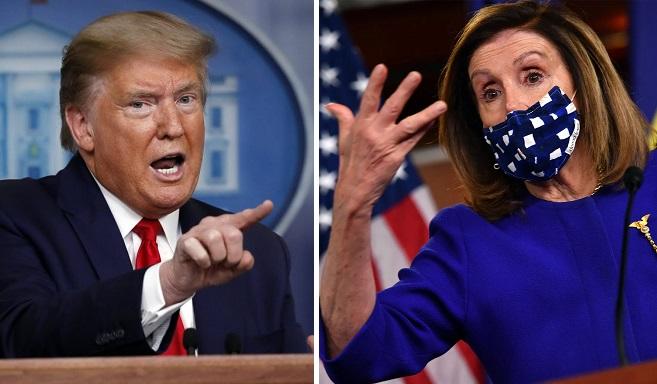
Pelosi ‘Hopes’ Trump Will “Immediately Resign” After White House Slams Democrats’ “Politically Motivated” Impeachment

Pelosi ‘Hopes’ Trump Will “Immediately Resign” After White House Slams Democrats’ “Politically Motivated” Impeachment

Update (1800ET): Speaker Pelosi has decided she wants the last word before the evening news shows begin and has released the following statement reiterating – once again – the exact same threats/promises she delivered earlier:

Pelosi Statement Following Virtual Meeting of the House Democratic Caucus Washington, D.C. Speaker Nancy Pelosi issued this statement following a virtual meeting of the House the House Democratic Caucus this afternoon:

“Today, the House Democratic Caucus had an hours-long conversation that was sad, moving and patriotic. It was a conversation unlike any other, because it followed an action unlike any other.

It is the hope of Members that the President will immediately resign. But if he does not, I have instructed the Rules Committee to be prepared to move forward with Congressman Jamie Raskin’s 25th Amendment legislation and a motion for impeachment.

Accordingly, the House will preserve every option including the 25th Amendment, a motion to impeach or a privileged resolution for impeachment.

With great respect, our deliberations will continue.”

…and so we wait.

*  *  *

Update (1635ET): A few minutes after the Democrats’ articles of impeachment were leaked (well timed ahead of the evening news cycle) and after President-Elect Biden would not be drawn on whether this decision was a good idea with only days in President Trump’s term to go, The White House has issued a brief statement claiming that the impeachment article that may be brought against President Trump is “politically motivated”

“As President Trump said yesterday, this is a time for healing and unity as one Nation.

A politically motivated impeachment against a President with 12 days remaining in his term will only serve to further divide our great country.”

*  *  *

Update (1615ET): NBC News reports that they have received a draft of the articles of impeachment that Democrats are planning to bring on Monday. The articles reportedly claim that Trump “engaged in high crimes and misdemeanors by inciting insurrection.”

“President Trump gravely endangered the security of the United States and its institutions of government,” the draft said.

“He threatened the integrity of the democratic system, interfered with the peaceful transition of power, and imperiled a coordinated branch of government. He thereby betrayed his trust as President, to the manifest injury of the people of the United States.”

“Wherefore President Trump, by such conduct, has demonstrated that he will remain a threat to national security, democracy, and the Constitution if allowed to remain in office, and has acted in a manner grossly incompatible with self-governance and the rule of law,” the draft continued.

“President Trump thus warrants impeachment and trial, removal from office, and disqualification to hold and enjoy any office of honor, trust, or profit under the United States.”

Presumably, this is very different from what Maxine Waters demanded of her supporters:

*  *  *

Update (1400ET): House Democrats plan to introduce new articles of impeachment against President Trump on Monday, Reuters reports.

Meanwhile, Bloomberg reports that Pelosi told Democrats in call that a top military official assured her safeguards are in place if President Trump initiates a nuclear strike, according to an aide who was on the call.

*  *  *

Update (1205ET): House Speaker Pelosi just cranked up the crazy to ’11’ by making the news cycle focus on President Trump’s use of nukes before he leaves. She just issued this statement:

Preventing an Unhinged President From Using the Nuclear Codes:

This morning, I spoke to the Chairman of the Joint Chiefs of Staff Mark Milley to discuss available precautions for preventing an unstable president from initiating military hostilities or accessing the launch codes and ordering a nuclear strike.

The situation of this unhinged President could not be more dangerous, and we must do everything that we can to protect the American people from his unbalanced assault on our country and our democracy.

Interestingly, there was no mention of what response she got from General Milley!

However, she does seem ok with allowing President-Elect Biden – who frequently forgot what state he was in, lashed out at reporters, and called voters ‘fat liars’ and ‘dog-faced pony soldiers’ – to have his hand on the trigger.

*  *  *

Update (0815ET): With the 25th Amendment out the window, Congressional Democrats are moving on to door #2 – impeachment. According to CNN, Democrats may vote on impeachment as soon as the middle of next week.

According to the report, House Speaker Nancy Pelosi and her leadership team are working out a “lightning-quick impeachment process,” according to “multiple Democratic sources.”

“This is urgent — this is an emergency of the highest magnitude,” Pelosi told reporters on Thursday, adding “My phone has been exploding with ‘impeach, impeach, impeach.'”

Pelosi and her leadership team spoke Thursday night about whether to hold a quick impeachment vote, and the overwhelming sentiment was to move ahead, according to multiple sources. While there were some dissenters concerned that the move could be perceived as an overreach and turn off Trump supporters in their districts, the view among most top Democrats — including Pelosi — is that Trump should be held accountable for his actions.
    The full Democratic caucus will speak Friday at 12 p.m. ET.
     
    Moving ahead with impeachment, of course, doesn’t mean Congress would be able to remove Trump from office. Senate Majority Leader Mitch McConnell could let the clock run out and not hold an impeachment trial in his chamber given that President-elect Joe Biden will be President on January 20. –CNN

    President-elect Joe Biden, meanwhile, has “no appetite” for opening an impeachment proceeding according to the report, and prefers to focus on taking office in less than two weeks.

    “Impeachment would not help unify this country,” said someone close to Biden, who added that “this is a matter to be decided by the Congress.”

    House Democrats will hold their first full-caucus since Wednesday’s mayhem at the US Capitol, when a group of protesters broke inside and a Trump supporter was shot dead by Capitol police.

    This call, scheduled for noon ET, will be an important moment in terms of what’s going to transpire over the next two weeks. While House Democrat after House Democrat has backed a second impeachment, the caucus itself hasn’t gathered since the dramatic events transpired. The call will be the first opportunity for lawmakers to talk to leadership about the impeachment issue, the 25th Amendment issue and significant security concerns related to the Capitol.
     
    Indeed, given the tight timeline, it isn’t possible to launch a formal impeachment inquiry like in 2019, an arduous undertaking that took several months.

    And just like last time, more political theater.

    *  *  *

    Update (1800ET): In a none too surprising move, Business Insider reports that, despite the growing bipartisan chorus for a last-minute change at the very top of the American government, Vice President Mike Pence doesn’t support removing President Donald Trump from office via the 25th Amendment.

    “Not happening,” said a Republican close to Pence when asked about growing calls for him to replace Trump. 

    So… impeachment it is then? Nancy, do you feel lucky?

    *  *  *

    Update (1410ET): Nancy Pelosi has joined Chuck Schumer in calling for 25th Amendment to remove Trump who “incited an armed insurrection against America.”

    Speaking at the same time as Joe Biden, who was revealing more members of his cabinet, and revealilng just how much respect she has for the president elect, Pelosi said that “If the vice president and the cabinet do not act the congress may be prepared to move forward with impeachment,” she says during a press conference.

    “Yesterday the president of the United States incited an armed insurrection against America,” she said adding that “in calling for this seditious act, the president has committed an unspeakable assault on our nation.”

    Pelosi also called Trump a “very dangerous person”, said that “this is an emergency of the highest magnitude” and added that “our Democracy is at risk if action is ignored.”

    She concluded that if the 25th amendment is not invoked my Mike Pence, Congress is prepared to proceed with impeachment.

    * * *

    New articles of impeachment against President Trump introduced by Rep. David Cicilline seek not only to remove him from office for the very short remainder of his term – they would block him from ever running for office again.

    According to the articles, President Trump’s insistence that he won the election by a “landslide” and other statements “encouraged – and foreseeably resulted in – imminent lawless action at the Capitol” on Wednesday.

    Trump’s behavior “warrants impeachment and trial, removal from office, and disqualification to hold and enjoy any office of honor, trust, or profit under the United States.”

    *  *  *

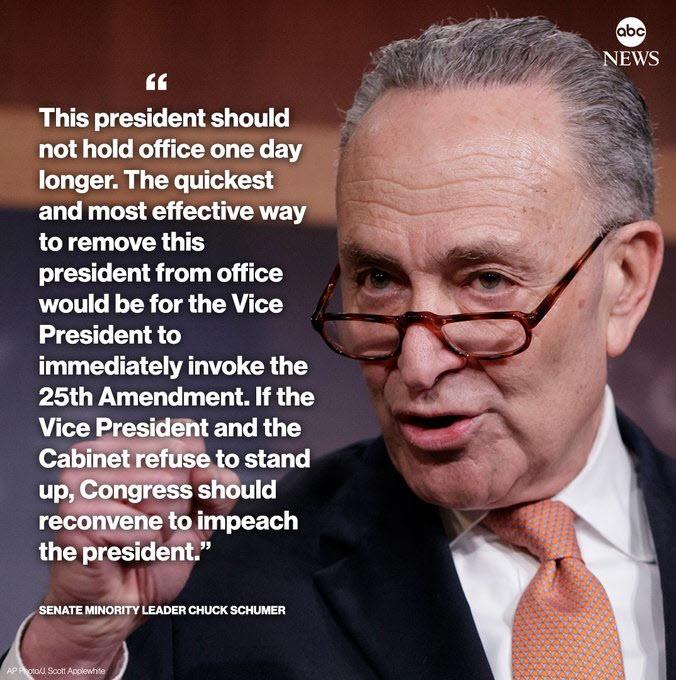
    Chuck Schumer, the top Senate Democrat, and incoming Senate majority leader after the Dems victory in the Georgia runoffs, called for Donald Trump to be immediately removed from office, saying that the outgoing president was directly responsible for Wednesday’s riot in the Capitol.

    In a statement, Schumer said Vice President Mike Pence should invoke the Constitution’s 25th amendment, using support of the cabinet to take over in the Oval Office until Joe Biden is inaugurated on January 20.

    “What happened at the US Capitol yesterday was an insurrection against the United States, incited by the president,” said Schumer. “This president should not hold office one day longer.”

    “If the vice president and the Cabinet refuse to stand up, Congress should reconvene to impeach the president,” Schumer added.

    And indicating that this is not just a frivolous tweet by Schumer, and that Democrats plan on pushing for this until completion, Nancy Pelosi is holding a 1pm presser in which we expect the topic of Trump’s prompt removal to be the main topic of discussion.


    Tyler Durden
    Sat, 01/09/2021 – 06:45

    via ZeroHedge News https://ift.tt/3boq1Wh Tyler Durden

    FDA Celebrates 10-Year Anniversary of a Food Safety Law That Hasn’t Made Our Food Safer

    FoodPoisoning

    In a week when hundreds of President Trump’s supporters stormed the U.S. Capitol as part of an effort to overturn the legitimate results of the 2020 presidential election—the latter of which Congress subsequently confirmed was won handily by President-elect Joe Biden—you’d be forgiven if it escaped your notice that one of the country’s worst food laws, the Food Safety Modernization Act (FSMA), just celebrated the 10th anniversary of its signing.

    FSMA, which was signed into law on January 4, 2011, by President Obama, gave the Food and Drug Administration (FDA) “more power to crack down on food-safety scofflaws and decrease the incidence of foodborne illness across the country,” I detailed in a 2012 law-review article, The Food-Safety Fallacy: More Regulation Doesn’t Necessarily Make Food Safer.

    Before madness overtook the Capitol this week, the FDA was celebrating the law’s birthday.

    “It’s not enough to respond to outbreaks of foodborne illness,” said Frank Yiannas, the FDA’s deputy commissioner for food policy, in a statement this week. “We must prevent them from happening in the first place.”

    That shift from a reactive to a proactive agency, Yiannas notes, was Congress’s mandate to the FDA in passing FSMA, the most noteworthy update of agency food-safety enforcement in decades. So how’s it going?

    Yiannas describes what he sees as FSMA’s key accomplishments, including that food businesses “are now taking concrete steps every day to reduce the risk of contamination” and that the law has caused a “bigger conversation about the importance of food safety,” strengthened agency partnerships with business and civil society, “advanced food safety,” and fostered “safer food in this country.”

    But has it really done that?

    In 2011, before FSMA was implemented, the Centers for Disease Control, which tracks and responds to foodborne illness outbreaks, estimated that tainted food causes around 48 million illnesses, 128,000 hospitalizations, and 3,000 deaths in the United States each year. Today, a decade on, those CDC estimates remain unchanged. Lest you think those CDC estimates merely haven’t been updated in some time, the agency reported earlier this year that “[t]he incidence of most infections transmitted commonly through food has not declined for many years.”

    So if FSMA has not reduced cases of foodborne illnesses, hospitalizations, and deaths, then what was it all for?

    Well, it turns out the law wasn’t really designed to reduce those illnesses, hospitalizations, or deaths. Indeed, the idea that FSMA would revolutionize the FDA by changing it from a reactive to a proactive agency always rang hollow. The FDA predicted that FSMA’s best-case reductions in foodborne illness would be an annual decline between 3.7 percent and 5.4 percent. Even that didn’t happen.

    The FDA knows FSMA is failing to achieve its objectives. Consider that nearly any time the agency discusses FSMA, it refers to foodborne illness as “a significant public health burden that is largely preventable.” In 2015, Dr. David Acheson, a former FDA associate commissioner for foods, rightly argued that the key marker for FSMA’s success would be whether the law “drive[s] down foodborne illness” and yields “the public health gains that this is all about.” But in 2018, a FSMA working group reported that using cases of foodborne illness to assess FSMA’s efficacy is “a high bar to prove a relationship to the FSMA rules.”

    That may be true. But FSMA cannot be a success if overall foodborne illness numbers don’t fall. Dramatically. And they have not.

    To be fair, FSMA isn’t all bad. The law did give the FDA one important power—the authority to order a recall of foods that are adulterated (tainted) or misbranded (labeled inaccurately), either of which could sicken or kill one or more persons. And though FSMA is a needless burdensome, clearly ineffective, and costly law that should be repealed forthwith, that’s not to say all federal food-safety laws or programs are wrongheaded. They’re not.

    For example, I’ve explained previously that the CDC’s PulseNet tracking program, which “prevents more than 275,000 cases of foodborne illness each year,” is a smart and highly successful program for tracing, combating, and limiting foodborne illness outbreaks. It’s also inexpensive and doesn’t impose additional regulations on food producers.

    Toward the end of Yiannas’s statement this week on FSMA, he references a new FDA approach he’s championing: the New Era of Smarter Food Safety.

    That evolving approach, which I explained last year will “ramp[] up the use of technology to improve traceability and reduce the spread and impact of future cases of foodborne illness,” is at odds with the proactive approach implemented under FSMA.

    That fact alone makes the New Era of Smarter Food Safety sound both realistic and promising. And it reiterates—along with CDC data and other factors—that a decade on, FSMA has failed to meet the lofty food-safety goals its supporters argued it would achieve.

    from Latest – Reason.com https://ift.tt/3q5hjAk
    via IFTTT

    Spanish Energy Markets Roiled Amid Chilling Temps

    Spanish Energy Markets Roiled Amid Chilling Temps

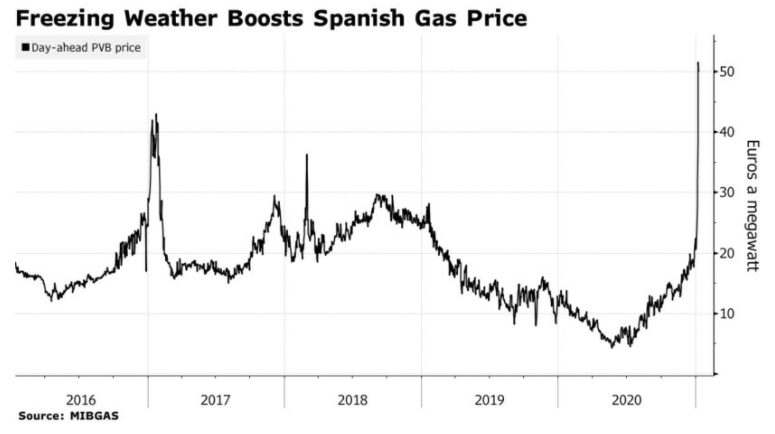
    A cold snap across Spain is expected to last through mid-January has resulted in natural gas prices more than doubling in the last week, according to Bloomberg.

    LNG prices trading at Spain’s Punto Virtual de Balance (PVB) gas trading hub hit a record 51.55 euros ($63.13) a megawatt-hour this week, or $18.54 per million British thermal units as the nation grapples with dangerously cold weather and snowfall in Madrid. 

    Spain has one of the largest LNG terminals in Europe. “Surging prices, coupled with a lack of available LNG vessels for longer journeys between Europe and Asia, will probably limit cargo exports from the nation’s ports and further tighten the supply of the fuel,” Bloomberg noted. 

    Frigid weather in China has resulted in surging LNG prices as well. This week Beijing meteorological station recorded one of the coldest temperatures in decades this past week, sending power demand through the roof. LNG imports in China last month were at record highs as demand to heat homes has surged. 

    A possible theory behind the wicked cold weather could be the sudden stratospheric warming splitting the polar vortex into two, allowing Arctic temperatures to pour into Europe and Asia. 

    “A strong sudden stratospheric warming event (SSWE) over the Pole has temperatures spiking in the Arctic, plummeting in portions Europe and Asia.

    The remnants of the Polar Vortex (PV) has also aided in unusual heavy snow in the forecast across portions of Spain in…forecast models spitting out over 12″ + of snow in the short term. While these areas of the world feel more “wintry”, it has allowed especially the northern half of the US to run much above normal in temperatures, losing our tap to cold air. Signs will need to be watched getting later into January, however, for the increased potential for cooler or colder outbreaks of air across the eastern/southern US if we can move the remnants of the PV more towards the US,” said Kirk Hinz, meteorologist with BAM Weather

    Tyler Durden
    Sat, 01/09/2021 – 07:35

    via ZeroHedge News https://ift.tt/3nvFtC2 Tyler Durden

    Don’t Dismiss Gold & Silver…

    Don’t Dismiss Gold & Silver…

    Authored by Alasdair Macleod vai GoldMoney.com,

    There is worrying evidence that 2021 will see the end of fiat currencies, led by the US dollar. US dollar money supply has accelerated at an extraordinary rate, a process that will continue.

    Signals from the markets that a monetary collapse is increasingly likely include a weakening dollar on the foreign exchanges, bitcoin’s price reflecting an growing disparity between the rate of its issue and that of fiat, rapidly rising commodity prices, and a bubble in non-fixed interest financial assets.

    Current thinking is yet to link these events with a developing collapse in fiat currencies, but it is only a matter of a relatively short period of time, perhaps spurred on by a banking crisis, before a realisation that a John Law-style financial asset and currency collapse is on the cards.

    While gold rose in dollar terms by 25% last year, it has yet to reflect an increasingly likely collapse in fiat currencies, which this article concludes is likely to happen in this new year.
    Introduction

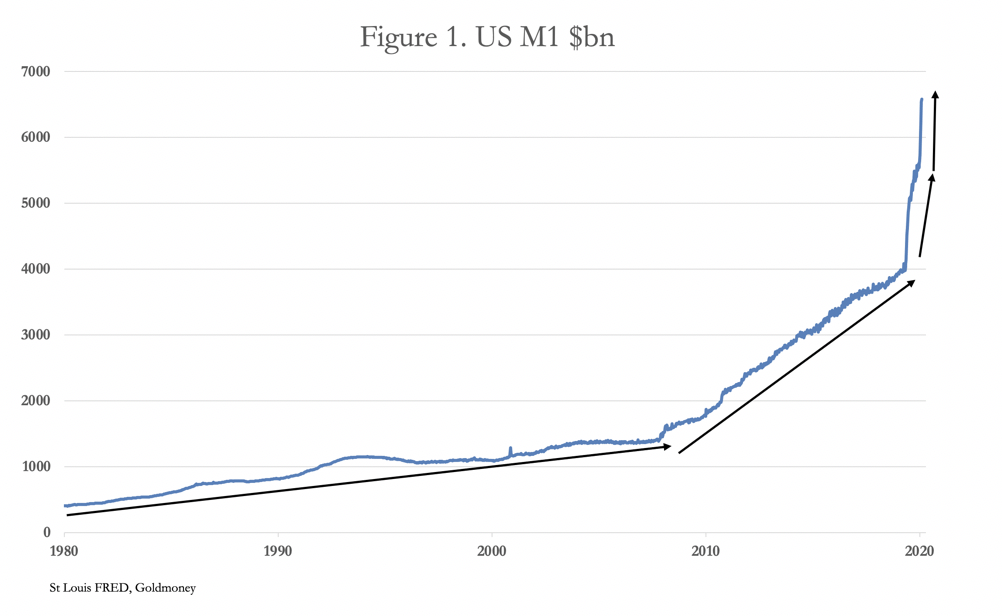
    We enter the new year with a growing realisation that fiat currency debasement is accelerating. It is hardly surprising that bitcoin bulls, who have learned about relative rates of currency issuance, are in the vanguard of those hedging increasing currency debasement. They are being encouraged by statistics in charts such as that shown in Figure 1.

    Institutional investors in increasing numbers are now clamouring on board what appears to them to be the only asset which offers a hedge for ever-increasing quantitative easing and government budget deficits. They continue to eschew the traditional hedges, precious metals, because they are only seeing one side of the story. The reason that bitcoin is on a tear is because of its heavily restricted rate of issuance relative to fiat. But investment managers still think in terms of profits measured in their own government’s fiat. For them, bitcoin is an investment or speculation, and despite monetary inflation they still believe money is dollars, euros, or whatever to be eventually sold for fiat. Managing money is their mandate, always to be accounted for in fiat, and they are tasked to deliver investment performance measured accordingly.

    With respect to fiat, they see the expansion of the money quantity, but in their muddled assessment of the future they still think that at some stage, central banks will succeed in rescuing their economies from disaster through monetary policies. While the short-term outlook is unclear, they read into rising commodity prices an expectation of increased future production. And the stunning performance of equity markets, assumed to be forward looking, is sending the same message. When covid is over, perhaps in the late spring, the common opinion appears to be that business activity will resume, and the economy will continue to grow.

    While the establishment’s portfolio managers are dreaming their dreams, gold closed up only 25% on the year, outperformed by most commodities by a country mile — a respectable performance as an investment asset, but barely noticed by the equity and crypto bulls.

    The underlying condition is the accelerating debasement of fiat. The chart in Figure 1 is not just a covid response. The rate of M1 monetary inflation has been increasing over the years, but only now has the rate of increase become hyperinflationary — there is no other word for it. So far, the Fed’s inflationary response has been just to the first round in the covid battle; round two is not yet reflected in the rate of hyperinflation, having been delayed by squabbling politicians. And the Fed’s flexible friend is yet to be fully deployed to prevent the US economy from being destabilised by the pre-covid crisis of September 2019 in the US repo market, and the trade and financial wars between America and China, which commenced in earnest in late 2018.

    The global banking system is now withdrawing credit from industrial borrowers, because bankers’ greed for loan business is now replaced by fear of non-performing loans. The commercial banks must rapidly contract their balance sheets in the face of collapsing businesses and supply chain disruption or face their own crisis.

    This is not a lending environment for the support from bank credit expansion that the Fed or any other central bank would wish for. Even without an overt banking crisis, the Fed and the US Treasury will have to work together in their attempts to rescue the US economy from an inevitable slump. They cannot succeed, but they must try, sacrificing the dollar as a deliberate act of economic policy.

    Therefore, the dollar and all the fiat currencies tied to it will become valueless, because there is a firm mandate in all welfare-driven nations to continually deploy monetary inflation at a rate that is now accelerating rapidly.

    Currency values are eventually determined by markets

    We know from the theories of exchange and from historical examples that fiat money is only money if it is accepted as such by the population, and that irrespective of the quantity in circulation the public can reject it utterly. Rejection of the medium of exchange is not something done lightly. It only happens when the state expands the quantity so recklessly that the public, being initially slow to understand that their money’s purchasing power is being debauched, collectively understands what their government is doing with money, and that there is no hope left for it.

    For today’s dollar, that this process can happen quickly is explained by the peculiar circumstance of the current situation compared with past hyperinflations for the following reasons:

    • The rapid rise in the price of bitcoin and other leading cryptocurrencies has forewarned a significant and growing minority of people about the consequences of an inflation of the quantity of state-issued fiat money. Alerted by bitcoin, whose price is rising rapidly, increasing numbers of the wider population are getting the message. It is only a small step for bitcoin bulls to realise that bitcoin’s price rising is a forewarning of a monetary collapse and not just the relative supply argument central to reporting today.

    • When it is more widely realised that the failing economy is not just a covid problem but that a 1930s slump already beckoned beforehand, investment managers will realise that hyperinflation of the money supply has not only arrived but will continue and end up destroying the currency.

    • Foreign holders of dollars and dollar assets are beginning to discard their $27 trillion stockpile, throwing all financing of the US Government’s exploding deficit onto the Fed’s shoulders. The Fed’s financing of the budget deficit and agency debt by QE will run into the headwinds of rising interest rates, reflecting an increasing time preference factor forced upon it through the foreign exchanges.

    • When it becomes clear that the Fed has lost control of US Treasury bond prices and therefore of equity market valuations, the dollar will collapse in tandem with asset prices — the closest precedent being John Law’s failed Mississippi bubble in 1720 France. This process of wealth destruction can be expected to be more sudden than the European hyperinflations of the early 1920s.

    • When a sounder form of circulating money is available a degree of economic activity can continue, and in doing so prolong the final collapse of the fiat currency. In Germany, between 1920—23 gold-backed US dollars circulated, and increasingly business contracts were struck either in dollars or adjusted by the rate of exchange. There is no offsetting form of circulating sound money to prolong the life of fiat currencies today.

    Monetary collapse is the fate that America and the other nations who look to the dollar as their reserve currency are increasingly certain to face. Furthermore, with modern economies highly financialised, the message that a currency breakdown is due will spread considerably more rapidly than in examples from the past. It is therefore possible fiat currencies will not survive to see 2021 out; they may not even survive to mid-year if, as seems highly likely, a global banking crisis occurs in the near future.

    The collapse of fiat wipes out financial services

    Our analysis is firmly pointing to a combined collapse of financial assets and currencies, likely to be unexpectedly sudden and would certainly be devastating. If, for a moment, we assume a total fiat currency collapse occurs, then all existing financial contracts, being denominated in fiat currencies, will become worthless. The accumulation of OTC derivatives, totalling some $606 trillion nominal, will become redundant, along with a further $30 trillion of exchange traded derivatives, because one side is always a fiat currency or a fiat currency’s interest rate. Global bond markets at a further $128 trillion would also be wiped out. Equities would lose most or all of their value until they can be priced in the successor to fiat money.  And being a financial asset designated in fiat, we can kiss goodbye to bank credit in its fiat form. Goodbye to pensions and insurance funds as well.

    Part of the elimination of derivatives involves the London forward settlement OTC market for gold and listed gold contracts on Comex. Notional values of these OTC contracts were $867bn according to the Bank for International Settlement at end-June 2020. Today, the main gold futures contract on Comex is capitalised at $111bn, which with other exchanges’ gold contracts gives an all-in total of about one trillion dollars. Those who believe they have exposure to gold in these markets will find they do not, and that the process of this discovery is bound to lead to a rush to obtain physical gold.

    In current dollars we are looking at the destruction of roughly one quadrillion dollars of financial and banking contracts. But as described later in this article, there is a solution, and that is to deploy central bank and government owned gold to stop the slide. Where governments are bold enough to do so, their currencies can become gold substitutes. Insofar as financial markets evolve from pure fiat to being based on these gold substitutes, then they have a future. But to the extent that they currently depend on the fuel of monetary inflation, that future will be severely restricted of eliminated. And after some normality returns under gold standards for different currencies, the relatively low and stable originary rate of interest for gold is likely to restrict future demand for derivatives even more.

    Bitcoin is not suited to replace fiat

    To the dismay of the crypto crowd, bitcoin is both unlikely and unsuited to succeed fiat as the common medium of exchange, for two important reasons. The first is central banks don’t own any and have no interest in adopting any form of crypto other than ones whose ledgers they control. We know they are racing to get central bank digital currencies up and running, partly to head off private sector alternatives. But these proposed CBDCs are just another form of fiat and will fail as surely as revolutionary France’s mandats territoriaux did following public rejection of the inflated and hated assignats.

    However, central banks and government treasury departments do own gold — almost certainly less than the 35,171.3 tonnes reported by the World Gold Council, when leases, loans and double-counting are allowed for. But the majority at least own some gold. Even though it is likely to be a last resort, turning their fiat currencies into gold substitutes is a central bank’s only option to avoid a complete currency collapse, and with it the collapse of all state spending.

    The second reason bitcoin and similar alternatives are unsuitable is one identified by Ludwig von Mises in a different context — the socialist calculation debate. Mises pointed out that for an economy to function it required unfettered market prices in order for entrepreneurs and businesses to be able to calculate returns on business investment. The other side of prices is their measurement in money terms. When state-issued currencies were functioning as gold substitutes — which was the situation for capitalistic economies at the time of the debate — their purchasing power was broadly stable over a typical investment cycle, allowing businesses and entrepreneurs to anticipate returns on a proposed investment. If an inflexible, limited-issue cryptocurrency like bitcoin became the circulation medium to replace fiat, no investment for a multi-year project could possibly be contemplated because of the effect on future prices. Measured in scarce bitcoin and with a firm cap on its total issue, prices for finished products at the end of the investment would end up being significantly lower than their production costs, thereby ruling out the project itself.

    That won’t stop cryptocurrencies like bitcoin continuing to soar while increasing numbers of the investing public see them as must-have wealth protection at a time of rapidly increasing fiat debasement. But that is a different function from operating as a practical means of exchange.

    The return to sound money

    Gold qualifies as sound money because of its inherent flexibility. If the market demands it, it can draw on above-ground gold stocks currently assigned to other uses, notably as jewellery which probably accounts for about half of all gold ever mined.  And annual mine supply throughout history has added to above-ground stocks at a similar pace to global population growth. These are the necessary conditions for a suitable form of money chosen by free markets, which is why whenever government money imposed on its population fails, for millennia the money to which everyone returns has always been metallic.

    We know that ever-increasing inflation of the dollar has turned, or is now turning into hyperinflation, by which is meant that it is now virtually impossible for the Fed to resist demands for a continual exponential acceleration of the money supply, ending with the dollar’s destruction. That being the case, the only thing that will stop a rapid and final collapse of the dollar’s purchasing power will be to turn it into a credible gold substitute, accepted by the general public staring into the abyss of a total monetary and economic collapse.

    Assuming the US Treasury’s 8,133.5 tonnes of gold still exists and has not been sold, leased or loaned, it is a relatively simple matter to turn fiat dollars into fully exchangeable gold substitutes and to reintroduce gold coinage into circulation. That is not to be disputed; though, admittedly, the sharp reductions in government spending that must accompany sound money are a more difficult topic which must be addressed at the same time.

    The most significant problems to be surmounted are both intellectual and political. Intellectual, because the monetary and economic establishment has spent the last fifty years denying gold has a monetary role, and political in that through imposing the dollar and with the assistance of the military complex, the American state sees itself as the world’s protector from Chinese and Russian ambitions — a hegemony it will be reluctant to lose.

    America’s current geostrategy is made even more difficult to abandon by the fact that by default Russia has already prepared itself for a gold standard by weaning itself off the dollar. Together with its citizens and as a deliberate act of policy since 1983, China has progressively cornered the market in physical gold. There can be no doubt that since that time China has accumulated a substantial tonnage of bullion not declared as monetary reserves, with which she can back the yuan. Arguably, the economic benefits of putting the yuan on a gold standard and for the Chinese government to abandon inflationary financing would incur less pain from the adjustment process than would be faced by any other nation. Unlike the Russians, private citizens in China owning some 17,000 tonnes will gain a wealth dividend from the introduction of a gold standard. Consequently, the re-establishment of a US gold standard would be seen by America’s permanent establishment as handing unacceptable levels of wealth and economic power to her enemies.

    The longer that America dithers about pinning a collapsing dollar to gold, the worse it will be for it. And assuming she actually has 8,133.5 tonnes of unencumbered monetary gold, not only is it the lowest ratio of national gold ownership to above ground stocks in over a hundred years, but it is also the lowest ratio of its gold to total monetary gold held by all the central banks.

    This side of a dollar crisis it is hard to assess how quickly the Fed and the US Government will correctly assess and adopt their only option. A significant drawback will be the necessity to return to balanced budgets, which entails massive spending cuts in not only public welfare but in the bloated defence budget. Get it wrong, and 8,000 tonnes of monetary gold could disappear remarkably quickly.

    Purely as a working assumption, at this early stage we should assume that a rapid collapse in the dollar’s purchasing power will eliminate between 95%—100% of it; the retention of any residual value being the consequence of changing fiat dollars into becoming credible gold substitutes.

    Confidence in this outcome is drawn from the psychological forces at play evidenced in previous fiat money collapses, both on the government side and on that of the general public. In particular, the lessons from the collapse John Law’s Mississippi scheme have worrying parallels with the current situation. Law used inflation of his unbacked livre to ramp the share prices of his Mississippi venture and his Banque Royale, ending up with the destruction of the livre, and therefore of the residual asset values in the combined venture when the bubble burst. Similarly, today’s central banks with their quantitative easing are feeding monetary inflation into the investment management industry, which ends up inflating investable assets on the central banks’ behalf.

    If this is the model we need to watch out for, then the collapse of fiat currencies’ purchasing power will not be on the lines of Germany’s 1919—1923 inflation, especially the final phase between May and November 1923. It will be governed by the speed of the collapse of financial assets, particularly bonds, whose prices are remarkably elevated, and their yields suppressed. The flight out of collapsing fiat currencies will continue to be measured against commodities and raw materials. At the consumer level, the destruction of the value of savings and monetary liquidity could become too rapid for a textbook crack-up boom. The time to dump collapsing currencies would be dramatically foreshortened, and naturally, some of the flight out from failing currencies will be into the limited supply of gold coins and bullion.

    The prospects for gold’s purchasing power

    The introduction to this article describes the backdrop to a shift in purchasing power away from failing fiat currencies. It also concludes that at some point, central banks will have no option other than to turn fiat currencies into gold substitutes. It has pointed out that attempts at a monetary reset without the backing of monetary gold will not only fail, but if the decline in existing fiat currencies is as rapid as this analysis suggests there will be insufficient time to implement fiat alternatives such as central bank digital currencies, and they would rapidly fail anyway.

    While the collapse of a fiat currency’s purchasing power will become increasingly obvious, demand for physical gold will increase its purchasing power, measured by the goods and assets it will buy. The desire to hoard relatively limited quantities of gold will increase at the same time as there is a desire to dump fiat money.

    Many people who think they have protected themselves with paper gold will find it evaporating due to it not being backed by readily available physical bullion. They are likely to add to the general demand to possess physical gold.

    It is therefore not just a matter of the dollar’s purchasing power losing, say, 98% from today. To this an assessment must be made due to the scarcity of gold arising from increasingly determined hoarding of the metal. It is the combination of these factors which drives prices in paper money up, while they fall catastrophically measured in gold. Examples of this effect were commonplace in Germany and Austria in 1922-23, when country estates and residential properties could be acquired for very small amounts of gold — $100 bought a six-bedroom house in a fashionable street in Berlin, when US dollars were trusted gold substitutes at $20.67 to the ounce.

    It follows from documented history and from reasoned theory that hyperinflation impoverishes the professional middle classes and bringing hardship and starvation to the wider population. On the threshold of the new year, this appears to be the outlook for anyone who does not take the precaution of hoarding gold. In the light of these factors, there is little point in discussing less important issues, such as the functioning of paper gold markets, let alone following the specious practice of making price forecasts.

    Silver

    The outlook for silver appears to be less cut and dried than for gold, if only because it is not held by central banks in their monetary reserves. Having been demonetised in the 1870s when Germany moved onto a gold standard, silver’s price measured in gold began a long decline from roughly 15:1 to a record 125:1 last March. Since then, silver has recovered to 71:1 currently.

    There is surely little doubt that as the relative moneyness of gold to fiat currencies increases as a result of the hyperinflationary policies of central banks, silver will return towards a relationship with gold that existed when there were metallic metal standards. In those times, coinage was of gold, silver and copper. Even though the abandonment of silver monetary standards in Europe led to a decline in the silver price relative to gold, silver still circulated as money. In fact, by ensuring that a silver to gold ratio in the coinage exceeds Isaac Newton’s 15 ½ to one by a reasonable margin, the problems inherent in maintaining a bimetallic standard do not arise. But in the order of events, a gold exchange standard with otherwise worthless fiat must be established first.

    It appears therefore that a return to credible gold substitutes will eventually lead to a lower silver to gold ratio; but it is, at this stage of its evolution hard to imagine it falling much below 20:1. This implies that during the fiat money collapse silver’s purchasing power will significantly outstrip that of gold, more than doubling on a relative basis.

    Tyler Durden
    Sat, 01/09/2021 – 07:00

    via ZeroHedge News https://ift.tt/2LB4D5f Tyler Durden

    Will Lisa Murkowski Be the Jim Jeffords of 2021?

    The Senate is split 50-50, leaving the tie-breaking vote in the hands of the Vice President. As I discussed here, this arrangement is not a recipe for stable control of the chamber. Accordingly, the last time this happened (in 2001), there was a power-sharing arrangement that divided authority and resources more evenly than occurs when one party has a true Senate majority.

    The 2001 power-sharing arrangement did not last very long, however. In June 2001, Vermont Senator James Jeffords left the Republican party and (more significantly) began to caucus with Senate Democrats, converting the 50-50 chamber to one with clear party control. This switch was momentous. Among other things, it scuttled the Bush Administration’s hope to move quickly on judicial nominees and shifted the legislative agenda. In return for his conversion, Senate Democrats made Jeffords Chair of the Environment and Public Works Committee.

    Will we see a replay of 2001? Alaska Senator Lisa Murkowski, who has run independent of her party on the ballot before, has called upon the President to resign and questioned her future with the Republican Party. Were we to become an independent, she would still need to decide where to caucus, for purposes committee assignments and the like. So were she to split with Republicans, and remain in the Senate, she would likely caucus with Democrats. The question, then, would be what might Senate Democrats offer to make it worth her while.

    Senator Murkowski is more liberal than her Republican colleagues on some issues, but is definitely more conservative than Democrats on others. One challenge may be that those issues that are most important to her constituents in Alaska, such as federal energy policy, may also be those issues where the gulf between Senator Murkowski’s preferences and those of Senate Democrats are the greatest. On the other hand, for purposes of climate policy, Senate Democrats may see significant value in a 51st Senator on their side (particularly given the 50th is West Virginia’s Joe Manchin).

    from Latest – Reason.com https://ift.tt/39e0GLO
    via IFTTT