Value Rotation Stalls As Bond Yields, Dollar Slide Tyler Durden
Thu, 11/19/2020 – 16:01
Stocks have never been more expensive, but that doesn’t stop the machines panic-buying them to record-erer expensive levels.
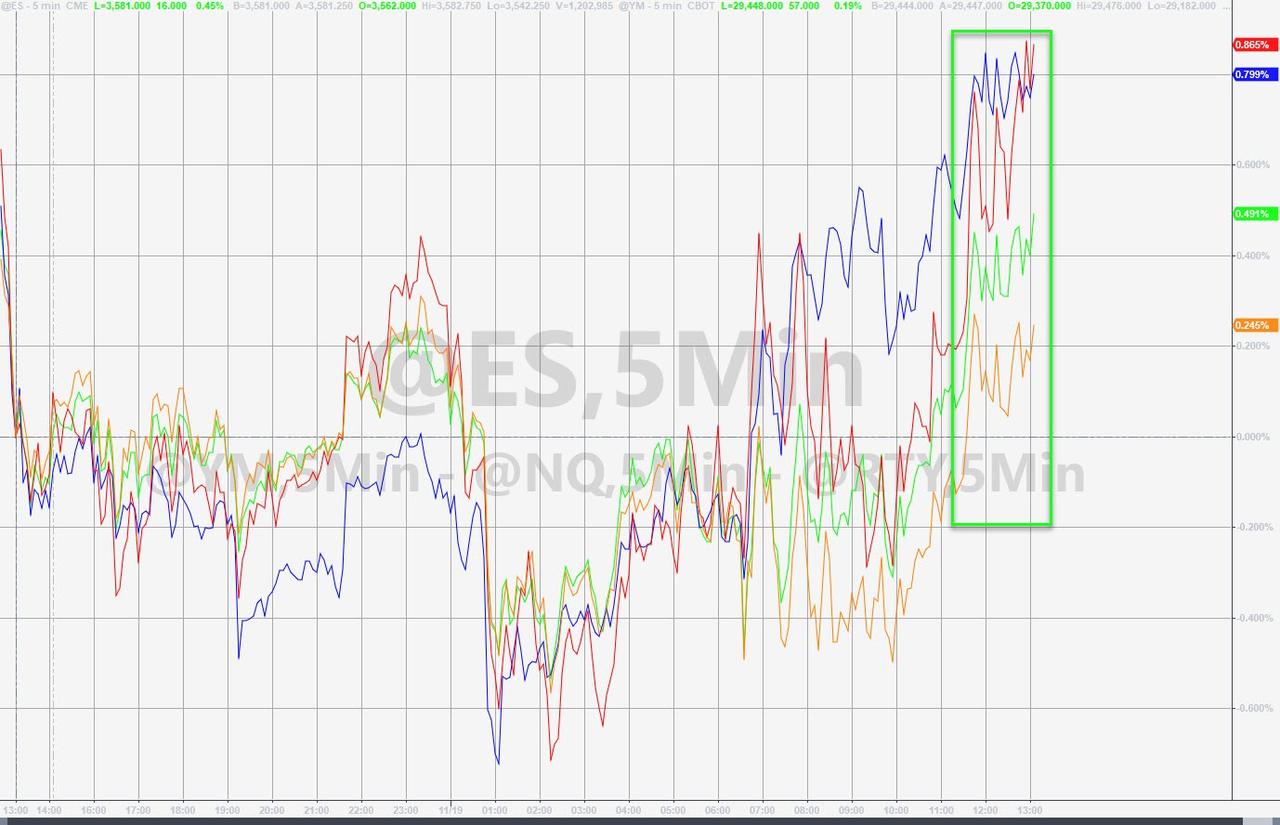
The major US equity indices were loitering with no intent for much of the day, gently unwinding the recent value-rotation when headlines hit on Schumer-McConnell talks (stimulus!!!! buy mortimer buy!)… The machines the headline, figured stimulus and were insta-bid…
But, the algos ignored the fact that Republicans said the meeting was about the government funding deadline, not COVID relief.
And after all that, all the majors ended higher on the day, with Nasdaq and Small Caps outperforming, Dow lagging…
This market has gone to ’11’ in terms of utter irrationality.
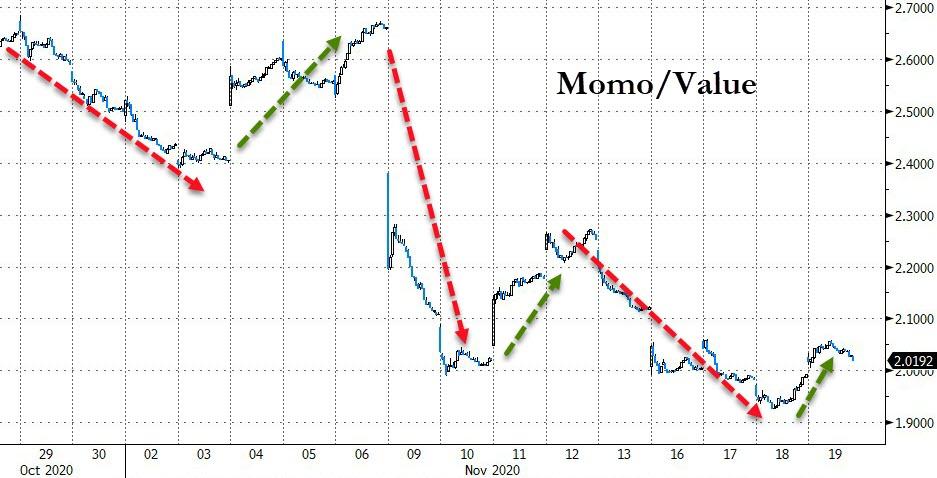
The value rotation unwound a little today…
Source: Bloomberg
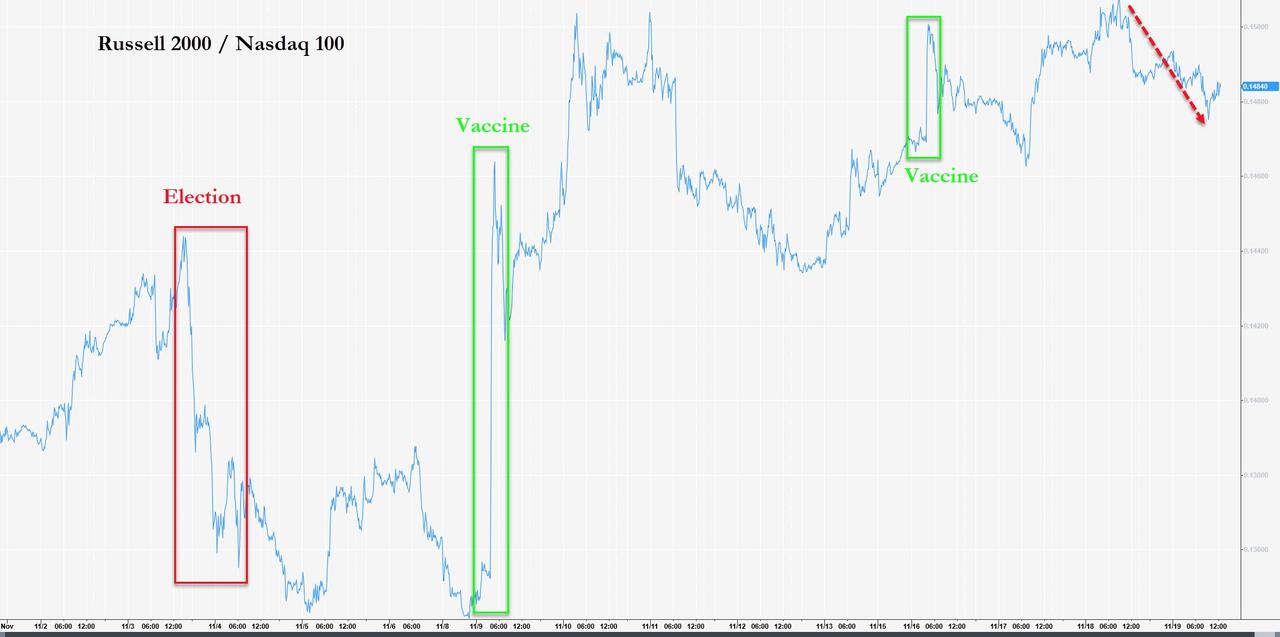
The Russell 2000 / Nasdaq 100 pair reverted a little today…
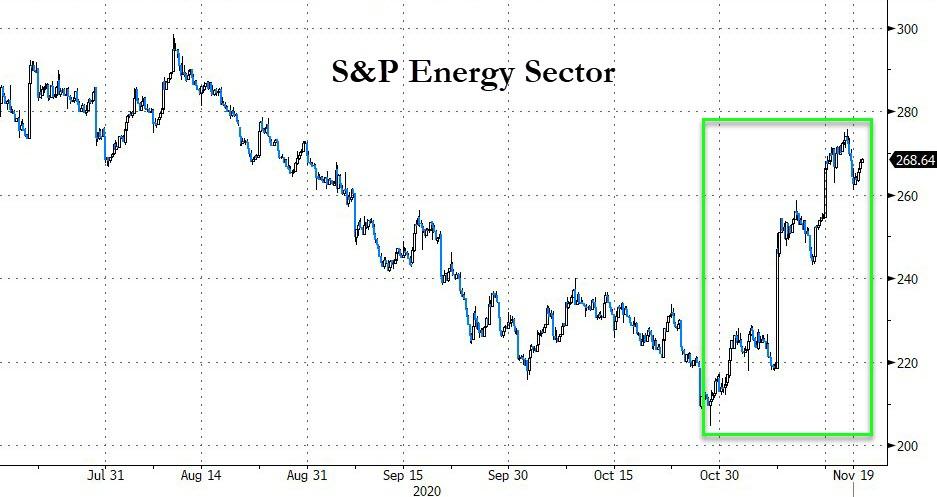
Energy stocks surged once again today (despite a marginal move in crude), pushing the Energy sector to its best Q4-to-date in at least 30 years…
Source: Bloomberg
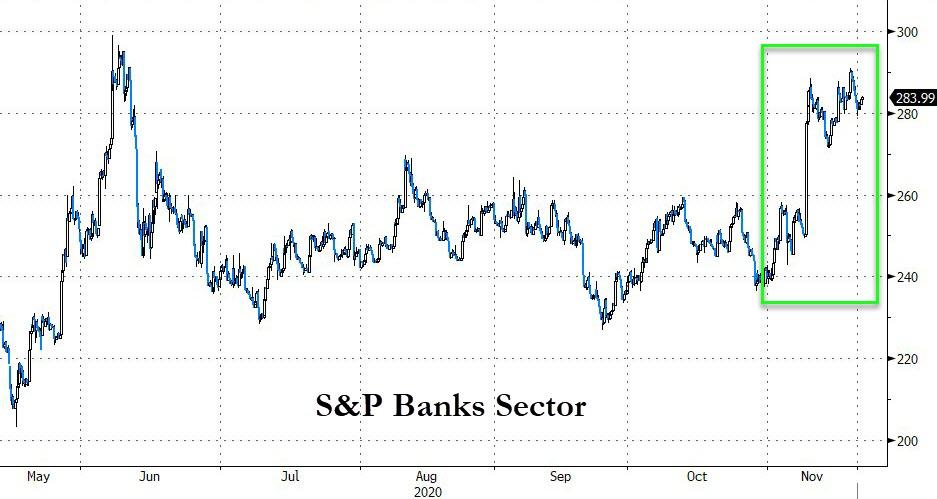
Banks were higher today…
Source: Bloomberg
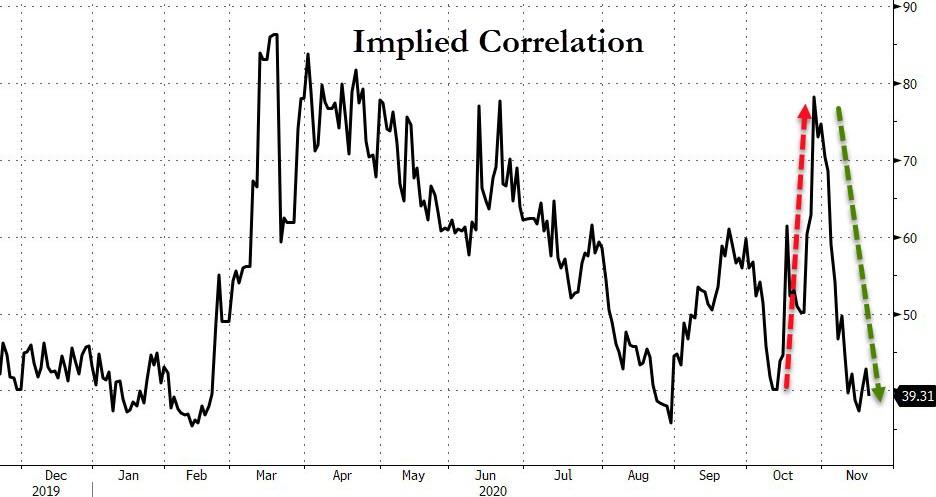
As VIX fell back to a 22 handle once again, implied correlation has tumbled to pre-COVID crisis levels (no systemic risk priced in to macro overlays)…
Source: Bloomberg
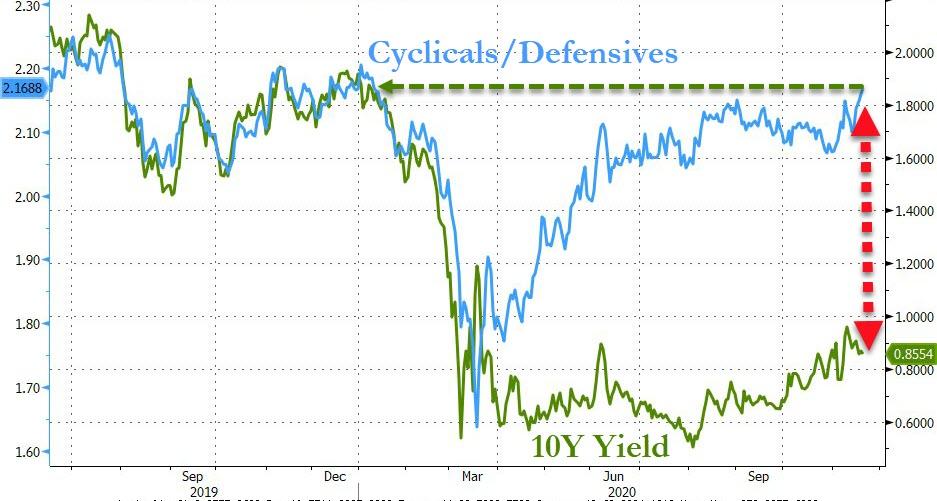
Cyclicals outperformed Defensives (pushing to their highest since Jan 2020), completely decoupled from bonds…
Source: Bloomberg
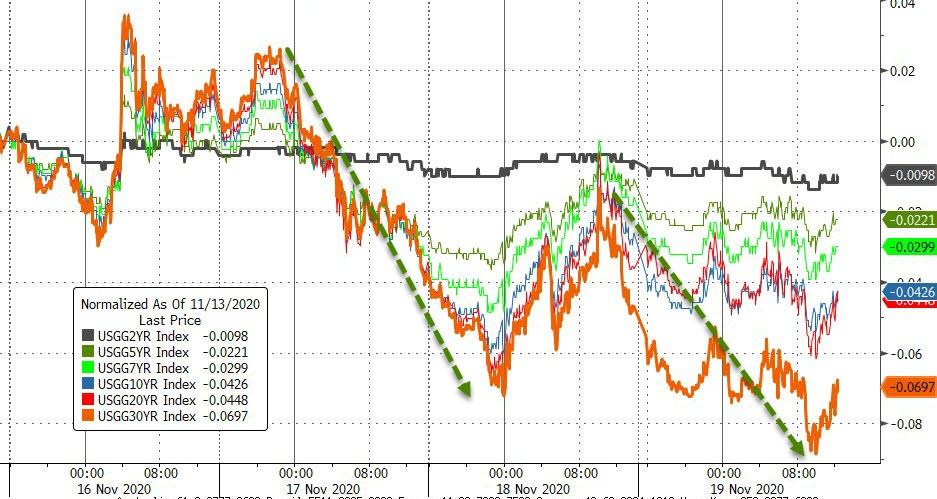
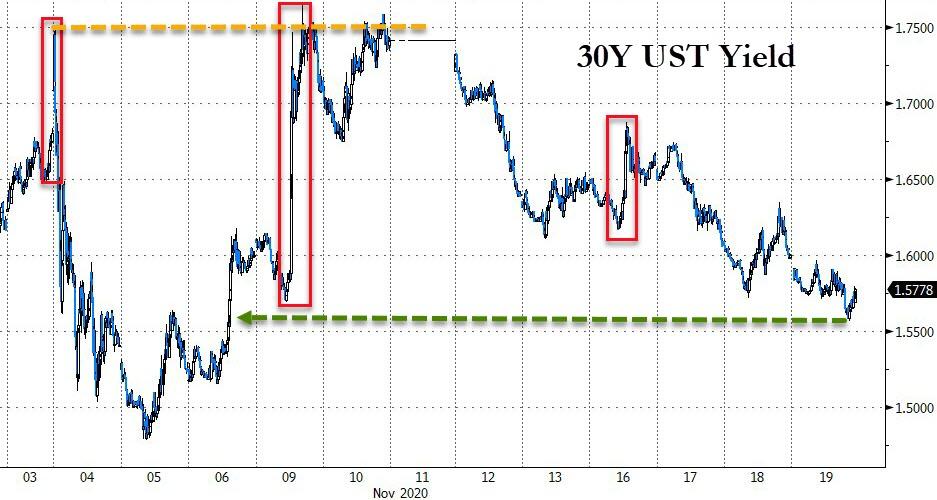
Treasuries were bid (with yields down around 2-3bps at the long-end, flat at the short-end)…
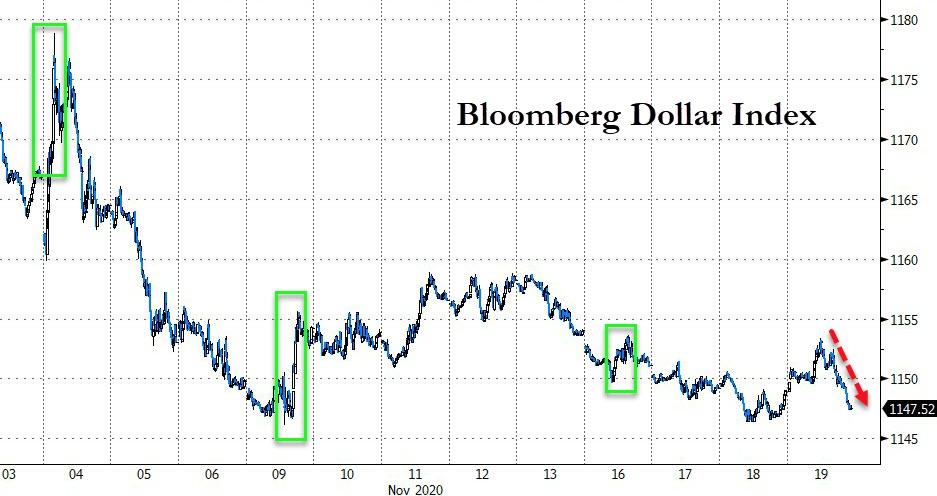
The Dollar roller-coastered higher then tumbled lower intraday, accelerating weaker on the Schumer headlines…
Source: Bloomberg
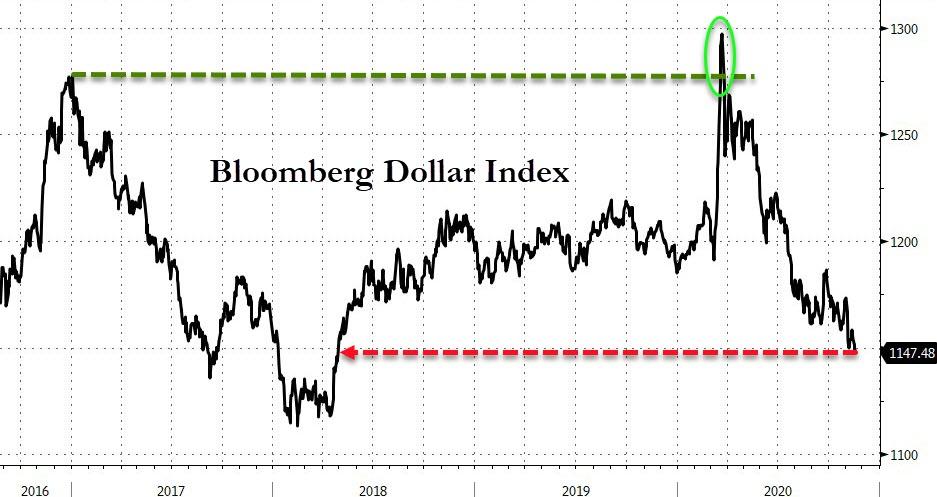
This is the lowest close for the dollar since April 2018…
Source: Bloomberg
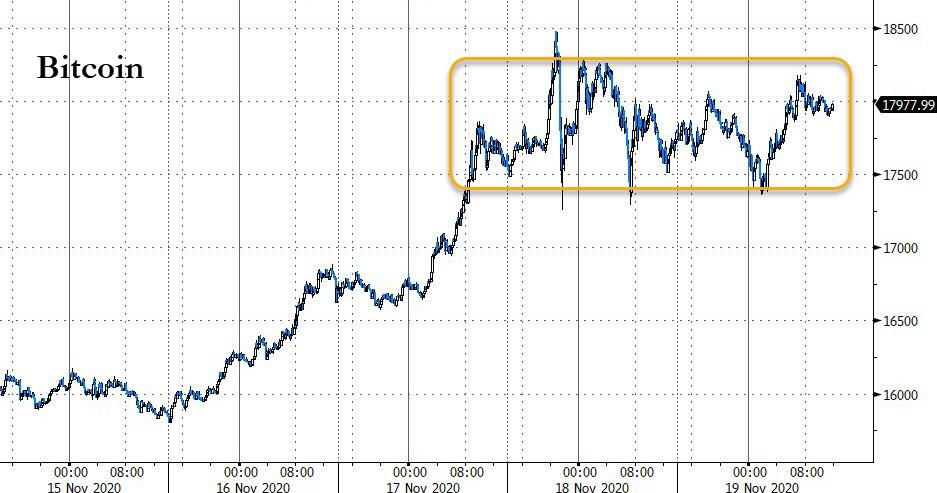
Bitcoin held steady around $18,000…
Source: Bloomberg
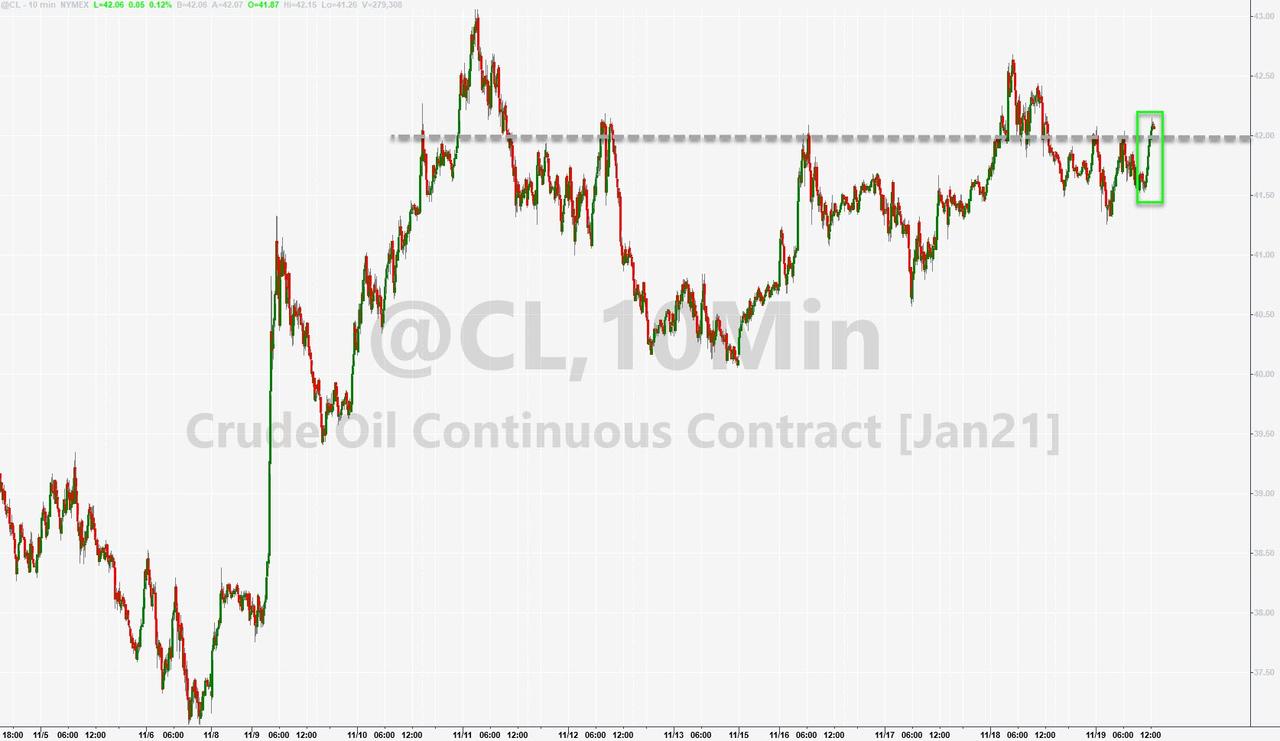
Oil prices clung to positive gains on the day, closing just above $42…
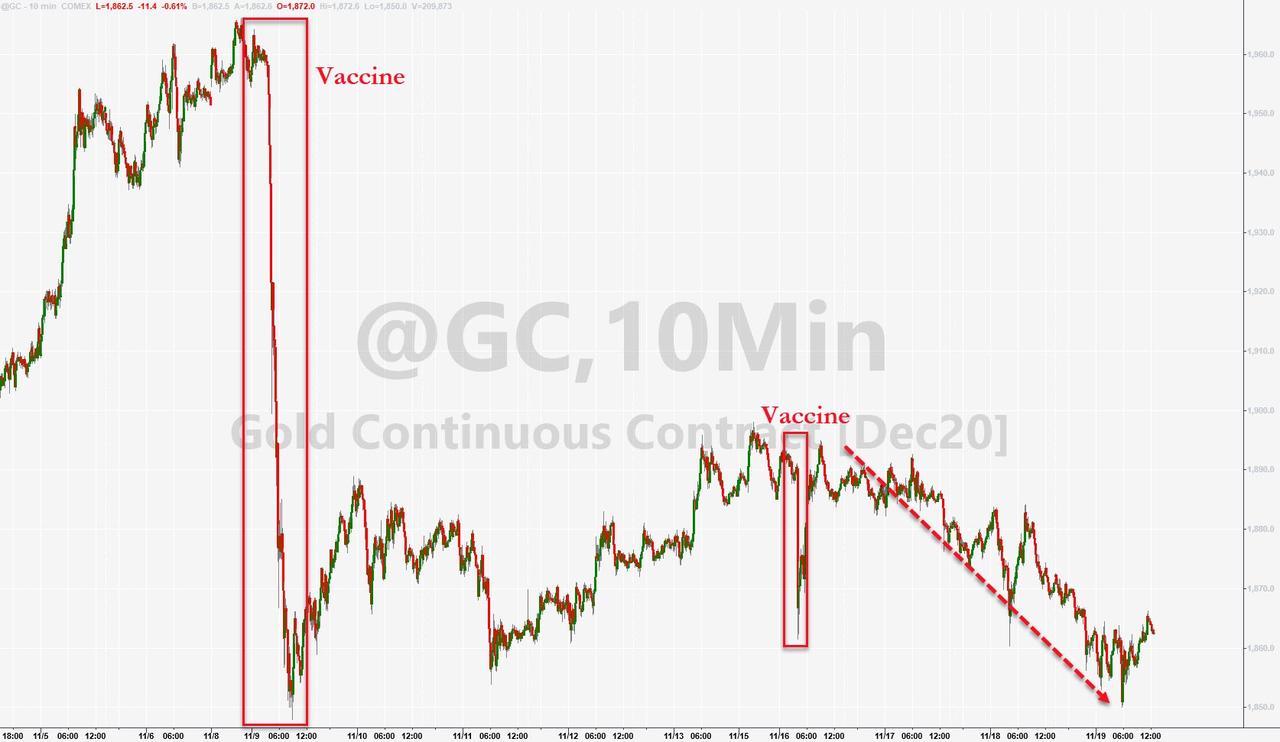
Gold traded lower, back near Pfizer vaccine lows…
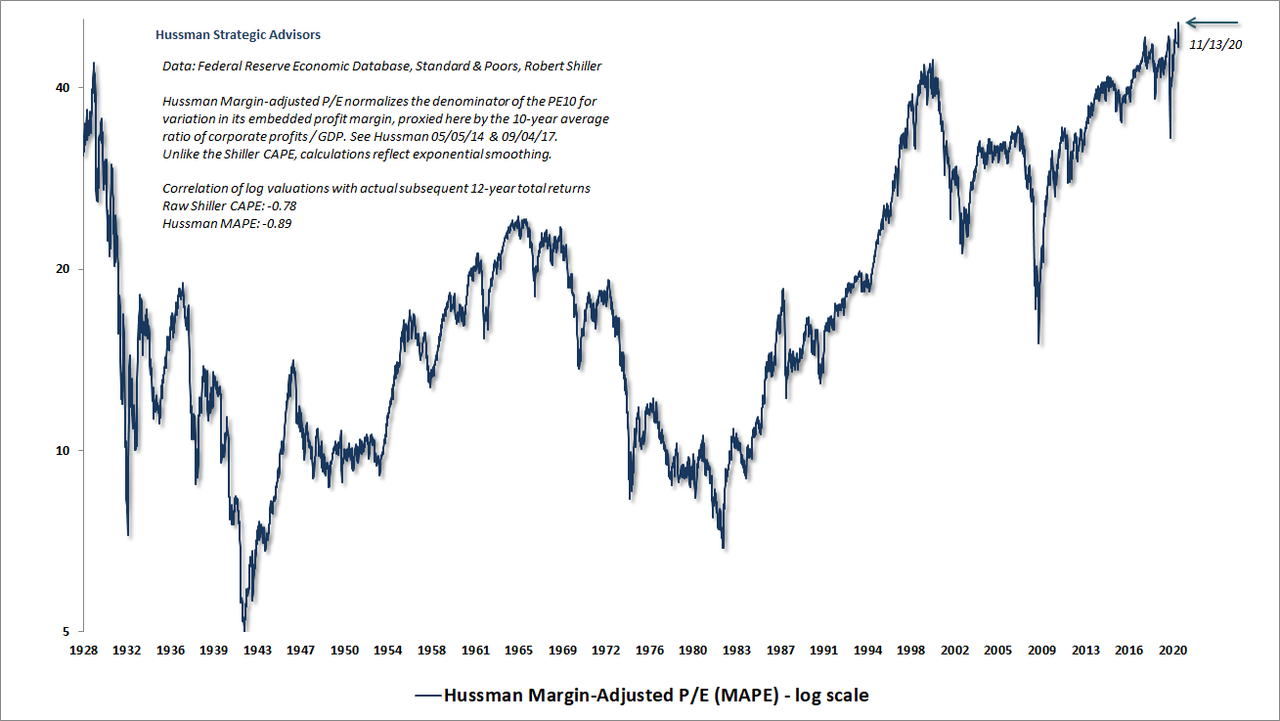
Finally, we note John Hussman’s latest note highlighting the fact that the valuation of U.S. stocks has never been more extreme, even at the 1929 and 2000 market peaks. Hussman points out that he has intentionally excluded the impact of pandemic GDP and profit weakness, which would otherwise make this measure even more extreme.
Hussman continues to expect the S&P 500 Index to lose two-thirds of its value over the completion of the current market cycle. That loss would not even breach historical valuation norms, but it would at least bring estimates of long-term expected S&P 500 returns closer to their historical average, in contrast to the negative 10-12 year prospects we observe at present.
“…we’re also well aware of how closely the speculative features of this market resemble the pre-crash peaks of August 1929 and March 2000, as well as lesser ones like January 1972 August 1987, and October 2007.”
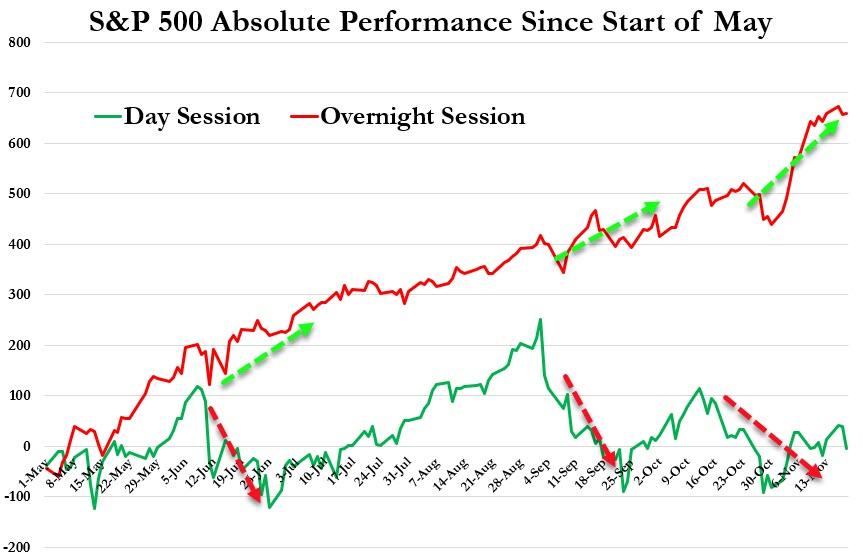
Still, there’s always the overnight session to make the big bucks…
via ZeroHedge News https://ift.tt/32ZPAHQ Tyler Durden
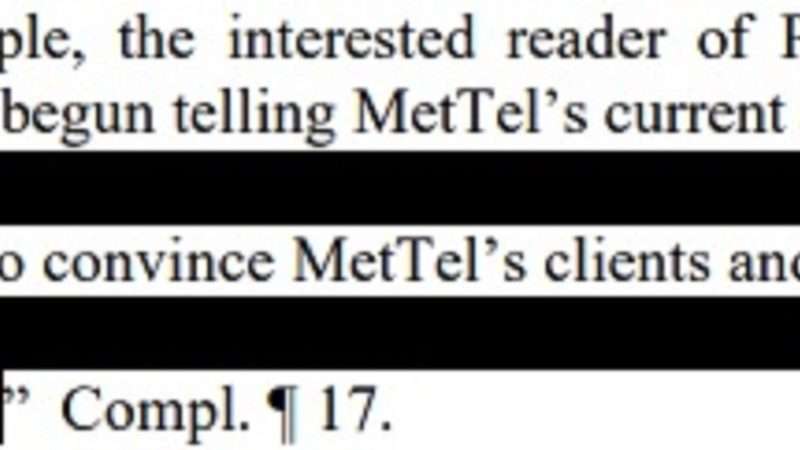
Not allowed, says Delaware Court of Chancery Vice Chancellor Joseph R. Slights III, dealing with my notice opposing such sealing. (Many thanks to my local counsel Garrett Rice of Ross Aronstam & Moritz LLP for all his invaluable help, and to UCLA law student Jenna Battaglia, who worked on the case with me.) Here is an excerpt from the Vice Chancellor’s opinion; for similar federal cases, see Parson v. Farley(which I had also filed) and Holmes v. Grambling:
Court of Chancery Rule 5.1 … codifies the “powerful presumption of public access” to court proceedings and records…. [Confidential treatment is allowed only if a party] can demonstrate that “the public interest in access to Court proceedings is outweighed by the harm that public disclosure of sensitive, non-public information would cause.”
By design, the burden of demonstrating [this] is exacting, recognizing that “[t]hose who decide to litigate in a public forum … must do so in a manner consistent with the right of the public to follow and monitor the proceedings and the result of [the] dispute.” In this regard, our courts appreciate that public access to the courts and their business is “fundamental to a democratic state and necessary in the long run so that the public can judge the product of the courts in a given case.” And the public cannot “judge the product of the courts in a given case” if the information being withheld is necessary for understanding “the nature of the dispute” or the court’s bases for a decision….
[A.] MetTel’s Interest in Confidentiality
The harm MetTel alleges will be inflicted upon it in the absence of confidentiality protections is too broad to meet the requirements of Rule 5.1…. [T]o show an interest in confidentiality that outweighs the public’s right of access, MetTel must do more than make “[g]eneric statements of harm.” The showing must be particularized; in other words, MetTel “must point to specific information like ‘trade secrets or competitively sensitive pricing information'” that is not in the public mix and, if disclosed, will cause clearly identified harm.
MetTel claims to meet this burden by alleging “harm beyond its reputation, including but not limited to direct harm to its business relationships with current and potential customers”[:] … “[o]nce that seed [of the defamatory statement] has been planted, the client will undertake a critical look at a provider with which it had been perfectly happy” and “may terminate the contract based on a pretext”; “there is a real risk that MetTel will be asked to bid on fewer and fewer contracts going forward”; and “[o]nce confidence [in] a provider’s financial stability is called into question, customers … can simply choose the non-confrontational option of selecting a different vendor.” …
[But] it is difficult to imagine a defamation case, at least in a commercial setting, where these same concerns would not always be present…. [And] it is evident from a comparison to the examples in Rule 5.1 that potentially defamatory statements, per se, are not the kind of information the drafters of Rule 5.1 intended to protect. The five examples in Rule 5.1 include: “trade secrets; sensitive proprietary information; sensitive financial, business, or personnel information; sensitive personal information such as medical records; and personally identifying information such as social security numbers, financial account numbers, and the names of minor children.” Each of these enumerated categories is discrete and reflects information that is not, or at least should not be, of interest to the general public in the quest to understand the dispute before the court or the bases for the court’s decisions.
While I do not dispute there is some risk of economic harm to MetTel if the redacted information is made public, allowing such information to remain redacted “merely because its disclosure could cause the parties economic harm” would turn the presumption of public access on its head and frustrate the purpose of Rule 5.1.
[B.] The Public’s Interest in Understanding the Bases of the Dispute
The public maintains a strong interest in access to the content of the alleged defamatory statements. If the information currently redacted remains so, the public will have no means to understand the dispute MetTel has asked the Court to adjudicate. This conflicts with the public’s right to “monitor the proceedings and result[s]”—a right, again, that “has been characterized as fundamental to a democratic state.” In other words, when “the supposedly-confidential information represents the nature of the dispute itself—the interest of the public in accessing this information outweighs the economic harm to the parties that disclosure may cause.” That is the case here.
While MetTel and Professor Volokh debate the legitimacy of Professor Volokh’s planned use for this information, nothing in our law obligates Professor Volokh to prove why he seeks access to information filed in a Delaware court, much less that his purpose is somehow “proper.” Instead, MetTel is obligated to prove that good cause exists to deny Professor Volokh access to the information he seeks as a member of the public. That information—the gravamen of the case—cannot be discerned from the redacted Complaint, which, at best, notifies the public that Granite made some unknown defamatory statements that MetTel now asserts are defamatory for some unknown reason(s). [Footnote:]
This is hardly adequate to enable the public “to follow and monitor the proceedings and the result of [the] dispute.”
Not only would it be impossible for a member of the public to understand what is going on in this case based on the pleadings, “it is difficult to envision a judicial opinion in this matter that could maintain the confidentiality of all the designated material and yet be comprehensible to the reading public.” In its Complaint, MetTel asks this Court to determine whether Granite committed defamation, tortious interference with prospective economic advantage, tortious interference with contractual relations, trade libel and deceptive trade practices. When this Court is called upon to determine the merits of these claims in trial or motion practice, the Court will not be able to render and deliver a comprehensible decision without reference to the currently redacted information.
[C.] MetTel’s Reliance on CapStack is Misplaced
Finally, MetTel claims that [under] this court’s decision in CapStack [a prior Court of Chancery case involving a request for an anti-libel injunction] …, MetTel “cannot, on the one hand, argue that the defamatory and tortious statements by Granite are causing irreparable harm, while, at the same time, repeat those defamatory and tortious statements in the public record.” …
[I]t is true that CapStack held that the plaintiffs had “failed to establish that irreparable harm will likely result,” relying in part on the fact that the information was already public through the pleadings[.] … [But u]nder MetTel’s reading of CapStack, the factual gravamen of a defamation complaint could never be disclosed to the public in a court document if that information was not previously disclosed, regardless of whether access to the particular statements would cause particularized harm, because disclosure would potentially foreclose a showing of irreparable harm.
That reading would eviscerate the presumption of public access, ignore our Rule 5.1 jurisprudence requiring a showing of good cause to rebut the presumption, and conflict with the general rule that the mere fact information is “previously undisclosed” is not enough to justify confidential treatment….
Looks quite right to me. Note that the underlying document has not yet been unsealed, because MetTel still has time to appeal.
from Latest – Reason.com https://ift.tt/2IXhNI8
via IFTTT
Ex-Trader Who Pleaded Guilty To FX Rigging Now Makes $400/Hr Advising Clients Suing Banks Tyler Durden
Thu, 11/19/2020 – 15:45
A former trader for BNP Paribas who once pleaded guilty to rigging FX benchmarks is now making a living in a new way: charging $400 per hour to act as a “consultant” for investors who are suing banks for forex manipulation.
Hey, it’s great work if you can get it…
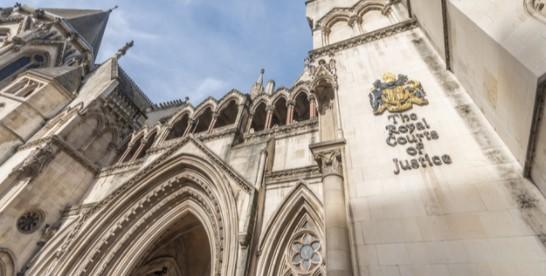
The trader, Jason Katz, is being hired by Allianz, Pimco and a number of other investors who have brought a multimillion dollar lawsuit against banks that include Citigroup and Barclays in London’s High Court. Similar lawsuits have been filed against Bank of America, among other banks, in the Southern District of New York.
According to FT, lawyers for the banks involved in the lawsuit recently filed documents asking a judge to prevent Katz from seeing confidential information in the lawsuit. They are claiming his involvement could be “interfering with the recollection of a key fact witness”.
They also argue that Katz’s $400 per hour fee is “excessive by any reasonable measure” due to the fact that he’s unemployed. Katz “cannot credibly claim that his services are worth $400 an hour to anybody other than the plaintiffs,” the court filing says.
Katz is a “full time stay at home dad,” according to statements he made during his 2017 sentencing.
Boris Bronfentrinker, lawyer for Allianz, said: “We can confirm that the UK claimants have made an application to add Jason Katz to the confidentiality ring in the circumstances where the banks have objected to his inclusion. They are trying to preclude him from accessing documents which are necessary for him to assist the claimants in pursuing their claims against the banks.”
The lawsuits against the banks are part of allegations of forex manipulation first raised in probes by U.S., Swiss and U.K. regulators. So far, they have led to $12 billion in fines and several traders facing criminal charges in the U.S.
We have documented numerous arrests related to FX manipulation over the last few years, including here, here and here.
via ZeroHedge News https://ift.tt/35N4val Tyler Durden
Throughout the fall, New York City repeatedly delayed reopening its schools for most students, despite an emerging scientific consensus that classrooms were not significant areas of spread for COVID-19. Now Mayor Bill de Blasio has ordered a full shutdown of schools due to rising coronavirus numbers; the city has reached the 3 percent test-positivity rate, the predetermined (and largely arbitrary) threshold for keeping kids at home.
Many parents are rightly infuriated, and even some district officials think the call might have been premature. New York bars and restaurants are operating under new restrictions, but they are still open for business, even though these establishments are believed to be far less safe than schools. Public school children and working-class families appear to be planners’ last priority.
This approach runs completely counter to the science. K-12 schools have not caused significant outbreaks. The risks to children are negligible, and there’s scant evidence that kids are infecting a large number of their teachers. Meanwhile, the adverse consequences for children who don’t attend classes in-person can be quite serious. Remote learning has been a stunning failure for younger kids, and the economically disadvantaged are falling further and further behind. Policy makers could be dooming a generation of at-risk students to years of suboptimal social and professional outcomes—and it’s all for nothing, since pandemic mitigation doesn’t actually require this course of action.
“Keeping kids out of the classroom will make recovering from the pandemic harder in the long term, while not keeping us any safer in the near term,” writes Nina Schwalbe, a professor at Columbia University’s Mailman School of Public Health, in The Atlantic. “Even with case numbers climbing in New York City, we know that schools are not driving the pandemic. However, one thing is clear with COVID-19: Our kids are paying the highest price.”
Like virtually all other aspects of the government’s approach to the pandemic, school closures have become a political football. President Trump and Education Secretary Betsy DeVos favor keeping schools open, which has prompted many anti-Trump partisans to dutifully take the opposite stance. But a growing number of journalists on both the left and the right think this is a terrible mistake. “Some things are true even though President Trump says them,” notesThe New York Times’ Nicholas Kristof. “Trump has been demanding for months that schools reopen, and on that he seems to have been largely right.”
“I don’t get why NYC feels bound to stick by a 3 percent positivity rule for closing schools when we know more about the virus now, including relatively low rates of transmission in schools,” tweets Nate Silver of FiveThirtyEight. “If I were a parent I’d be furious.”
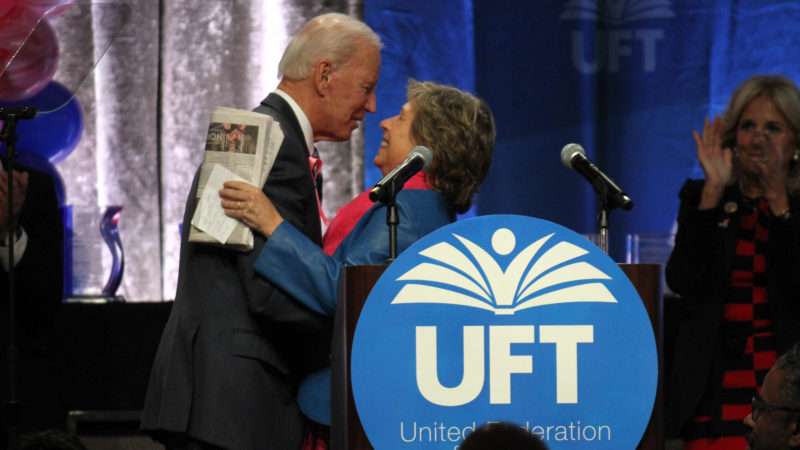
There is one pivotal reason that public schools have stayed shut, or quickly closed again, even as many private schools resume in-person classes: teachers unions. The unions have fought tooth and nail, ostensibly on behalf of their members, to keep schools closed. The unions maintain that distance learning is the only safe option for teaches—and some believe that this will remain the case for at least another year. Teachers unions are influential members of the Democratic Party’s coalition, and so many officials in blue cities feel they have little choice but to heed their demands.
President-elect Joe Biden is thus likely to be more reticent about school reopenings than President Trump. Indeed, some education experts believe Biden is inclined to nominate either Randi Weingarten or Lily Eskelsen Garcia to be the next secretary of education. Wingarten is the current boss of the American Federation of Teachers, and Garcia is the former head of the National Education Association. Biden has enjoyed strong support from both unions, and his wife, Jill Biden, is a member of the latter.
The decision to reopens schools is primarily made at the local level, so there’s only so much that any education secretary could do either way. But virtually no single person has worked harder to prevent kids from returning to their classrooms than Weingarten. Elevating her to the nation’s top education job would send a clear message about the new administration’s priorities.
from Latest – Reason.com https://ift.tt/3nJeCD1
via IFTTT
After 20 months on the tarmac following two fatal crashes, Boeing’s troubled 737 Max airliner has been given the green light to resume passenger flights, the Federal Aviation Administration announced Wednesday.
The plane’s return to the skies will not be immediate, however. The FAA is requiring a series of design changes laid out in a 115-page directive. It also put forward training requirements for pilots and maintenance requirements for airlines.
“This airplane has undergone an unprecedented level of scrutiny by the FAA,” Dickson said. “We have not left anything to chance here.”
After the FAA announcement, the Air Line Pilots Association released a statement saying it “believes that the engineering fixes to the flight-critical aircraft systems are sound and will be an effective component that leads to the safe return to service of the 737 MAX.”
Culture of Concealment
Boeing was aware of issues but did not disclose them to pilots or the FAA.
Investigators found a “culture of concealment” as well as “grossly insufficient oversight by the FAA.”
Fehrm says “The 737 is a Safe Aircraft” and this “chain of events will not happen again on an updated 737 MAX“.
Much of the discussion in from a pilot’s perspective that is hard to follow but the key details are easy to understand even if you do not understand the terminology.
The MCAS (Maneuver Characteristics Augmentation System) software was inaccurately classified as non “hazardous.”
The inaccurate classification allowed a single sensor to control the MCAS.
The MCAS was inaccurately coded.
The original MCAS listened to the Speed Trim reset, “the Pilot trims,” instead of the correct “AoA is below the threshold again.” The result was MCAS trims, the Pilot trims, MCAS trims, the Pilot trims…. After 24 rounds in the Lion Air jet, the Pilots lost the race with MCAS.
“MCAS went from a Pilot assist to a highly hazardous function by this single mistake in the MCAS software code. The whole drama came from the omission of a few code lines in the MAX Flight Control Computers software.“
Boeing Changes
I describe the above in sufficient detail so we can understand how little in MCAS needed change to take it from a hazardous function to one that would have caused no trouble if wrongly triggered.
In addition to this change, Boeing has made additional changes to increase safety further.
A single sensor no longer triggers MCAS. Both AoA sensors on the 737 MAX have to agree on the aircraft AoA, or Speed Trim including MCAS is deactivated (neither is needed to fly the plane. They are augmentation functions, i.e., good to have but not necessary).
On top of the dual-sensor activation of MCAS, its global authority, no matter what, is limited. The Pilot always has enough pitch control to fly the aircraft.
MCAS is Now Safe
To make MCAS safe, we only needed the correct reset criteria. But as the investigations dug deeper into how Boeing and FAA could miss how dangerous the original MCAS was, the requirements for changes grew. All eventualities, even remote ones, should be covered.
About Bjorn Fehrm
My Boeing contact who sent me the Leeham article notes Bjorn Fehrm is a former fighter test pilot and an aero engineer based in France.
Bjorn has said he would pilot the MAX as well as fly in it as a passenger.
Most Expensive Lines of Code in History
Boeing is out $20 billion, not counting pending lawsuits.
346 people are dead.
450 aircraft are grounded worth about $45 billion.
Mistrust of Boeing and the 737 Max will last for years.
Had a few lines of code been properly placed, there would not have been two crashes or 20 months of grounding even though other safety features were needed.
In retrospect, it is not really the lines of code that were the problem.
It was the “culture of concealment” coupled with “grossly insufficient oversight by the FAA.”
via ZeroHedge News https://ift.tt/3kK3ALV Tyler Durden
Throughout the fall, New York City repeatedly delayed reopening its schools for most students, despite an emerging scientific consensus that classrooms were not significant areas of spread for COVID-19. Now Mayor Bill de Blasio has ordered a full shutdown of schools due to rising coronavirus numbers; the city has reached the 3 percent test-positivity rate, the predetermined (and largely arbitrary) threshold for keeping kids at home.
Many parents are rightly infuriated, and even some district officials think the call might have been premature. New York bars and restaurants are operating under new restrictions, but they are still open for business, even though these establishments are believed to be far less safe than schools. Public school children and working-class families appear to be planners’ last priority.
This approach runs completely counter to the science. K-12 schools have not caused significant outbreaks. The risks to children are negligible, and there’s scant evidence that kids are infecting a large number of their teachers. Meanwhile, the adverse consequences for children who don’t attend classes in-person can be quite serious. Remote learning has been a stunning failure for younger kids, and the economically disadvantaged are falling further and further behind. Policy makers could be dooming a generation of at-risk students to years of suboptimal social and professional outcomes—and it’s all for nothing, since pandemic mitigation doesn’t actually require this course of action.
“Keeping kids out of the classroom will make recovering from the pandemic harder in the long term, while not keeping us any safer in the near term,” writes Nina Schwalbe, a professor at Columbia University’s Mailman School of Public Health, in The Atlantic. “Even with case numbers climbing in New York City, we know that schools are not driving the pandemic. However, one thing is clear with COVID-19: Our kids are paying the highest price.”
Like virtually all other aspects of the government’s approach to the pandemic, school closures have become a political football. President Trump and Education Secretary Betsy DeVos favor keeping schools open, which has prompted many anti-Trump partisans to dutifully take the opposite stance. But a growing number of journalists on both the left and the right think this is a terrible mistake. “Some things are true even though President Trump says them,” notesThe New York Times’ Nicholas Kristof. “Trump has been demanding for months that schools reopen, and on that he seems to have been largely right.”
“I don’t get why NYC feels bound to stick by a 3 percent positivity rule for closing schools when we know more about the virus now, including relatively low rates of transmission in schools,” tweets Nate Silver of FiveThirtyEight. “If I were a parent I’d be furious.”
There is one pivotal reason that public schools have stayed shut, or quickly closed again, even as many private schools resume in-person classes: teachers unions. The unions have fought tooth and nail, ostensibly on behalf of their members, to keep schools closed. The unions maintain that distance learning is the only safe option for teaches—and some believe that this will remain the case for at least another year. Teachers unions are influential members of the Democratic Party’s coalition, and so many officials in blue cities feel they have little choice but to heed their demands.
President-elect Joe Biden is thus likely to be more reticent about school reopenings than President Trump. Indeed, some education experts believe Biden is inclined to nominate either Randi Weingarten or Lily Eskelsen Garcia to be the next secretary of education. Wingarten is the current boss of the American Federation of Teachers, and Garcia is the former head of the National Education Association. Biden has enjoyed strong support from both unions, and his wife, Jill Biden, is a member of the latter.
The decision to reopens schools is primarily made at the local level, so there’s only so much that any education secretary could do either way. But virtually no single person has worked harder to prevent kids from returning to their classrooms than Weingarten. Elevating her to the nation’s top education job would send a clear message about the new administration’s priorities.
from Latest – Reason.com https://ift.tt/3nJeCD1
via IFTTT
“China Is Angry. China Can Be The Enemy”: Beijing Launches Extraordinary Attack On Australian Government Tyler Durden
Thu, 11/19/2020 – 15:12
With the war of words between China and the US on hiatus, especially as Beijing awaits for a pro-China Joe Biden to occupy the White House and normalize relations, Beijing has found a new diplomatic target to unleash hell on: Australia.
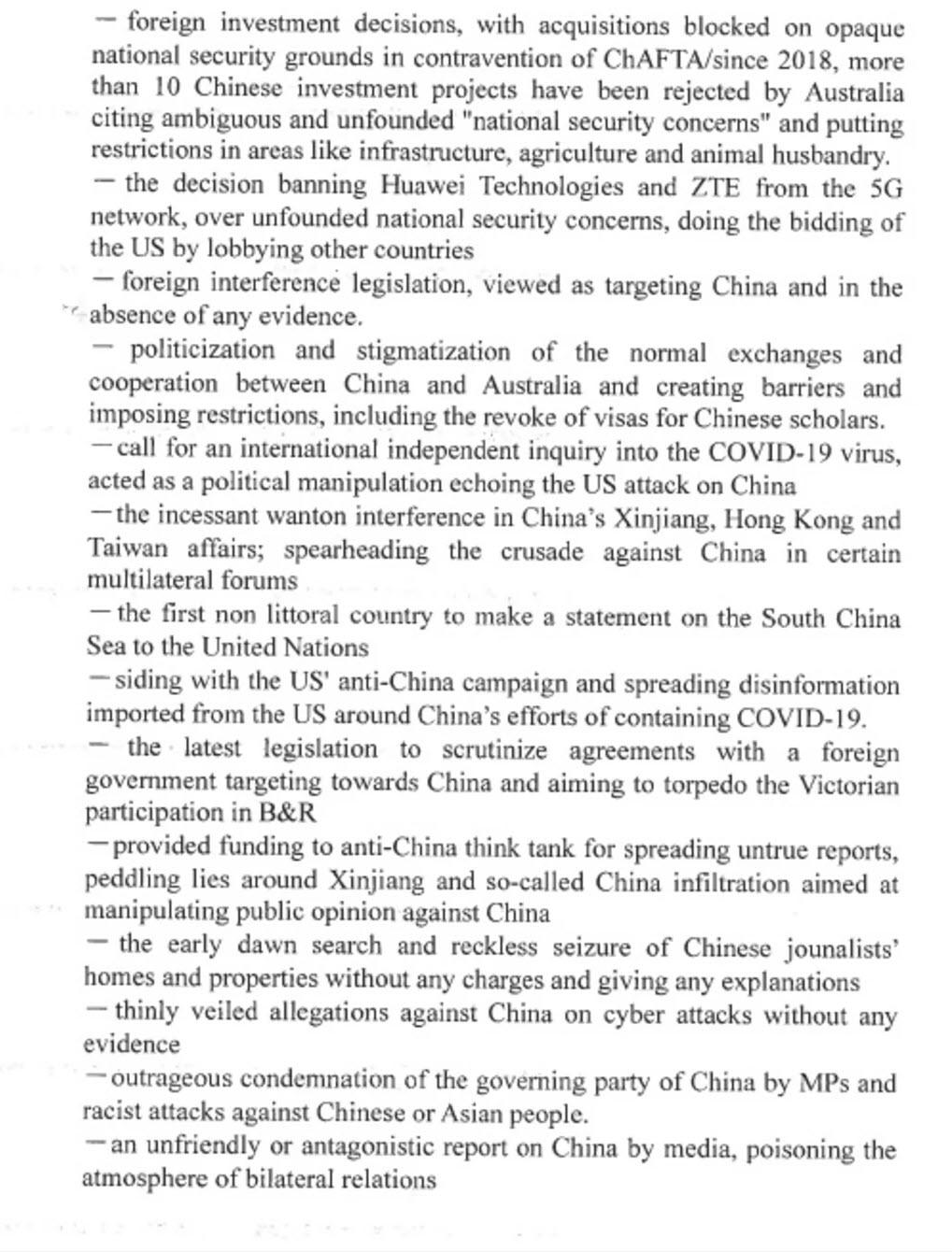
In what the Sydney Morning Herald dubbed “an extraordinary attack on the Australian government”, Beijing accused Australia of “poisoning bilateral relations” in a deliberately leaked document that threatens to escalate tensions between the two countries whose bilateral trade relations have already suffered a spectacular collapse in recent months.
The Chinese government document goes further than any public statements made by the Chinese Communist Party, accusing the Morrison government of attempting “to torpedo” Victoria’s Belt and Road deal, and blaming Canberra for “unfriendly or antagonistic” reports on China by independent Australian media.
“China is angry. If you make China the enemy, China will be the enemy,” a Chinese government official said in a briefing with a reporter in Canberra on Tuesday.
With China suddenly emboldened, perhaps expecting a Biden presidency to rollover to all of Beijing’s demands, the dossier of 14 grievances was handed over by the Chinese embassy in Canberra to Nine News, The Sydney Morning Herald and The Age in a diplomatic play that appears aimed at pressuring the Morrison government to reverse Australia’s position on key policies.
The list of Beijing grievances includes:
government funding for “anti-China” research at the Australian Strategic Policy Institute,
raids on Chinese journalists and academic visa cancellations,
“spearheading a crusade” in multilateral forums on China’s affairs in Taiwan, Hong Kong and Xinjiang,
calling for an independent investigation into the origins of COVID-19 (because clearly China has nothing to hide here)
banning Huawei from the 5G network in 2018, and
blocking 10 Chinese foreign investment deals across infrastructure, agriculture and animal husbandry sectors.
In a “targeted threat” to Australia’s foreign policy position, the Chinese official also said if Australia backed away from policies on the list, it “would be conducive to a better atmosphere”.
The dossier was delivered shortly before China’s Foreign Ministry spokesman Zhao Lijian laid the blame on Australia for the state of the relationship at a press conference in Beijing.
The list of grievances from the Chinese embassy.
“The Australian side should reflect on this seriously, rather than shirking the blame and deflecting responsibility,” he said.
In response to China’s scathing attack on Australian sovereignty, the Morrison government rejected Beijing’s characterisation and called for the Chinese government to answer its phone calls. “The ball is very much in China’s court to be willing to sit down and have that proper dialogue,” Trade Minister Simon Birmingham said on Wednesday.
But the Chinese government official, who spoke on the condition of anonymity because they are not authorised to speak publicly, said “why should China care about Australia?” and that phone calls would be “meaningless” while the “atmosphere is bad”.
The document also takes aim at “thinly veiled allegations against China on cyber attacks without any evidence” and claims Australia was the first country without a maritime presence in the South China Sea to condemn China’s actions at the United Nations. Australia followed the United States in July in branding China’s claims to the disputed area “unlawful”.
It also accuses MPs of “outrageous condemnations of the governing party of China and racist attacks against Chinese or Asian people” after Liberal Senator Eric Abetz demanded Chinese-Australian witnesses at a Parliamentary inquiry condemn the Chinese Communist Party.
* * *
Meanwhile, in response to the latest Chinese diplomatic provocation, Prime Minister Morrison said he wouldn’t compromise Australia’s national security and sovereignty according to Bloomberg.
“Australia will always be ourselves,” Morrison said in a television interview Thursday with the Nine Network. “We will always set our own laws and our own rules according to our national interests — not at the behest of any other nation, whether that’s the U.S. or China or anyone else.”
While Morrison’s response was commendable, it may also be futile: China has is placing increased pressure on Australia through trade sanctions and reprisals as it criticizes a raft of Australian policies. While ministerial ties with the U.S. ally have been in a deep freeze since April, when Morrison’s government called for independent investigators to enter Wuhan to probe the origins of the coronavirus, the prime minister’s visit to strategic partner Japan this week to sign a new defense pact has exacerbated tensions further.
Morrison, who said Thursday he had seen the “unofficial document that’s come out of the Chinese embassy,” added in the TV interview that Australia’s values, democracy and sovereignty “are not up for trade”; his government has labeled Chinese trade reprisals launched this year as “economic coercion.”
“We won’t be compromising on the fact that we’ll set what our foreign investment laws are, or how we build our 5G telecommunications networks, or how we run our systems to protect that are protecting against any interference,” Morrison said.
In what may be the most notable regional geopolitical development in recent years, Morrison visited his counterpart Yoshihide Suga in Tokyo in an attempt to build a coalition of “like-minded” democracies pushing back against what Beijing’s increasing influence in the Asia-Pacific region.
In addition to agreeing to a legal framework that will allow the military of each nation to stay in the other’s country to conduct joint exercises, Morrison and Suga issued a joint statement with criticisms of Chinese policies, including their “strong opposition to any coercive or unilateral attempts to change the status quo and thereby increase tensions in the region.”
This could also mean that China is about to have another major spat with Japan, similar to the mutual boycotts in 2013 over territorial disputes in the East China Sea. Hinting at this, China Foreign Ministry spokesman Zhao Lijian told a daily briefing in Beijing on Wednesday that the “Chinese side is strongly dissatisfied and firmly opposed to their press statement in which they accused China on the South China Sea and East China Sea issue.” The two nations “blatantly interfered in Hong Kong affairs and China’s internal affairs,” he said.
Ties between China and Australia, which until this year were very close trade partners, have been strained since 2018 when Canberra barred Huawei Technologies from building its 5G network and introducing anti-foreign interference laws aimed at halting Beijing’s “meddling” in domestic affairs.
“We stand up with other countries, whether it be on human rights issues or things that are happening around the world, including in China,” Morrison boomed. “Now if that is the source of tensions between Australia and China, well I can assure you that Australia will continue to be ourselves, we’ll continue to act in our own national interests, and pursue partnerships like the one” with Japan, which would “only strengthen stability and peace in the Indo-Pacific.”
China has imposed trade strikes on up to a dozen Australian products including wine, beef, barley, timber, lobster and coal now threaten $20 billion worth of Australian exports.
One reason why China feels it has all the leverage, is that it accounts for up to 40% of Australia’s exports and one in 13 Australian jobs, leading to rising anxiety among business figures and diplomats grappling with competing objectives: balancing Australia’s national security, maintaining a military deterrent to China’s regional aggression through a new defence agreement with Japan, and keeping economic lines with China open.
“This is a significant evolution of this relationship, but there is no reason for that to cause any concern elsewhere in the region,” Mr Morrison said. “I think it adds to the stability of the region, which is a good thing.”
Curiously, the monetary globalists quickly urged Australia not to antagonize Beijing too much: Reserve Bank governor Philip Lowe on Wednesday urged Australia to maintain a strong relationship with China. In his most direct comments on the multi-billion dollar diplomatic dispute to date, Dr Lowe said it was in the economy’s interest for the relationship between Australia and its largest trading partner to get back on track.
Alas that may not be easy: according to the SMH, the 14 items identified by the Chinese embassy document are seen by the Department of Foreign Affairs as key to Australia’s national interest and non-negotiable, leaving the two countries facing the prospect of an extended diplomatic and economic dispute.
The Department of Foreign Affairs and Trade said the Australian government makes “sound decisions in our national interest and in accordance with our values and open democratic processes. We are a liberal democratic society with a free media and a parliamentary democracy, where elected members and media are entitled to freely express their views,” the department said in a statement.
“The Australian government is always ready to talk directly in a constructive fashion about Australia’s relationship with China, including about our differences, and to do so directly between our political leaders. Such direct dialogue enables misrepresentation of Australia’s positions to be addressed in a constructive manner that enables our mutually beneficial relationship.”
via ZeroHedge News https://ift.tt/3kPGymW Tyler Durden
All indications suggest that infrastructure will be a major priority for both the White House and Congress next year. Whether anything will get passed is another question.
Both President-elect Joe Biden and House Speaker Nancy Pelosi (D–Calif.) have thrown their support behind big new spending initiatives, and some Senate Republicans have said that infrastructure could be one area ripe for bipartisan policymaking. And next September 2021 the federal government’s major surface transportation programs—covering everything from passenger rail to roads—will expire, providing an opportunity for a major overhaul of transportation spending.
“It would seem to be something that we can work together on in a productive way,” Sen. John Barrasso (R–Wy.) toldTheWall Street Journal, though he threw cold water on the Democrats’ most profligate spending plans.
Barrasso, who chairs the Senate’s Environmental and Public Works Committee, proposed a $287 billion surface transportation bill, with most of that money going toward roads and bridges.
That’s much less than what Democrats are looking to spend.
Earlier this year, the Democrat-controlled House passed a $1.5 trillion infrastructure package, of which $500 billion was dedicated to surface transportation spending. Funding that would require a doubling of the federal gas tax. Meanwhile, Biden has proposed $2 trillion in new spending for infrastructure upgrades and climate change mitigation.
If the goal is to improve the quality of the nation’s roads and bridges, these grand sums miss the mark, says Baruch Feigenbaum, transportation policy director at the Reason Foundation (which publishes this website) and the co-author of a new report on the condition of highways in each state.
“How you spend the money and the organization of the [Department of Transportation] and your policy priorities are much more important than the amount of funding that you have,” says Feigenbaum.
As an example, he cites North Carolina, which has the most extensive state-owned roadway network in the country (given that it doesn’t have locally owned roads) and a middle-of-the-pack level of gas tax. Nevertheless, his report ranked the state 6th in overall urban interstate pavement condition and 19th in rural interstate pavement condition. The pavement condition on the state’s urban and rural arterial roads ranked 16th and 20th, respectively.
Feigenbaum credits North Carolina for maintaining a leanly staffed department of transportation and for not letting politics prioritize its projects.
New Jersey, be contrast, comes in dead last in the Reason report’s ranking of state highway systems. Despite having one of the highest gas taxes in the county and spending the most per mile on its roads, the Garden State still has some of the worst pavement conditions for both rural and urban roads. Feigenbaum blames a badly managed, overly politicized transportation department that does a poor job of planning for future highway needs and prioritizing current spending.
Feigenbaum says the federal government could address some of these issues by withholding some transportation dollars from states that do a bad job of maintaining their road networks, and rewarding states that manage to keep their roads in good repair.
But that would be politically fraught, since it would penalize a lot of states. And the coming configuration of power—a Democrat-controlled White House and a Republican-controlled Senate—makes any major shake-up of infrastructure policy and spending levels less likely.
A five-year reauthorization of a surface transportation bill is more probable, says Feigenbaum. And there is a chance that Congress will just pass another short-term reauthorization of current programs, as it did earlier this year.
from Latest – Reason.com https://ift.tt/3nL0V6V
via IFTTT
All indications suggest that infrastructure will be a major priority for both the White House and Congress next year. Whether anything will get passed is another question.
Both President-elect Joe Biden and House Speaker Nancy Pelosi (D–Calif.) have thrown their support behind big new spending initiatives, and some Senate Republicans have said that infrastructure could be one area ripe for bipartisan policymaking. And next September 2021 the federal government’s major surface transportation programs—covering everything from passenger rail to roads—will expire, providing an opportunity for a major overhaul of transportation spending.
“It would seem to be something that we can work together on in a productive way,” Sen. John Barrasso (R–Wy.) toldTheWall Street Journal, though he threw cold water on the Democrats’ most profligate spending plans.
Barrasso, who chairs the Senate’s Environmental and Public Works Committee, proposed a $287 billion surface transportation bill, with most of that money going toward roads and bridges.
That’s much less than what Democrats are looking to spend.
Earlier this year, the Democrat-controlled House passed a $1.5 trillion infrastructure package, of which $500 billion was dedicated to surface transportation spending. Funding that would require a doubling of the federal gas tax. Meanwhile, Biden has proposed $2 trillion in new spending for infrastructure upgrades and climate change mitigation.
If the goal is to improve the quality of the nation’s roads and bridges, these grand sums miss the mark, says Baruch Feigenbaum, transportation policy director at the Reason Foundation (which publishes this website) and the co-author of a new report on the condition of highways in each state.
“How you spend the money and the organization of the [Department of Transportation] and your policy priorities are much more important than the amount of funding that you have,” says Feigenbaum.
As an example, he cites North Carolina, which has the most extensive state-owned roadway network in the country (given that it doesn’t have locally owned roads) and a middle-of-the-pack level of gas tax. Nevertheless, his report ranked the state 6th in overall urban interstate pavement condition and 19th in rural interstate pavement condition. The pavement condition on the state’s urban and rural arterial roads ranked 16th and 20th, respectively.
Feigenbaum credits North Carolina for maintaining a leanly staffed department of transportation and for not letting politics prioritize its projects.
New Jersey, be contrast, comes in dead last in the Reason report’s ranking of state highway systems. Despite having one of the highest gas taxes in the county and spending the most per mile on its roads, the Garden State still has some of the worst pavement conditions for both rural and urban roads. Feigenbaum blames a badly managed, overly politicized transportation department that does a poor job of planning for future highway needs and prioritizing current spending.
Feigenbaum says the federal government could address some of these issues by withholding some transportation dollars from states that do a bad job of maintaining their road networks, and rewarding states that manage to keep their roads in good repair.
But that would be politically fraught, since it would penalize a lot of states. And the coming configuration of power—a Democrat-controlled White House and a Republican-controlled Senate—makes any major shake-up of infrastructure policy and spending levels less likely.
A five-year reauthorization of a surface transportation bill is more probable, says Feigenbaum. And there is a chance that Congress will just pass another short-term reauthorization of current programs, as it did earlier this year.
from Latest – Reason.com https://ift.tt/3nL0V6V
via IFTTT
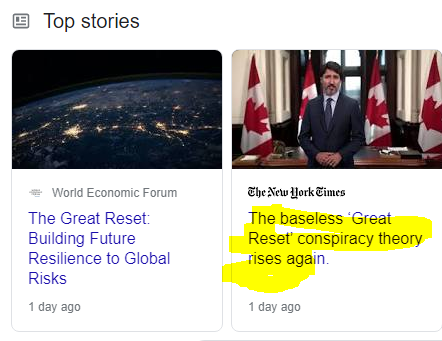
On the same day that the World Economic Forum heralded “The Great Reset” as a positive way to build “future resilience to global risks,” the New York Times declared the entire thing to be a “conspiracy theory.”
Yes, really.
The NYT was apparently upset that “The Great Reset” was trending on Twitter and published an article declaring it to be “A baseless conspiracy theory about the coronavirus.”
In reality, the WEF, NGOs and world leaders have for months been hyping the need to exploit the “opportunity,” in the words of Justin Trudeau, provided by the pandemic to achieve “The Great Reset”.
The NYT report mentioned Trudeau, but buried the fact that he had openly labeled COVID-19 an “opportunity” during a UN conference call.
On the same day the Times asserted that the issue was a fever dream of “far-right internet commentators,” the World Economic Forum itself celebrated “The Great Reset” as a way to build “future resilience to global risks.”
The NYT report then calls it an “unfounded rumor” that elites are using the pandemic “to impose their global economic control on the masses,” despite the fact that Davos globalist Karl Schwab specifically announces this very agenda in his recent book, COVID-19: The Great Reset.
As we previously highlighted, Schwab also openly endorses a technocratic dictatorship whereby people would accept implantable microchips that can read their thoughts as well as brain scans to be allowed to travel.
Suffice to say, the Times completely failed to mention Schwab’s book at all.
The NYT then evidently contacted both Twitter and Facebook in an attempt to get information about “The Great Reset” removed, but Twitter refused to do so and Facebook didn’t respond.
So in other words, in its attempt to persuade people that the elite aren’t pursuing a nefarious “Great Reset,” the newspaper of the elite lobbied to have information about this “conspiracy” (which doesn’t exist) removed from public consumption.
In the age of mass Silicon Valley censorship It is crucial that we stay in touch. I need you to sign up for my free newsletter here. Also, I urgently need your financial support here.
via ZeroHedge News https://ift.tt/2Ko3GN0 Tyler Durden