Massachusetts prosecutors persist in attempting to hold young women responsible for the conduct of troubled young men. This week, the Suffolk County District Attorney’s Office announced criminal charges against 21-year-old Inyoung You, for allegedly being so mean to her boyfriend that he committed suicide.
In the present case, 22-year-old Alexander Urtula committed suicide this past May, on the same day he was supposed to graduate from Boston College. Urtula and You had been dating for 18 months, according to Suffolk District Attorney Rachael Rollins. In the months leading up to his death, You allegedly sent Urtula 47,000 text messages, including some that said things like “go kill yourself” and “go die.”
Rollins accused You of making “demands and threats” and having “complete and total control over Mr. Urtula both mentally and emotionally.”
You, a South Korean national who was also studying at Boston College, is currently back in her native country. Rollins said prosecutors were talking with attorneys about her coming back voluntarily but would start extradition proceedings otherwise.
That’s right—a prosecutor is willing to extradite You back from South Korea for supposedly texting her boyfriend to death.
In this case, as with Carter, the cruel messages certainly don’t speak highly of the sender. Urging a depressed loved one to kill themselves rather than seek help is appalling—and perhaps Carter and You are both just monsters. But it’s not unimaginable that urging a suicidal partner to go through with it could be a misguided attempt at compassion, if the sender was also struggling with depression or heartbroken at watching a loved one’s long suffering. (Carter’s lawyers blamed her behavior in part on antidepressants.)
Dealing with someone close to you in the throes of serious mental illness can be a hugely taxing and confusing situation even for seasoned adults—and in these instances, we’re talking about 17 to 22 year olds.
Do we really want to start criminally prosecuting people for not handling these situations so well? Or to start locking people up for cruel words if the receiver happens to do something drastic?
We don’t know the state of You and Urtula’s relationship and we don’t know what kinds of things he had been saying to her when she told him to “go die.”
But phrases like that aren’t uncommon during nasty breakups. They can be (and usually are) rhetorical. A heat-of-the-moment response to some sort of provocation. The bitter pushback of someone treated poorly by a partner for too long. A plea to be left alone. A means of belittling. Or a horrid instruction. In short: highly contextual. Not the kind of thing folks like police and prosecutors have a great history with sorting out.
It’s perhaps telling that so far, the two people charged for these pro-suicide text crimes are young women in relationships with male partners. The prosecutions of Carter and You play into tropes about young seductresses and the cruel sway they can have over helpless male targets. In both cases, the state has portrayed the young women as purely evil narcissists and wielders of unimaginable power over poor, enraptured young men.
It’s a worrying trend.
Cases like these make criminals out of troubled teens and young adults, run counter to our current legal understandings of free speech, and represent a ridiculously over-punitive reaction. Which means that, unfortunately, they’re right in keeping with our country’s general attitude toward anything involving young people, relationships, and technology.
from Latest – Reason.com https://ift.tt/34gFr8b
via IFTTT
JPMorgan Is Now Giving Its Coders Licenses To Deal In Equities
The line between coders and traders at investment banks is starting to blur even further.
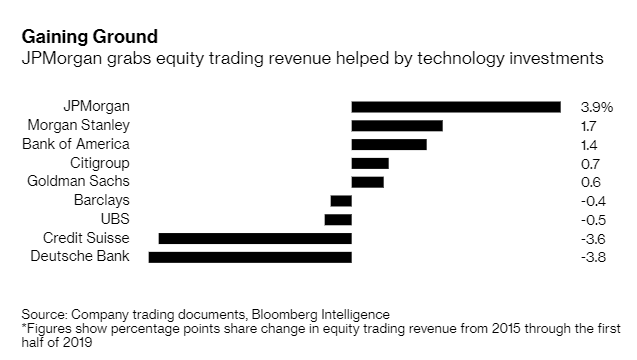
And leading the charge is JP Morgan, whose coders have now obtained licenses to deal in equities, according to Bloomberg.
The bank got regulatory approvals this month for two of its coders in London and New York to trade cash equities. JP Morgan is targeting eight more licenses for coders, globally, by the end of the year.
Jason Sippel, the bank’s head of global equities, said: “This is about convergence of the trader and quant. It’s moving at warp speed and re-inventing what the trading floor looks like.”
The move comes at a time when the largest investment banks have shelled out billions to automate trading while competition heats up. JP Morgan plans to deploy more than $11 billion just on technology initiatives alone this year. CEO Jamie Dimon has said that keeping up with technology is “critical” to the bank’s mission of gaining market share.
As such, JP Morgan is placing even more faith into its quants.
The bank has an “Analytics, Automation & Optimization” team that it set up years ago that is focused on using data across sectors like prime brokerage, derivatives and cash trading within its equities unit. The team is led by Hans Buehler and has grown to about 180 employees, from 86, in just three years. Employees dedicated to cash equities have doubled to 36.
Sippel continued: “We are hiring coders for equity sales who can tap into the reams of data we have to provide ideas.”
Sippel says his unit is also working on developing machine-learning based tools for the trading floor, like “RoboTrader”, a new tool that allows the company to automate pricing and hedging of equity options.
JP Morgan is the top ranked bank for equity derivatives trading as of 2018 and, in September, the bank said it had reached $500 billion in prime brokerage balances, ranking it in second. In Q3, the bank posted a surprise 5% decline in equity trading revenue to $1.5 billion.
Sippel concluded: “Looking forward, we will have much more automation.”
Years ago, markets used to pay a lot of attention to the money supply and trade deficits. Now, these numbers barely get a passing mention. In his latest podcast, Peter Schiff said he thinks what is old will become new again and trade deficits and money printing will once again come front and center.
The dollar has been trending weaker over the last few weeks and bond prices have been falling, with bond yields increasing accordingly. Peter said this reveals the problems that are building in the economy.
The dollar is weakening and interest rates are rising. That is going to mean higher consumer prices. It’s going to mean higher borrowing costs.”
Meanwhile, the Federal Reserve is doing everything it can to hold interest rates down. Last month, it started repo operations to inject short-term liquidity into the overnight borrowing markets. Last week, the Fed increased those operations. The New York Fed started offering at least $120 billion in daily operations. That’s up from $75 billion. The amount offered for term repo operations – on Oct. 24 and Oct. 29 was increased to at least $45 billion, from $35 billion. The Fed’s balance sheet increased by another $2 billion, and Peter said he thinks it will show a much bigger increase this week.
He also pointed out that people used to really pay attention to the money supply. Back in the 1970s, that was a number everybody waited for.
People actually cared about how much money the Fed was creating, until I guess, they created so much, people stopped caring.”
Then in the 1980s, people started fixating on the monthly trade deficit number. In fact, part of the reason for the 1987 stock market crash was the big trade deficit.
At some point, I guess the trade deficits become so big that people stopped worrying about them, because it was like, wait a minute, we have these huge deficits. We were worried about the deficits. They’re now bigger than ever, and so people stopped worrying.”
And the then numbers they started looking at were the jobs numbers.
I suppose nobody cared how much money we were printing or how big our trade deficits were as long as we were creating jobs. And of course, eventually, nobody even cared if the jobs were real, if the government made them up, or if they were low-paying or part-time. As long as we could keep printing a number that was somewhere around 200,000, everything was good and the stock market could keep going up, and nobody cared about the money supply and nobody cared about the trade deficits.”
But Peter said everything old is new again.
And I have a feeling that both the money supply and trade deficits are going to become big factors again and big numbers as this ‘not QE’ that the Fed is now doing gets bigger and bigger and bigger as the Fed is trying to keep the air from coming out of this bubble long enough to reelect Donald Trump
…That’s generally what the Federal Reserve always tries to do. They try to kick the can down the road long enough to reelect whoever’s in office.”
Trump came out with another tweet last week bashing the Fed and calling it derelict in its duties for not getting interest rates low enough. Peter said Trump is right about one thing.
The Fed is derelict in their duties, but for the opposite reason that he cites. Where the Fed has been derelict is in keeping interest rates too low. They’ve been providing too much of this so-called stimulus to the economy. That’s where they’ve been derelict. They have not been the provider of sound money. They have not provided the fiscal discipline that we want an independent central bank to provide. The whole idea of the independence of the central bank is to prevent the central bank from working with the government to expand the size of government and to expand debt. But that’s what they’ve been doing. And that’s what Donald Trump wants the Fed to do.”
The president has run up massive deficits and he wants the Fed to work with him to monetize the debt and delay the pain that would normally come with this kind of fiscal profligacy.
What you want the Fed to do is not to numb the pain but make sure the pain is felt so that the voters know that there’s pain and so there’s political pressure on the government to act responsibly, to stop borrowing, to cut government spending. But Donald Trump doesn’t want that. He just wants to get reelected. He wants to be Santa Clause and make sure everybody gets what they want, and so he wants the Fed to cooperate.”
Peter said the Fed will continue to work with the president “hand in glove” to continue marching the country on the road to bankruptcy.
In this episode, Peter also runs through some economic data and talks about the Facebook hearings before Congress. Peter said Facebook isn’t the threat – government is.
Stocks Slide Ahead Of Fed Amid Trade-Fade, Brextension Bounce
The market is priced for a rate-cut tomorrow (94% odds and The Fed has never disappointed when priced this high)…
Source: Bloomberg
But, what stocks won’t like is that Fed Funds appear to be pricing a cut-and-pause…
Source: Bloomberg
And that could be a problem as stocks appear to be demanding almost 3 more rate-cuts…
Source: Bloomberg
But then again, Powell knows, “the show must go on!”
China was ugly overnight…
Source: Bloomberg
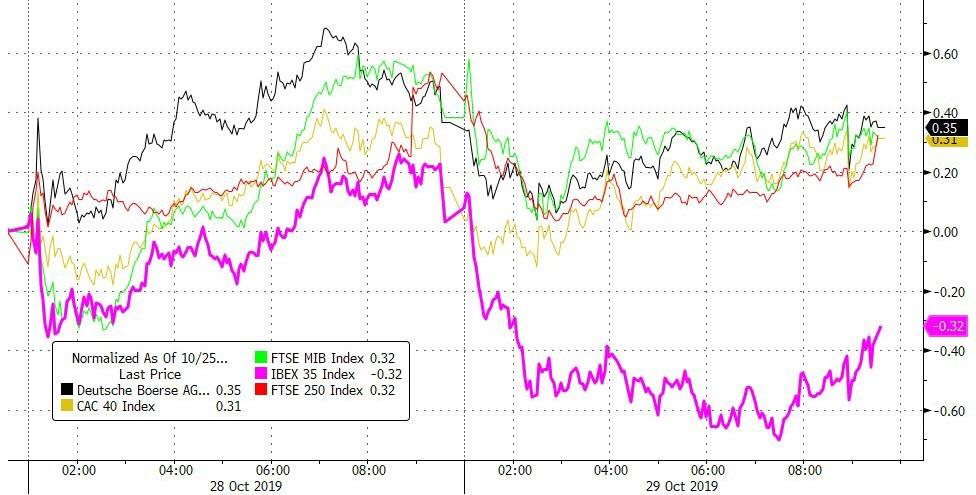
Spanish stocks were the big laggard in European markets
Source: Bloomberg
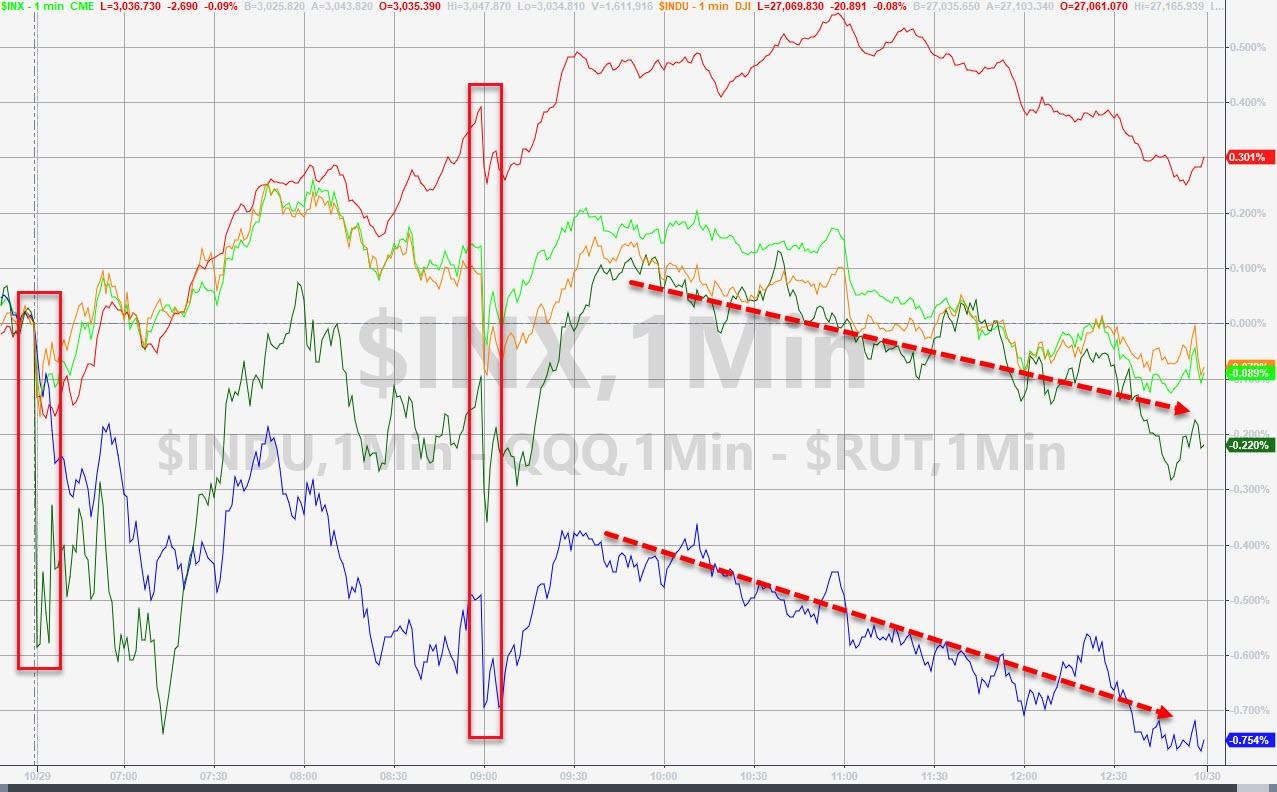
US stocks were mixed on the day with Alphabet dragging down Nasdaq but squeezefests pushing Small Caps higher (S&P hit a new intraday record high early)… Dow, S&P, and Trannies lost their gains into the close…
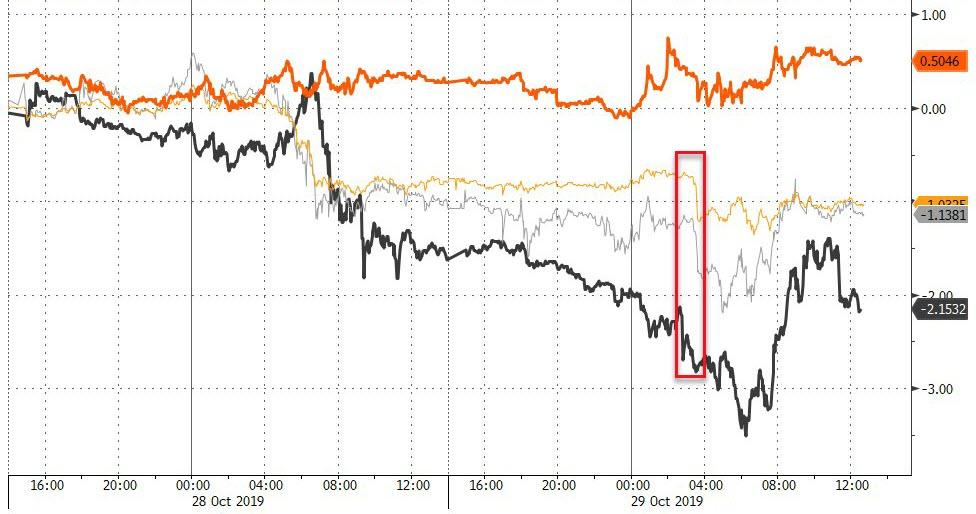
NOTE the 1200ET drop on a trade-related headline talking down the deal…
The weak open was bid/squeezed but after 1400ET, “Most Shorted” stocks started to accelerate lower into the close…
Source: Bloomberg
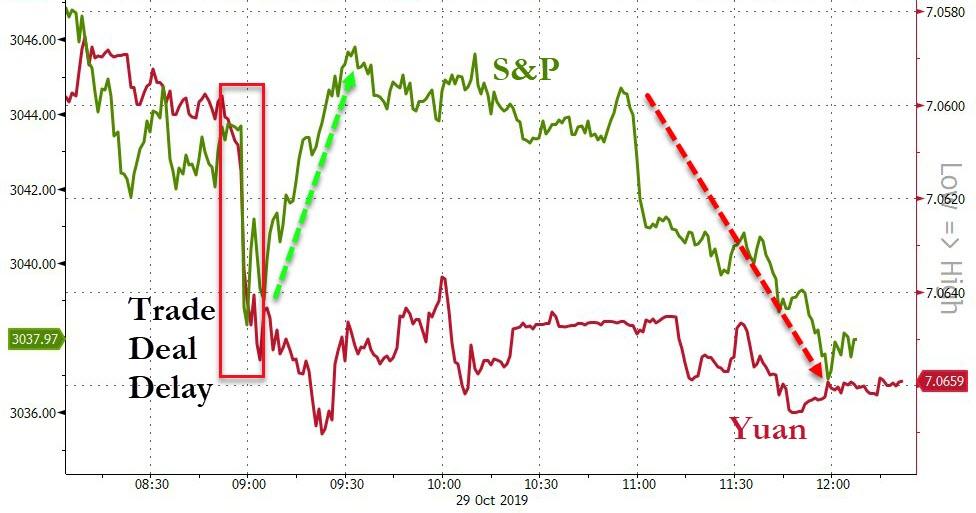
Yuan and stocks tumbled on the trade deal headlines but the machines were quick to bid back stocks… but were unable to hold them against the reality that yuan was signaling…
Source: Bloomberg
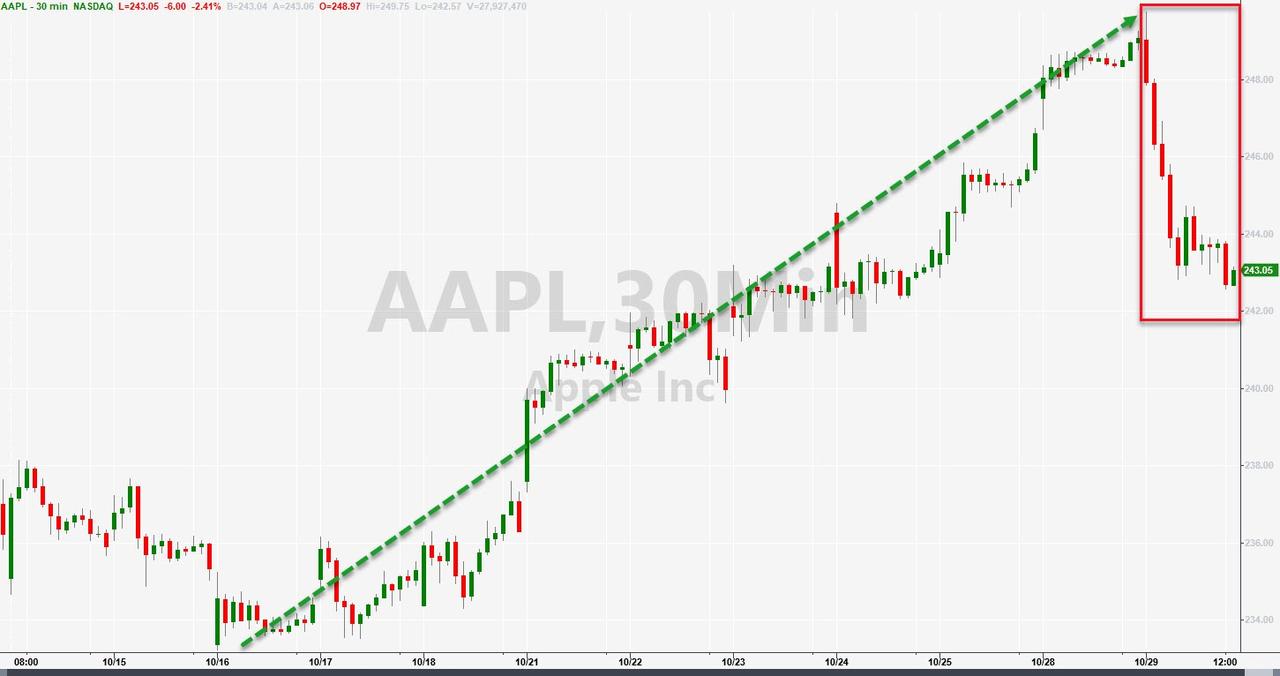
After rallying for 7 of the last 8 days, AAPL tumbled (on trade talk) – its worst day in 4 weeks…
GrubHub gagged…
Source: Bloomberg
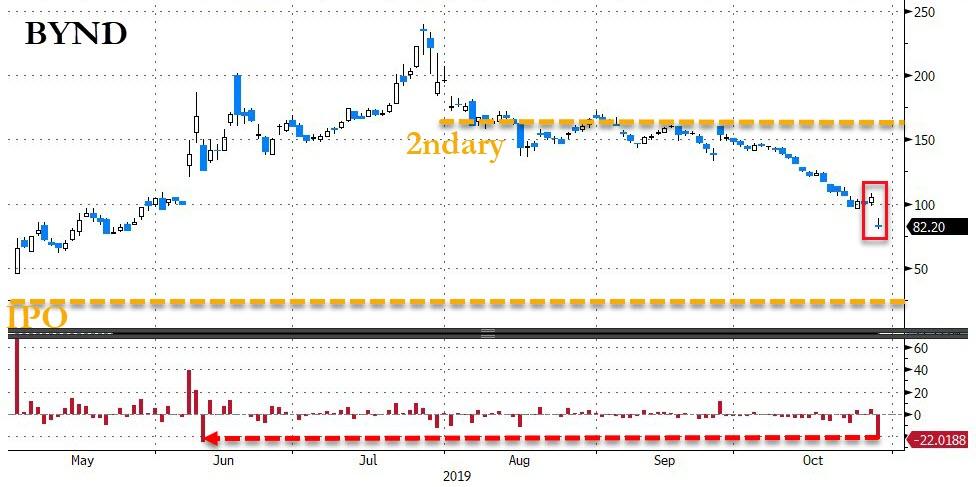
Beyond Meat barfed (on lock-up expiration fears after putting up big numbers last night)…
Source: Bloomberg
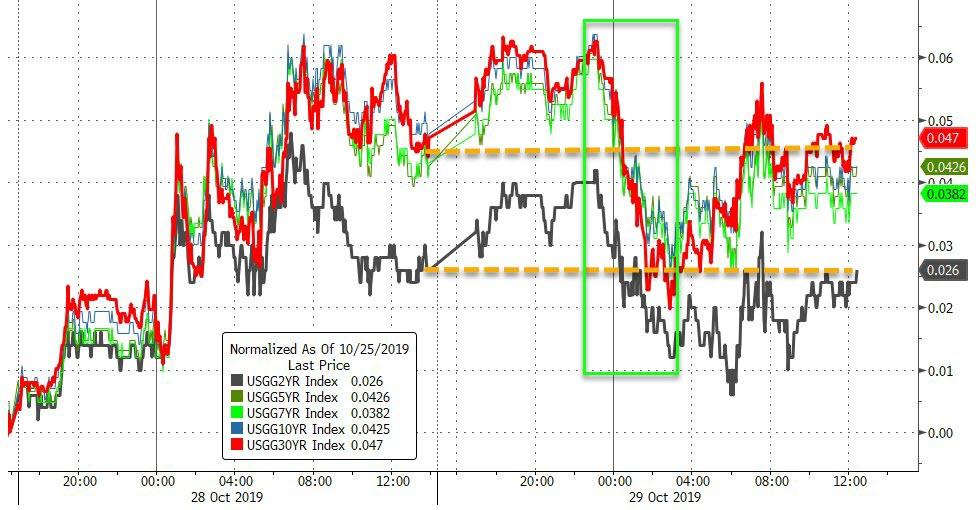
Treasury yields ended the day practically unchanged ahead of tomorrow’s FOMC, but bonds rallied from weakness overnight…
Source: Bloomberg
The Dollar ended lower for the second day in a row…
Source: Bloomberg
Cable bounced on election headlines and Brexit delays but faded back into the close…
Source: Bloomberg
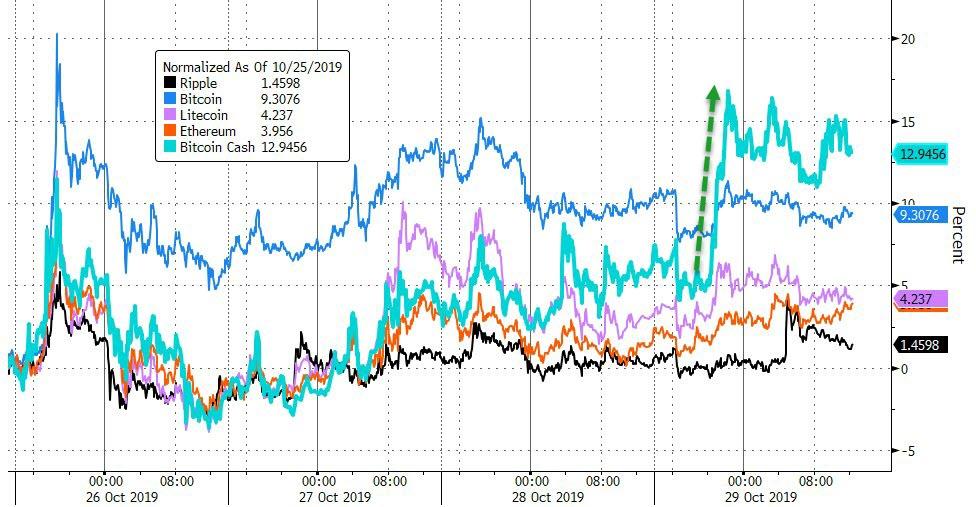
Most cryptos were flat today but Bitcoin Cash soared overnight…
Source: Bloomberg
Bitcoin flatlined for another day…
Source: Bloomberg
Copper managed very modest gains on the day but PMs and crude ended marginally lower…
Source: Bloomberg
Choppy day in oil-land as WTI rejected a $54 handle ahead of tonight’s API inventory data…
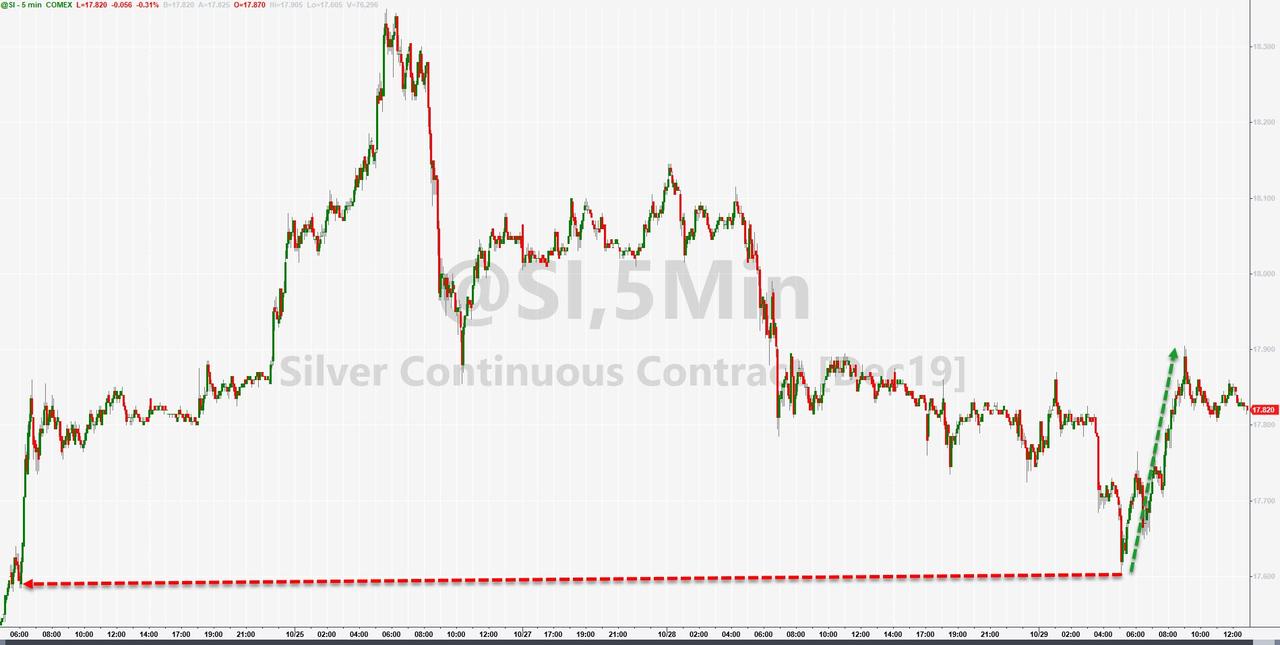
Gold remained below $1500 as Silver bounced off $17.60…
Finally, as stocks hit new record in intraday highs, the last six months has been dominated by defensive positioning as cyclicals remain lower…
Source: Bloomberg
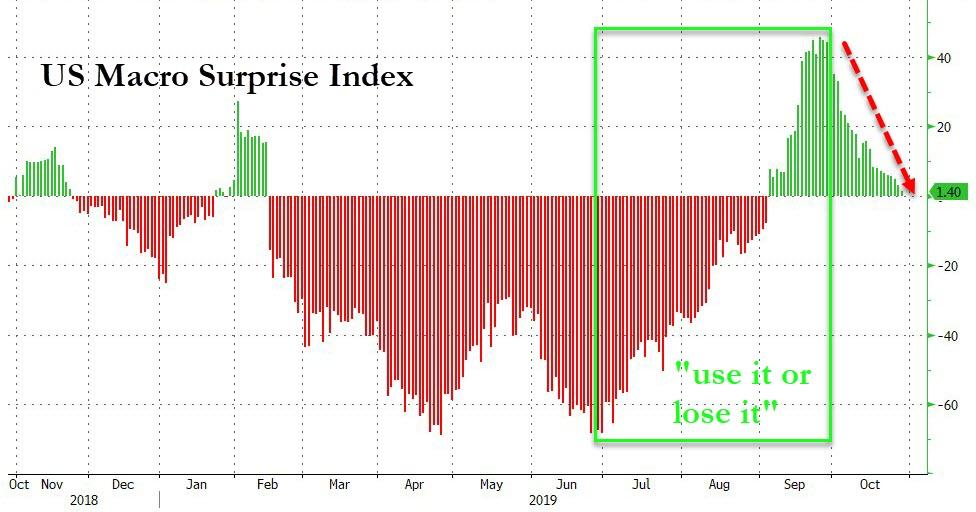
With US Macro data dumping in October (down 10 days in a row) after Q3’s “use it or lose it” panic…
More than half of American university students believe that wearing “offensive” Halloween costumes is not part of free expression and should “be punished.”
“Are highly offensive Halloween costumes (such as blackface) a protected form of free speech on campus, or should students who wear them be punished?”
51 per cent of students said that people who wear offensive costumes should be punished while 49 per cent said offensive costumes were a protected form of free speech.
However, when students at elite institutions were asked, they were even less likely to side with free speech, with 58 per cent of Ivy League students saying there should be consequences for wearing offensive outfits.
An even higher figure, three out of five students, within the California State University system said people who wore offensive costumes should be punished.
The results of the poll are unsurprising given that nearly 60 per cent of millennials think the Constitution “goes too far in allowing hate speech in modern America” and that the First Amendment should be re-written.
* * *
My voice is being silenced by free speech-hating Silicon Valley behemoths who want me disappeared forever. It is CRUCIAL that you support me. Please sign up for the free newsletter here. Donate to me on SubscribeStar here. Support my sponsor – Turbo Force – a supercharged boost of clean energy without the comedown.
For reasons I summarized here and here, the California case raises more difficult issues than the other sanctuary cases do, though I still believe California ultimately deserves to prevail on all the major issues at stake. But the administration’s cert petition focuses on Senate Bill 54, the least vulnerable of California’s three “sanctuary state” laws. That law restricts state and local officials from sharing information about immigrants within the state, with federal immigration-enforcement agencies.
Longstanding Supreme Court Tenth Amendment precedents forbid federal “commandeering” of state and local government officials by compelling them to help enforce federal law. But the Trump administration argues that SB 54 is preempted by 8 U.S.C. Section 1373, a controversial federal law mandating that “a Federal, State, or local government entity or official may not prohibit, or in any way restrict, any government entity or official from sending to, or receiving from, the Immigration and Naturalization Service information regarding the citizenship or immigration status, lawful or unlawful, of any individual.” Before Murphy, it was possible to argue that Section 1373 doesn’t violate the anti-commandeering rule, because it does not directly order states to cooperate with the federal government, but “merely” bars them from ordering their employees not to cooperate. As I see it, that distinction was always ultimately specious (see here and here). But the issue was not a simple one, and lower courts were divided on the subject. Murphy, however, decisively undercut the standard rationale for Section 1373. I explained why in an article published soon after the Supreme Court issued its decision:
Murphy struck down a provision of the federal Professional and Amateur Sports Protection Act (PASPA), which mandates that states may not “sponsor, operate, advertise, promote, license, or authorize by law or compact” sports betting. A coalition of sports leagues, including the National Collegiate Athletic Association, the National Basketball Association, the National Football League, and Major League Baseball, filed a lawsuit challenging two New Jersey state laws. The sports leagues argued New Jersey’s 2012 and 2014 laws, which partially repealed a prior prohibition on sports gambling within the state, qualified as “authorization” of sports betting and thus violated PASPA….
Like PASPA, Section 1373 is an attempt to circumvent the anti-commandeering rule’s strictures against federal mandates coercing states into helping to enforce federal law or enact a state law. Instead of directly ordering states to ban sports gambling, PASPA forbids states from repealing a prohibition of it in ways that “authorize” the activity under state law. But the Supreme Court saw through this subterfuge and struck down PASPA, because it violated the anti-commandeering rule by putting state legislatures “under the direct control of Congress” and issuing “direct orders to state legislatures.”
Section 1373 suffers from much the same flaw. Instead of directly ordering states and localities to divulge information to federal officials, it “merely” bars them from issuing orders to their subordinates forbidding such disclosure. But the practical effect is that states must comply with federal dictates.
Like PASPA, Section 1373 is an “order” to state and local officials; it undermines states’ control over their governmental machinery and partially transfers it to the federal government. In this case, federal law prevents states and localities from directing their law enforcement officials to pursue state and local priorities rather than assist federal immigration enforcers. As legal scholar Garrett Eppsputs it, “the federal government can’t order the states to dance to its tune; according to Murphy, it can’t tell the states they may not decide not to dance to the federal tune either. No double-negative tricks now!” Murphy undercuts Section 1373 in much the same way as it doomed PASPA.
The administration also argues that SB 54 is preempted by other federal immigration laws, and that it violates the doctrine of “intergovernmental immunity,” which which bars state laws that “regulate the United States directly or discriminate against the Federal Government or those with whom it deals.” But if any other federal law bars SB 54, it too would violate the anti-commandeering principle, in much the same was as Section 1373 does. And intergovernmental immunity only applies in cases of discrimination, where state law treats the federal government and its agents worse than other similarly situated parties. SB 54 and other sanctuary laws do not discriminate against the federal government for the simple reason that there is no private-sector analogue to federal immigration enforcement:
The concept of discrimination implies treating similarly situated entities differently. For example, a state government discriminates against entities that deal with the federal government if it imposes special restrictions on firms that rent cars to federal agencies that don’t apply to those that rent the same kinds of vehicles to private parties. But there is no true private counterpart to people who assist federal immigration raids, because no private entity has the legal right to deport people, forcibly separate families, and confine people in cages. These are the kinds of things that occur when federal officials apprehend suspected undocumented immigrants…
If—as the administration argues—the doctrine of intergovernmental immunity prevents states from refusing to cooperate with federal immigration-enforcement officials because they still sometimes cooperate with federal officials on other—very different—issues, and with officials from other states, that would undermine the entire anti-commandeering principle. States would be unable to withhold assistance from the federal government on any law-enforcement issue so long as they cooperated with them (or with other states) on anything else.
Hopefully, the Supreme Court will reinforce this growing judicial consensus by either rejecting the administration’s petition, or taking the case and upholding the Ninth Circuit. If the administration manages to prevail, it would set a dangerous precedent that goes far beyond immigration policy, creating a road map for federal coercion of states and local governments that can be used on a wide range of other issues. Conservatives who may cheer Trump’s efforts to coerce sanctuary cities may not be so happy when future Democratic presidents use similar tactics on issues such as gun control, education, or environmental enforcement. Particularly in our highly polarized era, Americans with a wide range of ideological commitments have good reason to support rigorous enforcement of constitutional federalism.
NOTE: For those interested, I have discussed the issues at stake in the “sanctuary state” case and other Trump-era sanctuary jurisdiction litigation in much greater detail in my recent Texas Law Review article on this subject.
from Latest – Reason.com https://ift.tt/2q6j06w
via IFTTT
For reasons I summarized here and here, the California case raises more difficult issues than the other sanctuary cases do, though I still believe California ultimately deserves to prevail on all the major issues at stake. But the administration’s cert petition focuses on Senate Bill 54, the least vulnerable of California’s three “sanctuary state” laws. That law restricts state and local officials from sharing information about immigrants within the state, with federal immigration-enforcement agencies.
Longstanding Supreme Court Tenth Amendment precedents forbid federal “commandeering” of state and local government officials by compelling them to help enforce federal law. But the Trump administration argues that SB 54 is preempted by 8 U.S.C. Section 1373, a controversial federal law mandating that “a Federal, State, or local government entity or official may not prohibit, or in any way restrict, any government entity or official from sending to, or receiving from, the Immigration and Naturalization Service information regarding the citizenship or immigration status, lawful or unlawful, of any individual.” Before Murphy, it was possible to argue that Section 1373 doesn’t violate the anti-commandeering rule, because it does not directly order states to cooperate with the federal government, but “merely” bars them from ordering their employees not to cooperate. As I see it, that distinction was always ultimately specious (see here and here). But the issue was not a simple one, and lower courts were divided on the subject. Murphy, however, decisively undercut the standard rationale for Section 1373. I explained why in an article published soon after the Supreme Court issued its decision:
Murphy struck down a provision of the federal Professional and Amateur Sports Protection Act (PASPA), which mandates that states may not “sponsor, operate, advertise, promote, license, or authorize by law or compact” sports betting. A coalition of sports leagues, including the National Collegiate Athletic Association, the National Basketball Association, the National Football League, and Major League Baseball, filed a lawsuit challenging two New Jersey state laws. The sports leagues argued New Jersey’s 2012 and 2014 laws, which partially repealed a prior prohibition on sports gambling within the state, qualified as “authorization” of sports betting and thus violated PASPA….
Like PASPA, Section 1373 is an attempt to circumvent the anti-commandeering rule’s strictures against federal mandates coercing states into helping to enforce federal law or enact a state law. Instead of directly ordering states to ban sports gambling, PASPA forbids states from repealing a prohibition of it in ways that “authorize” the activity under state law. But the Supreme Court saw through this subterfuge and struck down PASPA, because it violated the anti-commandeering rule by putting state legislatures “under the direct control of Congress” and issuing “direct orders to state legislatures.”
Section 1373 suffers from much the same flaw. Instead of directly ordering states and localities to divulge information to federal officials, it “merely” bars them from issuing orders to their subordinates forbidding such disclosure. But the practical effect is that states must comply with federal dictates.
Like PASPA, Section 1373 is an “order” to state and local officials; it undermines states’ control over their governmental machinery and partially transfers it to the federal government. In this case, federal law prevents states and localities from directing their law enforcement officials to pursue state and local priorities rather than assist federal immigration enforcers. As legal scholar Garrett Eppsputs it, “the federal government can’t order the states to dance to its tune; according to Murphy, it can’t tell the states they may not decide not to dance to the federal tune either. No double-negative tricks now!” Murphy undercuts Section 1373 in much the same way as it doomed PASPA.
The administration also argues that SB 54 is preempted by other federal immigration laws, and that it violates the doctrine of “intergovernmental immunity,” which which bars state laws that “regulate the United States directly or discriminate against the Federal Government or those with whom it deals.” But if any other federal law bars SB 54, it too would violate the anti-commandeering principle, in much the same was as Section 1373 does. And intergovernmental immunity only applies in cases of discrimination, where state law treats the federal government and its agents worse than other similarly situated parties. SB 54 and other sanctuary laws do not discriminate against the federal government for the simple reason that there is no private-sector analogue to federal immigration enforcement:
The concept of discrimination implies treating similarly situated entities differently. For example, a state government discriminates against entities that deal with the federal government if it imposes special restrictions on firms that rent cars to federal agencies that don’t apply to those that rent the same kinds of vehicles to private parties. But there is no true private counterpart to people who assist federal immigration raids, because no private entity has the legal right to deport people, forcibly separate families, and confine people in cages. These are the kinds of things that occur when federal officials apprehend suspected undocumented immigrants…
If—as the administration argues—the doctrine of intergovernmental immunity prevents states from refusing to cooperate with federal immigration-enforcement officials because they still sometimes cooperate with federal officials on other—very different—issues, and with officials from other states, that would undermine the entire anti-commandeering principle. States would be unable to withhold assistance from the federal government on any law-enforcement issue so long as they cooperated with them (or with other states) on anything else.
Hopefully, the Supreme Court will reinforce this growing judicial consensus by either rejecting the administration’s petition, or taking the case and upholding the Ninth Circuit. If the administration manages to prevail, it would set a dangerous precedent that goes far beyond immigration policy, creating a road map for federal coercion of states and local governments that can be used on a wide range of other issues. Conservatives who may cheer Trump’s efforts to coerce sanctuary cities may not be so happy when future Democratic presidents use similar tactics on issues such as gun control, education, or environmental enforcement. Particularly in our highly polarized era, Americans with a wide range of ideological commitments have good reason to support rigorous enforcement of constitutional federalism.
NOTE: For those interested, I have discussed the issues at stake in the “sanctuary state” case and other Trump-era sanctuary jurisdiction litigation in much greater detail in my recent Texas Law Review article on this subject.
from Latest – Reason.com https://ift.tt/2q6j06w
via IFTTT
Trucking Slowdown Ahead Of Holiday Season Suggests Consumer Is Faltering
The trucking industry continues to decelerate into year-end at a time when it should be rocketing higher ahead of the holiday season.
Old Dominion Freight Line reported 3Q19 earnings last Thursday and warned the domestic economy is slowing. The freight company reported revenue declines Y/Y for the quarter, which was the first drop since 2016.
The rare decline in revenue from Old Dominion is a sign that the domestic economy is faltering, and it’s likely being led lower by deteriorating consumer demand. This means the manufacturing recession has successfully transmitted weakness into the consumer segment of the economy, which accounts for 70% of GDP.
This comes at a time when Wall Street is betting on Federal Reserve easing and a healthy consumer to rebound the economy between 4Q19 and 1Q20.
However, there’s a significant problem, for the Federal Reserve to be successful in a quick economic rebound, the latest interest rate cut cycle should’ve started when inflation turned lower in October 2018.
Essentially this means the cut cycle, which began on July 2019, was way too late, at most a ten-month policy error, suggesting that stimulative cuts won’t filter into the economy until next summer. Monetary policy works in 12-month lags, so Wall Street’s optimism about an economic rebound in the near term will likely end in disappointment.
“Our leads still point to a leg lower in consumption into the middle of next year, as prior Fed policy still comes through the economic data,” said Teddy Vallee, CIO of Pervalle Global.
As stocks zoom to new highs with anticipation of an imminent economic revival, today’s trucking industry woes are suggesting that the economy isn’t going to rebound this year as Wall Street believes. Also, it indicates that the consumer is fragile and will likely result in lackluster holiday sales for retailers.
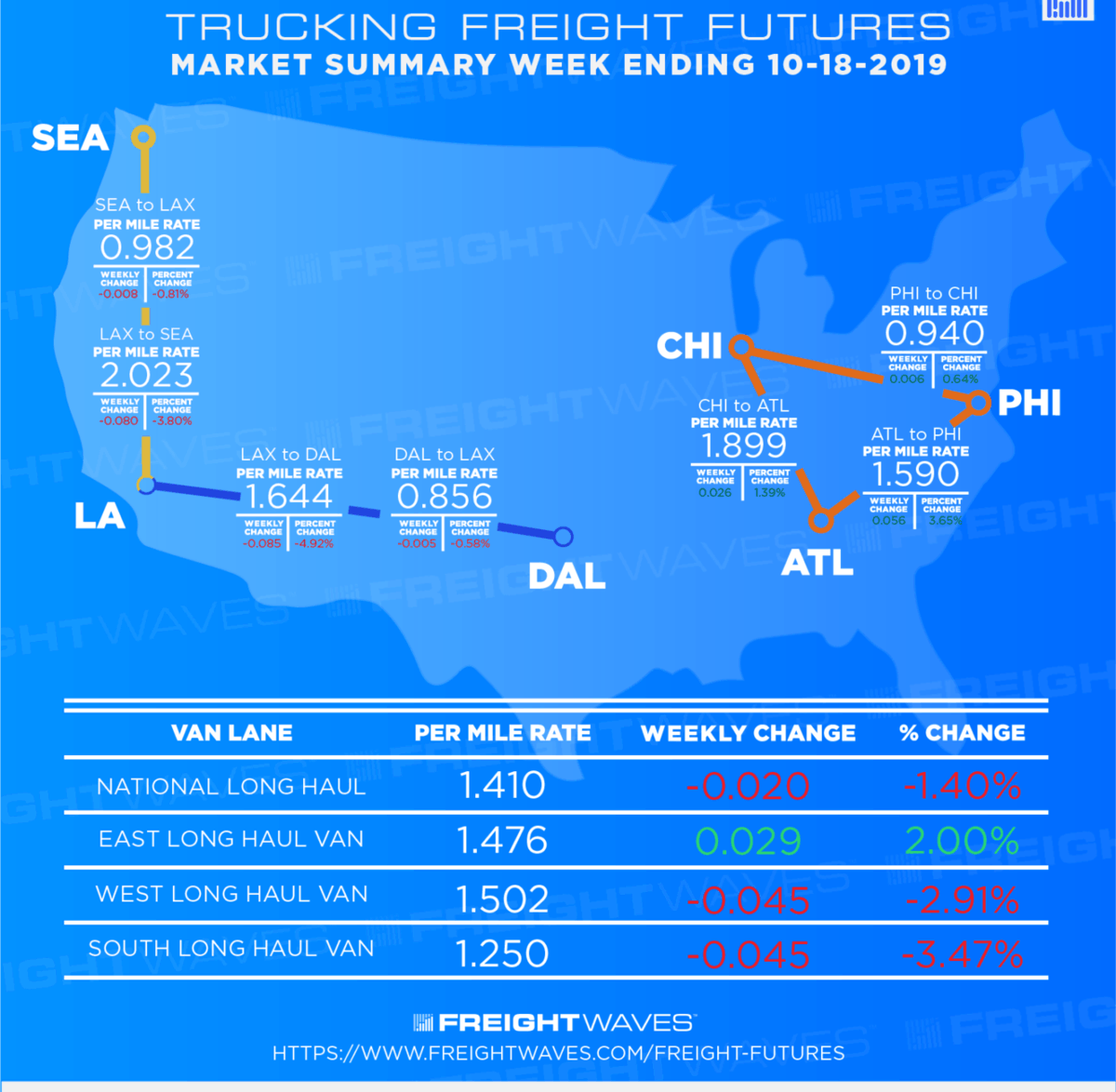
FreightWaves published a new report Thursday that detailed how trucking “load volumes continue to decelerate into the peak holiday shopping season.”
The DHL Supply Chain/FreightWaves Pricing Power Index, a real-time demand and supply indicator of the trucking industry, recorded 25 late last week, less than 50 means demand is lackluster and overcapacity plagues the industry. A score above 50 means demand is higher than capacity.
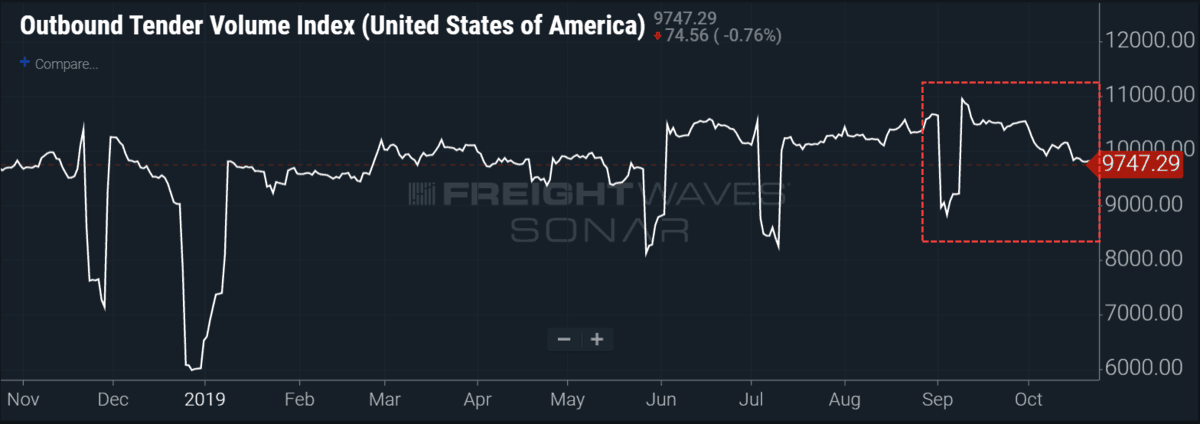
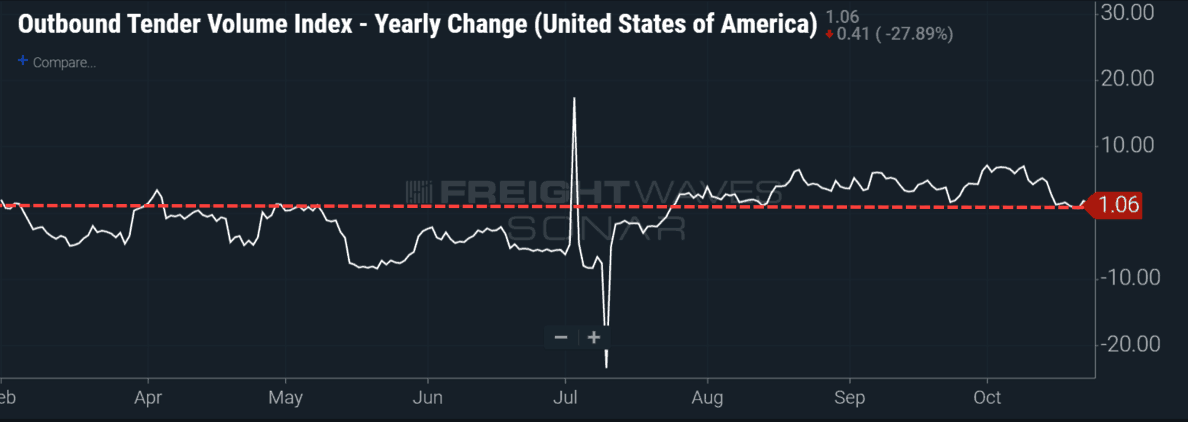
The Outbound Tender Volume Index, a real-time monitor of trucking load volumes across the US, showed demand is in decline entering the holiday season. The index significantly weakened in October, and coupled with an economy that is stalling, these trends have become “worrisome” to Freight Waves analysts.
Freight spot rates continued to slide into October. Rates are expected to remain on a downward trajectory as freight demand slumps, and overcapacity remains an issue in 2020.
The slowdown in the domestic trucking industry suggests the consumer is likely to disappoint this holiday season.
And for more color on consumer trends, not just in the US but perhaps on a global view, the global shipping container industry is sounding an alarm.
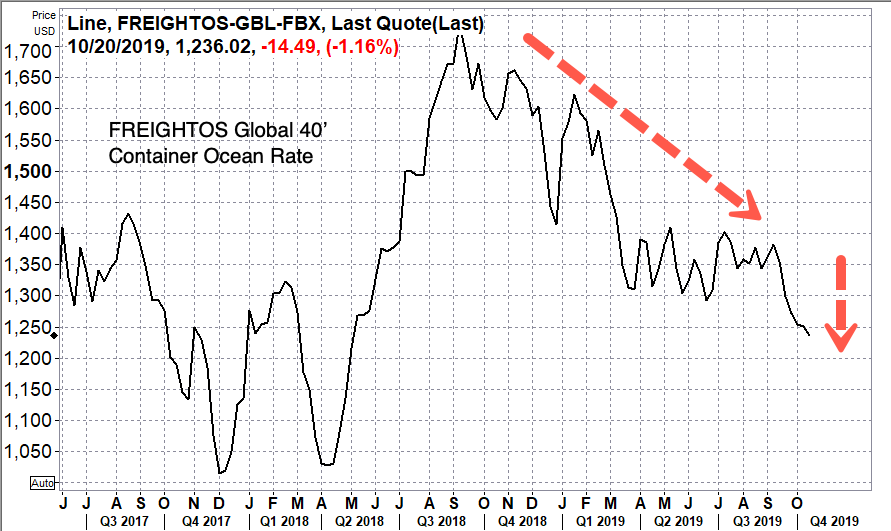
Shipping rates for 40′ containers have taken another leg lower in the last several months. This means retailers are ordering fewer consumer goods from China and other emerging markets, a clear indication the consumer is weakening.
Last week, Amazon guided its forecast for the holiday season lower. Analysts were absolutely shocked, but it marks the beginning of a new trend where the consumer is expected to come under financial stress, pull back on spending, and could start saving as the next recession nears. Tracking freight rates and volumes of various forms of transportation in domestic and global supply chains have given us perhaps an idea of what’s to come, that is, an underwhelming holiday season for retailers.
In response to the “epidemic” of underage e-cigarette use, public schools are deploying the tried-and-true method of lying to children about the hazards of drug use, because how could that possibly backfire? A misinformation sheet about vaping, published by the Florida-based Nemours Foundation and distributed to eighth-graders at my daughter’s school in Dallas, illustrates this approach, making scary claims that can easily be debunked by anyone with an internet connection.
The handout, written by Florida physician Lonna Gordon, repeatedly conflates legal, nicotine-delivering e-cigarettes with the black-market cannabis products that have figured prominently in the recent outbreak of vaping-related lung injuries. After incorrectly defining e-cigarettes, which do not contain tobacco and do not burn anything, as “battery-powered smoking devices” (emphasis added), Gordon says they use “cartridges filled with a liquid that usually contains nicotine.”
In the next paragraph, Gordon warns that “experts are reporting serious lung damage in people who vape, including some deaths.” Later she says “e-cigarettes…may cause serious lung damage and even death” and reiterates that “recent studies report serious lung damage in people who vape, and even some deaths.” There is no evidence to support such claims with regard to legal nicotine products.
“Even if you don’t vape every day,” Gordon says, “you can still get addicted. How quickly someone gets addicted varies. Some people get addicted even if they don’t vape every day.”
As far as Gordon is concerned, you can be addicted to a substance even if you use it only occasionally, which suggests that any pattern of drug use is indistinguishable from addiction. That does not make much sense, but it’s convenient for alarmists who warn that e-cigarettes are hooking an entire generation of young people on nicotine, even though frequent use remains rare among teenagers who don’t smoke.
Gordon claims “studies show that vaping makes it more likely that someone will try other tobacco products, like regular cigarettes.” What the studies actually show is that teenagers who vape are more likely to try cigarettes than those who don’t vape. The causal interpretation that Gordon presents as a fact is a matter of dispute, since pre-existing differences could account for this correlation. The weight of the evidence, including the fact that smoking has fallen to record lows among teenagers as e-cigarette use has surged, indicates that vaping is, on the whole, replacing smoking rather than promoting it.
Even if teenagers vape nicotine-free e-liquids, Gordon says, they should still be worried, because those fluids “have chemicals in them.” You know what else has chemicals? Everything kids eat, drink, and breathe, not to mention the kids themselves and every object they interact with.
These silly warnings, which echo pseudoscientific anti-vaping propaganda from government agencies such as the Food and Drug Administration and the Massachusetts Department of Public Health, might scare some especially credulous teenagers away from e-cigarettes. But at what cost?
If schools want students to believe and act on the health advice offered in class, they should try telling the truth. As it is, they are perverting science education and undermining critical thinking while spreading potentially dangerous misinformation. If e-cigarettes are as deadly as Gordon implies, students might reasonably conclude, maybe they’d be better off smoking, even though that is indisputably a much more dangerous source of nicotine. For students who see through this nonsense, the main message, as with drug “education” generally, is not to trust people in positions of authority, which is a salutary lesson but probably not the one that schools are trying to teach.
from Latest – Reason.com https://ift.tt/2Jz4WcN
via IFTTT
It’s that time again, the magic levitation show, but this one is a peculiar one. I talked a bit about it in Zombieland, but the continuation on the same path this week ahead of the Fed meeting is actually getting quite embarrassing as all pretense that markets are anything but a Fed subsidy program are being dropped.
Synchronized quantitative easing Morgan Stanley calls. And it’s apparently working, after all now have new highs again in front of the Fed policy announcement tomorrow.
Just like the the previous 2 times this year:
Again we have wedges on both $SPX and $VIX heading into this Fed meeting.
What has made this action so unusual is the historic shriveling of volume and the nonstop gap, ramp and camp program we’re seeing now:
From my perch this type of action can persist and price can drift higher, but is subject to future gap filling and therefore, risk building.
All of this action is of course now coming in conjunction with the liquidity bombs the Fed is throwing on markets on a daily basis.
I talked about these issues a bit yesterday on CNBC:
And so here we are today, the day before the Fed meeting and $SPX has again approached the upper trend line as $VIX has been compressing:
Tight wedges, consistent patterns suggesting another volatility spike to come.
The Fed will cut rates tomorrow with markets again at all time highs, just like in July and in September. What’s the primary driver of the rate cut decision tomorrow? Market expectations of course. The Fed can’t afford to disappoint markets.
The Fed is insisting they’re not running QE, but the market sure is acting like it is.
There is great hope that the Fed rate cut tomorrow will succeed this time to levitate prices above the trend line and keep it above. Perhaps that will be the case, but this renewed price levitation is again coming with negative divergence, uneven participation, and extremely tight price channels that are at risk of breaking if any sellers make their presence felt with volume.
For now enjoy the magic show, but keep in mind that all magic shows eventually come to an end and everyone is left wondering how they were deceived by the magician on the stage. Jay Powell will take the stage tomorrow and tell everyone that the economy is in a good place. But he’s using 3 rate cuts, $60B in monthly treasury bill buying and a daily $120B pro facility to pull off that magic trick.
* * *
For the latest public analysis please visit NorthmanTrader. To subscribe to our market products please visit Services.