Twitter Might Start Labeling President Trump’s “Offensive” Tweets

Twitter is considering a new policy that would label tweets from politicians – including President Trump – when they violate the company’s (admittedly nebulous) community standards policy. Put another way, the platform, which has been exposed for discriminating against and shadow-banning conservative voices, is now planning to publicly shame politicians who express conservative views.

Vijaya Gadde, Twitter’s head of legal, policy, and trust and safety, who famously appeared alongside CEO Jack Dorsey during an interview with journalist Tim Pool on Joe Rogan’s podcast last month, said during a Washington Post event on Wednesday that the company might start adding messages to these tweets to explain why they haven’t been removed from the platform, according to the Hill.

Gadde

Vijaya Gadde

Twitter has long held that some posts from public figures should remain up because they are “newsworthy,” even when they violate Twitter guidelines.

“One of the things we’re working really closely on with our product and engineering folks is, ‘How can we label that?'” Gadde said during the Post event.

 “How can we put some context around it so people are aware that that content is actually a violation of our rules and it is serving a particular purpose in remaining on the platform?”

Gadde mentioned the policy, which is under consideration, during a response to a question about whether Trump can say whatever he wants on Twitter. As it stands, Twitter’s public policy states that tweets from politicians are “important” to public debate.

“When we leave that content on the platform there’s no context around that and it just lives on Twitter and people can see it and they just assume that is the type of content or behavior that’s allowed by our rules,” Gadde said.

However, Gadde added that the platform’s “newsworthiness” policy doesn’t offer blanket protection to all tweets from public figures. Violent threats (and, presumably, deadnaming a trans person) would be an exception.

“An example would be a direct violent threat against an individual that we wouldn’t leave on the platform because of the danger it poses to that individual,” Gadde said.

“But there are other types of content that we believe are newsworthy or in the public interest that people may want to have a conversation around,” she added.

We look forward to hearing Twitter’s explanation about why they applied their new scarlet letter to all of the president’s tweets about the migrant crisis at the southern border

via ZeroHedge News https://ift.tt/2U2tnqi Tyler Durden

WeWork’s $1.9 Billion Loss Is A Typical Tech Bubble 2.0 Story

Authored by Jesse Colombo via RealInvestmentAdvice.com,

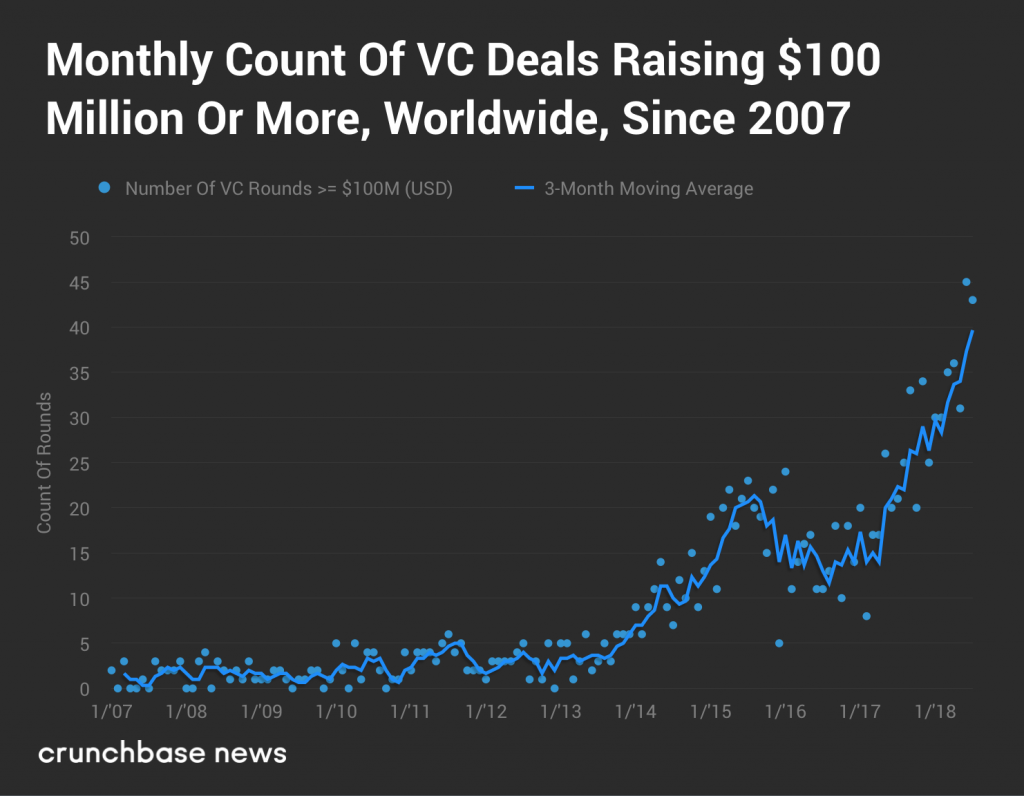
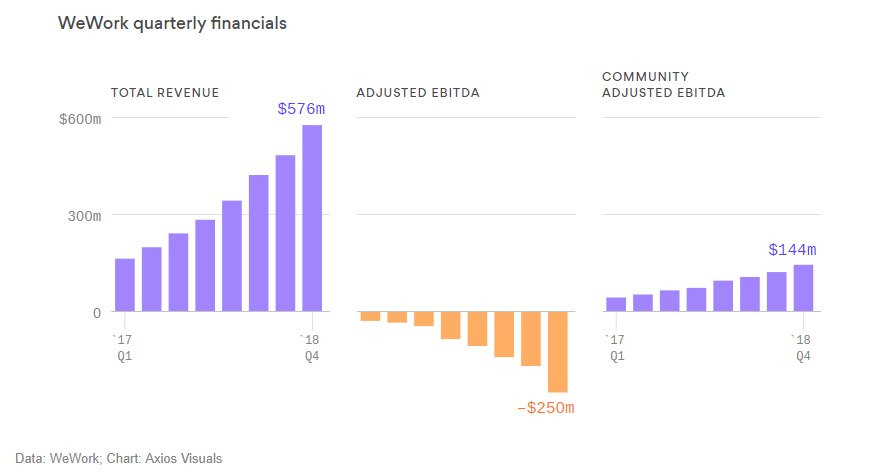
On Monday, unicorn WeWork reported that it lost $1.9 billion on $1.8 billion revenue in 2018. WeWork is a company that provides shared workspaces and related services for startups. WeWork can be thought of as a company that sells “picks & shovels” to the startup community and is, therefore, a play on the tech startup bubble that I’m warning about.

Like most other unicorns and the startups that it serves, WeWork is hemorrhaging cash left and right (which is very fitting):

WeWork is attempting to cash in on the explosion of tech startup activity over the past five years (which I’ve explained is a byproduct of the Fed-driven stock market bubble):

The U.S. stock market bubble and the tech startup bubble formed because the Fed and other central banks cut interest rates to ultra-low levels and flooded the world with trillions of dollars worth of liquidity in order to encourage an economic recovery after the Great Recession. There are some worrisome parallels between today’s liquidity-driven tech startup bubble and the early stages of the 1920s German hyperinflation (which started out as a liquidity-driven boom), when the newly printed money found its way into countless businesses that were recently formed (which is what we call “startups” today). It seemed like an innovation boom, but it was just pushing paper around.

The excellent book “Dying of Money” describes this phenomenon well:

Along with the paradoxical wealth and poverty, other characteristics were masked by the boom and less easy to see until after it had destroyed itself. One was the difference between mere feverish activity, which did certainly exist, and real prosperity which appeared, but only appeared, to be the same thing. There was no unemployment, but there was vast spurious employment – activity in unproductive or useless pursuits.The ratio of office and administrative workers to production workers rose out of all control. Paperwork and paperworkers proliferated. Government workers abounded, and heavy restraints against layoffs and discharges kept multitudes of redundant employees ostensibly employed. The incessant labor disputes and collective bargaining consumed great amounts of time and effort. Whole industries of fringe activities, chains of middlemen, and an undergrowth of general economic hangers-on sprang up. Almost any kind of business could make money. Business failures and bankruptcies became few. The boom suspended the normal processes of natural selection by which the nonessential and ineffective otherwise would have been culled out. Practically all of this vanished after the inflation blew itself out.

I believe that a very high percentage of today’s startups are actually malinvestments that only exist due to the false signal created when the Fed and other central banks distorted the financial markets and economy with their aggressive monetary stimulus programs after the global financial crisis. See this definition of malinvestment from the Mises Wiki:

Malinvestment is a mistaken investment in wrong lines of production, which inevitably lead to wasted capital and economic losses, subsequently requiring the reallocation of resources to more productive uses. “Wrong” in this sense means incorrect or mistaken from the point of view of the real long-term needs and demands of the economy, if those needs and demands were expressed with the correct price signals in the free market. Random, isolated entrepreneurial miscalculations and mistaken investments occur in any market (resulting in standard bankruptcies and business failures) but systematic, simultaneous and widespread investment mistakes can only occur through systematically distorted price signals, and these result in depressions or recessions. Austrians believe systemic malinvestments occur because of unnecessary and counterproductive intervention in the free market, distorting price signals and misleading investors and entrepreneurs. For Austrians, prices are an essential information channel through which market participants communicate their demands and cause resources to be allocated to satisfy those demands appropriately. If the government or banks distort, confuse or mislead investors and market participants by not permitting the price mechanism to work appropriately, unsustainable malinvestment will be the inevitable result.

It’s inevitable that the startup bubble is going to burst and tens of thousands of unprofitable startups around the globe are simply going to close their doors. Companies like WeWork, which sell the “picks & shovels” to the startup bubble, will go down with the ship. If WeWork is hemorrhaging billions of dollars during the best of times, just imagine what will happen when the overall startup bubble bursts?! It’s not a pretty picture. Even if you don’t invest or work in the startup sector, it still affects you and your investments because the U.S. startup bubble is a major driver of economic activity and job creation since the Great Recession.

via ZeroHedge News https://ift.tt/2CLXUOo Tyler Durden

US Income, Spending Disappoint As Fed’s Favorite Inflation Signal Weakens

Following the tumble in income (Jan) and spending (Dec) in the last reported month, expectations were for a modest rebound of 0.3% MoM for each, but both underwhelmed.

  • US consumer spending rose just 0.1% MoM in January (well below the +0.3% gain, but still a rebound from the 0.6% MoM drop in Dec)

  • US personal income rose 0.2% MoM in February (missing the 0.3% MoM expectation).

The spending figures, which reflected weaker sales of new autos, signals first-quarter growth faces additional headwinds, though surveys show consumers remain generally upbeat despite projections for slower expansion.

Both income and spending growth year-over-year fell to notable lows…

The spending data add to signs of weakness just ahead of the February retail sales report Monday.

Adjusted for inflation, January spending on goods dropped 0.2% on a monthly basis while purchases of services increased, driven by financial services and insurance.

The most recent month saw a small drop in savings rate from the surging 7.7% in December to 7.5%…

At the same time as spending fell short of projections, inflation also eased, sending an early warning on the economy in the first quarter that may add to concerns about the outlook.

The Fed’s preferred price gauge – tied to consumption – fell 0.1% in January from the previous month and was up 1.4% from a year earlier, matching the annual projection with the slowest reading since late 2016.

Excluding food and energy, so-called core prices rose 0.1%, less than estimated. The index was up 1.8% from January 2018, also below forecasts, after an upwardly revised 2% gain.

All in all, call it some economic justification of the Fed’s patient stance (though that 1.4% headline inflation is of course driven by oil prices.) Chairman Jerome Powell said this month rates could be on hold for “some time” as inflation remains muted and global risks cloud the outlook.

Is this more goldilocks?

via ZeroHedge News https://ift.tt/2HZV63S Tyler Durden

Why Presidential Candidate Arvin Vohra Wants Libertarians to Wage a Culture War

||| Vohra for PresidentBy the time the Libertarian Party gets around to selecting its presidential nominee 14 months from now, it could conceivably be a contest headlined by Rep. Justin Amash (?–Mich.), Overstock.com founder Patrick Byrne, and some billionaire to be named later.

But if the country’s third-largest political party were making that choice in March 2019 instead of May 2020, one of the bodies on that final debate stage would likely belong to former Libertarian National Committee (LNC) vice chair and 2018 U.S. Senate candidate Arvin Vohra. That may come as a surprise to those unaccustomed to hearing politicians campaign on the “total abolishment of the welfare state” while making social media jokes about shooting up school boards. It would also, not coincidentally, irritate a good number of Libertarians.

With the exit in January of previous vice presidential nominee Bill Weld, Vohra now has undisputed claim of being the most divisive figure within the Libertarian Party (L.P.). His series of intentionally provocative statements about age-of-consent laws, government schools, and the immorality of military service prompted unsuccessful attemps to suspend him from the Libertarian National Committee in February and April last year, with the latter effort falling just one vote short of the required two-thirds majority. Three months later, Vohra was routed by the party writ large in his bid for a third term as LNC veep. Undeterred, the 39-year-old educator promptly announced his presidential candidacy.

||| FacebookSince then, Vohra has finished a distant fourth in Virginia’s race for U.S. Senate, with just 1 percent of the vote (one of the lowest L.P. Senate totals in the country). He is now making the rounds to some of the same state Libertarian conventions that have censured him in the past. I attended one such gathering on Saturday in Hightstown, New Jersey, where Vohra addressed a body that rebuked him in November 2017 by a vote of 21 to 1 (with one abstention).

“I was warned earlier today that three-fourths of you in this room are openly hostile to me,” he began, “and I was honestly surprised. I don’t think I’ve ever been in a room where a fourth of the people haven’t made up their mind yet.” From there Vohra launched into an argument about “the necessity of culture war in politics.”

“The fundamental truth,” he asserted, “the absolute unchangeable fundamental truth that we’re facing right now in American politics is this: This culture produced this government. If we knock down this government, if we…fire everybody, we shut down all the departments, we shut down…everything. If we do that today, then this culture will recreate this exact government by tomorrow.”

I caught up with Vohra after his speech to ask him more about how he thinks such messaging can succeed within the Libertarian Party and in American politics as a whole. The conversation ranged from the alt-right to open borders to jury nullification. The following is an edited transcript:

Matt Welch: So the basic question with you, obviously, besides what a monster you are, is: You made this turn, right? You made this decisive turn from being the Libertarian we could take home to Mom to being the Libertarian, my God, we just cannot ever take home to Mom. Since that moment, you’ve got some censure votes, including in New Jersey; disputed ones on L.P. National; lost re-election bid for vice chair; ran for Senate and didn’t do that well comparatively to the field. Are you seeing market signals that your approach is working?

Arvin Vohra: Yes.

Historically, I can at least say that the other approach has backfired. It’s my opinion that if we’d had Dr. [Mary] Ruwart instead of Bob Barr and then Gary Johnson and then Gary Johnson again, we wouldn’t have an alt-right today. Because all of those teenagers who are looking to angrily rebel against what they perceive as an inimical authority would have a different direction to go in, a direction that’s just as upsetting to their parents. Because going off against public schools and going against the income tax, that’s just as upsetting to your parents as all the stuff that they’re saying right now.

And what’s actually happened, instead of people who want to rebel coming to the Libertarian Party, coming to this peaceful idea of voluntarism and anarchism, you have the opposite happening. You have all the people who used to be libertarians and suddenly turned alt-right. That reverse process, to me, is a direct consequence of that let’s make libertarianism as mom-friendly and as harmless as possible [approach]. There are some people who like things that are mom-friendly: moms. There are some people that don’t want things to be mom-friendly: the entire younger generation.

I discuss the very things that Dr Ruwart was attacked for, because I know that as an anarchist, I’m going to be attacked for the same things.

You look at my Senate campaign, and you compare it to Larry Sharpe’s governor campaign. My Senate campaign, I didn’t have time for it, it was a paper campaign, it was basically nothing. Larry Sharpe’s campaign was one of the most organized, one of the best fundraising campaigns ever. His phrasing was friendlier. My phrasing was unfriendly. At the end of it, it didn’t really make that much difference. [Sharpe also finished in fourth place, with 1.6 percent of the vote.]

What that says to me is the biggest issue that we have is, we’re not really getting into the national debate. People will look at most Libertarian candidates—and I certainly used to be a nice, friendly Libertarian candidate—people look at them and say, “Yeah, that guy seems kind of nice. I’m going to go vote for this guy, this other person, because this guy might overlap with me on more of my issues, but he doesn’t have the same chance of getting elected, and he’s not going to speak to my number one issue.” I would say that most voters have one or two issues that on the scales of policy matter more than everything else combined. And that’s why I don’t think they’re stupid when they vote Democrat or Republican. I think they’re making, for the most of them, the logical, rational decision.

And so a lot of what I’m doing is speaking to issues that neither Democrats nor Republicans are talking about. Even though they have some baseline emotional appeal there, they’re not issues that are being discussed. So things like abolishing public schools, things like leaving NATO, things like ceasing to be the world’s police, letting socialist Europe fend for itself, bring the troops home, laying them off, and cutting taxes. These aren’t things that you hear from the other parties. And so that’s where we’re seeing a message that isn’t already out there.

Other types of success are happening at an individual level. I mean, like I said during the speech, if my saving one person from military recruitment—and it was obviously a lot more than one person—but even if it’s just one person, if I’m saving one person from military recruitment, and all I have to do is lose one election as vice chair? It’s an easy decision for me.

Welch: So, some people will hear or read this and say, “Oh, so you want the alt-right vote”—you know, you’re obviously, like, pandering to racists. What’s your response to people who see your kind of heightening-the-contradictions approach as overlapping with that, and then being problematic because of it?

Vohra: Sure. The incorrect solution, for example with the military, is what Gary Johnson did. Which is basically put out billboards outside of military bases, be like, “Military, rah-rah!”

The correct approach to the military is what Larry Sharpe said, which is, “I get why you joined the military. Now leave the military, because it’s not doing that, and come join us.” Converting and pandering are not the same. I’m not trying to pander to the alt-right. I don’t support racists. I mean, you can look at my face and see that I wouldn’t really be interested in a lot of people getting really racist.

Welch: And you threw some shade at [Ludwig von Mises Institute President] Jeff Deist in August 2017, if I’m remembering correctly.

Vohra: So that, to me, is pandering. When you use white nationalist code-phrases like “blood and soil,” then you’re pandering. You’re legitimizing a problematic ideology. My goal is not that. That’s not what I have been doing. That’s not what I will be doing. Even when I went on the Chris Cantwell show, I wasn’t saying, “Yeah, you know, white power’s the best.” I was saying, “We need to end the state. This is not a useful way to do it. I don’t think that racism is the right way to go about it.”

When I reach out to the alt-right now, it’s designed to be conversion, as in: Stop wasting your time on this racist nonsense. Start using your time to defund the state, to get rid of government schools, to make sure that you have just as much of a right to do whatever you want with the fruits of your earnings as we now at least recognize that a woman has the right, or a man has a right, to do with his or her own body. Just as we expect active consent in the sexual sphere, we need to be expecting that in the financial sphere.

Is that going to convert everyone away from the alt-right? Of course not, but it’s going to convert some people. Because some people aren’t there because they’re racist, they’re just acting racist because that’s the requirement for being in the group. And I think that’s a very convertible group. They’re not set in their ways. They’re young. A lot of them were just looking for some rebellion, and I’ve got a much better rebellion here that’s going to actually do something positive for America.

Welch: Now, you have long thought that a convertible group are homeschool parents—

Vohra: Yes.

Welch: —and families and such. They’re still outnumbered by the people who you are equating in a more abrasive moment to welfare queens, people who are sucking up intergenerational welfare. What is your response to, “Hey, look, you are actively alienating 90 percent or 80 percent of a population out there by insulting them”?

Vohra: I’ve converted some people from military service. I’ve converted a lot more people to homeschooling.

I mean, homeschooling is the future of education. Just as 20 years ago, legalization was the future of drug policies, today homeschooling is the future of education. Free-market education is just better. What’s changed now, versus a while ago, is that now we have people who were homeschooled that are now entering their twenties and thirties, having kids, and they’re becoming intergenerational non-welfare recipients. They have a different ethos. And is that number smaller than the number of people in government schools? Absolutely. Is it many times the number of people that voted for Gary Johnson? No question.

So it’s true that some people are going to hear the message and say, you know, “You’re criticizing me.” And people respond two ways to criticism. Some get bent out of shape and get defensive; that’s fine. Some improve. And I’ve been lucky so far that some portion of the people that I have reached out to have improved—they have switched over to homeschooling.

If I’m the nominee, that number is going to be proportionally increased to some extent, because the message of homeschooling—the message that government schools are intergenerational welfare, the idea that parents should provide education for their kids, either through paying for it or if they’re providing it directly—that’s a message most people just haven’t heard. They haven’t had the chance to reject it. And to say that they’re going to reject the arguments before we even make them is an absurdly defeatist political strategy. I mean, we have to at least make the argument, give them the chance to reject it. And if they reject it, then they reject it, but at least let them actually do that.

Welch: But the military thing in particular. A lot of people are in the military, lots and lots of people. Including people [who] are pretty ripe for a libertarian message. So what do you think about the critique that the messaging, the way that you describe their choices, is needlessly repelling people who would otherwise be receptive to libertarianism?

Vohra: You have to get an actual conversion. If you’re not getting a real conversion, if you’re just getting that pandering pseudo-conversion, you’re spelling the end of your own movement.

And here’s what happens, and here’s what we’ve been seeing happening. Which is: People come on board, they don’t actually believe in all the message, because we’ve presented it in a way that could be interpreted as almost anything. And then they predictably either try to change our messaging to something absurd—and having interviewed God knows how many candidates on my own show, I’ve seen that sometimes the messaging isn’t really libertarian. And the result of that has been that we’re not driving our actual message.

When it comes to people in the military, I have two options. I can either say something, or I can say nothing. I can just do what everyone else does: Rah-rah troops, thank you for your service, all that kind of stuff. And in doing that, I’ll do two things. One, I’ll make some people a little bit open, but not actually consider the issue. I’m going to make it much easier to recruit young people, because that’s how young people are recruited—you say rah-rah veterans, that’s like the number one recruiting tool, is praising veterans and active servants. That’s how you get the young people in there. And I’d be basically adding to the problem.

When I started doing this, it was not that long after an LNC member had joined the Marines, had publicly announced it, with support and advice from another LNC member. And the general response from the Libertarian community was just rah-rah military. When I saw that, I could see how deep a cultural problem that we had.

And we do have a cultural problem. My goal is to convert people from their belief in militarism, from their belief that joining the military is a good idea, to a belief that anything else would be a better option. And that is going to be a hard sell. There’s no nice and easy way to do it. There’s no friendly way to lead to that actual conversion.

You can be friendly, and get someone to maybe hear you out or pretend to understand what you’re saying. But what has not happened in the past is that no one’s actually understood the message. At this point, they know what my message is, they disagree with it, and some have stopped disagreeing, some have come around.

Welch: You have an interesting rap about the culture war: that the culture that we have produced the government that we have, and we could throw it away tomorrow and we would just reproduce the government. A lot of libertarians—large-L, small-l alike—kind of have an instinctive sense of wanting to retreat from the culture war, because so much bad stuff happens there: bad thinking, bad argumentation, bad policies. What is your argument for why we should embrace, or at least join, the culture war?

Vohra: You can’t change policy at a deep and fundamental level without changing the culture. If we say, for example, that joining the military is the best thing you can do ever, then it’s a little bit confusing to say that everything the military does is really bad. That is a level of illogic that really rings false in the ears of almost everyone. You can’t say public school teachers are really, really good and the best people ever, but public schools are totally immoral. It doesn’t make any sense to anyone who hears that kind of stuff.

If we’re going to actually change policy in a deep and lasting way—I mean transform policy. I don’t mean these tiny little just insignificant things that we spend so much time on. I mean big things: abolishing government school, abolishing the income tax. That requires a big change in policy, and that needs to have a big change in culture.

To the next step, though, I don’t think that I’ve seen, with the possible exception of Bush Jr., I don’t think I’ve really seen somebody win a presidential election without also winning a cultural war at the same time. Trump won a culture war. Obama won a cultural war. Reagan won a culture war.

You have people who are winning culture wars. You can’t avoid a cultural war and expect to win at the political level. You’ll get people to say that you’re nice, and then they’ll vote for the other guy.

Welch: You mentioned in your talk about how of all the crazy shit that Libertarians say, open borders is one of the hardest sells. Why do you think that is? And what should a Libertarian messaging be, based on that insight?

Vohra: It’s very difficult because people are afraid of outsiders. People in every culture in history, to some extent, have been afraid of outsiders. And the rhetoric coming from the pro-open-borders side makes that problem worse, because they only talk about poor, starving refugees, and everybody here’s like, “Oh, I don’t want to have to feed a poor starving refugee!”

My focus on immigration is now, and has always been, on highly skilled workers. Because I believe that highly skilled workers should be able to go to any country that’s willing to hire highly skilled workers. I believe that keeping them out would be about a stupid as keeping out computers and oil, which is the only two things that are close to as important, although still less important to a business’s success than highly skilled workers.

So I focus on that a lot more. With that opening, you know, if it’s a more involved speech, then I discuss how a lot of the times the people who make the greatest innovations are not necessarily people who have degrees and other credentials. They’re people who are motivated, they are people who are innovative, they’re entrepreneurs.

And so the culmination, to me, really come to this position that we should have totally open borders and no welfare, because all the people who are coming over for opportunities can still do that. And if anybody’s coming over for welfare—and some people say it’s no people and some people say it’s a very small number of people, I think it’s probably a very small number of people—can’t do it. Just shut that part down.

And so I think that to speak to the people who are opposed to open borders, you’re actually better off with a spokesperson like me, who is abrasive and is kind of an a-hole, because they want to hear that, like, the mean, selfish, elitist guy wants open borders, not the bleeding-heart, let-me-give-all-of-your-money-to-the-starving-person guy wants open borders.

Welch: All right, anything else that I should be aware of that you’re doing, looking forward to? What should we be paying attention to?

Vohra: The biggest difference you’re going to see between me and, I think, most other candidates, is not what I’ll do if I win. Because whether I win or whether Justin Amash wins or whether Adam Kokesh wins, probably the first thing that any of us is going to do is pardon a lot of people, probably starting with Edward Snowden and Julian Assange and Ross Ulbricht. They might have a different order, I don’t know, but I’m pretty sure there’s going to be a lot of pardons in the first [months].

The difference is going to be what do we do in the campaign even if we lose. If I’m the nominee and I don’t get elected, here’s what you’re going to see. You’re going to see, through this extensive discussion of pardons and nullification, basically, everybody who heard of Aleppo, that number of people will know about jury nullification. That’s guaranteed.

And that means there’s going to be more jury nullification. Because most people don’t do jury nullification because they don’t know it, they don’t know the history of it. They don’t know that it brought freedom of the press to America. They don’t know that. If they all did that, people would be fired up to be on juries and nullify stupid laws.

You’re going to see a lot more bitcoin use. Why? Because cryptocurrency depends on network effect. A major presidential candidate talking about cryptocurrency can have a major influence.

You’re going to see a lot more homeschooling, because I’m going to be talking about that every chance I get. Abolish public schools; here’s why homeschooling is better. And you’re going to see a lot of people converting to homeschooling.

That’s if I lose, those benefits. That’s the benefits of an Arvin Vohra non-successful run as Libertarian Party nominee. If I win, we know what happens. I fire basically everybody, taxes go to zero, we bring all the troops home, we’re no longer the world’s policeman, and we can live in peace and prosperity.

from Hit & Run https://ift.tt/2FDpoXi
via IFTTT

These Are The 5 Banks Most Exposed To Turkish Chaos

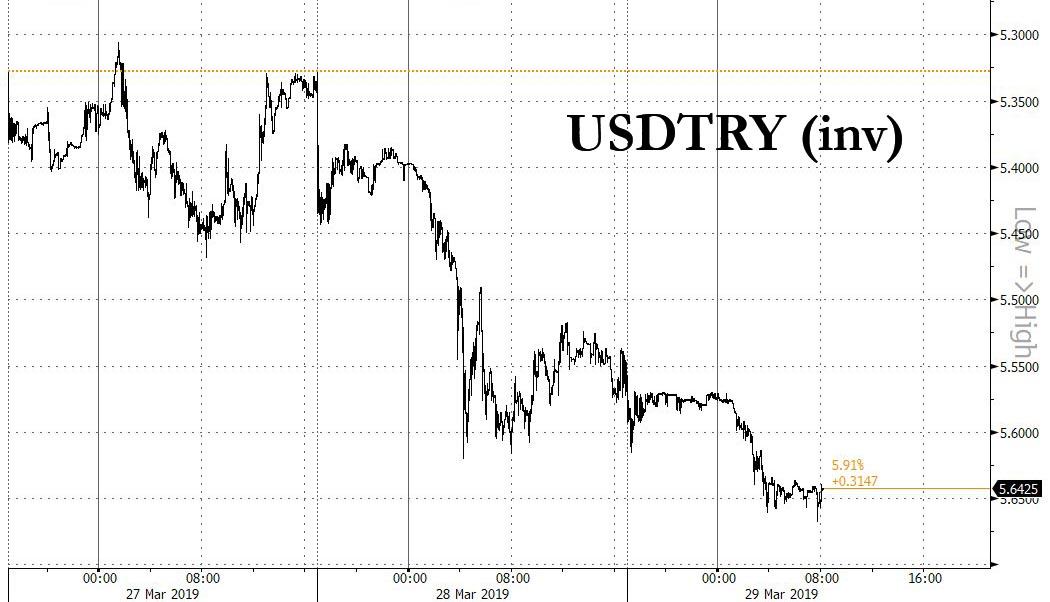
Despite Erdogan’s ever more desperate attempts to keep the lira elevated ahead of this weekend’s local elections, culminating with sending overnight TRY swap rates to an insane 1300% on Wednesday, consensus is now that after this weekend’s catalyst passes things will quickly go from bad to worse for Turkey as Turkish official foreign reserves plummet, putting the nation on the verge of a liquidity (and solvency, if enough foreign investors have lost faith) crisis.

This sentiment is shared not only by locals, where government data showed a panic scramble out of lira as Turkish residents increased their their hard-currency holdings for an 11th week running, the longest streak since September 2013, to a record $179 billion, but also foreigners with TD Securties strategist Cristian Maggio tempting fate (and Erdogan’s assassination squad) overnight with a recommendation to buy USDTRY calls with a 7.9 target, predicting that “attempts to maintain lira stability ahead of local elections may ultimately prove unsustainable and USD/TRY may move significantly higher when normal conditions are restored.”

In any case, the Lira has been a one way train lower ever since the Turkish Central Bank ended the idiotic experiment with crushing all foreign investor confidence by boosting swaps to mindblowing levels.

Amid the collapse in Turkish central bank reserves, the plunge in the lira and local financial assets, should a worst case scenario for Turkey materialize, questions relating to European banks exposure to Turkey have once again resurfaced as they did last summer.

Responding to these questions, and seeking to mitigate some of investor panic, overnight Goldman’s Jernej Omahen writes that the most recent data suggests:

  1. Turkey exposure of EU banks is limited in scope and scale;
  2. Contagion channel via EU banks is somewhat limited
  3. deteriorating outlook might incrementally add to (the already changing) strategies of European banks in Turkey as this is the second period of elevated volatility in Turkish assets within the past c. one year, the first being Q3-18;

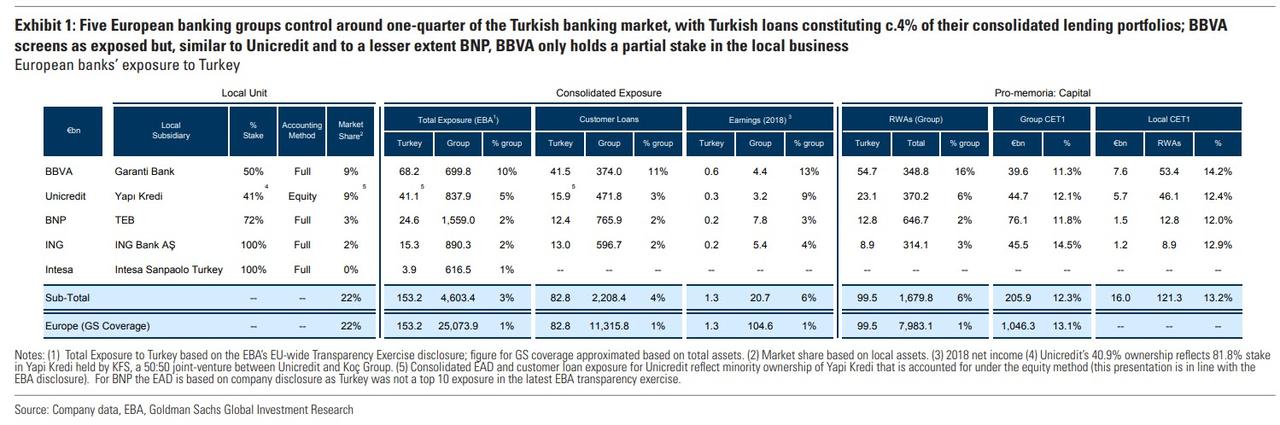
With that disclaimer in mind, Goldman claims that Turkey exposure of EU banks is “limited in scope and scale” as Turkey accounted for <1% of total EAD and c.1% of Net Profit for Goldman's EU banks coverage in 2018: of more 50 banks under Goldman coverage, five have Turkey exposure of >1% of total EAD, with gross exposure ranging from 10% of EAD for BBVA, 5% for Unicredit to 2% or less for ING (2%), BNP (2%) and ISP (1%). Also worth noting that European banks tend not to have 100% ownership of Turkish subsidiaries, so one needs to adjust for the actual shareholding.

Here is the details from Goldman:

Within our European coverage of >50 banks, 5 groups list Turkey as a meaningful exposure according to the transparency data published by the European Banking Authority (EBA). Notably, the affected banks remain relatively well diversified; although together they control roughly one-quarter of the Turkish market, their respective Turkish exposure stands on average at c.3% of consolidated EAD. While BBVA screens as an outlier, we note that similar to Unicredit and BNP, the Spanish group only holds a partial stake in the local business. For our coverage as a whole, Turkey accounted for <1% of total EAD in 2018 and c.1% of our Net Profit for 2018.

Some more details: while Bank for International Settlements (BIS) statistics do not provide name-by-name exposures, Goldman uses it to provide context for the single-name disclosure published by the European Banking Authority (EBA) as a part of a 2018 EU-wide transparency exercise. According to the BIS data, total foreign claims of the foreign banking sector against Turkey stood at  US$175bn as of the end of 3Q18 (of which Europe accounted for US$144bn), down from a peak of US$269bn at the beginning of 2016. Note that the BIS data captures private as well as public sector lending to Turkish residents as well as interbank lending.

In light of the country’s intransigent executive branch, where Erdogan has already hinted he may soon push for a rate cut, Goldman concedes that Turkish economic volatility will likely maintain a spotlight on banks present in Turkey. Yet Goldman bizarrely claims that “while the EU banks control broadly a quarter of the Turkish market, the overall risk for the European sector appears small” as  the Turkish exposure is:

  1. small, in an absolute sector context;
  2. concentrated  among a handful of larger banking groups; and
  3. represents a small fraction of these banks’ overall balance sheets – this is due to the respective Euro banks’ size, diversification and partial ownership of local units.

All in, Goldman concludes that the EU bank contagion channel is limited, however in the context of limited contagion. As a reminder, it was just last summer when Goldman calculated that beyond a certain level of the Turkish lira, the country’s local banks would collapse. If and when that happens, we strongly doubt that European banks with exposure to Turkey will find their contagion to be “limited.”

via ZeroHedge News https://ift.tt/2OyJc1T Tyler Durden

Apple’s Rotten Core

Authored by Charles Hugh Smith via OfTwoMinds blog,

Entering commoditized, fiercely competitive low-margin services cannot substitute for the high-margin profits that will be lost as global recession and saturation erode iPhone sales.

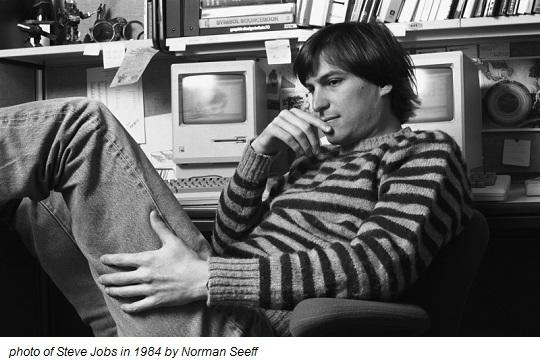
Apple has always been equally an enterprise and a secular religion. The Apple Faithful do not tolerate heretics or critics, and non-believers “just don’t get it.”

So the first thing any critic must do is establish their credentials as a Believer:My first Mac model 0001 was the 21,447th made in week 32 of 1984 in Fremont, California. Now that we’ve established that, we can move on to my profound sense of anguished abandonment that Apple ceased producing the iPhone SE, the only form factor that works for me.

But Apple Faithful are accustomed to repeated bouts of anguished abandonment; it’s just one of the burdens the faithful must bear.

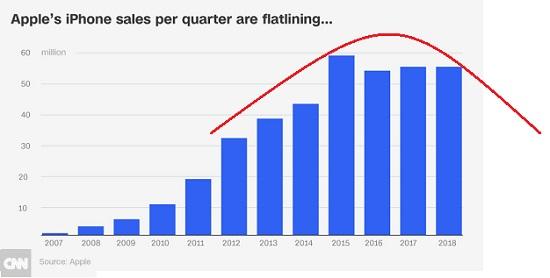
Focusing on the enterprise rather than the religion, Apple’s core–its revenue and profit potential–is rotten. As the charts below illustrate, despite all the happy talk about growing “services,” the hardware-software iPhone generates nearly 60% of Apple’s revenues. The iPhone ecosystem is also the foundation of the “services” currently being hyped as replacement sources of revenue.

The problem is that the proprietary features of the iPhone that have generated strong demand as prices kept rising are reaching diminishing returns. People want the status of owning an iPhone, but there are limits on what the bottom 90% can pay for that status.

The new features of the $1,000 iPhones have also reached diminishing returns. This is analogous with adding memory to a computer or increasing the pixel count in a digital camera: at some point, the added feature no longer has any impact on the user experience.

As the second chart illustrates, the market for costly mobile phones is saturated: everyone on the planet who could afford one and wants one has already bought one. As we all know, the “fix” for saturation is to speed up the product cycle so the existing owners are forced to buy a newer and much more costly model every year or two.

But this strategy also has diminishing returns: people get tired of getting ripped off by accelerating replacement cycles and eventually some percentage step off the merry-go-round and switch to a much cheaper and less demanding (product-cycle-wise) alternative.

Then there’s the other problem: without Steve Jobs, there is no “next big thing” at Apple. As I’ve explained many times here and in my books, value flows to scarcity, and Apple’s enormous profits are based on the artificial scarcity Apple has been able to impose on the market by closely guarding its proprietary mix of hardware and software.

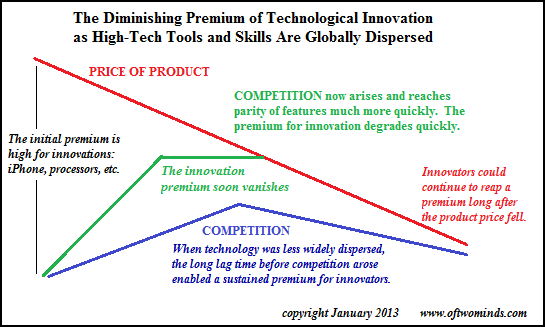
But as this chart attempts to explain, the price innovators can charge as competition increases diminishes as the innovations lose their scarcity value. The faster the advances and product cycles, the faster the erosion of pricing power.

Why the Innovation Premium Is Diminishing (January 16,2013)

The innovations of late-cycle iPhones are out of synch with the price increases.Apple is moving from selling innovations worth an extra couple hundred dollars to resting on its status-symbol laurels as a “luxury brand.”

That may work well in a global expansion, i.e. the past 10 years, but as the world economy contracts (don’t dare call it recession), that strategy will not yield the same results it did in the expansionary cycle.

Lastly, the “services” Apple is entering are commoditized and extremely competitive, markets in which it has very little proprietary territory to defend.Payment systems and credit cards are commoditized markets: there is very little differentiating the options and the host of competitors is expanding rapidly.

Many competitors are well-funded and experienced in maintaining customer loyalty. Payment systems and credit cards aren’t a sideline as they are for Apple; these are the banks’ bread and butter and they will not make it easy for Apple to carve off a proprietary territory.

As I’ve also noted, commoditized products and services have low profit margins.Apple generated its tens of billions of dollars in profits by reaping extraordinary margins; those margins cannot be transferred to commoditized services.

The content creation and delivery sector is also commoditized and fiercely competitive. There is very little to differentiate the services and generate scarcity value, and as the global recession deepens, consumers will be paring back their subscriptions, not adding them. There is quite a lot of free content out there and those on a budget have many options.

What happens to Apple’s “growth story” once iPhone sales decline and the much-hyped services generate a mere trickle of net profit?

Apple is facing a secular decline in its proprietary flagship that generated huge profit margins. Entering commoditized, fiercely competitive low-margin services cannot substitute for the high-margin profits that will be lost as global recession and saturation erode iPhone sales.

*  *  *

Pathfinding our Destiny: Preventing the Final Fall of Our Democratic Republic ($6.95 ebook, $12 print, $13.08 audiobook): Read the first section for free in PDF format. My new mystery The Adventures of the Consulting Philosopher: The Disappearance of Drake is a ridiculously affordable $1.29 (Kindle) or $8.95 (print); read the first chapters for free (PDF). My book Money and Work Unchained is now $6.95 for the Kindle ebook and $15 for the print edition. Read the first section for free in PDF format. If you found value in this content, please join me in seeking solutions by becoming a $1/month patron of my work via patreon.com.

via ZeroHedge News https://ift.tt/2U5zhai Tyler Durden

Good News! No Need to Have a Mental Breakdown Over ‘Climate Collapse’

ApocalypseClimateRona978Dreamstime“What if I told you there was a paper on climate change that was so uniquely catastrophic, so perspective-altering, and so absolutely depressing that it’s sent people to support groups and encouraged them to quit their jobs and move to the countryside?” asks reporter Zing Tsjeng over at Vice. She is citing Professor of Sustainability Leadership at Cumbria University Jem Bendell’s “Deep Adaptation” paper that asserts that man-made climate change will result in “a near-term collapse in society with serious ramifications for the lives of readers.” How near-term? In about 10 years or so.

Bendell says that he came to his dire prediction while on a recent unpaid sabbatical during which he “reviewed the scientific literature from the past few years.” He asserts that “the summary of science is the core of the paper as everything then flows from the conclusion of that analysis.” As a consequence, he claims to have discerned from his reading of recent climate science the initiation of drastic non-linear effects that are quickly leading to “runaway climate change.” Therefore, his review forced him to “establish the premise that it is time we consider the implications of it being too late to avert a global environmental catastrophe in the lifetimes of people alive today.” Bendell seems now to be grappling with a kind of spiritual crisis as a result of his melancholy study.

How catastrophic? “When I say starvation, destruction, migration, disease and war, I mean in your own life,” he writes. “With the power down, soon you wouldn’t have water coming out of your tap. You will depend on your neighbours for food and some warmth. You will become malnourished. You won’t know whether to stay or go. You will fear being violently killed before starving to death.”

Bendell decries “professional environmentalists [for] their denial that our societies will collapse in the near-term” and invites readers “to consider the value of leaving mainstream views behind.” But is Bendell’s reading of the recent climate science accurate? My own review of the literature suggests that he has essentially constructed a “parade of horribles” argument that falls apart under a more dispassionate analysis. Bendell anticipates that some critics will reject his grim conclusions by resorting to what he calls unwarranted and psychologically protective “collapse-denial.”

While trying to avoid the “collapse-denial” pitfall, a review of the most recent scientific literature suggests that while climate change will pose significant problems for humanity over the remainder of this century, near-term societal collapse due to runaway climate change is unlikely.

Bendell does report the relatively uncontroversial data that average global surface temperatures have increased by 0.9°C since 1880 and that 17 of the 18 warmest years in that record have all occurred since 2001. The State of the Climate in 2017 report issued last year by the American Meteorological Society cites weather balloon and satellite datasets indicating that, since 1979, the increase of global average temperature in the lower troposphere is proceeding at the rate of between 0.13°C and 0.19°C per decade. According to NASA’s Earth Observatory, the rate of temperature increase since 1975 as measured by thermometers at the surface is roughly 0.15-0.20°C per decade. The State of the Climate in 2017 report also notes that climate models assessed by Coupled Model Intercomparison Project Phase 5 (CMIP5) projected that the lower troposphere should be warming at the rate of 0.27°C per decade.

Reconciling the discrepancy between the rates of empirical and modeled temperature increase will depend on what equilibrium climate sensitivity (ECS) turns out to be. ECS is conventionally defined as how much warming can be expected to result from a doubling of atmospheric carbon dioxide. There is still considerable debate among climate researchers about the magnitude of this figure.

A 2018 article in Climate Dynamics calculated a relatively low climate sensitivity of range of between 1.1°C and 4.05°C (median 1.87°C). Another 2018 study in the Journal of Geophysical Research: Atmospheres estimated a higher ECS that is likely between 2.4°C and 4.6°C (median 3.3°C). The study noted that its analysis “provides no support for low values of ECS (below 2°C)” suggested by other analyses such as the one in Climate Dynamics. The higher that ECS is, the more likely the models’ rate of increase is right and the worse the effects of climate change are liable to be.

Ice

Bendell is particularly concerned about the rate of warming in the Arctic. He correctly observes that the Arctic is warming at twice the rate of the global average. Between the 1920s and the 1940s, a large warming event occurred in the Arctic. Researchers have concluded that that increase was most likely the result of natural internal atmospheric variability. While early 20th century Arctic warming was comparable to the recent 30-year warming, the temperature levels during the past five years (2014–18) have exceeded all previous records since 1900.

As a result of warming temperatures, the extent of arctic sea ice has been falling since 1980 at the rate of 12.8 percent per decade. Some recent research suggests that Arctic warming is affecting weather patterns in the northern hemisphere such as polar vortex outbreaks in the mid-latitudes.

Bendell chiefly hangs his prognostication of “our near-term extinction” on the “permafrost carbon bomb” hypothesis. The idea is that lots of carbon is trapped in the Arctic permafrost and in subsea methane hydrates, and that warming will produce a feedback loop in which carbon will be exponentially released into the atmosphere. Adding Arctic carbon dioxide to the atmosphere is bad enough, but rising temperatures will purportedly cause the non-linear release of vast amounts of methane which has a global warming potential that is 28 to 36 times greater than carbon dioxide.

In support of this dire scenario, Bendell points to a 2013 report in Nature that conjectured that warming could lead to a burp of 50-gigatons of methane over less than 10 years out of the Arctic Ocean. The result would be an immediate increase of global temperatures by about 5°C at a cost to the global economy of $60 trillion. The size of the global economy was then about $70 trillion. Rather than merely cratering the global economy, such a methane burp might also result in our extinction.

So how worried should we be? Bendell handwaves aside numerous more current scientific reviews and studies that conclude that a permafrost carbon bomb is implausible. One comprehensive 2017 review of sources and sinks of methane reported that “atmospheric measurements at long-term monitoring stations show no significant increase of Arctic methane emissions. This suggests that at present, Arctic emission increases are negligible or small in absolute terms.”

Bendell instead speculates that recent increases in atmospheric methane indicate that a nonlinear Arctic methane catastrophe that could result in “our near-term extinction” is in the offing. As evidence, he cites a recent experiment in which German researchers monitored chunks of melting permafrost for seven years and found that they did emit more than expected amounts of methane. Based on this experiment, the researchers calculate that “the permafrost soils of Northern Europe, Northern Asia and North America could produce up to 1 gigaton of methane and 37 gigatons of carbon dioxide by 2100.” That’s 1 gigaton of methane over 80 years, not 50 gigatons in 10 years. And as it happens, human activity emitted 37 gigatons of carbon dioxide in 2018, which means that Arctic permafrost thawing would add just a bit over 1 percent to annual carbon dioxide emissions between now and 2100.

In addition, a 2017 Nature Communications study traces the increases in atmospheric levels of methane that Bendell references not to permafrost, but instead to a combination of leaks from fossil fuel production and higher emissions from agriculture and wetlands. A 2019 Scientific Reports modeling study finds that abating man-made methane emissions would “limit methane-caused climate warming by 2100 even in the case of an uncontrolled natural Arctic methane emission feedback.” It appears that “our near-term extinction” from a detonating permafrost carbon bomb is highly unlikely.

Other than the trends in the Arctic region, Bendell asserts that humanity is already seeing the impacts of global warming on storms, drought, and flood frequencies. Climate change is also set to dramatically reduce harvests resulting in global famines. He further asserts that half of the world’s coral reefs have died in the past 30 years and that rising temperature is causing an exponential rise in mosquito and tickborne illnesses.

Weather

Let’s take storms first. In a 2018 study, researchers associated with the Global Precipitation Climatology Project reported that global precipitation increased between 1979 and 2017 by 0.33 percent per decade, for an overall increase of about 1 percent. Interestingly another 2018 study in the Bulletin of the American Meteorological Society (BAMS) reported, “The take-home message from our study using the new 33+ years of high-resolution global precipitation dataset is that there seems not to be any detectable and significant positive trends in the amount of global precipitation due to the now well-established increasing global temperature. While there are regional trends, there is no evidence of increase in precipitation at the global scale in response to the observed global warming.”

While the global trend toward more precipitation is small, meteorologists have found that there has been a significant increase in the frequency of more intense rainstorms. “On a global scale, the observational annual-maximum daily precipitation has increased by an average of 5.73 millimeters (0.23 inch) over the last 110 years, or 8.5 percent in relative terms,” reported a 2015 study.

Tropical cyclones are the most damaging type of storms. Most climate models project that as temperatures rise there will be fewer but bigger hurricanes, typhoons, and cyclones. The MIT climatologist Kerry Emanuel reports a significant global increase since 1980 in all storms with maximum wind speeds above 175 kilometers per hour (109 miles per hour). Storms of 200 km/h (125 mph) and more have doubled in number, and those of 250 km/h (155 mph) and more have tripled. Climatologist Ryan Maue tracks global tropical cyclone activity and he also finds that while the number of cyclones has been declining since 1980, the trend toward bigger storms has been slightly increasing. While cyclones generate dangerous coastal storm surges, the good news is that global mortality from storm surges has been decreasing since the 1960s.

Storm surges from cyclones will likely become more damaging as water from melting glaciers and ice caps on land drains into the oceans and increase average sea level. A 2018 BAMS article notes that sea level rise is accelerating at 0.084 millimeters per year. On top of the current rate of 3 millimeters per year, this implies an average rise of about 20 inches by 2100. Between 1880 and 2015, sea level rose by almost 9 inches.

Using a worst-case climate scenario in which no efforts were made to reduce future warming, a 2018 study in Earth’s Future projected that sea level would rise by 2 and half feet by 2100. The researchers estimated that that increase would globally expand the area of land located in the 1-in-100 year coastal flood plain from its current area of about 210,000 square miles, to 290,000 square miles in 2100. The percent of the global population threatened by coastal flooding would rise (in the worst case scenario) from 3.6 percent now to about 5.4 percent by 2100.

A 2018 study in Global Environmental Change, this one also evaluating the economic effects of projected sea level increases ranging from 1 to 6 feet by 2100, concluded that it would be cost effective to invest in the protection of just 13 percent of the global coastline, thus safeguarding 90 percent of the global coastal floodplain population and 96 percent of assets in the global coastal floodplain. If these projections are approximately correct, addressing sea level rise will be costly, but it does not portend near-term societal collapse.

One might expect that more intense rainstorms should result in more flooding, but a 2017 study investigating maximum streamflow trends around the globe in the Journal of Hydrology found that there were more streamflow measuring “stations with significant decreasing trends than significant increasing trends across all the datasets analysed, indicating that limited evidence exists for the hypothesis that flood hazard is increasing.”

Another 2018 study in Water Resource Research reported that “flood magnitudes are decreasing despite widespread claims by the climate community that if precipitation extremes increase, floods must also.” The explanations for declining flood magnitudes include the possibility that soils now tend to be drier and so absorb more water, and that intense rainstorms–while more frequent–are geographically smaller, thus inundating less area. On the other hand, the Dartmouth Flood Observatory reports that the annual number of large floods increased from about 50 in the mid-1980s to around 200 in the early 2000s, and have fallen a bit since.

The opposite of flooding is drought. Is man-made global warming having an effect on the global prevalence of drought? A 2012 study in Nature concluded that “there has been little change in drought over the past 60 years.” A 2014 study in Nature Climate Change, however, suggested that “increased heating from global warming may not cause droughts but it is expected that when droughts occur they are likely to set in quicker and be more intense.” A 2015 study in Earth and Space Science found that the percent of global land area subject to drought has not changed since 1901, even though global evaporation rates and temperatures have increased. The authors suggest that increased precipitation may have counteracted a global trend toward more drought.

Whatever the trend in floods, droughts, and storms, the fact is that the global death rate due to natural disasters has fallen steeply over the past century, from about 24 per 100,000 annually in the 1920s to below 1 per year in the 2010s. This is remarkable considering that world population has quadrupled over that period, and it obviously cuts against Bendell’s dismal prognostications that humanity will be unable to successfully adapt to climate change.

Famine

Bendell asserts that “we are already in the midst of dramatic changes that will impact massively and negatively on agriculture within the next twenty years.” These impacts are supposedly already inducing the “sense of near-term disruption to our ability to feed ourselves and our families.” When contemplating Bendell’s prophecies of imminent agricultural collapse, everyone should keep in mind that cereal and livestock production have both nearly quadrupled since 1961 even as average global temperatures have risen.

In support of his claims that global famine triggered by climate change looms, Bendell references a couple of modeling studies that condescendingly suggest that farmers will essentially do nothing to adapt to climate change. But that’s not correct. For example, farmers in the U.S. and Canada are now taking advantage of the fact that the cornbelt is shifting northward due to warming temperatures.

Oddly, as evidence of impending famine, Bendell cites a 2015 Environmental Research Letter socioeconomic modeling study that actually finds that without climate change grain yields in 2050 would be between 65 and 55 percent higher than they were in 2005. With climate change, depending on the scenario, yields would be only be 45 to 60 percent greater. This is well within a 2017 BioScience study’s projection of a global food demand increase by 2050 that ranges between 25 to 70 percent above current global production.

In any case, many researchers find that agriculture can continue to produce more food while simultaneously adapting to future climate change. For example, a 2017 policy report for the European Commission found that “the impact of climate change on agricultural production in 2050 is negative but relatively small at the aggregated global level.” Remarkably, that study reported that efforts to mitigate greenhouse gas emissions from the agricultural sector by, for example, increasing the prices of fuel and fertilizer, would have a bigger negative impact on agricultural production than would climate change.

Oceans

Coral reefs occupy less than one quarter of one percent of our oceans, but they’re home to an estimated 25 percent of all marine species. Bendell correctly observes that coral bleaching due to rising average temperatures in the tropical oceans is increasing. When water temperatures get too hot, corals expel their symbiotic algae and that deprives them of nourishment. The BAMS State of the Climate 2017 report noted that mass coral bleaching has historically occurred when ocean temperatures rose during El Niño events in 1983, 1998, and 2010. However, an unprecedented 36-month ocean heatwave in 2014 to 2017 affected 75 percent of Earth’s tropical reefs, and at nearly 30 percent of reefs, it reached mortality level. Mass bleaching used to occur once every 25–30 years in the 1980s, but now mass bleaching returns about every six years and is expected to further accelerate.

Clearly reefs are suffering from the heat, but some recent research hints that they are adapting to cope with rising temperatures. A 2019 global analysis of coral bleaching over the past two decades in Nature Communications reports that “in the last decade, the onset of coral bleaching has occurred at significantly higher sea surface temperatures (∼0.5 °C) than in the previous decade.” The researchers suggest that individuals of various coral species that are especially liable to bleach when temperatures warm “may have declined and/or adapted such that the remaining coral populations now have a higher thermal threshold for bleaching.” In other words, corals appear to be evolving to withstand higher temperatures.

Disease

“In some regions we are witnessing an exponential rise in the spread of mosquito and tick-borne viruses as temperatures become more conducive to them,” writes Bendell. He cites a 2018 European Commission report evaluating the impact of climate change on the rates of viral disease chiefly spread by mosquitoes. All things being equal, the report notes that the range of two disease carrying mosquito species—Aedes aegypti and Aedes albopictus—are likely to expand as the global temperatures rise. These two especially vexatious species transmit Zika, dengue, and Chikungunya viruses. Climate change will eventually enable these species to expand their ranges, concurred a 2019 modeling study in Nature Microbiology, but “in the next 5 to 15 years, the models predict that spread of both species will be driven by human movement, rather than environmental changes.”

While certainly burdensome, the mortality rates for Zika, dengue, and chikungunya are low. So even implausibly assuming that no progress at all is made in controlling these pests and the diseases they transmit, their spread does not threaten near-term human extinction.

Fortunately, progress is being made on vaccines for each of these (and many other) vector-borne illnesses. In addition, biotechnologists are developing techniques that can either prevent mosquitoes from carrying pathogens or eliminate the pests from the landscape altogether. Similar biotech interventions are being developed to control diseases spread by other vectors as well. As a result, the role of climate change will decreasingly figure as a factor in determining human exposure to vector-borne illnesses.

Apocalypse

Bendell acknowledges that some researchers have suggested developing geoengineering as an emergency backup plan for cooling down the planet in case global warming runs faster than current projections suggest. But he dismisses it as a potential way to ameliorate climate change because he thinks that its unpredictability will prevent its deployment. This objection will not hold if most people think that rapidly rising temperatures is about to cause global social collapse. As it happens, a 2019 Nature Climate Change study, “Halving warming with idealized solar geoengineering moderates key climate hazards,” by Harvard engineer Peter Irvine and colleagues, finds that spreading sulfur dioxide into the stratosphere to reduce average temperatures by about half the amount temperatures would increase if atmospheric carbon doubled would not likely destabilize current weather patterns.

“It would not be unusual to feel a bit affronted, disturbed, or saddened by the information and arguments I have just shared,” observes Bendell in his discussion of “systems of denial.” Such climate collapse denialism, he argues, is rooted in mixture of wishful thinking, paternalistic efforts to protect the public from despairing, and the refusal to accept our powerlessness to stop climate doom. Collapse denialism is further buttressed by the norms of scientific understatement, the natural psychological resistance to thinking about death, and the institutional positive problem-solving emphases of non-profit, private, and governmental organizations.

Bendell suggests that many people accept much of the data about climate change that he reports, but choose to interpret them in a way that makes them ‘safer’ to their personal psychologies. This, he asserts, amounts to a form of “interpretative denial.” On the other hand, Bendell admits he has “chosen to interpret the information as indicating inevitable collapse, probable catastrophe and possible extinction.” Thus it would seem that his predictions of imminent civilizational collapse are the consequence of a form of “interpretative confirmation.”

Recall that Bendell asserts that “the summary of science is the core of the paper as everything then flows from the conclusion of that analysis.” If his reading of current climate science is faulty or biased, then, so too, are his arguments. My reading of the recent scientific literature finds that while man-made climate change is a significant and growing problem, it does not portend, as argued by Bendell, imminent massive social collapse and the possibility of near-term human extinction.

That being the case, I must conclude, that as well-meaning as he may be, Bendell is engaging in “apocalypse abuse.” Like earlier practitioners of that suspect craft, Bendell operates chiefly by extrapolating only the most horrendous trends, while systematically ignoring any ameliorating or optimistic ones, offering worst-case scenarios in the guise of balanced presentations.

Bendell writes that the impending end of the world has caused him to reevaluate his work choices. He muses that “in order to let oneself evolve in response to the climate tragedy one may have to quit a job—and even a career.” Way back in 1971, overpopulation doomster Paul Ehrlich similarly told Look magazine, “When you reach a point where you realize further efforts will be futile, you may as well look after yourself and your friends and enjoy what little time you have left. That point for me is 1972.” Forty-eight years later, Ehrlich is still predicting an imminent ecological apocalypse and I suspect that Bendell will be doing the same thing in the year 2065.

In his paper Bendell does lamely observe, “We do not know if the power of human ingenuity will help sufficiently to change the environmental trajectory we are on.” Maybe not, but it’s a far better bet than is his concocted case for collapse fatalism.

from Hit & Run https://ift.tt/2FAQpKQ
via IFTTT

Boeing Anti-Stall Software Mistakenly Activated Before Deadly Crash, Investigators Believe

So far, Boeing executives have done a remarkable job of deflecting questions about the role Boeing’s MCAS anti-stall software played in the two plane crashes that inspired airlines around the world to ground the workhorse jets. But that’s about to get a lot harder.

Confirming widely held suspicions, investigators have reportedly determined that MCAS was active at the time Ethiopian Airlines flight ET302 plunged to Earth in March 10, just minutes after taking off from an airport in Addis Ababa, according to WSJ. The report confirms what the CEO of Ethiopian Airlines told the press earlier in the week, when he said that the airline believed the software had been active at the time, though he couldn’t confirm it.

Boeing

Investigators have reached a “preliminary conclusion” that the software automatically activated, according to what they told FAA officials during a high-level briefing with the FAA on Thursday. WSJ said it is the “strongest indication yet” that the software was involved in both the Lion Air and Ethiopian Airlines crashes, which killed more than 350 people.

US air safety experts have been analyzing information from the “black boxes” recovered from ET302 for the past few days. Meanwhile, a full preliminary report from the Ethiopian authorities is expected in the next few days.

Earlier this week, Boeing announced changes to MCAS, including allowing input from two sensors instead of one. Investigators suspect faulty data from the sensor helped trigger the system. Boeing is also adding certain cockpit alerts.

Here’s an illustration of how MCAS works (courtesy of Bloomberg):

Boeing

via ZeroHedge News https://ift.tt/2HZQw5G Tyler Durden

S&P Futures Jump On Renewed “Trade Talk Optimism”, Set For Best Quarter Since 2009

Global stocks and US equity futures rose in a broad rally to end the strongest quarter for global markets since 2012 (and for the S&P since 2009) while bond yields rebounded after a prolonged slide on growth worries amid renewed “trade talk optimism” after Bloomberg reported overnight that U.S. negotiators have been working “line-by-line” through the text of the trade truce agreement and Steven Mnuchin said he had a “productive working dinner” the previous night in Beijing.

On Friday, Treasury Secretary Steven Mnuchin and U.S. Trade Representative Robert Lighthizer held meetings in Beijing to ensure there were no discrepancies in the English and Chinese-language versions of the text, and also to balance the number of working visits to each capital,

And yet, while traders saw this as signs of optimism, the reality is that this was only necessary because the two sets of drafts appeared to differ substantially, and the focus on the joint wording “has become a key issue after U.S. officials complained that Chinese versions of the text had walked back or omitted commitments made by negotiators.” The two sides have very different understandings of certain words, according to one of the officials, who noted that China’s Vice Commerce Minister Wang Shouwen started his career as a translator at the ministry.

As always expect lots of noise on the trade front and little to no signal, although markets will look for any excuse to window dress stocks sharply higher today. Sure enough, futures on the S&P 500, Nasdaq and Dow Jones all rose, and despite recent turbulence, the S&P 500 gained 12.3% so far this quarter, on pace for the best quarterly performance since 2009.

The MSCI World Index was up 0.17% on the day, and was set to post its best quarterly performance since March 2012

European markets opened higher, with the European STOXX 600 index up 0.4 percent. France’s CAC 40 index led gains, up 0.77 percent, while Britain’s FTSE 100 index was up 0.6 percent. Germany’s DAX rose 0.4 percent with miners and retailers leading the way higher.

Earlier, stocks rose across Asia, with China stocks leading gains across regional equity markets with U.S.-China trade talks underway in Beijing; Shanghai Composite and CSI 300 indexes both on course for their best quarter since 2014; The MSCI Asia Pacific Index was up 9% in 1Q.

“Our base case is for the current tariff truce extension to yield only a partial resolution, including select U.S. tariff rollbacks in exchange for some Chinese concessions on imports, market access and intellectual property,” strategists at UBS wrote in a note to clients.

European sovereign bond yield were marginally higher and the euro slumped even as German unemployment fell to a fresh record low.  Even so, German and French government bond yields were poised on for their biggest monthly falls since June 2016, ending a month where heightened anxiety about global growth prospects have sparked a flood into fixed income globally.

“We have moved a lot in the last two weeks so there is a bit of pause for now,” said Pooja Kumra, European rates strategist, TD Securities.

In the US, the 10Y Treasury yield edged up to 2.4263% from a 15-month low of 2.352% touched on Thursday after an almost relentless fall since the Federal Reserve’s dovish tone last week sparked worries about the U.S. economic outlook, after Thursday’s latest Q4 GDP revision showed U.S. economic growth was slower than initially thought growing a revised 2.2% from an earlier reading of 2.6%.

In overnight central bank news, Fed’s Bullard said the normalization process in US is at an end and suggested they have gone as far as they can. Bullard also commented that it is premature to consider a rate cut now and that he sees a likely rebound in economic growth during Q2 and the rest of 2019.

In the latest Brexit news, UK House of Commons speaker selects no amendments for debate today. A UK government source confirmed they were laying a motion to give MPs a vote on the withdrawal agreement only for Friday without the political declaration on the future relationship between the EU and the UK, while a government source said the vote to approve the withdrawal agreement would meet the EU’s test to extend A50 to May 22nd and is said to be substantially different to MV3. UK government ministers privately suggested a general election will be called if Friday’s vote is rejected or things “fall apart”, according HuffPost’s Paul Waugh. Elsewhere, there were comments from House Speaker Bercow that the new government motion meets his tests and only covers withdrawal agreement, while Sun’s Tom Newton Dunn reports it will occur at 14:30GMT/10:30EDT. In any case, there is little expectation in the EU today that the Withdrawal Agreement will pass and as such, the EU mood is one of resignation now, according to BBC’s Adler. However, a last minute burst of optimism emerged after SNP’s Gray says some Labour MP’s are preparing to back PM May’s agreement.

In FX, the Bloomberg Dollar Spot Index headed for its best week in seven amid stronger equity markets and optimism about a possible U.S.-China trade agreement. Quarter-end flows clouded the short-term outlook in the major currencies, providing choppy price action at times. The euro was initially lower, sliding as much as 1.121, before rebounding sharply to $1.1235, following speculation that today’s Brexit vote just may pass; even so it was headed for its worst month since October, weighed down by fears about economic growth and cautious signals from the European Central Bank. The Euro has also been weighed down by speculation the ECB will introduce a tiered deposit rate, providing a sign that policymakers plant to keep interest rates low for longer.

The Turkish lira continued its slid, dropping 1.7%, a day after it had plunged 4 percent. President Tayyip Erdogan blamed the currency’s weakness on attacks by the West ahead of nationwide local elections on Sunday. TD Securities recommended a lira short whereby it urged clients to buy USDTRY calls targeting 7.9 after this weekend’s elections pass.

The big mover, however, was the British pound, which fired slumped as low as $1.3004 after sliding more than 1 percent the previous day, before rebounding sharply higher above 1.31 on speculation that some Labour MPs may back May’s deal. It looks like it will be another nailbiter until the end.

Sterling had taken a knock as the prospect of a swift agreement on Brexit faded with the British parliament yet again failing to agree on a way forward.

In commodities, oil extended gains as the OPEC+ coalition’s production cuts supported prices, putting crude markets on track for their biggest quarterly rise since 2009. WTI trade at $59.76 per barrel, up 0.8 percent on the day and recovering from Thursday’s low of $58.20.

Market Snapshot

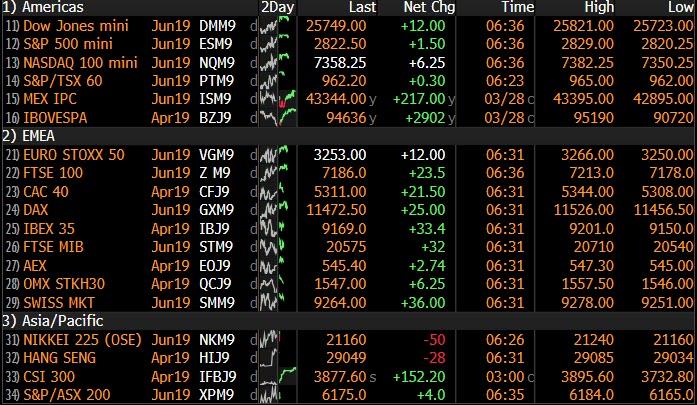
  • S&P 500 futures up 0.4% to 2,832.25
  • STOXX Europe 600 up 0.4% to 378.18
  • German 10Y yield unchanged at -0.068%
  • Euro up 0.06% to $1.1228
  • Brent Futures up 0.4% to $68.08/bbl
  • Italian 10Y yield rose 3.2 bps to 2.132%
  • Spanish 10Y yield fell 0.4 bps to 1.086%
  • MXAP up 0.6% to 159.47
  • MXAPJ up 0.7% to 527.75
  • Nikkei up 0.8% to 21,205.81
  • Topix up 0.6% to 1,591.64
  • Hang Seng Index up 1% to 29,051.36
  • Shanghai Composite up 3.2% to 3,090.76
  • Sensex up 0.1% to 38,595.64
  • Australia S&P/ASX 200 up 0.08% to 6,180.73
  • Kospi up 0.6% to 2,140.67
  • Brent Futures up 0.4% to $68.08/bbl
  • Gold spot down 0.1% to $1,288.79
  • U.S. Dollar Index up 0.05% to 97.25

Top Overnight News from Bloomberg

  • Chinese and U.S. negotiators are working line-by-line through the text of an agreement that can be put before President Donald Trump and counterpart Xi Jinping to defuse a nearly year-long trade war, according to officials familiar with the matter
  • Federal Reserve Bank of New York President John Williams, one of the U.S. central bank’s top policy makers, downplayed fears of recession risks being signaled by bond markets. James Bullard, president of the St. Louis Fed, said he expected second-quarter growth to rebound after a sluggish start to the year and calls for a rate cut were “premature.”
  • White House economic adviser Larry Kudlow said Thursday the Trump administration is prepared to keep negotiating with China for weeks or even months to reach a trade deal that will ensure the world’s second- largest economy improves market access and intellectual-property policies for U.S. companies
  • Japan’s industrial production rose in February, though it wasn’t enough to signal a turnaround from months of declines as weak overseas demand weighs
  • Oil heads for its best quarter in almost 10 years as the OPEC+ coalition’s production cuts and the loss of barrels due to U.S. sanctions on Iran and Venezuela outweighed a wobbly demand outlook
  • With overseas holdings already at record levels, the April 1 inclusion of a slice of China’s near-$13 trillion of onshore bonds in a Bloomberg Barclays index will usher in fund managers who use the benchmark. Strategists see $100 billion or more flowing in in 2019 and for years to come
  • A jumbo wager on an Australian interest-rate cut has emerged again, stoking speculation the same trader is hoping to strike gold at the third attempt.A splurge of buying has seen open interest in Australia’s April bank bill futures jump almost 30 percent so far this week to the highest since May 2016, suggesting sizable new longs are being built
  • London continued to lead the U.K.’s weakening property market at the start of 2019, with values falling the most since the financial crisis a decade ago
  • German unemployment fell to a fresh record low, suggesting that the country’s buoyant services sector is offsetting weakness in manufacturing
  • Russia and Iran’s energy ministers will discuss a possible extension of the OPEC+ agreement to curb oil production when they meet in Moscow next week
  • As Treasury issuance outstrips crisis-era records, the rising share of government bonds in market-weighted fixed-income indexes is pulling in more global investors

Asian equity markets were higher across the board as the region took impetus from the US, where all major indices finished positive and trade-sensitive sectors outperformed on optimism as US-China high-level talks resumed in Beijing. ASX 200 (+0.1%) eked mild gain as most sectors remained afloat heading into quarter-end although gold miners were heavily weighed after the precious metal succumbed to the pressure from a firmer greenback. Nikkei 225 (+0.8%) was driven by currency weakness with Daiichi Sankyo surging nearly 16% to hit limit up and a record high after it signed a USD 6.9bln collaboration and commercialization deal for its cancer drug with AstraZeneca in which it will receive an upfront payment of USD 1.35bln. Elsewhere, Hang Seng (+1.0%) conformed to the upbeat tone and the Shanghai Comp. (+3.2%) outperformed as trade discussions continued in Beijing and after China announced electricity and fuel costs reductions ahead of incoming VAT cuts. Huawei also supported the risk appetite after it posted a 25% increase in annual profits despite the ongoing US tiff, although not all stocks benefitted as some contended with disappointing earnings including China’s largest lender ICBC which fell short of FY net forecasts after flat Q4 profits. Finally, 10yr JGBs were lower as the fixed income complex eased from the rampant inflows seen this week and as gains in stocks dampened demand for safe-haven assets, although downside was limited with the BoJ also in the market for JPY 710bln of JGBs in the belly to super long-end.

Top Asian News

  • Japan’s Job Outlook Brightest in Decades. Pity About the Wages
  • Foreigners Dive Back Into China Stocks, Buy Most Since December
  • Bet on Philippine Boom Pays Off for This Top-Performing Manager
  • Jet Airways Is Said to Miss Paying $109 Million Loan From HSBC

A relatively upbeat start for European equities [Euro Stoxx 50 +0.5%] following on from a stellar performance in Asia, wherein the Shanghai Composite ended the week higher in excess of 3% as US-Sino talks concluded on a seemingly positive note. Broad based gains are seen across major indices, UK’s FTSE (+0.5%) is keeping its composure amid the Brexit-induced weakness in the Sterling and as heavyweight mining names benefit from the surge in base metal prices: [Antofagasta (+2.6%), Glencore (+2.4%), Anglo American (+2.1%) and Rio Tinto (+2.0%)]. Sector-wise, material names lead the gains, whilst consumer discretionary names benefit from positive broker moves for Kering (+1.4%), LVMH (+1.2%) and Richemont (+0.9%). Looking at individual movers, Wirecard (-6.9%) shares plumb the depths following yet another FT article which noted that half the company’s revenues come from partners whilst noting that at some of them there is a mismatch with reality on the ground. A Wirecard executive has noted the article in incorrect and misleading. Elsewhere, yet more trouble for Scandi banks with Swedbank (-9.5%), Nordea Bank (-9.8%) lower after New York regulators reportedly expanded money laundering scandal probe into Nordea Bank.

Top European News

  • H&M Surges as Earnings Beat Analyst Estimates on Fewer Discounts
  • Altice Jumps as Drahi’s Carrier Predicts Higher French Growth
  • Italy’s Nexi Says IPO Offering Value Seen at EU1.9b- EU2.2b
  • Pound Reverses Gains as Chance May’s Brexit Deal Passes Seen Low

In FX, USD – The Greenback remains firm overall, but has lost a bit of momentum against a few G10 and other counterparts at the start of the final trading session of the week, month and quarter as latest US-China trade talk reports suggest more progress made. However, the DXY has nudged above the 97.300 level that capped its advances yesterday and in doing so crossed a key Fib at 97.245 (76.4% retrace of the fall from 97.711 to 95.735), which bodes well from a chart standpoint ahead of potentially pivotal data including Chicago PMI and a trio of Fed speakers (Williams, Kaplan and Quarles).

  • NZD/AUD/CAD – Bucking the broad trend on the aforementioned constructive US-China vibes, but with the Kiwi also getting a much needed fillip from ANZ’s consumer sentiment survey overnight showing an improvement in March. Nzd/Usd rebounded to just over 0.6800 at one stage, but then pared gains on more dovish RBNZ impulses, albeit indirectly as JPM updated its 2019 outlook for NZ rates with back-to-back cuts now seen in May and June. Similar story for the Aussie that briefly reclaimed 0.7100 before fading, while the Loonie is still relatively rangebound between 1.3420-45 ahead of Canadian PPI data.
  • JPY/EUR/CHF/GBP – All softer vs the Usd, with the Jpy extending its retreat from a fraction shy of 110.00 to circa 110.92 amidst reports of Japanese selling for FY end on top of the general improvement in risk sentiment. However, supply is said to be sitting at 111.00 and the recent 110.96 peak is still providing technical resistance. The single currency is holding just above 1.1200 with buying interest touted from 1.1210 down to the figure and decent option expiry interest also supporting as 1.5 bn rolls off at the NY cut vs 1.2 bn from 1.1250-60. The Franc is essentially flat vs the Buck and Euro around 0.9950 and within 1.1190-65 parameters respectively following SNB comments on Thursday reinforcing the commitment to maintain NIRP and intervention given the Chf’s ongoing high valuation and fragility in the currency markets. Last, but by no means least heading into yet another crucial Brexit vote in the HoC, the Pound is depressed with Cable almost losing the 1.3000 handle despite a big buy order at 1.3010 and Eur/Gbp pivoting 0.8600 where a sizeable 1 bn expiries reside and run-off only 30 minutes or so before the Parliament decide whether to back the WA.
  • EM – In contrast to partial recoveries elsewhere, the Lira has lurched to new lows vs the Dollar not far from 5.6600 as the run continues almost relentlessly, and with little last respite from a narrower than forecast Turkish trade deficit.

In commodities, WTI (+0.8%) and Brent (+0.6%) futures are on the front foot thus far amid the overall positive risk sentiment around the market as US-China talks are to continue next week after concluding in Beijung on a positive note. WTI futures extended gains above USD 59.00/bbl and remain in relatively close proximity to USD 60.00/bbl whilst Brent futures reside around USD 67.50/bbl. In the month of March, Brent Crude advanced around 1.6% whilst WTI crude posted gains in excess of 4%. In terms of recent energy news-flow Russian Energy Minister denied the report that Russia will only agree to extend output cut deal by 3 months and said Russia and Iran potential extension of OPEC+ deal. This follows source reports yesterday that OPEC and Russia could agree to a 3-month extension of the current agreement at the June meeting. Elsewhere, Gold ekes mild gains following yesterday’s slump below USD 1300/oz. Meanwhile, copper and iron are extending on earlier gains as optimism surrounding trade talks bolster the base metals. Russia Energy Minister denies report that Russia will only agree to extend output cut deal by 3 months and said Russia and Iran potential extension of OPEC+ deal. (Newswires) This follows source reports yesterday that OPEC and Russian could agree to a 3-month extension of the current agreement at the June meeting.

US Event Calendar

  • 8:30am: Personal Income, est. 0.3%, prior -0.1%; Personal Spending, est. 0.3%, prior -0.5%
  • 8:30am: PCE Deflator YoY, est. 1.4%, prior 1.7%; PCE Core YoY, est. 1.9%, prior 1.9%
  • 9:45am: MNI Chicago PMI, est. 61, prior 64.7
  • 10am: New Home Sales, est. 619,500, prior 607,000; New Home Sales MoM, est. 2.06%, prior -6.9%
  • 10am: U. of Mich. Sentiment, est. 97.8, prior 97.8; Mich. Current Conditions, prior 111.2; Expectations, prior 89.2

DB’s Jim Reid concludes the overnight wrap

Welcome to the last business day of Q1, a quarter that most market participants will remember more fondly than Q4 2018. Craig is skiing at the moment but assuming he’s not like me and doesn’t get injured every time he steps foot on the snow, he’ll be doing the usual performance review when he’s back on Monday. Today is also the day that 1008 days after the Brexit vote, the UK was supposed to leave the EU. However if I had to make a spread as to how many more days the UK will continue to be in the EU I don’t think I’d quite know where to start. Anywhere from 14 to infinity. I’m happy to trade on this spread if anyone wants to. I’ve ordered a bit of furniture for our new house from Italy and yesterday I enquired as to when it might arrive. The guy on the other end of the phone then proceeded to tell me that there was something called Brexit that was going on and told me all about how it was going, his views on every politician involved, and that the risks to his business (and to my table) of a no deal Brexit. By the end of the conversation I was none the wiser about when it will arrive. Suffice to say that if you’re reading this in Italy and you need a new table and there’s a no deal Brexit, then I may be in a position to do business.

Today we will get a fresh vote on the Withdrawal Agreement (WA) at about 2:30pm but only the WA part and not the Political Declaration on the Future Relationship as with the two previous votes. Maybe I’ll get my chairs but not my table then. The government hopes that by separating out the two, the WA could have a greater chance of success. Furthermore, it satisfies Speaker Bercow’s criteria that the vote must be on something different to last time. The other thing it satisfies is the EU’s criteria from their European Council meeting last week that in order to get an extension of the Brexit deadline from the 12 April to 22 May (the day before the European Parliament elections begin), the House of Commons just needs to approve the WA.

However, it’s not obvious that this will help the government win, with Labour’s shadow Brexit Secretary, Sir Keir Starmer, saying that if the two were separated, “that would mean leaving the EU with absolutely no idea where we’re heading. That cannot be acceptable, and we wouldn’t vote for that.” And on the other side, one of the main reasons the ERG and DUP MPs have been opposed to the deal has been the backstop, which is a part of the WA.

Another issue is that this risks complicating the ratification process, as in UK law under the European Union (Withdrawal) Act 2018, to ratify the WA it requires that both the WA and the framework for the future relationship have been approved in a motion by the House of Commons. Therefore, unless new legislation were passed that changed this requirement, the political declaration on the future relationship would still need to be approved in a motion by the House of Commons before the WA could be ratified. Maybe the benchmark for any defeat today will be how it compares to the indicative votes supporting a second referendum and the Customs Union – the two that got closest to a majority.

Sterling weakened against every other G10 currency yesterday (-1.10% vs USD but +0.2% this morning), although other UK assets performed strongly, with sterling’s decline supporting the FTSE 100 (+0.56%) to outperform other European indices yesterday, while UK 10yr gilt yields fell -1.2bps yesterday, the only major European country to see ten-year debt yields fall.

In the US-China trade negotiations, Trade Representative Lighthizer and Secretary Mnuchin will be continuing talks today, before China’s Vice Premier, Liu He, returns to Washington for further talks next week. Treasury Secretary Mnuchin has said overnight that they had a “very productive” working dinner yesterday with Chinese negotiators. National Economic Council Director Kudlow said yesterday that they are willing to extend the talks if necessary, saying that “If it takes a few more weeks, or if it takes months, so be it.” Kudlow also addressed the Commerce Department’s report on auto tariffs, which President Trump is currently reviewing. A decision on whether or not to impose broad import tariffs on the sector was supposed to come within 90 days of the report’s submission. That would put the deadline at May 19 for an announcement, but Kudlow said that Trump “could take longer” to reach a final decision.

Asian markets are responding to the Mnuchin headline and the positive Wall Street lead this morning with China’s bourses leading the advance – the Shanghai Comp (+2.54%), CSI (+3.21%) and Shenzhen Comp (+2.60%) are all up. The Nikkei (+0.78%), Hang Seng (+0.77%) and Kospi (+0.42%) are also up. Elsewhere, futures on the S&P 500 are up +0.18%. In terms of overnight data releases, we saw Japan’s February industrial production in line with consensus at +1.4% mom, marking the first gain after three consecutive negative readings while the February unemployment rate came in at 2.3% yoy (vs. 2.5% yoy expected), matching the 25 year low set in May 2018. February retail sales came in at +0.2% mom (vs. +1.0% mom expected) with an upward revision to the previous month to -1.8% mom from -2.3% mom. South Korea’s February industrial production was at -2.6% mom (vs. -0.7% mom expected), the largest decline since February 2017, due to a drop in the production of cars and transportation equipment. Meanwhile the UK’s March GfK consumer confidence number was unchanged compared to prior month at -13 (vs. -14 expected).

Before this US equities advanced yesterday perhaps helped by some slightly positive real-time economic data (more below). The S&P 500, DOW, and NASDAQ rose +0.36%, +0.36%, and +0.34%, with gains fairly broad-based. The main laggard was utilities, as rising rates pressured the bond-proxy sectors. Earlier in the day, European indexes had a mostly negative day, with the STOXX 600 down -0.12%, though the DAX did eke out a +0.08% gain. Bund and treasury yields rose +1.2bps and +2.3bps, respectively, and the US move was encouragingly driven entirely by inflation breakevens. The 10y breakeven rate rose +3.3bps, its biggest rise since January, though at 1.86%, it’s likely still a bit low for the Fed to be completely comfortable. Notably, Japanese 10-year yields are down to -0.094%. The Bank of Japan’s stated policy is to keep them “around zero percent,” so they’re approaching the edge of the potential policy range, though it’s not clear how concerned the BoJ would be at falling yields, as opposed to rising yields.

Early yesterday, President Trump asked in a tweet that “OPEC increase the flow of Oil” because “price of Oil (is) getting too high.” That initially caused WTI oil prices to drop -2.04%, but they subsequently retraced higher as the session continued to end the day near flat at $59.38 per barrel. Energy sector stocks performed in-line with the broader index, rising +0.37%. The rebound was especially striking, since it coincided with a further rally for the dollar, with the DXY index gaining +0.47%. That sent an index of emerging market currencies to its lowest level since January 3, falling -0.16% on the day.

The Turkish Lira plunged again against the dollar, down -4.16% yesterday to reach 5.5603. The central bank announced that its foreign exchange reserves rose by $2.4bn last week, easing some concerns that it was using up its firepower trying to prevent currency depreciation, which helped the currency strengthen around +1.07% off its trough. Funding markets normalized a bit, with overnight liquidity back down to 32%, down from Wednesday’s peak of over 1,300%. This morning lira is down further -0.43%.

Turning to the Fed Speakers, James Bullard, president of the St. Louis Fed, said that he expects growth to rebound in second-quarter after a sluggish start to the year while adding that calls for a rate cut were “premature.” Elsewhere, John Williams, president of the New York Fed, said that “the most likely case” was for U.S. growth of 2% with the economy continuing to add jobs amid low unemployment and added that “I still see the probability of a recession this year or next year as being not elevated relative to any year.” On inversion of the yield curve, he said that “there’s a lot of reasons to think that it has been a recession predictor for reasons in the past that kind of don’t apply today,” and “I think it’s telling us that growth will be pretty modest” in the U.S. and global economies going forward.

Data releases were mixed yesterday but there was some positive more real-time signs in the US. US Q4 GDP saw a downward revision to an annualised QoQ rate of 2.2% (vs. 2.6% in the previous estimate), while the personal consumption reading was revised down to 2.5% from 2.8%. Pending home sales also fell by -1.0% in February (vs. -0.5% expected), bringing the YoY total to -5.0%. However, initial jobless claims came in beneath expectations at 211k (vs. 220k expected), the lowest reading in nine weeks, while the previous reading was also revised down by 5k. Furthermore, the Kansas City Fed manufacturing index rose sharply to 10 in March (vs. 0 expected), with the 9 point increase being the largest since December 2016.

In the Eurozone, the economic sentiment indicator released by the European Commission fell once again in March, reaching 105.5 (vs. 105.9 expected), its lowest level since October 2016 and the 9th consecutive monthly decline. Meanwhile, German consumer prices rose by 1.5% in March (vs. 1.6% expected), the lowest level for 11 months. It’ll be interesting to see whether today’s French and Italian inflation data and Monday’s for the Eurozone paint a similar picture.

Looking to the day ahead, we have the latest big Brexit vote as well as more trade talks in Beijing between the US and China. It’s also another busy day for data. From Europe, we’ve got French and Italian CPI readings for March, in Germany we’ve got February’s retail sales figures and March’s change in unemployment, and from the UK, we’ll get the latest reading of Q4 GDP, along with February’s mortgage approvals, consumer credit, and M4 money supply. From the US, we’ll get the final University of Michigan sentiment reading for March, personal income for February, personal spending for January, the MNI Chicago PMI for March, along with February’s new home sales. In Canada, we’ll get January’s GDP figure.

via ZeroHedge News https://ift.tt/2FHnchA Tyler Durden

Futuristic Tech-Driven Policing Will Only Be as Good as the Cops Doing It: New at Reason

In Washington, D.C. in 2054, a Department of PreCrime determines who is going to commit a crime before it happens. The government uses three mutants, known as “precogs,” who have precise visions of future events. Police are sent in advance to arrest the not-quite-criminals and, voila, the crime rate drops to zero. That is the backdrop of the movie, “Minority Report,” based on a story from the late Orange County sci-fi writer Philip Dick.

Dystopian stories take real-life trends and extrapolate them far into the future, as a way to explore the moral conundrums of current policies. Flash forward 17 years from the movie’s release (or back 35 years from the future!), and we find the Los Angeles Police Department wanting to impose its own version of what is known as “predictive policing.” Instead of mutants, LAPD uses computers and human analysts.

The department pinpointed high-crime LASER zones—Los Angeles Strategic Extraction and Restoration—and tried to determine where to deploy a greater police presence. That sounded OK, but the computer system also created a profile of actual people who might have a propensity to commit crimes based on data about gang membership and arrest records. That’s startling.

The inspector general found that “44 percent of chronic offenders had either zero or one arrest for violent crimes” and “about half had no arrest for gun-related crimes,” according to a Los Angeles Times report, which noted that LAPD ultimately suspended the tool. Apparently, these technologies work better in the movies.

It reminds me of the state attorney general’s APPS program (Armed Prohibited Persons System), which sends agents to the homes of people who are no longer are deemed eligible to own firearms. It sounds like a great way to remove guns from “bad guys,” until one realizes that the complex computer-generated lists are woefully inaccurate, according to some reports. Our government cannot get its current databases right, so how could we expect it to predict the future, asks Stephen Greenhut.

View this article.

from Hit & Run https://ift.tt/2HLAnRP
via IFTTT