Here’s Why The US Economy Would Continue To Crash Even If All Lockdowns Were Lifted Immediately…

Here’s Why The US Economy Would Continue To Crash Even If All Lockdowns Were Lifted Immediately…

Authored by Michael Snyder via TheMostImportantNews.com,

COVID-19 has created an enormous amount of fear, and that fear is doing far more damage to the economy than the actual virus is.  In an environment of fear, financial institutions become a lot tighter with their money, and that inevitably causes economic activity to slow down.  For example, just consider what happened in 2008.  Mortgage lending standards suddenly became much more strict, and that greatly contributed to the horrific housing price crash which left millions upon millions of Americans underwater on their mortgages.  Unfortunately, this coronavirus pandemic has created a wave of fear that is far greater than what we experienced during the last recession, and that has enormous implications for the months ahead.

Extremely loose lending standards helped create debt-fueled “booms” throughout our economy in recent years, but now lending standards are going in the complete opposite direction very rapidly.

For instance, Chase is now requiring a credit score of at least 700 for all new home loans, and they are one of the financial institutions that is now requiring a down payment of at least 20 percent

A Chase spokesperson confirmed that starting April 14, new mortgage applicants will need a minimum credit score of 700 and a down payment of 20%. Refinancing applications for non-Chase mortgages will also need the same score. Chase didn’t disclose its previous lending standards but the average downpayment for first-time home buyers is around 6%, according to a 2018 survey from the National Association of Realtors.

If you own your home, would you have been approved for a mortgage under the new Chase standards?

And Chase is far from alone.  In fact, most major mortgage lenders have now tightened up, and Redfin is estimating that about a quarter of all home buyers last year would not have qualified under the new standards.

So if you remove about a quarter of all buyers from the marketplace moving forward, what happens to the housing market?

Yes, there will be an implosion, and it will happen no matter whether coronavirus lockdowns are in effect or not.

And home equity loans are going to be hit even harder.  As I discussed last week, Wells Fargo is no longer taking HELOC applications at all.

So now matter how good your credit is, you simply cannot get a home equity line of credit from Wells Fargo at this point.

This is what fear does.

We see similar things happening in the credit card industry.  Standards have been greatly tightened for new customers, and in some instances existing customers are having their limits slashed or their cards suddenly canceled.  The following comes from Newsweek…

Analysts warn that credit card companies are lowering credit limits and canceling cards—often without warning—amid the pandemic-induced economic crisis, just as they did during the Great Recession.

If you think that this won’t have a dramatic impact on the U.S. economy, then you probably haven’t been paying attention.

Our economy is a consumer driven economy, and if consumers don’t have access to easy credit there is no way in the world that economic activity will return to previous levels.

Of course even if they did have access to easy credit, many Americans are so afraid of this virus that they have no intention of resuming normal economic patterns any time soon

Here’s hoping you enjoyed the last movie or concert you attended, because if the results of a new survey are accurate, it may be a long, long time before such events are ever popular again. According to the research, 40% of Americans plan to avoid public spaces unless “absolutely necessary” long after the coronavirus pandemic has subsided.

The survey, commissioned by Vital Vio, asked 1,000 U.S. adults about how they envision every day life in the wake of the coronavirus. All in all, it looks like there are suddenly a whole lot more germaphobes in the land of the free. Over four in five (82%) said they are now more aware of, and concerned about, cleaning protocols in public areas. Additionally, 58% are more suspicious about their friends’ and family’s hygiene habits.

And a lot of companies are also going to be extremely hesitant to “return to normal” because of the threat of lawsuits.

Earlier today, I was stunned to learn that 771 coronavirus-related lawsuits have already been filed…

Hundreds of lawsuits stemming from the coronavirus pandemic are rapidly amassing in state and federal courts, the first wave of litigation challenging decisions made early during the crisis by corporations, insurance companies and governments.

Claims have been filed against hospitals and senior-living facilities, airlines and cruise lines, fitness chains and the entertainment industry – 771 as of Friday, according to a database compiled by Hunton Andrews Kurth, an international law firm tracking cases that emerge from the pandemic.

Isn’t that insane?

I have repeatedly warned my readers that it will be exceedingly difficult to “return to normal” in our overly litigious society, but even I didn’t expect so many lawsuits so soon.

And this is just the beginning.  Eventually there will be thousands upon thousands of coronavirus lawsuits, and they will tie up our courts for the foreseeable future.

This pandemic just seems to be magnifying everything that is wrong with our society, and at this point the future looks so bleak that even perpetually optimistic Warren Buffett is throwing in the cards

A 95% plunge in passengers. Billions in losses. A rush for new debt. A recovery that executives expect to take years. Coronavirus is roiling the airline industry and the Oracle of Omaha has seen enough.

Warren Buffett told investors Saturday that Berkshire Hathaway has sold its entire stakes in the four largest U.S. airlines — AmericanDeltaSouthwestUnited — as the pandemic upends another bet on the sector that the famed investor had shunned for years before a surprise return in 2016.

Buffett understands that fear of this virus is going to paralyze air travel for a very long time to come, and he is getting out while he still can.

But if our society cannot even handle COVID-19, what will things look like once much worse things start happening?

It has been sobering to watch how rapidly our “snowflake society” has melted during this pandemic.

Now virtually the entire nation is paralyzed by fear, and the once great U.S. economy is crashing all around us.

And the really bad news is that this is just the beginning…


Tyler Durden

Mon, 05/04/2020 – 17:50

via ZeroHedge News https://ift.tt/3fjBWEe Tyler Durden
Hertz Hurts! Car-Renter Shares Routed On Reports Restructuring Adviser Hired

Hertz Hurts! Car-Renter Shares Routed On Reports Restructuring Adviser Hired

It would appear an already over-levered car-rental business is not “essential“?

Just days after The Wall Street Journal reported that Hertz is preparing for a possible bankruptcy filing after the rental-car company failed to make lease payments to preserve cash amid the Covid-19 pandemic, the journal reports tonight that the firm has hired an additional adviser to help prepare for a planned bankruptcy filing, according to people familiar with the matter.

Revolving lender Barclays is working with Latham & Watkins LLP, while a group of term loan lenders has engaged financial adviser Houlihan Lokey Inc., and law firm Arnold & Porter Kaye Scholer LLP, the people said.

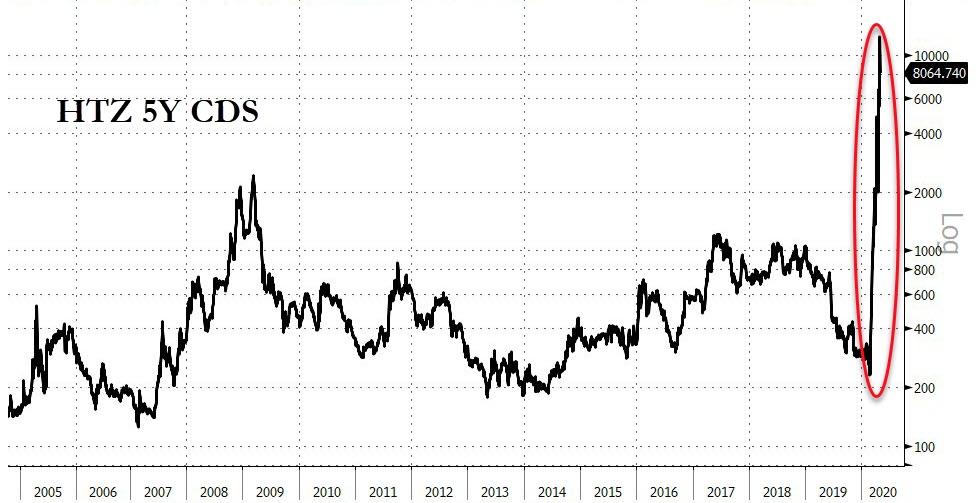
For veterans of past credit cycles, it should be no real surprise that the rental car business is on its last legs, but CDS spreads this time are screaming default is imminent (and that recovery values for any debt are extremely low)…

Source: Bloomberg

Hertz has $17 billion worth of debt, which includes $3.7 billion of corporate bonds and loans and $13.4 billion of vehicle-backed notes.

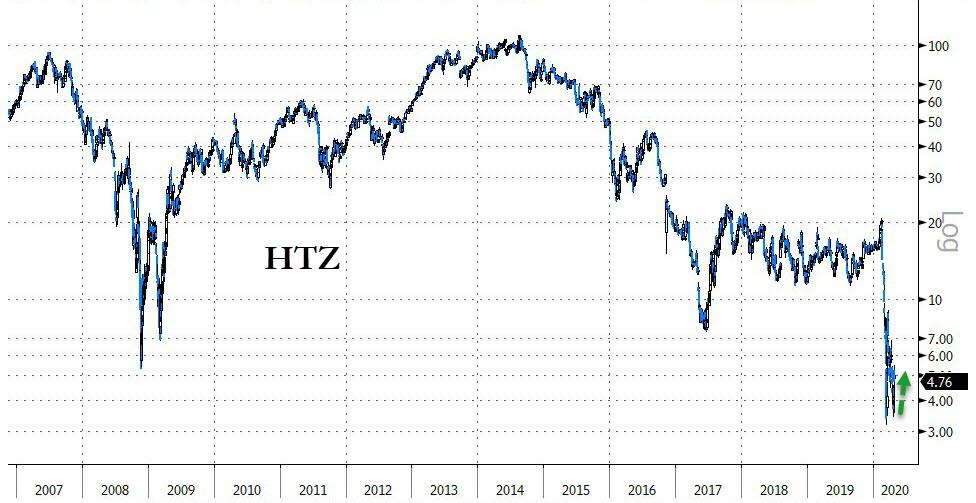
Last week, we ‘mocked’ the stock price remaining ever hopeful that is has some value ($650 mm market cap)…

Source: Bloomberg

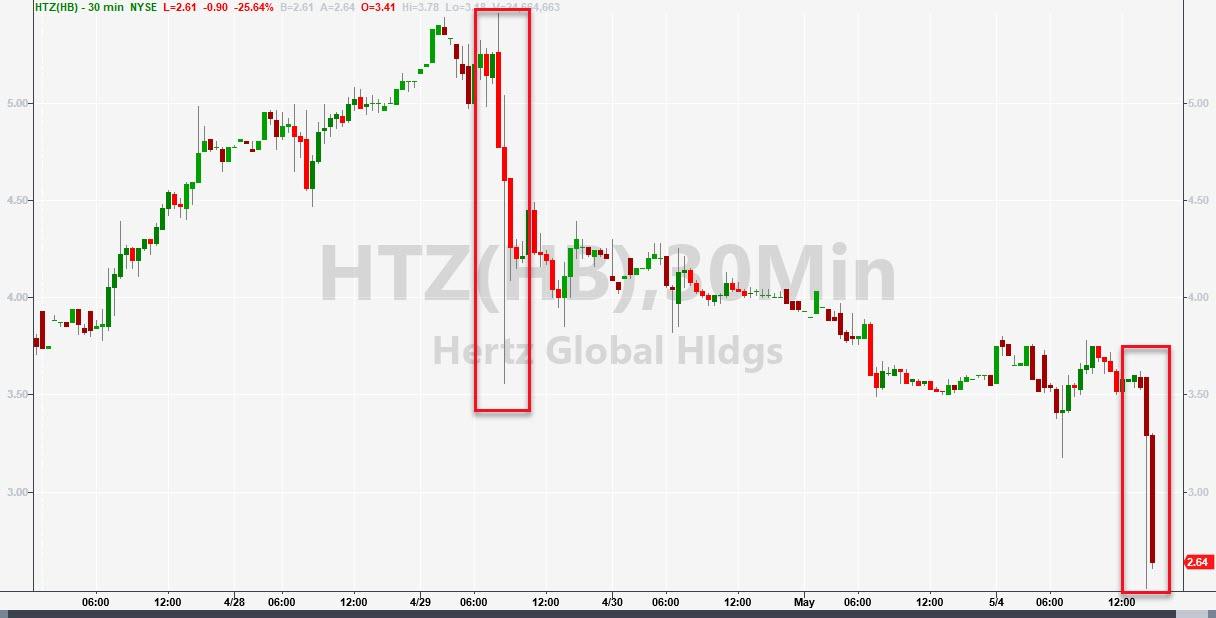
All of that is out the window tonight as HTZ is down almost 30% after hours…

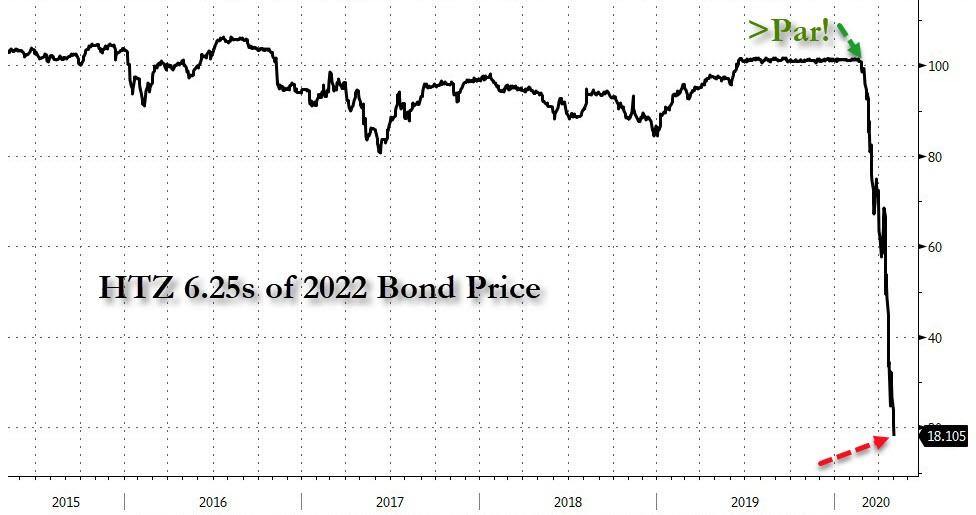
Hertz shares are well on their way to zero… as the bonds are trading at just 18c on the dollar…

In recent months, both Hertz and rival Avis have cut executive pay and resorted to furloughs and job cuts, with Hertz last month laying off about 10,000 employees in North America. Avis said Monday it would try to borrow $400 million for general purposes.

And before they beg for a bailout, even before the pandemic, Hertz and its rivals were struggling with losing customers to ride-hailing firms such as Uber and Lyft.


Tyler Durden

Mon, 05/04/2020 – 17:34

via ZeroHedge News https://ift.tt/2YAoENQ Tyler Durden

Neiman Marcus Strikes Bankruptcy Deal With Creditors As ‘Rona Rout Claims Latest Victim

Neiman Marcus Strikes Bankruptcy Deal With Creditors As ‘Rona Rout Claims Latest Victim

It’s the coronavirus outbreak’s latest – and perhaps its biggest – retail casualty.

Neiman Marcus is joining J Crew and JC Penney in restructuring as the department store – a class of retailer that has been particularly hard-hit by the outbreak – has reportedly reached a deal with its creditors for a loan to get it through bankruptcy.

With that, the troubled department store chain, which has been widely expected to file before mid-May, is set to file any day now, according to the report, which also claimed that PIMCO would act as the lead lender.

Of course, as we explained weeks ago, it’s hardly surprising that a store widely known by the nickname “Needless Markups” has finally buckled under its onerous debt burden.

Reuters reported that another mall anchor icon, luxury retailer Neiman Marcus Group, has also skipped a bond payment week to Marble Ridge Capital LP, according to a letter from the hedge fund to the luxury department store retailer sent Thursday, setting the heavily indebted chain on a path toward bankruptcy.

And as we explained then, the biggest loser in all of this is America’s malls and – more importantly – the owners of the securities backed by the debt owed by said malls.

This confirms a recent report from Reuters according to which Neiman Marcus was preparing to file for bankruptcy. As Reuters adds, a Neiman bankruptcy filing would likely be contentious. A trustee for some of the company’s bondholders, including Marble Ridge, sued Neiman last year, claiming the company and its owners robbed investors of the value of luxury e-commerce site MyTheresa in the earlier debt restructuring. The biggest loser from this waterfall of default which will collapse all cash flow payments from these massive retail giants, is the mall sector, which as a reminder was the target of the “Big Short 2” via the CMBX Series 6 BBB- index, and which plunged in late March making all those – such as Carl Icahn 0 who had bet on the collapse of that icon of US life, malls, very rich…

… and in fact, unlike the broader market which has staged a remarkable rebound in recent weeks, the mall-heavy Series 6 CMBX tranche continues to slide, and was just shy of all time lows at last check, which is a vivid reminder of what price discovery looks like when there is no Fed backstop (for now Powell is not buying deeply impaired CMBX tranches; that may change soon).

And as we noted in the above quote, among securities backed by the debt of commercial real-estate, CMBX Series 6 BBB-, a security comprised of mostly mall debt, will likely fare the worst.


Tyler Durden

Mon, 05/04/2020 – 17:31

via ZeroHedge News https://ift.tt/3fjUWTa Tyler Durden

Mirror-Image Decoupling

We begin the news with a US measure to secure its supply chain for a critical infrastructure – the bulk power grid. David Kris unpacks a new Executive Order restricting purchases of foreign equipment for the grid. As with all these measures, China is the unspoken target.

Nick Weaver, meanwhile, explains the remarkable extent of surveillance built into Xiaomi phones and questions the company’s claim that it was merely acquiring pseudonymous ad-related data like others in the industry.

It wouldn’t be the Cyberlaw Podcast if we didn’t wrangle over using mobile phones to combat the coronavirus. Mark MacCarthy says that several countries – Australia, the UK, and perhaps France – are deviating from the Gapple model for  contact tracing. Several others, though, have bought in. India, meanwhile, is planning a much more government-driven approach to using phone apps to deal with the pandemic.

Mark ventures into even more contested territory in response to an article in The Atlantic by Jack Goldsmith and Andrew Woods, who argue that China has won the debate with John Perry Barlow over whether the Internet will be a force for free speech. Mark and I more or less agree, which sends me off on a rant about the growing self-confidence and ham-handedness of Big Tech as they get comfortable in their role as Guardians of What You Can’t Say on the Internet. Things you can’t say include plausible arguments about the still highly unsettled question of how best to deal with COVID-19 and descriptions of treatment options that have been entertained by President Trump without establishment approval, not to mention “unverified” statements (not, notably, false ones) that could cause “social unrest.” Just reading such things, it turns out, will lead at least Facebook to track you down and tell you that it knows what you did and wants to correct your flirtation with thoughtcrime – a practice that earned it praise from Rep. Adam Schiff.

Nick and I note the difficulty Facebook is having getting out of FOSTA cases in Texas, and I ask why FOSTA hasn’t already spelled doom for end-to-end encryption since it basically does what the EARN IT Act does, and all right-thinking Americans have been told that that act Spells Doom For End-to-End Encryption.

David explains why Amazon is facing tough new scrutiny from both parties: A Wall Street Journal article that questioned the accuracy of Amazon testimony before Congress has generated claims of perjury, a demand that Jeff Bezos testify, and suggestions that the administration open a criminal antitrust probe.

“You can’t decouple from me! I’m decoupling from you!” That’s the sentiment from Chinese officials, anyway, as they push forward with their own remarkably familiar supply chain security regulations. David explains that while the rules are similar to those in the United States, they’re tougher and more likely to be implemented in a slow, inexorable way. And, of course, the United States is the unspoken target of them all.

Download the 314th Episode (mp3).

You can subscribe to The Cyberlaw Podcast using iTunes, Google Play, Spotify, Pocket Casts, or our RSS feed. As always, The Cyberlaw Podcast is open to feedback. Be sure to engage with @stewartbaker on Twitter. Send your questions, comments, and suggestions for topics or interviewees to CyberlawPodcast@steptoe.com. Remember: If your suggested guest appears on the show, we will send you a highly coveted Cyberlaw Podcast mug!

The views expressed in this podcast are those of the speakers and do not reflect the opinions of their institutions, clients, friends, families, or pets.

from Latest – Reason.com https://ift.tt/2YxQkTp
via IFTTT

Well, at Least He’s My Accused Sexual Assaulter!

How should we think through the sexual assault allegations against Joe Biden? Turns out it’s damned hard to without running smack into not just with Biden’s own situational ethics when it comes to believing women but the entire intellectually corrupting two-party mindset that poisons politicians and journalists alike.

So conclude panelists Nick Gillespie, Katherine Mangu-Ward, Peter Suderman, and Matt Welch on today’s Reason Roundtable podcast. The group tackles thorny issues of due process and double standards, and it also gets into some discussion about the nascent presidential campaign of non-accused Rep. Justin Amash (L–Mich.) before debating the best personal strategy for coping with coronavirus: buying a car, learning to cut hair, or just dropping a bunch of MDMA in Central Park.

Audio production by Ian Keyser and Regan Taylor.

Music Credit: ‘Ether Oar’ by The Whole Other.

Relevant links from the show:

Joe Biden Denies Sexual Assault Accusation, Fails To Explain Why ‘Believe Victims’ Doesn’t Apply to Tara Reade,” by Robby Soave

Justin Amash: If Biden Assaulted Tara Reade, He Is Disqualified From Being President,” by Nick Gillespie

On Biden Sexual Assault Allegation, Silence Then Hypocrisy,” by Elizabeth Nolan Brown

New York Times Editor Excuses Paper’s Slow Tara Reade Coverage: ‘Kavanaugh Was a Running, Hot Story,’” by Robby Soave

Trump Says Rape Accuser E. Jean Carroll Isn’t His Type,” by Elizabeth Nolan Brown

Will Public Discourse Ever Recover from the Kavanaugh Hearings?” by Nick Gillespie

Justin Amash: People Want a President ‘Who Is Normal, Honest, Practical, Capable,’” by Nick Gillespie and John Osterhoudt

Justin Amash Becomes the First Libertarian Member of Congress,” by Matt Welch

Justin Amash Is Running for President as a Libertarian,” by Matt Welch

Trump Administration Projects 200,000 American COVID-19 Deaths by June 1,” by Ronald Bailey

Lockdown Is Ending, Whether Governments Approve or Not,” by Eric Boehm

Reopening States Aren’t Faring So Well. Neither Are the Ones Staying Closed,” by Elizabeth Nolan Brown

Coronavirus Stimulus Has Cost $3.6 Trillion, but Oversight Is Still Severely Lacking,” by Eric Boehm

from Latest – Reason.com https://ift.tt/3ftSzNE
via IFTTT

What Happens When You Cancel Rent, Mortgages, And Debt?

What Happens When You Cancel Rent, Mortgages, And Debt?

Authored by Joe Jarvis via The Daily Bell,

In Ancient Greece around 600 BC the commoners had fallen into heavy debt.

First they mortgaged their land, and delivered the majority of their crops to the lender.

But after a bad harvest, the farmers needed to borrow more in order to afford another planting.

With nothing left they used their freedom, and the freedom of their family as collateral.

Many were sold into debt slavery after defaulting on this second loan.

That’s when a poor aristocrat, Solon, was elected ruler by appealing to both the landowners and the heavily indebted commoners.

He canceled the commoners’ debts and ended debt slavery.

The commoners were free of their debts and servitude. But they still needed to eat.

Suddenly they had no one to loan them money to plant crops. And the wealthy didn’t have the labor to make full use of their farmland.

Greece was hit with food shortages. Any resources the commoners may have saved on their debts had to be poured back into feeding their hungry family.

Meanwhile, many of the wealthy became poor– except for Solon’s friends who he told about the debt cancellation in advance so they could seize the best lands before it happened.

Debt cancellation didn’t make the commoners more wealthy, it just made the wealthy poorer, and everyone hungry.

It was the type of lose/ lose deal the Bolsheviks call for today.

Already the federal government has instructed the Department of Housing and Urban Development, as well as Fannie and Freddie loans, that no one will be evicted or foreclosed on during this crisis.

New York, California, and many other states and cities have followed suit, pausing evictions for the next two to three months.

It was the government in the first place who stopped most of these people from working, so it’s hard to place blame on the people who can’t pay rent.

But now a growing movement is calling for a rent strike.

These activists don’t just want a pause on evictions. They want Governors to invent the dictatorial power to simply forgive rent and utility payments for three months. Just erase them.

I mean why not, they have invented plenty of other powers during this emergency.

The Bolshevik attitude is, of course, that the evil rich landlords can afford to go without collecting rent for a few months.

That might be true in some cases. But even the biggest landlords have bills– like paying maintenance employees, sewer, water, and the mortgage.

And in other cases it will bankrupt the little guys, the landlords who are just starting out, or only have a few properties.

The Bolshevik solution is to simply go further. Rent strikers want the government to also force banks to forgive three months’ worth of mortgage payments for landlords.

In New York a bill is already in the works. But #RentStrike2020 is a national movement.

And now Congress has taken up the cause. Sovereign Man explains a bill in the works:

Congress is now considering the Rent and Mortgage Cancellation Act which would cancel all rent and mortgage payments for the duration of the pandemic, and possibly beyond for up to a year.

And the law would be retroactive, so they’d go back in time to March 13 to cancel rent.

The government would then set up a fund for landlords and mortgage holders “allowing them to recoup their losses, so long as they agree to abide by a set of fair renting and lending practices for a period of five years.

Some of those conditions include not raising the rent for five years, and not denying renters based on credit history, or criminal record.

This is insane. First the government will tell landlords that the contracts they signed are void. And then, if someone wants to rent your property who has a history of not paying rent, you’re not allowed to reject them.

But as long as you bend the knee to DC, they’ll print the money to pay you.

This is extortion. Do you want your money? You gotta play by our rules.

And based on the amount of money being printed right now, a five-year freeze on rent could be catastrophic. Who knows what the dollar will be worth in five months, let alone five years.

This is the type of policy that destroys economies. It is something you would expect of Venezuela, not the “Land of the Free.”

We can’t simply wave a magic wand and get out of our debts. There will be, at some point, very real consequences.

For example, it doesn’t matter how many dollars are printed if enough food isn’t grown. But right now the supply of money is massively expanding while the supply of goods and services is shrinking.

But the government still thinks it can print it’s way to prosperity.

And we are just at the beginning of this. These will not be the last calls for debt forgiveness and canceled obligations.

The first $2.2 trillion bailout will take us out to about the beginning of summer. Then what?

After that it seems like the solution everyone has settled on is to abandon all sense of reason, and simply cede dictatorial power to the government to control the economy.

And we’ll ignore history and everything we know about economics to pretend the negative consequences won’t reverberate to every corner of the economy.

We can’t stop the asinine actions of our governments and peers.

But we can absolutely take control of our own situation, and rise up to rebuild when the government promises inevitably fall flat.


Tyler Durden

Mon, 05/04/2020 – 17:05

via ZeroHedge News https://ift.tt/35DhuK8 Tyler Durden

Mirror-Image Decoupling

We begin the news with a US measure to secure its supply chain for a critical infrastructure – the bulk power grid. David Kris unpacks a new Executive Order restricting purchases of foreign equipment for the grid. As with all these measures, China is the unspoken target.

Nick Weaver, meanwhile, explains the remarkable extent of surveillance built into Xiaomi phones and questions the company’s claim that it was merely acquiring pseudonymous ad-related data like others in the industry.

It wouldn’t be the Cyberlaw Podcast if we didn’t wrangle over using mobile phones to combat the coronavirus. Mark MacCarthy says that several countries – Australia, the UK, and perhaps France – are deviating from the Gapple model for  contact tracing. Several others, though, have bought in. India, meanwhile, is planning a much more government-driven approach to using phone apps to deal with the pandemic.

Mark ventures into even more contested territory in response to an article in The Atlantic by Jack Goldsmith and Andrew Woods, who argue that China has won the debate with John Perry Barlow over whether the Internet will be a force for free speech. Mark and I more or less agree, which sends me off on a rant about the growing self-confidence and ham-handedness of Big Tech as they get comfortable in their role as Guardians of What You Can’t Say on the Internet. Things you can’t say include plausible arguments about the still highly unsettled question of how best to deal with COVID-19 and descriptions of treatment options that have been entertained by President Trump without establishment approval, not to mention “unverified” statements (not, notably, false ones) that could cause “social unrest.” Just reading such things, it turns out, will lead at least Facebook to track you down and tell you that it knows what you did and wants to correct your flirtation with thoughtcrime – a practice that earned it praise from Rep. Adam Schiff.

Nick and I note the difficulty Facebook is having getting out of FOSTA cases in Texas, and I ask why FOSTA hasn’t already spelled doom for end-to-end encryption since it basically does what the EARN IT Act does, and all right-thinking Americans have been told that that act Spells Doom For End-to-End Encryption.

David explains why Amazon is facing tough new scrutiny from both parties: A Wall Street Journal article that questioned the accuracy of Amazon testimony before Congress has generated claims of perjury, a demand that Jeff Bezos testify, and suggestions that the administration open a criminal antitrust probe.

“You can’t decouple from me! I’m decoupling from you!” That’s the sentiment from Chinese officials, anyway, as they push forward with their own remarkably familiar supply chain security regulations. David explains that while the rules are similar to those in the United States, they’re tougher and more likely to be implemented in a slow, inexorable way. And, of course, the United States is the unspoken target of them all.

Download the 314th Episode (mp3).

You can subscribe to The Cyberlaw Podcast using iTunes, Google Play, Spotify, Pocket Casts, or our RSS feed. As always, The Cyberlaw Podcast is open to feedback. Be sure to engage with @stewartbaker on Twitter. Send your questions, comments, and suggestions for topics or interviewees to CyberlawPodcast@steptoe.com. Remember: If your suggested guest appears on the show, we will send you a highly coveted Cyberlaw Podcast mug!

The views expressed in this podcast are those of the speakers and do not reflect the opinions of their institutions, clients, friends, families, or pets.

from Latest – Reason.com https://ift.tt/2YxQkTp
via IFTTT

Well, at Least He’s My Accused Sexual Assaulter!

How should we think through the sexual assault allegations against Joe Biden? Turns out it’s damned hard to without running smack into not just with Biden’s own situational ethics when it comes to believing women but the entire intellectually corrupting two-party mindset that poisons politicians and journalists alike.

So conclude panelists Nick Gillespie, Katherine Mangu-Ward, Peter Suderman, and Matt Welch on today’s Reason Roundtable podcast. The group tackles thorny issues of due process and double standards, and it also gets into some discussion about the nascent presidential campaign of non-accused Rep. Justin Amash (L–Mich.) before debating the best personal strategy for coping with coronavirus: buying a car, learning to cut hair, or just dropping a bunch of MDMA in Central Park.

Audio production by Ian Keyser and Regan Taylor.

Music Credit: ‘Ether Oar’ by The Whole Other.

Relevant links from the show:

Joe Biden Denies Sexual Assault Accusation, Fails To Explain Why ‘Believe Victims’ Doesn’t Apply to Tara Reade,” by Robby Soave

Justin Amash: If Biden Assaulted Tara Reade, He Is Disqualified From Being President,” by Nick Gillespie

On Biden Sexual Assault Allegation, Silence Then Hypocrisy,” by Elizabeth Nolan Brown

New York Times Editor Excuses Paper’s Slow Tara Reade Coverage: ‘Kavanaugh Was a Running, Hot Story,’” by Robby Soave

Trump Says Rape Accuser E. Jean Carroll Isn’t His Type,” by Elizabeth Nolan Brown

Will Public Discourse Ever Recover from the Kavanaugh Hearings?” by Nick Gillespie

Justin Amash: People Want a President ‘Who Is Normal, Honest, Practical, Capable,’” by Nick Gillespie and John Osterhoudt

Justin Amash Becomes the First Libertarian Member of Congress,” by Matt Welch

Justin Amash Is Running for President as a Libertarian,” by Matt Welch

Trump Administration Projects 200,000 American COVID-19 Deaths by June 1,” by Ronald Bailey

Lockdown Is Ending, Whether Governments Approve or Not,” by Eric Boehm

Reopening States Aren’t Faring So Well. Neither Are the Ones Staying Closed,” by Elizabeth Nolan Brown

Coronavirus Stimulus Has Cost $3.6 Trillion, but Oversight Is Still Severely Lacking,” by Eric Boehm

from Latest – Reason.com https://ift.tt/3ftSzNE
via IFTTT

What Motivated the Supreme Court’s pre-New Deal Liberty of Contract Jurisprudence?

I have a new article in the George Mason Law Review, Class Legislation, Fundamental Rights, and the Origins of Lochner and Liberty of Contract. Here is the abstract:

While legal scholars and historians have criticized many judicial doctrines from the pre-New Deal period, critics have been especially scathing in their attacks on the “liberty of contract” doctrine enforced most famously in Lochner v. New York. Until recently, academics routinely asserted that the Lochner Court’s Justices simply made up the doctrine based on a combination of belief in laissez-faire economics and hostility to workers’ rights.

Contemporary scholars, by contrast, have reconstructed the period’s due-process jurisprudence, finding in it a principled commitment to a conception of justice with philosophical and jurisprudential roots dating back to the Founding and beyond. There are two primary lines of this revisionist literature. One emphasizes traditional Anglo-American hostility to “class legislation”—legislation that arbitrarily favors or disfavors particular factions. The other emphasizes the influence of the natural rights tradition, tempered by precedent and historicism, on the Court’s due-process decisions. Part I of this Article reviews the debate that emerged in the 1990s and early 2000s between partisans of these interpretations.

Part II of this Article discusses subsequent developments in the class legislation vs. fundamental rights debate through the present time, noting an increasing convergence between the two sides; both sides acknowledge that both class legislaton and fundamental rights played significant roles in the development of the Supreme Court’s due process jurisprudence, with the remaining debate primarily over which doctrine deserves more emphasis in histortical recountings.

This Article concludes by noting that as this debate has progressed, certain areas of historical consensus have emerged. First, both sides agree that the Court did not attempt to enforce anything approaching a night watchman-type laissez-faire policy on government. Second, both sides agree that the Supreme Court’s fundamental-rights jurisprudence, often traced to the 1930s, in fact began to emerge in the pre–New Deal period. Finally, they agree that the Supreme Court Justices who adopted and applied the liberty of contract doctrine did not have the cartoonish reactionary motives attributed to them by Progressive and New Deal critics. Rather, the Justices, faced with constitutional challenges to novel assertions of government power, sincerely tried to protect liberty as they understood it, consistent with longstanding constitutional doctrines that reflected the notion that governmental authority had limits enforceable via the Due Process Clause.

Howard Gillman, author of a leading book on Lochner and currently Chancellor of UC Irvine, responds here.

from Latest – Reason.com https://ift.tt/3c7jQDw
via IFTTT

Victoria Dumped: L Brands Plunges After Agreeing To Terminate LBO Deal With Sycamore

Victoria Dumped: L Brands Plunges After Agreeing To Terminate LBO Deal With Sycamore

Victoria’s Secret parent L Brands is plunging after hours after announcing it had reached a mutual agreement with Sycamore Partners to terminate their previously announced going private transaction.

The announcement comes ten days after  Victoria was dumped – for the first time – when Sycamore Partner sued to scrap its deal with L Brands, claiming that the decision by L Brands to close its U.S. stores in March, furlough the majority of its workers and skip April rent payments – as if it had any choice in doing so in an economy that was effectively shut down – were violations of the proposed transaction, according to a lawsuit filed by Sycamore in a Delaware court Wednesday.

As of today, however, the two companies have agreed to settle all pending litigation and agreed to mutually release all claims.

L Brands announced that as part of As part of L Brands’ strategy, the company remains committed to establishing Bath & Body Works as a pure-play public company and is taking the necessary steps to prepare the Victoria’s Secret Lingerie, Victoria’s Secret Beauty and PINK businesses (collectively, Victoria’s Secret) to operate as a separate, standalone company.

The market, which already knew the LBO was likely not going to happen, was not too happy with the news and sent LBrands stock plunging as much as 16% now that LBrands will somehow have to find a way to remain viable on its own.

From the press release:

L Brands Outlines Go-Forward Strategy

  • Mutual Agreement with Sycamore Partners to Terminate Previously Announced Transaction
  • Remains Committed to Establishing Bath & Body Works as a Pure-Play Public Company; Taking Necessary Steps, Including Implementing Cost Reductions and Performance Improvements, to Prepare Victoria’s Secret Businesses to Operate on a Separate, Standalone Basis
  • Previously Announced Leadership and Governance Changes Effective as of 2020 Annual Meeting of Stockholders

COLUMBUS, Ohio, May 04, 2020 (GLOBE NEWSWIRE) — L Brands, Inc. (NYSE: LB) today announced a mutual agreement with Sycamore Partners to terminate their previously announced transaction and outlined its go-forward strategy for the company to drive long-term shareholder value. As part of L Brands’ strategy, the company remains committed to establishing Bath & Body Works as a pure-play public company and is taking the necessary steps to prepare the Victoria’s Secret Lingerie, Victoria’s Secret Beauty and PINK businesses (collectively, Victoria’s Secret) to operate as a separate, standalone company. In addition, the company’s previously announced changes to the Board of Directors and leadership will take effect as of L Brands’ 2020 Annual Meeting of Stockholders.

Sarah Nash, current director and future Chair of L Brands’ Board, said, “Like all retailers, the company faces an extremely challenging business environment. Our Board believes that it is in the best interests of the company, our stockholders and our associates to focus our efforts entirely on navigating this environment to address those challenges and positioning our brands for success rather than engaging in costly and distracting litigation to force a partnership with Sycamore. We are implementing significant cost reduction actions and performance improvements at Victoria’s Secret while continuing to drive strong growth at Bath & Body Works. We will continue to make decisions and take actions with the best interests of all our stakeholders and the future of our company in mind.”


Tyler Durden

Mon, 05/04/2020 – 16:55

via ZeroHedge News https://ift.tt/2YwHiGc Tyler Durden