Today in Supreme Court History: May 3, 1802

5/2/1802: Washington D.C. incorporated as the capital of the United States. Article I, Section 8 empowers Congress to “To exercise exclusive Legislation in all Cases whatsoever, over such District (not exceeding ten Miles square) as may, by Cession of particular States, and the Acceptance of Congress, become the Seat of the Government of the United States.”


from Latest – Reason.com https://ift.tt/2YsSVxH
via IFTTT

Today in Supreme Court History: May 3, 1802

5/2/1802: Washington D.C. incorporated as the capital of the United States. Article I, Section 8 empowers Congress to “To exercise exclusive Legislation in all Cases whatsoever, over such District (not exceeding ten Miles square) as may, by Cession of particular States, and the Acceptance of Congress, become the Seat of the Government of the United States.”


from Latest – Reason.com https://ift.tt/2YsSVxH
via IFTTT

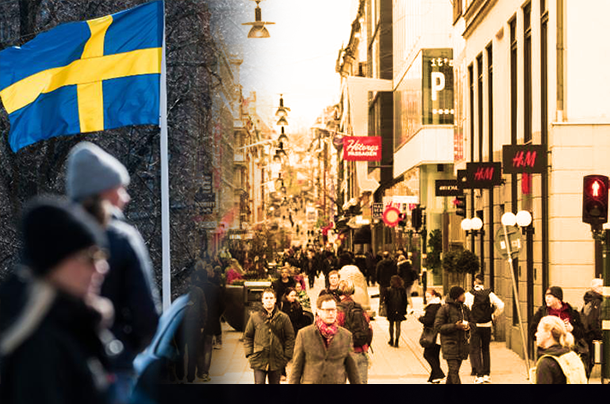
Why Sweden Has Already Won The Debate On COVID-19 “Lockdown” Policy

Why Sweden Has Already Won The Debate On COVID-19 “Lockdown” Policy

Authored by Patrick Henningson via 21stCenturyWire.com,

As Europe and North America continue suffering their steady economic and social decline as a direct result of imposing “lockdown” on their populations, other countries have taken a different approach to dealing with the coronavirus threat. You wouldn’t know it by listening to western politicians or mainstream media stenographers, there are also non-lockdown countries. They are led by Sweden, Iceland, Belarus, Japan, South Korea and Taiwan. Surprisingly to some, their results have been as good or better than the lockdown countries, but without having to endure the socio-economic chaos we are now witnessing across the world. For this reason alone, Sweden and others like them, have already won the policy debate, as well as the scientific one too.

Unlike much of the rest of the world who saw fit to unquestioningly follow China’s lead on everything from quarantining, to economic shutdowns, to contact tracing, and PCR mass testing, nonlockdown countries have instead opted for a somewhat lighter touch – preserving their economies and societies, and in doing so avoiding an endless daisy chain of new problems and obstacles deriving directly from the imposition of brutal lockdown policy.

On the European front, the Scandinavian country of Sweden is now garnering more attention than before, and has become an object of both criticism and fascination for those against or in favor of lockdown policy. While countries like the United States and Great Britain continue to top the global tables in terms of COVID-19 death tolls, Sweden has only suffered marginal casualties in comparison, while avoiding the intense strain on society and loss in public confidence which lockdown governments are now grappling with as they continue to push their populations to the limits of social stress and economic tolerance. You could say those governments are already careening over the edge by looking at the latest jobless figures coming out the US with 30 million new people filing for unemployment in the last few weeks.

Unlike many others, Sweden has not enforced any strict mass quarantine measures to contain COVID-19, nor has it closed any of its borders. Rather, Swedish health authorities have issued a series of guidelines for social distancing and other common sense measures covering areas like hygiene, travel, public gatherings, and protecting the elderly and immune compromised. They have kept all preschools, primary and secondary schools open, while closing college and universities who are now doing their work and lectures online. Likewise, many bars and restaurants have remained open, and shoppers do not have to perform the bizarre ritual of queuing around the block standing 2 meters apart in order to buy groceries.

According to the country’s top scientists, they are now well underway to achieving natural herd immunity. It seems this particular Nordic model has already won the debate.

Because Sweden decided to follow real epidemiological science and pursue a common sense strategy of herd immunity, it doesn’t need to “flatten of the curve” because its strategic approach has the added benefit of achieving a much more gradual and wider spread.

Anders Tegnell, Sweden’s government advisor for epidemiology explains, “We are all trying to keep the spread of this disease as low as possible, mainly to prevent our healthcare system from being overstretched, but we have not gone for the complete lockdown. We have managed to keep the number of cases low enough so the intensive care units have kept working and there has always been 20 per cent beds empty and enough protective equipment, even in Stockholm, where there has been a huge stress on healthcare. So in that way the strategy has worked.”

Similarly, it doesn’t have the deal with the newest “crisis” obstacle which lockdown states seem to be using as an excuse not to reopen society and the economy, which the fear of a “second peak” which governments are telling the public will wreak havoc on the nation by “infecting the vulnerable” and will “overwhelm the health services” if everything is suddenly reopened and social isolation and distancing is relaxed.

This catch-22 which countries like the US and UK are caught in is predicated on the belief that the coronavirus might suddenly unleash itself again on the populace. Certainly, there could be a second surge, but it should be noted that this is also a direct result of the decision to impose lockdown in the first place. According to top epidemiologist Dr Knut Wikkowski, the decision to lockdown only delayed the inevitable for countries like the US and UK, and quite possibly made the COVID-19 problem even worse than it would have previously been in the short to midterm, but in the long-term the results would be relatively the same proportionally in term of human casualties.

The penny should have really dropped after it was revealed two weeks ago by Oxford Professor Carl Heneghan, Director for Centre for Evidence-Based Medicine, that the peak of the UK’s coronavirus “crisis” actually came a full week before Boris Johnson initiated lockdown on March 23rd.

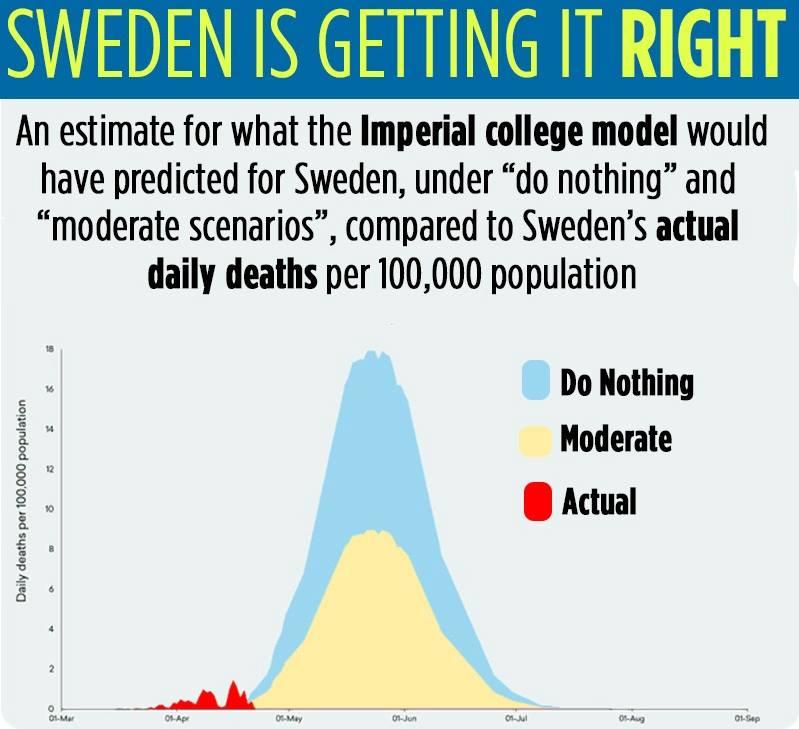
In fact, if you plug in Sweden’s actual data into Neil Ferguson’s own infamous computer model which sent the UK government into mass-panic mode, here’s what you would get:

The numbers don’t lie, but statistics can be made to tell any story the narrator wants, especially when the storyteller is government. Just look at the last 50 years of announcements regarding unemployment and inflation levels. One thing we should have learned by now is that government will never let things like facts and real science get in the way of a slow motion train wreck in progress, hence you can see some UK officials still clinging to Ferguson’s initial prediction as some sort of “proof” that the lockdown was necessary to avoid “mass death.”

Outside of popular supposition and media talking points, there is no scientific study which shows that lockdown saved any significant number of lives. Instead, new data strongly suggests quite the opposite.

The Ribbing of Sweden

As western lockdown countries drift further and further into an economic and social purgatory, non-lockdown countries like Sweden seem to be the target of bad-natured criticism by western media punditry. This seems to be out of spite more than anything, as some journalists are sensing defeat after they had thrown their lot in with draconian lockdown policy early on, unquestioningly backing their governments’ one-size-fits-all approach to emergency management, once again invoking the TINA (There Is No Alternative) principle which history shows often precedes most man-made calamities from World War I, the Iraq War in 2003, to the 2008 Wall Street Bail Out.

Nonetheless, the media and political pressure has been almost relentless on Sweden for not complying with the west’s “lockdown consensus.”

The country has also been roundly criticized by some 2,300 academics who piled on scorn upon it in a letter posted in March demanding the government change course and immediately head for lockdown.

However, the country has held off, and has since won endorsements from a number of eminent academics and professionals, like Professor Heneghan who hailed Sweden for “holding its nerve,” in the face of such public condemnation. That steadfastness seems to finally be paying dividends now, as some western mainstream media outlets, and even the UN itself, are acknowledging their comparable success. The New York Post begrudgingly acknowledged that Sweden received praise from the high chair of global public health at the World Health Organization (WHO), now lauded it as a “model” for overcoming the coronavirus crisis.

Dr. Micheal Ryan, WHO head of emergency management said, “What it has done differently is it has very much relied on its relationship with its citizenry and the ability and willingness of its citizens to implement self-distancing and self-regulate.”

He added, “In that sense, they have implemented public policy through that partnership with the population …. I think if we are to reach a new normal, Sweden represents a model if we wish to get back to a society in which we don’t have lockdowns.”

So according to WHO, it is Sweden which could be the new normal – and not the reactionary medieval quarantine policies favored by other states. Is WHO really making an argument against obsessive social isolation, and collective economic suicide? Such words from WHO should, in theory, be reassuring to those stuck in their lockdown death spirals. But many in the west are still convinced of the TINA principle, even if their next door neighbor has chosen a short and more practical route through the eye of the storm.

More than anything, this conundrum speaks to the relationship between people and their governments. Indeed, it is the social contract between government and its citizens which forms the core of the country’s policy formation. The idea that the choice of lockdown policy is a straight trade-off between lives and economy is a false dichotomy which ignores many concomitant variables and factors which are at play.

“I don’t think it was in terms of economy versus a health of people. I think it was a broader concern about the social fabric in general,” said Lars Trägårdh, professor of history and civil society studies at Ersta Sköndal University College.

“It is wonderful that we have retained the amount of freedoms that we have here ….Who would have thought, you know, that Swedish social democracy would be in bed with American right-wing libertarians? Not me,” remarked Trägårdh.

Professor Cecilia Soderberg-Naucler from Sweden’s Karolinska Institute explained why the state was duty-bound to take the direction it did. “We must establish control over the situation, we cannot head into a situation where we get complete chaos. No one has tried this route, so why should we test it first in Sweden, without informed consent?” said Soderberg-Naucler.

This concept of people talking responsibility for their actions and for public well-being is actually enshrined in Sweden’s constitution. This means that the state does not have to threaten and abuse its citizens for things like not observing social distancing and buying ‘non essential items’ when out shopping, or meeting in small groups – as some governments are doing. Swedes know the risks and observe government guidelines accordingly. They also acknowledge that humans are not perfect and won’t use police and courts to punish citizens if they are not following guidelines to the letter – as is the case in many lockdown countries. In lockdown countries, the bad blood between the public and government will not evaporate after the ‘crisis’ is over, which is a real problem which lockdown governments will continue facing in the future.

Still, New York Post had to include the caveat that Sweden was something of a pariah state for “controversially refused restrictions.” The propaganda war could be seen in the paper’s subtle wordsmithing, where editors even went so far as to change their headline from “WHO lauds Sweden as ‘model’ in coronavirus fight for resisting lockdown,” to a slightly more incendiary “WHO lauds lockdown-ignoring Sweden as a ‘model’ for countries going forward”

Swedish critics are quick to point out how poorly it’s doing compared to its Scandinavian neighbors, Denmark, Norway and Finland. They do this by pointing to the new global bible of public policy – the World-o-Meter coronavirus running totals – which for some people is now the end all and be all which it comes to declaring how really, really bad things are, and will continue to be (because that meter just keeps on running).

As of today, Sweden, which has a population of roughly 10.5 million, has recorded 21,092 cases and 2,586 fatalities from COVID-19, that’s roughly 256 deaths per million people.

By contrast, its southern neighbor Denmark which has a population of 5.8 million has recorded 9,1058 cases and 452 fatalities, roughly 78 deaths per million persons.  Norway is similar population at 5.4 million, and has recorded 7,738 cases and 210 deaths, that’s 39 deaths per million. Finland has a population of 5.5 million confirmed just 4,995 cases and 211 deaths, with 38 deaths per million.

Critics of Sweden have all seized upon these differences in order to condemn their government for being “irresponsible” and “playing Russian roulette” with their citizens’ lives. If one didn’t know better from all the hysterical rhetoric, you’d think there was an impending genocide happening there. While these sort of polemic arguments seem to work in the narrow band of reality that are social media threads, the reality is that after scaling up its neighbors’ results to be in line with Sweden’s larger population which is roughly twice their size, the difference is statistically insignificant for a country of 10.5 million. They are basically arguing that when comparing Sweden to its neighbor Denmark, that a proportional difference of approximately 1,500 fatalities warrants Sweden closing all its schools and shutting down its entire economy and suffer all the chaos ill effects that goes with that course of action.

To put things in even more perspective, while Sweden has already suffered  2,586 COVID deaths in 2020, back in 2018 there were approximately 6,997 total respiratory disease deaths in Sweden – and the country’s healthcare capacity was not overrun, nor were any of their public systems stretched to breaking point.

It’s a ridiculous argument on its face, and yet, this is the line of thinking which seems to permeate through lockdown countries desperate to justify their own fatal policy decision.

It’s not a discussion for faint hearts, but this has been a reality for nations since time immemorial who have faced war, plagues and pandemics. There is no perfect answer, but there are practical answers that take utilitarianism into account.

Fear of the ‘Second Wave’

In what can only be described as a macabre display of bad faith, exasperated naysayers from lockdown countries seem to almost eager to see Sweden fall victim to the dreaded “second wave” which many Britons and Americans insist is a fait accompli, as their political leaders and science “experts” keep telling them. The threat of a “second wave” is certainly being used by some governments to justify an increasingly unpopular lockdown policy, but also lends itself to the preferences of Bill Gates who has been publicly advocating an open-ended lockdown arrangement until such a time that salvation will arrive in the form of a vaccine for the coronavirus. But even the most optimistic scenario would be somewhere between 18 months and two years, which begs the question of whether democracies and their economies can survive such an extended period of tumult. That’s a scenario which no one can realistically endorse, and yet it’s given prime time by mainstream media outlets who have been keen of offer-up the Gates plan as another TINA solution to the “pandemic.” Besides the obvious civilizational problems with the Gates global lock-up plan, it chronically ignores the fact that there are non-lockdown countries like Sweden who never opted into the west’s collective self-destruction pact.

Not everyone is on board with the inevitability of a “second wave” which the American and British government keeps insisting is coming if lockdown is lifted too early. Renowned Scottish microbiologist Professor Hugh Pennington is not convinced, saying that such a second peak is unlikely. “No, I’m not sure where this ‘second peak’ idea comes from,” says Pennington.

Still, Prof. Pennington seemed miffed as to where Boris Johnson’s government is getting its science from. “I know where it comes from, it comes from flu. Because when we have a flu pandemic we always get a second peak, and sometimes we get a third peak …. Now, why we should get one with this virus, I don’t quite understand …. It just seems to be a phenomenon with flu, and I don’t see any reason myself, and I haven’t seen any evidence to support the idea that there would be a second peak of the virus.”

According to other experts, one of the fundamental problem with lockdown policy favored by the US, UK other European countries, is that it was never evidence-based, or “guided by the science.” Quite the opposite in fact. Rather, it was a political decision, undertaken by politicians. Never in history has a country enacted such a universal measure which quarantines the healthy as well as the sick and infirmed. This also flies in the face of hundreds of years of epidemiological science and epidemic policy, and eschews the entire concept of natural herd immunity.

Again, the pragmatic approach would have been to protect those most directly effected by COVID-19 which is overwhelmingly the elderly and those in palliative care – a policy which would eventually bring a population herd immunity as a natural by-product of that policy. That’s been the approach taken by Sweden and other states, and according to numerous experts in the field, it makes sense on both an epidemiological level and well as a social and economic level.

In a recent interview with Radio 5, leading Swedish epidemiologist, Dr. Johan Gieseck, remarked how the UK had initially proposed the same plan as Sweden, but then Boris Johnson came under intense pressure from the media and opposition after the arrival of Imperial College’s notorious “500,000 dead” paper presented to the government by Prof. Neil Ferguson. As a result, UK officials quickly changed course in a “180 degree U-turn,” said Gieseck, who was shocked how an unpublished paper relying on computer models and with no peer review – could have played such a crucial role in altering such an important policy decision. How did that happen? One only has to look at the obvious nexus of funding between the UK government, Imperial College and the Gates Foundation to get a possible answer to that question.

The real question in all of this should be: who and what is driving western governments’ disastrous lockdown policy? After reviewing the evidence, we can rule out one possibility: it’s certainly not the science.

Listen to Johan Giesecke’s recent interview here on “Why Lockdowns Are The Wrong Policy.”


Tyler Durden

Sun, 05/03/2020 – 07:00

via ZeroHedge News https://ift.tt/3caZx7S Tyler Durden

What It’s Like To Be a Rational Optimist in a Pandemic

Matt Ridley is one of the best-selling—and best-regarded—science and economics writers on the planet. He wrote recently that in the face of the coronavirus pandemic “we are about to find out how robust civilisation is” and that “the hardships ahead will be like nothing we have ever known.” Given that Ridley’s best-known book is 2010’s The Rational Optimist, those dire words caught some of his fans by surprise.

Ridley’s next book, How Innovation Works: And Why It Flourishes in Freedom (Harper), will be published in May. It touches on many questions now of acute interest, including how to set the stage for major breakthroughs in medicine and technology. Innovation, the book argues, “cannot be modelled properly by economists, but it can easily be discouraged by politicians.”

In late March, Reason‘s Nick Gillespie spoke with Ridley via Skype from their respective self-quarantines in New York and Northumberland, England. They discussed the political response to COVID-19, Ridley’s longstanding distrust of viruses and bats, and when we’ll be able to reopen the world economy.

Reason: You are the rational optimist. But when the coronavirus hit North America and Europe, you wrote a couple of pieces that were striking to me because of the pessimism involved. You talked about how you thought we would never be faced with something like this. Can you explain how the emergence of this pandemic has shaken some of your beliefs about progress?

Ridley: Well, the first thing I should say is that I’ve never believed that the world is the best of all possible worlds and can’t be improved—you know, that we’ve already reached nirvana. One of the things I’m very clear about in The Rational Optimist is there are still problems to be solved. There are still threats. There are still risks. I personally think we’ve been worrying about the wrong risks, and this is a reminder that we have been doing that. But I’ll hold my hands up and say I was not out there saying, “Watch out. There’s a pandemic coming.” I wish I had been.

But back in 1999, I was asked to write a short book about the future of disease, and I did say in that if we do have a pandemic that goes crazy—that combines high contagiousness with high lethality—then it will be a virus, not a protozoan or a bacteria. We’re on top of those enemies pretty well. It’s not going to be like the plague or like malaria. We’re too good at beating those big organisms. It’s the tiny ones, the viruses, that we’re still pretty bad at.

I also said it’s gonna be a respiratory virus. Why? Just look around you: People are coughing and sputtering all the time. There are up to 200 different kinds of respiratory viruses that we give each other every winter. We call them the common cold or flu. Some of them are rhinoviruses, some of them are coronaviruses. So there’s clearly something pretty irresistible to the virus tribe about the urban human population.

And the third thing I said was that it might come out of bats. I said that because a whole bunch of relatively new diseases have come out of bats in recent decades. And in fact, that’s been even more true since I said that, because [the 2003 outbreak of] SARS was after I made that remark. The reason is because bats are mammals like us, and it’s relatively easy for a virus to jump from a mammal to a mammal. Bats are animals that live in huge crowds—in huge densities. There’s a cave in Texas that has a famous bat roost in it. It has roughly the population of Mexico City living in that cave. So respiratory viruses are going to enjoy bats, and they’re going to enjoy humans, and there’s going to be a crossover between them.

We didn’t learn from SARS, which was a really good canary in the coal mine—a very clear warning that these wet wildlife markets in China were a dangerous place for crossover between species. That’s because the animals are alive in the markets. The problem is not bringing meat to market. The problem is bringing live animals that are coughing and sputtering. We had a dry run with a virus that wasn’t very contagious, but it was very dangerous: SARS. We should have said, “Look, this is a real threat.”

I had taken some comfort from the degree of improvement in molecular biological knowledge. The fact that we could sequence SARS in three months or something—that felt electric-fast. Because 20 years ago we hadn’t sequenced a single virus. So [with SARS], we’d read its recipe. We knew its defects. We knew how to attack it, in theory. And I had sort of vaguely in the back of my mind assumed that vaccine production would speed up as well.

We sequenced [the new coronavirus] in days. It’s almost instantaneous. But it turns out, as I now realize reading up, that vaccine development is about as slow as it was 20 years ago. I read something recently about how the whooping cough vaccine was developed in four years flat in the 1930s by two very remarkable American women. Four years is not that much longer than it’s probably going to take us to find a vaccine to this. So we have left the door unguarded, in one respect. We’ve let obstacles get in the way of the development of vaccines.

So we assume that this all started at a wet market in China. It was clear to observers, health officials and whatnot, that something was going on. We know the Chinese government is going to lie about how great they are. But what were the fundamental missteps in the United States and the United Kingdom when it came to containing this? 

One of the lessons is that countries like South Korea were better prepared. And that was partly because of SARS. They got more of a fright from SARS in Asia than we did in the West, and so they set up this system of “contact tracing” based on extensive testing that they were geared up for in a way that we weren’t. Both in the U.K. and the U.S., we were very slow to ramp up testing for the virus. And testing turned out to be crucial. That’s one lesson.

The other lesson is we relied too much on the World Health Organization, and I think it has very serious questions to answer after this. If you look at what it was saying in January—it was repeating untrue Chinese claims that this virus was not transmissible human to human, and it was praising China to the skies, and it was ignoring whistleblowers in Taiwan and elsewhere. These are questions that need to be looked into, because I think if the World Health Organization had run the flag up in January, we all might have reacted a bit quicker.

Would you say that South Korea, Taiwan, and Singapore have been exemplary in their response to the coronavirus?

On the whole? Yes. What South Korea did was it tracked it—tested lots of people and found out who they’d been in contact with. It issued each of them with an app so that they could go back through their records and find out who they came close to, which is pretty remarkable. There turned out to be one superspreader who had gone to a church and met a huge number of people. Tracking down his contacts proved vital. So yes, I do think that track and trace is the technique that’s gonna work in the absence of antivirals and vaccines and so on.

Because what’s particularly dangerous about this virus, as I read it, is that it is highly contagious in the very first few days of infection. Whereas with SARS it’s about eight days before you infect someone else, with COVID-19, it’s about four days. And quite a lot of this transmission is happening from people who are symptom-free. Young people seem to get a very, very mild version. They don’t even think there’s anything wrong with them. That is a very dangerous feature.

I’ll add one other way in which my country in particular was not ready for this, or I myself was not ready for this: In January, we were obsessed with Brexit. None of us could pay attention to anything else. I mean, that doesn’t excuse us being caught out in February, but it does excuse us perhaps not being aware of things in January. And of course that’s true of every country. America was obsessed with the presidential campaign—

And impeachment. 

Yeah.

On the one hand, you’re interested in questions of public health and science. On the other, you’re a big defender of individual freedom. It’s in the subtitle of your forthcoming book, How Innovation Works: And Why It Flourishes in Freedom. Is there a necessary tension between public health, as it was practiced in a country like South Korea or a country like Taiwan, and the freedom that we take for granted in the West?

Yes, there is. We’re seeing that very clearly. Not just in terms of what you might call the technology of tracing people, but also in terms of the police state that we are now living in, where we’ve got policemen arresting people for going on unnecessary walks. That’s one of the worrying things about this. But what I would say is, yes, I’m afraid it is necessary to be pretty draconian when you’re in the middle of a pandemic, as it was during the plague in centuries past. If you want to avoid that, then you need to unleash the freedom to innovate, to solve the problem, in good times.

Where I think we’ve been mistaken is we’ve made it very hard for people to bring forward medical devices, vaccines, drugs, etc., partly because of safety regulations, but partly because of just bureaucratic growth. I have this statistic in my book: How long does it take to get a license for use for a medical device on average? It’s like 20 months in America, and it’s something like 17 months in Germany. It takes too long to decide whether a new hip joint or a new ventilator or a new kind of personal protective equipment is safe.

The result of that, of course, is invisible, because you’re deterring people from going into these fields. You’re deterring people from inventing and innovating in this area. So you can’t point to it and say, “Show me the product that we could have licensed a bit quicker.” The point was he never brought it forward, because he looked at how dysfunctional this market was and stayed away, and so it never got developed. That’s one of the issues we have to learn is [the importance of] freedom to innovate.

But there is a tension. I’m not the perfect libertarian. I’m not someone who says that in the middle of a dangerous pandemic, the state should have no power to shut down society. On the other hand, we can have an argument about whether we are to some extent overreacting.

What is the role of dissent in a pandemic? Everybody, with the exception of very doctrinaire anarchists, is going to say, “You know what, when there is a genuine emergency, different rules apply.” There are a lot of conspiracy theories about how this disease actually was grown in a Chinese government lab as some kind of bioweapon. Toby Young, the British writer who works at Quillette, was talking about how we’re simply wrong to shut down the economy, because when you look at it from a strictly economic point of view, the recession we’re causing is actually going to kill more people. In the United States, the Food and Drug Administration and the Centers for Disease Control and Prevention keep going back and forth about whether or not it’s a good idea for people to wear masks when they go outside. What is the role of dissent, of pushback against authority, in a moment like this? 

I personally think there’s no reason to shut down debate at a moment like this. Quite the reverse, actually. I think that what this is showing us is there is no monopoly on wisdom. Nobody knows exactly what the right answer is. It’s possible that we are overreacting. At the beginning, I thought we probably were, because I’d seen so many busted flushes. So many wolves had come along, and we’d cried wolf, and it wasn’t a wolf: bird flu, swine flu, SARS, MERS, Ebola. Ebola was a wolf for people in Africa, but it wasn’t for the rest of the world. It’s right to have that debate about whether or not this is a real threat.

It’s also right to have a debate about what the prognoses are, because there’s been a dangerous tendency in this country—I don’t know whether it’s true to the same extent in the U.S.—to believe the models, to put them on a pedestal. Imperial College came out with a model saying that up to half a million people might die [in the U.K.] unless we brought in much more draconian restrictions on people’s freedoms. And that caused them to bring forward the lockdown of the economy. Now, that model is not unchallengeable. It’s got some very unhappy assumptions in it. And it was immediately challenged by another model from Oxford University—which I think went far too far in the other direction and put some crazy assumptions in about how quickly we’d get this under control. But that has reminded us that models are just that: They are models. They’re not scripture.

And that, by the way, is a lesson for the climate change debate, where models have been deified to much too great a degree. But we’ll leave that on one side for the moment.

So I don’t want to stop anybody coming out with an article saying, “here’s my evidence why the Chinese invented it,” or “here’s my evidence why it’s easily cured with this crack here that I’ve got made out of dandelions, brewed at midnight under the full moon.” Let a thousand flowers bloom in this. Let everybody say what they want. But let them produce their evidence, and let them put up with a bit of criticism if their evidence is bad.

In the case of the idea that it’s a Chinese bioweapon, I’ve seen very good molecular biological evidence that that is extremely implausible. So I don’t object to the theory being advanced, but I don’t think anyone should object to it being severely criticized too.

Some people found your take on the coronavirus to be credible because of your history of skepticism. Your willingness to publicly discuss what you’re thinking and how the evidence has changed your mind helped them take this virus more seriously. 

Certainly as somebody who has pooh-poohed alarmism about many different things, from the population explosion through to climate change…I’m all for debunking scares. So for me, as someone who’s almost a professional debunker of scares, to come out and say, “This one is quite scary, and we just need to take it seriously,” has made some of my friends stop and think.

What are the markers that go into figuring out where we are, if what we’re doing is working, and when we can start to reopen things? 

Short answer: I don’t know. I haven’t got a model, and even if I did, I wouldn’t believe it, because it’ll depend on assumptions.

What we don’t really know, in my view, is which measures are working best. Was closing the schools a good idea or a bad idea, because it sent kids back to stay with their grandparents, and the grandparents are at more risk?

The way I see it developing is that we will get better at curing people who get it. Hydroxychloroquine and things like that may be helpful. Or the way in which just simply laying patients on their fronts, not their backs, when you’re ventilating them apparently is helping. So we’re going to get a little better at saving lives. We’re going to ramp up the capacity for hospitalization, [the number of] ventilators and so on. We’re going to improve the testing over the next few weeks so that we’re going to get better at contact tracing. And once we’ve done that, we can start to lift these restrictions, because when it does flare up, we can quickly track down who’s at risk and put them under lock and key, rather than the whole of society. Eventually we’ll get to the point where the only people who have gotta be really careful are the very vulnerable, and the rest of us can get on with a relatively normal life.

Now, will that happen in April? I doubt it. Will it happen in May? I hope so. Will it happen in June? I jolly well think so, ’cause I think that’s the point where we have to start to take Toby Young’s arithmetic very seriously and say, “Sorry, we’re killing more people by leaving them locked up with abusive partners, alone and in danger of committing suicide, workless and unable to feed themselves properly, more prone to take drugs and alcohol,” whatever it might be. There’s a whole bunch of things that’ll be going wrong with society because of this lockdown.

There are good things about this—sorry, that’s not the right word. There are no good things about it, but there are less bad things. The big one is that it does not kill children. Influenza was quite good at killing kids. Smallpox was lethal among children. We’re incredibly lucky in that respect. But of course that has contributed to the young feeling somewhat invulnerable, and that’s made it harder for them to take seriously the restrictions on movement.

We’ve been talking mostly about the public health interventions. What about the economic responses? The federal government just passed the single largest spending bill in U.S. history. What are the types of responses, consistent with limited government, that are likely to work, and what are the ones that are likely to do more damage? I mean, we’re still digging out of the bailouts from the financial crisis 12 years ago. 

Yeah, I think the U.K. paid off its last debt from the Napoleonic Wars just a few years ago. There is no doubt that when you hugely increase the scope of government, it tends not to retreat as fast as you would like. Britain didn’t end [World War II–era] food rationing until something like 1954. And the argument was always, “There are some people at the bottom of society who might not be able to afford food.” Well, it turned out the reason they couldn’t afford food was because food was being rationed, and so the supply wasn’t responding to demand in the same way, and so the price wasn’t coming down. Do you see what I mean? It was a sort of circular argument.

There is a real danger that what we’ve done is nationalized huge swaths of the economy. We will find it very hard to undo it. The moment you start to say, “We’ll no longer subsidize you for the fact that your business is struggling,” a lot of people will be saying, “I’m going to go bust if that happens!” On the other hand, the idea that the government steps in during this period because we think it’s temporary might be quite a reasonable one. In other words, if everyone was just to sort of say, “Right, I’m closing down my business overnight,” it would be harder to start the economy up again. But there’s got to be a degree of rethinking of how we run the economy in the wake of this. We can take a bit of a blank-slate approach. Things that we’ve said for years, “You can’t do that because there’s huge vested interests.”

Can you give us an example? 

Well, for a start, the [regulations] around product safety. Not all of them, obviously—we’ve got to have some. But it’s clear that if we can suddenly say, “let’s tear up these regulations in order to respond quickly [to the pandemic],” well then we shouldn’t be doing that anyway. These regulations are unnecessary. A lot of reporting requirements are about sending bits of paper from one person to another. It’s now being said, we don’t need to do that: “We don’t need to get that bit of paper from you. We’ll just get the grant out to you straight away.” A lot of the complication around taxes—it turns out to be much simpler to run a tax system than we thought. We need to have a real drains-up look at what we don’t need to do.

Likewise, we need to have a look at how we as individuals, not just government, run society. That’s things like videoconferencing, what you and I are doing right now. I’m gonna try and insist that I have an awful lot fewer face-to-face meetings and an awful lot more meetings of this kind, ’cause they’re generally efficient. And it turns out the technology has really advanced. Five or 10 years ago if we did this, we’d have dropouts, we’d have freeze-ups, there’d be all sorts of stuff that wouldn’t quite work. I remember trying to do a lecture to Texas about eight years ago, and there was a 10-minute delay—or maybe it was a two-minute delay. But it was paralytically difficult to do in those conditions.

A number of people I’ve spoken to say, “You know what? Our regular weekly meeting is happening at half the time now.”

This interview has been edited for style and clarity. For a podcast version, subscribe to The Reason Interview With Nick Gillespie.

from Latest – Reason.com https://ift.tt/3feI1BP
via IFTTT
What It’s Like To Be a Rational Optimist in a Pandemic

Matt Ridley is one of the best-selling—and best-regarded—science and economics writers on the planet. He wrote recently that in the face of the coronavirus pandemic “we are about to find out how robust civilisation is” and that “the hardships ahead will be like nothing we have ever known.” Given that Ridley’s best-known book is 2010’s The Rational Optimist, those dire words caught some of his fans by surprise.

Ridley’s next book, How Innovation Works: And Why It Flourishes in Freedom (Harper), will be published in May. It touches on many questions now of acute interest, including how to set the stage for major breakthroughs in medicine and technology. Innovation, the book argues, “cannot be modelled properly by economists, but it can easily be discouraged by politicians.”

In late March, Reason‘s Nick Gillespie spoke with Ridley via Skype from their respective self-quarantines in New York and Northumberland, England. They discussed the political response to COVID-19, Ridley’s longstanding distrust of viruses and bats, and when we’ll be able to reopen the world economy.

Reason: You are the rational optimist. But when the coronavirus hit North America and Europe, you wrote a couple of pieces that were striking to me because of the pessimism involved. You talked about how you thought we would never be faced with something like this. Can you explain how the emergence of this pandemic has shaken some of your beliefs about progress?

Ridley: Well, the first thing I should say is that I’ve never believed that the world is the best of all possible worlds and can’t be improved—you know, that we’ve already reached nirvana. One of the things I’m very clear about in The Rational Optimist is there are still problems to be solved. There are still threats. There are still risks. I personally think we’ve been worrying about the wrong risks, and this is a reminder that we have been doing that. But I’ll hold my hands up and say I was not out there saying, “Watch out. There’s a pandemic coming.” I wish I had been.

But back in 1999, I was asked to write a short book about the future of disease, and I did say in that if we do have a pandemic that goes crazy—that combines high contagiousness with high lethality—then it will be a virus, not a protozoan or a bacteria. We’re on top of those enemies pretty well. It’s not going to be like the plague or like malaria. We’re too good at beating those big organisms. It’s the tiny ones, the viruses, that we’re still pretty bad at.

I also said it’s gonna be a respiratory virus. Why? Just look around you: People are coughing and sputtering all the time. There are up to 200 different kinds of respiratory viruses that we give each other every winter. We call them the common cold or flu. Some of them are rhinoviruses, some of them are coronaviruses. So there’s clearly something pretty irresistible to the virus tribe about the urban human population.

And the third thing I said was that it might come out of bats. I said that because a whole bunch of relatively new diseases have come out of bats in recent decades. And in fact, that’s been even more true since I said that, because [the 2003 outbreak of] SARS was after I made that remark. The reason is because bats are mammals like us, and it’s relatively easy for a virus to jump from a mammal to a mammal. Bats are animals that live in huge crowds—in huge densities. There’s a cave in Texas that has a famous bat roost in it. It has roughly the population of Mexico City living in that cave. So respiratory viruses are going to enjoy bats, and they’re going to enjoy humans, and there’s going to be a crossover between them.

We didn’t learn from SARS, which was a really good canary in the coal mine—a very clear warning that these wet wildlife markets in China were a dangerous place for crossover between species. That’s because the animals are alive in the markets. The problem is not bringing meat to market. The problem is bringing live animals that are coughing and sputtering. We had a dry run with a virus that wasn’t very contagious, but it was very dangerous: SARS. We should have said, “Look, this is a real threat.”

I had taken some comfort from the degree of improvement in molecular biological knowledge. The fact that we could sequence SARS in three months or something—that felt electric-fast. Because 20 years ago we hadn’t sequenced a single virus. So [with SARS], we’d read its recipe. We knew its defects. We knew how to attack it, in theory. And I had sort of vaguely in the back of my mind assumed that vaccine production would speed up as well.

We sequenced [the new coronavirus] in days. It’s almost instantaneous. But it turns out, as I now realize reading up, that vaccine development is about as slow as it was 20 years ago. I read something recently about how the whooping cough vaccine was developed in four years flat in the 1930s by two very remarkable American women. Four years is not that much longer than it’s probably going to take us to find a vaccine to this. So we have left the door unguarded, in one respect. We’ve let obstacles get in the way of the development of vaccines.

So we assume that this all started at a wet market in China. It was clear to observers, health officials and whatnot, that something was going on. We know the Chinese government is going to lie about how great they are. But what were the fundamental missteps in the United States and the United Kingdom when it came to containing this? 

One of the lessons is that countries like South Korea were better prepared. And that was partly because of SARS. They got more of a fright from SARS in Asia than we did in the West, and so they set up this system of “contact tracing” based on extensive testing that they were geared up for in a way that we weren’t. Both in the U.K. and the U.S., we were very slow to ramp up testing for the virus. And testing turned out to be crucial. That’s one lesson.

The other lesson is we relied too much on the World Health Organization, and I think it has very serious questions to answer after this. If you look at what it was saying in January—it was repeating untrue Chinese claims that this virus was not transmissible human to human, and it was praising China to the skies, and it was ignoring whistleblowers in Taiwan and elsewhere. These are questions that need to be looked into, because I think if the World Health Organization had run the flag up in January, we all might have reacted a bit quicker.

Would you say that South Korea, Taiwan, and Singapore have been exemplary in their response to the coronavirus?

On the whole? Yes. What South Korea did was it tracked it—tested lots of people and found out who they’d been in contact with. It issued each of them with an app so that they could go back through their records and find out who they came close to, which is pretty remarkable. There turned out to be one superspreader who had gone to a church and met a huge number of people. Tracking down his contacts proved vital. So yes, I do think that track and trace is the technique that’s gonna work in the absence of antivirals and vaccines and so on.

Because what’s particularly dangerous about this virus, as I read it, is that it is highly contagious in the very first few days of infection. Whereas with SARS it’s about eight days before you infect someone else, with COVID-19, it’s about four days. And quite a lot of this transmission is happening from people who are symptom-free. Young people seem to get a very, very mild version. They don’t even think there’s anything wrong with them. That is a very dangerous feature.

I’ll add one other way in which my country in particular was not ready for this, or I myself was not ready for this: In January, we were obsessed with Brexit. None of us could pay attention to anything else. I mean, that doesn’t excuse us being caught out in February, but it does excuse us perhaps not being aware of things in January. And of course that’s true of every country. America was obsessed with the presidential campaign—

And impeachment. 

Yeah.

On the one hand, you’re interested in questions of public health and science. On the other, you’re a big defender of individual freedom. It’s in the subtitle of your forthcoming book, How Innovation Works: And Why It Flourishes in Freedom. Is there a necessary tension between public health, as it was practiced in a country like South Korea or a country like Taiwan, and the freedom that we take for granted in the West?

Yes, there is. We’re seeing that very clearly. Not just in terms of what you might call the technology of tracing people, but also in terms of the police state that we are now living in, where we’ve got policemen arresting people for going on unnecessary walks. That’s one of the worrying things about this. But what I would say is, yes, I’m afraid it is necessary to be pretty draconian when you’re in the middle of a pandemic, as it was during the plague in centuries past. If you want to avoid that, then you need to unleash the freedom to innovate, to solve the problem, in good times.

Where I think we’ve been mistaken is we’ve made it very hard for people to bring forward medical devices, vaccines, drugs, etc., partly because of safety regulations, but partly because of just bureaucratic growth. I have this statistic in my book: How long does it take to get a license for use for a medical device on average? It’s like 20 months in America, and it’s something like 17 months in Germany. It takes too long to decide whether a new hip joint or a new ventilator or a new kind of personal protective equipment is safe.

The result of that, of course, is invisible, because you’re deterring people from going into these fields. You’re deterring people from inventing and innovating in this area. So you can’t point to it and say, “Show me the product that we could have licensed a bit quicker.” The point was he never brought it forward, because he looked at how dysfunctional this market was and stayed away, and so it never got developed. That’s one of the issues we have to learn is [the importance of] freedom to innovate.

But there is a tension. I’m not the perfect libertarian. I’m not someone who says that in the middle of a dangerous pandemic, the state should have no power to shut down society. On the other hand, we can have an argument about whether we are to some extent overreacting.

What is the role of dissent in a pandemic? Everybody, with the exception of very doctrinaire anarchists, is going to say, “You know what, when there is a genuine emergency, different rules apply.” There are a lot of conspiracy theories about how this disease actually was grown in a Chinese government lab as some kind of bioweapon. Toby Young, the British writer who works at Quillette, was talking about how we’re simply wrong to shut down the economy, because when you look at it from a strictly economic point of view, the recession we’re causing is actually going to kill more people. In the United States, the Food and Drug Administration and the Centers for Disease Control and Prevention keep going back and forth about whether or not it’s a good idea for people to wear masks when they go outside. What is the role of dissent, of pushback against authority, in a moment like this? 

I personally think there’s no reason to shut down debate at a moment like this. Quite the reverse, actually. I think that what this is showing us is there is no monopoly on wisdom. Nobody knows exactly what the right answer is. It’s possible that we are overreacting. At the beginning, I thought we probably were, because I’d seen so many busted flushes. So many wolves had come along, and we’d cried wolf, and it wasn’t a wolf: bird flu, swine flu, SARS, MERS, Ebola. Ebola was a wolf for people in Africa, but it wasn’t for the rest of the world. It’s right to have that debate about whether or not this is a real threat.

It’s also right to have a debate about what the prognoses are, because there’s been a dangerous tendency in this country—I don’t know whether it’s true to the same extent in the U.S.—to believe the models, to put them on a pedestal. Imperial College came out with a model saying that up to half a million people might die [in the U.K.] unless we brought in much more draconian restrictions on people’s freedoms. And that caused them to bring forward the lockdown of the economy. Now, that model is not unchallengeable. It’s got some very unhappy assumptions in it. And it was immediately challenged by another model from Oxford University—which I think went far too far in the other direction and put some crazy assumptions in about how quickly we’d get this under control. But that has reminded us that models are just that: They are models. They’re not scripture.

And that, by the way, is a lesson for the climate change debate, where models have been deified to much too great a degree. But we’ll leave that on one side for the moment.

So I don’t want to stop anybody coming out with an article saying, “here’s my evidence why the Chinese invented it,” or “here’s my evidence why it’s easily cured with this crack here that I’ve got made out of dandelions, brewed at midnight under the full moon.” Let a thousand flowers bloom in this. Let everybody say what they want. But let them produce their evidence, and let them put up with a bit of criticism if their evidence is bad.

In the case of the idea that it’s a Chinese bioweapon, I’ve seen very good molecular biological evidence that that is extremely implausible. So I don’t object to the theory being advanced, but I don’t think anyone should object to it being severely criticized too.

Some people found your take on the coronavirus to be credible because of your history of skepticism. Your willingness to publicly discuss what you’re thinking and how the evidence has changed your mind helped them take this virus more seriously. 

Certainly as somebody who has pooh-poohed alarmism about many different things, from the population explosion through to climate change…I’m all for debunking scares. So for me, as someone who’s almost a professional debunker of scares, to come out and say, “This one is quite scary, and we just need to take it seriously,” has made some of my friends stop and think.

What are the markers that go into figuring out where we are, if what we’re doing is working, and when we can start to reopen things? 

Short answer: I don’t know. I haven’t got a model, and even if I did, I wouldn’t believe it, because it’ll depend on assumptions.

What we don’t really know, in my view, is which measures are working best. Was closing the schools a good idea or a bad idea, because it sent kids back to stay with their grandparents, and the grandparents are at more risk?

The way I see it developing is that we will get better at curing people who get it. Hydroxychloroquine and things like that may be helpful. Or the way in which just simply laying patients on their fronts, not their backs, when you’re ventilating them apparently is helping. So we’re going to get a little better at saving lives. We’re going to ramp up the capacity for hospitalization, [the number of] ventilators and so on. We’re going to improve the testing over the next few weeks so that we’re going to get better at contact tracing. And once we’ve done that, we can start to lift these restrictions, because when it does flare up, we can quickly track down who’s at risk and put them under lock and key, rather than the whole of society. Eventually we’ll get to the point where the only people who have gotta be really careful are the very vulnerable, and the rest of us can get on with a relatively normal life.

Now, will that happen in April? I doubt it. Will it happen in May? I hope so. Will it happen in June? I jolly well think so, ’cause I think that’s the point where we have to start to take Toby Young’s arithmetic very seriously and say, “Sorry, we’re killing more people by leaving them locked up with abusive partners, alone and in danger of committing suicide, workless and unable to feed themselves properly, more prone to take drugs and alcohol,” whatever it might be. There’s a whole bunch of things that’ll be going wrong with society because of this lockdown.

There are good things about this—sorry, that’s not the right word. There are no good things about it, but there are less bad things. The big one is that it does not kill children. Influenza was quite good at killing kids. Smallpox was lethal among children. We’re incredibly lucky in that respect. But of course that has contributed to the young feeling somewhat invulnerable, and that’s made it harder for them to take seriously the restrictions on movement.

We’ve been talking mostly about the public health interventions. What about the economic responses? The federal government just passed the single largest spending bill in U.S. history. What are the types of responses, consistent with limited government, that are likely to work, and what are the ones that are likely to do more damage? I mean, we’re still digging out of the bailouts from the financial crisis 12 years ago. 

Yeah, I think the U.K. paid off its last debt from the Napoleonic Wars just a few years ago. There is no doubt that when you hugely increase the scope of government, it tends not to retreat as fast as you would like. Britain didn’t end [World War II–era] food rationing until something like 1954. And the argument was always, “There are some people at the bottom of society who might not be able to afford food.” Well, it turned out the reason they couldn’t afford food was because food was being rationed, and so the supply wasn’t responding to demand in the same way, and so the price wasn’t coming down. Do you see what I mean? It was a sort of circular argument.

There is a real danger that what we’ve done is nationalized huge swaths of the economy. We will find it very hard to undo it. The moment you start to say, “We’ll no longer subsidize you for the fact that your business is struggling,” a lot of people will be saying, “I’m going to go bust if that happens!” On the other hand, the idea that the government steps in during this period because we think it’s temporary might be quite a reasonable one. In other words, if everyone was just to sort of say, “Right, I’m closing down my business overnight,” it would be harder to start the economy up again. But there’s got to be a degree of rethinking of how we run the economy in the wake of this. We can take a bit of a blank-slate approach. Things that we’ve said for years, “You can’t do that because there’s huge vested interests.”

Can you give us an example? 

Well, for a start, the [regulations] around product safety. Not all of them, obviously—we’ve got to have some. But it’s clear that if we can suddenly say, “let’s tear up these regulations in order to respond quickly [to the pandemic],” well then we shouldn’t be doing that anyway. These regulations are unnecessary. A lot of reporting requirements are about sending bits of paper from one person to another. It’s now being said, we don’t need to do that: “We don’t need to get that bit of paper from you. We’ll just get the grant out to you straight away.” A lot of the complication around taxes—it turns out to be much simpler to run a tax system than we thought. We need to have a real drains-up look at what we don’t need to do.

Likewise, we need to have a look at how we as individuals, not just government, run society. That’s things like videoconferencing, what you and I are doing right now. I’m gonna try and insist that I have an awful lot fewer face-to-face meetings and an awful lot more meetings of this kind, ’cause they’re generally efficient. And it turns out the technology has really advanced. Five or 10 years ago if we did this, we’d have dropouts, we’d have freeze-ups, there’d be all sorts of stuff that wouldn’t quite work. I remember trying to do a lecture to Texas about eight years ago, and there was a 10-minute delay—or maybe it was a two-minute delay. But it was paralytically difficult to do in those conditions.

A number of people I’ve spoken to say, “You know what? Our regular weekly meeting is happening at half the time now.”

This interview has been edited for style and clarity. For a podcast version, subscribe to The Reason Interview With Nick Gillespie.

from Latest – Reason.com https://ift.tt/3feI1BP
via IFTTT

How is the government to decide what meetings are “essential”?

Yesterday, a per curiam Sixth Circuit panel (Sutton, McKeague, and Nalbandian) decided Maryville Baptist Church v. Beshear. (Eugene blogged about it earlier.) This decision halted the Kentucky governor’s prohibition on “drive-in” church services. The Governor’s policy, the court found, violates the Kentucky Religious Freedom Restoration Act and the Free Exercise Clause. I commend this opinion on several levels.

First, the decision approaches this difficult issue with the sobriety and respect it deserves. There was no hyperbolic rhetoric or accusations of bad faith. Indeed, the Court credited the Governor with the presumption of regularity:

We don’t doubt the Governor’s sincerity in trying to do his level best to lessen the spread of the virus or his authority to protect the Commonwealth’s citizens.

The panel found that the Governor was doing his best to prevent the spread of an unprecedented epidemic.

Second, the court only decided issues that it needed to resolve. Specifically, it declined to resolve the validity of the in-person service ban:

The balance is more difficult when it comes to in-person services. Allowance for drive-in services this Sunday mitigates some harm to the congregants and the Church. In view of the fastmoving pace of this litigation and in view of the lack of additional input from the district court, whether of a fact-finding dimension or not, we are inclined not to extend the injunction to inperson services at this point. We realize that this falls short of everything the Church has asked for and much of what it wants. But that is all we are comfortable doing after the 24 hours the plaintiffs have given us with this case. In the near term, we urge the district court to prioritize resolution of the claims in view of the looming May 20 date and for the Governor and plaintiffs to consider acceptable alternatives. The breadth of the ban on religious services, together with a haven for numerous secular exceptions, should give pause to anyone who prizes religious freedom. But it’s not always easy to decide what is Caesar’s and what is God’s—and that’s assuredly true in the context of a pandemic.

The last sentence had a subtle, but effective reference to religion.

Third, the decision provides reasoned consideration that people of all persuasions and faiths can relate to. Consider this passage:

The Governor insists at the outset that there are “no exceptions at all.” Appellee Br. at 21. But that is word play. The orders allow “life-sustaining” operations and don’t include worship services in that definition. And many of the serial exemptions for secular activities pose comparable public health risks to worship services. For example: The exception for “life-sustaining” businesses allows law firms, laundromats, liquor stores, and gun shops to continue to operate so long as they follow social-distancing and other health-related precautions. R. 1-7 at 2–6. But the orders do not permit soul-sustaining group services of faith organizations, even if the groups adhere to all the public health guidelines required of essential services and even when they meet outdoors.

The contrast between “life-sustaining” and “soul-sustaining” is poetic and persuasive. This crystal-clear prose explains with precision why the government’s policy is internally inconsistent. (Though the unsigned decision is per curiam, I would bet anyone a buckeye this language came from Judge Sutton’s chambers). Why can some people meet in groups with social distancing, but not others? The government must make a subjective judgment about what is “essential” and what is not. For example, the Pennsylvania Governor determined that making marshmallow peeps was “life-sustaining” but selling firearms was not. (This policy was thankfully reversed.)

The Sixth Circuit tears apart Kentucky’s policy:

Assuming all of the same precautions are taken, why is it safe to wait in a car for a liquor store to open but dangerous to wait in a car to hear morning prayers? Why can someone safely walk down a grocery store aisle but not a pew? And why can someone safely interact with a brave delivery woman but not with a stoic minister? The Commonwealth has no good answers. While the law may take periodic naps during a pandemic, we will not let it sleep through one.

And why does the state trust some professions, but not the clergy to practice social distancing?

Keep in mind that the Church and Dr. Roberts do not seek to insulate themselves from the Commonwealth’s general public health guidelines. They simply wish to incorporate them into their worship services. They are willing to practice social distancing. They are willing to follow any hygiene requirements. They are not asking to share a chalice. The Governor has offered no good reason so far for refusing to trust the congregants who promise to use care in worship in just the same way it trusts accountants, lawyers, and laundromat workers to do the same. If any group fails, as assuredly some groups have failed in the past, the Governor is free to enforce the social distancing rules against them for that reason.

If people can congregate, elbow-to-elbow on an airplane, they should be able to do the same in a house of worship.

Moreover, the state cannot dictate alternatives that the house of worship can adopt.

Sure, the Church might use Zoom services or the like, as so many places of worship have decided to do over the last two months. But who is to say that every member of the congregation has access to the necessary technology to make that work? Or to say that every member of the congregation must see it as an adequate substitute for what it means when “two or three gather in my Name.” Matthew 18:20; see also On Fire Christian Ctr., Inc. v. Fischer, No. 3:20-CV-264- JRW, 2020 WL 1820249, at *7–8 (W.D. Ky. Apr. 11, 2020).

Not all faiths can use Zoom. Certain Jewish groups will not use electricity during the Sabbath and other holidays. It is simply impossible for them to live-stream a Passover seder or the Kol Nidre service during Yom Kippur. And there are some rituals that can only be performed with a quorum of ten, know as a minyan.

Marc DeGirolami provides the Catholic perspective at Mirror of Justice:

Consider religious observance. If one’s view is that all of the true goods of religious observance can be obtained individually, at home, in solitary prayer in front of a screen, then one will think that distinguishing between churches and liquor stores–treating the goods of the human activities that these places foster unequally–is perfectly justified. But if one’s view of the true goods of religious observance is very different, then one will not accept these arguments.

Marc also draws attention to a jarring video from Italy. A police officers interrupts a mass, and tells the priest to stop the service, and disperse his parishioners. At the time, there were 14 people, who were spaced out in a huge church. Marc relates that the government had re-opened certain businesses, including museums. But not churches.

The dialogue is in Italian, but you can follow along. The priest tells the officer, “All right, I’ll pay the fine, or whatever there is to pay.” The officer says people can watch the live-stream. The priest replies that his parishioners cannot receive communion online.

Zoom may be an answer to online education. But it is not a replacement for deeply held religious practices. Thankfully, laws like RFRA ensure that the government cannot substantially burden free exercise, even if it acts with purported neutrality. I hedge, slightly, because often a policy of neutrality is premised on a secular understanding of what is “life-sustaining” and what is “soul-sustaining.” For many Americans, what is “soul-sustaining” is “life-sustaining.” A house of worship is far more essential than a liquor store.

from Latest – Reason.com https://ift.tt/3f6ULKC
via IFTTT

How is the government to decide what meetings are “essential”?

Yesterday, a per curiam Sixth Circuit panel (Sutton, McKeague, and Nalbandian) decided Maryville Baptist Church v. Beshear. (Eugene blogged about it earlier.) This decision halted the Kentucky governor’s prohibition on “drive-in” church services. The Governor’s policy, the court found, violates the Kentucky Religious Freedom Restoration Act and the Free Exercise Clause. I commend this opinion on several levels.

First, the decision approaches this difficult issue with the sobriety and respect it deserves. There was no hyperbolic rhetoric or accusations of bad faith. Indeed, the Court credited the Governor with the presumption of regularity:

We don’t doubt the Governor’s sincerity in trying to do his level best to lessen the spread of the virus or his authority to protect the Commonwealth’s citizens.

The panel found that the Governor was doing his best to prevent the spread of an unprecedented epidemic.

Second, the court only decided issues that it needed to resolve. Specifically, it declined to resolve the validity of the in-person service ban:

The balance is more difficult when it comes to in-person services. Allowance for drive-in services this Sunday mitigates some harm to the congregants and the Church. In view of the fastmoving pace of this litigation and in view of the lack of additional input from the district court, whether of a fact-finding dimension or not, we are inclined not to extend the injunction to inperson services at this point. We realize that this falls short of everything the Church has asked for and much of what it wants. But that is all we are comfortable doing after the 24 hours the plaintiffs have given us with this case. In the near term, we urge the district court to prioritize resolution of the claims in view of the looming May 20 date and for the Governor and plaintiffs to consider acceptable alternatives. The breadth of the ban on religious services, together with a haven for numerous secular exceptions, should give pause to anyone who prizes religious freedom. But it’s not always easy to decide what is Caesar’s and what is God’s—and that’s assuredly true in the context of a pandemic.

The last sentence had a subtle, but effective reference to religion.

Third, the decision provides reasoned consideration that people of all persuasions and faiths can relate to. Consider this passage:

The Governor insists at the outset that there are “no exceptions at all.” Appellee Br. at 21. But that is word play. The orders allow “life-sustaining” operations and don’t include worship services in that definition. And many of the serial exemptions for secular activities pose comparable public health risks to worship services. For example: The exception for “life-sustaining” businesses allows law firms, laundromats, liquor stores, and gun shops to continue to operate so long as they follow social-distancing and other health-related precautions. R. 1-7 at 2–6. But the orders do not permit soul-sustaining group services of faith organizations, even if the groups adhere to all the public health guidelines required of essential services and even when they meet outdoors.

The contrast between “life-sustaining” and “soul-sustaining” is poetic and persuasive. This crystal-clear prose explains with precision why the government’s policy is internally inconsistent. (Though the unsigned decision is per curiam, I would bet anyone a buckeye this language came from Judge Sutton’s chambers). Why can some people meet in groups with social distancing, but not others? The government must make a subjective judgment about what is “essential” and what is not. For example, the Pennsylvania Governor determined that making marshmallow peeps was “life-sustaining” but selling firearms was not. (This policy was thankfully reversed.)

The Sixth Circuit tears apart Kentucky’s policy:

Assuming all of the same precautions are taken, why is it safe to wait in a car for a liquor store to open but dangerous to wait in a car to hear morning prayers? Why can someone safely walk down a grocery store aisle but not a pew? And why can someone safely interact with a brave delivery woman but not with a stoic minister? The Commonwealth has no good answers. While the law may take periodic naps during a pandemic, we will not let it sleep through one.

And why does the state trust some professions, but not the clergy to practice social distancing?

Keep in mind that the Church and Dr. Roberts do not seek to insulate themselves from the Commonwealth’s general public health guidelines. They simply wish to incorporate them into their worship services. They are willing to practice social distancing. They are willing to follow any hygiene requirements. They are not asking to share a chalice. The Governor has offered no good reason so far for refusing to trust the congregants who promise to use care in worship in just the same way it trusts accountants, lawyers, and laundromat workers to do the same. If any group fails, as assuredly some groups have failed in the past, the Governor is free to enforce the social distancing rules against them for that reason.

If people can congregate, elbow-to-elbow on an airplane, they should be able to do the same in a house of worship.

Moreover, the state cannot dictate alternatives that the house of worship can adopt.

Sure, the Church might use Zoom services or the like, as so many places of worship have decided to do over the last two months. But who is to say that every member of the congregation has access to the necessary technology to make that work? Or to say that every member of the congregation must see it as an adequate substitute for what it means when “two or three gather in my Name.” Matthew 18:20; see also On Fire Christian Ctr., Inc. v. Fischer, No. 3:20-CV-264- JRW, 2020 WL 1820249, at *7–8 (W.D. Ky. Apr. 11, 2020).

Not all faiths can use Zoom. Certain Jewish groups will not use electricity during the Sabbath and other holidays. It is simply impossible for them to live-stream a Passover seder or the Kol Nidre service during Yom Kippur. And there are some rituals that can only be performed with a quorum of ten, know as a minyan.

Co-blogger Marc DeGirolami provides the Catholic perspective at Mirror of Justice:

Consider religious observance. If one’s view is that all of the true goods of religious observance can be obtained individually, at home, in solitary prayer in front of a screen, then one will think that distinguishing between churches and liquor stores–treating the goods of the human activities that these places foster unequally–is perfectly justified. But if one’s view of the true goods of religious observance is very different, then one will not accept these arguments.

Marc also draws attention to a jarring video from Italy. A police officers interrupts a mass, and tells the priest to stop the service, and disperse his parishioners. At the time, there were 14 people, who were spaced out in a huge church. Marc relates that the government had re-opened certain businesses, including museums. But not churches.

The dialogue is in Italian, but you can follow along. The priest tells the officer, “All right, I’ll pay the fine, or whatever there is to pay.” The officer says people can watch the live-stream. The priest replies that his parishioners cannot receive communion online.

Zoom may be an answer to online education. But it is not a replacement for deeply held religious practices. Thankfully, laws like RFRA ensure that the government cannot substantially burden free exercise, even if it acts with purported neutrality. I hedge, slightly, because often a policy of neutrality is premised on a secular understanding of what is “life-sustaining” and what is “soul-sustaining.” For many Americans, what is “soul-sustaining” is “life-sustaining.” A house of worship is far more essential than a liquor store.

from Latest – Reason.com https://ift.tt/3f6ULKC
via IFTTT

China’s Exploiting The COVID-19 Pandemic To Expand In Asia

China's Exploiting The COVID-19 Pandemic To Expand In Asia

Authored by Con Coughlin via The Gatestone Institute,

While the rest of the world is preoccupied with tackling the coronavirus pandemic, China is intensifying its efforts to extend its influence in the South China Sea by intimidating its Asian neighbours.

The arrival of China’s Liaoning aircraft carrier, together with five accompanying warships, in the South China Sea earlier this month has resulted in a significant increase in tensions in the Asia-Pacific region as Beijing seeks to take advantage of the coronavirus pandemic to flex its muscles.

So far in April, there were claims that a Chinese coast guard vessel deliberately rammed and sank a Vietnamese fishing boat operating close to the disputed Paracel Islands. All the fishermen survived and were transferred to two other Vietnamese fishing vessels operating nearby.

The incident prompted a furious response from the Vietnamese government, which accused Beijing of violating its sovereignty and threatening the lives of its fishermen. The US State Department said it was “seriously concerned” about the incident and called on Beijing “to remain focused on supporting international efforts to combat the global pandemic, and to stop exploiting the distraction or vulnerability of other states to expand its unlawful claims in the South China Sea.”

In other incidents, Chinese vessels have been accused of harassing Indonesian fishing boats, as well as tailing Malaysian oil-exploration boats.

At the same time, China has provoked a diplomatic dispute with the Philippines following Beijing’s declaration that a region over which Manila claims sovereignty in the South China Sea is Chinese territory.

The dispute concerns China’s recent announcement that it intends to administer two disputed groups of islands and reefs in the waterway. One district covers the Paracel Islands, and the other has jurisdiction over the Spratlys, where China has built a network of fortified man-made islands. The Philippines has a presence of its own on at least nine islands and islets in the area, and bitterly opposes Chinese attempts to extend its influence.

Beijing has long claimed control over the South China Sea and the surrounding area because of its strategic significance as one of the world’s busiest waterways. Around one third of the world’s shipping passes through it and carries trade worth around $3 trillion. In addition, the waters contain lucrative fisheries, and huge oil and gas reserves are believed to lie beneath its seabed.

China’s gradual encroachment on the area has been resisted by other countries in the region such as Vietnam, the Philippines, Taiwan, Malaysia and Brunei, which all have competing claims of their own.

As the region’s dominant power, China has shown little interest in seeking to resolve these conflicting claims peacefully. Instead, it has resorted to brute force, using its increasingly powerful navy to assert its dominance by harassing the shipping of rival states, even, at times, in their own territorial waters.

China’s increasingly aggressive action, known in Beijing as “Wolf Warrior diplomacy”, has prompted US Secretary of State Mike Pompeo to warn that China is taking advantage of the world’s preoccupation with the coronavirus pandemic to push its territorial ambitions in the South China Sea. At a recent briefing to foreign ministers of the 10-member Association of Southeast Asian Nations (ASEAN), Mr Pompeo stated:

“Beijing has moved to take advantage of the distraction [over Covid-19], from China’s new unilateral announcement of administrative districts over disputed islands and maritime areas in the South China Sea, its sinking of a Vietnamese fishing vessel earlier this month, and its ‘research stations’ on Fiery Cross Reef and Subi Reef.”

Despite the Trump administration’s preoccupation with tackling the coronavirus pandemic, Washington is not prepared to tolerate China’s aggressive actions. Three ships from the US Seventh Fleet, together with an Australian frigate, have responded by sailing through the disputed waters in a show of force.

China’s communist leadership may believe that they can take advantage of the coronavirus pandemic to bully their Asian neighbours. But this show of force by the US Navy should send a timely reminder to Beijing as to which country is the real military power in the region.


Tyler Durden

Sat, 05/02/2020 – 23:50

via ZeroHedge News https://ift.tt/3c34uzK Tyler Durden

These Are The 10 Most Expensive (And Cheapest) Cities In The World

These Are The 10 Most Expensive (And Cheapest) Cities In The World

Where personal wealth is concerned, there are two sides to every story.

The first of which is the amount of money a person earns, and the other is what they choose to spend their money on. As Visual Capitalist’s Katie Jones notes, the latter is influenced by the cost of living in the city where they reside – an ever-changing metric that is driven by a wide variety of factors, such as currency, population growth, or external market movements.

Today’s graphic visualizes the findings from the 2020 Worldwide Cost of Living report and uses data from 133 cities to rank the most expensive cities in the world.

Note: Report research was conducted towards the end of 2019, before the COVID-19 outbreak.

Asia Dominates the Ranking

Globally, the cost of living has fallen by an average of 4% over the last year, with much of the movement up and down the ranking being driven by currency fluctuations.

The locations with the highest cost of living are largely split between Europe and Asia. For the second time in the report’s 30-year history, three cities are tied as the top spot—Singapore, Hong Kong, and Osaka.

Source: EIU. New York City is index baseline (score = 100). Ties in index score values are denoted by (t).

Osaka is a newcomer to the top spot, climbing four places over the last year to join cost of living heavyweight champions, Singapore and Hong Kong. As Japan’s third-largest city, Osaka is a major financial hub and a breeding ground for emerging startups, with relatively low real estate costs compared to Singapore and Hong Kong.

Three European cities (Paris, Zurich, and Geneva) sit atop the most expensive city rankings, compared to seven cities only 10 years ago. Similarly, 31 of the 37 European cities have seen a decrease in cost of living overall—largely as a result of the Euro or local currencies losing value relative to the U.S. dollar.

Finally, the top 10 is rounded out with two cities from the United States (New York, Los Angeles) and one from Israel (Tel Aviv).

The Cheapest Cities

While East Asia is home to many of the world’s most expensive cities, South Asia hosts the largest grouping of cities with the lowest cost of living.

Source: EIU. New York City is index baseline (score = 100). Ties in index score values are denoted by (t).

Three Indian cities dominate the cheapest cities ranking due to a combination of low wages and high levels of income inequality, preventing any price increases.

Meanwhile, political and economic turmoil is a common denominator among the cheapest cities outside of South Asia. For example, the Syrian Civil War resulted in an economic collapse, leading to high inflation and a downward spiral in value for the Syrian pound.

A Spanner in the Works

The COVID-19 pandemic is estimated to cost the global economy up to $2 trillion in 2020, so while governments attempt to boost the economy, many are concerned about higher inflation rates spreading across the world.

With a recession becoming more likely, uncertainty around real estate prices will heighten for every city, regardless of their cost of living ranking.

As we navigate chaotic and uncertain times, the next cost of living survey could look very different to today—the most important question will be how permanent the damaging effects of the pandemic will be.


Tyler Durden

Sat, 05/02/2020 – 23:25

via ZeroHedge News https://ift.tt/2WiDyWc Tyler Durden

Johnstone: Biden Is Everything The Democrats Are

Johnstone: Biden Is Everything The Democrats Are

Authored by Caitlin Johnstone via Medium.com,

Joe Biden is not an “imperfect candidate” for the Democrats.

He is the perfect candidate, because he’s everything the party is: Demented. Decrepit. Bloodthirsty. Corrupt. Cronyistic. Authoritarian. Reactionary. Rapey.

He is exactly what they deserve. He is exactly what they are.

Joe Biden is the Democrat’s Democrat. He is the perfect representative of the party. They should even take it a step further and replace that donkey with Joe Biden.

Biden is to the Democrats as Trump is to the Republicans. Everyone’s just wearing their true face now.

~

If you’re willing to sacrifice all principles, all sanity and all morality to get rid of Trump, what exactly is the point of getting rid of Trump?

~

We know Biden is a liar. He’s been pinged for lying his whole career. Everyone is trying to undermine the victim’s character in order to discredit her while ignoring Joe’s character. We know he lies. He also has a history of unwanted sexual advances. His story is not credible.

~

Nobody actually believes that Biden didn’t sexually assault Tara Reade. Nobody’s actually confident that Creepy Uncle Hair Sniffer isn’t a rapist, they’re just pretending they are. I can understand saying “It’s possible but unproven”, but saying it’s false is so gross and dishonest.

They’re accusing Reade of lying for partisan reasons, when in reality that’s exactly what they are doing: they’re pretending they believe Handsy Joe Biden is incapable of shoving his fingers into a woman without her consent, and they are lying. Out of pure partisan loyalty.

~

It’s funny how refusing to support a literal dementia patient who has been credibly accused of rape for the world’s most powerful elected office is a very, very normal thing to do, yet people are acting like it’s bizarre and freakish.

~

Which looks more likely to you? (A) That Reade seeded a bunch of vicious lies about Senator Joe Biden in the 1990s with the intention of someday sabotaging his presidential bid in the distant future for some reason, or (B) that a powerful man sexually assaulted a woman?

~

It’s so weird how Joe Biden is a spent piece of leftover 1970s beltway flotsam made of plastic donor class dinner parties and AIPAC lobbying but everyone’s all pretending they like him as a person and stuff.

~

There are no fact-based and intellectually robust arguments for working within the establishment to manifest revolutionary agendas, but there are a lot of highly effective intellectually dishonest arguments for why it’s okay for you to pretend otherwise and go back to sleep.

~

“They destroyed the economy over a virus, but the narrative about the virus is completely fake!”

Perhaps. But so is the narrative about “the economy”.

~

Terence McKenna once said “We are led by the least among us. The least intelligent, the least noble, the least visionary.” Can’t think of a better illustration of this than having Donald Trump versus Joe Biden competing for the most powerful elected office on the planet.

~

Hey remember when Trump provoked a missile retaliation that led to scores of injured US soldiers by assassinating Iran’s top military commander for no legitimate reason, lied about the whole thing, and then suffered no consequences or political repercussions of any kind? Good times.

~

Democrats are so fucking stupid and ridiculous that the Krassenstein brothers are still a thing.

~

All of humanity’s worst atrocities have been legal. Genocide. Slavery. Torture. The fact that you can squint at the imprisonment and extradition of a journalist for exposing US war crimes in such a way that makes it look “legal” does not mean it isn’t unforgivably evil.

~

It’s always about power. Power comes before everything, including profit, which is why you see escalations against nations who’d be very profitable to continue trading with and why critics of US foreign policy are attacked far more aggressively than critics of its domestic policy.

Manipulators understand that wealth control is a means to power and not an end in itself; that’s why you see things like Zuckerberg hurting his own profit margins by making changes to Facebook which make the platform less fun to use but shore up establishment narrative control.

Power trumps profit every time. Manipulators are driven ultimately by the desire to control as many humans as possible to the greatest extent possible. Money is a useful tool for accomplishing that, but in a pinch they’ll swap it out for military/police force or censorship etc.

Wealth is a narrative construct and can be gained or lost or made obsolete in a new narrative paradigm. Elite manipulators understand that it’s hard, nonconceptual control over hard, nonconceptual objects that gives them their actual alpha status over the rest of the humans.

~

“A newly democratized media environment has made it difficult for people to distinguish fact from fiction.”

‘Oh no! What do we do?’

“Censor everyone except authoritative news sources.”

‘Authoritative news sources? Like who?’

“The ones who lied about Russiagate and all the wars.”

~

As a general rule, indie media should not attack other indie media. If you’re not punching up, you’re punching down.

~

People ask me “Well, what should we do? How do we fix this thing?” And of course my only possible answer is, “Do what I’m doing! Or your version of it.” Of course I’m doing the thing I think we should do to solve the problems of our species. Why would I be doing anything else?

~

Revolution is an inside job. This is not an egoically pleasing fact, but it is a fact. It’s much more fun for egoic mind to believe both the problem and the solution exists in other people, but in reality the changes you can make in yourself will have far greater effects on the world.

There are vast, vast depths within all of us, and we are capable of making vast, vast changes to those depths. We are in fact far more capable of doing this than we are of changing the outside world through force of will. And interestingly when we do this, we do change the world. And we do it far more efficaciously than we can by trying to will it to conform with the noises in our babbling thinky brain.

*  *  *

Thanks for reading! The best way to get around the internet censors and make sure you see the stuff I publish is to subscribe to the mailing list for my website, which will get you an email notification for everything I publish. My work is entirely reader-supported, so if you enjoyed this piece please consider sharing it around, liking me on Facebook, following my antics onTwitter, checking out my podcast on either YoutubesoundcloudApple podcasts or Spotify, following me on Steemit, throwing some money into my hat on Patreon or Paypal, purchasing some of my sweet merchandise, buying my books Rogue Nation: Psychonautical Adventures With Caitlin Johnstone and Woke: A Field Guide for Utopia Preppers. For more info on who I am, where I stand, and what I’m trying to do with this platform, click here. Everyone, racist platforms excluded, has my permission to republish, use or translate any part of this work (or anything else I’ve written) in any way they like free of charge.

Bitcoin donations:1Ac7PCQXoQoLA9Sh8fhAgiU3PHA2EX5Zm2


Tyler Durden

Sat, 05/02/2020 – 23:00

via ZeroHedge News https://ift.tt/2KUuDEV Tyler Durden