Putin Says Worst Of Russia’s Virus-Induced Recession Over As Recovery Nears Tyler Durden
Thu, 08/27/2020 – 19:25
President Vladimir Putin spoke with Rossiya 24 TV channel, transcribed by RT News, on Thursday, indicating the worst of the virus-indued recession is over for the Russian economy.
“We believe the peak of our problems has passed, and I hope we will gradually begin to recover,” Putin said. “We are not much different from other countries in the world – I think our recovery will be secured next year.”
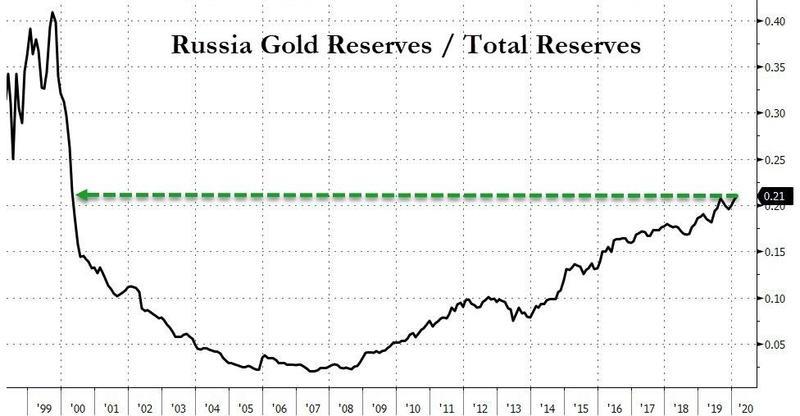
Putin said the country’s macroeconomic backdrop is stable following a deep plunge in economic activity earlier this year due to coronavirus lockdowns. He said low inflation levels and increasing gold reserves had put the national economy on a pathway towards recovery.
Putin reiterated, as he did in June (see: “Putin Says US Social Unrest Show “Deep-Seated Internal Crises”), his government’s quick response effort to contain the virus has been much better than the US. He noted then, that President Trump’s poor handling of the pandemic and social unrest signaled “deep-seated internal crises” in the West.
Just weeks ago, Putin unveiled the world’s first approved COVID-19 vaccine. However, safety and efficacy data of the drug has yet to be released. A vaccine widely available in the country could accelerate recovery in 2021.
Putin pointed out Russia continues to boost precious metals purchases and increase FX reserves to $590 billion.
“This creates an additional safety cushion … It’s not a panacea for all ills, but it is important,” he said, adding that the holdings allow the government to fund budgets and fulfill social obligations.
The Russian economy is expected to contract eight percent this year. Putin said the plunge won’t be as bad at that, expected to fall around five and six percent range.
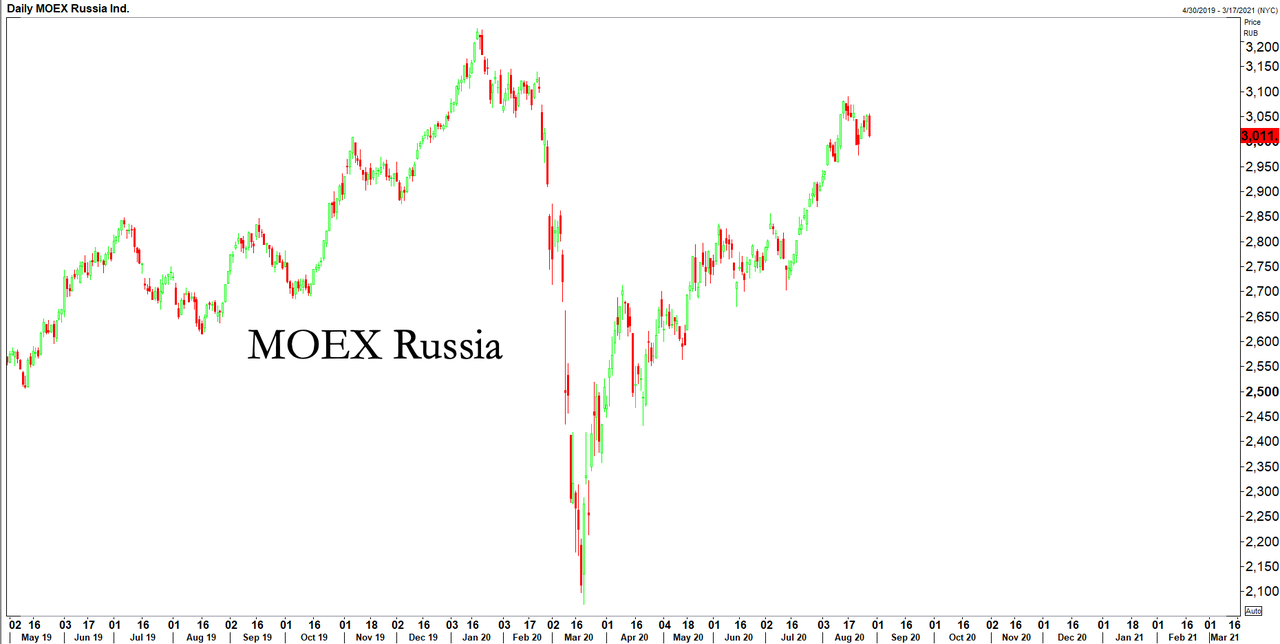
Recovery hopes in Russia were seen in a recent Reuters poll, with respondents revealing the MOEX stock index could hit new highs in 2021.
As for the US, facing a double-recession with continued depressionary unemployment, along with no end to the virus pandemic insight, a recovery could be several years away.
via ZeroHedge News https://ift.tt/32BxFpY Tyler Durden
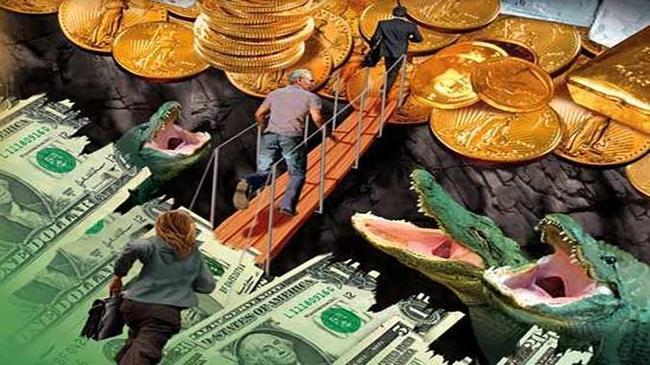
As the Federal Reserve’s quantitative easing practices generate the biggest debt bubble in history, gold futures are trading at record highs, a phenomenon some have called “a bit of a mystery.”
However, this “mystery” was solved long ago by the laws of economics. The only “mystery” here is why—contrary to centuries of economic wisdom—we allowed centralized paper money to become the dominant form of currency in the first place.
As recent waves of civil unrest and economic turmoil have prompted some to look back in time and reflect on the observations of the Founding Fathers, it seems most have opted to reject them entirely.
Yet among the founders’ many warnings against the institutions that would eventually dominate the modern world are the timeless—and astonishingly accurate—warnings against central banking.
On August 1, 1787, George Washington wrote in a letter to Thomas Jefferson that “paper currency [can] ruin commerce, oppress the honest, and open the door to every species of fraud and injustice.” Jefferson also opposed the concept, warning that “banking establishments are more dangerous than standing armies.” James Madison called paper money “unjust,” recognizing that it allowed the government to confiscate and redistribute property through inflation: “It affects the rights of property as much as taking away equal value in land.”
In other words, inflation is a hidden form of taxation. Washington understood this. Jefferson understood this. Madison understood this. And generations of preeminent economists since then—from Ludwig von Mises to F.A. Hayek, to Murray Rothbard—have understood this quite clearly.
And there’s nothing controversial or mysterious about sound money, that is, currency backed by some form of secure, fixed weight commodity like gold or silver. Both have been valued in some fashion for six thousand years and have been used as currency for around twenty-six hundred years. As confidence in the dollar continues to nosedive, the market is not only putting more confidence in gold and silver, but in some cryptocurrencies sharing many of the characteristics of gold.
The presidencies of Woodrow Wilson and Franklin D. Roosevelt are rightfully regarded as some of the darkest years for freedom in America. Often overlooked, however, are the deeply repressive monetary policies introduced by both presidents. In 1838, Senator John C. Calhoun foreshadowed the economic evils that would eventually emerge at the peak of the Progressive Era, explaining,
“It is the nature of stimulus…to excite first, and then depress afterwards….Nothing is more stimulating than an expanding and depreciating currency. It creates a delusive appearance of prosperity, which puts everything in motion. Everyone feels as if he was growing richer as prices rise.”
Seventy-five years later, the autocrats running the Wilson administration dealt two devastating blows to liberty with the Federal Reserve Act and the Revenue Act, forever marking 1913 as a tragic year for liberty. Both laws struck at the heart of property rights by establishing the Federal Reserve System and the income tax, respectively. Then, in 1933, Roosevelt issued Executive Order No. 6102, requiring Americans to surrender much of their gold to the US government. Shortly after, Congress passed the Gold Reserve Act of 1934, artificially raising the price of gold and guaranteeing the government a profit of $14.33 for each ounce of gold it had seized from the people.
Finally, in 1971, President Richard Nixon—like any self-respecting twentieth-century Keynesian—committed himself to finishing the work of Wilson and Roosevelt by closing the gold window, forever divorcing the gold standard from the dollar. Rather than usher in a new era of economic stability, this unnatural union between the Fed and the federal government produced a vicious loop of boom-bust cycles and depressions. The consequences have not only been inflation and devaluation (both of which have stripped the people of their purchasing power and savings); now, every time a depression hits, the government is allowed to do two things: grow its power and tax and spend at will without fear of accountability.
In other words, with every inflation of currency comes an inflation of government power.
With government shutdowns of local economies, the second economic quarter of this year was among the worst in history, with the total debt-to-GDP reaching a staggering 136 percent. As the national debt approaches $27 trillion (with even bigger spending bills in the works), we can expect the days of such flagrant government spending to come to a screeching halt. If we continue on this path, that correction will result in an unprecedented collapse of the dollar and the monetary system. The ultimate danger in this scenario: the government eventually confiscates the vast majority or even all private property in order to pay off the national debt. As German American economist Hans Sennholz once said, “Government debt is a government claim against personal income and private property—an unpaid tax bill.”
This is why a dramatic downsizing of government is key to bringing the US out of this manic, outmoded cycle of depressions and upswings. For the government to fulfill its core function as a safeguard of liberty, we must prevent it from meddling in affairs beyond the boundaries prescribed by the Founding Fathers. This includes a swift withdrawal from the use of paper fiat currency and spending cuts across the board.
Such a sweeping transformation could begin with the state governments, the legislatures of which could override the federal government by passing legislation allowing individuals to use gold and silver currency.
Regardless, if meaningful legislative action is not taken somewhere, we have little choice other than to acquiesce to the gloom and terror of socialism—a system that would devour all in its path and make slaves of once free people for generations to come. Freedom is the natural ability of people to control their own destiny. Sound money has the ability to help keep people free.
via ZeroHedge News https://ift.tt/2EyHSLR Tyler Durden
Over 100 Former John McCain Staffers Endorse Biden, Explicitly Because He’s Worse On War Tyler Durden
Thu, 08/27/2020 – 18:45
You can’t make this stuff up. The New York Times presents us with the only “respectable” option, given it’s all about “character” that can supposedly measure up to the national security state’s late great patriotic icon:
More than 100 former staff members for Senator John McCain are supporting Joseph R. Biden Jr., a show of support across the political divide that they hope amplifies the “Country First” credo of the former Arizona senator.
Many of the onetime McCain aides who signed the letter share his hawkish foreign policy views and recoil from Mr. Trump’s “America First” politics, which Mr. Salter called his “coddling of dictators or disinterest in our alliances.”
We should interject that in the late Senator McCain’s twisted Manichean worldview it was not at all “Country First” to begin with, more like “Which country to invade first?”
The list of signatories includes a range of people — from chiefs of staff in Mr. McCain’s Senate office to junior aides on his campaigns — who worked for him over his 35 years in Congress and during two presidential bids.
Mark Salter, Mr. McCain’s longtime chief aide and speechwriter, helped organize the letter.
“We have different views of Joe Biden and the Democratic Party platform — most of us will disagree with a fair amount of it — but we all agree that getting Donald Trump out of office is clearly in the national interest,” Salter said.
The Libertarian Institute’s Scott Horton summed it up best by noting sarcastically, John McCain’s staff just endorsed Biden, “explicitly because he’s worse on war” – meaning that the very thing that most common sense people long considered to be the worst thing about McCain and his legacy becomes a “virtue” in the eyes of his former staff and writers at the NY Times.
Look who’s glowingly proud:
“We believe we are acting in accord with John McCain’s charge to put “country first” when we urge Americans to elect former vice president Biden and Sen. Harris the next president and vice president of the United States.” https://t.co/k7mLOuNeTb
Got that? “Country First” means world empire and endless war; while on the contrary, “America First” means world empire and endless war at the hands of someone who whines about it sometimes.
The Connecticut Supreme Court has had some interesting debates in past years about the First Amendment “fighting words” exception (e.g., State v. Baccala (Conn. 2017)and State v. Parnoff (Conn. 2018)). Today’s State v. Liebenguth unsurprisingly holds that saying “fucking niggers” to a black person—apparently referring to that person—is punishable fighting words, even when the words don’t lead to a fight, and when they are said to a government enforcement official (but perhaps not when they are said to a police officer).
Michael McCargo, a New Canaan parking enforcement officer, had put a $15 ticket to David Liebenguth; Liebenguth then came up to McCargo (perhaps in part because McCargo’s vehicle was still blocking Liebenguth’s car).
“… McCargo testified that the defendant’s demeanor then ‘escalated,’ with the defendant [having said] that the parking authority was ‘[fucking] [un]believable’ and [having told] McCargo that he had given him a parking ticket ‘because my car is white…. [N]o, [you gave] me a ticket because I’m white.’ As the defendant, who is white, spoke with McCargo, who is African-American, he ‘flared’ his hands and added special emphasis to the profanity he uttered. Even so, according to McCargo, the defendant always remained a ‘respectable’ distance from him. Finally, as the defendant was walking away from McCargo toward his own vehicle, he spoke the words, ‘remember Ferguson.'”
McCargo also testified that, “[a]fter both men had returned to and reentered their vehicles, McCargo, whose window was rolled down … thought he heard the defendant say the words, ‘fucking niggers’ [twice]. This caused him to believe that the defendant’s prior comment about Ferguson had been made in reference to the then recent [and highly publicized] shooting of an African-American man by a white police officer in Ferguson, Missouri [on August 9, 2014, approximately three weeks earlier]. [McCargo] thus believed that the [defendant’s reference to Ferguson was a ‘threat’] meant to imply that what had happened in Ferguson ‘was going to happen’ to him.”
The court concluded that this was indeed fighting words—face-to-face insults that had a tendency to lead to a fight. The strongest argument for defendant, I think, relied on the Baccala precedent; here is what the court said in response:
[T]he relevant facts of Baccala … are as follows. “On the evening of September 30, 2013, the defendant [Nina C. Baccala] telephoned the Stop & Shop supermarket in Vernon to announce that she was coming to pick up a Western Union money transfer so they would not close the customer service desk before she arrived…. [Baccala] spoke with Tara Freeman, an experienced assistant store manager … [who] informed [Baccala] that the customer service desk already had closed… [Baccala] became belligerent, responded that she ‘really didn’t give a shit,’ and called Freeman ‘[p]retty much every swear word you can think of’ before the call was terminated….
“… [A] few minutes after she telephoned, [Baccala] arrived at the supermarket, which was occupied by customers and employees…. [After some further disagreement,] ‘[Baccala] proceeded to loudly call Freeman a ‘fat ugly bitch’ and a ‘cunt,’ and said ‘fuck you, you’re not a manager,’ all while gesticulating with her cane…. Freeman remained professional. She simply responded, ‘[h]ave a good night,’ which prompted [Baccala] to leave the supermarket.’ …”
We began our analysis of Baccala’s claim with the observation that the language she used was both extremely offensive and intentionally demeaning. We nevertheless concluded that her utterances did not rise to the level of fighting words because, under the circumstances, they were not likely to trigger an immediate violent response by the average person in Freeman’s position. In reaching this conclusion, we relied primarily on four considerations relative to the circumstances of the encounter.
First, the verbal assault that Baccala launched against Freeman on the telephone placed Freeman on notice of the possibility that Baccala would resort to similar language when she arrived at the supermarket a few minutes later. Second, as a person in an “authoritative [position] of management and control,” Freeman would be expected to diffuse such a hostile situation by “model[ing] appropriate, responsive behavior, aimed at de-escalating the situation,” both for the sake of other customers and store personnel alike. Third, as a store manager, Freeman had a measure of control over the premises insofar as she could demand that Baccala leave if she became abusive, threaten to have Baccala arrested for trespassing if she didn’t leave, and follow through on that threat if necessary. Fourth, there was no reason to think that Freeman’s professional and restrained response to Baccala’s offensive harangue was atypical of the manner in which an average person in Freeman’s position would have responded to the same provocation under the same circumstances.
In the present case, the first three of the foregoing factors support the conclusion that the defendant’s utterances were, in fact, fighting words. In contrast to the notice Freeman had received with respect to the likelihood of an angry and offensive, face-to-face outburst by Baccala, McCargo had no forewarning of the verbal abuse that the defendant inflicted on him. Unlike Freeman, McCargo was not acting in a supervisory capacity with respect to the safety and well-being of others. Nor did he have any degree of control over the area in which his encounter with the defendant took place.
Only the fourth factor we considered in Baccala—the fact that Freeman did not resort to violence in responding to the verbal provocation she confronted—militates against a finding that the average person in the same situation as McCargo, who also refrained from any physical retaliation, likely would have had an immediate violent response to the defendant’s verbal attack. In Baccala, however, our conclusion that the response of the average supermarket manager in Freeman’s situation probably would be no different from Freeman’s necessarily was predicated on the existence of the first three factors discussed—none of which is present here. Moreover, in Baccala, we expressly acknowledged that we might have reached a different conclusion if Baccala had directed the same language at Freeman after Freeman had completed work and left the supermarket. Notably, that situation—in which Freeman would not have been acting in a managerial or supervisory capacity, had no real control over the relevant premises, and was more or less alone with Baccala—is much more like the circumstances McCargo found himself in when he was accosted by the defendant.
Finally, we agree with the observation that “[r]acial insults, relying as they do on the unalterable fact of the victim’s race and on the history of slavery and race discrimination in this country, have an even greater potential for harm than other insults.” R. Delgado, “Words That Wound: A Tort Action for Racial Insults, Epithets, and Name-Calling,” 17 Harv. C.R.-C.L. L. Rev. 133, 143 (1982); see id., 135–36 (explaining that such insult “injures the dignity and self-regard of the person to whom it is addressed, communicating the message that distinctions of race are distinctions of merit, dignity, status, and personhood”); see also Matusick v. Erie County Water Authority, 757 F.3d 31, 38 n.3 (2d Cir. 2014) (observing that word “nigger” has “unique … power to offend, insult, and belittle”); Toussaint v. Brigham & Women’s Hospital, Inc., 166 F. Supp. 3d 110, 116 n.4 (D. Mass. 2015) (“[t]he word ‘nigger’ has unique meaning that makes its use particularly egregious”). In light of the uniquely injurious and provocative nature of the term, we also agree that its use is all the more likely to engender the kind of violent reaction that distinguishes fighting words from the vast majority of words that, though also offensive and provocative, are nevertheless constitutionally protected.
And I think this makes sense: In determining whether a word is “fighting words,” courts have to consider whether the word is indeed likely to start a fight when used as a face-to-face insult—and the past of the word, as it affects present reactions to it, is surely relevant to that evaluation. I don’t think the court was trying to distinguish Baccala on this score; even taking into account the statistical reality that women are in general less likely than men to act violently, I think calling a woman a “cunt” may well lead to violence, and the court stressed that “in Baccala, we expressly acknowledged that we might have reached a different conclusion if Baccala had directed the same language at Freeman after Freeman had completed work and left the supermarket.”
The court also rejected the argument that words said to McCargo, as a public official, can’t be fighting words:
[T]he defendant argues that “a public official [such as McCargo] is expected to exercise a greater degree of self-restraint in the face of provocation than is a civilian.” To support this assertion, however, the defendant cites to cases involving offensive language directed at police officers … [e.g.,] “[t]hat’s fucked up, those pigs can’t do that[.]” [The court in that case] went on to explain that, “[a]long with good judgment, intelligence, alertness, and courage, the job of police officers requires a thick skin. Theirs is not a job for people whose feelings are easily hurt.”
Although we agree that police officers generally are expected to exercise greater restraint than the average citizen when confronted with offensive language or unruly conduct, McCargo was not a police officer, and his duties cannot fairly be characterized as similar to those of a police officer. Additionally, McCargo’s testimony concerning his five years of experience as a parking enforcement officer—testimony in which he explained that he never before had been on the receiving end of such hostile or offensive language or had ever reported a prior incident to the police—suggests that the abuse McCargo endured during his encounter with the defendant well exceeded that which someone in his position reasonably might be expected to face. Consequently, although we do agree with the Appellate Court that McCargo, like any parking enforcement official, undoubtedly was aware that some members of the public might well express frustration and even anger upon receiving a ticket, we disagree that the average African-American parking official would have been prepared for and responded peaceably to the kind of racial slurs, threatening innuendo, and aggressive behavior with which McCargo was confronted.
Justice Maria Araujo Kahn joined the majority, but also wrote separately to say that (1) she thinks the fighting words exception should be rejected, but (2) given its existence, these words qualify. Here’s part of her criticism of the exception:
The ultimate inquiry of the fighting words exception is whether a speaker’s words would reasonably result in a violent reaction by its intended recipient. Considering the stereotypes associated with immutable characteristics of the addressee, however, produces discriminatory results “because its application depends on assumptions about how likely a listener is to respond violently to speech.” W. Reilly, “Fighting the Fighting Words Standard: A Call for Its Destruction,” 52 Rutgers L. Rev. 947, 948 (2000). This approach essentially requires courts to promulgate stereotypes on the basis of race, gender, age, disability, ethnicity, and sexual orientation, among others, and has led to much of the scholarly criticism of the fighting words exception.
I will refrain from enumerating a laundry list of a stereotypes related to violent responses from which flow myriad discriminatory results, but I illustrate one example of a common refrain in society and courts: women are less likely than men to react to offensive situations with physical violence. Allowing such a stereotype into the analysis of whether a reasonable person in the addressee’s circumstances is likely to respond to words with violence creates a situation in which “almost nothing one could say to a woman would be proscribed by the fighting words doctrine ….”
The overarching result is that groups of people that, for example, are stereotyped as docile due to their gender or ethnicity, or who have physical limitations due to their age or disability that prevent them from responding violently—the precise groups that face persistent discrimination—must endure a higher level of offensive speech before being afforded legal remedies that comport with our constitution. From the speaker’s perspective, such a result allows him or her to more readily and viciously verbally assault certain oppressed groups without fear of criminal prosecution….
Justice Steven D. Ecker also joined, but suggested that (1) the fighting words exception should generally be rejected, but (2) perhaps should be replaced by an exception focused on
speech communicated publicly to an addressee, in a face-to-face encounter, using words or images that demean the addressee on the basis of his or her race, color, national origin, ethnicity, religion, gender, sexual orientation, disability, or like trait, and under circumstances indicating that the speaker intends thereby to cause the addressee severe psychic pain.
I think any such proposed exception would violate the principle of R.A.V. v. City of St. Paul; that case held that the government may not target bigoted fighting words for special punishment (though it may punish fighting words generally)—it’s hard to see how that’s consistent with a rule saying that the government must target only bigoted fighting words, if it wants to punish any such words. But perhaps Justice Ecker’s tentative proposal is implicitly calling for reversing R.A.V. on this score; and in any event, it is only one Justice’s opinion, not joined by another member of the court. (My personal view is that the shift Justice Ecker describes would improperly target certain words for punishment precisely because of the bigoted viewpoint they express, even when that’s a means for narrowing the existing fighting words exception.)
Incidentally, for those interested in the debate about whether it’s improper even to mention “nigger” (and perhaps other epithets) in discussion of the facts of cases, note that the three opinions in this case mentioned the word an aggregate of 52 times—even while condemning the defendant for using the word as an insult—and the Justices also said the word 6 times in oral argument. I agree with the Justices on this score; I think that when judges (or law professors or students or others) are discussing the facts of a case, they ought to discuss them candidly, and without expurgation.
from Latest – Reason.com https://ift.tt/3jmg24g
via IFTTT
Human beings are often terrible at foresight and generally learn hard lessons chiefly from failure. That has certainly been the case for the COVID-19 pandemic. Public health officials, politicians, and the public, by means of repeated policy failures, are still learning what works when it comes to mitigating the COVID-19 pandemic.
A partial list of initial failures in the U.S. includes underestimating the virulence of the pathogen by some public health officials; a massive bureaucratic screw-up by the Centers for Disease Control and Prevention (CDC) that delayed the rollout of diagnostic testing as the pandemic was taking off; the belief that airborne transmission was not a significant route of infection but instead the virus was chiefly passed along via direct contact with infected people and indirect contact with surfaces in the immediate environment; the early assertion that citizens didn’t need to wear face masks to protect themselves from infection; epidemiological models making worst-case projections of millions of COVID-19 deaths by assuming that people wouldn’t change their behaviors; the claim that the anti-malarial drug hydroxychloroquine was a “game changer” as a COVID-19 treatment; and a president who has doggedly insisted since February that the virus would miraculously fade or disappear soon.
So what has been learned over the past eight months? While conclusions are still preliminary, researchers now calculate that the COVID-19 coronavirus is about three times more contagious than seasonal flu; the availability of diagnostic testing in the U.S. has greatly improved but is still nowhere near where it needs to be; airborne transmission contributes significantly to the spread of the disease; when the background rate of infections is high the widespread adoption of face masks is an effective and very economically valuable method for stemming COVID-19 infections; when epidemiological models took into account actual changes in human behavior, their COVID-19 death projections declined steeply; and the Food and Drug Administration (FDA) has concluded that hydroxychloroquine is not a useful COVID-19 therapeutic. But what about President Donald Trump’s oft-repeated prediction that the virus will one day soon just disappear?
Epidemiological research suggests that COVID-19 will only fade away once the threshold for herd immunity is reached. Herd immunity is the resistance to the spread of a contagious disease that results if a sufficiently high proportion of a population is immune to the illness. Some people are still susceptible, but they are surrounded by immune individuals who serve as a barrier, preventing the microbes from reaching them. Herd immunity can be achieved via mass infection or mass vaccination. Epidemiologists estimate that the COVID-19 threshold for herd immunity is around 60 to 70 percent.
Some of Trump’s fans have recently been touting the idea that COVID-19 herd immunity is closer than initial epidemiological projections have suggested. I, too, have reported that very preliminary studies on unsuspected preexisting T-cell immunity to the coronavirus and speculative modeling results suggest that the effective herd immunity threshold may actually be close, at least, in some countries and some regions of the U.S. (In other words, the possibility of a lower herd immunity threshold is a lucky accident, not the result of presidential prescience.)
Now a new modeling study in the Proceedings of the National Academy of Sciences by a team of researchers associated with the University of Illinois at Urbana-Champaign suggests that the COVID-19 “heterogeneity-modified herd immunity” threshold has already been reached in some metropolitan areas of the U.S. Their model stands in contrast to many of the epidemiological models noted above that are based on the homogeneous assumption that basically every individual is equally liable to become infected and then to transmit their infection on to others.
The Illinois researchers define heterogeneity as the biological and social susceptibility of individual members of the population to COVID-19 viral infection. Biological heterogeneity takes into account differences in such factors as the strength of immune responses, genetics, age, and comorbidities. Social heterogeneity reflects variations in the number of close contacts that each individual has with different people. Basically the more social a person is, the more likely they are to get infected early in the epidemic and then become immune. The researchers combine biological and social heterogeneity to derive what they call an immunity factor.
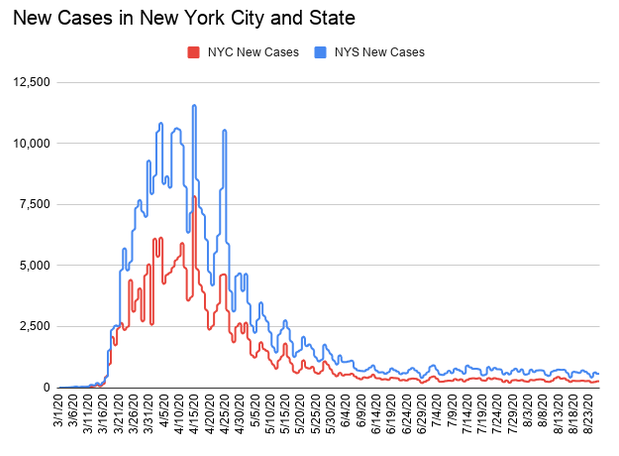
The team tests their model on real-world empirical data from hospitalizations, intensive care unit (ICU) occupancy and daily deaths from New York City and Chicago to figure out changes over time in the effective reproduction number for the virus in those cities. The effective reproduction number is the number of people to whom an individual can transmit infection at any specific time, and it changes as more of the population becomes immunized through either infection or vaccination. In addition, the effective reproduction number is affected by people’s behaviors such as social distancing and widespread mask-wearing.
Taking the effects of biological and social heterogeneity on COVID-19 transmissibility, the researchers calculate that the herd immunity threshold is likely somewhere between 20 and 30 percent of the population. According to recent reports, more than 20 percent of New York City residents have probably been infected with the coronavirus.
Seeking to see what might happen this fall, the researchers model possible outcomes of the second wave of the COVID-19 epidemic in New York City and Chicago. They consider what they call a “worst-case scenario” in which all current mitigation efforts are fully relaxed and bars, theaters, and restaurants open with negligible social distancing and mask-wearing. Their heterogeneity-modified model projects virtually no second wave of COVID-19 cases in New York City which indicates that herd immunity has likely been achieved there.
On the other hand, they calculate that Chicago has not passed the herd immunity threshold. Nevertheless, the effects of biological and social heterogeneity would still result in a substantial reduction of the magnitude of the second wave there, even under the worst-case scenario. The possible good news is that their results suggest “that the second wave can be completely eliminated in such medium-hit locations [as Chicago], if appropriate and economically mild mitigation measures are adopted, including e.g. mask wearing, contact tracing, and targeted limitation of potential super-spreading events, through limitations on indoor bars, dining and other venues.”
Based on data from late May, researchers also calculate that most states were then still far away from reaching their heterogeneity-modified herd immunity thresholds. However, this summer’s surge in COVID-19 cases may have brought some states closer to herd immunity. While the coronavirus may not just fade away, these calculations imply that the U.S. has a good chance to avoid a potentially disastrous second wave this fall if the public maintains reasonable social distancing and mask-wearing efforts.
from Latest – Reason.com https://ift.tt/2QybTOi
via IFTTT
Senior editor, Ash Bennington, hosts Tommy Thornton, founder of Hedge Fund Telemetry, to check the pulse of the market. Tommy discusses how frothy markets have seen price action heavily skewed by sentiment, and how, with companies withholding guidance for the year, investors are flying blind. He and Ash go over some of the tools Tommy utilizes to examine market trends and momentum, explore how short sellers are currently getting smoked, and consider whether the Fed can continue its QE binge. Tommy then provides his view on the Fed’s move toward average inflation targeting and his forward outlook for the next few months. In the intro, Nick Correa provides an overview of Fed Chair Jay Powell’s speech at the Jackson Hole Symposium and how the Fed is shifting course regarding inflation targeting.
via ZeroHedge News https://ift.tt/3lndEw1 Tyler Durden
This is the transcript of my podcast last Sunday, THE WOLF STREET REPORT. You can listen to it on YouTube, and you can find it on Apple Podcasts, Spotify, Stitcher, Google Podcasts, iHeart Radio, and others.
Through the first half of August – which is normally a quiet period for the bond market in the US – a total of $56 billion in junk bonds and leveraged loans were issued by junk-rated companies, according to S&P Global. That was nearly 50% higher than the prior records for the same period in 2012 and 2016, and more than double the amount issued in the entire month of August last year.
The Fed’s announcement on March 23rd that it would start buying corporate bonds and bond ETFs set off a huge rally in the bond market, including in the junk-bond market.
The rally started before the Fed ever actually bought the first bond. And then the Fed hardly bought anything by Fed standards. Through the end of July, it bought just $12 billion in corporate bonds and bond ETFs, including a minuscule $1.1 billion in junk bond ETFs. It’s not even a rounding error on its $7-trillion mountain of assets.
But the announcement was enough to trigger the biggest junk-debt chase in the shortest amount of time the world has likely ever seen. And it kept the zombies walking, and it generated a whole new generation of zombies too.
The junk-bond ETFs the Fed dabbled in hold junk-bonds issued by companies that have been taken over by Private Equity firms in leveraged buyouts, where the acquired company itself borrows the money to pay for its own acquisition. Leveraged buyouts produced the first big wave of bankruptcies among retailers that started years before the Pandemic, and included Toys R Us, now liquidated.
The junk bond ETFs that the Fed has bought hold these types of bonds, including bonds by PetSmart, which was taken over in a leveraged buyout by private-equity firm, BC Partners.
In the second quarter, companies that had been taken over by private-equity firms issued over $31 billion in junk-bonds, the highest level since 2014, according to Dealogic. The third quarter is on the same track: In July, companies owned by private-equity firms issued $10 billion in junk bonds.
And it goes far beyond private equity firms.
Carnival, the largest cruise-ship operator, with a deep-junk credit rating of triple-C, and whose revenues collapsed to near nothing as all its cruises have been canceled, while the restart of its cruises gets pushed out further and further, well, in early August, it sold its third bond issue since the Pandemic: $900 million in junk bonds, with a yield of nearly 10%.
Royal Caribbean, the second-largest cruise-ship operator, issued $3.3 billion in junk bonds in May.
The collateral for these cruise-line bonds? Cruise ships, among other things. But the value of these cruise ships today is very hard to ascertain, beyond scrap value, because until cruises are back in full swing, whenever that may be, if ever, cruise ships are just a huge expense.
Cruise lines are now burning cash day after day, and they’ll continue to burn cash for months if not years, even after they start operating again, and they’re piling on mountains of debt in order to raise cash that they’ll burn before they’ll ever start operating again.
If they weren’t zombies before the Pandemic, they’ll be zombies going forward.
This borrowed cash will be gone, and the debt will remain, and they won’t be able to get rid of this debt and trim it down unless they restructure it, either in bankruptcy court or outside of bankruptcy court, by transferring all or much of the equity to creditors, with shareholders getting wiped out, or mostly wiped out, and some creditors taking big losses too.
But instead, they got bailed out, and they were turned into zombies, and a whole new generation of zombies was born that will add to the number of existing zombies.
For investors, a restructuring would be ugly. But for the cruise lines, it would be a great thing. They’d be smaller and nimbler and they’d be more able to invest, and they could move forward. But no. Instead of allowing this to happen, they were turned into zombies.
With this strategy of bailing out and pumping up the corporate credit market, and particularly the junk-bond market and leveraged-loan market, the Fed made it possible for corporate zombies to raise new money from investors and become even bigger zombies, rather than being restructured and cleaned up. And it’s causing a whole new generation of zombies to be born.
And their over-indebted balance sheets are now clogging up the economy and productivity and future economic growth.
Even the Bank for International Settlements uses the term “zombie.” Zombie companies, as the BIS defines the term, are unable to cover debt servicing costs from current profits over an extended period, and they end up having to borrow money to pay interest on existing debts.
Zombies are over-leveraged very risky companies with a business model that is not self-sustaining – meaning it needs to constantly raise new money from new creditors to pay existing creditors.
That’s OK for young companies that may not have a product yet, and may not have sales yet, or are just starting to get sales and they’re ramping up – though generally, at that level, equity financing rather than debt financing is the choice here.
But once a company has been around for years, has thousands of employees, and billions of dollars in assets and liabilities, in theory, its business model should be such that its revenues should cover all operating expenses plus interest.
Back in the late 1980s, less than 3% of the companies listed on US stock exchanges were zombies, according to the BIS. By 2018, 19% were zombies, including just about the entire shale oil and gas sector, much of which is now in bankruptcy court or heading that way, or emerging from it.
This is the condition companies were in when they walked into the Pandemic.
The BIS found that the rise of the zombies is linked to reduced financial pressure, meaning easy money forever. The BIS study also found that zombie companies are less productive and crowd out investment in more productive firms.
Often, zombies are already marked by a junk-rating. Their operating cash flows are thin and insufficient to pay for interest expenses, and they have to borrow money to keep going. If they cannot get new funding, they’ll have to default on existing debts.
The hope for creditors is that these companies can always issue new junk bonds or leveraged loans to service existing debts, thus paying existing creditors with money raised from new creditors.
Some junk-rated companies have been able to issue bonds in the United States in recent weeks at yields below 3%. These companies have a relatively high probability of default, and they will need to borrow more money in the future, or else they will default, and investors are lending them money at record low yields that for now barely beat inflation, and leaves almost nothing to compensate them for credit risk.
S&P Global and Moody’s are forecasting that the default rate for junk-rated US companies will exceed 12% in early 2021. But the market doesn’t care. The market thinks these companies will never default.
And they won’t default if they keep getting new money to burn.
The whole fracking industry was founded on that principle:
Increase oil production at astounding rates, burn cash forever, and borrow more and more money to fund the cash burn, and as long as markets kept funding the cash burn, it worked out.
But then, one day, the market opened its eyes and saw that the companies now had a huge amount of debt and not nearly enough cash flow to fund the interest payments or even operating expenses without more borrowing, and the market grew skittish, and when it grew skittish, funding dried up, and then these companies tumbled into bankruptcy one after the other, hundreds of them by now.
This was based on the time-honored principle that something works, until it doesn’t.
Short-term rescue interventions by governments or central banks during a sudden crisis, such as the Pandemic, are one thing, particularly if they support the unemployed, but also if they unfreeze credit that had frozen up even for healthy companies.
But when these rescue efforts become long-term conditions where zombies are being propped up, and where more and more zombies are being created, and where existing zombies become even bigger zombies – that’s quite another thing.
And that’s precisely what has happened after every bailout. It led to long-term easy money and constant stimulus, even during the Good Times, that kept the zombies walking and multiplying, no matter what.
This happened after the Financial Crisis too. Zombies were kept walking, and during the Good Times, they weren’t restructured as interest rates remained low, though the Fed raised them timidly starting in 2015, too little too late, and though the Fed began to unwind its QE holdings in 2017, too little, too late.
And as soon as the slightest quivers when through the credit markets in 2019, the Fed did a U-turn on interest rates and stopped its QE unwind and then rolled out the repo-market bailout.
So when the Pandemic came, there was a huge amount of risk already piled up, and an enormous record-breaking amount of corporate debt, and the economy was crowded with zombie companies running around.
And the Fed with its bailout programs made all of those problems worse. It tries to eliminate the risk of loss of investors, and it keeps bailing out the riskiest companies, instead of letting the companies restructure in bankruptcy court, shed their debts, make investors eat their losses, and move on in nimbler more productive form.
Without this self-cleansing process, capitalism can no longer function. Risky things need to be allowed to blow up, investors need to be allowed to take losses, and yeah, markets need to be allowed to go wild, which reminds investors in the future to be more prudent.
These processes see to it that capital is allocated based on risk and productivity, and that unproductive cash-burn machines are restructured or dismantled so that they don’t clog up the economy.
Without that function, the economic system bogs down, stuffed with zombies that are hobbling from bailout to bailout, never really restructuring their debts and making investors take the losses. Easy money is a curse for capitalism.
* * *
You can listen to and subscribe to THE WOLF STREET REPORT on YouTubeand you can find it on Apple Podcasts, Spotify, Stitcher, Google Podcasts, iHeart Radio, and others.
Arrests Made After ‘Suspicious Vehicles With Out-Of-State Plates’ Stopped In Kenosha Tyler Durden
Thu, 08/27/2020 – 18:05
Police in Kenosha, Wisconsin arrested nine individuals on Wednesday evening on charges of disorderly conduct after stopping several ‘suspicious vehicles with out-of-state plates’ and suspecting the occupants of “preparing for criminal activity related to the civil unrest,” according to Fox29 Philadelphia.
Several other charges are pending, according to the Kenosha County DA.
The suspects were driving three vehicles; a black school bus, a bread truck and a tan minivan.
Police said this began with a citizen tip that the vehicles planned to meet in a remote lot near State Highway 50 and Green Bay Road,
Officers began surveilling the vehicles after locating them, assisted by U.S. Marshals — and confirmed the out-of-state plates.
Police said officers followed them to a gas station near Washington Road and 30th Avenue, where officers observed the occupants of the bus and bread truck exit and attempt to fill multiple fuel cans. –Fox29
Understandably, officers then suspected “that the occupants of these vehicles were preparing for criminal activity related to the civil unrest,” after which they attempted to make contact and investigate the incident.
The police noted that “the officers exited their vehicles, identified themselves, were wearing appropriate identification and then detained the occupants of the bus and bread truck.”
As officers closed in, the driver of the minivan attempted to pull away, but was stopped by police who forced an entry into the vehicle and arrested the occupants.
The vehicles contained helmets, gas masks, protective vests, illegal fireworks and suspected controlled substances, according to the report.
Is this the van? If so, it would suggest that the group was part of “Riot Kitchen,” a Seattle-based group which operates a food truck (and buys lots of gasoline, allegedly).
Our whole Riot Kitchen crew, who had been in Kenosha today to feed protesters, has just been violently arrested by feds in unmarked vans.
A Democratic Congressman prompted backlash this week after he claimed that anyone owning a gun in America has small genitals.
Illinois Rep. Sean Casten made the comments during a Zoom call with college students last week.
“If you are a constitutionalist, unless you’re a member of well-regulated militia, tell me why you need to own a gun, right? Having small genitals is not a sufficient reason to own a gun,” Casten declared.
Watch:
There you have it, an elected representative seriously proclaiming that if you exercise your Second Amendment rights it must mean you have a tiny penis (or vagina, presumably for women gun owners).
Casten is a strict gun control advocate, has pushed legislation to increase background checks, ban ‘assault weapons’, and has endorsed the anti-gun group Everytown.
In a statement to The Daily Caller, Republican Jeanne Ives’ campaign, (Casten’s opponent in Illinois) explained how the Congressman’s comments are not only derogatory, but also dangerous.
“Sean Casten references Justice John Paul Stevens’ dissent for the minority in Heller v. DC, which established the individual right to self-protection. Since he likes history, John Paul Stevens – after he left the bench – wrote an op-ed calling for the abolition of the Second Amendment,” the statement reads.
“That is what Sean Casten is referring to, as he ridicules law-abiding firearms owners as just ‘guys with small genitals.’ Sean Casten sold himself to IL06 as moderate in 2018. He represents decent professional people,” the statement continues.
“In this clip, he takes a radical position and describes those who oppose him in the most offensive, degrading terminology that he can possibly think of. Sean Casten has shown us who he is – an extremist, and what he wants – to abolish freedoms and make government your keeper. Our question to voters: Is that what you want?” the statement concludes.
via ZeroHedge News https://ift.tt/34DRwri Tyler Durden
The Connecticut Supreme Court has had some interesting debates in past years about the First Amendment “fighting words” exception (e.g., State v. Baccala (Conn. 2017)and State v. Parnoff (Conn. 2018)). Today’s State v. Liebenguth unsurprisingly holds that saying “fucking niggers” to a black person—apparently referring to that person—is punishable fighting words, even when the words don’t lead to a fight, and when they are said to a government enforcement official (but perhaps not when they are said to a police officer).
Michael McCargo, a New Canaan parking enforcement officer, had put a $15 ticket to David Liebenguth; Liebenguth then came up to McCargo (perhaps in part because McCargo’s vehicle was still blocking Liebenguth’s car).
“… McCargo testified that the defendant’s demeanor then ‘escalated,’ with the defendant [having said] that the parking authority was ‘[fucking] [un]believable’ and [having told] McCargo that he had given him a parking ticket ‘because my car is white…. [N]o, [you gave] me a ticket because I’m white.’ As the defendant, who is white, spoke with McCargo, who is African-American, he ‘flared’ his hands and added special emphasis to the profanity he uttered. Even so, according to McCargo, the defendant always remained a ‘respectable’ distance from him. Finally, as the defendant was walking away from McCargo toward his own vehicle, he spoke the words, ‘remember Ferguson.'”
McCargo also testified that, “[a]fter both men had returned to and reentered their vehicles, McCargo, whose window was rolled down … thought he heard the defendant say the words, ‘fucking niggers’ [twice]. This caused him to believe that the defendant’s prior comment about Ferguson had been made in reference to the then recent [and highly publicized] shooting of an African-American man by a white police officer in Ferguson, Missouri [on August 9, 2014, approximately three weeks earlier]. [McCargo] thus believed that the [defendant’s reference to Ferguson was a ‘threat’] meant to imply that what had happened in Ferguson ‘was going to happen’ to him.”
The court concluded that this was indeed fighting words—face-to-face insults that had a tendency to lead to a fight. The strongest argument for defendant, I think, relied on the Baccala precedent; here is what the court said in response:
[T]he relevant facts of Baccala … are as follows. “On the evening of September 30, 2013, the defendant [Nina C. Baccala] telephoned the Stop & Shop supermarket in Vernon to announce that she was coming to pick up a Western Union money transfer so they would not close the customer service desk before she arrived…. [Baccala] spoke with Tara Freeman, an experienced assistant store manager … [who] informed [Baccala] that the customer service desk already had closed… [Baccala] became belligerent, responded that she ‘really didn’t give a shit,’ and called Freeman ‘[p]retty much every swear word you can think of’ before the call was terminated….
“… [A] few minutes after she telephoned, [Baccala] arrived at the supermarket, which was occupied by customers and employees…. [After some further disagreement,] ‘[Baccala] proceeded to loudly call Freeman a ‘fat ugly bitch’ and a ‘cunt,’ and said ‘fuck you, you’re not a manager,’ all while gesticulating with her cane…. Freeman remained professional. She simply responded, ‘[h]ave a good night,’ which prompted [Baccala] to leave the supermarket.’ …”
We began our analysis of Baccala’s claim with the observation that the language she used was both extremely offensive and intentionally demeaning. We nevertheless concluded that her utterances did not rise to the level of fighting words because, under the circumstances, they were not likely to trigger an immediate violent response by the average person in Freeman’s position. In reaching this conclusion, we relied primarily on four considerations relative to the circumstances of the encounter.
First, the verbal assault that Baccala launched against Freeman on the telephone placed Freeman on notice of the possibility that Baccala would resort to similar language when she arrived at the supermarket a few minutes later. Second, as a person in an “authoritative [position] of management and control,” Freeman would be expected to diffuse such a hostile situation by “model[ing] appropriate, responsive behavior, aimed at de-escalating the situation,” both for the sake of other customers and store personnel alike. Third, as a store manager, Freeman had a measure of control over the premises insofar as she could demand that Baccala leave if she became abusive, threaten to have Baccala arrested for trespassing if she didn’t leave, and follow through on that threat if necessary. Fourth, there was no reason to think that Freeman’s professional and restrained response to Baccala’s offensive harangue was atypical of the manner in which an average person in Freeman’s position would have responded to the same provocation under the same circumstances.
In the present case, the first three of the foregoing factors support the conclusion that the defendant’s utterances were, in fact, fighting words. In contrast to the notice Freeman had received with respect to the likelihood of an angry and offensive, face-to-face outburst by Baccala, McCargo had no forewarning of the verbal abuse that the defendant inflicted on him. Unlike Freeman, McCargo was not acting in a supervisory capacity with respect to the safety and well-being of others. Nor did he have any degree of control over the area in which his encounter with the defendant took place.
Only the fourth factor we considered in Baccala—the fact that Freeman did not resort to violence in responding to the verbal provocation she confronted—militates against a finding that the average person in the same situation as McCargo, who also refrained from any physical retaliation, likely would have had an immediate violent response to the defendant’s verbal attack. In Baccala, however, our conclusion that the response of the average supermarket manager in Freeman’s situation probably would be no different from Freeman’s necessarily was predicated on the existence of the first three factors discussed—none of which is present here. Moreover, in Baccala, we expressly acknowledged that we might have reached a different conclusion if Baccala had directed the same language at Freeman after Freeman had completed work and left the supermarket. Notably, that situation—in which Freeman would not have been acting in a managerial or supervisory capacity, had no real control over the relevant premises, and was more or less alone with Baccala—is much more like the circumstances McCargo found himself in when he was accosted by the defendant.
Finally, we agree with the observation that “[r]acial insults, relying as they do on the unalterable fact of the victim’s race and on the history of slavery and race discrimination in this country, have an even greater potential for harm than other insults.” R. Delgado, “Words That Wound: A Tort Action for Racial Insults, Epithets, and Name-Calling,” 17 Harv. C.R.-C.L. L. Rev. 133, 143 (1982); see id., 135–36 (explaining that such insult “injures the dignity and self-regard of the person to whom it is addressed, communicating the message that distinctions of race are distinctions of merit, dignity, status, and personhood”); see also Matusick v. Erie County Water Authority, 757 F.3d 31, 38 n.3 (2d Cir. 2014) (observing that word “nigger” has “unique … power to offend, insult, and belittle”); Toussaint v. Brigham & Women’s Hospital, Inc., 166 F. Supp. 3d 110, 116 n.4 (D. Mass. 2015) (“[t]he word ‘nigger’ has unique meaning that makes its use particularly egregious”). In light of the uniquely injurious and provocative nature of the term, we also agree that its use is all the more likely to engender the kind of violent reaction that distinguishes fighting words from the vast majority of words that, though also offensive and provocative, are nevertheless constitutionally protected.
And I think this makes sense: In determining whether a word is “fighting words,” courts have to consider whether the word is indeed likely to start a fight when used as a face-to-face insult—and the past of the word, as it affects present reactions to it, is surely relevant to that evaluation. I don’t think the court was trying to distinguish Baccala on this score; even taking into account the statistical reality that women are in general less likely than men to act violently, I think calling a woman a “cunt” may well lead to violence, and the court stressed that “in Baccala, we expressly acknowledged that we might have reached a different conclusion if Baccala had directed the same language at Freeman after Freeman had completed work and left the supermarket.”
The court also rejected the argument that words said to McCargo, as a public official, can’t be fighting words:
[T]he defendant argues that “a public official [such as McCargo] is expected to exercise a greater degree of self-restraint in the face of provocation than is a civilian.” To support this assertion, however, the defendant cites to cases involving offensive language directed at police officers … [e.g.,] “[t]hat’s fucked up, those pigs can’t do that[.]” [The court in that case] went on to explain that, “[a]long with good judgment, intelligence, alertness, and courage, the job of police officers requires a thick skin. Theirs is not a job for people whose feelings are easily hurt.”
Although we agree that police officers generally are expected to exercise greater restraint than the average citizen when confronted with offensive language or unruly conduct, McCargo was not a police officer, and his duties cannot fairly be characterized as similar to those of a police officer. Additionally, McCargo’s testimony concerning his five years of experience as a parking enforcement officer—testimony in which he explained that he never before had been on the receiving end of such hostile or offensive language or had ever reported a prior incident to the police—suggests that the abuse McCargo endured during his encounter with the defendant well exceeded that which someone in his position reasonably might be expected to face. Consequently, although we do agree with the Appellate Court that McCargo, like any parking enforcement official, undoubtedly was aware that some members of the public might well express frustration and even anger upon receiving a ticket, we disagree that the average African-American parking official would have been prepared for and responded peaceably to the kind of racial slurs, threatening innuendo, and aggressive behavior with which McCargo was confronted.
Justice Maria Araujo Kahn joined the majority, but also wrote separately to say that (1) she thinks the fighting words exception should be rejected, but (2) given its existence, these words qualify. Here’s part of her criticism of the exception:
The ultimate inquiry of the fighting words exception is whether a speaker’s words would reasonably result in a violent reaction by its intended recipient. Considering the stereotypes associated with immutable characteristics of the addressee, however, produces discriminatory results “because its application depends on assumptions about how likely a listener is to respond violently to speech.” W. Reilly, “Fighting the Fighting Words Standard: A Call for Its Destruction,” 52 Rutgers L. Rev. 947, 948 (2000). This approach essentially requires courts to promulgate stereotypes on the basis of race, gender, age, disability, ethnicity, and sexual orientation, among others, and has led to much of the scholarly criticism of the fighting words exception.
I will refrain from enumerating a laundry list of a stereotypes related to violent responses from which flow myriad discriminatory results, but I illustrate one example of a common refrain in society and courts: women are less likely than men to react to offensive situations with physical violence. Allowing such a stereotype into the analysis of whether a reasonable person in the addressee’s circumstances is likely to respond to words with violence creates a situation in which “almost nothing one could say to a woman would be proscribed by the fighting words doctrine ….”
The overarching result is that groups of people that, for example, are stereotyped as docile due to their gender or ethnicity, or who have physical limitations due to their age or disability that prevent them from responding violently—the precise groups that face persistent discrimination—must endure a higher level of offensive speech before being afforded legal remedies that comport with our constitution. From the speaker’s perspective, such a result allows him or her to more readily and viciously verbally assault certain oppressed groups without fear of criminal prosecution….
Justice Steven D. Ecker also joined, but suggested that (1) the fighting words exception should generally be rejected, but (2) perhaps should be replaced by an exception focused on
speech communicated publicly to an addressee, in a face-to-face encounter, using words or images that demean the addressee on the basis of his or her race, color, national origin, ethnicity, religion, gender, sexual orientation, disability, or like trait, and under circumstances indicating that the speaker intends thereby to cause the addressee severe psychic pain.
I think any such proposed exception would violate the principle of R.A.V. v. City of St. Paul; that case held that the government may not target bigoted fighting words for special punishment (though it may punish fighting words generally)—it’s hard to see how that’s consistent with a rule saying that the government must target only bigoted fighting words, if it wants to punish any such words. But perhaps Justice Ecker’s tentative proposal is implicitly calling for reversing R.A.V. on this score; and in any event, it is only one Justice’s opinion, not joined by another member of the court. (My personal view is that the shift Justice Ecker describes would improperly target certain words for punishment precisely because of the bigoted viewpoint they express, even when that’s a means for narrowing the existing fighting words exception.)
Incidentally, for those interested in the debate about whether it’s improper even to mention “nigger” (and perhaps other epithets) in discussion of the facts of cases, note that the three opinions in this case mentioned the word an aggregate of 52 times—even while condemning the defendant for using the word as an insult—and the Justices also said the word 6 times in oral argument. I agree with the Justices on this score; I think that when judges (or law professors or students or others) are discussing the facts of a case, they ought to discuss them candidly, and without expurgation.
from Latest – Reason.com https://ift.tt/3jmg24g
via IFTTT