Could the COVID-19 Epidemic Fade This Fall Without New Lockdowns?

CoronavirusDown2RaulBaldeanDreamstime

Human beings are often terrible at foresight and generally learn hard lessons chiefly from failure. That has certainly been the case for the COVID-19 pandemic. Public health officials, politicians, and the public, by means of repeated policy failures, are still learning what works when it comes to mitigating the COVID-19 pandemic.

A partial list of initial failures in the U.S. includes underestimating the virulence of the pathogen by some public health officials; a massive bureaucratic screw-up by the Centers for Disease Control and Prevention (CDC) that delayed the rollout of diagnostic testing as the pandemic was taking off; the belief that airborne transmission was not a significant route of infection but instead the virus was chiefly passed along via direct contact with infected people and indirect contact with surfaces in the immediate environment; the early assertion that citizens didn’t need to wear face masks to protect themselves from infection; epidemiological models making worst-case projections of millions of COVID-19 deaths by assuming that people wouldn’t change their behaviors; the claim that the anti-malarial drug hydroxychloroquine was a “game changer” as a COVID-19 treatment; and a president who has doggedly insisted since February that the virus would miraculously fade or disappear soon.

So what has been learned over the past eight months? While conclusions are still preliminary, researchers now calculate that the COVID-19 coronavirus is about three times more contagious than seasonal flu; the availability of diagnostic testing in the U.S. has greatly improved but is still nowhere near where it needs to be; airborne transmission contributes significantly to the spread of the disease; when the background rate of infections is high the widespread adoption of face masks is an effective and very economically valuable method for stemming COVID-19 infections; when epidemiological models took into account actual changes in human behavior, their COVID-19 death projections declined steeply; and the Food and Drug Administration (FDA) has concluded that hydroxychloroquine is not a useful COVID-19 therapeutic. But what about President Donald Trump’s oft-repeated prediction that the virus will one day soon just disappear?

Epidemiological research suggests that COVID-19 will only fade away once the threshold for herd immunity is reached. Herd immunity is the resistance to the spread of a contagious disease that results if a sufficiently high proportion of a population is immune to the illness. Some people are still susceptible, but they are surrounded by immune individuals who serve as a barrier, preventing the microbes from reaching them. Herd immunity can be achieved via mass infection or mass vaccination. Epidemiologists estimate that the COVID-19 threshold for herd immunity is around 60 to 70 percent.

Some of Trump’s fans have recently been touting the idea that COVID-19 herd immunity is closer than initial epidemiological projections have suggested. I, too, have reported that very preliminary studies on unsuspected preexisting T-cell immunity to the coronavirus and speculative modeling results suggest that the effective herd immunity threshold may actually be close, at least, in some countries and some regions of the U.S. (In other words, the possibility of a lower herd immunity threshold is a lucky accident, not the result of presidential prescience.)

Now a new modeling study in the Proceedings of the National Academy of Sciences by a team of researchers associated with the University of Illinois at Urbana-Champaign suggests that the COVID-19 “heterogeneity-modified herd immunity” threshold has already been reached in some metropolitan areas of the U.S. Their model stands in contrast to many of the epidemiological models noted above that are based on the homogeneous assumption that basically every individual is equally liable to become infected and then to transmit their infection on to others.

The Illinois researchers define heterogeneity as the biological and social susceptibility of individual members of the population to COVID-19 viral infection. Biological heterogeneity takes into account differences in such factors as the strength of immune responses, genetics, age, and comorbidities. Social heterogeneity reflects variations in the number of close contacts that each individual has with different people. Basically the more social a person is, the more likely they are to get infected early in the epidemic and then become immune. The researchers combine biological and social heterogeneity to derive what they call an immunity factor.

The team tests their model on real-world empirical data from hospitalizations, intensive care unit (ICU) occupancy and daily deaths from New York City and Chicago to figure out changes over time in the effective reproduction number for the virus in those cities. The effective reproduction number is the number of people to whom an individual can transmit infection at any specific time, and it changes as more of the population becomes immunized through either infection or vaccination. In addition, the effective reproduction number is affected by people’s behaviors such as social distancing and widespread mask-wearing.

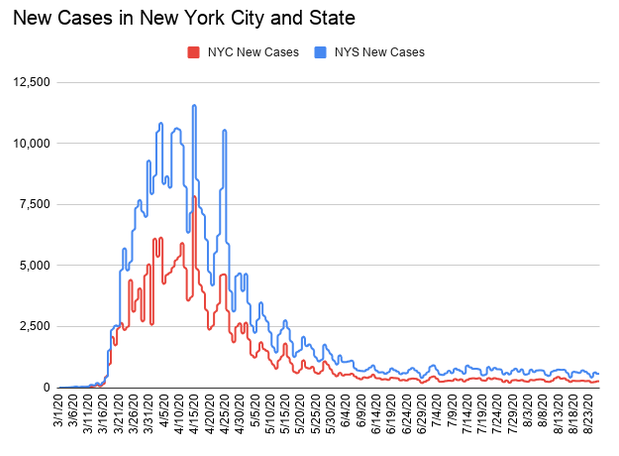
Taking the effects of biological and social heterogeneity on COVID-19 transmissibility, the researchers calculate that the herd immunity threshold is likely somewhere between 20 and 30 percent of the population. According to recent reports, more than 20 percent of New York City residents have probably been infected with the coronavirus.

Seeking to see what might happen this fall, the researchers model possible outcomes of the second wave of the COVID-19 epidemic in New York City and Chicago. They consider what they call a “worst-case scenario” in which all current mitigation efforts are fully relaxed and bars, theaters, and restaurants open with negligible social distancing and mask-wearing. Their heterogeneity-modified model projects virtually no second wave of COVID-19 cases in New York City which indicates that herd immunity has likely been achieved there.
On the other hand, they calculate that Chicago has not passed the herd immunity threshold. Nevertheless, the effects of biological and social heterogeneity would still result in a substantial reduction of the magnitude of the second wave there, even under the worst-case scenario. The possible good news is that their results suggest “that the second wave can be completely eliminated in such medium-hit locations [as Chicago], if appropriate and economically mild mitigation measures are adopted, including e.g. mask wearing, contact tracing, and targeted limitation of potential super-spreading events, through limitations on indoor bars, dining and other venues.”

Based on data from late May, researchers also calculate that most states were then still far away from reaching their heterogeneity-modified herd immunity thresholds. However, this summer’s surge in COVID-19 cases may have brought some states closer to herd immunity. While the coronavirus may not just fade away, these calculations imply that the U.S. has a good chance to avoid a potentially disastrous second wave this fall if the public maintains reasonable social distancing and mask-wearing efforts.

from Latest – Reason.com https://ift.tt/2QybTOi
via IFTTT
DOJ Interim Final Rule Restricts Reliance on Guidance Documents

Yesterday, the Department of Justice released an interim final rule on “Processes and Procedures for Issuance and Use of Guidance Documents.” (Hat tip: Chris Walker.) This new rule constrains the ability of agency’s to rely upon guidance documents in enforcement actions and in court. Specifically, the rule bars the Justice Department from bringing enforcement actions based upon non-compliance with agency guidance and places limits upon the Department’s seeking deference to agency guidance documents promulgated after the rule is adopted. One effect of this rule is that agencies will have a more difficult time seeking Auer deference for regulatory interpretations embodied in guidance documents, which will also protect agencies from losing cases under the more demanding test for Auer deference detailed in Kisor v. Wilkie.

The new rule will be effective immediately upon its publication of the Federal Register, and codified at 28 C.F.R. § 50.27, though DOJ will accept comments on the rule for 30 days after publication, and may revise the rule in response to those comments. The rule is intended to implement Executive Order No. 13,891Promoting the Rule of Law Through Improved Agency Guidance Documents.

Issuing this directly as an interim final rule, instead of as a proposed rule first and then a final rule after notice and comment, may seem a bit unusual, and it is.  But do not be surprised if we see more of this sort of thing. As Kristin Hickman noted, the Supreme Court blessed the greater use of interim final rulemakings in the Little Sisters decision from this past term, and I would not be at all surprised if agencies seek to take advantage of this going forward, as interim final rules are a much quicker way to implement changes in regulatory policy.

from Latest – Reason.com https://ift.tt/2FUKTqb
via IFTTT

DOJ Interim Final Rule Restricts Reliance on Guidance Documents

Yesterday, the Department of Justice released an interim final rule on “Processes and Procedures for Issuance and Use of Guidance Documents.” (Hat tip: Chris Walker.) This new rule constrains the ability of agency’s to rely upon guidance documents in enforcement actions and in court. Specifically, the rule bars the Justice Department from bringing enforcement actions based upon non-compliance with agency guidance and places limits upon the Department’s seeking deference to agency guidance documents promulgated after the rule is adopted. One effect of this rule is that agencies will have a more difficult time seeking Auer deference for regulatory interpretations embodied in guidance documents, which will also protect agencies from losing cases under the more demanding test for Auer deference detailed in Kisor v. Wilkie.

The new rule will be effective immediately upon its publication of the Federal Register, and codified at 28 C.F.R. § 50.27, though DOJ will accept comments on the rule for 30 days after publication, and may revise the rule in response to those comments. The rule is intended to implement Executive Order No. 13,891Promoting the Rule of Law Through Improved Agency Guidance Documents.

Issuing this directly as an interim final rule, instead of as a proposed rule first and then a final rule after notice and comment, may seem a bit unusual, and it is.  But do not be surprised if we see more of this sort of thing. As Kristin Hickman noted, the Supreme Court blessed the greater use of interim final rulemakings in the Little Sisters decision from this past term, and I would not be at all surprised if agencies seek to take advantage of this going forward, as interim final rules are a much quicker way to implement changes in regulatory policy.

from Latest – Reason.com https://ift.tt/2FUKTqb
via IFTTT

Tucson Handyman Gets His Jeep Back After He Threatens to Fight the Forfeiture

Kevin-McBride-GI-photo

What happens when innocent people stand up to government bullies who use civil forfeiture laws to steal their property? In many cases, the bullies, unaccustomed to such resistance, fold like a cheap suit. That is what happened today in Tucson, where the government returned Kevin McBride’s Jeep, which police seized in May after his girlfriend allegedly used it for a $25 marijuana sale.

Until last Friday, the Pima County Attorney’s Office was demanding a $1,900 ransom for the safe return of McBride’s lovingly restored Jeep, saying “an outright return of the vehicle is inappropriate in this case.” But the day after the Goldwater Institute threatened to sue on McBride’s behalf, arguing that Arizona’s civil forfeiture law unconstitutionally requires property owners to prove their innocence, prosecutors changed their tune.

“Upon inquiry pursuant to A.R.S. § 13-4309(3)(a) & (b), remission is declared,” says a letter dated August 21 from Deputy County Attorney Kevin Krejci, the same official who told McBride in an August 11 letter that he would have to pay $1,900 under a “mitigation” agreement to get his Jeep back. “The 2000 JEEP WRANGLER…is released from seizure for forfeiture. The seizing agency and any person holding property for the seizing agency are hereby authorized to arrange the release of the seizure for forfeiture on this property.”

Goldwater Institute spokesman Mike Brownfield says “there was no explanation given.” But I will go out on a limb and suggest that the government’s swift reversal has something to do with the negative publicity and legal risk generated by a case like this one, in which McBride lost his only means of transportation and the basis of his livelihood as a handyman because he let his girlfriend take his Jeep to a convenience store so she could fetch him a cold soda while he was working. The cops claim she then sold marijuana to an undercover officer for $25. Although the charges against her were dropped, the Jeep remained in custody, accused of participating in criminal activity, because that is how civil forfeiture works.

Arizona law would have allowed McBride to challenge the forfeiture by arguing that he “did not know and could not reasonably have known” about the alleged illegal use of his property. But the burden would have been on him to prove that, and it would have required spending thousands of dollars on a lawyer, with no guarantee of winning, if the Goldwater Institute had not agreed to represent him for free. Law enforcement agencies count on those barriers when they extort money from innocent property owners like McBride, who naturally tend to give up when they discover that fighting the forfeiture will cost more than the bribe demanded by the government’s lawyers, and in many cases more than the property is worth.

Did I mention that Arizona law enforcement agencies get to keep 100 percent of the proceeds from the forfeitures they handle? If the government sold the Jeep for $15,000 (which is what McBride estimates it is worth), local cops and prosecutors would have split the money. Even without risking a legal challenge, they would have gotten $1,900 for the price of a letter if McBride had done the sensible thing by surrendering. Multiply those ill-gotten gains by all the seizures that happen in Arizona, and you’ve got nearly $30 million to pad law enforcement budgets each year, a consideration that tends to warp policing priorities. While the public safety payoff from seizures like this one is zero, the profit adds up.

“Kevin isn’t the only person who’s been targeted by civil asset forfeiture schemes—and unfortunately, he probably won’t be the last,” says Goldwater Institute senior attorney Matt Miller. “The Goldwater Institute will continue to put pressure on states to reform or repeal these unfair laws—whether through legal action or through state legislatures amending these laws to require a criminal conviction.”

[This post has been revised to clarify the timing of Krejci’s letter.]

from Latest – Reason.com https://ift.tt/3jm8G0C
via IFTTT

“The Most Dramatic Shift In The History Of Food Service” – Restaurants Suddenly Can’t Find Enough Workers

“The Most Dramatic Shift In The History Of Food Service” – Restaurants Suddenly Can’t Find Enough Workers

Tyler Durden

Thu, 08/27/2020 – 17:25

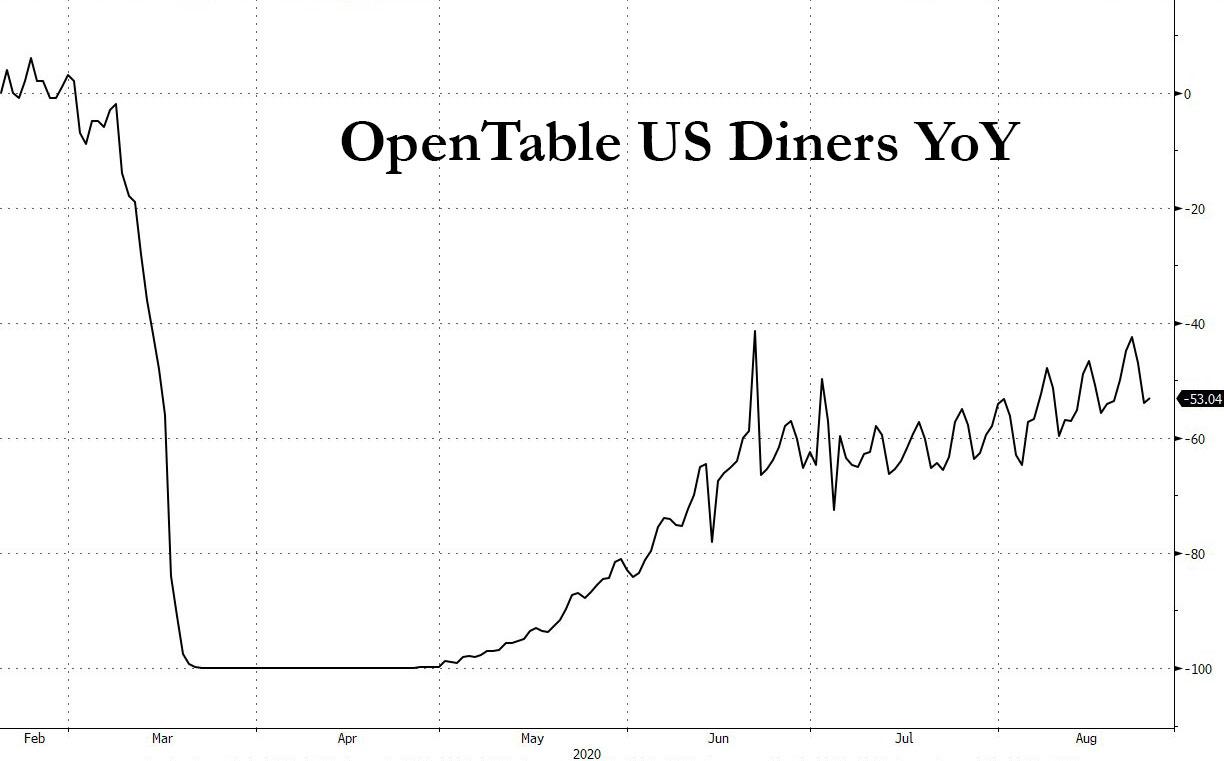
At time when the US restaurant sector is suffering from a crisis of unprecedented proportions, with diners in US restaurants roughly half where they were compared to a year ago due to ongoing covid lockdown measures…

… a new crisis has emerged: a persistent labor shortage despite the greatest jump in unemployment in 80 years.

The reason why the this time is indeed different from previous economic slowdowns when restaurants offered an important lifeline for the newly unemployed and would always be packed with minimum wage workers is because the Covid-19 pandemic has left service-sector jobs with a higher chance of infection; as a result even higher wages aren’t luring workers into the kitchen.

According to Bloomberg, key restaurant labor demographics such as teenagers, at the urging of their parents, and the elderly, are staying away for health and safety reasons, and emergency-enhanced unemployment checks have kept others on the sidelines.

And while many restaurant chains are finally paying more – or so they claim – that has failed to fill current their staff openings.

“This is the most dramatic shift that’s happened in the modern history of food service” said Aaron Allen, chief strategist at restaurant consultancy Aaron Allen & Associates. “It’s the first time people have left the industry and decided not to come back.”

According to the latest BLS Jolts report, as of mid-July, only about half of the 6.1 million food-service jobs that the U.S. lost in March and April had returned. This is a U-turn from early in the pandemic, when restaurant chains pared menus, reduced store hours and cut staff.

Not everyone is suffering: while many traditional restaurants continue to struggle as consumers avoid dining rooms, fast-food chains and those with carryout have reported steady improvement this summer as socially distancing consumers opt for drive thrus, Bloomberg reports. At the same time, delivery-focused companies like Papa John’s and Domino’s Pizza have thrived.

In June, McDonald’s said that in order to capitalize on the rebound in fast food, it planned to hire 260,000 this summer. Subway, Taco Bell, Dunkin’ Brands Group Inc., Papa John’s and Chipotle are also looking to expand payrolls on a smaller scale. But the lack of workers is complicating efforts.

That said, the lack of teenage workers – who would rather sit at home and daytrade the “market” – is good news for others as it has meant mostly higher wages:

Michael Lippert, president of GPS Hospitality LLC, which operates almost 500 Burger King, Popeyes and Pizza Hut locations, said hiring has been particularly tough because fewer teenagers are applying. This has pushed up wages and led the company to expand overtime, previously reserved for management, to hourly workers. Last week, the company held a virtual job fair, with a target of hiring 3,000 workers.

“The economic environment likely is not going to change. If it does, I don’t know that it will improve,” he said. “I think the labor force will remain tight for the next several months.”

And speaking of higher wages, Flynn Restaurant Group, which operates Taco Bell, Arby’s and Applebee’s locations, said it’s paying hourly workers more than it did a year ago at its 280 Taco Bell restaurants.

While keeping restaurants fully staffed has always been difficult, “the uncertainty around Covid has made this even more of a challenge,” said Greg Flynn, the company’s founder and chief executive officer. He added the task remains daunting in spite of high jobless rates and economic contraction.

Some more good news: Wendy expects 4% wage inflation for the year, double the Fed’s newly revised “target.” The higher wages are “what you need to pay at the moment on a year-over-year basis to actually staff your restaurants,” said Gunther Plosch, the company’s chief financial officer, on Wendy’s second-quarter earnings call on Aug. 5.

Yet an odd, if symmetric, wage inelasticity has emerged: whereas previously restaurants offering minimum wage would always be fully staffed, this time higher pay is suddenly insufficient for workers like Alonzo Rice in Orlando, Florida. A former Burger King cook and member of the Fight for $15 campaign to increase restaurant wages, Rice has been working odd jobs since his restaurant hours dwindled and then disappeared altogether amid the pandemic. With government benefit ending, he’s now once again starting to apply for jobs, but his old line of work just isn’t worth the risk, he said.

“I’m not applying to any restaurant jobs.”

Maybe… but when the money runs out and Alonzo is desperate to pay next month’s rent, he will, and so will everyone else once the full gamut of fiscal stimulus fades at which point wages will tumble once again.

via ZeroHedge News https://ift.tt/2EvNx5m Tyler Durden

2020 Nightmare: Armies Of Lawyers Ready To Fight A Long Legal Battle Over Election Results

2020 Nightmare: Armies Of Lawyers Ready To Fight A Long Legal Battle Over Election Results

Tyler Durden

Thu, 08/27/2020 – 17:05

Authored by Michael Snyder via TheMostImportantNews.com,

Armies of lawyers have already been recruited, reasons to question the legitimacy of the 2020 election results are already being floated, and top politicians on both sides are already urging a fight to the bitter end. 

Initially, it appeared that we might avoid this sort of a scenario.  For several months Joe Biden had a large lead in all of the major national polls, and some people were even discussing the possibility of a “landslide”.  But now the polls are tightening up, and this is especially true in the swing states which will ultimately decide the outcome of the election.  If the race is quite tight once we get to election night, it is likely that neither side will be willing to concede until every conceivable legal challenge is completely exhausted

That could mean an extended legal battle lasting for months, and that is something that none of us should want to see.

But it appears that such an outcome could be quite likely.  In fact, former FEC chair Michael Toner is warning that the 2020 election could potentially be “Bush v. Gore on steroids”

The November presidential election is poised to become the most litigated vote in recent U.S. history, according to a former federal election honcho.

“The 2020 election might be Bush v. Gore on steroids,” said Michael Toner, a former chairman of the Federal Election Commission and former chief counsel at the Republican National Committee.

I don’t like the sound of that at all.

When that election happened, I was actually going to law school down in Florida, and it was complete and utter madness.

In the end, Bush’s legal team was superior to Gore’s, and that may have made all the difference.

This time around, both sides have recruited “armies of volunteer lawyers” in the key battleground states…

President Trump and presumptive Democratic nominee Joseph R. Biden’s campaigns have enlisted armies of volunteer lawyers in battleground states and swing districts to fight out close calls on Election Day. Both sides have already filed multiple lawsuits.

The Biden campaign has been particularly aggressive in rounding up lawyers.  At one point, Biden bragged that his campaign had already recruited 600 lawyers

Joe Biden’s campaign is assembling hundreds of lawyers nationwide to monitor potential voting issues as part of its extensive voter protection efforts heading into the general election.

Speaking at a virtual fundraiser Wednesday, the presumptive Democratic nominee said his team has organized 600 lawyers and others across the country to “try to figure out why the chicanery is likely to take place.”

One of the fastest ways to ruin anything is to get lawyers involved.

I was once a lawyer, and so I know what I am talking about.

And I have a feeling that this election will end up in the hands of the lawyers after election night.  I do not believe that either side is going to be willing to concede if the results are remotely close, and earlier this week Hillary Clinton actually said that Joe Biden should not concede “under any circumstances”

“Joe Biden should not concede under any circumstances because I think this is going to drag out, and eventually I do believe he will win if we don’t give an inch and if we are as focused and relentless as the other side is,” Clinton said in an excerpt posted Tuesday.

That certainly sounds quite ominous.

On multiple occasions, President Trump has also indicated that he may challenge the outcome of the election, and one of the biggest things that he is concerned about are mail-in ballots.  The following is what he told “Fox and Friends” not too long ago

“Now with that being said, I have to tell you that if you go with this universal mail-in, where you send millions of votes–in California tens of millions of ballots being sent to everybody and their dogs, okay? Dogs are getting them, okay? People that have been dead for 25 years are getting them–you have to see what’s happening. Then you’re never going to have a fair election.”

In this case, I think that Trump has a very legitimate point.

In some states, millions of mail-in ballots are being sent out to voters whether the voters request them or not.  That opens a door for all sorts of potential vote fraud, and this is something that alarms me greatly.

In this election, every single vote in the battleground states is going to matter, and the integrity of the voting process is of paramount importance.

At first, Joe Biden had built up impressive leads in many of the most important swing states, but now those leads are deteriorating.  Just check out the following numbers that pollster Frank Luntz just posted on Twitter

Swing state polls on August 25th:

Pennsylvania

• 2016: Hillary +9.2

• 2020: Biden +5.7

Michigan

• 2016: Hillary +9.0

• 2020: Biden +6.7

Wisconsin

• 2016: Hillary +11.5

• 2020: Biden +6.5

Florida

• 2016: Hillary +2.9

• 2020: Biden +4.8

Those numbers should definitely set off alarm bells for Democrats.

And today Real Clear Politics has posted four new battleground polls that show how much the race is shifting.  One poll shows Biden up by only 3 points in Florida, another has him up by only 2 points in Arizona, a third has him up by only 1 point in North Carolina, and a fourth poll actually has Trump up by 1 point in Wisconsin.

Trump was definitely not supposed to win Wisconsin this time around, and so that should definitely be freaking Democrats out.

So why are the polls moving in Trump’s direction?

Well, it appears that all of the violence that is going on around the country is backfiring on the Democrats in a major way.  Trump is perceived to be the “law and order candidate”, and Biden is making a massive political mistake by not strongly speaking out against the riots that are happening on a nightly basis.

According to one recent survey, 59 percent of voters say that violent crime is a “very important” factor in deciding who to vote for…

The bedlam is now reflected in the polls, with Americans becoming increasingly concerned about law and order.

“A sizable 59 percent of voters in the survey indicate that violent crime, which President Trump has framed as happening in Democrat-controlled cities, is a ‘very important’ factor in casting their ballots,” writes Rusty Weiss.

And Zogby Analytics has just released new numbers that seem to show that the chaos in our major cities is helping Trump significantly…

“As violent protests and violent crime continue to spike in cities like Chicago, Milwaukee New York City, and Portland, Trump’s standing with urban voters in large cities (59% at least somewhat approved/38% at least somewhat disapproved), and small cities (51% at least somewhat approved/49% at least somewhat disapproved) continues to climb higher.”

It truly is ironic what we are witnessing.  All of these protesters think that they are promoting the cause of “social justice”, but their actions may be giving us four more years of Trump instead.

At this point, even CNN’s Don Lemon is realizing that Joe Biden’s inaction on these issues is moving the poll numbers

“That’s all you. This is where I come in. We’ll get to that. But when you said it’s too little too late, I don’t know about that. I mean, we still have a lot of time left until election day. I do think that this —what you said was happening in Kenosha is a Rorschach test for the entire country. I think this is a blind spot for Democrats. I think Democrats are hoping this will go away, and it’s not going to go away.”

I think maybe Joe Biden may be afraid to do it. I’m not sure. Maybe he won’t, maybe he is. He’s got to address it. He’s got to come out and talk about it. He’s got to do a speech like Barack Obama did about race. He’s got to come out and tell people that he’s going to deal with the issue of police reform in this country, and that’s what’s happening now is happening under Donald Trump’s watch. When he is the president, Kamala Harris is the vice president. Then they will take care of this problem. But guess what? The rioting has to stop. Chris, as you know, and I know it’s showing up in the polling, it’s showing up in focus groups. It is the only thing right now that is sticking.

If the election had been held a couple of months ago, Joe Biden probably would have won by a large margin, but now everything is changing.

At this point it appears that we could have a very tight election with legal challenges that could last for months afterwards.  If such a scenario plays out, that could definitely set the stage for the sort of civil unrest that I warn about in my new book.

Could you imagine the national temper tantrum that we would see if Trump has a very, very narrow lead after election night?

Of course the left will pull out every legal trick in the book in order to try to deny Trump a second term, and Trump has his own army of lawyers ready to fight back.

I have a feeling that things are going to get very, very ugly, and that is extremely unfortunate.

via ZeroHedge News https://ift.tt/3b5rzSw Tyler Durden

WHO Skips Wuhan During China Trip; “Sat In Beijing For Three Weeks”

WHO Skips Wuhan During China Trip; “Sat In Beijing For Three Weeks”

Tyler Durden

Thu, 08/27/2020 – 16:45

A delegation from the World Health Organization tasked with investigating the origins of COVID-19 failed to go to Wuhan, China ‘ground zero’ for the pandemic, and instead “sat in Beijing for three weeks” according to a senior US official, who told the Financial Times that Western governments are skeptical over China’s commitment to identifying the origins of the pandemic.

“Any chance of finding a smoking gun is now gone,” the official continued. Though we’re not sure what any team of investigators would find after China blocked international epidemiologists for eight months after the outbreak began.

Australian MP Dave Sharma told the Times: “The international community is right to have serious concerns about the rigour and independence of the WHO’s early response to this pandemic, and its seeming wish to avoid offending China.

“If this allegation is proven, it is another disturbing incident of the WHO — which is charged with safeguarding global public health — putting the political sensitivities of a member state above the public health interests of the world, in the critical early stages of this pandemic. We are all now bearing the immense costs of such a policy.”

The WHO, meanwhile, says that the three-week visit was ‘merely laying the groundwork in advance of a full international mission,’ but gave no indication when this might happen.

After initially bristling at calls from Australia, the US and other countries for a probe into the outbreak, which has claimed more than 800,000 lives, Chinese president Xi Jinping in May endorsed a WHO-led inquiry.

But the WHO resolution “to identify the zoonotic source of the virus and the route of introduction to the human population” — which was backed by more than 130 countries — has been dogged by concerns over transparency and access. –Financial Times

A two-person WHO team has recently concluded its three-week assignment in China to lay the groundwork for an investigation into the source of the virus. This was in advance of the full mission, therefore, there are no ‘results of the WHO’s recent mission’ to share.”” said the UN agency in a statement last week.

Backing the WHO was China’s foreign ministry, which said on Wednesday that questions over the legitimacy of the WHO inquiry were “totally unjustified,” and that China had acted responsibly by inviting the WHO during a “critical period” of trying to prevent a resurgence of the virus.”

“We hope all relevant countries . . . can be like China to adopt a positive attitude and work together with the WHO,” they added.

Anyone buying this?

US Secretary of State Mike Pompeo predicted in July that the WHO inquiry would be “completely whitewashed,” while President Trump – who terminated US ties with the WHO in May, said the organization was under Beijing’s “total control.”

Even a Council on Foreign Relations senior fellow for global health, Huang Yanzhong, said the investigation would require unrestricted access to Wuhan, along with other parts of China – such as the southwestern Yunnan province, in order to conclude anything.

“It would be unrealistic to expect that the inquiry would be a purely scientific endeavour,” he said, adding that the WHO might focus purely on the animal origin theory of the virus rather than a lab accident.

“In response to questions from the FT this week, the WHO said its advance team had remote conversations with senior scientists from the Wuhan Institute of Virology. It agreed with China that preliminary epidemiological studies around the Wuhan market and the first cluster of cases would be conducted in the coming weeks and months.

The international team will work with Chinese researchers to support these studies initially remotely, and later locally. The exact timing will depend on the advance and preliminary results of the initial studies,” the organisation said.” –Financial Times

Mainstream scientists, particularly those from China, maintain that Sars-Cov-2, the virus which causes COVID-19, originated from horseshoe bats in the southwest region of the country, which were found to carry a coronavirus that is a 96% genetic match.

What most scientists won’t consider, is that the virus could have been cultured by a team of coronavirus experts operating out of Wuhan, who were criticized in 2015 for ‘gain-of-function’ experiments to give bat coronavirus the ability to infect humans.

Sometimes the simplest explanation makes you a conspiracy theorist.

via ZeroHedge News https://ift.tt/3baq1qI Tyler Durden

Tucson Handyman Gets His Jeep Back After He Threatens to Fight the Forfeiture

Kevin-McBride-GI-photo

What happens when innocent people stand up to government bullies who use civil forfeiture laws to steal their property? In many cases, the bullies, unaccustomed to such resistance, fold like a cheap suit. That is what happened today in Tucson, where the Pima County Attorney’s Office suddenly agreed to return Kevin McBride’s Jeep, which police seized in May after his girlfriend allegedly used it for a $25 marijuana sale.

Until today, prosecutors were demanding a $1,900 ransom for the safe return of McBride’s lovingly restored Jeep, saying “an outright return of the vehicle is inappropriate in this case.” But a week after the Goldwater Institute threatened to sue on McBride’s behalf, arguing that Arizona’s civil forfeiture law unconstitutionally requires property owners to prove their innocence, prosecutors changed their tune. “Upon inquiry pursuant to A.R.S. § 13-4309(3)(a) & (b), remission is declared,” writes Deputy County Attorney Kevin Krejci, the same official who told McBride in an August 11 letter that he would have to pay $1,900 under a “mitigation” agreement to get his Jeep back. “The 2000 JEEP WRANGLER…is released from seizure for forfeiture.” Goldwater Institute spokesman Mike Brownfield says “there was no explanation given.”

I will go out on a limb and suggest that the government’s swift reversal has something to do with the negative publicity and legal risk generated by a case like this one, in which McBride lost his only means of transportation and the basis of his livelihood as a handyman because he let his girlfriend take his Jeep to a convenience store so she could fetch him a cold soda while he was working. The cops claim she then sold marijuana to an undercover officer for $25. Although the charges against her were dropped, the Jeep remained in custody, accused of participating in criminal activity, because that is how civil forfeiture works.

Arizona law would have allowed McBride to challenge the forfeiture by arguing that he “did not know and could not reasonably have known” about the alleged illegal use of his property. But the burden would have been on him to prove that, and it would have required spending thousands of dollars on a lawyer, with no guarantee of winning, if the Goldwater Institute had not agreed to represent him for free. Law enforcement agencies count on those barriers when they extort money from innocent property owners like McBride, who naturally tend to give up when they discover that fighting the forfeiture will cost more than the bribe demanded by the government’s lawyers, and in many cases more than the property is worth.

Did I mention that Arizona law enforcement agencies get to keep 100 percent of the proceeds from the forfeitures they handle? If the government sold the Jeep for $15,000 (which is what McBride estimates it is worth), local cops and prosecutors would have split the money. Even without risking a legal challenge, they would have gotten $1,900 for the price of a letter if McBride had done the sensible thing by surrendering. Multiply those ill-gotten gains by all the seizures that happen in Arizona, and you’ve got nearly $30 million to pad law enforcement budgets each year, a consideration that tends to warp policing priorities. While the public safety payoff from seizures like this one is zero, the profit adds up.

from Latest – Reason.com https://ift.tt/3jm8G0C
via IFTTT

Rights and Wrongs of Sports Boycotts

NBA

Over the last two days, NBA players have boycotted their league’s playoff games in protest of police brutality and racism, and players in several other professional sports leagues have followed suit. NBA players have now agreed to resume playing in the near future, and I expect the same thing is likely to happen in other leagues. But the whole episode still raises the more general issue of when and if sports boycotts are justified. This situation is not the first time players or others have advocated boycotting a sports event, and it is unlikely to be the last.

It may not be easy to come up with a rule that effectively deals with every case. But, at least as a general rule, I think there is good justification for boycotts when the organizers of the event in question are themselves perpetrating a serious injustice, and even more when holding the event directly causes injustices in and of itself. On  the other hand, the case is weaker when the purpose of the boycott is to pressure otherwise innocent third parties into supporting a political cause—even a just one.

I have previously advocated boycotting Olympics, World Cup tournaments, and other major sports events hosted by oppressive authoritarian regimes, and ideally denying them the right to host such events in the first place. The reason is that the hosts are directly culpable in perpetrating grave evil, and hosting such events almost inevitably provides a propaganda opportunity for them and bolsters their position on the international stage:

The standard argument against boycotts is the traditional idea that international sports events should be kept free of politics. The problem with this theory is that the Olympics and other similar events are virtually always used as propaganda tools by host governments, as happened with Nazi Germany in 1936, the USSR in 1980, and Vladimir Putin’s regime in 2014 [when Russia hosted the Winter Olympics]. For this reason, it is nearly impossible to make them genuinely politically neutral. The only realistic options are either to allow repressive regimes to use the Games to burnish their public image, keep them from hosting in the first place, or forestall their propaganda by means of a boycott that undercuts the Games’ public relations benefits for the hosts.

In addition, the sports events themselves are often run in ways that directly perpetrate grave injustices, such as forcible displacement of large numbers of people in order to make way for sports stadiums and related facilities:

The Olympics are a great sports event. But they also cause great harm. Host cities routinely lose enormous amounts of money on the games, and end up with decaying stadiums that have little or no value. Even worse, governments often forcibly displace large numbers of people from their homes and businesses in order to make room for Olympic venues. Over 1 million people lost their homes for the 2008 Beijing games alone. Brazil… similarly evicted large numbers of people for the… Rio Olympics, and even more to build stadiums for the 2014 World Cup. Most of those evicted are the poor and people lacking in political power.

Boycotting sports events where such practices occur can help deter their recurrence in the future. Denying propaganda opportunities to oppressive regimes and tarnishing their image can incentivize reforms. At the very least, boycotts in such cases can deny revenue and PR opportunities to the perpetrators of grave wrongs.

Things are more complicated in a case like the NBA players’ brief boycott of the last two days. Racial profiling and abusive police practices more generally are serious injustices (I have tried to highlight the need to curb racial profiling for years, now), and the players’ desire to combat them is laudable. We should also not forget that, in a league where most of the players are black men, it is highly likely that many of them and their families have experienced racial profiling and other abusive police behavior directly, as have a substantial majority of African-American males.

Still, it’s hard to argue that the targets of the boycott—NBA owners and fans—are the ones responsible for the injustice, in the ways that, say, the Russian and Chinese governments are responsible for the injustices their regimes perpetrate. It is even harder to argue that NBA games directly cause police brutality and racial profiling, in the way that forcible displacement of people to make way for stadiums is directly caused by current arrangements for hosting the Olympics and the World Cup.

The theory behind the boycott is that it might pressure NBA owners  into lobbying for reform. But it is by no means clear that the owners have the influence to make any significant difference on the issue. Few people even know the names of the owners, much less look to them for guidance on moral and political issues. The owners are, of course, wealthy people who might contribute to reform causes. But it’s far from clear they will contribute much more money as a result of a boycott, or that their contributions will make a significant difference, either.

In addition, if it is right to use boycotts to pressure owners (and perhaps others) into supporting one just cause, why not others? Sadly, US police abuses are far from the only significant injustice in the world today, or even the most serious ones. There are arguably even worse injustices in US immigration policy, for example. If players boycott games until owners address every serious injustice in the world, we will probably never have any professional sports competitions for a long time to come!

It might still be reasonable to use boycotts to pressure third parties into action if doing so has a high likelihood of success and is likely to do a lot more good than harm. But, at the very least, boycotts targeting third parties should only be undertaken if there is strong evidence that such success is likely and that a boycott is more likely to succeed than other types of measures. That is especially true when those boycotting are players who have a contractual obligation to participate in games, as opposed to fans and others who have no such duty.

Here, NBA players and other professional athletes do in fact have a range of alternative options that are likely to be at least equally effective. They can use their high public profile to speak out against and condemn police abuses (as many have already done). They can also contribute money (and urge others to do so) to organizations that promote much-needed reforms such as ending the War on Drugs, eliminating qualified immunity, combating racial profiling, and banning asset forfeitures. All of these reforms would both help curb law-enforcement abuses generally, and be of special benefit to minority communities (which disproportionately suffer from those abuses). Moreover, less confrontatioal strategies are less likely than boycotts to generate a counterproductive public backlash. In view of these alternatives, NBA players have done the right thing in ending the short-lived boycott, and instead pursuing their cause by other means.

That said, there may be issues over which boycotts of US sports leagues by players might have stronger justification. In some instances, the NBA and other major US sports leagues really are perpetrators of injustice, not just bystanders. The most common example is the egregious use of public funds to subsidize sports stadiums.  Studies by economists across the political spectrum consistently show that government subsidies for sports stadiums hurt local economies more than they benefit them. These subsidies routinely fleece the general public for the benefit of billionaire owners and millionaire players, while also damaging local economies. In some cases, cities compound the injustice by using eminent domain to forcibly displace residents and businesses in order to build stadiums.

If players were to boycott the NBA, NFL, and other major sports leagues until the owners agreed to abjure public subsidies for stadiums and the use of eminent domain to seize land for them, the players could very likely achieve that goal in short order! Unlike in the case of police abuses, the owners are key players in perpetrating these injustices, and they could easily end them if they wanted to.

In the case of the NBA, there is also its complicity in running basketball schools in China under the sponsorship of the oppressive Chinese government, where many young players have suffered severe abuse. This practice, too, could be ended if the players were willing to boycott until owners agreed to accept that demand.

I do not claim that the players are hypocritical or morally culpable for largely ignoring these issues where their leagues are morally complicit, and instead focusing on racist police brutality. Many may not even know much about stadium subsidies and the Chinese basketball program, whereas—for understandable reasons—they are well aware of police abuses and racial profiling.

To the extent the players are blameworthy here, the same can be said of fans—myself included—who continue to patronize these leagues. That may be especially true of those—again including myself—who are aware of the stadium subsidies, yet continue to watch games anyway (as I certainly do).

That said, both players and others would do well to focus their sports boycotts on those cases where event organizers are themselves culpable in perpetrating injustice, and especially those where the event itself is part of the cause. We cannot completely exclude the possibility that boycotts can be justified in some other cases. But they are likely to be less common, and require a higher burden of proof to justify the use of boycotts instead of less disruptive tactics.

from Latest – Reason.com https://ift.tt/2QsV4V9
via IFTTT

UCLR Online Symposium on Seila Law v. CFPB

The University of Chicago Law Review Online has just published a symposium on the Supreme Court’s decision in Seila Law v. Consumer Financial Protection Bureau, in which the Court held that the CFPB’s structure was unconstitutional and, consequently, that the for-cause removal limitation was invalid.

My own contribution to the symposium, “Conservative Minimalism and the Consumer Financial Protection Bureau,” focuses on how the Chief Justice’s opinion for the Court in Seila Law exhibits many of the conservative minimalist features of his jurisprudence. Here is the abstract (from SSRN):

The October 2019 Term offered further confirmation that Chief Justice Roberts is a conservative minimalist. This jurisprudential approach was on display in Seila Law v. Consumer Financial Protection Bureau, where the Chief Justice wrote the opinion for the Court invalidating a for-cause requirement for removal of the CFPB Director. Chief Justice Roberts’ decision embraced a conservative conception of separation of powers, closely aligned with the “unitary executive” theory. Yet his application of this theory was quite restrained. While embracing principles that would seem to have broader application, the Chief Justice eschewed any questioning of prior precedent and provided the plaintiffs with minimal relief, adopting a surgical approach to severability. Whatever the substantive merits of the Chief Justice’s Seila Law opinion, it was quite consistent with his overall jurisprudence since joining the Court.

Several of the essays are worth a read. Here is a list of the contributions to the symposium:


from Latest – Reason.com https://ift.tt/2EDZqpF
via IFTTT