No, Donald Trump Did Not ‘Shrink’ Government

TrumpWhisper

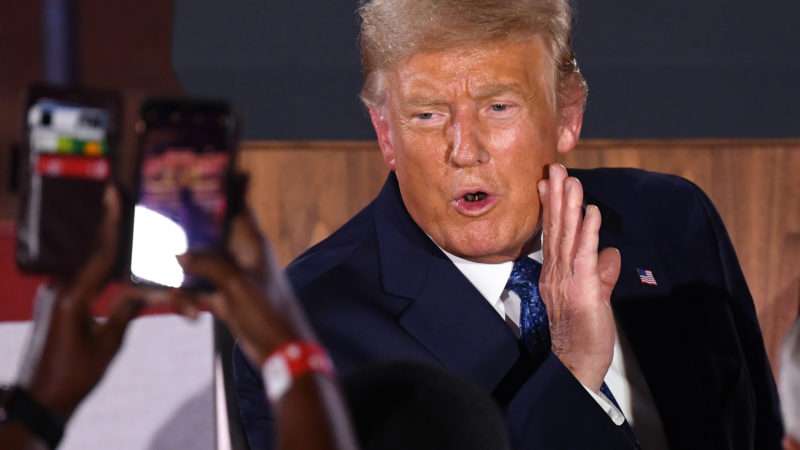
Early in Wednesday night’s Republican National Convention broadcast, South Dakota Gov. Kristi Noem reeled off a list of reasons she thinks voters should reward President Donald Trump with a second term. Among them: “He shrunk government.”

Alas, that statement isn’t close to being true.

The most traditional way to measure the size of government is to count how much money it spends. In Barack Obama’s last full fiscal year of 2016 (covering, as fiscal years do, the period from October 1 the previous year to September 30 of the annum in question), the federal government spent $3.85 trillion—$2.43 trillion on “mandatory” items (Social Security, Medicare, Medicaid, etc.), $1.16 trillion on discretionary outlays (more than half of which went to the Pentagon), and $230 billion on debt service. (I’m using here numbers compiled by The Balance, which differ slightly from those of the Congressional Budget Office but are broken out in more detail.)

In fiscal year 2020, before the coronavirus pandemic triggered a record amount of spending, the federal government was on course to cough up $4.79 trillion—$2.98 trillion mandatory, $1.44 trillion discretionary, and $380 billion in interest.

So under Trump’s signature, before any true crisis hit, the annual price tag of government went up by $937 billion in less than four years—more than the $870 billion price hike Obama produced in an eight-year span that included a massive federal response to a financial meltdown.

Ah, comes the inevitable rejoinder, but it’s Congress that has the power of the purse! Quite so. And that Congress was controlled by the president’s political party for 54 percent of his tenure, during which time Republicans jointly agreed through a series of continuing resolutions and must-pass, little-read “omnibus” packages to lift Obama-era spending caps, wave away the debt ceiling limit on federal borrowing, and fulfill Trump’s campaign pledge to “save,” rather than reform, old-age entitlement programs.

Trump came into office promising to “prime the pump” at the tail end of a historically long economic expansion and stock market bull run, rather than use the opportunity of comparative prosperity to prepare for a rainy day and/or address the long-term fiscal unsustainability that the government’s own economists have been warning about for well over a decade. Any case that he has been shrinking government must lie elsewhere.

So how about executive branch employment? According to the St. Louis Fed, crunching numbers from the Bureau of Labor Statistics, Trump inherited a civilian workforce of 2.815 million and kept that basically flat until it started rising around last July, presumably because the 2020 Census started to jack the number northward. No cuts.

In a March report, the Office of Personnel Management (OPM) and Office of Management and Budget (OMB) produced similar numbers—essentially flat executive branch employment, very mild growth, and expected 2020 uptick. No cuts.

That leaves us with Trump’s best case: Did he cut the regulatory state?

Not according to our friends at the Competitive Enterprise Institute (CEI), a free-market think tank that seeks the reform of the administrative state. CEI produces a valuable annual survey each spring titled Ten Thousand Commandments, which attempts to measure the number, scope, trajectory, and economic impact of Washington’s regulatory apparatus.

Here are that report’s estimates over the past five years across five categories: overall cost of regulations on the economy, amount of money spent by the federal government to administer the regulatory state, number of new economically significant regulations (with an annual impact of $100 million-plus), the ratio of regulations made to laws enacted (dubbed the “Unconstitutionality Index”), and the number of final rules in the Federal Register.

2015: $1.885 trillion economic impact ($14,832 per household), $63 billion in administration costs, 3,410 final new rules, 30 regulatory rules per law, 61 economically significant rules, 80,260 pages in the Federal Register.

2016: $1.9 trillion impact ($14,809 per household), $63 billion administration, 3,853 new rules, 18 rules per law, 83 economically significant rules, 95,894 Federal Register pages.

2017: $1.9 trillion impact ($14,666 per household), $66 billion administration, 3,281 new rules, 34 rules per law, 68 economically significant rules, 61,308 Federal Register pages.

2018: $1.9 trillion impact (now called a “placeholder estimate,” due to the “limited available federal government data and reports…and the illegal neglect on the part of the federal government to provide a regularly updated estimate of the aggregate costs of regulation”), $71 billion administration, 3,368 rules, 11 rules per law, 35 economically significant rules, 63,645 Federal Register pages.

2019: $1.9 trillion placeholder estimated impact, 2,964 new rules (“the lowest count since records began being kept in the 1970s”), $72 billion administration, 28 rules per law, 70 economically significant rules, 70,938 Federal Register pages.

So: Estimated regulatory costs are flat, not shrunk (though the per capita amount is slightly lower), and administrative costs are slightly higher. The two metrics that are noticeably down are the number of pages in the Federal Register (a somewhat symbolic measure) and the annual growth in regulations.

The aggregate total of regulations issued since 1976 (when the Federal Register began itemizing them) has increased from 195,189 at the end of Obama’s tenure to 204,802 now.

The Trump administration, as I have documented in the past, has taken more concrete deregulatory steps than any presidency since Ronald Reagan’s. But that doesn’t mean he has “shrunk” the regulatory state.

More worrying, there have been many signs in the past two years that the president is going to overwhelm any modest deregulatory victories with an increasingly interventionist industrial policy. CEI, which has been somewhat rosier toward the 45th president than I have, sounded some ominous warnings in its annual report this May. “Trump cuts,” the authors observe. “But Trump also adds”:

Trump sports regulatory impulses of his own that could derail or even eclipse the rollback agenda not just in 2020 but for years beyond….Trump’s proclivity for trade restrictions and his ad hoc zeal for antitrust and media regulation (such as swipes at Amazon and the AT&T–Time Warner merger) are well known. There are additional less well-known warning signs of regulatory initiatives that have emerged or heightened during the Trump tenure, such as the president’s approval of a permanent reauthorization of the Land and Water Conservation Fund, and his boasting of “the largest public lands package in a decade, designating 1.3 million acres…of new wilderness” for a federal government that already owns a large portion of the continent….

Trump’s own regulatory impulses have become the most pertinent concern, particularly where he exhibits substantial agreement with regulatory advocates on issues such as antitrust policy, regulatory action against tech firms and traditional media companies, and industrial and social policy.

Much more in that vein at this link.

You can argue plausibly that Joe Biden and the Democratic Party will grow the government more. But the fact is, the guy railing against socialism night after night this week has grown spending faster than his predecessor and shown considerably less interest in confronting the entitlement bomb, all while cutting neither the federal workforce nor the size of the regulatory state.

There’s only one presidential candidate campaigning every day to shrink government. It’s certainly not the Republican.

from Latest – Reason.com https://ift.tt/3jodIJY
via IFTTT
Rights and Wrongs of Sports Boycotts

NBA

Over the last two days, NBA players have boycotted their league’s playoff games in protest of police brutality and racism, and players in several other professional sports leagues have followed suit. NBA players have now agreed to resume playing in the near future, and I expect the same thing is likely to happen in other leagues. But the whole episode still raises the more general issue of when and if sports boycotts are justified. This situation is not the first time players or others have advocated boycotting a sports event, and it is unlikely to be the last.

It may not be easy to come up with a rule that effectively deals with every case. But, at least as a general rule, I think there is good justification for boycotts when the organizers of the event in question are themselves perpetrating a serious injustice, and even more when holding the event directly causes injustices in and of itself. On  the other hand, the case is weaker when the purpose of the boycott is to pressure otherwise innocent third parties into supporting a political cause—even a just one.

I have previously advocated boycotting Olympics, World Cup tournaments, and other major sports events hosted by oppressive authoritarian regimes, and ideally denying them the right to host such events in the first place. The reason is that the hosts are directly culpable in perpetrating grave evil, and hosting such events almost inevitably provides a propaganda opportunity for them and bolsters their position on the international stage:

The standard argument against boycotts is the traditional idea that international sports events should be kept free of politics. The problem with this theory is that the Olympics and other similar events are virtually always used as propaganda tools by host governments, as happened with Nazi Germany in 1936, the USSR in 1980, and Vladimir Putin’s regime in 2014 [when Russia hosted the Winter Olympics]. For this reason, it is nearly impossible to make them genuinely politically neutral. The only realistic options are either to allow repressive regimes to use the Games to burnish their public image, keep them from hosting in the first place, or forestall their propaganda by means of a boycott that undercuts the Games’ public relations benefits for the hosts.

In addition, the sports events themselves are often run in ways that directly perpetrate grave injustices, such as forcible displacement of large numbers of people in order to make way for sports stadiums and related facilities:

The Olympics are a great sports event. But they also cause great harm. Host cities routinely lose enormous amounts of money on the games, and end up with decaying stadiums that have little or no value. Even worse, governments often forcibly displace large numbers of people from their homes and businesses in order to make room for Olympic venues. Over 1 million people lost their homes for the 2008 Beijing games alone. Brazil… similarly evicted large numbers of people for the… Rio Olympics, and even more to build stadiums for the 2014 World Cup. Most of those evicted are the poor and people lacking in political power.

Boycotting sports events where such practices occur can help deter their recurrence in the future. Denying propaganda opportunities to oppressive regimes and tarnishing their image can incentivize reforms. At the very least, boycotts in such cases can deny revenue and PR opportunities to the perpetrators of grave wrongs.

Things are more complicated in a case like the NBA players’ brief boycott of the last two days. Racial profiling and abusive police practices more generally are serious injustices (I have tried to highlight the need to curb racial profiling for years, now), and the players’ desire to combat them is laudable. We should also not forget that, in a league where most of the players are black men, it is highly likely that many of them and their families have experienced racial profiling and other abusive police behavior directly, as have a substantial majority of African-American males.

Still, it’s hard to argue that the targets of the boycott—NBA owners and fans—are the ones responsible for the injustice, in the ways that, say, the Russian and Chinese governments are responsible for the injustices their regimes perpetrate. It is even harder to argue that NBA games directly cause police brutality and racial profiling, in the way that forcible displacement of people to make way for stadiums is directly caused by current arrangements for hosting the Olympics and the World Cup.

The theory behind the boycott is that it might pressure NBA owners  into lobbying for reform. But it is by no means clear that the owners have the influence to make any significant difference on the issue. Few people even know the names of the owners, much less look to them for guidance on moral and political issues. The owners are, of course, wealthy people who might contribute to reform causes. But it’s far from clear they will contribute much more money as a result of a boycott, or that their contributions will make a significant difference, either.

In addition, if it is right to use boycotts to pressure owners (and perhaps others) into supporting one just cause, why not others? Sadly, US police abuses are far from the only significant injustice in the world today, or even the most serious ones. There are arguably even worse injustices in US immigration policy, for example. If players boycott games until owners address every serious injustice in the world, we will probably never have any professional sports competitions for a long time to come!

It might still be reasonable to use boycotts to pressure third parties into action if doing so has a high likelihood of success and is likely to do a lot more good than harm. But, at the very least, boycotts targeting third parties should only be undertaken if there is strong evidence that such success is likely and that a boycott is more likely to succeed than other types of measures. That is especially true when those boycotting are players who have a contractual obligation to participate in games, as opposed to fans and others who have no such duty.

Here, NBA players and other professional athletes do in fact have a range of alternative options that are likely to be at least equally effective. They can use their high public profile to speak out against and condemn police abuses (as many have already done). They can also contribute money (and urge others to do so) to organizations that promote much-needed reforms such as ending the War on Drugs, eliminating qualified immunity, combating racial profiling, and banning asset forfeitures. All of these reforms would both help curb law-enforcement abuses generally, and be of special benefit to minority communities (which disproportionately suffer from those abuses). Moreover, less confrontatioal strategies are less likely than boycotts to generate a counterproductive public backlash. In view of these alternatives, NBA players have done the right thing in ending the short-lived boycott, and instead pursuing their cause by other means.

That said, there may be issues over which boycotts of US sports leagues by players might have stronger justification. In some instances, the NBA and other major US sports leagues really are perpetrators of injustice, not just bystanders. The most common example is the egregious use of public funds to subsidize sports stadiums.  Studies by economists across the political spectrum consistently show that government subsidies for sports stadiums hurt local economies more than they benefit them. These subsidies routinely fleece the general public for the benefit of billionaire owners and millionaire players, while also damaging local economies. In some cases, cities compound the injustice by using eminent domain to forcibly displace residents and businesses in order to build stadiums.

If players were to boycott the NBA, NFL, and other major sports leagues until the owners agreed to abjure public subsidies for stadiums and the use of eminent domain to seize land for them, the players could very likely achieve that goal in short order! Unlike in the case of police abuses, the owners are key players in perpetrating these injustices, and they could easily end them if they wanted to.

In the case of the NBA, there is also its complicity in running basketball schools in China under the sponsorship of the oppressive Chinese government, where many young players have suffered severe abuse. This practice, too, could be ended if the players were willing to boycott until owners agreed to accept that demand.

I do not claim that the players are hypocritical or morally culpable for largely ignoring these issues where their leagues are morally complicit, and instead focusing on racist police brutality. Many may not even know much about stadium subsidies and the Chinese basketball program, whereas—for understandable reasons—they are well aware of police abuses and racial profiling.

To the extent the players are blameworthy here, the same can be said of fans—myself included—who continue to patronize these leagues. That may be especially true of those—again including myself—who are aware of the stadium subsidies, yet continue to watch games anyway (as I certainly do).

That said, both players and others would do well to focus their sports boycotts on those cases where event organizers are themselves culpable in perpetrating injustice, and especially those where the event itself is part of the cause. We cannot completely exclude the possibility that boycotts can be justified in some other cases. But they are likely to be less common, and require a higher burden of proof to justify the use of boycotts instead of less disruptive tactics.

from Latest – Reason.com https://ift.tt/2QsV4V9
via IFTTT

UCLR Online Symposium on Seila Law v. CFPB

The University of Chicago Law Review Online has just published a symposium on the Supreme Court’s decision in Seila Law v. Consumer Financial Protection Bureau, in which the Court held that the CFPB’s structure was unconstitutional and, consequently, that the for-cause removal limitation was invalid.

My own contribution to the symposium, “Conservative Minimalism and the Consumer Financial Protection Bureau,” focuses on how the Chief Justice’s opinion for the Court in Seila Law exhibits many of the conservative minimalist features of his jurisprudence. Here is the abstract (from SSRN):

The October 2019 Term offered further confirmation that Chief Justice Roberts is a conservative minimalist. This jurisprudential approach was on display in Seila Law v. Consumer Financial Protection Bureau, where the Chief Justice wrote the opinion for the Court invalidating a for-cause requirement for removal of the CFPB Director. Chief Justice Roberts’ decision embraced a conservative conception of separation of powers, closely aligned with the “unitary executive” theory. Yet his application of this theory was quite restrained. While embracing principles that would seem to have broader application, the Chief Justice eschewed any questioning of prior precedent and provided the plaintiffs with minimal relief, adopting a surgical approach to severability. Whatever the substantive merits of the Chief Justice’s Seila Law opinion, it was quite consistent with his overall jurisprudence since joining the Court.

Several of the essays are worth a read. Here is a list of the contributions to the symposium:


from Latest – Reason.com https://ift.tt/2EDZqpF
via IFTTT

No, Donald Trump Did Not ‘Shrink’ Government

TrumpWhisper

Early in Wednesday night’s Republican National Convention broadcast, South Dakota Gov. Kristi Noem reeled off a list of reasons she thinks voters should reward President Donald Trump with a second term. Among them: “He shrunk government.”

Alas, that statement isn’t close to being true.

The most traditional way to measure the size of government is to count how much money it spends. In Barack Obama’s last full fiscal year of 2016 (covering, as fiscal years do, the period from October 1 the previous year to September 30 of the annum in question), the federal government spent $3.85 trillion—$2.43 trillion on “mandatory” items (Social Security, Medicare, Medicaid, etc.), $1.16 trillion on discretionary outlays (more than half of which went to the Pentagon), and $230 billion on debt service. (I’m using here numbers compiled by The Balance, which differ slightly from those of the Congressional Budget Office but are broken out in more detail.)

In fiscal year 2020, before the coronavirus pandemic triggered a record amount of spending, the federal government was on course to cough up $4.79 trillion—$2.98 trillion mandatory, $1.44 trillion discretionary, and $380 billion in interest.

So under Trump’s signature, before any true crisis hit, the annual price tag of government went up by $937 billion in less than four years—more than the $870 billion price hike Obama produced in an eight-year span that included a massive federal response to a financial meltdown.

Ah, comes the inevitable rejoinder, but it’s Congress that has the power of the purse! Quite so. And that Congress was controlled by the president’s political party for 54 percent of his tenure, during which time Republicans jointly agreed through a series of continuing resolutions and must-pass, little-read “omnibus” packages to lift Obama-era spending caps, wave away the debt ceiling limit on federal borrowing, and fulfill Trump’s campaign pledge to “save,” rather than reform, old-age entitlement programs.

Trump came into office promising to “prime the pump” at the tail end of a historically long economic expansion and stock market bull run, rather than use the opportunity of comparative prosperity to prepare for a rainy day and/or address the long-term fiscal unsustainability that the government’s own economists have been warning about for well over a decade. Any case that he has been shrinking government must lie elsewhere.

So how about executive branch employment? According to the St. Louis Fed, crunching numbers from the Bureau of Labor Statistics, Trump inherited a civilian workforce of 2.815 million and kept that basically flat until it started rising around last July, presumably because the 2020 Census started to jack the number northward. No cuts.

In a March report, the Office of Personnel Management (OPM) and Office of Management and Budget (OMB) produced similar numbers—essentially flat executive branch employment, very mild growth, and expected 2020 uptick. No cuts.

That leaves us with Trump’s best case: Did he cut the regulatory state?

Not according to our friends at the Competitive Enterprise Institute (CEI), a free-market think tank that seeks the reform of the administrative state. CEI produces a valuable annual survey each spring titled Ten Thousand Commandments, which attempts to measure the number, scope, trajectory, and economic impact of Washington’s regulatory apparatus.

Here are that report’s estimates over the past five years across five categories: overall cost of regulations on the economy, amount of money spent by the federal government to administer the regulatory state, number of new economically significant regulations (with an annual impact of $100 million-plus), the ratio of regulations made to laws enacted (dubbed the “Unconstitutionality Index”), and the number of final rules in the Federal Register.

2015: $1.885 trillion economic impact ($14,832 per household), $63 billion in administration costs, 3,410 final new rules, 30 regulatory rules per law, 61 economically significant rules, 80,260 pages in the Federal Register.

2016: $1.9 trillion impact ($14,809 per household), $63 billion administration, 3,853 new rules, 18 rules per law, 83 economically significant rules, 95,894 Federal Register pages.

2017: $1.9 trillion impact ($14,666 per household), $66 billion administration, 3,281 new rules, 34 rules per law, 68 economically significant rules, 61,308 Federal Register pages.

2018: $1.9 trillion impact (now called a “placeholder estimate,” due to the “limited available federal government data and reports…and the illegal neglect on the part of the federal government to provide a regularly updated estimate of the aggregate costs of regulation”), $71 billion administration, 3,368 rules, 11 rules per law, 35 economically significant rules, 63,645 Federal Register pages.

2019: $1.9 trillion placeholder estimated impact, 2,964 new rules (“the lowest count since records began being kept in the 1970s”), $72 billion administration, 28 rules per law, 70 economically significant rules, 70,938 Federal Register pages.

So: Estimated regulatory costs are flat, not shrunk (though the per capita amount is slightly lower), and administrative costs are slightly higher. The two metrics that are noticeably down are the number of pages in the Federal Register (a somewhat symbolic measure) and the annual growth in regulations.

The aggregate total of regulations issued since 1976 (when the Federal Register began itemizing them) has increased from 195,189 at the end of Obama’s tenure to 204,802 now.

The Trump administration, as I have documented in the past, has taken more concrete deregulatory steps than any presidency since Ronald Reagan’s. But that doesn’t mean he has “shrunk” the regulatory state.

More worrying, there have been many signs in the past two years that the president is going to overwhelm any modest deregulatory victories with an increasingly interventionist industrial policy. CEI, which has been somewhat rosier toward the 45th president than I have, sounded some ominous warnings in its annual report this May. “Trump cuts,” the authors observe. “But Trump also adds”:

Trump sports regulatory impulses of his own that could derail or even eclipse the rollback agenda not just in 2020 but for years beyond….Trump’s proclivity for trade restrictions and his ad hoc zeal for antitrust and media regulation (such as swipes at Amazon and the AT&T–Time Warner merger) are well known. There are additional less well-known warning signs of regulatory initiatives that have emerged or heightened during the Trump tenure, such as the president’s approval of a permanent reauthorization of the Land and Water Conservation Fund, and his boasting of “the largest public lands package in a decade, designating 1.3 million acres…of new wilderness” for a federal government that already owns a large portion of the continent….

Trump’s own regulatory impulses have become the most pertinent concern, particularly where he exhibits substantial agreement with regulatory advocates on issues such as antitrust policy, regulatory action against tech firms and traditional media companies, and industrial and social policy.

Much more in that vein at this link.

You can argue plausibly that Joe Biden and the Democratic Party will grow the government more. But the fact is, the guy railing against socialism night after night this week has grown spending faster than his predecessor and shown considerably less interest in confronting the entitlement bomb, all while cutting neither the federal workforce nor the size of the regulatory state.

There’s only one presidential candidate campaigning every day to shrink government. It’s certainly not the Republican.

from Latest – Reason.com https://ift.tt/3jodIJY
via IFTTT

Fed’s New Policy Will Compound Its Errors

Fed’s New Policy Will Compound Its Errors

Tyler Durden

Thu, 08/27/2020 – 16:25

Submitted by Mike “Mish” Shedlock,

The Fed announced a new inflation policy today. It won’t improve anything.

Fed Updates Long Term Strategy

Today the Fed issued an update to its Longer-Term Goals on Monetary Policy.

  • On maximum employment, the FOMC emphasized that maximum employment is a broad-based and inclusive goal and reports that its policy decision will be informed by its “assessments of the shortfalls of employment from its maximum level.” The original document referred to “deviations from its maximum level.”

  • On price stability, the FOMC adjusted its strategy for achieving its longer-run inflation goal of 2 percent by noting that it “seeks to achieve inflation that averages 2 percent over time.” To this end, the revised statement states that “following periods when inflation has been running persistently below 2 percent, appropriate monetary policy will likely aim to achieve inflation moderately above 2 percent for some time.” 

  • The updates to the strategy statement explicitly acknowledge the challenges for monetary policy posed by a persistently low interest rate environment. Here in the United States and around the world, monetary policy interest rates are more likely to be constrained by their effective lower-bound than in the past.

Price Stability

Fed chair Jerome Powell would not recognize price stability if it jumped out of the audience and spit grapefruit juice in his eye. Somehow the Fed is wedded to a goal of 2% inflation with no explanation as to why the goal should be 2% in the first place.

Moreover, inflation is under 2% because the Fed ignores housing prices, employer health care costs, education, and stock market bubbles.

Offsetting Errors

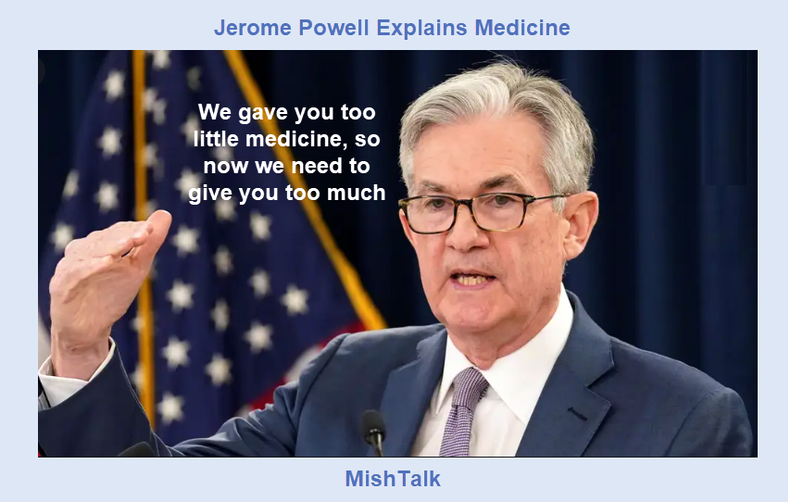
The idea that one can offset errors by further errors in the other direction is pure nonsense. It’s as if a doctor said “For the last three months we gave you too little medicine so for the next three months we will give you too much.” 

Alternatively, think of it this way.

No Economic Benefit to Inflation

My Challenge to Keynesians “Prove Rising Prices Provide an Overall Economic Benefit” has gone unanswered.

There is no economic benefit to inflation but there are winners and losers. The winners are those with first access to money, namely the banks and the already wealthy.

The Fed complains about income and wealth inequality but they are the primary source.

BIS Deflation Study

The BIS did a historical study and found routine price deflation was not any problem at all.

Deflation may actually boost output. Lower prices increase real incomes and wealth. And they may also make export goods more competitive,” stated the study.

For a discussion of the BIS study, please see Historical Perspective on CPI Deflations

Asset Bubble Deflation

It’s asset bubble deflation that is damaging. When asset bubbles burst, debt deflation results.

Central banks’ seriously misguided attempts to defeat routine consumer price deflation is what fuels the destructive build up of unproductive debt and asset bubbles that eventually collapse.

The problem is not deflation, it’s the Fed’s misguided attempts to prevent it.

via ZeroHedge News https://ift.tt/3hDJJxl Tyler Durden

Powell, Pelosi, & Pentagon Pummel Big-Tech, Bonds, & Bullion

Powell, Pelosi, & Pentagon Pummel Big-Tech, Bonds, & Bullion

Tyler Durden

Thu, 08/27/2020 – 16:01

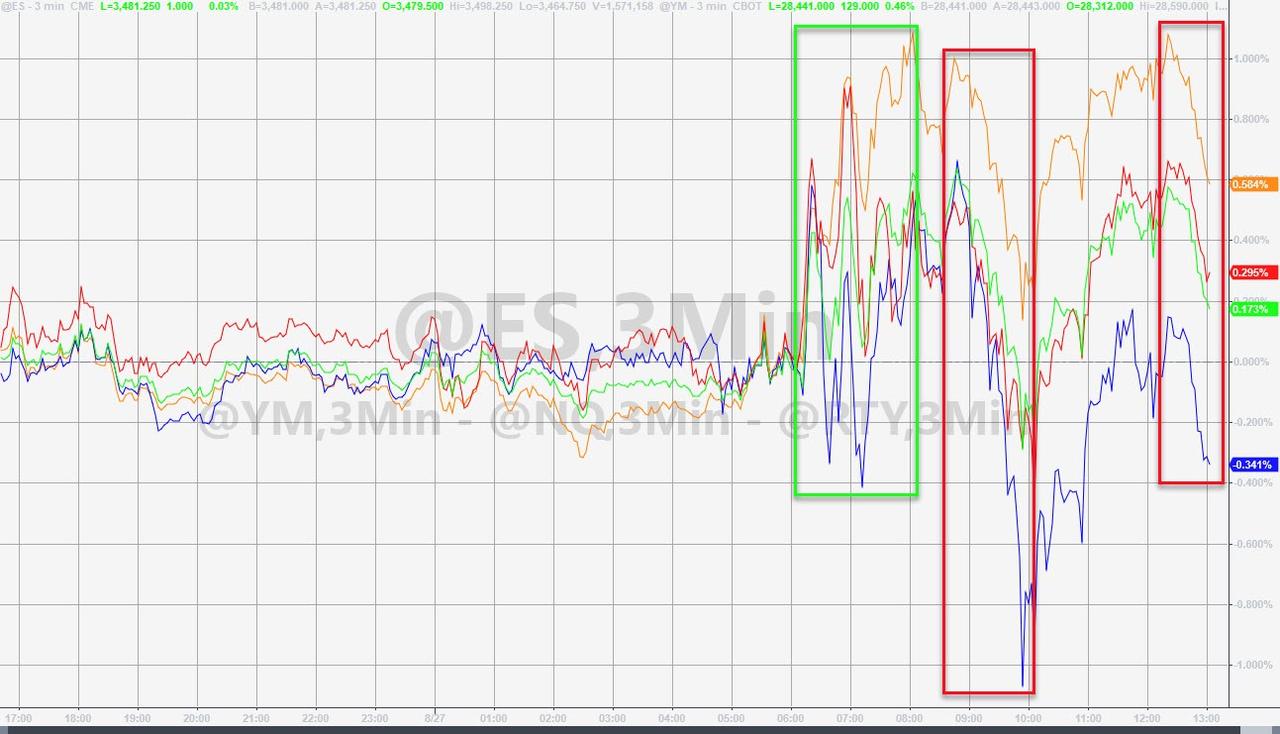
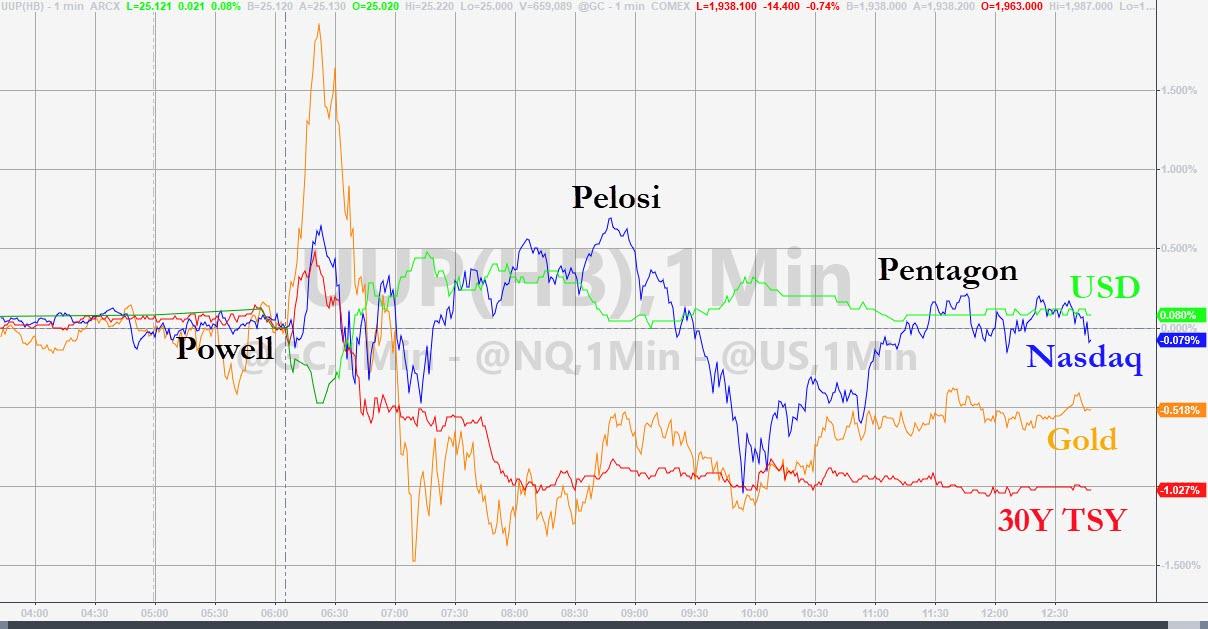
Fed Chair Powell’s initial comments spiked stocks:

*POWELL SAYS FED TO SEEK INFLATION THAT ‘AVERAGES’ 2% OVER TIME

…then ‘moderation’ sent them reeling:

*POWELL SAYS ANY INFLATION OVERSHOOTS WILL BE MODERATE

but he later reassured that they would let inflation run and things took off again…

*POWELL: SEEK TO RUN INFLATION ABOVE 2% AFTER PERIODS BELOW 2%

Then Pelosi triggered a drop in stocks (hitting right as Europe closed)…

1129ET *PELOSI SAYS NOT BUDGING ON STIMULUS, REPUBLICANS HAVE TO MOVE

This didn’t help!

1315ET *Kaplan: Markets Need to Understand How to Operate Without Fed Support

And then Pentagon headlines spooked markets a little late on…

1420ET *CHINA MILITARY SAYS U.S. WARSHIP EXPELLED NEAR PARACEL ISLANDS

And then Pelosi again…

1515ET *MEADOWS-PELOSI TALK DOESN’T APPEAR TO YIELD BREAK-THROUGHS

1530ET *PELOSI SAYS SHE IS STICKING TO HER DEMANDS ON STIMULUS

And in the end The Dow notably outperformed as Nasdaq swung around desperately trying to stay green but failed…

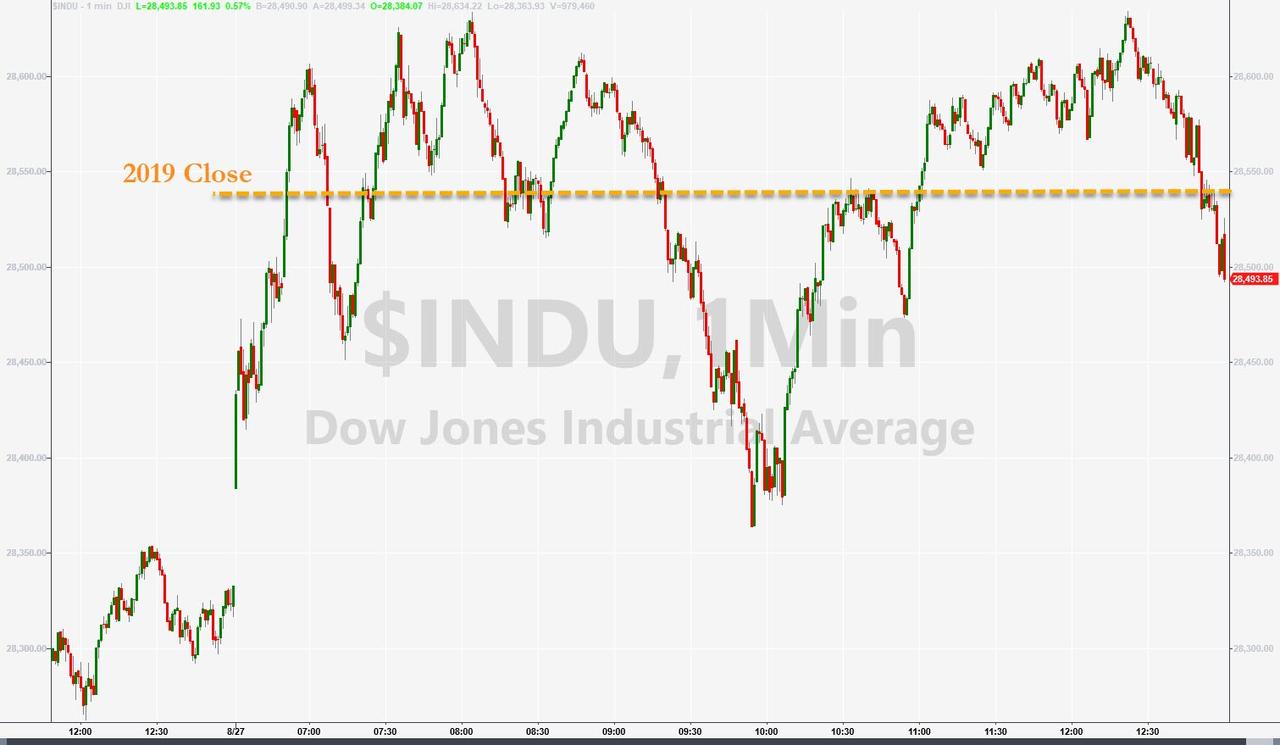
The Dow’s big mission was get back to even on the year…

Source: Bloomberg

28,538 was the magic number (green YTD) but the machines failed to hold it…

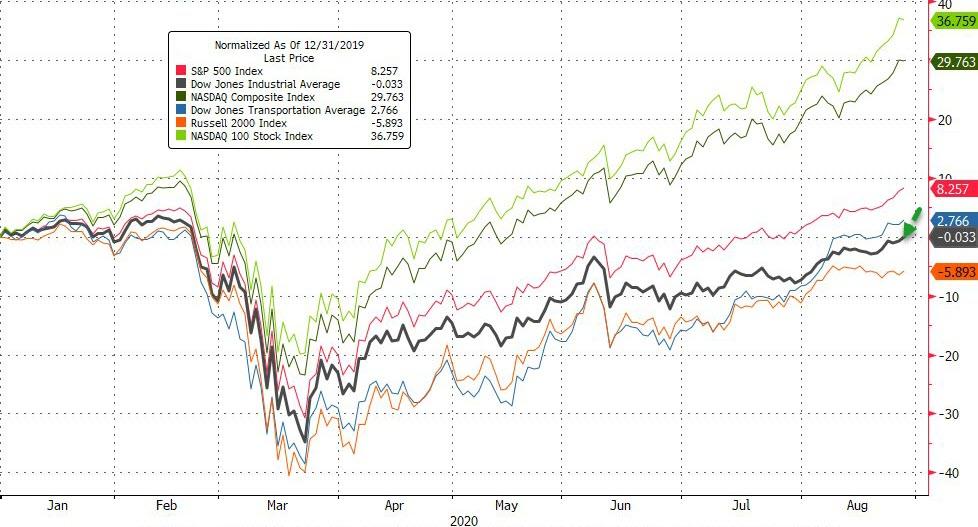
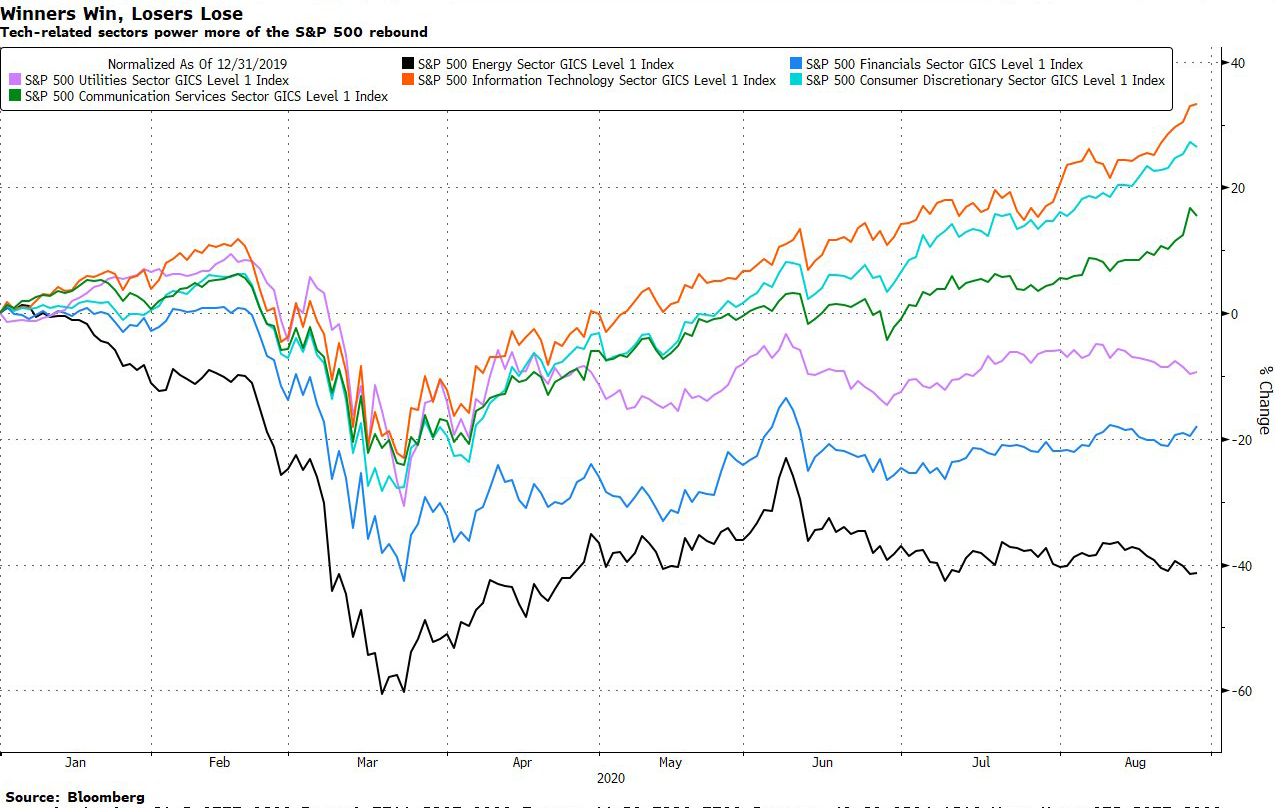
But there’s a growing chasm between winners and losers…

Source: Bloomberg

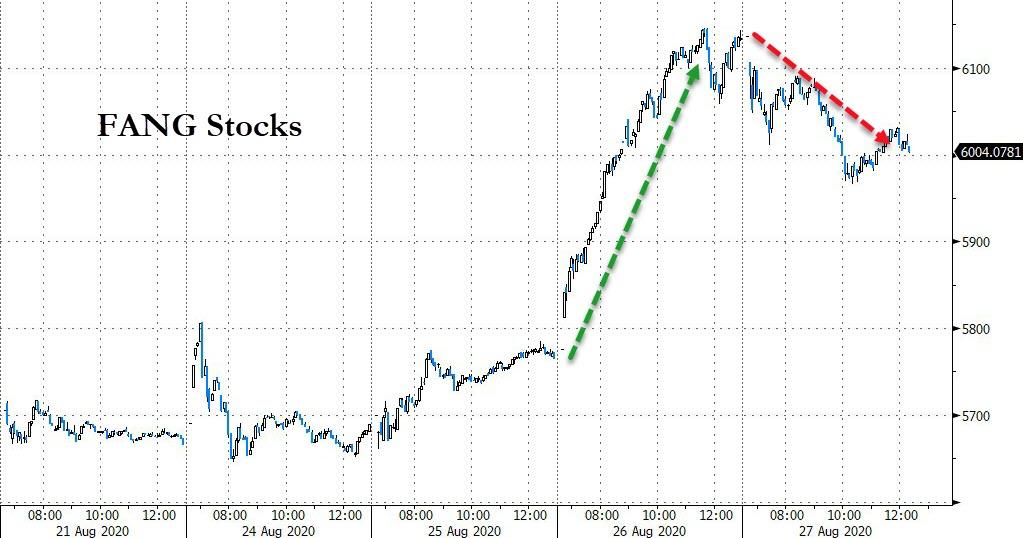
But Big-Tech stocks ended lower (after yesterday’s meltup)!!

Source: Bloomberg

“Inconceivable!”

Across the asset classes the volatility was similar (from the Powell headline drop)…

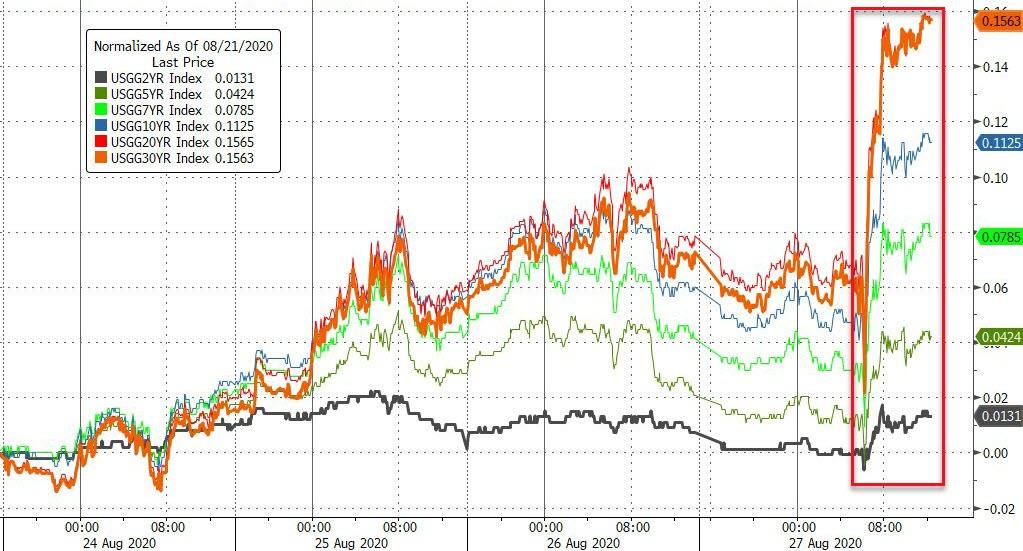
Bonds definitely suffered most…

Source: Bloomberg

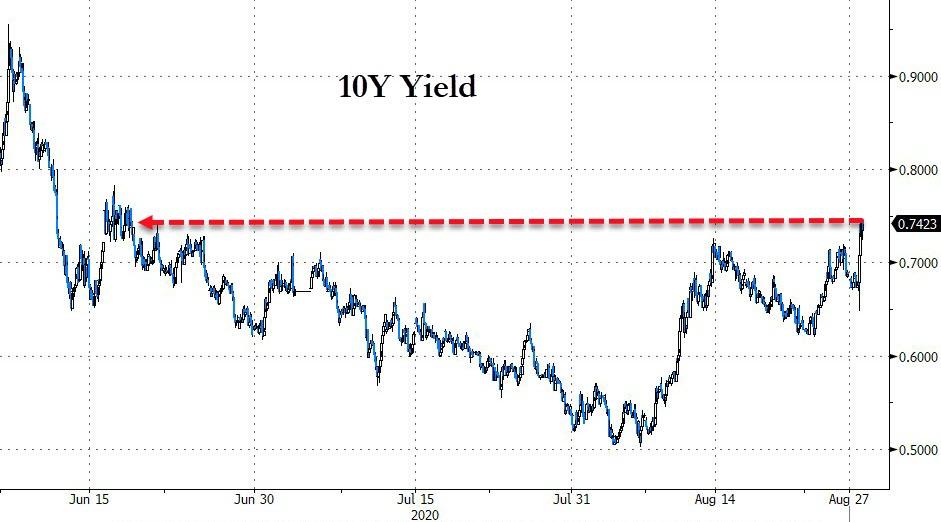
with 10Y Yields (which fell immediately after Powell spoke) soaring to 2-month highs…

Source: Bloomberg

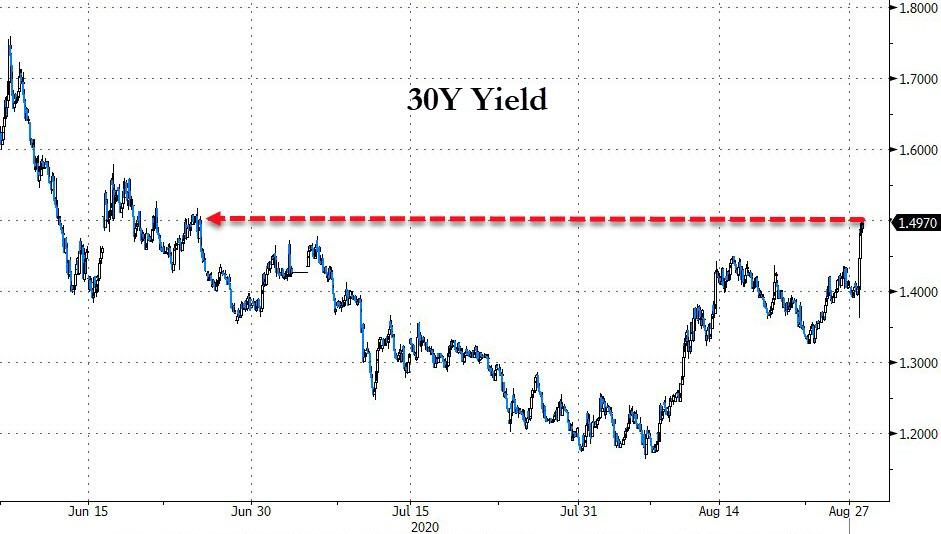
And 30Y TSY yields hitting 1.50% for the first time since June…

Source: Bloomberg

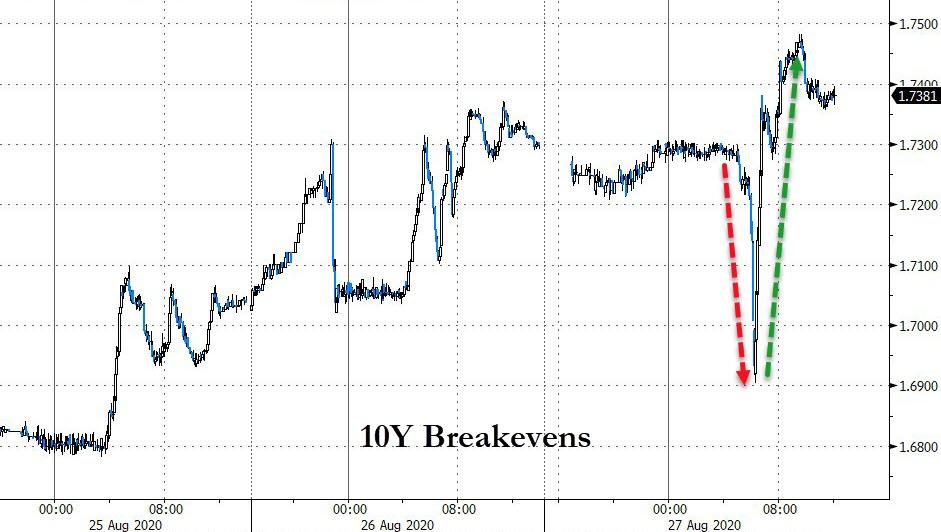
Breakevens initially plunged before taking off to its highest since January…

Source: Bloomberg

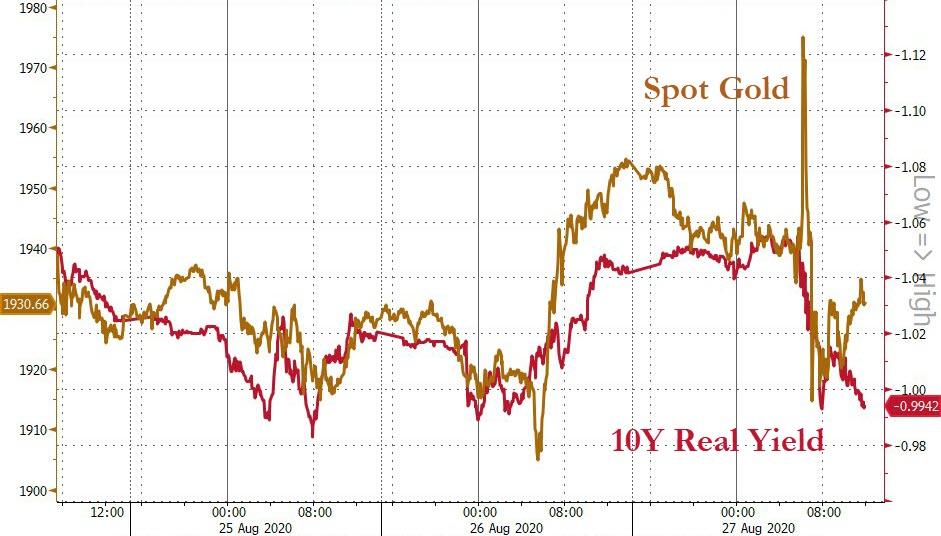
Real Yields increased (back below -1.00%)…

Source: Bloomberg

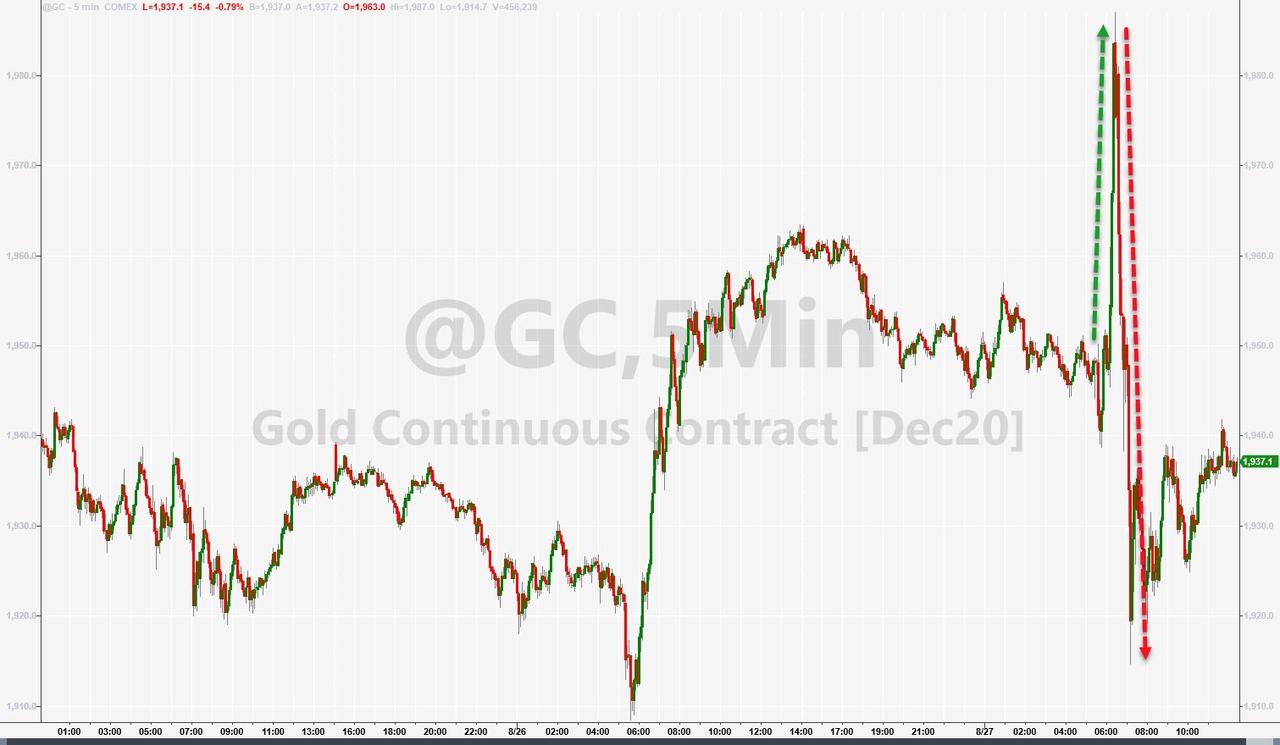
Gold ended the day lower despite Powell’s “money printer go brrr” speech but after a big pump and dump…

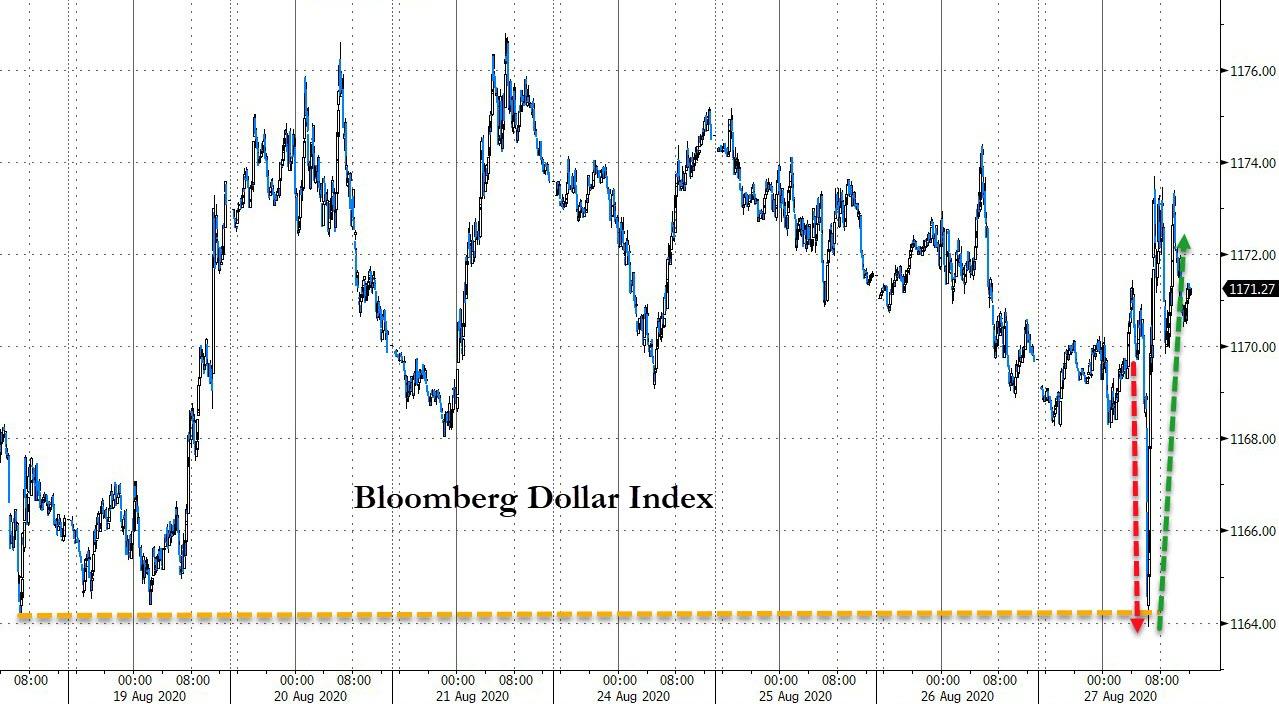
The dollar mirrored gold, dumping on Powell’s initial comments but then rocketed higher…

Source: Bloomberg

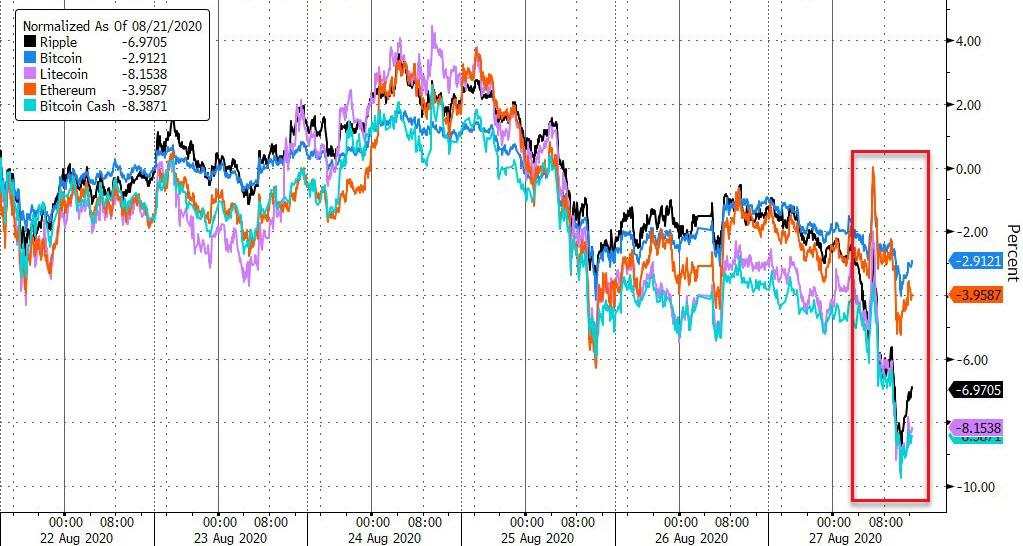
Cryptos were sold today…

Source: Bloomberg

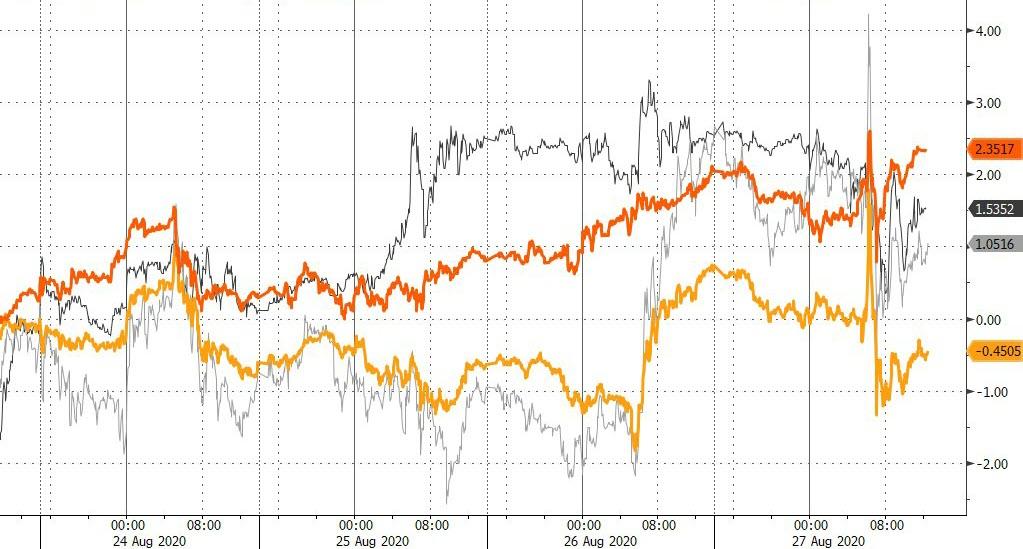
Gold is down on the week as copper leads…

Source: Bloomberg

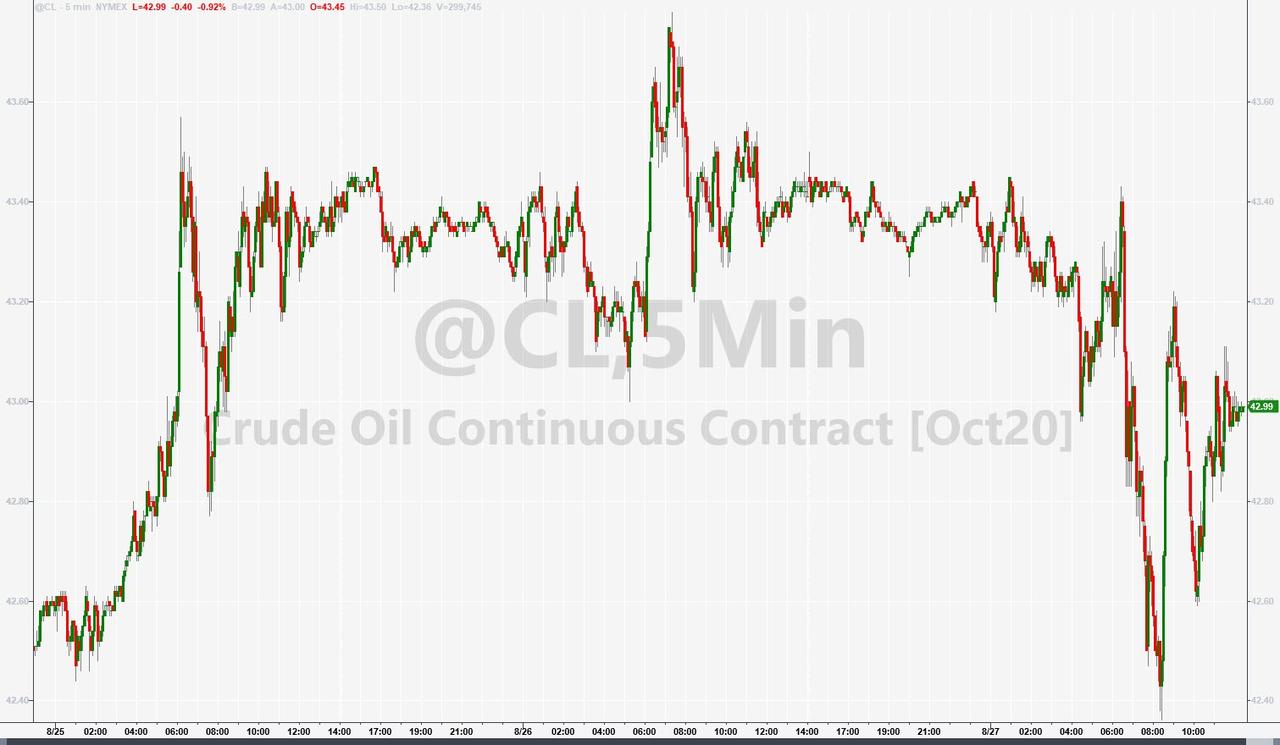
Oil prices fell, unable to scramble back above $43…

Finally, some context for today’s move in bonds…

Source: Bloomberg

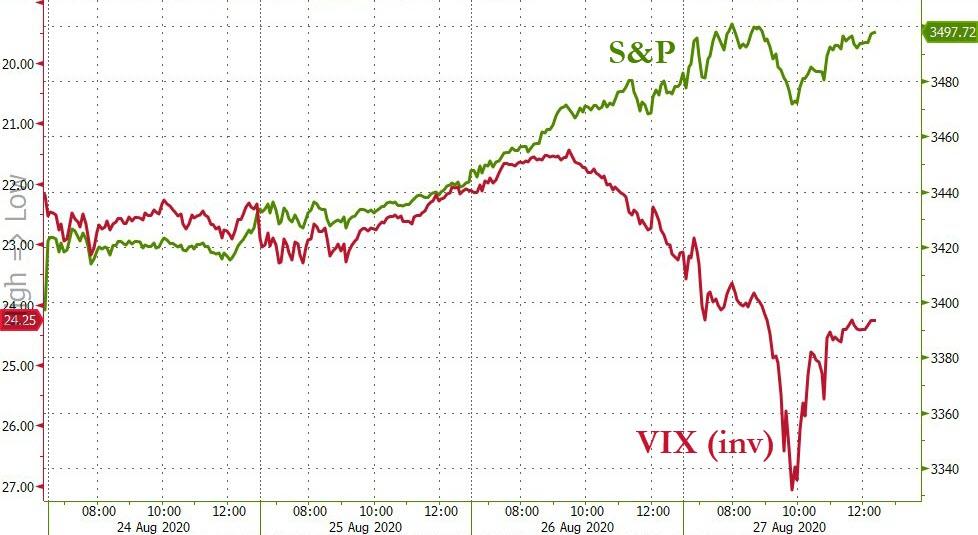
And one wonders what message VIX is sending? Everyone levered long calls or is this protection-overlays beginning?

Source: Bloomberg

via ZeroHedge News https://ift.tt/2QttXJl Tyler Durden

‘He Is Rooting For This’: Biden Accuses Trump Of “Encouraging” Violence As Mayhem Begins To Affect Polls

‘He Is Rooting For This’: Biden Accuses Trump Of “Encouraging” Violence As Mayhem Begins To Affect Polls

Tyler Durden

Thu, 08/27/2020 – 15:55

Joe Biden has accused President Trump of “encouraging” the race riots because they’re “a political benefit” to his reelection campaign.

Repeating identical talking points in Thursday appearances on CNN and MSNBC, Biden claimed that Trump is “absolutely” rooting for violence on the streets of America.

He views this as a political benefit to him. He’s rooting for more violence,” Biden told MSNBC. “He’s encouraging this. He’s not diminishing it at all. This is his America now.”

The former vice president quoted Trump aide Kellyanne Conway saying that chaos would be better for their side. “When has a president ever — a spokesperson for the president ever said something like that?” Biden asked.

Biden said he is open to visiting Wisconsin following days of violent protests there after police shot a Black man, but that it would have to be done safely and that he did not want to “become part of the problem.

Biden also addressed attacks on the seriousness of his Catholic faith from Catholic allies of Trump. “I think it’s kind of preposterous,” Biden said. “I never miss Mass. It’s part of who I am.” –Bloomberg

The former Vice President also addressed House Speaker Nancy Pelosi’s suggestion that he skip debates with Trump, saying “As long as the commission continues down the straight and narrow as they have, I’m going to debate him.”

I’m going to be a fact-checker on the floor, while I’m debating him.

Perhaps Biden’s comments were inspired by a Thursday Politico article highlighting how the unrest in Kenosha and other parts of the country are “playing into Trump’s hands.”

“There’s no doubt it’s playing into Trump’s hands,” said former Madison, WI mayor Paul Soglin (D). There’s a significant number of undecided voters who are not ideological, and they can move very easily from Republican to the Democratic column and back again. They are, in effect, the people who decide elections. And they are very distraught about both the horrendous carnage created by police officers in murdering African Americans, and … for the safety of their communities.”

And as the New York Times notes:

While many demonstrators have been peaceful, others have set fire to buildings. At least four businesses downtown have been looted. Men armed with guns have shown up to confront protesters, leading to the shooting of three people, two of them fatally. On Wednesday, a white teenager from across the state line in Illinois was arrested in connection to the shooting, and Mr. Trump vowed to send in federal law enforcement and additional National Guard troops.

In Kenosha County, where the president won by fewer than 250 votes in 2016, those who already supported Mr. Trump said in interviews that the events of the past few days have simply reinforced their conviction that he is the man for the job. But some voters who were less sure of their choice said the chaos in their city and the inability of elected leaders to stop it were currently nudging them toward the Republicans.

“I’m not 100 percent sure of anything yet,” said 41-year-old tractor factory worker John Geraghty. “But as of now I’m really not happy about how Democrats are handling any of this.”

“The Democratic agenda to me right now is America is systematically racist and evil and the only people who can fix it are Democrats,” he added. “That’s the vibe I get.”

And in a poll taken between June and early august – before the Kenosha riots, Marquette Law School found that public support for Black Lives Matter in Wisconsin had dropped from +25 to +0 in Wisconsin over the course of two months.

The Times notes the case of 62-year-old flooring company owner Don Biehn, who was standing in line at a gun store on Tuesday afternoon to buy his first pistol in order to protect his business.

Mr. Biehn said he had been calling county and state officials for days, trying to explain how grave the situation was.

There’s people running all over with guns — it’s like some Wild West town,” Mr. Biehn said. “We are just waiting here like sitting ducks waiting to get picked off.”

He added: “It’s chaos — everybody is afraid.”

Mr. Trump, he said, “was not my man,” but now he is grateful he is president.New York Times

And here’s the punchline from the New York Times

“Some Democrats, nervous about condemning the looting because they said they understood the rage behind it, worried that what was happening in their town might backfire and aid the president’s re-election prospects.”

via ZeroHedge News https://ift.tt/3hCOgjz Tyler Durden

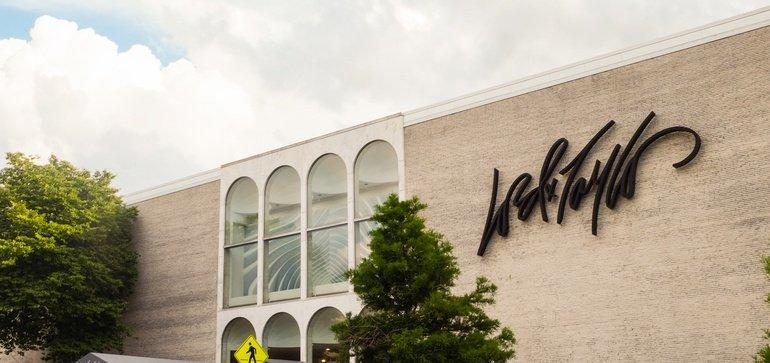
With No Buyer In Sight, Lord & Taylor Liquidates All Stores

With No Buyer In Sight, Lord & Taylor Liquidates All Stores

Tyler Durden

Thu, 08/27/2020 – 15:50

By RetailDive,

It looks like nobody will ever know if the tie-up between an online apparel site and a storied department store would have worked.

  • Bankrupt Le Tote and Lord & Taylor on Tuesday said all 38 department store locations have begun going-out-of-business sales, adding a final few to the 24 already in progress.

  • The company said it is “still entertaining various opportunities” in hopes of selling itself as a going concern, according to an emailed press release.

  • But in a statement, Chief Restructuring Officer Ed Kremer said the liquidations are “prudent” in order to maximize the value of the stores’ inventory.

When Le Tote took over Lord & Taylor last year, several observers scoffed, while others noted it was the first time in a long time that the department store’s parent had any interest in it beyond its real estate. While former owner Hudson’s Bay Co. found willing buyers for Lord & Taylor’s buildings, including its famous Italianate flagship in New York, for example, its merchandising and marketing were left to drift — aside from a placement on Walmart.com three years ago.

Le Tote’s ability to salvage Lord & Taylor, founded in 1826 and one of the strongest retailers in the U.S. for decades, was never a sure thing. But the pandemic managed to scuttle its prospects entirely. The company filed under Chapter 11 earlier this month.

“I am extraordinarily proud of the continued efforts of our store and corporate team members as they have worked tirelessly over the past several months, under unprecedented conditions, to preserve this historic brand,” Kremer said. “We have a long road ahead of us and I am grateful and humbled by the dedication and resiliency of our team.”

As of last week, Amazon now owns the Lord & Taylor flagship building in Manhattan, and appears to be working on making a name for itself in fashion. If so, becoming what Lord & Taylor once was — a destination for accessible, stylish American designs — may be a worthy goal.

via ZeroHedge News https://ift.tt/2YJ5TqG Tyler Durden

Beauharnais v. Illinois and Libel of Racial, Religious, Etc. Groups

This matter came up on another thread, so I thought I’d briefly discuss it in more detail.

In Beauharnais v. Illinois (1952), the Supreme Court upheld a “group libel” law that outlawed statements that expose racial or religious groups to contempt or hatred, unless the speaker could show that the statements were true and were said with “good motives” and for “justifiable ends.” The Court’s rationale was that (1) libel was constitutionally unprotected, and (2),

[T]he Illinois legislature may warrantably believe that a man’s job and his educational opportunities and the dignity accorded him may depend as much on the reputation of the racial and religious group to which he willy-nilly belongs, as on his own merits. This being so, we are precluded from saying that speech concededly punishable when immediately directed at individuals cannot be outlawed if directed at groups with whose position and esteem in society the affiliated individual may be inextricably involved.

The Court therefore upheld Beauharnais’ conviction for distributing leaflets that called on the Chicago Mayor and City Council “to halt the further encroachment, harassment and invasion of white people, their property, neighborhoods and persons, by the Negro,” called for “One million self respecting white people in Chicago to unite,” and stated that, “If persuasion and the need to prevent the white race from becoming mongrelized by the negro will not unite us, then the aggressions … rapes, robberies, knives, guns and marijuana of the negro, surely will.”

Like some other old cases, such as Schenck v. U.S. (1919), Abrams v. U.S. (1919), Gilbert v. Minnesota (1920), and Gitlow v. New York (1925) (which upheld restrictions on speech sharply critical of the war and the draft, and speech expressing support for overthrowing the government), Beauharnais has never been formally overruled. But several appellate courts have held or strongly suggested that it’s no longer binding precedent. See Nuxoll ex rel. Nuxoll v. Indian Prairie Sch. Dist. # 204, 523 F.3d 668, 672 (7th Cir. 2008); Am. Booksellers Ass’n, Inc. v. Hudnut, 771 F.2d 323, 331 n.3 (7th Cir. 1985) (likewise); Collin v. Smith, 578 F.2d 1197, 1205 (7th Cir. 1978); Tollett v. United States, 485 F.2d 1087, 1094 n.14 (8th Cir. 1973); Dworkin v. Hustler Magazine Inc., 867 F.2d 1188, 1200 (9th Cir. 1989). No courts, to my knowledge, have applied it in recent decades. Leading First Amendment scholars have taken the same view, Erwin Chemerinsky, Constitutional Law: Principles and Policies 1043-45 (4th ed. 2011); Laurence Tribe, Constitutional Law, § 12-17, at 926; Toni M. Massaro, Equality and Freedom of Expression: The Hate Speech Dilemma, 32 Wm. & Mary L. Rev. 211, 219 (1991); Robert C. Post, Cultural Heterogeneity and Law: Pornography, Blasphemy, and the First Amendment, 76 Calif. L. Rev. 297, 330-31 (1988); some others disagree, but the dominant view here is clear.

And I think those authorities are correct, because post-Beauharnais cases have firmly rejected the reasoning of the case (just as cases such as Brandenburg v. Ohio have rejected the reasoning of Schenck, Abrams, Gilbert, and Gitlow).

[1.] New York Times Co. v. Sullivan (1964), rejected the view that libel is categorically unprotected. Recall that the premise of Beauharnais was that libel was just unprotected, and therefore group libel is as punishable as individual libel.

[2.] To be sure, New York Times Co. v. Sullivan recognized that knowing or reckless falsehoods can be punished; but Garrison v. Louisiana (1964) made clear that, for statements on matters of public concern, truth has to be an absolute defense, regardless of whether the statements are made for “good motives” and for “justifiable ends.” Beauharnais upheld a law that didn’t make truth a complete defense, reasoning that,

As to the defense of truth, Illinois in common with many States requires a showing not only that the utterance state the facts, but also that the publication be made “with good motives and for justifiable ends.” … What has been called “the common sense of American criminal law” … has been adopted in terms by Illinois. The teaching of a century and a half of criminal libel prosecutions in this country would go by the board if we were to hold that Illinois was not within her rights in making this combined requirement.

But that “teaching of a century and a half of criminal libel prosecutions in this country”—that good motives and justifiable ends could be required for a truth defense to prevail—did indeed go by the board in Garrison, which reasoned,

We next consider whether the historical limitation of the defense of truth in criminal libel to utterances published “with good motives and for justifiable ends” should be incorporated into the New York Times rule as it applies to criminal libel statutes; in particular, we must ask whether this history permits negating the truth defense, as the Louisiana statute does, on a showing of malice in the sense of ill-will. The “good motives” restriction … liberalized the common-law rule denying any defense for truth. We need not be concerned whether this limitation serves a legitimate state interest to the extent that it reflects abhorrence that “a man’s forgotten misconduct, or the misconduct of a relation, in which the public had no interest, should be wantonly raked up, and published to the world, on the ground of its being true.” In any event, where the criticism is of public officials and their conduct of public business, the interest in private reputation is overborne by the larger public interest, secured by the Constitution, in the dissemination of truth.

“If upon a lawful occasion for making a publication, he has published the truth, and no more, there is no sound principle which can make him liable, even if he was actuated by express malice…. It has been said that it is lawful to publish truth from good motives, and for justifiable ends. But this rule is too narrow. If there is a lawful occasion —a legal right to make a publication—and the matter true, the end is justifiable, and that, in such case, must be sufficient.”

Moreover, even where the utterance is false, the great principles of the Constitution which secure freedom of expression in this area preclude attaching adverse consequences to any except the knowing or reckless falsehood. Debate on public issues will not be uninhibited if the speaker must run the risk that it will be proved in court that he spoke out of hatred; even if he did speak out of hatred, utterances honestly believed contribute to the free interchange of ideas and the ascertainment of truth…. [P]ermitting a finding of malice based on an intent merely to inflict harm, rather than an intent to inflict harm through falsehood, “it becomes a hazardous matter to speak out against a popular politician, with the result that the dishonest and incompetent will be shielded.”

[3.] New York Times dealt with libel of public officials; Garrison also mentioned public officials, though also talked more broadly about “[d]ebate on public issues”; but Gertz v. Robert Welch, Inc. (1974) made clear that the First Amendment protections against punishment of libel apply to all speech about matters of public concern, whether it touches on public or private figures. Gertz did allow proven compensatory damages to be recovered by private figures on a showing merely of negligence, but presumed damages and punitive damages could only be awarded on a showing of knowing or reckless falsehood, just as for public officials and public figures. It’s even clearer that criminal punishment for statements on matters of public concern likewise requires knowing or reckless falsehood.

[4.] Gertz also reaffirmed that libel law doesn’t apply to true statements; the Court’s reasoning began with the premise that “there is no constitutional value in false statements of fact.” And Philadelphia Newspapers, Inc. v. Hepps (1986) made clear that, on matters of public concern, the plaintiff (whether a public or private figure) had to prove falsehood, rather than requiring the defendant to prove truth. That is even more clearly so for criminal punishment; here again the statute in Beauharnais would be deficient under modern law.

[5.] Now that still leaves the question: What if the statute in Beauharnais were limited to false statements of fact about a racial or religious group that tended to expose it to contempt or hatred, which the defendant said knowing that they were false or likely false?

Even that statute, though, would be inconsistent with current law.

[A.] R.A.V. v. City of St. Paul (1992) held that, even within a zone of unprotected speech (there, fighting words), the government generally can’t single out certain kinds of speech for special punishment, especially viewpoint-based punishment. Just as the Court in R.A.V. struck down a law that was read as specially banning bigoted “fighting words”—face-to-face personal insults that tend to provoke a violent reaction—so a law that specially bans bigoted libels would be unconstitutional, too. This is an oversimplification, given the complexity of R.A.V. and of Virginia v. Black (2003), and certain exemptions that they contain. But it’s pretty clear that a law banning libel of races and religions would be seen as closely analogous to the R.A.V. law banning race- and religion-based fighting words. (R.A.V. did cite Beauharnais, but only for its general statement that there is a defamation exception, since that was the Court’s first libel case that expressly so held.)

[B.] Finally, in U.S. v. Alvarez (2012), five Justices (two in the concurrence and three in the dissent) agreed that

there are broad areas in which any attempt by the state to penalize purportedly false speech would present a grave and unacceptable danger of suppressing truthful speech

and gave as examples of those areas, “false statements about philosophy, religion, history, the social sciences, the arts, and the like.” In the words of the dissent,

The point is not that there is no such thing as truth or falsity in these areas or that the truth is always impossible to ascertain, but rather that it is perilous to permit the state to be the arbiter of truth.

Even where there is a wide scholarly consensus concerning a particular matter, the truth is served by allowing that consensus to be challenged without fear of reprisal. Today’s accepted wisdom sometimes turns out to be mistaken. And in these contexts, “[e]ven a false statement may be deemed to make a valuable contribution to public debate, since it brings about ‘the clearer perception and livelier impression of truth, produced by its collision with error.'”

The plurality didn’t disagree, and if anything supported even broader protection for false statements.

Statements about race and crime (the statements involved in Beauharnais itself) would likely qualify as being “about … the social sciences … and the like,” and thus would be categorically protected under Alvarez.

[* * *]

For all these reasons, I think that lower courts should feel no more bound by the reasoning of Beauharnais than they are by Schenck, Abrams, Gilbert, and Gitlow. But even if a court concludes that Beauharnais has to be applied as to a group libel statute identical to Illinois’ until it’s expressly reversed by the Court, to my knowledge there are no such criminal statutes remaining, except for a seemingly never-used one in Massachusetts; and the common-law tort of libel likewise doesn’t extend to such large groups (see, e.g., Mikolinski v. Burt Reynolds Prod. Co. (Mass. App. Ct. 1980)).

from Latest – Reason.com https://ift.tt/2EvtO5O
via IFTTT

Biden Rejects Pelosi’s Advice To Skip Debates with Trump

biden-pelosi

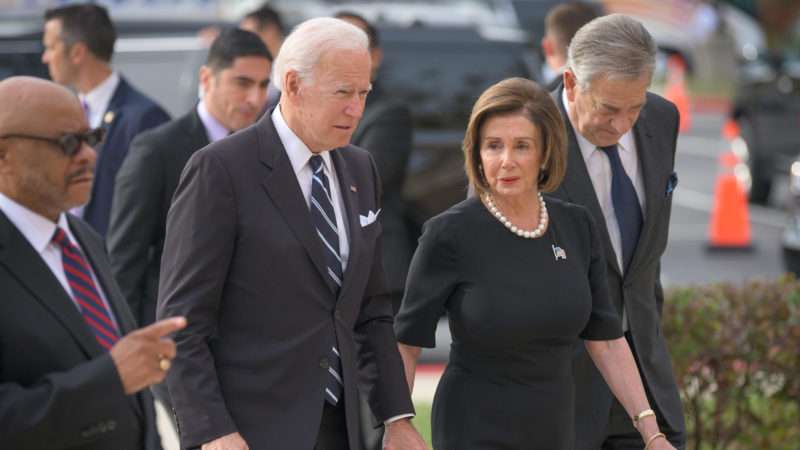
Speaker Nancy Pelosi (D–Calif.) today advised Democratic presidential nominee Joe Biden to skip any debates with the incumbent. “I do not think that the president of the United States has comported himself in a way that has any association with truth, evidence, data, and facts,” says Pelosi.

Biden has rightly rejected the suggestion. He’s right to do so: Pelosi’s position is risible, especially for the whopping 41 percent of us who identify as something other than Republican (26 percent) or Democrat (31 percent). Last week’s Democratic National Convention was more inward-looking than 16th-century China and this week’s Republican counterpart is similarly aimed almost completely at people who are already going to vote for their party’s guy.

Presidential debates offer nonpartisan voters an opportunity to get a better sense of the candidates and what they think. Even from a tactical perspective, Pelosi’s advice is dumb. Anyone who has is following the election has legitimate doubts about Joe Biden’s mental state—and Donald Trump’s too. They are 77 years and 74 years old, respectively, and neither of them inspires much confidence that they have all their marbles. It was only a few weeks ago that Biden was asking a reporter if he was a “junkie,” while Trump, who himself mused about skipping the debates earlier this year, has faced inquiries about his physical condition.

Ideally, the debates would also be open to any other candidates who are on the ballot in enough states that it is mathematically possible win the election, a standard met by the Libertarian Party’s Jo Jorgensen and the Green Party’s Howie Hawkins. According to Gallup, 57 percent of Americans agree that a “third major party is needed.” Adding such candidates to the debates would both make the events far more popular and hugely improve politics.

As it stands, Biden and Trump have tentatively agreed to three debates before the November 3 election. While there’s no reason to expect Biden to change his mind and follow Nancy Pelosi’s advice, there’s zero hope that the Commission on Presidential Debates, which is run jointly by the Democratic and Republican parties, will allow electorally viable third parties to participate. Because if there’s one thing that Democrats and Republicans hate more than each other, it’s every other party that’s on the ballot.

Bonus video: In 2016, I offered four reasons why Libertarian nominee Gary Johnson should have been included in the presidential debates:

from Latest – Reason.com https://ift.tt/2YDhQhC
via IFTTT