Beauharnais v. Illinois and Libel of Racial, Religious, Etc. Groups

This matter came up on another thread, so I thought I’d briefly discuss it in more detail.

In Beauharnais v. Illinois (1952), the Supreme Court upheld a “group libel” law that outlawed statements that expose racial or religious groups to contempt or hatred, unless the speaker could show that the statements were true and were said with “good motives” and for “justifiable ends.” The Court’s rationale was that (1) libel was constitutionally unprotected, and (2),

[T]he Illinois legislature may warrantably believe that a man’s job and his educational opportunities and the dignity accorded him may depend as much on the reputation of the racial and religious group to which he willy-nilly belongs, as on his own merits. This being so, we are precluded from saying that speech concededly punishable when immediately directed at individuals cannot be outlawed if directed at groups with whose position and esteem in society the affiliated individual may be inextricably involved.

The Court therefore upheld Beauharnais’ conviction for distributing leaflets that called on the Chicago Mayor and City Council “to halt the further encroachment, harassment and invasion of white people, their property, neighborhoods and persons, by the Negro,” called for “One million self respecting white people in Chicago to unite,” and stated that, “If persuasion and the need to prevent the white race from becoming mongrelized by the negro will not unite us, then the aggressions … rapes, robberies, knives, guns and marijuana of the negro, surely will.”

Like some other old cases, such as Schenck v. U.S. (1919), Abrams v. U.S. (1919), Gilbert v. Minnesota (1920), and Gitlow v. New York (1925) (which upheld restrictions on speech sharply critical of the war and the draft, and speech expressing support for overthrowing the government), Beauharnais has never been formally overruled. But several appellate courts have held or strongly suggested that it’s no longer binding precedent. See Nuxoll ex rel. Nuxoll v. Indian Prairie Sch. Dist. # 204, 523 F.3d 668, 672 (7th Cir. 2008); Am. Booksellers Ass’n, Inc. v. Hudnut, 771 F.2d 323, 331 n.3 (7th Cir. 1985) (likewise); Collin v. Smith, 578 F.2d 1197, 1205 (7th Cir. 1978); Tollett v. United States, 485 F.2d 1087, 1094 n.14 (8th Cir. 1973); Dworkin v. Hustler Magazine Inc., 867 F.2d 1188, 1200 (9th Cir. 1989). No courts, to my knowledge, have applied it in recent decades. Leading First Amendment scholars have taken the same view, Erwin Chemerinsky, Constitutional Law: Principles and Policies 1043-45 (4th ed. 2011); Laurence Tribe, Constitutional Law, § 12-17, at 926; Toni M. Massaro, Equality and Freedom of Expression: The Hate Speech Dilemma, 32 Wm. & Mary L. Rev. 211, 219 (1991); Robert C. Post, Cultural Heterogeneity and Law: Pornography, Blasphemy, and the First Amendment, 76 Calif. L. Rev. 297, 330-31 (1988); some others disagree, but the dominant view here is clear.

And I think those authorities are correct, because post-Beauharnais cases have firmly rejected the reasoning of the case (just as cases such as Brandenburg v. Ohio have rejected the reasoning of Schenck, Abrams, Gilbert, and Gitlow).

[1.] New York Times Co. v. Sullivan (1964), rejected the view that libel is categorically unprotected. Recall that the premise of Beauharnais was that libel was just unprotected, and therefore group libel is as punishable as individual libel.

[2.] To be sure, New York Times Co. v. Sullivan recognized that knowing or reckless falsehoods can be punished; but Garrison v. Louisiana (1964) made clear that, for statements on matters of public concern, truth has to be an absolute defense, regardless of whether the statements are made for “good motives” and for “justifiable ends.” Beauharnais upheld a law that didn’t make truth a complete defense, reasoning that,

As to the defense of truth, Illinois in common with many States requires a showing not only that the utterance state the facts, but also that the publication be made “with good motives and for justifiable ends.” … What has been called “the common sense of American criminal law” … has been adopted in terms by Illinois. The teaching of a century and a half of criminal libel prosecutions in this country would go by the board if we were to hold that Illinois was not within her rights in making this combined requirement.

But that “teaching of a century and a half of criminal libel prosecutions in this country”—that good motives and justifiable ends could be required for a truth defense to prevail—did indeed go by the board in Garrison, which reasoned,

We next consider whether the historical limitation of the defense of truth in criminal libel to utterances published “with good motives and for justifiable ends” should be incorporated into the New York Times rule as it applies to criminal libel statutes; in particular, we must ask whether this history permits negating the truth defense, as the Louisiana statute does, on a showing of malice in the sense of ill-will. The “good motives” restriction … liberalized the common-law rule denying any defense for truth. We need not be concerned whether this limitation serves a legitimate state interest to the extent that it reflects abhorrence that “a man’s forgotten misconduct, or the misconduct of a relation, in which the public had no interest, should be wantonly raked up, and published to the world, on the ground of its being true.” In any event, where the criticism is of public officials and their conduct of public business, the interest in private reputation is overborne by the larger public interest, secured by the Constitution, in the dissemination of truth.

“If upon a lawful occasion for making a publication, he has published the truth, and no more, there is no sound principle which can make him liable, even if he was actuated by express malice…. It has been said that it is lawful to publish truth from good motives, and for justifiable ends. But this rule is too narrow. If there is a lawful occasion —a legal right to make a publication—and the matter true, the end is justifiable, and that, in such case, must be sufficient.”

Moreover, even where the utterance is false, the great principles of the Constitution which secure freedom of expression in this area preclude attaching adverse consequences to any except the knowing or reckless falsehood. Debate on public issues will not be uninhibited if the speaker must run the risk that it will be proved in court that he spoke out of hatred; even if he did speak out of hatred, utterances honestly believed contribute to the free interchange of ideas and the ascertainment of truth…. [P]ermitting a finding of malice based on an intent merely to inflict harm, rather than an intent to inflict harm through falsehood, “it becomes a hazardous matter to speak out against a popular politician, with the result that the dishonest and incompetent will be shielded.”

[3.] New York Times dealt with libel of public officials; Garrison also mentioned public officials, though also talked more broadly about “[d]ebate on public issues”; but Gertz v. Robert Welch, Inc. (1974) made clear that the First Amendment protections against punishment of libel apply to all speech about matters of public concern, whether it touches on public or private figures. Gertz did allow proven compensatory damages to be recovered by private figures on a showing merely of negligence, but presumed damages and punitive damages could only be awarded on a showing of knowing or reckless falsehood, just as for public officials and public figures. It’s even clearer that criminal punishment for statements on matters of public concern likewise requires knowing or reckless falsehood.

[4.] Gertz also reaffirmed that libel law doesn’t apply to true statements; the Court’s reasoning began with the premise that “there is no constitutional value in false statements of fact.” And Philadelphia Newspapers, Inc. v. Hepps (1986) made clear that, on matters of public concern, the plaintiff (whether a public or private figure) had to prove falsehood, rather than requiring the defendant to prove truth. That is even more clearly so for criminal punishment; here again the statute in Beauharnais would be deficient under modern law.

[5.] Now that still leaves the question: What if the statute in Beauharnais were limited to false statements of fact about a racial or religious group that tended to expose it to contempt or hatred, which the defendant said knowing that they were false or likely false?

Even that statute, though, would be inconsistent with current law.

[A.] R.A.V. v. City of St. Paul (1992) held that, even within a zone of unprotected speech (there, fighting words), the government generally can’t single out certain kinds of speech for special punishment, especially viewpoint-based punishment. Just as the Court in R.A.V. struck down a law that was read as specially banning bigoted “fighting words”—face-to-face personal insults that tend to provoke a violent reaction—so a law that specially bans bigoted libels would be unconstitutional, too. This is an oversimplification, given the complexity of R.A.V. and of Virginia v. Black (2003), and certain exemptions that they contain. But it’s pretty clear that a law banning libel of races and religions would be seen as closely analogous to the R.A.V. law banning race- and religion-based fighting words. (R.A.V. did cite Beauharnais, but only for its general statement that there is a defamation exception, since that was the Court’s first libel case that expressly so held.)

[B.] Finally, in U.S. v. Alvarez (2012), five Justices (two in the concurrence and three in the dissent) agreed that

there are broad areas in which any attempt by the state to penalize purportedly false speech would present a grave and unacceptable danger of suppressing truthful speech

and gave as examples of those areas, “false statements about philosophy, religion, history, the social sciences, the arts, and the like.” In the words of the dissent,

The point is not that there is no such thing as truth or falsity in these areas or that the truth is always impossible to ascertain, but rather that it is perilous to permit the state to be the arbiter of truth.

Even where there is a wide scholarly consensus concerning a particular matter, the truth is served by allowing that consensus to be challenged without fear of reprisal. Today’s accepted wisdom sometimes turns out to be mistaken. And in these contexts, “[e]ven a false statement may be deemed to make a valuable contribution to public debate, since it brings about ‘the clearer perception and livelier impression of truth, produced by its collision with error.'”

The plurality didn’t disagree, and if anything supported even broader protection for false statements.

Statements about race and crime (the statements involved in Beauharnais itself) would likely qualify as being “about … the social sciences … and the like,” and thus would be categorically protected under Alvarez.

[* * *]

For all these reasons, I think that lower courts should feel no more bound by the reasoning of Beauharnais than they are by Schenck, Abrams, Gilbert, and Gitlow. But even if a court concludes that Beauharnais has to be applied as to a group libel statute identical to Illinois’ until it’s expressly reversed by the Court, to my knowledge there are no such criminal statutes remaining, except for a seemingly never-used one in Massachusetts; and the common-law tort of libel likewise doesn’t extend to such large groups (see, e.g., Mikolinski v. Burt Reynolds Prod. Co. (Mass. App. Ct. 1980)).

from Latest – Reason.com https://ift.tt/2EvtO5O
via IFTTT
Biden Rejects Pelosi’s Advice To Skip Debates with Trump

biden-pelosi

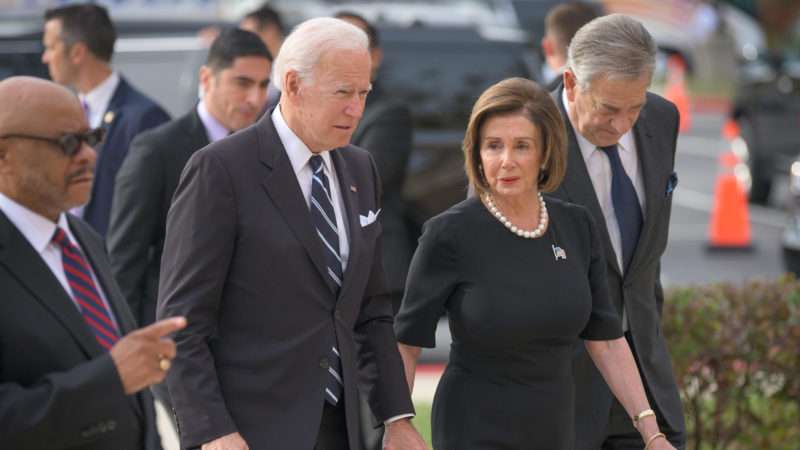
Speaker Nancy Pelosi (D–Calif.) today advised Democratic presidential nominee Joe Biden to skip any debates with the incumbent. “I do not think that the president of the United States has comported himself in a way that has any association with truth, evidence, data, and facts,” says Pelosi.

Biden has rightly rejected the suggestion. He’s right to do so: Pelosi’s position is risible, especially for the whopping 41 percent of us who identify as something other than Republican (26 percent) or Democrat (31 percent). Last week’s Democratic National Convention was more inward-looking than 16th-century China and this week’s Republican counterpart is similarly aimed almost completely at people who are already going to vote for their party’s guy.

Presidential debates offer nonpartisan voters an opportunity to get a better sense of the candidates and what they think. Even from a tactical perspective, Pelosi’s advice is dumb. Anyone who has is following the election has legitimate doubts about Joe Biden’s mental state—and Donald Trump’s too. They are 77 years and 74 years old, respectively, and neither of them inspires much confidence that they have all their marbles. It was only a few weeks ago that Biden was asking a reporter if he was a “junkie,” while Trump, who himself mused about skipping the debates earlier this year, has faced inquiries about his physical condition.

Ideally, the debates would also be open to any other candidates who are on the ballot in enough states that it is mathematically possible win the election, a standard met by the Libertarian Party’s Jo Jorgensen and the Green Party’s Howie Hawkins. According to Gallup, 57 percent of Americans agree that a “third major party is needed.” Adding such candidates to the debates would both make the events far more popular and hugely improve politics.

As it stands, Biden and Trump have tentatively agreed to three debates before the November 3 election. While there’s no reason to expect Biden to change his mind and follow Nancy Pelosi’s advice, there’s zero hope that the Commission on Presidential Debates, which is run jointly by the Democratic and Republican parties, will allow electorally viable third parties to participate. Because if there’s one thing that Democrats and Republicans hate more than each other, it’s every other party that’s on the ballot.

Bonus video: In 2016, I offered four reasons why Libertarian nominee Gary Johnson should have been included in the presidential debates:

from Latest – Reason.com https://ift.tt/2YDhQhC
via IFTTT

Chen Guangcheng Fled China to America, and Last Night He Spoke at the RNC. How About Opening Our Doors to Oppressed Hongkongers Too?

Screen Shot 2020-08-27 at 1.29.20 PM

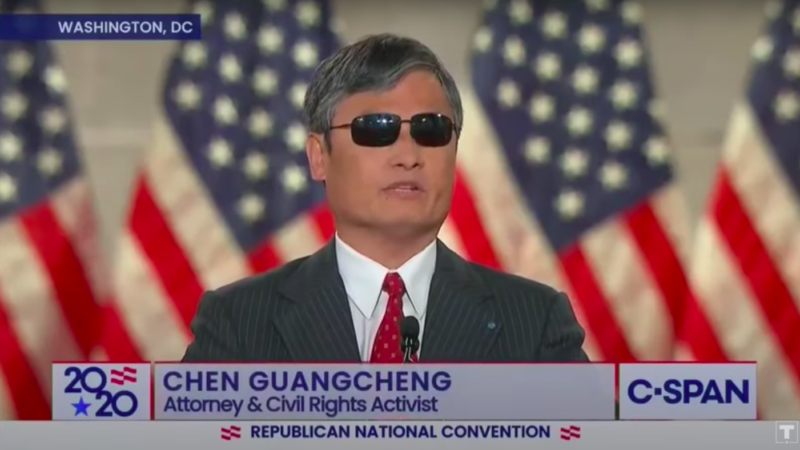
In an otherwise humdrum night of Republican National Convention (RNC) programming, Chinese dissident Chen Guangcheng, who escaped his home country in 2012, gave a speech that stood out.

Chen is a divisive figure among overseas dissidents and fellow critics of the Chinese Communist Party (CCP), but his story is a powerful one. In June 2005, he organized a class-action lawsuit against the authorities in Shandong province over the sterilizations and abortions that the government was imposing on citizens as part of the “one child” policy. Just months later, Chen and his family were imprisoned inside their home, where they were kept until the following year; Chen then began to serve a full-fledged prison sentence. On completing it in 2010, he was returned to further house arrest and further surveillance. Finally, in 2012, Chen sought refuge at the U.S. embassy, where he hid for several weeks; with the help of U.S. officials, he then fled to New York City with his wife and children.

In his speech last night, he told audiences how hard it is to stand up to tyranny. “When I spoke out against China’s ‘one child’ policy and other injustices, I was persecuted, beaten, and put under house arrest,” he said. “In China, expressing beliefs or ideas not approved by the CCP—religion, democracy, human rights—can lead to prison. The nation lives under mass surveillance and censorship.”

He is right on all of those counts. The CCP is responsible for the brutal internment of the Uighur minority group, forced sterilizations and abortions, and crackdowns on speech and academic freedom in Hong Kong. The CCP has disappeared Hong Kong’s booksellers, heavily regulated the internet to control what types of websites people can access via the “Great Firewall,” and expelled foreign journalists and news bureaus to suppress the flow of information abroad. The Chinese government to this day scrubs references to its 1989 Tiananmen Square massacre from the internet. The list of ways the Chinese government systematically deprives its citizens of their rights—their ability to speak and write, create families of all sizes, access historical information, move about freely, agitate for change—goes on and on. Chen, a man who has been imprisoned by the state both in his own home and in a government facility, is immensely qualified to speak on this.

The candidate on whose behalf he was speaking, on the other hand, has failed to offer oppressed Hongkongers the most basic form of help: refuge. As my colleague Eric Boehm wrote in May, “With the freedom of Hongkongers under direct assault, the United States should throw open its doors to accept any of the city’s residents who need a place to go.”

This could take the form of asylum, a direct pathway to citizenship, or an expansion of visa programs to work or study in the U.S. Such an initiative could cover Hongkongers alone, or could be extended to mainland Chinese as well. The British government is already opening its doors to Hongkongers, and Australia has been flirting with following suit. Why are we so reticent?

In his speech, Chen remarked, “I’m forever grateful to the American people for welcoming me and my family to the United States where we are now free.” Many more people ought to have that opportunity—and that’s within the president’s power to accomplish.

from Latest – Reason.com https://ift.tt/3ls0MEK
via IFTTT

Elon Musk’s Net Worth Eclipses $100 Billion As The Fed Drives Inequality Gap Wider

Elon Musk’s Net Worth Eclipses $100 Billion As The Fed Drives Inequality Gap Wider

Tyler Durden

Thu, 08/27/2020 – 15:20

Of all the subsidies Elon Musk has received for Tesla, there has been none bigger than the Fed injecting trillions into the stock market to buoy stock prices in the midst of one of the worst recessions the country has ever seen.

And helping along the Fed are regulators, who seem to be perfectly content in Tesla’s mysterious and bewildering stock spike that has seen its shares nearly 10x off lows over the course of less than 18 months on little material news.

It’s these subsidies, combined with regulatory impotence, that have pushed Elon Musk’s net worth to well over $100 billion.

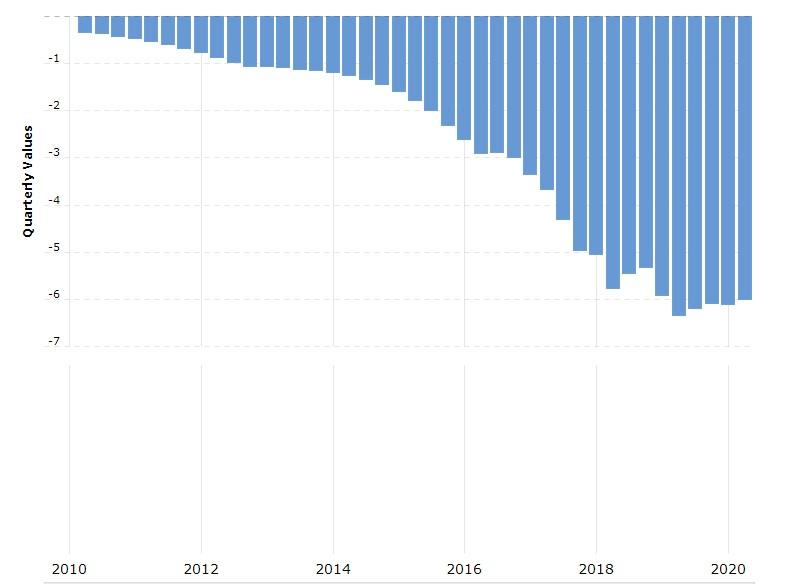
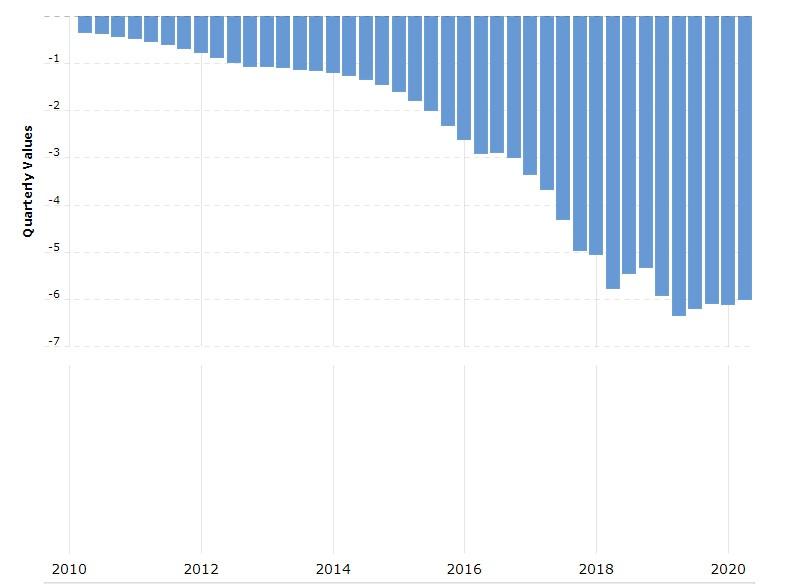
And if you don’t think the system is broken yet, keep in mind that Tesla has an accumulated deficit over its lifespan of about $6 billion. This means the company has lost $6 billion more than it has generated in profits and paid out in dividends.

Tesla Accumulated Deficit (via MacroTrends.com)

While much of the story this week was Amazon’s Jeff Bezos watching his net worth balloon to over $200 billion, Tesla CEO Elon Musk’s net worth breached the $100 billion mark at the same time, according to Bloomberg. The difference, of course, is that Bezos runs a sustainable and consistently profitable business while Musk runs a three-ring circus out of a tent in Fremont. 

Neither Bezos nor Musk would have achieved such milestones of wealth had the Fed not intervened in the markets months ago. The income inequality is getting to a fever pitch that people are finding hard to ignore. 

And what better way to fight a problem than with more problematic thinking? That’s what Bernie Sanders is proposing. Rather than bringing his beef to the Fed, where it belongs, he would rather simply confiscate wealth from billionaires.

Sanders said Wednesday: “We cannot continue to allow billionaires like Jeff Bezos and Elon Musk to become obscenely rich while millions of Americans face eviction, hunger and economic desperation. It’s time to fundamentally change our national priorities.”

…to socialism.

In addition to Musk and Bezos, other billionaires worldwide have been the beneficiary of global monetary policy as well. India’s Mukesh Ambani tacked $22.5 billion onto his net worth this year as well. Mark Zuckerberg’s net worth also eclipsed $100 billion earlier this month. 

Regardless, the public is starting to wake up:

via ZeroHedge News https://ift.tt/32vqPT9 Tyler Durden

Are The Tables Starting To Turn?

Are The Tables Starting To Turn?

Tyler Durden

Thu, 08/27/2020 – 15:05

Authored by Raul Ilargi Meijer via The Automatic Earth blog,

Pew Research Center poll that’s already a month old (and a lot happened since) concluded that violent crime is a major issue according to 59% of voters (almost as much as coronavirus): 74% of Republicans and 46% of Democrats. But during the DNC, held after the poll was already out, the issue wasn’t addressed at all. Democrats talked about police violence, but not riot violence.

At this week’s RNC, this situation is -of course- very different. The DNC pushes the GOP into the role of the party of law and order, and they’re all too willing to take up that role. But I was wondering about something else, or “bigger”, this morning. That is, Joe Biden et al are very light on policies, because in their view their most important issue is to get people to vote *against* Donald Trump, rather than *for* Biden.

And I’m thinking maybe that’s starting to boomerang, to blow up in their faces, whether perhaps people are beginning to lean towards NOT voting for Joe Biden, instead of NOT voting for Donald Trump, “at any cost”. In that context, it appears telling that according to a new Reuters/Ipsos poll, Biden saw no “convention poll bounce” in his numbers after the DNC, while ironically, Trump did.

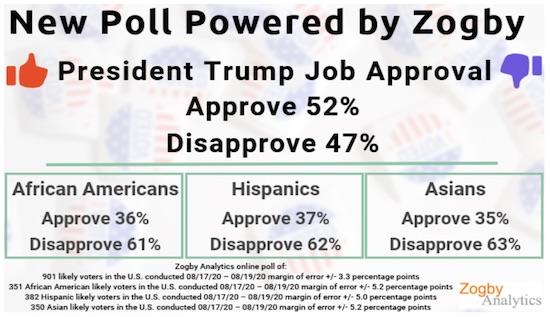
Whereas according to a Zogby Analytics poll, Trump’s job approval numbers are now at record high levels. And I know polls -and pollsters- can be biased, and so can the press quoting them, but to see three in a row, Reuters/Ipsos, Rasmussen, Zogby, all reporting similar movement, may still be significant.

Trump Job Approval Rating Hits Record At 52%

Buoyed by blacks and independent voters, as well as urban dwellers shocked by the Black Lives Matter protest violence raging in some cities, President Trump’s approval rating has hit a new high, according to a survey heavy with minority voters. The latest Zogby Analytics poll just shared with Secrets had Trump’s approval at 52%. “The president has recorded his best job approval rating on record,” said pollster Jonathan Zogby.

What’s more, his approval rating among minorities was solid and, in the case of African Americans, shockingly high. Zogby said 36% of blacks approve of the president, as do 37% of Hispanics and 35% of Asians. Approval among independent voters is also up, to 44%. And “intriguingly,” said Zogby, 23% of Democrats approve of Trump.

It was the latest to show that Trump’s approval went up during the Democratic National Convention. Rasmussen Reports had it at 51% at the end of the convention. In a shock from past election years, Joe Biden got no convention poll bounce, according to a newly released Reuters/Ipsos poll. [..] Zogby, in his analysis, took a stab at the reasoning. First, he said, his and other polls are confirming that the nation is nearly evenly divided politically and that despite some showing a big Biden lead, the race is extremely close.

He suggested that the battle is for the “10%-20%” who haven’t made their minds up on whom to vote for and who likely won’t make up their minds until Election Day, just like in 2016. “We are as polarized a nation, on a level not seen since the Civil War,” said Zogby. He also said that the violence playing out in cities such as Kenosha, Wisconsin, and Portland, Oregon, are pushing urban voters to Trump.

A fresh Rasmussen poll about Biden’s lead in the polls (which reached double digits not long ago), indicates that there’s not much left of that lead. That, but the way, is similar to a CNN poll a number of weeks ago. Significantly, Rasmussen suggests that: Even if Biden’s now-slim lead in the polls were to remain frozen as of today, Trump would still have a clear path to an electoral college victory.

Biden’s Polling Lead Has Collapsed

Just a month and a half ago, Rasmussen Reports had Joe Biden 10-points ahead of President Donald Trump in the polls. Now he’s only ahead by one point, within the margin of error. Even if Biden’s now-slim lead in the polls were to remain frozen as of today, Trump would still have a clear path to an electoral college victory, as Hillary Clinton lead Trump in the popular vote by just over two points in the 2016 election. While it is impossible to know the exact reason (or reasons) for Biden’s polling collapse, it comes as the economy continues to rebound from the coronavirus, riots continue to ravage liberal run cities longer than anyone expected (to no condemnation from Joe Biden and Kamala Harris)..

[..] Rasmussen was among the closest mainstream pollster in approximating the popular vote in the 2016 election. Rasmussen had Hillary Clinton up 1.7 points over Trump on election day 2016, while she ended up winning the popular vote by 2.1 points above him (48.2% vs. 46.1%). The Real Clear Politics average of polls had Hillary up for six points. Unlike the other polls, Rasmussen correctly saw Trump had a path to victory in the electoral college.

And of course Don Lemon warned yesterday on CNN that Biden has to start addressing the riots, because by remaining silent he’s letting Trump run away with the issue. But it’s not entirely clear how Biden would do that: the Democrats have supported BLM and protesters -as well as rioters- in general for most of the year, and now they would have to turn against them?

The sports boycotts that yesterday came seemingly out of nowhere all at the same time, look like they’re well intentioned but too late. There is too much news, and there are too many videos, out there to keep portraying what’s happening in the streets of Kenosha and Minneapolis and many other cities, as a one-sided problem. There is violence on both, or even many, sides.

Tonight, Thursday August 27, it’s Donald Trump’s turn to address the RNC, and the entire press, the entire nation, will pay attention. Nobody feels they can afford not to. Almost half the country will already have their minds made up about what a terrible person he is, while the other almost half will think he’s doing great. It’s the “10%-20%” who haven’t made their minds up that he must reach, and given how the country feels about violence in the streets, he may well succeed in reaching quite a few.

For which he can thank the DNC. “Orange Man Bad” may have once looked to be a winning strategy, but by now it feels mostly a limiting one.

*  *  *

We try to run the Automatic Earth on donations. Since ad revenue has collapsed, your support is now an integral part of the process. Thank you for your ongoing support.

via ZeroHedge News https://ift.tt/2YGIUMP Tyler Durden

Used Class 8 Truck Sales Are Stabilizing As Prices Bounce Back

Used Class 8 Truck Sales Are Stabilizing As Prices Bounce Back

Tyler Durden

Thu, 08/27/2020 – 14:50

We noted less than a week ago that used car prices were rocketing past pre-pandemic highs – and now it seems as though the used truck market is starting to follow suit. It’s amazing what a couple trillion dollars in Fed liquidity can do, isn’t it?

Regardless, after a year of falling prices that was helped along by massive supply chain disruptions due to Covid, used Class 8 truck prices have had an upswing this summer. After stabilizing in July, prices appear to be once again on a steady rise, according to new data from FreightWaves

Chris Visser, J.D. Power commercial truck senior analyst, said: “Pricing is solidifying, customers are buying more used trucks and new truck orders and deliveries are heading back in the right direction.”

Late model sleeper cabs are now fetching their highest average prices in a year, as Class 8 auction results continue to “remain solid” for the second month in a row. Same-dealer preliminary sales were up 16% month over month in July, according to ACT Research. Volumes are up 48% year over year and month-over-month average prices were up 4%. 

ACT VP Steve Tam said: “The current economic slowdown is largely driven by a dramatic reduction in spending on services. In the commercial vehicle world, that means freight continues to move, albeit at a somewhat lower pace.”

Jim Griffin, chief operating officer at Fleet Advantage, added: “The used prices at least in the midterm have bottomed, and we’re seeing them come back. We’ve seen the auction values start to rebound a bit over the last six weeks. And now we’re starting to see a little bounce in the retail as well.”

The smaller fleets that have survived through the pandemic are once again adding both drivers and trucks, the report notes. 

“They’re taking up some of our used assets. Most of what we’re seeing is with established channels or established smaller fleets that are looking for capacity,” Griffin concluded. 

Visser concluded: “When a massive black swan event blows up everyone’s forecasting models, the human gut becomes the main driver of decisions. Fleets waited to see what would happen to freight volumes once the stockpiling effect shook out. And they seem to be OK with what they are seeing.”

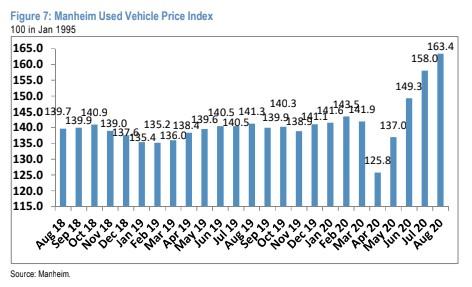
Recall, we noted less than a week ago that new research from Manheim showed used car prices had exploded to hit new all time highs. The Manheim Used Vehicle Value index climbed to 163.4 in the first 15 days of August from 158.0 in July.

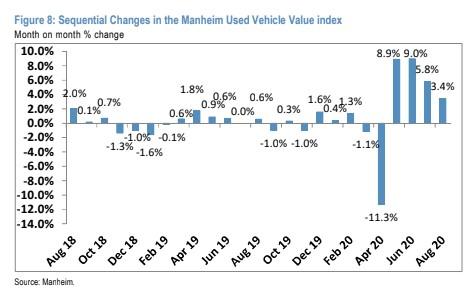
“Prices rose another +3.4% sequentially in the first 15 days of August after rising +5.8% m/m in July,” a new note from J.P. Morgan highlights. It continues: “With the Manheim Index at 163.4 in early August (January 1995 = 100), used prices are now +13.9% higher vs. the then record level in February just prior to the pandemic and are +15.6% y/y.”

J.P. Morgan notes that “Since April, the Manheim Used Vehicle Value index recovered +8.9% m/m in May, +9.0% m/m in June, +5.8% m/m in July, and is now +3.4% m/m in the first 15 days of August. Stronger prices suggest potential gains on sale of off-lease vehicles and higher collateral value, helping reduce loan losses.”

The note predicted that prices should see some respite heading into the fall, as “pent up demand” as a result of the Covid-19 pandemic should subside. Most of this demand has already been satisfied, according to Manheim, and consumers are growing “increasingly frustrated” from the high prices. 

It’s worth noting, however, that these same prognosticators were predicting a “sharp drop” in prices heading into the back end of the summer. That obviously didn’t materialize. Additionally, the same note said that consumers could be waiting for a second round of stimulus to purchase a vehicle. 

It doesn’t seem like fleet operators are doing the same…

via ZeroHedge News https://ift.tt/3hAuMfz Tyler Durden

Turley: Do The New George Floyd Documents Constitute A Defense For Accused Former Officers?

Turley: Do The New George Floyd Documents Constitute A Defense For Accused Former Officers?

Tyler Durden

Thu, 08/27/2020 – 14:29

Authored by Jonathan Turley,

New documents in the George Floyd investigation have been released and it is likely that they will be key to the criminal defense of the accused officers in that case.

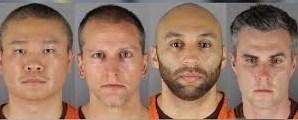
The documents contain accounts of extremely high levels of fentanyl in Floyd’s blood that could have contributed to his death. The documents are likely to feature significantly in the criminal defense of former officers Tou Thao, Derek Chauvin, J Alexander Kueng and Thomas Lane.  While admissibility can be challenged, they reflect findings that will be raised at trial on the impact of these drugs in Floyd’s system.

However, the documents in my view do not conclusively establish that the drug use was the cause of the death. Indeed, some reaffirm the view of prosecutors.  I do not believe that these documents should not be treated as determinative evidence by the court in pre-trial motions. In other words, this should go to a jury.

The newly released documents include three documents that address the fentanyl issue but there is a critical point of conflict in the accounts.  One document is a memo from county attorney Amy Sweasy where she offers a summary of a conversation with Andrew Baker, the Hennepin County chief medical examiner. It includes the following account:

Fentanyl 11. He said, “that’s pretty high.” This level of fentanyl can cause pulmonary edema. Mr. Floyd’s lungs were 2-3x their normal weight at autopsy. That is a fatal level of fentanyl under normal circumstances. . . . AB said that if Mr. Floyd had been found dead in his home (or anywhere else) and there were no other contributing factors he would conclude that it was an overdose death.

That is clearly something the defense could highlight to the jury.  Floyd is shown in videotapes complaining that he could not breathe when he was not under restraint. However, the handwritten notes from a meeting contains a notable countervailing statement:

Fentanyl at 11 ng/ml — this is higher than chronic pain patient. If he were found dead at home alone & no other apparent cause, this could be acceptable to call an OD. Deaths have been certified w/ levels of 3.

Baker: I am not saying this killed him.

That is an important distinction since the level of fentanyl could have been a contributor but the legal cause remained the kneeling on the neck of Floyd. Indeed, there is a telling third document from the Armed Forces Medical Examiner System. The federal officials asked for the review and the document states:

The Office of the Armed Forces Medical Examiner agrees with the autopsy findings and the cause of death certification of George Floyd as determined by the Hennepin County Medical Examiner’s Office. His death was caused by the police subdual and restraint in the setting of severe hypertensive atherosclerotic cardiovascular disease, and methamphetamine and fentanyl intoxication. The subdual and restraint had elements of positional and mechanical asphyxiation. The presence of sickle cell trait is a significant finding in this context.

We concur with the reported manner of death of homicide.

The point is that the fentanyl could have made Floyd more vulnerable or susceptible to a fatal medical emergency. However, that would not in my view clearly negate the criminal charge.  There is a torts doctrine that “you take your victims as you find them,” meaning that you are still liable for injuries or deaths even if the outcome was magnified by a pre-condition. So, the fact that someone was more susceptible to greater injury due to age or medical condition does not excuse your liability for the full damages when your intentional or negligent tort was the cause of the injury.

Thus, the recently released material cuts both ways for the defendants. To the extent that the officers heard Floyd complaining that he could not breathe while still in the car only confirms that he had some medical emergency or condition.  That could make the conduct of the officials more sanctionable, not less.  Officers commonly deal with people who have drugs in their system and are legally required to consider any medical threat in how they address such encounters.  They can argue that the drug use was a type of superseding intervening factor. However, these documents still support the prosecutors on the ultimate cause of death in the level of restraint used by the officers.

via ZeroHedge News https://ift.tt/3hBjojo Tyler Durden

Chen Guangcheng Fled China to America, and Last Night He Spoke at the RNC. How About Opening Our Doors to Oppressed Hongkongers Too?

Screen Shot 2020-08-27 at 1.29.20 PM

In an otherwise humdrum night of Republican National Convention (RNC) programming, Chinese dissident Chen Guangcheng, who escaped his home country in 2012, gave a speech that stood out.

Chen is a divisive figure among overseas dissidents and fellow critics of the Chinese Communist Party (CCP), but his story is a powerful one. In June 2005, he organized a class-action lawsuit against the authorities in Shandong province over the sterilizations and abortions that the government was imposing on citizens as part of the “one child” policy. Just months later, Chen and his family were imprisoned inside their home, where they were kept until the following year; Chen then began to serve a full-fledged prison sentence. On completing it in 2010, he was returned to further house arrest and further surveillance. Finally, in 2012, Chen sought refuge at the U.S. embassy, where he hid for several weeks; with the help of U.S. officials, he then fled to New York City with his wife and children.

In his speech last night, he told audiences how hard it is to stand up to tyranny. “When I spoke out against China’s ‘one child’ policy and other injustices, I was persecuted, beaten, and put under house arrest,” he said. “In China, expressing beliefs or ideas not approved by the CCP—religion, democracy, human rights—can lead to prison. The nation lives under mass surveillance and censorship.”

He is right on all of those counts. The CCP is responsible for the brutal internment of the Uighur minority group, forced sterilizations and abortions, and crackdowns on speech and academic freedom in Hong Kong. The CCP has disappeared Hong Kong’s booksellers, heavily regulated the internet to control what types of websites people can access via the “Great Firewall,” and expelled foreign journalists and news bureaus to suppress the flow of information abroad. The Chinese government to this day scrubs references to its 1989 Tiananmen Square massacre from the internet. The list of ways the Chinese government systematically deprives its citizens of their rights—their ability to speak and write, create families of all sizes, access historical information, move about freely, agitate for change—goes on and on. Chen, a man who has been imprisoned by the state both in his own home and in a government facility, is immensely qualified to speak on this.

The candidate on whose behalf he was speaking, on the other hand, has failed to offer oppressed Hongkongers the most basic form of help: refuge. As my colleague Eric Boehm wrote in May, “With the freedom of Hongkongers under direct assault, the United States should throw open its doors to accept any of the city’s residents who need a place to go.”

This could take the form of asylum, a direct pathway to citizenship, or an expansion of visa programs to work or study in the U.S. Such an initiative could cover Hongkongers alone, or could be extended to mainland Chinese as well. The British government is already opening its doors to Hongkongers, and Australia has been flirting with following suit. Why are we so reticent?

In his speech, Chen remarked, “I’m forever grateful to the American people for welcoming me and my family to the United States where we are now free.” Many more people ought to have that opportunity—and that’s within the president’s power to accomplish.

from Latest – Reason.com https://ift.tt/3ls0MEK
via IFTTT

Bourgeois Libertarianism Can Save America

zumaamericastwentyeight307803

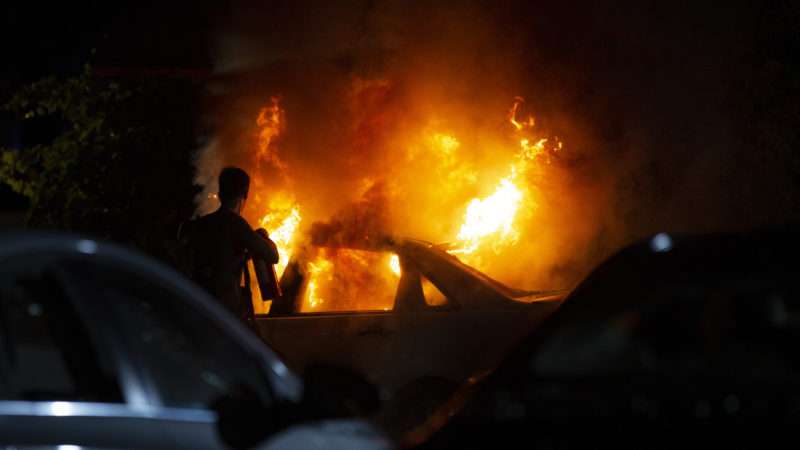
As various American cities descend into weeks or even monthslong street disorder, launched by anger and anguish over police brutality, standard American political ideas and groups seem equally powerless to preserve the domestic tranquility for which Americans theoretically give over large chunks of our fortunes and our choices to government. Many of these protests have evolved into generalized orgies of destruction and even arson, which is the most fiendishly destructive thing the average person can do in dense cities and which has been done with careless glee dozens of times.

In the places Americans gather to publicly reason with each other via awkward two-sentence chunks and snide insults, a disturbingly large number of people are insisting we recapitulate the stark choices that Germany seemed to offer its citizens a century ago between the world wars: a controlling, decadent left out to destroy private property, and a right that embraces a harsh, violent authoritarianism suspicious of outsiders of all stripes. 

Both sides’ appeal is energized by the existence of the other, and both seem so obviously intolerably evil to each other that they agree on one thing: that no moral or prudential choice exists other than to join one of those two sides and come out swinging. 

The blood on the streets of Kenosha, Wisconsin (Kenosha, Wisconsin!) this week is a small preview of where that path leads.  

Traditional American libertarianism, to the extent either side acknowledges its existence, is seen by both leftists and rightists as either supporting the Evil Side or, at best, a pusillanimous, pie-in-the-sky distraction from the necessary business of seizing state power to crush the enemy.

But that old school, non-revolutionary, bourgeois American libertarianism, if actually embraced by most Americans, remains the only peaceful way out.

That it’s a mistake—both morally wrong and likely ineffective—to use government force to solve most social problems is one of libertarianism’s staid tenets. As the past months should have made evident, police power in the conventional sense can’t keep cities secure if even a small number of people are unwilling to live and let live. State power simply cannot rule a people if even a small, energized minority refuses to let it. If you actually care about a functioning civilization, it is never enough to have the state controlled by the “right side.” 

What makes civilization work, when it does, is people roughly hewing to libertarian principles, which, fortunately for Western civilization, most people do even when they are not being governed in a libertarian manner. 

What makes civilizations collapse, as we are now seeing, is people relentlessly seeking state or state-like solutions to their perceived grievances, particularly the kind that threaten your fellow citizens’ liberty to live, think, express, work, save, and do business in peace, even if you have a good reason to be angry and feel a burning, even justified, need to see things change. 

To begin at the root of the current unrest, a more libertarian world would not have a police force engaged in continual series of overaggressive assaults on citizens, whether or not suspected of crimes. We suffer that now because police, as representatives of the state, are not subject to the same discipline for their crimes that most citizens are. 

At that same time, a more thoroughly libertarian world would not see certain tactics pursued by some on the progressive left who agree with the libertarian goal of reducing police’s unjust spasms of “authority.” For instance, that world would not have angry mobs insisting threateningly that random fellow citizens join them in some public expression of political piety, however noble the cause. It would also lack roving mobs setting fire to buildings and breaking windows. 

Those actions, unchecked and continual, tear at the roots of civilization that have made us as wealthy as we are—the relatively free and unmolested ability of people to possess wealth and space and use it to offer goods and services to others for a price. 

American movement libertarianism was revolutionary—but only intellectually so. Most American libertarians, even in the face of continual obscene injustices on the part of the state, never figured that reducing the civic order to a violent battlefield was the just or prudent response, especially in a world where most fellow citizens didn’t want libertarian governance. The mission has always been selling people on the idea that they would benefit from more libertarian governance.

Thus, the notion of “no justice, no peace” that animates both angry anti-police-brutality progressives and major aspects of historic American foreign policy doesn’t quite ring true for most American libertarians. Another country’s criminality has often been insufficient to convince many libertarians that the mass life and property destruction of war were justified. Likewise, even though they are inspired by justified anger at recalcitrant and evil government policy, the weeks of property destruction and occasional attacks on bystanders are perhaps not the just or effective response.

Libertarians have a narrow sense of when and how force can be justly brought to bear to right wrongs. When it comes to either overseas war or domestic battles to change government policy or public attitudes, most libertarians can’t agree that the lives and property of those innocent of committing the crime should suffer, especially when the connection between the violence or destruction and righting all relevant wrongs is tentative and uncertain.

The standard American libertarian has been traditionally and boringly bourgeois. Many think that while preserving life is indeed a higher priority than preserving property, property’s vital role in human flourishing and happiness both individually and socially means that one cannot blithely treat it as sacrificeable to make some point about how angry you are or to pursue a vaguely seen path to “justice” for others.

The fanaticism of seeking to bloodily right all the world’s wrongs, then, was never really the libertarian thing. The love of peace and prosperity that motivates libertarians to embrace liberty inclined them to think that truly effective and secure social change came not from violence, chaos, and force, but from treating fellow human minds and bodies with respect, as ends not means, and attempting to persuade them that libertarian ideas ought to shape human social life. 

The fanatical pursuit of “no justice, no peace” makes any reasonable civic life impossible. In a polity where agreement from a critical mass of your fellow citizens is necessary, certain sacrifices of peace in pursuit of justice will likely damage your chances of getting the kind of justice you say you want.

Such possibly counterproductive sacrifices include large scale denials of the right to use public streets unmolested and the idea that the livelihoods and savings of people with no direct connection to the wrongs can be justly ruined, most especially given what we know about how weeks or months of urban violence destroy prosperity for decades 

Those craving hope for America’s near future might take small comfort in the fact that, as newsmaking as they rightly are, as fascinatingly grim as they are to discuss, as much as they dramatize in a colorfully violent way real fault lines in the beliefs and hopes of America writ large, the number of people so far fighting in the streets, breaking windows, and setting fires is very, very tiny in comparison to the vast number of Americans who do in fact, consciously or unconsciously, live their lives according to the tenets of bourgeois libertarianism.

That is the lived philosophy of the peaceful enjoyment of life and property, mostly minding one’s own business, living and letting live, not enforcing orthodoxies of thought and expression no matter how good the cause, or treating other people’s lives and property as sacrificable for a political goal. We are seeing that even a small number of people choosing to not live in accordance with those libertarian principles creates civic spaces in which no one can thrive—not even, in the long run, the people choosing to create chaos in the name of justice.

from Latest – Reason.com https://ift.tt/2EnxC9t
via IFTTT

Chicago Police Sued Again For Botched Raid, Pointing Guns At Grandma and Child

Leyalina Lazar-1

Chicago police ransacked a woman’s house and held a grandmother and 4-year-old at gunpoint based on a sloppy search warrant, a federal civil rights lawsuit filed today alleges.

According to the suit, 15 plainclothes Chicago police officers broke through the front door of the apartment of Jasmine Vale, her 4-year-old daughter, Leyalina Lazar, and Leyalina’s grandmother, Khamme Lazar, 70, as they were preparing for bed on February 27.

The lawsuit says officers trained their guns on the grandmother, who was saying her nighttime prayers, and the child. They then allegedly screamed obscenities at Vale and made her lie face down on the floor with a gun pointed at her head. After the officers herded the trio onto a couch, still at gunpoint, police allegedly ransacked the house.

“They cut couch pillows open, dumped clothes, damaged dressers and tables,” the lawsuit says. “They threw Jasmine’s nail products all over the floor and destroyed her technician’s table, costing her thousands of dollars. They even destroyed Khamme’s Christmas decorations and ripping or cutting open Leyalina’s prized stuffed animals, ‘bunny Sarah’ and ‘monkey.'”

The lawsuit claims the use of an invalid search warrant, excessive force, and unwarranted property destruction violating Vale and her family’s Fourth Amendment rights. The allegations are the latest in a string of lawsuits and investigations by local news outlets that describe Chicago police busting into the wrong houses and terrorizing innocent families.

Vale’s lawsuit says the search warrant was based on a tip from an anonymous informant that Khamme’s son possessed an unlicensed handgun. Chicago police never bothered to learn that Khamme’s son had moved to California several years ago. No gun was found, and no arrests were made.

Local news outlet CBS 2 found that Chicago SWAT teams were frequently relying on sloppy, unverified search warrants to ransack houses; hold families, including children, at gunpoint; and in one case handcuff an 8-year-old child. In another case, 17 Chicago police officers burst into a family’s house with their guns drawn during a 4-year-old’s birthday party.

Last year, two Chicago police officers were convicted on federal charges that they paid off informants, lied to judges to secure search warrants, and stole cash and drugs from places they raided. Two women have subsequently filed civil suits against the dirty cops, claiming they used bogus search warrants to ransack their houses, point guns at their children, and frame them for drug possession. 

Vale’s attorney, Al Hofeld, has represented nine other families with similar stories. In another lawsuit filed last year, a Chicago family claims police officers raided their house three times in four months looking for someone they say they don’t even know.

In 2018, The Chicago City Council approved a $2.5 million settlement to a family who claimed CPD officers stormed their house and pointed a gun at a three-year-old girl.

These horror stories led Chicago’s Inspector General to launch an investigation last year into how Chicago police vet information and execute search warrants. That investigation is still ongoing, according to the office’s website.

The Chicago Police Department also revised its policies for search warrant executions in January, requiring officers to “maintain a sensitive approach and use due care to safeguard the physical and emotional well-being” of any children present “to minimize trauma following the execution of a search warrant.”

However, Vale’s lawsuit says those requirements, vague as they are, were not followed during the search warrant execution on her house. The officers were rude, vulgar, and left without apologizing, slamming the door behind them.

Reason reported last year on public records showing that Chicago police executed more than 11,000 search warrants over a five-year period, predominantly in the city’s low-income and minority neighborhoods, and nearly half of them did not result in an arrest.

The Chicago Police Department declined to comment, citing the pending litigation.

from Latest – Reason.com https://ift.tt/3liZCM1
via IFTTT