More Than a Year Before Breonna Taylor’s Death, Some of the Same Cops Were Involved in Another Home Invasion Based on Dubious Evidence

Louisville-pot-raid-10-26-18

Brett Hankison, the Louisville, Kentucky, detective who was fired because of his role in the fruitless drug raid that killed Breonna Taylor last March, was also involved in a botched 2018 home invasion that terrified a family wrongly suspected of growing marijuana. So were at least four other Louisville police officers who participated in the case that led to Taylor’s death, which has figured prominently in nationwide protests against police brutality. The overlap suggests a pattern of shoddy investigation and reckless paramilitary tactics that could have been detected before it killed an innocent woman.

In both cases, police broke into people’s homes based on dubious evidence, and the residents initially thought they were being robbed. In Taylor’s case, her boyfriend, Kenneth Walker, grabbed a gun and fired at the intruders, injuring one of them in the leg. Police responded with a hail of more than 20 bullets, at least eight of which struck Taylor, who was unarmed. According to the acting police chief, Hankison “displayed an extreme indifference to the value of human life” when he “wantonly and blindly fired 10 rounds” into Taylor’s apartment. So far no criminal charges have been filed against Hankison or the other officers. While no one died during the 2018 marijuana raid, things easily could have turned out differently.

Detective Joshua Jaynes obtained the no-knock warrant to search Taylor’s apartment, which Hankison and two other plainclothes officers, Jonathan Mattingly and Myles Cosgrove, executed in the middle of the night on March 13, based entirely on guilt by association. Because Taylor, a 26-year-old EMT and aspiring nurse, remained friendly with a former boyfriend suspected of drug dealing, who sometimes received packages at her apartment, Jaynes suggested that she was involved in the illegal activity. But a local postal inspector later said there was nothing suspicious about those packages, which reportedly contained clothing and shoes.

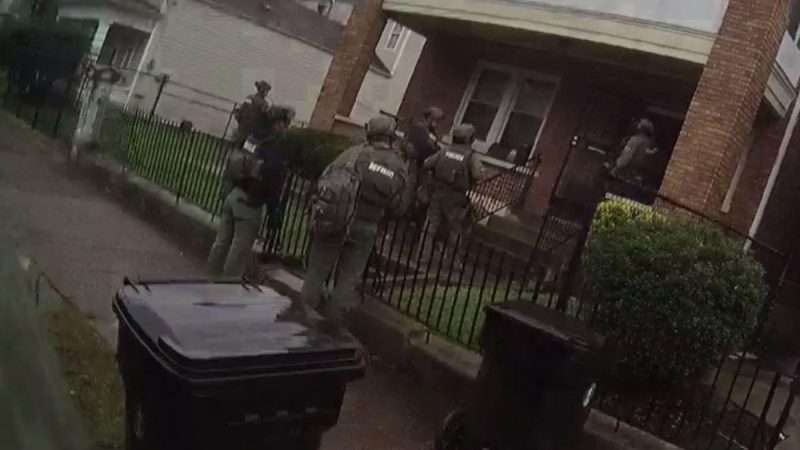
The warrant to search the house where Mario Daugherty and Ashlea Burr lived, which police executed on the morning of October 26, 2018, was based on a tip about a prior tenant, who allegedly was growing marijuana there. According to a lawsuit that Daugherty and Burr filed a year later, 14 SWAT officers stormed into their home without warning, breaking the front door, tossing flash-bang grenades, and shouting commands while threatening them and their three teenaged children with “assault rifles.”

Although the warrant ostensibly required the cops to knock and announce themselves, body camera footage shows they shouted “Police! Search warrant!” at the same moment they used a battering ram to force the door open. As that detail suggests, there is often little practical difference between a no-knock search and a knock-and-announce search. In Taylor’s case, police had a no-knock warrant, but they nevertheless banged on the door for 30 seconds or so, and they claim they announced themselves—a point disputed by her boyfriend and her neighbors. Even if the cops did say something as they broke down the door, that announcement could easily have been missed by Taylor and her boyfriend, who were sleeping at the time of the raid.

During the 2018 raid, the residents clearly did not realize the people invading their home were police officers. According to the lawsuit, one of the couple’s daughters, Zariyah, who was 14 at the time, “ran through the back door and into the yard in an effort to reach her grandmother’s house next door.” The cops pursued her.

“Officers drew their assault rifles on her, yelling commands at her to get on the ground,” the complaint says. “[Zariyah] was extremely frightened, began crying and submitted [by kneeling on] the ground. It was cold and rainy, and [Zariyah] was not wearing any socks, shoes or a jacket. She repeatedly requested to be taken to her grandmother’s next door, but the Officers refused the requests, kept her in the cold, wet conditions, and kept their rifles on her.”

Zariyah can be heard sobbing in a video of the raid’s aftermath. “Hold on, hon, we’re almost done, OK?” says one of the officers. “We’ll get you back inside. You’re not hurt, right? You’re just scared? I’m sorry.”

The police should be sorry, especially given the lack of probable cause for the search.

In his application for a warrant to search the house, Detective Joseph Tapp said police received a tip from someone who reported that “a black male named Anthony McClain is growing marijuana and has multiple bags of marijuana packaged for sale in the front bed room.” According to Tapp, the tipster “also stated a white female named Holly was [McClain’s] girlfriend and owned the house.”

If Tapp had bothered to look up the property records, he would have seen that the house is in fact owned by a man named Kevin Hyde, who was renting it to Daugherty and Burr. The lawsuit also notes that “nobody named Anthony McClain or Holly lived at the house at or near the time of the raid,” that “Ashlea is not white,” and that “nobody in the house was growing marijuana or had multiple bags of marijuana packaged for sale.”

Aside from this obviously erroneous or outdated tip, the search warrant was based on three brief visits to the house. During his first “surveillance,” on October 5, Tapp saw “a Black male” enter the house and leave 10 minutes later. Tapp then “approached the house to conduct a knock and talk.” When he “stepped on the open porch,” he said, “the smell of fresh marijuana could be smelled.” He knocked on the door, but no one answered, so he left.

During his second “surveillance,” on October 22, Tapp saw “a black male” arrive in a “gray Jaguar” with an Indiana license plate and enter the house. The car was registered to Daugherty, whom WDRB, the Fox TV station in Louisville, describes as “a local artist whose work has been featured at the Kentucky Derby Museum and on local news.” The car was not registered to “a black male named Anthony McClain” or to a woman named Holly, which really should have given Tapp pause. The next day, three days before the raid, Tapp “approached the house and again was hit with a strong smell of fresh marijuana coming from within the house.”

Tapp argued that the tip, “the witness of the short stay,” and “the strong fresh smell of marijuana on separate occasions,” combined with his “training and experience,” provided probable cause for a search. Yet the tip was demonstrably false, visiting a house for 10 minutes is not inherently suspicious, and apparently there is something wrong with Tapp’s nose, since police found no evidence of marijuana cultivation or drug dealing at the house, just a small amount of cannabis. No charges were filed against Daugherty or Burr.

Vice News reports that “at least five of the officers involved in the raid”—Hankison, Jaynes, Cosgrove, Mike Campbell, and Mike Nobles—also took part in the case that resulted in Taylor’s death. “Daugherty and Burr didn’t realize the overlap in officers until recently, when they were watching the news,” Vice says. “They recognized Hankison, looked back at some of the paperwork LMPD had left behind, and noticed two familiar names: Hankison and Cosgrove.”

Daugherty and Burr’s lawsuit, which they filed in Jefferson County Circuit Court, alleges that the Louisville Metro Police Department “fails to adequately train its officers regarding obtaining search warrants in order to protect citizens’ Fourth Amendment rights.” While they asked for compensatory damages, punitive damages, and legal fees, Daugherty says their main aim was to publicize this sort of abuse in the hope of protecting other potential victims.

“We just wanted to get our story out there because we didn’t want this to happen to anybody innocent and anybody innocent’s life to get lost,” he told Vice. “I feel like after it happened to us, if the leaders would have stepped out and tried to assist us, I feel like we could have gotten a change way before Breonna’s death. I feel like her death could have been avoided.”

from Latest – Reason.com https://ift.tt/3gD3qnA
via IFTTT
Remember When a Democratic Polling Firm Fired the Guy Who Thought Violent Protests Could Backfire Politically?

sipaphotosten990620

Back in June, the sudden firing of data scientist David Shor from the progressive consulting firm Civis Analytics raised eyebrows.

Shor had publicized research from the social scientist Omar Wasow showing that violent protests tend to backfire on progressive goals—tipping the 1968 election in favor of the law-and-order candidate, Richard Nixon, for instance—whereas peaceful protests often succeed. In response, Shor was widely derided by the left. On Twitter, the progressive activist Ari Trujillo Wesler accused him of using his “anxiety and ‘intellect’ as a vehicle for anti-blackness.” Employees and clients of Civis Analytics said Shor’s statement—which, to be clear, was merely an endorsement of well-grounded social science research that says nonviolent protest is strategically superior—had threatened their very safety, according to New York magazine’s Jonathan Chait.

As a result, Shor was terminated. The exact reason for the firing was never specified, but it spoke to concerns among many liberal thinkers—Chait, Vox‘s Matt Yglesias, and others—that certain sects of the left are unwilling to have difficult conversations about tactics. This is a concern shared by many libertarians, and supporters of free speech culture more broadly.

On Wednesday, polling by Marquette Law School showed that support for Black Lives Matter has plummeted among white Wisconsinites. (The poll was conducted before the recent police shooting in Kenosha, and thus does not reflect attitudes toward that event.)

“A substantial majority approved of protests in June, but this fell to an even split, 48-48 in August,” wrote polling director Charles Franklin. Black and Hispanic attitudes toward Black Lives Matter changed little over the summer, but white approval had fallen and “become net negative.”

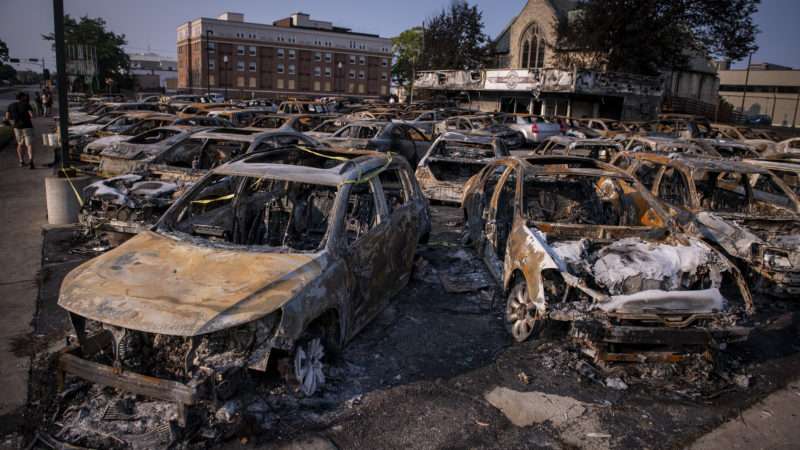
A related piece in Politico surveyed residents of Kenosha—where peaceful protests but also violence, rioting, fires, and looting have consumed the streets at night—and perhaps unsurprisingly discovered plenty of wariness, even among people who are not exactly the law-and-order type:

“There’s no doubt it’s playing into Trump’s hands,” said Paul Soglin, who served as mayor of Madison, on and off, for more than two decades. “There’s a significant number of undecided voters who are not ideological, and they can move very easily from Republican to the Democratic column and back again.They are, in effect, the people who decide elections. And they are very distraught about both the horrendous carnage created by police officers in murdering African Americans, and … for the safety of their communities.” …

Billy Stevens, an African American man who was helping paint the murals, agreed that the violence and destruction on display in the city give Trump more to point to in his reelection campaign.

“He tries to paint a picture of Democratic leaders being weak. Personally, I think it’s divisive in times like these,” Stevens said. At the same time, Stevens said Kenosha is desperate for order. “Now we’re sending in more troops for a large show of force immediately. I do think it’s needed right now.” ..

Soglin said he’s concerned some Democrats aren’t paying close enough attention to the business owners and residents in communities coming under attack who want protection. The situation is likely having the biggest effect on swing voters, he said.

John “Sly” Sylvester, a longtime Democrat and radio personality who has been active in the labor movement, said he feared Democrats have a “blind spot” to rioters and looters.

Meanwhile, Joe Biden’s lead in Minnesota—whose governor has dispatched the National Guard to quell continuing protest-related violence in Minneapolis—continues to shrink. He was up more than 10 points on July 1, but his lead is now just five points, according to the latest polls.

This is not to say that Biden’s campaign is imperiled: He’s still clearly ahead. Nor is it the case that Biden is the avatar of violent protests and Trump the avatar of a return to normalcy. Biden has condemned needless violence and failed to fall in line with the more militant left wing of the Democratic Party. Meanwhile, the lawlessness has actually occurred on Trump’s watch, and the president has done very little to effectively counter it: Trump’s main contributions thus far have been to sweep peaceful protesters from Lafayette Park in Washington D.C. so that he could pose for a photo; deploy federal law enforcement officers to Portland, where the unrest only worsened; and tweet the words “LAW AND ORDER.”

But there’s plenty of reason to think that Shor’s concerns, and Wasow’s research, have even more relevance today than they did at the start of the summer. It would be wise for progressives to consider the well-supported idea that what’s happening in Kenosha and Minneapolis—and Portland, and even Washington, D.C.—is a net negative for the causes they support.

from Latest – Reason.com https://ift.tt/3jiTSju
via IFTTT

Bourgeois Libertarianism Can Save America

zumaamericastwentyeight307803

As various American cities descend into weeks or even monthslong street disorder, launched by anger and anguish over police brutality, standard American political ideas and groups seem equally powerless to preserve the domestic tranquility for which Americans theoretically give over large chunks of our fortunes and our choices to government. Many of these protests have evolved into generalized orgies of destruction and even arson, which is the most fiendishly destructive thing the average person can do in dense cities and which has been done with careless glee dozens of times.

In the places Americans gather to publicly reason with each other via awkward two-sentence chunks and snide insults, a disturbingly large number of people are insisting we recapitulate the stark choices that Germany seemed to offer its citizens a century ago between the world wars: a controlling, decadent left out to destroy private property, and a right that embraces a harsh, violent authoritarianism suspicious of outsiders of all stripes. 

Both sides’ appeal is energized by the existence of the other, and both seem so obviously intolerably evil to each other that they agree on one thing: that no moral or prudential choice exists other than to join one of those two sides and come out swinging. 

The blood on the streets of Kenosha, Wisconsin (Kenosha, Wisconsin!) this week is a small preview of where that path leads.  

Traditional American libertarianism, to the extent either side acknowledges its existence, is seen by both leftists and rightists as either supporting the Evil Side or, at best, a pusillanimous, pie-in-the-sky distraction from the necessary business of seizing state power to crush the enemy.

But that old school, non-revolutionary, bourgeois American libertarianism, if actually embraced by most Americans, remains the only peaceful way out.

That it’s a mistake—both morally wrong and likely ineffective—to use government force to solve most social problems is one of libertarianism’s staid tenets. As the past months should have made evident, police power in the conventional sense can’t keep cities secure if even a small number of people are unwilling to live and let live. State power simply cannot rule a people if even a small, energized minority refuses to let it. If you actually care about a functioning civilization, it is never enough to have the state controlled by the “right side.” 

What makes civilization work, when it does, is people roughly hewing to libertarian principles, which, fortunately for Western civilization, most people do even when they are not being governed in a libertarian manner. 

What makes civilizations collapse, as we are now seeing, is people relentlessly seeking state or state-like solutions to their perceived grievances, particularly the kind that threaten your fellow citizens’ liberty to live, think, express, work, save, and do business in peace, even if you have a good reason to be angry and feel a burning, even justified, need to see things change. 

To begin at the root of the current unrest, a more libertarian world would not have a police force engaged in continual series of overaggressive assaults on citizens, whether or not suspected of crimes. We suffer that now because police, as representatives of the state, are not subject to the same discipline for their crimes that most citizens are. 

At that same time, a more thoroughly libertarian world would not see certain tactics pursued by some on the progressive left who agree with the libertarian goal of reducing police’s unjust spasms of “authority.” For instance, that world would not have angry mobs insisting threateningly that random fellow citizens join them in some public expression of political piety, however noble the cause. It would also lack roving mobs setting fire to buildings and breaking windows. 

Those actions, unchecked and continual, tear at the roots of civilization that have made us as wealthy as we are—the relatively free and unmolested ability of people to possess wealth and space and use it to offer goods and services to others for a price. 

American movement libertarianism was revolutionary—but only intellectually so. Most American libertarians, even in the face of continual obscene injustices on the part of the state, never figured that reducing the civic order to a violent battlefield was the just or prudent response, especially in a world where most fellow citizens didn’t want libertarian governance. The mission has always been selling people on the idea that they would benefit from more libertarian governance.

Thus, the notion of “no justice, no peace” that animates both angry anti-police-brutality progressives and major aspects of historic American foreign policy doesn’t quite ring true for most American libertarians. Another country’s criminality has often been insufficient to convince many libertarians that the mass life and property destruction of war were justified. Likewise, even though they are inspired by justified anger at recalcitrant and evil government policy, the weeks of property destruction and occasional attacks on bystanders are perhaps not the just or effective response.

Libertarians have a narrow sense of when and how force can be justly brought to bear to right wrongs. When it comes to either overseas war or domestic battles to change government policy or public attitudes, most libertarians can’t agree that the lives and property of those innocent of committing the crime should suffer, especially when the connection between the violence or destruction and righting all relevant wrongs is tentative and uncertain.

The standard American libertarian has been traditionally and boringly bourgeois. Many think that while preserving life is indeed a higher priority than preserving property, property’s vital role in human flourishing and happiness both individually and socially means that one cannot blithely treat it as sacrificeable to make some point about how angry you are or to pursue a vaguely seen path to “justice” for others.

The fanaticism of seeking to bloodily right all the world’s wrongs, then, was never really the libertarian thing. The love of peace and prosperity that motivates libertarians to embrace liberty inclined them to think that truly effective and secure social change came not from violence, chaos, and force, but from treating fellow human minds and bodies with respect, as ends not means, and attempting to persuade them that libertarian ideas ought to shape human social life. 

The fanatical pursuit of “no justice, no peace” makes any reasonable civic life impossible. In a polity where agreement from a critical mass of your fellow citizens is necessary, certain sacrifices of peace in pursuit of justice will likely damage your chances of getting the kind of justice you say you want.

Such possibly counterproductive sacrifices include large scale denials of the right to use public streets unmolested and the idea that the livelihoods and savings of people with no direct connection to the wrongs can be justly ruined, most especially given what we know about how weeks or months of urban violence destroy prosperity for decades 

Those craving hope for America’s near future might take small comfort in the fact that, as newsmaking as they rightly are, as fascinatingly grim as they are to discuss, as much as they dramatize in a colorfully violent way real fault lines in the beliefs and hopes of America writ large, the number of people so far fighting in the streets, breaking windows, and setting fires is very, very tiny in comparison to the vast number of Americans who do in fact, consciously or unconsciously, live their lives according to the tenets of bourgeois libertarianism.

That is the lived philosophy of the peaceful enjoyment of life and property, mostly minding one’s own business, living and letting live, not enforcing orthodoxies of thought and expression no matter how good the cause, or treating other people’s lives and property as sacrificable for a political goal. We are seeing that even a small number of people choosing to not live in accordance with those libertarian principles creates civic spaces in which no one can thrive—not even, in the long run, the people choosing to create chaos in the name of justice.

from Latest – Reason.com https://ift.tt/2EnxC9t
via IFTTT

Tesla Driver Was “Watching Movie” On Autopilot When Car Slammed Into Parked Police Cruiser

Tesla Driver Was “Watching Movie” On Autopilot When Car Slammed Into Parked Police Cruiser

Tyler Durden

Thu, 08/27/2020 – 14:10

In a lede that we feel like we are writing on a weekly basis, a Tesla on Autopilot has – once again – slammed into an inanimate police cruiser

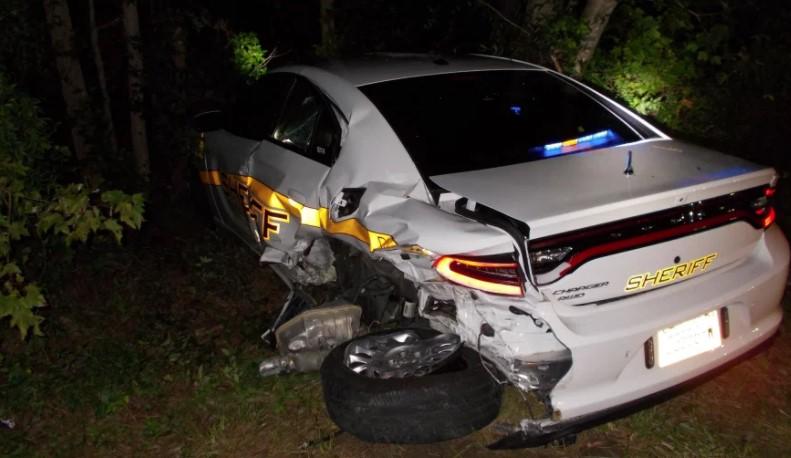
The collision took place in Nash County, North Carolina, where a Nash County deputy and a trooper with the highway patrol were on the side of the road attending to another accident. Without warning, the Tesla “slammed into the deputy’s cruiser”, according to CBS 17, leave the cruiser a mangled wreck off the side of the road.

The incident raises an obvious question:

The impact knocked both the deputy and the trooper to the ground. The driver was identified as Devainder Goli of Raleigh. He said he was “watching a movie on his phone while the car was on auto-pilot when the collision occurred.” He was charged with failure to move over and location of television in a vehicle. 

Nash County Sheriff Keith Stone said: “It was a simple lane closure and then suddenly death was at our footsteps.”

He continued: “It shows automation is never going to take the place of the motoring public paying attention, not texting, not being on the phone, but focusing on what you were doing, that is, driving.”

“Thankfully, no one was injured,” Trooper Jeff Wilson continued. 

Recall, last month, we pointed out when a Tesla on Autopilot smashed into the pack of another patrol vehicle, this one on the side of the road near Benson, AZ. 

“The impact caused the patrol vehicle to collide with the back of an ambulance, but fortunately the occupants of the ambulance weren’t injured. The driver of the Tesla had non-life-threatening injuries. Please AZ – #MoveOver! It’s the law & it helps everyone get home safely,” the Arizona DPS wrote.

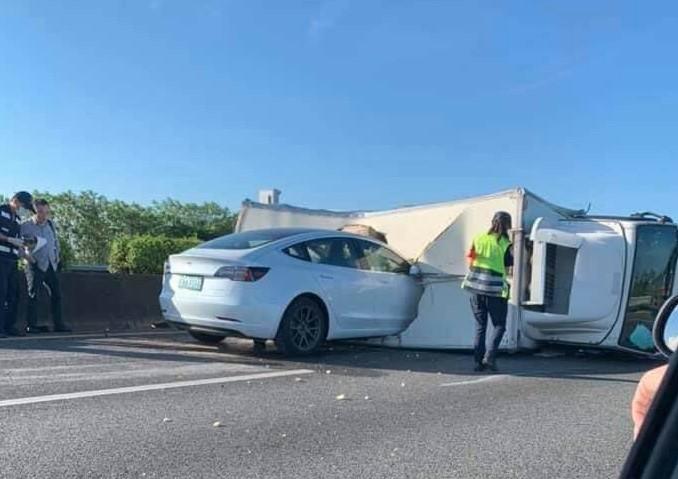
Recall, it was just about a month before that when we reported about a Tesla traveling on a highway in Taiwan, at what appeared to be full speed, before slamming directly into an overturned truck that was laying across the highway. The Tesla appeared to make little or no change in direction before hitting the truck. 

Days before that incident, we reported on a Tesla that was found to have driven off a cliff under “mysterious” circumstances in Santa Clara County, California. 

According to the California Highway Patrol, the Tesla “went over” the cliff, and the driver, 60-year-old Pleasanton resident James Yacorzynski, was found dead at the scene. 


Finally, in late spring, we reported that Tesla’s Autopilot was to blame for a similar near-fatal accident that took place last December. A Massachusetts State Police trooper had just pulled over a vehicle on the side of Route 24 in West Bridgewater when the trooper’s vehicle was slammed into by the Tesla. 

The driver who was pulled over, Maria Smith, said: “It just happened so quick. Before I knew it, my car was flying forward. I looked behind me, and my whole back windshield was blown out. There was glass in my hair.”


via ZeroHedge News https://ift.tt/2ECEBuW Tyler Durden

Grocers And Producers Profit From And Love Food Stamps

Grocers And Producers Profit From And Love Food Stamps

Tyler Durden

Thu, 08/27/2020 – 13:50

Authored by Bruce Wilds via Advancing Time blog,

To those people that think America’s Supplemental Nutrition Assistance Program (SNAP) is supported by those simply wanting to feed the poor, think again. Some of the biggest supporters of what for years was commonly known as “food stamps” are the companies selling food to those on the program. A person that has grown cynical about government spending might even go so far as to say SNAP is more about enriching food producers and grocers than feeding the hungry.

Yes They Do!

In April of 2020, U.S. Secretary of Agriculture, Sonny Perdue announced emergency benefit increases have reached $2.0 billion per month for SNAP households. These emergency benefits represent a 40% increase in overall monthly SNAP benefits. Perdue went on to say, “President Trump is taking care of America’s working-class families who have been hit hard with economic distress due to the coronavirus. Ensuring all households receive the maximum allowable SNAP benefit is an important part of President Trump’s whole of America’s response to the coronavirus.”

The website sponsored by the Center on Budget and Policy Priorities is just one of many such groups that tout the benefits of the program. For many people SNAP is seen as the federal government’s most responsive economic safety net. It gives 40 million Americans a monthly food allowance that can only be spent at food stores and farmers’ markets. The program dumped out around $60 billion in benefits in 2019. Half of these benefits were spent at superstores like Walmart and nearly 30 percent were used at supermarkets like Safeway but today we are seeing a shift towards online shopping. Currently, more than 258,000 firms are authorized to accept SNAP benefits.

When it comes to the government being upfront as to where SNAP money goes, don’t hold your breath. A case can be made that taxpayers and the general public have a right to know how much money retailers get by redeeming food stamps. This extends to companies such as Walmart, Amazon, and even the convenience store down the street. An article in the HuffPost two years ago bashed the lack of transparency and what many taxpayers consider a lame excuse for not disclosing how and where the money is spent. The fact is we need and have a right to know exactly how much was spent and at exactly which stores. The government argues that disclosing dollar figures for individual firms would hurt their business and such details should be exempt from the Freedom of Information Act.

This Woman Is Probably Not On SNAP

An audit of how and where SNAP money is being spent would go a long way in clarifying the effectiveness of this program. Throughout the program’s history, politicians and news reporters have obsessed over just what people were purchasing with their benefits. Decades ago, President Ronald Reagan talked about “strapping young bucks” buying T-bone steaks.  

For years the beneficiaries of this program used “actual stamps” but now their funds are put on debit cards that are far less visible in checkout lines. A big reason taxpayers are kept in the dark is that retail trade associations, such as the Food Marketing Institute have swooped in arguing the stigma flowing from negative attitudes toward food stamp recipients can create problems for those on the program. Some even went so far as to argue it might cause landlords to increase rent if they discovered tenants were getting SNAP benefits.

A troubling development for many local grocery stores is that online retailer Amazon has been approved to accept SNAP also known as EBT in most states. It could be said, Amazon has used its purchase of Whole Foods, to backdoor its way into this lucrative market. This really muddies the water when it comes to how and where poor people shop for food. While Amazon will rush to claim they will provide products at great prices it will put massive pressure on brick and mortar community grocers located in poor communities and force them out of business.

The SNAP program has opened to Amazon millions of new customers that previously were unable to get credit-cards because of bad credit. An internet search shows that Amazon has tightly latched onto the program as another way to grow ever larger by feeding at the government teat. Stores located in low-income areas often have a lot of problems with shoplifters making it difficult to compete, this will only make things worse as lazy patrons throw these grocers under the bus in response to the gentle promise of shopping made easier, free Amazon Prime, and more from the predatory behemoth retailer.

It is important Americans understand what is happening behind the curtain of the SNAP program facade. SNAP is as much about moving people into purchasing more expensive items than simply feeding the poor. Grocers and food producers love the program because it is another way to tap into the government’s spending machine. Of course, when you search for, “Online Grocery Shopping Sites” it should not be a surprise that Amazon is already near the top of the list. As a result of Amazon pushing into these areas, it can be argued we will see a big increase in the number of places where people claim “food deserts” exist.

A big issue is what those on the program buy and how it affects their spending. For example, poor John or Jill that has ten dollars in cash slated for food would use their SNAP card instead of cash. This then allows them to use the money for something they consider more important such as a lottery ticket, beer, or cigarettes. It also translates into people on SNAP being able to afford food items that many hard-working Americans others feel they cannot afford. The fact recipients are able to shift spending or do what could be called “substitute shopping” muddies the issue of just how helpful the program is.

A Lot Of SNAP Money Goes To Buying This

A USDA website looks into what foods are typically purchased by SNAP households. The USDA website notes this to some extent the difficulty in pinpointing exactly what items are being bought with SNAP benefits. An interesting chart on the above site shows that generally less healthy foods are purchased by those on the SNAP program. This includes what is known as “prepared foods” which are often much more expensive per ounce than their unprepared counterparts.

Food Inflation has recently been in the news a great deal. With many Americans out of work due to Covid-19, it is taking its toll on the working poor who were already struggling well before the virus brought much of the economy to a halt. SNAP was designed to supplement the food budget of needy families so they can purchase healthy food and move towards self-sufficiency. Instead, it has become a generous gift to grocers and the companies that prepackage snacks and foods. Anyone that has traveled to other countries will immediately notice not all foods are packaged in small hard plastic and pumped full of preservatives.

These packaging practices have been a big factor in driving food prices higher. In 2018 analysis reported the three largest food and beverage companies in the U.S. are PepsiCo., Tyson Foods, and Nestle, all of these are big beneficiaries of SNAP. This is a subject I have written about in the past, below are several links to those articles. When looking at this program, I contend, a great deal of money could be saved if purchases were limited to a few “approved items” and basic foods. This would eliminate much of the wasteful spending going to items such as snacks and sugary beverages.

From all indications, one group that has not been a huge beneficiary of rising food prices are framers. A new report released on August 4th by the American Farm Bureau Federation shows farm bankruptcies have continued to increase. AFBF found bankruptcies rose 8% over the last 12 months with 580 filings. The Midwest, Northwest, and Southeast recorded the most farm bankruptcies. While filings slowed in the first half of 2020, it was partly because of direct financial assistance provided to farmers via the Coronavirus Food Assistance Program and Paycheck Protection Program (PPP) loans.

We should expect a lot more Americans are going to sign onto the SNAP program for help in the coming weeks. Now that they have been cut off from receiving a $600 per week stimulus check that flowed from the CARES act, buying groceries has become more difficult. Since the program ended the ability of tens of millions of Americans to buy food or pay bills has been impacted. Many of these consumers will be forced to shop more carefully and buy less expensive foods. This is exactly what the grocers and food producers that love SNAP do not want to happen.

*  *  *

This post dovetails with many of my past writings, for more I might suggest reading the article below. Other related articles may be found in my blog archive, thanks for reading, your comments are encouraged,

via ZeroHedge News https://ift.tt/3gB9oVY Tyler Durden

Pelosi On Stimulus Talks: ‘We’re Not Budging’

Pelosi On Stimulus Talks: ‘We’re Not Budging’

Tyler Durden

Thu, 08/27/2020 – 13:30

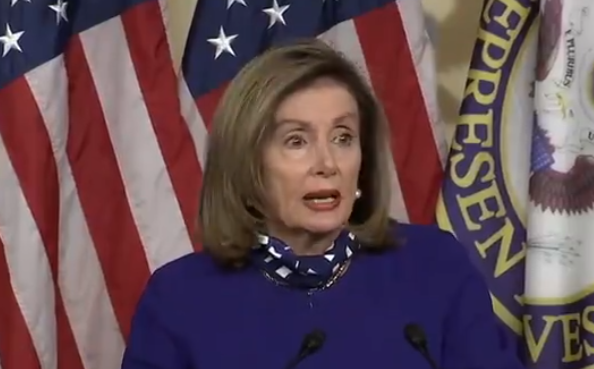
House Speaker Nancy Pelosi (D-CA) said on Thursday that Congressional Democrats are sticking to their $2 trillion-plus coronavirus relief demands, and has blamed the GOP for refusing to compromise amid the ongoing impasse.

We’re not budging,” Pelosi told Capitol Hill reporters. “They have to move. They have to move.”

(Or, they don’t and President Trump will authorize stimulus extensions until the election)

“Why should there be a bill that has far less [of] what the public needs?” Pelosi added. “We have that responsibility, and they’re just going to have to come up with more money.”

The comments came just hours before Pelosi was scheduled to speak by phone with White House chief of staff Mark Meadows — the first conversation between the sides since the talks broke down on Aug. 7.

That day, Pelosi and Senate Minority Leader Charles Schumer (D-N.Y.) had offered to reduce their initial $3.4 trillion demand by $1 trillion, but only if Republicans were willing to hike their opening bid of $1.1 trillion by the same $1 trillion — a proposal the GOP leaders quickly rejected.

Pelosi warned Thursday that if the Republicans’ position remains unchanged her phone call with Meadows won’t last long. –The Hill

“That could be a very short conversation if they’re not ready to meet in the middle,” Pelosi added.

According to The Hill, Democratic leaders say they had a much easier time negotiating with Treasury Secretary Steven Mnuchin before Mark Meadows joined the conversation.

Meadows, a former congressman from North Carolina, had had no problem walking away from funding bills during his years in office – even when they were endorsed by members of his own party.

Pelosi lashed out at her former colleague on Thursday, characterizing him as ‘Mnuchin’s staffer.’

“This is a conversation only to respect the fact that [he is] the president’s representative — not even the lead negotiator, that would be Mnuchin,” Pelosi said – before the 80-year-old lawmaker forgot Meadows’ name. “We consider whatever his name is — what’s his name? — Meadows there staffing Mr. Mnuchin. And if they are willing to meet us in the middle then we can sit down and talk.”

“So this is: you called me, I’m returning your call. Are you ready to bring much more money to the table?”

Meadows and Pelosi have a call scheduled for 2:30 p.m. according to The Hill.

via ZeroHedge News https://ift.tt/3aZEcif Tyler Durden

Strong Demand For 7 Year Auction Concludes Week Of Record Treasury Issuance

Strong Demand For 7 Year Auction Concludes Week Of Record Treasury Issuance

Tyler Durden

Thu, 08/27/2020 – 13:21

After two monster auctions earlier this week, when demand for both the 2 and 5 Year auctions was off the chart, moments ago the Treasury sold another record-sized auction when it placed $47 billion in 7 year paper, up $3 billion from last month, and which like the last two was met with impressive demand.

Thanks to the concession following today’s selloff across the curve, the high yield in today’s auction once again stopped through the When Issued, pricing at 0.519%, 0.8bps through the WI.

The Bid to Cover, unlike the week’s prior auctions, was strong but not remarkably so, and at 2.472 was just above last month’s 2.449 but below the six auction average of 2.55.

The internals were better, with Indirects taking down 68.03%, not only well above the recent average of 63.7%, but the highest since November. And with Directs taking down 16.4% of the auction, virtually unchanged from last month, Dealers were left with just 15.3%, far below the six-auction average of 23.1% and also the lowest since March of 2019.

Overall, this was another stellar auction, this time on the belly of the curve, and judging by the impressive demand it was the latest indication that the Fed’s message that no rate hikes are coming any time soon, was heard loud and clear by the market.

via ZeroHedge News https://ift.tt/2YGt2dd Tyler Durden

Bad Monetary Theory Enables Disastrous Government Policies

Bad Monetary Theory Enables Disastrous Government Policies

Tyler Durden

Thu, 08/27/2020 – 13:19

Via SchiffGold.com,

Last month, gold broke its all-time record price. As we have explained, to really understand what’s going on, you need to flip the equation. Dollars are at an all-time record low compared to gold. Simply put, the recent surge in gold prices is all about currency debasement.

We were on this path long before coronavirus reared its ugly head. After all, this gold bull market started back in 2015. But the government response to the pandemic put the process in hyperdrive. In March, the Federal Reserve embarked on a policy of money printing to infinity and beyond. And there is no end in sight. The Fed is apparently even willing to turn the other way the inevitable result of printing money – price inflation – begins to become apparent in the economy.

As economist Patrick Barron pointed out in an article published at the Mises Wire, unsound money has been at the heart of disastrous government policies throughout history. This time is no different. The Fed “cure” for the coronavirus economic meltdown is really part of the problem…

The following article by Patrick Barron was originally published at the Mises Wire. The opinions expressed for your consideration are the author’s and do not necessarily reflect those of Peter Schiff or SchiffGold. 

Austrian school economists know that unsound money has been at the heart of disastrous government policies since time immemorial. The greater the ignorance of money, the greater the monetary debasement in order to fund government’s latest folly.

Monetary debasement always ends badly, but end it will. Robert L. Shuettinger and Eamon Butler, cofounder and director of the Adam Smith Institute, wrote Forty Centuries of Wage and Price Controls: How Not to Fight Inflation (2009), a very readable short book that covers a vast expanse of time. In The Ethics of Money Production, Jörg Guido Hülsmann outlined all the various schemes used over the millennia by those in government to counterfeit the lifeblood of the economy for their own purposes. But Professor Hulsmann, who wrote the book in 2010, probably could not have predicted the scale of today’s money expansion. What is the point of all this?

Well, the point is that the ignorant public and the tyrants who rule them apparently believe that all that is wanting to achieve some great goal is money. And since government can conjure all the money that it desires out of thin air, government ought to do so. It’s really as simple as that.

Fiat Money Makes Keynesian Economics Appear to Be Possible

Along the way some almost universally accepted economic principles have had to be shunted aside. John Maynard Keynes, author of The General Theory of Employment, Interest, and Money and considered to be the father of modern macroeconomics, managed to concoct a new economic school of thought that completely ignored Say’s law. No longer was money an indirect medium of exchange to facilitate the transfer of real goods and services for other real goods and services, what Frank Shostak calls the exchange of “something for something.” No. Now money itself could be conjured out of thin air and used to confiscate real goods and services. No longer would government be forced to convince its constituents that its latest spending proposal was so necessary that it could justify an increase in taxes and/or the reduction or elimination of some other spending programs. Barring the failure of those two funding options, it would no longer be forced, as it had in the past, to convince savers that its credit was good. In other words, spending would be completely unshackled from the reality of uncertainty and scarcity.

Fiat Money Hides the Consequences of Lockdowns

The coronavirus pandemic has exposed the hollowness of what is called modern monetary theory (MMT). The horrible consequences of government shutdowns throughout the country have been truly “papered over” with trillions of dollars of fiat money through so-called stimulus checks, handouts to politically connected businesses, and boosts in unemployment payments. Real money would have revealed the damage to the world economy long ago, and I am do not doubt that shutdowns would have quickly stopped being used as a tool for controlling the virus. As it is, the shutdowns linger in many parts of the world, because the consequences are not yet fully seen.

The End of the Credit Cycle

Yet the coronavirus-inspired shutdowns and helicopter money to placate a frightened populace are merely the latest examples of foolish government policies made possible only by the government’s ability to conjure money out of thin air. The broader background of weakening bank balance sheets has ensured a recession and possibly a depression through bank credit expansion funded not by an increase in real savings but central banks. In his latest warning that the end of the most recent credit cycle is nigh, Alasdair Macleod of Goldmoney.com paints a bleak picture of the weakness of the “globally systemically important banks” (G-SIBs):

the elephant in the room is systemic risk — visible to all but simply ignored. This is partly due to everyone in government and central banks, as well as their epigones in the investment industry and mainstream media, believing our economic problems are only a matter of Covid-19.

Governments have introduced emergency plans. The US Government is distributing money by metaphorical helicopters, and Britain has a furlough scheme and tax deferments. But they do little to alleviate the concerns of highly leveraged commercial bankers, facing the prospects of soaring bad debts. Bank balance sheet asset values to market capitalisation ratios strongly suggest the banking system cannot cope with what is ahead.

There is NOTHING that government can do to help the economy other than remove barriers to wealth creation and preservation that it itself created and allow the people the freedom to pursue their own ends. Since government creates nothing itself, all interventions interfere with what the people themselves desire and are nothing more than transfers of wealth for the benefit of some and the destruction of wealth for all. Yet wealth destruction may not be the worst thing that can happen. A nation can lose its freedom entirely when government doubles down and doubles down time and again in the pursuit of phantom fixes with ever-increasing amounts of fiat money conjured out of thin air. It happened in Rome (Inflation and the Fall of Rome, a speech by Joseph R. Peden). It happened in Weimar Germany (When Money Dies, by Adam Fergusson).

It certainly can happen here and now.

via ZeroHedge News https://ift.tt/2QwpPbK Tyler Durden

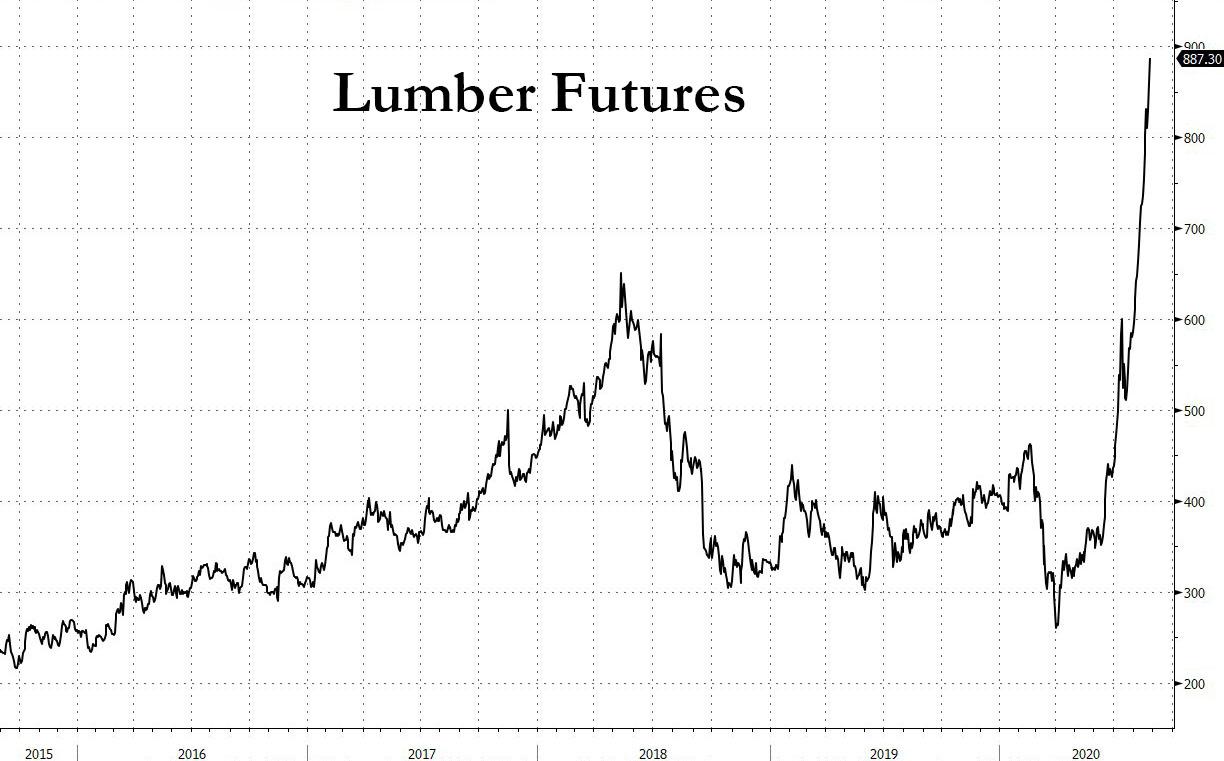
Limit Up: Lumber Spikes To Unprecedented Level After Soaring 240% In 5 Months

Limit Up: Lumber Spikes To Unprecedented Level After Soaring 240% In 5 Months

Tyler Durden

Thu, 08/27/2020 – 13:00

With the Fed now desperate to hit an average of 2% inflation for the foreseeable future (it remains unclear over what period the “average” will be calculated), the price of lumber is certainly helping the US central bank, because as WKRN writes, if you are in need of lumber, then it is likely you are on a long waiting list with others.

Driven by a new housing boom (which may soon become a bubble) in single-family houses as residents of major cities flee in droves for the suburbs, demand for lumber is soaring while supply is negligible. Which – even in our time of upside down economics – means that  prices will continue to soar. For those planning to build a deck, fence or house this fall, you may want to think twice.

“They’re basically at historic levels across the bar,” Chris Lewis said, Vice President of Sales at Rogers Manufacturing Corporation.

“It’s all through the roof.”

No pun intended. Lewis said due to COVID-19 production at lumber mills has slowed down. Their production now sits around 60% to 70% of what it should be in relation to the demand.

“They’re all saying ‘we’re trying, we just cant,’” Lewis said in addition to high prices they are also struggling with availability issues.

Amid the onset of coronavirus lumber production slowed, and experts thought demand would drop. But instead, it soared.

“[People] are at home bored. They’re going to build an addition; fix something on their house; build a dec; redo this; or redo that,” Lewis said.

Picking up where we last looked at it, the price of lumber futures just hit a record $887.30, limit up on the session. That’s a 240% increase since the start of April.

“According to my suppliers, we’ve seen a two almost two and a half times of cost increase,” Jeff Checko said, broker with The Ashton Real Estate Group. “You’re going to see impact in the delivered asking prices from builders and quoted pricing for custom homes and home renovation projects.”

The recent spike is causing the price of an average new single-family home to increase by $16,000 since late April, according to the National Association of Home Builders.

“These builders that have these houses for $350,000-$550,000 – now instead of paying $30,000-$40,000 for their framing package – they’re spending $75,000-$90,000 for their framing package. So, when does that kill the deal?” Lewis asked.

Unfortunately, Lewis doesn’t see anything changing anytime soon. Unless, demand drops and supply grows. If prices continue to rise, Lewis said it may be hard for customers to find lumber on store shelves.

“We have problems pricing something because we don’t know where our cost will be next week,” Lewis said. “When does it stop, where is the top.”

via ZeroHedge News https://ift.tt/2QusPW3 Tyler Durden