District of Columbia Working Group Finds Prominent Abolitionist, James Birney, Has a “Legacy” That Does Not Merit Recognition.

The District of Columbia authorized a working group to make recommendations about public displays. The Committee states that “[c]ommemoration on a District of Columbia asset is a high honor reserved for esteemed persons with a legacy that merits recognition.” And how should that person’s legacy be assessed? The working group identified five factors:

1. Participation in slavery – did research and evidence find a history of enslaving other humans, or otherwise supporting the institution of slavery?

2. Involvement in systemic racism – did research and evidence find the namesake serving as an author of policy, legislation or actions that suppressed persons of color and women?

3. Support for oppression – did research and evidence find the namesake endorsed and participated in the oppression of persons color and/or women?

4. Involvement in supremacist agenda – did research and evidence suggest that the namesake was a member of any supremacist organization?

5. Violation of District human rights laws – did research and evidence find the namesake committed a violation of the DC Human Right Act, in whole or part, including discrimination against protected traits such as age, religion, sexual orientation, gender identity and natural origin?

I knew these purges would never end at eliminating confederate statutes. The third and fifth factors are so broad, as to sweep in every “namesake” who is commemorated in the District of Columbia.

From these five factors, the Working Group identified five ways to address the “namesake.” Call them the five degrees of cancellation.

  1. Recommend renaming the asset
  2. Recommend removal of the asset
  3. Recommend contextualization of the asset
  4. Clear namesake from further review
  5. Recommend additional research prior to final decision point

The Working Group recommends renaming twenty-one schools. By my count five schools are named after Presidents. Perhaps the most bizarre name on this list is James Birney. They would strip his name from a public school.
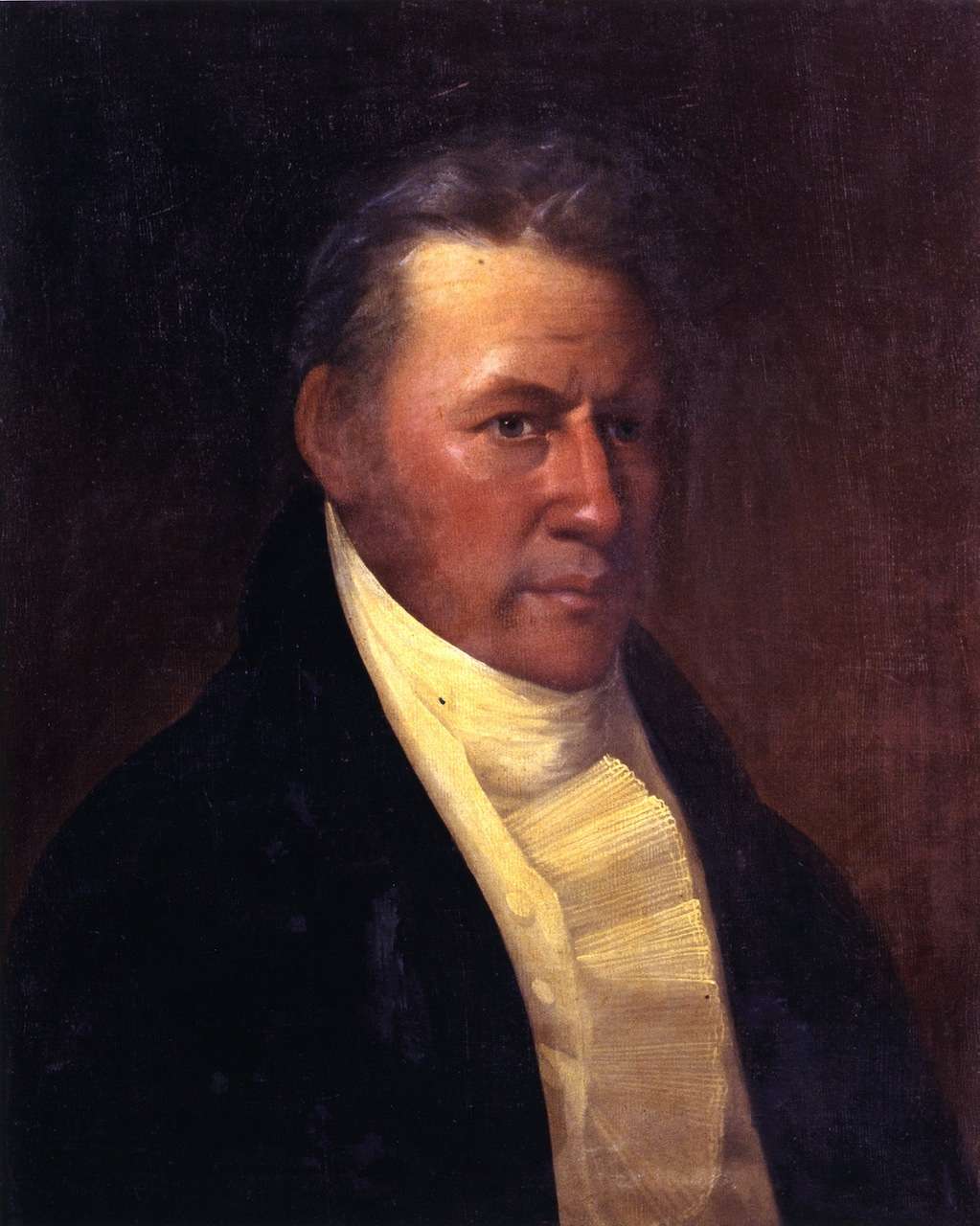
James Birney

You have probably never heard of Birney. He was a prominent abolitionist. Randy and I discuss him in our new book on Slavery and the Constitution (stay tuned):

Birney had formerly been a slaveholder in Kentucky, but later moved to Cincinnati, Ohio to advocate against slavery. In 1836, he founded the abolitionist newspaper The Philanthropist. In his paper, he not only opposed slavery, he also maintained that African Americans were entitled to equal rights and opportunities with white people.

Birney was instrumental in developing the arguments against the constitutionality of the Fugitive Slave Act. He recruited Salmon Chase, then a young lawyer, to work on Matilda’s case. We explain:

Matilda’s father sent slave catchers to find her and bring her back. Soon, she was located and held in custody. The slave catchers sought her removal from Ohio pursuant to the Fugitive Slave Act of 1793. Birney recruited his fellow Cincinnatian attorney, Salmon Chase to assist in Matilda’s legal defense. They sought a writ of habeas corpus for Matilda’s freedom. Together, Birney and Chase developed an argument that Congress lacked the enumerated powers to enact the Fugitive Slave Act. Therefore, the slave catchers could not rely on this law to remove Matilda. And, because the Act was unconstitutional, state judges were not obligated to assist slave catchers who were attempting to return runaway slaves….

Birney later went on to be a leader of the anti-slavery Liberty party.

 In 1840 and 1844, Birney was the Liberty Party’s candidate for president. The Liberty party adopted a stridently antislavery platform, which proved to largely unsuccessful.

I have little faith in the Working Group’s ability to parse the five factors for cancellation. If they included Birney, their research was woefully incomplete. And if Birney’s former slaveholding permanently disqualifies him, then Justice John Marshall Harlan–the legendary Plessy dissenter–is out. Of course, his views on Chinese people would violate the third and fifth principles.

The Working Group also urged the Mayor to “recommend the Federal government remove, relocate, or contextualize the following assets.”

  1. Christopher Columbus – Columbus Fountain (federal)
  2. Benjamin Franklin – Benjamin Franklin Statue (federal)
  3. Andrew Jackson – Andrew Jackson Statue (federal)
  4. Thomas Jefferson – Jefferson Memorial (federal)
  5. George Mason – George Mason Memorial (federal)
  6. Francis Griffith Newlands – Newlands Memorial Fountain (federal)
  7. Albert Pike – Albert Pike Statue (federal)
  8. George Washington – Washington Monument, George Washington Statue (federal)

They missed the FDR monument. He enacted internment of Japanese Americans. I can’t imagine how that prominent monument on the National Mall evaded the Working Group’s careful scrutiny. And they missed the John Marshall statute outside the D.C. Circuit Courthouse. He is not safe.

The District of Columbia has even proposed renaming itself as the Douglass Commonwealth, after Frederick Douglass. Wait till residents read what Frederick Douglass wrote about racial preferences. Here is an excerpt from Justice Thomas’s Grutter dissent:

Frederick Douglass, speaking to a group of abolitionists almost 140 years ago, delivered a message lost on to day’s majority:

“[I]n regard to the colored people, there is always more that is benevolent, I perceive, than just, manifested towards us. What I ask for the negro is not benevolence, not pity, not sympathy, but simply justice. The American people have always been anxious to know what they shall do with us . . . . I have had but one answer from the beginning. Do nothing with us! Your doing with us has already played the mischief with us. Do nothing with us! If the apples will not remain on the tree of their own strength, if they are worm-eaten at the core, if they are early ripe and disposed to fall, let them fall! . . . And if the negro cannot stand on his own legs, let him fall also. All I ask is, give him a chance to stand on his own legs! Let him alone! . . . [Y]our interference is doing him positive injury.” What the Black Man Wants: An Address Delivered in Boston, Massachusetts, on 26 January 1865, reprinted in 4 The Frederick Douglass Papers 59, 68 (J. Blassingame & J. McKivigan eds. 1991) (emphasis in original).

Like Douglass, I believe blacks can achieve in every avenue of American life without the meddling of university administrators. Because I wish to see all students succeed whatever their color, I share, in some respect, the sympathies of those who sponsor the type of discrimination advanced by the University of Michigan Law School (Law School). The Constitution does not, however, tolerate institutional devotion to the status quo in admissions policies when such devotion ripens into racial discrimination. Nor does the Constitution countenance the unprecedented deference the Court gives to the Law School, an approach inconsistent with the very concept of “strict scrutiny.”

These purges will sweep in everyone.

from Latest – Reason.com https://ift.tt/2EPMygH
via IFTTT
Right of Publicity Lawsuit by Alleged “Pantless Couponer” Dismissed

From the Report and Recommendation by Magistrate Judge Philip R. Lammens in Anderson v. Coupons in the News (M.D. Fla. July 28, 2020), which Judge James S. Moody, Jr. just adopted yesterday:

This lawsuit arises out of Plaintiff’s visit to a Best Buy store in Lady Lake, Florida, during which she got into a dispute with an employee over an expired coupon and was ultimately arrested for disorderly conduct. While there is disagreement as to whether Plaintiff dropped her pants during the dispute, Defendant Coupons in the News …, subsequently used Plaintiff’s mug shot in articles posted on its website that detailed the events and labeled Plaintiff the “Pantless Couponer.”

Plaintiff brought this action against Coupons alleging that its conduct in publishing the articles was actionable on the theories of commercial misappropriation of likeness, invasion of privacy, intentional infliction of emotional distress, and unjust enrichment….

Central to her claims against Coupons, is Plaintiff’s conclusory allegation that the subject articles are advertisements…. [But] the articles attached to the Second Amended Complaint (Exhibits B and C) clearly are not advertisements…. On their face, the articles recount the events surrounding Plaintiff’s arrest at the Best Buy store. Crimes and arrests are newsworthy matters, falling within the scope of legitimate public concern….

“[W]ithin the scope of legitimate public concern are matters customarily regarded as ‘news,'” which includes publications concerning crimes, arrests, police raids, suicides, marriages, divorces etc…. Florida courts have confirmed that “where one becomes an actor in an occurrence of public interest, it is not an invasion of her right to privacy to publish her photograph with an account of such occurrence.” “Just because the story and the photograph may be embarrassing or distressful to the plaintiff does not mean the newspaper cannot publish what is otherwise newsworthy.” …

Plaintiff alleges in a conclusory manner that Coupons’ publication of the articles with her mugshot was outrageous. However, while the articles may be embarrassing or distressful to Plaintiff, they detail a matter of legitimate public concern and are certainly not “atrocious … and utterly intolerable in a civilized community.” Accordingly, Plaintiff has failed to allege a plausible claim against Coupons for intentional infliction of emotional distress ….

Plaintiff also seeks damages from Coupons for unjust enrichment. To state a claim for unjust enrichment, Plaintiff must allege that she has conferred a benefit on Coupons, who has knowledge thereof; Coupons voluntarily accepted and retained the benefit conferred; and the circumstances are such that it would be inequitable for Coupons to retain the benefit without first paying the value thereof to Plaintiff….

Plaintiff alleges that the articles with her “misappropriated” photograph conferred some unspecified benefit on Coupons. It is unclear what benefit the articles could possibly have conferred since they simply recounted the events surrounding Plaintiff’s arrest (with Plaintiff’s photograph used as an illustration); and the articles were not advertisements, nor did they directly promote a product or service of Coupons. Accordingly, Plaintiff has failed to allege a plausible claim against Coupons for unjust enrichment.

Likely because of Florida’s anti-SLAPP statute, the District Court ordered that, “Defendant Coupons in the News, LLC’s is directed to file its motion for attorney’s fees and costs within fourteen (14) days of this Order.”

from Latest – Reason.com https://ift.tt/3jztZvR
via IFTTT

The Feds Who Made America’s Fentanyl Freakout Worse

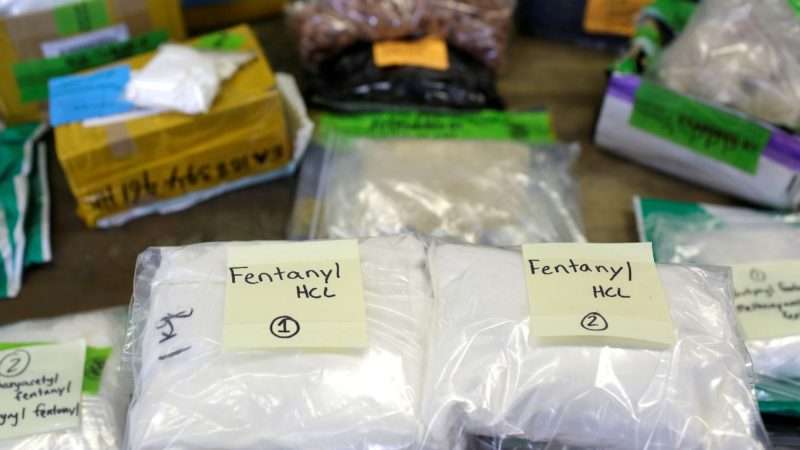
Fentanyl

Police officers in Texas were told some terrifying news on June 26, 2018: Anti-government flyers poisoned with a deadly opioid had been placed on Harris County Sheriff’s Office squad cars, and a sergeant who had touched one was en route to the hospital with overdose symptoms. The incident set off a flurry of media coverage, and it frightened police halfway across the country. The Maine Information Analysis Center forwarded Harris County’s bulletin to local departments, while the Commonwealth Fusion Center wrote its own safety alert for Massachusetts officers.

But it wasn’t true. Three days later, a laboratory analysis found that there was no fentanyl on the flyers. The Harris County Sheriff’s Office blamed the panic on a problem with field test kits.

Fentanyl, a synthetic opioid hundreds of times more powerful than morphine, is responsible for about half of overdose deaths in the United States. Among law enforcement, it has taken on mythical properties. First responders around the country have claimed to have nearly died from accidental exposure, based on the scientifically inaccurate idea that a deadly amount of fentanyl can pass through human skin or even poison the air around it.

That myth has spread through a surprising avenue: America’s counterterrorism agencies.

Leaked police documents reviewed by Reason show that fusion centers—local liaison offices set up by the Department of Homeland Security in the wake of 9/11—have circulated fentanyl myths, causing police officers to panic and wasting first responders’ time.

The documents were first released as part of BlueLeaks, a massive trove of law enforcement data leaked by the hacker collective Anonymous. Out of 121 fentanyl-related bulletins in the BlueLeaks trove reviewed by Reason, at least 36 claimed that fentanyl could be absorbed through the skin and at least 41 discussed the alleged danger of airborne fentanyl.

FBI officials even claimed that fentanyl is “very likely a viable option” for a chemical terrorist attack in a September 2018 bulletin, although they also admitted that there is “no known credible threat reporting” suggesting that anyone was actually planning such an attack.

The more the myths spread, the more officers in the field panicked, convinced that they had fallen victim to an accidental fentanyl overdose.

Fentanyl is a genuinely dangerous drug. A state trooper in Salem County, New Jersey, fainted and had to be revived with naloxone in September 2018 during a drug bust, according to a bulletin by the New Jersey Regional Operations and Intelligence Center. The officer had touched their face with fentanyl-contaminated hands—likely bringing the drug into contact with the mouth or eyes—and later tested positive for opioid exposure.

But overdosing “from transdermal and airborne exposure to Illicitly Manufactured Fentanyl (IMF) is a near scientific impossibility,” according to the Harm Reduction Coalition.

In other words, fentanyl can’t jump through air or the skin to suddenly kill you.

The drug can be administered through skin patches, but these patches require moisture and work over a long period of time. Similarly, someone would have to stand near an industrial-sized concentration of fentanyl for more than two and a half hours to feel the effects of the drug through airborne exposure.

The difficulty of overdosing by touching fentanyl didn’t stop law enforcement—including the federal Drug Enforcement Agency—from warning the public that fentanyl could be “absorbed through the skin.”

Meanwhile, many alleged “overdoses” by first responders seemed to be caused by panic—and the more they happened, the more panic they spread.

One state trooper was responding to an overdose in Sussex County, Delaware when he was suddenly struck by “an accelerated heart rate and light headedness,” which turned into “a tingling sensation in his legs,” according to an October 2018 bulletin by the Delaware Information & Analysis Center, the state’s fusion center.

Rapid heartbeat and dizziness are symptoms of anxiety—not opioid overdose—but the Delaware trooper was rushed to the hospital and “treated” with naloxone.

That was enough to convince the Delaware Information & Analysis Center, which warned officers “to treat all unknown substances as if they could be deadly if inhaled or absorbed through the skin” in its bulletin about the incident.

The Young Physicians Section of the American Medical Association complained in a 2019 resolution that “paranoia” around accidental fentanyl exposure was causing first responders to “waste” naloxone on non-incidents while fearing for their lives around actual overdose victims.

Drug myths were not the only misinformation spread by fusion centers. Fusion centers have called “Don’t Tread On Me” flags a sign of extremism, warned that ironic tweets about Florida could “incite” terrorist attacks, and spread bizarre warnings about “radical Islamist tattoos.”

A U.S. Senate report in 2012 found that fusion centers had spent up to $1.2 billion to provide “oftentimes shoddy” and “rarely timely” information.

When it came to fentanyl, the War on Terror and the War on Drugs combined to create a toxic dose of misinformation.

The High Intensity Drug Trafficking Area (HIDTA) program operates much the same way as fusion centers—it is a program for sharing information between local law enforcement and the White House drug czar—with much less media scrutiny.

Much of the information about fentanyl in the BlueLeaks dump came from HIDTA’s regional Investigative Support Center in Arizona.

Every bulletin about fentanyl from the Arizona office between May 2015 and January 2018 came with a warning that fentanyl “can be fatal if swallowed, inhaled or absorbed through the skin.”

Bulletins from the Arizona office ended up on the servers of law enforcement agencies across California, including the fusion centers for northern California and Orange County, spreading the misinformation about skin contact to dozens of local departments.

The bulletins also correctly mentioned that fentanyl “can enter the body through the inadvertent touching of the mouth, nose, or other mucous membranes.”

The Arizona office finally dropped its warnings about skin absorption in early 2018, as public awareness about fentanyl grew.

“Law enforcement bulletins regarding fentanyl have changed over time,” a spokesperson for the Arizona office tells Reason. “Information received by law enforcement over the past five years regarding fentanyl exposure is continually updated.”

And the federal government began to distribute better fentanyl safety recommendations beginning in November 2017. The Department of Justice released a video in August 2018 showing that “incidental skin contact” can be safely dealt with using soap and water.

But misinformation about fentanyl continues to frustrate medical professions, as the 2019 resolution by the American Medical Association emphasized.

“Stigma of opioid abuse and overdose has already made first-responders reluctant to intervene in a timely manner when someone is suspected of overdosing,” the resolution warned. “Further delays in administration of naloxone in the setting of opioid overdose can have fatal consequences.”

The Commonwealth Fusion Center and Delaware Information & Analysis Center have not responded to requests for comment.

from Latest – Reason.com https://ift.tt/3bhH6Pj
via IFTTT

District of Columbia Working Group Finds Prominent Abolitionist, James Birney, Has a “Legacy” That Does Not Merit Recognition.

The District of Columbia authorized a working group to make recommendations about public displays. The Committee states that “[c]ommemoration on a District of Columbia asset is a high honor reserved for esteemed persons with a legacy that merits recognition.” And how should that person’s legacy be assessed? The working group identified five factors:

1. Participation in slavery – did research and evidence find a history of enslaving other humans, or otherwise supporting the institution of slavery?

2. Involvement in systemic racism – did research and evidence find the namesake serving as an author of policy, legislation or actions that suppressed persons of color and women?

3. Support for oppression – did research and evidence find the namesake endorsed and participated in the oppression of persons color and/or women?

4. Involvement in supremacist agenda – did research and evidence suggest that the namesake was a member of any supremacist organization?

5. Violation of District human rights laws – did research and evidence find the namesake committed a violation of the DC Human Right Act, in whole or part, including discrimination against protected traits such as age, religion, sexual orientation, gender identity and natural origin?

I knew these purges would never end at eliminating confederate statutes. The third and fifth factors are so broad, as to sweep in every “namesake” who is commemorated in the District of Columbia.

From these five factors, the Working Group identified five ways to address the “namesake.” Call them the five degrees of cancellation.

  1. Recommend renaming the asset
  2. Recommend removal of the asset
  3. Recommend contextualization of the asset
  4. Clear namesake from further review
  5. Recommend additional research prior to final decision point

The Working Group recommends renaming twenty-one schools. By my count five schools are named after Presidents. Perhaps the most bizarre name on this list is James Birney. They would strip his name from a public school.

James Birney

You have probably never heard of Birney. He was a prominent abolitionist. Randy and I discuss him in our new book on Slavery and the Constitution (stay tuned):

Birney had formerly been a slaveholder in Kentucky, but later moved to Cincinnati, Ohio to advocate against slavery. In 1836, he founded the abolitionist newspaper The Philanthropist. In his paper, he not only opposed slavery, he also maintained that African Americans were entitled to equal rights and opportunities with white people.

Birney was instrumental in developing the arguments against the constitutionality of the Fugitive Slave Act. He recruited Salmon Chase, then a young lawyer, to work on Matilda’s case. We explain:

Matilda’s father sent slave catchers to find her and bring her back. Soon, she was located and held in custody. The slave catchers sought her removal from Ohio pursuant to the Fugitive Slave Act of 1793. Birney recruited his fellow Cincinnatian attorney, Salmon Chase to assist in Matilda’s legal defense. They sought a writ of habeas corpus for Matilda’s freedom. Together, Birney and Chase developed an argument that Congress lacked the enumerated powers to enact the Fugitive Slave Act. Therefore, the slave catchers could not rely on this law to remove Matilda. And, because the Act was unconstitutional, state judges were not obligated to assist slave catchers who were attempting to return runaway slaves….

Birney later went on to be a leader of the anti-slavery Liberty party.

 In 1840 and 1844, Birney was the Liberty Party’s candidate for president. The Liberty party adopted a stridently antislavery platform, which proved to largely unsuccessful.

I have little faith in the Working Group’s ability to parse the five factors for cancellation. If they included Birney, their research was woefully incomplete. And if Birney’s former slaveholding permanently disqualifies him, then Justice John Marshall Harlan–the legendary Plessy dissenter–is out. Of course, his views on Chinese people would violate the third and fifth principles.

The Working Group also urged the Mayor to “recommend the Federal government remove, relocate, or contextualize the following assets.”

  1. Christopher Columbus – Columbus Fountain (federal)
  2. Benjamin Franklin – Benjamin Franklin Statue (federal)
  3. Andrew Jackson – Andrew Jackson Statue (federal)
  4. Thomas Jefferson – Jefferson Memorial (federal)
  5. George Mason – George Mason Memorial (federal)
  6. Francis Griffith Newlands – Newlands Memorial Fountain (federal)
  7. Albert Pike – Albert Pike Statue (federal)
  8. George Washington – Washington Monument, George Washington Statue (federal)

They missed the FDR monument. He enacted Japanese internment. I can’t imagine how that prominent monument on the National Mall evaded the Working Group’s careful scrutiny. And they missed the John Marshall statute outside the D.C. Circuit Courthouse. He is not safe.

The District of Columbia has even proposed renaming itself as the Douglass Commonwealth, after Frederick Douglass. Wait till residents read what Frederick Douglass wrote about racial preferences. Here is an excerpt from Justice Thomas’s Grutter dissent:

Frederick Douglass, speaking to a group of abolitionists almost 140 years ago, delivered a message lost on to day’s majority:

“[I]n regard to the colored people, there is always more that is benevolent, I perceive, than just, manifested towards us. What I ask for the negro is not benevolence, not pity, not sympathy, but simply justice. The American people have always been anxious to know what they shall do with us . . . . I have had but one answer from the beginning. Do nothing with us! Your doing with us has already played the mischief with us. Do nothing with us! If the apples will not remain on the tree of their own strength, if they are worm-eaten at the core, if they are early ripe and disposed to fall, let them fall! . . . And if the negro cannot stand on his own legs, let him fall also. All I ask is, give him a chance to stand on his own legs! Let him alone! . . . [Y]our interference is doing him positive injury.” What the Black Man Wants: An Address Delivered in Boston, Massachusetts, on 26 January 1865, reprinted in 4 The Frederick Douglass Papers 59, 68 (J. Blassingame & J. McKivigan eds. 1991) (emphasis in original).

Like Douglass, I believe blacks can achieve in every avenue of American life without the meddling of university administrators. Because I wish to see all students succeed whatever their color, I share, in some respect, the sympathies of those who sponsor the type of discrimination advanced by the University of Michigan Law School (Law School). The Constitution does not, however, tolerate institutional devotion to the status quo in admissions policies when such devotion ripens into racial discrimination. Nor does the Constitution countenance the unprecedented deference the Court gives to the Law School, an approach inconsistent with the very concept of “strict scrutiny.”

These purges will sweep in everyone.

from Latest – Reason.com https://ift.tt/2EPMygH
via IFTTT

Right of Publicity Lawsuit by Alleged “Pantless Couponer” Dismissed

From the Report and Recommendation by Magistrate Judge Philip R. Lammens in Anderson v. Coupons in the News (M.D. Fla. July 28, 2020), which Judge James S. Moody, Jr. just adopted yesterday:

This lawsuit arises out of Plaintiff’s visit to a Best Buy store in Lady Lake, Florida, during which she got into a dispute with an employee over an expired coupon and was ultimately arrested for disorderly conduct. While there is disagreement as to whether Plaintiff dropped her pants during the dispute, Defendant Coupons in the News …, subsequently used Plaintiff’s mug shot in articles posted on its website that detailed the events and labeled Plaintiff the “Pantless Couponer.”

Plaintiff brought this action against Coupons alleging that its conduct in publishing the articles was actionable on the theories of commercial misappropriation of likeness, invasion of privacy, intentional infliction of emotional distress, and unjust enrichment….

Central to her claims against Coupons, is Plaintiff’s conclusory allegation that the subject articles are advertisements…. [But] the articles attached to the Second Amended Complaint (Exhibits B and C) clearly are not advertisements…. On their face, the articles recount the events surrounding Plaintiff’s arrest at the Best Buy store. Crimes and arrests are newsworthy matters, falling within the scope of legitimate public concern….

“[W]ithin the scope of legitimate public concern are matters customarily regarded as ‘news,'” which includes publications concerning crimes, arrests, police raids, suicides, marriages, divorces etc…. Florida courts have confirmed that “where one becomes an actor in an occurrence of public interest, it is not an invasion of her right to privacy to publish her photograph with an account of such occurrence.” “Just because the story and the photograph may be embarrassing or distressful to the plaintiff does not mean the newspaper cannot publish what is otherwise newsworthy.” …

Plaintiff alleges in a conclusory manner that Coupons’ publication of the articles with her mugshot was outrageous. However, while the articles may be embarrassing or distressful to Plaintiff, they detail a matter of legitimate public concern and are certainly not “atrocious … and utterly intolerable in a civilized community.” Accordingly, Plaintiff has failed to allege a plausible claim against Coupons for intentional infliction of emotional distress ….

Plaintiff also seeks damages from Coupons for unjust enrichment. To state a claim for unjust enrichment, Plaintiff must allege that she has conferred a benefit on Coupons, who has knowledge thereof; Coupons voluntarily accepted and retained the benefit conferred; and the circumstances are such that it would be inequitable for Coupons to retain the benefit without first paying the value thereof to Plaintiff….

Plaintiff alleges that the articles with her “misappropriated” photograph conferred some unspecified benefit on Coupons. It is unclear what benefit the articles could possibly have conferred since they simply recounted the events surrounding Plaintiff’s arrest (with Plaintiff’s photograph used as an illustration); and the articles were not advertisements, nor did they directly promote a product or service of Coupons. Accordingly, Plaintiff has failed to allege a plausible claim against Coupons for unjust enrichment.

Likely because of Florida’s anti-SLAPP statute, the District Court ordered that, “Defendant Coupons in the News, LLC’s is directed to file its motion for attorney’s fees and costs within fourteen (14) days of this Order.”

from Latest – Reason.com https://ift.tt/3jztZvR
via IFTTT

The Feds Who Made America’s Fentanyl Freakout Worse

Fentanyl

Police officers in Texas were told some terrifying news on June 26, 2018: Anti-government flyers poisoned with a deadly opioid had been placed on Harris County Sheriff’s Office squad cars, and a sergeant who had touched one was en route to the hospital with overdose symptoms. The incident set off a flurry of media coverage, and it frightened police halfway across the country. The Maine Information Analysis Center forwarded Harris County’s bulletin to local departments, while the Commonwealth Fusion Center wrote its own safety alert for Massachusetts officers.

But it wasn’t true. Three days later, a laboratory analysis found that there was no fentanyl on the flyers. The Harris County Sheriff’s Office blamed the panic on a problem with field test kits.

Fentanyl, a synthetic opioid hundreds of times more powerful than morphine, is responsible for about half of overdose deaths in the United States. Among law enforcement, it has taken on mythical properties. First responders around the country have claimed to have nearly died from accidental exposure, based on the scientifically inaccurate idea that a deadly amount of fentanyl can pass through human skin or even poison the air around it.

That myth has spread through a surprising avenue: America’s counterterrorism agencies.

Leaked police documents reviewed by Reason show that fusion centers—local liaison offices set up by the Department of Homeland Security in the wake of 9/11—have circulated fentanyl myths, causing police officers to panic and wasting first responders’ time.

The documents were first released as part of BlueLeaks, a massive trove of law enforcement data leaked by the hacker collective Anonymous. Out of 121 fentanyl-related bulletins in the BlueLeaks trove reviewed by Reason, at least 36 claimed that fentanyl could be absorbed through the skin and at least 41 discussed the alleged danger of airborne fentanyl.

FBI officials even claimed that fentanyl is “very likely a viable option” for a chemical terrorist attack in a September 2018 bulletin, although they also admitted that there is “no known credible threat reporting” suggesting that anyone was actually planning such an attack.

The more the myths spread, the more officers in the field panicked, convinced that they had fallen victim to an accidental fentanyl overdose.

Fentanyl is a genuinely dangerous drug. A state trooper in Salem County, New Jersey, fainted and had to be revived with naloxone in September 2018 during a drug bust, according to a bulletin by the New Jersey Regional Operations and Intelligence Center. The officer had touched their face with fentanyl-contaminated hands—likely bringing the drug into contact with the mouth or eyes—and later tested positive for opioid exposure.

But overdosing “from transdermal and airborne exposure to Illicitly Manufactured Fentanyl (IMF) is a near scientific impossibility,” according to the Harm Reduction Coalition.

In other words, fentanyl can’t jump through air or the skin to suddenly kill you.

The drug can be administered through skin patches, but these patches require moisture and work over a long period of time. Similarly, someone would have to stand near an industrial-sized concentration of fentanyl for more than two and a half hours to feel the effects of the drug through airborne exposure.

The difficulty of overdosing by touching fentanyl didn’t stop law enforcement—including the federal Drug Enforcement Agency—from warning the public that fentanyl could be “absorbed through the skin.”

Meanwhile, many alleged “overdoses” by first responders seemed to be caused by panic—and the more they happened, the more panic they spread.

One state trooper was responding to an overdose in Sussex County, Delaware when he was suddenly struck by “an accelerated heart rate and light headedness,” which turned into “a tingling sensation in his legs,” according to an October 2018 bulletin by the Delaware Information & Analysis Center, the state’s fusion center.

Rapid heartbeat and dizziness are symptoms of anxiety—not opioid overdose—but the Delaware trooper was rushed to the hospital and “treated” with naloxone.

That was enough to convince the Delaware Information & Analysis Center, which warned officers “to treat all unknown substances as if they could be deadly if inhaled or absorbed through the skin” in its bulletin about the incident.

The Young Physicians Section of the American Medical Association complained in a 2019 resolution that “paranoia” around accidental fentanyl exposure was causing first responders to “waste” naloxone on non-incidents while fearing for their lives around actual overdose victims.

Drug myths were not the only misinformation spread by fusion centers. Fusion centers have called “Don’t Tread On Me” flags a sign of extremism, warned that ironic tweets about Florida could “incite” terrorist attacks, and spread bizarre warnings about “radical Islamist tattoos.”

A U.S. Senate report in 2012 found that fusion centers had spent up to $1.2 billion to provide “oftentimes shoddy” and “rarely timely” information.

When it came to fentanyl, the War on Terror and the War on Drugs combined to create a toxic dose of misinformation.

The High Intensity Drug Trafficking Area (HIDTA) program operates much the same way as fusion centers—it is a program for sharing information between local law enforcement and the White House drug czar—with much less media scrutiny.

Much of the information about fentanyl in the BlueLeaks dump came from HIDTA’s regional Investigative Support Center in Arizona.

Every bulletin about fentanyl from the Arizona office between May 2015 and January 2018 came with a warning that fentanyl “can be fatal if swallowed, inhaled or absorbed through the skin.”

Bulletins from the Arizona office ended up on the servers of law enforcement agencies across California, including the fusion centers for northern California and Orange County, spreading the misinformation about skin contact to dozens of local departments.

The bulletins also correctly mentioned that fentanyl “can enter the body through the inadvertent touching of the mouth, nose, or other mucous membranes.”

The Arizona office finally dropped its warnings about skin absorption in early 2018, as public awareness about fentanyl grew.

“Law enforcement bulletins regarding fentanyl have changed over time,” a spokesperson for the Arizona office tells Reason. “Information received by law enforcement over the past five years regarding fentanyl exposure is continually updated.”

And the federal government began to distribute better fentanyl safety recommendations beginning in November 2017. The Department of Justice released a video in August 2018 showing that “incidental skin contact” can be safely dealt with using soap and water.

But misinformation about fentanyl continues to frustrate medical professions, as the 2019 resolution by the American Medical Association emphasized.

“Stigma of opioid abuse and overdose has already made first-responders reluctant to intervene in a timely manner when someone is suspected of overdosing,” the resolution warned. “Further delays in administration of naloxone in the setting of opioid overdose can have fatal consequences.”

The Commonwealth Fusion Center and Delaware Information & Analysis Center have not responded to requests for comment.

from Latest – Reason.com https://ift.tt/3bhH6Pj
via IFTTT

Bill De Blasio Says NYC Indoor Dining May Not Happen Until June 2021

Bill De Blasio Says NYC Indoor Dining May Not Happen Until June 2021

Tyler Durden

Tue, 09/01/2020 – 15:20

Not satisfied with watching from the sidelines as his city descends into a war zone, Mayor Bill de Blasio seems to be doing everything he can to drive citizens and business owners out of the city. His latest idea came on Monday, when de Blasio said he may not open indoor dining in the city until a vaccine for Covid is released. This means that indoor dining in the nation’s most popular city may not happen during 2020, despite the fact that outdoor dining is going to be far more difficult to continue heading into the winter months.

We’re sure this will be the most “popular” idea with restaurant owners since Philadelphia’s Mayor was spotted dining indoors in Maryland while keeping Philadelphia-area restaurants shut down for indoor dining. The news, obviously, could be crippling to business owners. 

de Blasio has backed a June 1, 2021 re-open date, despite many other major U.S. cities all setting up to re-open heading into the fall. He said Monday: “We do expect — and pray for and expect — a vaccine in the spring that will allow us to get more back to normal, but I will absolutely tell you, we’re going to keep looking for that situation where we can push down the virus enough where we would have more ability to address indoor dining.”

Meanwhile, the city is posting its lowest infection rate in months at 0.59%. Across the river in New Jersey, restaurants are setting up to reopen for indoor dining at 25% capacity starting Friday (in addition to open outdoor seating). Almost every other region in New York has also reopened for some type of indoor dining.

But de Blasio isn’t convinced: “Is there a way where we can do something safely with indoor dining? So far we have not had that moment, honestly. It’s going to take a huge step forward to get to that point and that’s the truth.”

Meanwhile, NYC residents are also taking “giant steps” as they flee the city in droves.

via ZeroHedge News https://ift.tt/34RBA4U Tyler Durden

The True Costs Of Zombie Companies And Easy Money

The True Costs Of Zombie Companies And Easy Money

Tyler Durden

Tue, 09/01/2020 – 15:00

By Ali Mecklai of Mises Institute

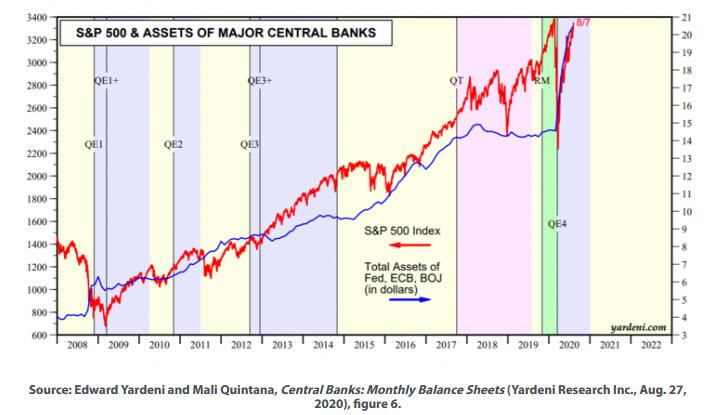
Recent data published by Yardeni Research Inc., Bank for International Settlements (BIS), the Institute of International Finance (IIF), and in the Federal Reserve Bank of St. Louis Economic Data (FRED) database offers an insight into the true extent of central banking practices before and during the covid-19 pandemic.

The wide-ranging implications of this can be seen through several critical dimensions. But first we must understand the destructive nature of central banking.

If we accept the main premise of central banking, that the central bank is the lender of last resort, it follows that in this last resort event the central bank must have a pool of wealth to lend from. After all, in order to lend to someone, you have to own something of value. In this situation, the central bank prints money, which, to that extent, is where it derives its pool of assets for lending from, taking from people via inflation. Paradoxically, the central bank therefore lends to banks by stealing from the people, whereas the banks are then expected to loan that money back to people. This theft is, however, subtle, not seen as a direct tax or immediate confiscation, but through the destruction of real savings and purchasing power.

From the beginning of this year to June, the total assets of major central banks (the Fed, ECB, BOJ, PBOC) have jumped by a near $6 trillion. This rapid ascent is likely going to continue as the year progresses. Similarly, in Q1 of this year, global debt rose to $258 trillion, representing an all-time high of 392 percent of GDP. Households, businesses, and governments are taking on more debt in hopes of offsetting the acute economic pains of the crisis. But the false sedative of debt will soon dissipate, revealing the true pain behind all these distractions. Make no mistake, what is being done by governments and enabled by central banks is akin to paying credit card debt with more credit cards.

This data should alarm you and the immediate question should be, Who’s going to pay for it, and who benefits? In the bizarre world of negative interest rates, however, that question becomes all the more complicated.

Artificially low interest rates have enabled the longest bull run in US history (2009–20). Cheap borrowing has propped up unprofitable zombie corporations which rely on loans to pay back loans. In conjunction with quantitative easing efforts, the S&P 500 has not only recovered since the covid March meltdown but surpassed its all-time high.

Low interest rates have historically made it cheaper to mortgage a house, finance a car, and pay for student debt—in the long term, however, it has made all of these more expensive. By enabling cheap borrowing to finance spending, particularly on assets such as housing and in the equities market, central banks have infused those markets with artificial demand which in turn causes prices to skyrocket.

By indirectly monetizing and devaluing the real value of debt, central banks have cut the brake wires off government spending.

Its no coincidence that the moment the Fed started to unwind its balance sheet in 2018 markets went berserk. When the Fed shrank its assets by just around 6 percent between early 2018 and February 2019, the market plummeted by twice that.

The most recent market faltering in March was a very real indicator of upcoming economic trouble. It was all covered up by the Fed, however, which bought $500 billion in Treasury securities and $200 billion in mortgage-backed securities to provide so called “emergency liquidity.”

In effect, the Fed’s actions diverted scarce resources from productive sectors to monetize government debt, inflate a chaotic asset bubble, and send the bill to everyone else. Importantly, this has created an environment of haves and have-nots. So, although so-called conservative politicians are scratching their heads about the popular rise of socialism, should we really be that surprised?

The true mark of economic recovery should not be measured nominally in dollars and cents, but in terms real interest rates. When markets, not bureaucrats and central bankers, set interest rates, markets equilibrate, allowing for productive and allocative efficiency. The true sign of a growing and healthy economy should instead be a positive real interest rate set by market forces.

Positive real interest rates indicate that investments/savings are yielding positive returns and thus creating wealth. This means that people, businesses, and governments are rewarded for saving. In the world of negative interest rates, the opposite is true.

When real interest rates are negative, they create distortions in markets. Consider that between March 23 and the day I write this (August 8), nearly every popular US asset has inflated. Equities such as the NASDAQ and S&P 500 have risen by 61 percent and 50 percent respectively, bitcoin by 81 percent, and gold by 36 percent. Through the manipulation and debasement of currency, however, this asset inflation should be a warning signal to everyone not that their assets are necessarily worth more, but their dollars worth less.

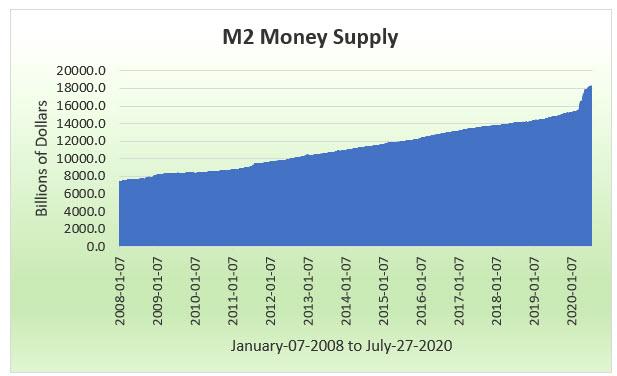
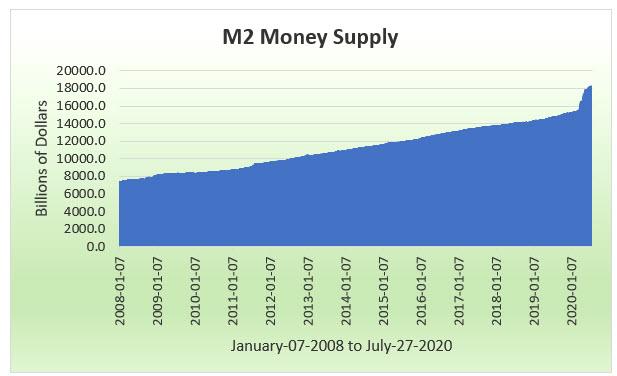
This asset inflation coincided with a sharp M2 money supply increase (roughly 20 percent year over year).

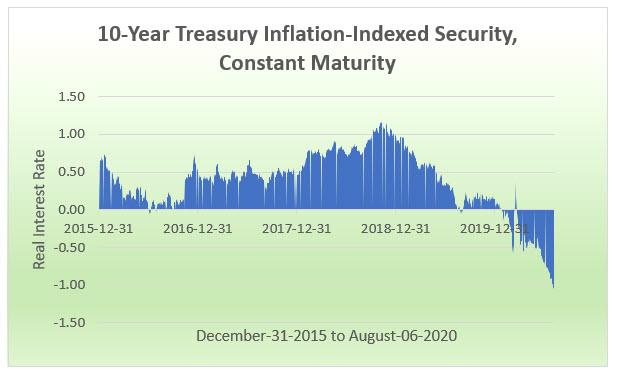
Nonetheless, when real interest rates are negative, bubbles are to be expected. Since the covid crisis, ten-year inflation-indexed bond yields have crashed, falling even below –1 percent.

Source: FRED (10-Year Treasury Inflation-Indexed Security, Constant Maturity [DFII10], accessed Aug. 26, 2020), https://fred.stlouisfed.org/series/DFII10.

Unsurprisingly, these rates have dropped so low not particularly because their yield is negative (although they did dip below that level slightly in March), but because inflation is higher than the yields.

This is something that the traditional CPI (Consumer Price Index) will fail to capture. Using irrelevant baskets of consumer goods such as air travel, nightclubs, and hotels among other things paints a false picture. Of course, now more than ever there is more money chasing fewer goods, with many businesses being closed and stimulus checks coming in. The recent sharp increase in the money supply will therefore drive real inflation even higher and real interest rates lower.

Source: Fred (M2 Money Stock [M2], accessed Aug. 17, 2020), https://fred.stlouisfed.org/series/M2.

Real negative rates serve to accelerate global indebtedness and solidify zombification. As the balance sheets of central banks grow, so does the indirect subsidization of inefficient corporations. By taking out corporate loans at a real interest rate of below zero, zombie corporations manage to have their lender of circumstance actually pay them for taking on debt. By keeping inefficient players in the marketplace, innovative entrepreneurs are blocked from creating wealth and market barriers to entry are raised through a slow and steady engulfment of scarce resources, furthering an unprecedented inequality of wealth via central bank–induced monopolization.

In 2019 the BIS determined that over 10 percent of the publicly traded firms of fourteen developed countries were zombies. My assessment is that by the end of this crisis that statistic will be much higher. In the US, the number is nearly 20 percent according to Deutsche Bank Securities.

When borrowing money is so cheap (in fact, they pay you!) zombification is an inevitable process. Analyzing quarterly data from 1998 to 2020, 8 percent of the variance of corporate debt levels as a percentage of equity can be directly attributed to changes in M2 levels. Utilizing regression analysis, the null hypothesis of this relationship (that the variables are unrelated) has a p-value of 0.0000 and a t-score of 588, or in other words there is an almost 100 percent chance that the relationship between these two variables is statistically significant.1

Japan is the historical home of zombies and is still suffering from the peak of its crisis in the eighties. As of 2018, Japanese corporations had taken out $4.59 trillion in loans, the highest amount since 1997. Japan’s myriad economic problems not only include the zombification of its companies but also of its people, as they face the challenges of an aging population. As its balance sheet surpasses 100 percent of GDP, the BOJ is essentially doubling down on past failed policies.

Source: Edward Yardeni and Mali Quintana, Central Banks: Monthly Balance Sheets (Yardeni Research Inc., Aug. 27, 2020), figure 5.

Keeping inefficient zombie corporations may boost short-term employment by avoiding the general turnover of firm market share; however, in the long term they massively drain resources and block future employers out of the marketplace. The BIS writes:

Specifically, the estimation results suggest that a 1 percentage point increase in the narrow zombie share in a sector lowers the capital expenditure (capex) rate of non-zombie firms by around 1 percentage point, a 17% reduction relative to the mean investment rate. Similarly, employment growth is 0.26 percentage points lower, an 8% reduction. However, under both definitions we find that non-zombie companies invest more and have higher employment growth.

Following the 2008 crisis a radical experiment of depressed and even negative interest rates was employed by the Fed, BOC (Bank of Canada), ECB (European Central Bank), and other central banks. Now, however, the resources that were previously available to fight recessions have been totally depleted combating the last recession. Fighting debt with debt is irresponsible and unfair to future generations—clearly fiscal and monetary restraint is needed.

The interplay between rising debt levels, negative real interest rates, and zombification should concern us all—especially in the context of global lockdowns. But it should not be capitalism which we blame for this crisis. Quite the contrary, in fact; we should blame central banking and its destructive economic capabilities.

via ZeroHedge News https://ift.tt/3jzZ2Yn Tyler Durden

3 Peopled Wounded In ‘Mass Stabbing’ Near Manchester High School

3 Peopled Wounded In ‘Mass Stabbing’ Near Manchester High School

Tyler Durden

Tue, 09/01/2020 – 14:47

Three people have been hurt following a ‘stabbing’ near a high school in Stockport, according to the Manchester Evening News.

Emergency services were called to the scene, and three people have reportedly been taken to the hospital with serious injuries, but not much else is known about the case, according to media reports.

Some reports claimed an arrest has been made, but the facts remain unclear.

A GMP spokesman said “[p]olice were called to reports of a stabbing off The Fairway in Offerton, Stockport on Tuesday, Sept. 1.”

“Emergency services attended and three people have been taken to hospital with injuries.”

Details about the attacker, including their gender, age, race and motive, remain a mystery. According to reports, officers left the scene less than an hour ago.

This latest attack comes just 2 days after a woman was slashed by an unknown assailant, for reasons that haven’t been determined. The incident took place on Rudheath Avenue in Withington, south Manchester. The 24-year-old young mother had been walking with her son when a man approached her with a knife then suddenly stabbed her before running off.

A few days before that, two men were stabbed at a Manchester restaurant.

Knife crime has become an increasingly troubling public hazard across Britain, but particularly in cities like Manchester and London.

The trend has prompted some knife makers to explore unorthodox solutions.


via ZeroHedge News https://ift.tt/3i1cDYg Tyler Durden

Will Anti-Racist Law Reviews Publish Anti-Anti-Racist Articles by Anti-Anti-Racist Authors?

Legal scholarship is different from scholarship in other disciplines. The vast majority of law professors publish in law reviews run by students. These journals are not peer reviewed. Student editors may, but are not required, to seek out comments from professors in the field. Indeed, for the most part, third-year law students are solely responsible for publication decisions. And these decisions have serious implications. Applicants on the entry level market tend to have at least one law review publication. And applicants for tenure need to have several law review publications. (The precise number will vary by school).

Many critics of the current model contend that it is inherently unfair for scholars to place their careers in the hands of 3L student editors. I am sympathetic to this argument, but I’m not convinced the alternative is necessarily better. I have had good experiences with peer review and I have had terrible experiences with peer review. Professors may have greater expertise in a field, but they may also have stronger biases about what is and is not acceptable scholarship. I find that students tend to be more open-minded because they do not reside within a discipline’s echo chamber. As a result, my suspicion is that student law reviews are more likely to publish a wider range of ideas that are outside the mainstream.

That benefit is especially helpful for right-of-center scholars. It is difficult for conservatives or libertarians to burrow into peer review editorial boards. There are simply fewer right-of-center professors to begin with. But there are far more right-of-center law students. And they are able to join editorial boards with far greater ease. To be sure, there is still viewpoint discrimination. When I applied to be an Articles Editor in 2008, the outgoing board demanded to know if I could fairly review an article by a liberal law professor. Of course, I could. And the vast majority of articles are authored by left-of-center academics. Fortunately, I managed to skate by. I imagine those dynamics have worsened over the past decade, but I know that conservatives can still break through.

Going forward, I worry that law reviews are moving in a direction that will make it difficult, if not impossible for conservative authors to publish.

Consider a recent incident at the Washington University Law Review (in St. Louis). Andy Koppelman offered this brief description:

In one of his classes at Stanford Law School this past May, Prof. Michael McConnell read from a historical quotation that included the N word.  (The quotation’s accuracy is disputed; more on that below.)  When criticized by Stanford students and faculty for it, he explained that he “make[s] it a priority in [his] class to emphasize issues of racism and slavery in the formation of the Constitution, and directly quote many statements by supporters and opponents of slavery.”  He went on to explain: “First, I hope everyone can understand that I made the pedagogical choice with good will — with the intention of teaching the history of our founding honestly.  Second, in light of the pain and upset that this has caused many students, whom I care deeply about, I will not use the word again in the future.”

That should have been that.  But then, at distant Washington University in St. Louis, where he had written an entirely unrelated article for a law review symposium, there was a movement to revoke publication.  The law review ended up instead issuing a statement denouncing his actions.

McConnell’s article was not about race. It was about the free exercise of religion. (Although critics may argue that everything is about race.) The students objected to McConnell, as an author, regardless of what he had written for the journal. Professor John Inazu recounts that the students wanted to rescind the publication altogether, but the University would not allow them to:

Some of the protesters originally wanted the Law Review to withdraw its publication offer to Professor McConnell. Washington University School of Law Dean Nancy Staudt prevented this action after consulting with the university’s general counsel but authorized this protest statement instead.

The statement began with a disclaimer:

These statements do not necessarily reflect the views of Washington University in St. Louis, Washington University School of Law, the Washington University Law Review as an institution, the contributors to the symposium, or anyone other than the undersigned authors.

The statement was signed by some, but not all of the members of the Law Review. Here is an excerpt:

In publishing this statement, we seek to balance our own condemnation of Professor McConnell’s action with the academic freedom that we, as members of a journal committed to publishing a diversity of competing ideas, unequivocally support. Nevertheless, Professor McConnell’s action comes amidst a national reckoning on systemic racism, white supremacy, and police violence in the United States, and his use of the n-word—no matter the setting—cannot be divorced from this larger context. We apologize to our readers, especially the Black members of the Washington University community, whom the Law Review has hurt by publishing Professor McConnell’s work.

This incident was a flash point. It is common enough for a student-run publication to rescind an offer of publication based on the content of the article. But it is far less common for a student-run publication to try to rescind an offer of publication based on the professor’s speech outside the article. I am aware of one other student-run journal that recently considered such a cancellation, but upon advice from faculty advisors, abandoned the move. I fear these sorts of incidents will become more common.

Consider a recent statement from the Emory Law Journal. The Journal is hosting a symposium issue, titled “Systemic Racism in the Law & Anti-Racist Solutions.” Generally, I find that law reviews make some effort to foster ideological diversity. Often this representation is little more than tokenism. I have been on many panels were my views are vastly outnumbered, yet I could still speak. But I can’t imagine that any diversity of thought will be permitted for this symposium. The core of anti-racism is to deny space to those who are not anti-racist. Kendi stated this point quite clearly in his book:

The only remedy to racist discrimination is antiracist discrimination. The only remedy to past discrimination is present discrimination. The only remedy to present discrimination is future discrimination.

In short, a symposium dedicated to anti-racism would be an inherent contradiction if it published articles that were anti-anti-racist. I think this argument extends further. Even if a given article was deemed sufficient anti-racist (whatever that means), the journal could plausibly review the author’s statements elsewhere to determine if he or she was sufficiently anti-racist. Certainly Michael McConnell would flunk such a litmus test. I’m sure that all of us have something in our background that could cross some line.

This sort of anti-racist approach test is not limited to the symposium. The Emory Law Journal offered an additional statement:

ELJ is committed to being an anti-racist organization, both in our ranks and in our scholarship. This is just one part of that mission. We look forward to reading your essays and moving the conversation forward.

Presumably, all submissions to this journal will have to be viewed through the two-fold anti-racist prism. First, determine if an article is anti-anti-racist. Second, determine if the author of the article is anti-anti-racist.

These standards would spell the death-knell for conservatives publishing in law review. Even if a mundane article manages to clear all of the editorial hurdles, it can be spiked at the last minute by a claim of anti-anti-racism–either against the article or the author. And these charges cannot be rebutted, unless an editor is willing to push back, and be deemed anti-anti-racist.

Statements from Deans and Law Reviews about anti-racism may seem innocuous, and indeed necessary for the current motion. But we should recognize that these statements will institutionalize viewpoint discrimination: only one perspective on a given issue is permissible. In the long run, academic freedom and open discourse will suffer.

At the present moment, I have submissions out to law reviews. I’m sure there is a chance that editors may retaliate against me (not that they needed any additional motivation). Let them prove me right. Tenure was designed for exactly these sorts of dynamics.

But make no mistake. This treatment will not be limited to McConnell, or Eugene Volokh, or me. Even well-meaning liberals will be targeted. Andy Koppelman, a card-carrying liberal, sketches his own demise:

I hope it isn’t only a matter of time before I get attacked for compelling students to read racist writings….  The campaign against McConnell shows how it would happen.  It will be acknowledged that I have not advocated racist ideas.  But, it will be said, I’ve been insensitive.  I have shown a shocking lack of respect.  I’m complicit in systemic racism.  My lack of sensitivity has needlessly harmed my students.  I need to be held accountable.  Students should never be required to deal with a professor who has acted this way.  A pledge not to do it again does not undo the continuing harm.  And so forth.

Will journals keep lists of professors they should not publish? (Don’t dare call them “blacklists.”). Or will journals reject submissions from professors who do not sign social justice statements?

You are not safe. You will not be immunized by signing the right statements or staying quiet. No amount of virtue signaling will ever be enough. Eventually, everyone will be subject to cancellation.

from Latest – Reason.com https://ift.tt/3hO8W8x
via IFTTT