‘Affordability’ Politics Is a Major Opening for the Free Market Message in the New Year


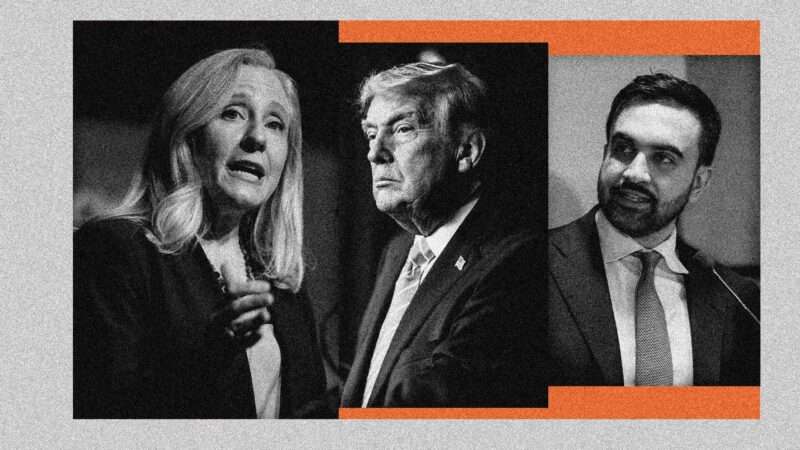
Abigail Spanberger, Donald Trump, and Zohran Mamdani | Eddie Marshall | Derek French | ZUMAPRESS | Daniel Torok/White House | Peter Casey | TNS | Newscom

This week, incoming Virginia Gov. Abigail Spanberger released a policy agenda for her administration that’s allegedly intended to deliver lower living costs for the state’s residents.

None of her initial proposals—mandating utilities build more energy storage capacity, stretching out the eviction process for delinquent renters, and banning health insurers from charging additional fees to tobacco users—seems particularly promising.

As Manhattan Institute scholar Judge Glock pointed out on X, basically everything the governor-elect has proposed will raise, not lower, costs.

That’s pretty disappointing (if not necessarily surprising) for a politician who just won her gubernatorial election by pitching herself as the “affordability” candidate.

Across the political spectrum, everyone is trying to say their agenda will enable Americans to buy more for less, while proposing policies that would leave everyone poorer.

Zohran Mamdani elevated himself from long-shot leftist candidate to soon-to-be Mayor of New York City with a relentless focus on making the Big Apple affordable to working-class residents. (His actual agenda is a lot more focused on using price controls to obscure how much everything actually costs.)

President Donald Trump has likewise claimed the mantle of “affordability,” even as he’s hiked tariffs on imported goods.

It’d be tempting then to dismiss affordability politics as empty messaging or even cynical rebranding for the same tired state interventions from both the left and the right.

And yet, free marketers have cause to be optimistic that partisan politics in 2026 might revolve around the question of affordability.

Whatever its failings at setting a policy agenda, the affordability framing does at least refocus partisan arguments on the thing that free marketers have the best answers for and on which free markets can actually deliver.

To paraphrase Joseph Schumpeter, the achievement of capitalism is enabling average people to consume more things for increasingly less effort.

It’s a promise that free markets keep delivering on. The real cost of the electronic device you’re using to read this article compared to what it would have been a decade ago should be evidence enough of that.

When it comes to questions about how to bring down the costs of healthcare or housing, free marketers have the best answers. Government regulations of prices and production are driving up costs. Eliminating those regulations will bring them back down.

The fact that politicians as different as Mamdani and Spanberger won on a common affordability message is evidence that voters are hungry for policy proposals that promise to bring everyday prices down.

The flawed, interventionist affordability platforms they offer are an opportunity for free marketers to clearly and patiently explain why their interventions will fail.

When they do fail, free marketers can reap the benefits of being right about the thing that people care about the most right now.

It’s fair to say that libertarian politics in 2025 was at a low ebb. A major reason for that is that too many of the political debates that have dominated the headlines and viral X posts have been either irrelevant to the cause of free markets or are divisive among the people who support them.

An appreciation for capitalist-enabled material progress can’t tell you a lot about whether the Jeffrey Epstein files should be released, for instance.

Support for small government doesn’t imply a particular position on whether the East Wing of the White House should be enlarged.

Laws of supply and demand don’t say who counts as a “Heritage American” or what’s the appropriate social sanction for people who said ugly things about the Charlie Kirk assassination.

Anyone remotely invested in the debate about the Trump-Kennedy Center rebranding has almost no time for the stock libertarian interjection that we really shouldn’t have a federal arts venue at all.

When our politics revolves around these squabbles, the cause of generally shrinking the size and scope of government doesn’t get a lot of play in the conversation.

Even when the story of the day did directly involve the proper role of the state in 2025, free marketers in good standing can end up on either side of an issue.

The Department of Government Efficiency (DOGE) was an incredibly clumsy, mostly unsuccessful effort by the Trump administration to accomplish a libertarian-ish goal of saving taxpayers’ money by making government more “efficient.”

Free marketers, even within the pages of Reason, are split on whether we should be mad at the dismal results or grateful for the effort.

Where Trump’s exercises of executive power have been the most alarming and most extreme, the mainstream debates about them generally devolve into much less compelling quibbling over the details.

Instead of arguing about whether the president can execute suspected drug smugglers on a whim, we end up debating whether two strikes on an alleged drug boat were justified or if one would have been enough.

The administration’s deportation drive has generally provoked procedural criticisms about individual raids and removals, not a more substantive defense of open immigration.

The front page debate about tariffs, and the president’s power to impose them unilaterally, is an exception that proves the rule.

Free marketers have been the leading critics of the Trump administration’s tariff regime, precisely because our ideas and the evidence offer a compelling case that raising taxes on imported goods makes things more expensive and people poorer.

Congressional Democrats have largely failed to turn voter anger about higher tariff-induced prices into their own compelling case against Trump precisely because they’re not free marketers and thus can’t fully abandon their own protectionist sympathies.

It’s notable that part of Spanberger’s winning message was criticism of Trump’s tariffs. (It’s convenient that she, as a governor of a state, has no power over trade policy.)

The daily partisan squabbles that dominate political news have long been of little interest to libertarians, who have a more fundamental critique of state power to share. For all that’s alarming and novel about politics during the second Trump administration, political debates revolving around superficial bullshit are par for the course.

It’s for this reason that affordability politics offers so much promise for the free market message in the coming year.

When a centrist Democrat says that we should make housing more affordable by making it harder to evict non-paying tenants, free marketers can counter with both sound theory and empirical evidence that making the rental housing business riskier for landlords leads them to raise costs to offset that risk.

When a socialist Democrat says we can make housing more affordable by getting rid of market prices entirely, we can point to how well that’s worked in the past.

And when a MAGA Republican says tariffs and immigration restrictions will lower Americans’ costs of living, we can counter with sound arguments that restrictions on the international movement of goods and people will do the opposite.

It’d be naive to think political debates in 2026 will be significantly more substantive than they were in 2025. Culture wars that are orthogonal to free market concerns will still drive much of the conversation.

But to the degree that politicians see an advantage in running on a message of affordability, that’s an opening for free marketers.

Explaining why making things cost more won’t make them cost less is frustrating. It’s also easy and compelling. The rise of affordability politics means that it will offer a lot of opportunities to deliver that simple message in the New Year.

The post 'Affordability' Politics Is a Major Opening for the Free Market Message in the New Year appeared first on Reason.com.

from Latest – Reason.com https://ift.tt/bzavmpU
via IFTTT
“Dana-Farber Cancer Institute Agrees to Pay $15M to Settle Fraud Allegations Related to Scientific Research Grants”

From a Justice Department press release two weeks ago (I learned about the case just today from the excellent Science Fictions podcast [Tom Chivers & Stuart Ritchie] [formerly The Studies Show], one of the few podcasts to which I pay to subscribe):

Dana-Farber Cancer Institute Inc. (Dana-Farber) has agreed to pay $15,000,000 to resolve allegations that, between 2014 and 2024, it violated the False Claims Act by making materially false statements and certifications related to National Institutes of Health (NIH) research grants….

As part of the settlement, Dana-Farber admitted that its researchers used funds from six NIH grants to conduct research that resulted in 14 publications in scientific journals containing misrepresented and/or duplicated images and data. The publications reused images to represent different experimental conditions; duplicated images to represent different testing conditions, mice, and/or timepoints; or rotated, magnified, or stretched images. Further, Dana-Farber admitted that a supervising researcher failed to exercise sufficient oversight over these researchers, and that Dana-Farber spent funds from those six NIH grants that were unallowable.

As part of the settlement, Dana-Farber also admitted that another researcher received four NIH grants after submitting grant applications that discussed a journal article authored by the researcher but did not disclose that certain images and data in that article were misrepresented and/or duplicated. The United States contends that Dana-Farber caused the submission of false claims to NIH by falsely certifying compliance with grant terms and conditions, spending grant funds on unallowable expenses, and obtaining grants through false and misleading statements.

Dana-Farber cooperated with the government in this matter and received credit under the Department’s guidelines for taking disclosure, cooperation, and remediation into account in False Claims Act cases. Among other actions, Dana-Farber summarized voluminous materials relevant to the government’s investigation, voluntarily disclosed additional allegations of research misconduct relevant to the government’s investigation, voluntarily produced materials without a subpoena, sought to resolve this matter expeditiously, accepted responsibility for its conduct, and implemented remedial measures.

The civil settlement includes the resolution of claims brought under the qui tam or whistleblower provisions of the False Claims Act by Sholto David. Under those provisions, a private party can file an action on behalf of the United States and receive a portion of any recovery. David will receive $2,625,000 under today’s settlement….

You can see the Settlement Agreement for more details, including a list of the 14 potentially affected publications and their authors.

The post "Dana-Farber Cancer Institute Agrees to Pay $15M to Settle Fraud Allegations Related to Scientific Research Grants" appeared first on Reason.com.

from Latest – Reason.com https://ift.tt/bPrxNiv
via IFTTT

Man Who Had Pleaded Guilty to Felony Forgery of Court Orders Sues Over Being Called “Convicted Felon”

An excerpt from Arnstein v. Stein Saks, PLLC, decided last week by New York County trial court judge Judy Kim (currently being appealed) (you can also read plaintiff’s Complaint and legal argument opposing the motion to dismiss):

Plaintiff alleges that defendants defamed him in their motion to dismiss an action filed against them …, Mark Goldberg v. Mark Rozenberg Esq. et al… (the “Bronx Action”). The plaintiff in the Bronx Action, Mark Goldberg, sued defendants for defamation based on statements made in yet another lawsuit, … entitled The Natural Sapphire Company v Marz Rozenberg et al.

Plaintiff contends that, as part of defendants’ motion to dismiss the Bronx Action, they “gratuitously referred to [p]laintiff by name and included salacious statements regarding his past conviction—accusing him of forgery and labeling him a ‘convicted felon’—without any connection to the issues or parties in that case.” Plaintiff asserts claims for defamation and abuse of process ….

“[A] statement made in the course of legal proceedings is absolutely privileged if it is at all pertinent to the litigation.” … Here, defendants’ statements about plaintiff in the Bronx Action were pertinent to the motion to dismiss that action. While plaintiff was not a party in the Bronx Action, defendant asserted that he was the principal of the Natural Sapphire Company and, in that capacity, employed Goldberg, and was part of a coordinated campaign of meritless actions filed against defendants after defendants filed in Federal Court against The Natural Sapphire Company asserting violations of the Americans with Disabilities Act. This information is pertinent to, inter alia, defendants’ request for sanctions in the Bronx Action. Accordingly, they fall within the absolute litigation privilege, precluding the defamation claims asserted here.

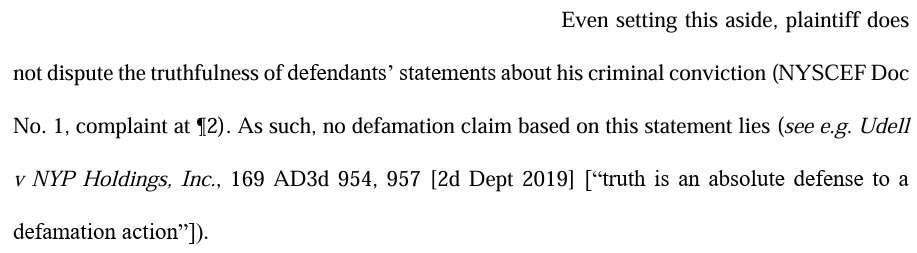
Even setting this aside, plaintiff does not dispute the truthfulness of defendants’ statements about his criminal conviction. As such, no defamation claim based on this statement lies…. “[T]ruth is an absolute defense to a defamation action” ….

Neither has plaintiff stated an abuse of process claim. [Details omitted. -EV] Finally, defendants’ request for sanctions is granted to the extent that plaintiff is enjoined from commencing any new litigation in the New York State courts against any defendant herein without obtaining prior approval from the court. The record reflects that such relief is necessary “to prevent use of the judicial system as a vehicle for harassment, ill will and spite.”

Here’s a post on the original forgery case; for more on the broader pattern of attempts to vanish online material using (among other things) forged or fraudulent orders, see my Shenanigans (Internet Takedown Edition):

9 Months in Prison for Forging Court Orders Aimed at Vanishing Online Material

“Arnstein … submitted the counterfeit orders, which appeared to be valid on their face, to Google and requested that Google de-index the websites containing the purportedly defamatory information.”

From a Justice Department press release put out last Friday, about a case you may have seen discussed here and here:

Michael Arnstein was sentenced today to nine months in prison for conspiring to forge a federal judge’s signature on counterfeit court orders that Arnstein submitted to Google to get negative reviews about his business removed from Google search results. Arnstein pled guilty on September 15, 2017, before U.S. District Court Judge Andrew L. Carter Jr., who imposed today’s sentence.

Manhattan U.S. Attorney Geoffrey S. Berman said: “Michael Arnstein’s blatant criminal scheme to exploit the authority of the federal judiciary for his company’s benefit was outrageous. As Arnstein has learned, his attempts to remove negative reviews about his business from Google search results by forging a U.S. District Court judge’s signature may have worked in the short term, but it also earned him nine months in a federal prison.”

According to the allegations contained in the Complaint, the felony Information to which Arnstein pled guilty, and statements made during court proceedings:

Between February 2014 and February 2017, Arnstein engaged in a scheme to submit counterfeit federal court orders to Google, Inc. (“Google”) in an effort to get websites containing unfavorable postings about Arnstein’s business de-indexed from Google’s internet search results. In furtherance of this scheme, Arnstein and others forged the signature of a United States District Judge for the Southern District of New York on more than 10 counterfeit court orders. These counterfeit orders listed the websites containing purportedly defamatory information about Arnstein’s business and ordered the removal of such information from the websites. Arnstein then submitted the counterfeit orders, which appeared to be valid on their face, to Google and requested that Google de-index the websites containing the purportedly defamatory information.

* * *In addition to the prison term, Arnstein, 41, of Yonkers, New York, was sentenced to three years of supervised release, the first five months of which Arnstein must serve in home detention. Arnstein was also ordered to pay a fine of $20,000 and to perform 200 hours of community service during his term of supervised release.

Mr. Berman praised the outstanding investigative work of the Federal Bureau of Investigation and the United States Marshals Service. He also thanked Google for its helpful assistance in this investigation.

The prosecution of this case is being overseen by the Office’s Complex Frauds and Cybercrime Unit. Assistant U.S. Attorneys Sheb Swett and Daniel S. Noble are in charge of the prosecution.

Here’s an excerpt from an e-mail from Arnstein mentioned in the criminal complaint:

[N]o bullshit: if I could do it all over again I would have found another court order injunction for removal of links (probably something that can be found online pretty easily) made changes in photoshop to show the links that I wanted removed and then sent to ‘removals@google.com’ as a pdf – showing the court order docket number, the judges [sic] signature – but with the new links put in. google isn’t checking this stuff; that’s the bottom line b/c I spent $30,000 fuckin thousand dollars and nearly 2 fuckin years to do what legit could have been done for about 6 hours of searching and photoshop by a guy for $200., all in ONE DAY ….

I should note that the Lumen Database was also instrumental in the prosecution.

The post Man Who Had Pleaded Guilty to Felony Forgery of Court Orders Sues Over Being Called "Convicted Felon" appeared first on Reason.com.

from Latest – Reason.com https://ift.tt/kyspGqC
via IFTTT

If You Give a Bear a Badge, Will It Respect Your Rights?


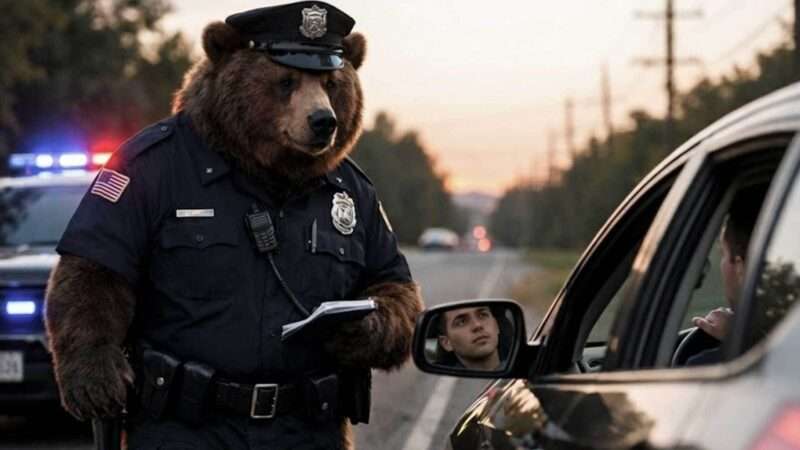
A bear in a police uniform approaches a car on the side of a road. | ChatGPT | Eddie Marshall

A few years ago in Connecticut, Mark and Carol Brault complained that state officials had strapped a camera to the neck of a black bear that was known to frequent their property. They alleged that the Connecticut Department of Energy and Environmental Protection (DEEP), which suspected them of illegally feeding bears, was employing the furry spy in an attempt to back up that allegation. That DEEP strategy, the Braults argued, violated their Fourth Amendment right to “be secure in their persons, houses, papers, and effects” against “unreasonable searches and seizures.”

The couple’s claim was complicated by the Supreme Court’s “open fields” doctrine, which says private property beyond the immediate vicinity of a home, a.k.a. the “curtilage,” is not protected by the Fourth Amendment. But it seemed unlikely that Bear Number 119, the camera-carrying animal that Mark Brault had photographed “near the center of our property,” was familiar with the finer points of Fourth Amendment case law. Assuming it was not, there was no assurance that it would confine itself to the Braults’ “open fields” and avoid the “curtilage” around their home.

If police need a warrant to deploy a drug-sniffing dog on the porch of a suspected marijuana grower’s house, as the Supreme Court held in the 2013 case Florida v. Jardines, similar restrictions presumably would apply when the government deploys camera-toting bears against people suspected of feeding them. The problem is that the paths of unsupervised bears do not necessarily follow judicial guidelines.

That case illustrates the point that enlisting bears in law enforcement can be legally risky. But we should not be too hasty in concluding that bears are completely incapable of complying with constitutional requirements and respecting civil liberties. In some respects, they may be better than humans.

‘As Old as the Common Law’

The Braults, who own 114 acres of forested land in Hartland, Connecticut, operate a private nature preserve that charges admission to visitors interested in seeing bears and other wildlife. In a 2020 lawsuit, the town of Hartland accused them of violating a local ordinance against feeding bears, a charge they denied.

In the midst of that dispute, Mark Brault encountered a bear he recognized, but it was wearing a new outfit. On the morning of May 20, 2023, he reported, “I observed Bear Number 119 near the center of our property, within 200 yards of our residence.” The bear “was wearing a video camera,” which was “affixed to a collar” that DEEP “apparently had placed” on the animal. “I have known that bear for a long time,” Brault said. “I know it frequents my property and adjacent properties. I know that it was tagged by [DEEP] previously, but not collared.”

That affidavit was attached to a lawsuit that Brault and his wife filed in the U.S. District Court for the District of Connecticut 10 days after his unnerving encounter with the camera-equipped bear. DEEP “is conducting warrantless ground-level photographic surveillance of the interior of [our] property,” the Braults alleged. Although the area was “clearly posted with ‘no trespassing’ signs,” they said, DEEP “did not have a search warrant authorizing or permitting photographic surveillance of the interior of [our] property.” Presumably, the bear did not have a warrant either.

According to the Supreme Court, however, neither the presence of signage nor the absence of a warrant was constitutionally significant. “The special protection accorded by the Fourth Amendment to the people in their ‘persons, houses, papers and effects,’ is not extended to the open fields,” Justice Oliver Wendell Holmes Jr. wrote for a unanimous Court in the 1924 case Hester v. United States, which involved illegal whiskey production in South Carolina. “The distinction between the latter and the house is as old as the common law.”

The Court reaffirmed that principle in the 1984 case Oliver v. United States, which involved a marijuana farm discovered by Kentucky state police. “In the case of open fields, the general rights of property protected by the common law of trespass have little or no relevance to the applicability of the Fourth Amendment,” Justice Lewis F. Powell Jr. wrote in the majority opinion. Although the marijuana growers “erected fences and ‘No Trespassing’ signs around the property,” the Court rejected “the suggestion that steps taken to protect privacy establish that expectations of privacy in an open field are legitimate.”

The implication was that “open fields” need not actually be open. Even when private property is fenced and marked with “No Trespassing” signs, the Court said, “no expectation of privacy legitimately attaches to open fields.” At the same time, it acknowledged that the Fourth Amendment does apply to “the ‘curtilage,’ the land immediately surrounding and associated with the home.”

Under the “open fields” doctrine, the Supreme Court ruled three years later in United States v. Dunn, police likewise did not need a warrant to approach a barn located about 50 yards from a home, even though they had to cross several fences on the way. Nor did they need a warrant to peer into the barn, where they ultimately found a laboratory producing the methamphetamine precursor phenylacetone, because at that point they were still located in “open fields.” The majority concluded that “the barn and the area around it lay outside the curtilage of the house.”

‘Ill-Founded Reasoning’

The “open fields” doctrine is misbegotten, the Institute for Justice argues. The civil liberties group says the “distinction” that Holmes deemed “as old as the common law” in Hester was based on a misunderstanding.

“The sole citation to support this historical assertion was to three pages of Blackstone’s Commentaries,” Institute for Justice attorneys Robert Frommer and Anthony Sanders noted in a 2017 Supreme Court brief. “The problem with Justice Holmes’ citation is that in those pages, Blackstone was not talking about open fields, officers of the law, or even trespass. Instead, he was discussing the elements of burglary. Blackstone simply lays out the rule that to commit burglary, among other elements, the burglar must break into a home, and do it at night.”

Holmes “took this distinction between burglary and other crimes and gave it constitutional significance by applying it to an area—an open field—that Blackstone does not even address,” Frommer and Sanders added. “By the same, ill-founded reasoning, Hester could have stated that the Fourth Amendment does not apply to the government entering homes during the day, or entering buildings such as barns and warehouses at all, all areas Blackstone contrasted to a break-in of the home at night.”

That highly improbable result, Frommer and Sanders argued, “is the logical conclusion once the citation to Blackstone is actually examined. In short, the citation to Blackstone did nothing to support the Court’s refusal to apply the Fourth Amendment to an ‘open field.'”

Given the persistence of this exception to the Fourth Amendment, however, it is not surprising that DEEP argued, in its motion to dismiss the Braults’ lawsuit, that “all the activity alleged in the complaint falls squarely within the ‘open fields’ doctrine.” Nor did Frommer think the Braults were likely to prevail in arguing that DEEP’s ursine surveillance violated the Fourth Amendment. Their best bet, he suggested shortly after they filed their complaint, would be to emphasize the unpredictable meandering of camera-bearing bears.

“The problem with slapping a camera onto a bear and then unleashing it into the wild is that you can’t control where that bear goes,” Frommer said. “For all the officer knows, the bear could park itself right outside somebody’s house, with the camera capturing everything therein.” Or as he put it in a more colorful turn of phrase, “turning wildlife into unguided surveillance drones is unbearable,” and “Connecticut should paws its animal camera program so as not to infringe on Nutmeggers’ privacy and security.”

‘Not Practicable To Secure a Warrant’

While the distinction between “open fields” and “curtilage” might escape the average bear, that does not necessarily mean bears cannot be trusted to follow other Fourth Amendment principles laid down by the Supreme Court. In the 1988 case California v. Greenwood, for example, the Court ruled that people do not have a reasonable expectation of privacy in the trash they leave on the curb for collection. Bears seem to instinctively understand that you don’t need a warrant to rummage through someone’s garbage.

A century ago in Carroll v. United States, the Supreme Court likewise held that police do not need a warrant to search motor vehicles. The case involved two suspected Michigan bootleggers whom federal prohibition agents stopped as they were driving west on the road from Detroit to Grand Rapids. The agents searched the car and found 68 bottles of whiskey and gin hidden behind the upholstery of the seats. “Contraband goods concealed and illegally transported in an automobile or other vehicle may be searched for without a warrant,” the Court ruled.

As the majority saw it, that leeway was a practical necessity. “It is not practicable to secure a warrant” in such cases, Chief Justice William Howard Taft explained, “because the vehicle can be quickly moved out of the locality or jurisdiction in which the warrant must be sought.” But there was a catch: Police still need “probable cause for believing” a car contains contraband.

The Supreme Court has said probable cause is equivalent to a “substantial chance” or a “fair probability” that evidence of a crime will be discovered. The Court has not defined the concept more precisely than that. Since humans struggle to understand what probable cause means in practice, it seems unrealistic to expect that bears will do any better. The evidence suggests they are not even trying.

If bears did worry about probable cause, they might be able to supply it with a simple sniff of the air. In the 2013 case Florida v. Harris, the Supreme Court unanimously held that an “alert” by a dog trained to detect illegal drugs is enough, by itself, to justify a car search. Although the Court has not addressed bears in this context, there is reason to think it also would view them as four-legged probable cause generators.

“Bears are known for their exceptional sense of smell,” the San Diego Animal Sanctuary notes. “In fact, their olfactory abilities are often considered the best among all animals on Earth.”

They’ve got numbers to back that up: “The average dog’s sense of smell is roughly 100 times better than that of a human. A bloodhound, which is one of the best tracking dogs, is 300 times better. But a bear’s olfactory ability is 7 times better than a bloodhound’s.”

With certain notable exceptions, however, bears are unlikely to be sniffing for drugs, as opposed to honey, berries, porridge, or picnic baskets. And even if they do decide to search a car, we can be pretty sure they will not assert the right to seize any cash they come across, as human police officers routinely do under civil forfeiture laws.

Watching the Watchers

Just as bears have no interest in your money, they generally do not seem to mind, or even notice, when people record them as they go about their business. Sometimes they even seem to like it. That also stands in sharp contrast with the behavior of human cops, who frequently object (or worse) when bystanders use cell phones to document their official conduct, even though several federal appeals courts have held that people have a First Amendment right to do that—a point on which the U.S. Department of Justice concurs.

Bears also compare favorably to humans when it comes to the use of deadly force. While more than 600 people are killed by American law enforcement officers each year, The Alaska Frontier counted just eight fatal bear attacks in the United States from 2020 through 2022, an average of fewer than three a year. That is pretty reassuring, even taking into account the fact that the United States has more cops (about 720,000) than bears (around 340,000).

On balance, it is fair to say that bears, despite their general ignorance of constitutional law, pose a much less grave threat to your civil liberties than humans do. But the factors that weigh in favor of bears—a lack of interest in your contraband or money, a tendency to mind their own business, and a disinclination toward violence unless they perceive a threat to themselves or their cubs—probably make them ill-suited to careers in law enforcement.

The post If You Give a Bear a Badge, Will It Respect Your Rights? appeared first on Reason.com.

from Latest – Reason.com https://ift.tt/IfnLxJi
via IFTTT

“Dana-Farber Cancer Institute Agrees to Pay $15M to Settle Fraud Allegations Related to Scientific Research Grants”

From a Justice Department press release two weeks ago (I learned about the case just today from the excellent Science Fictions podcast [Tom Chivers & Stuart Ritchie] [formerly The Studies Show], one of the few podcasts to which I pay to subscribe):

Dana-Farber Cancer Institute Inc. (Dana-Farber) has agreed to pay $15,000,000 to resolve allegations that, between 2014 and 2024, it violated the False Claims Act by making materially false statements and certifications related to National Institutes of Health (NIH) research grants….

As part of the settlement, Dana-Farber admitted that its researchers used funds from six NIH grants to conduct research that resulted in 14 publications in scientific journals containing misrepresented and/or duplicated images and data. The publications reused images to represent different experimental conditions; duplicated images to represent different testing conditions, mice, and/or timepoints; or rotated, magnified, or stretched images. Further, Dana-Farber admitted that a supervising researcher failed to exercise sufficient oversight over these researchers, and that Dana-Farber spent funds from those six NIH grants that were unallowable.

As part of the settlement, Dana-Farber also admitted that another researcher received four NIH grants after submitting grant applications that discussed a journal article authored by the researcher but did not disclose that certain images and data in that article were misrepresented and/or duplicated. The United States contends that Dana-Farber caused the submission of false claims to NIH by falsely certifying compliance with grant terms and conditions, spending grant funds on unallowable expenses, and obtaining grants through false and misleading statements.

Dana-Farber cooperated with the government in this matter and received credit under the Department’s guidelines for taking disclosure, cooperation, and remediation into account in False Claims Act cases. Among other actions, Dana-Farber summarized voluminous materials relevant to the government’s investigation, voluntarily disclosed additional allegations of research misconduct relevant to the government’s investigation, voluntarily produced materials without a subpoena, sought to resolve this matter expeditiously, accepted responsibility for its conduct, and implemented remedial measures.

The civil settlement includes the resolution of claims brought under the qui tam or whistleblower provisions of the False Claims Act by Sholto David. Under those provisions, a private party can file an action on behalf of the United States and receive a portion of any recovery. David will receive $2,625,000 under today’s settlement….

You can see the Settlement Agreement for more details, including a list of the 14 potentially affected publications and their authors.

The post "Dana-Farber Cancer Institute Agrees to Pay $15M to Settle Fraud Allegations Related to Scientific Research Grants" appeared first on Reason.com.

from Latest – Reason.com https://ift.tt/bPrxNiv
via IFTTT

Swalwell Pledges To Arrest ICE Agents And Take Away Their Driver’s Licenses

Swalwell Pledges To Arrest ICE Agents And Take Away Their Driver’s Licenses

Authored by Jonathan Turley,

Rep. Eric Swalwell (D., Cal.) will not be outdone again.

Recently, Swalwell was outvoted in Congress by a colleague who had died months earlier. 

Now, he is ensuring that, when it comes to violating the Constitution, no one is even close. This week, Swalwell pledged that, if elected California governor, he will arrest ICE officers and take away their driver’s licences.

On MS NOW’s “All In,” Swalwell was asked by host Jason Johnson:

 “What would you do if you are able to be elected as governor of California? … What would you bring to the table as a governor of California?”

Swalwell responded:

“Well, you have immense powers as governor of California and your responsibility to protect the most vulnerable in the state. So if the president is going to send ICE agents to chase immigrants through the fields where they work, what I’m going to do is make sure that they take off their masks and show their faces, that they show their identification. And if they commit crimes that they’re going to be charged with crimes, if it’s falsely imprisoning people, if it’s kidnapping, if it’s assault battery, they’re going to be held accountable. I also think if the governor has the ability to issue driver’s licenses to people in California, if you’re going to wear a mask and not identify yourself, you’re not going to be eligible to drive a vehicle in California. There’s a lot you can do, but most importantly, you have to go on offense. Otherwise, the most vulnerable in our community will always be on defense.

Democrats appear to be morphing into predecessors like Gov. George Wallace (D., Ala.), pledging to defy federal authority and bar federal agents from their states. Wallace also reportedly threatened to arrest federal officers (and then later backed down when he was threatened with court action).

In an “age of rage,” the most irate and irrational reigns supreme.

From demanding that any Democratic nominee pledge to demolish the new Trump ballroom to opposing parental rights in schools, Swalwell has struggled to find traction with far-left California voters.

However, he is now promising to violate the Constitution. That did not take long. We do not even have a clear idea of who will be the frontrunners in the election. It is like a game of chicken where Swalwell immediately drives off the cliff before anyone gets into their cars.

Ironically, it is precisely what he has accused Donald Trump of doing: disregarding the Constitution when it suits his political agenda.

In case it matters to anyone left in California, he cannot do this. Seizing federal agents sort of went out of constitutional style after the Civil War. The “immense powers as governor of California” do not include dictating what federal officers can wear on their faces or bodies.

The first tiny barrier to Swalwell’s antebellum policies is the Supremacy Clause, which prevents states from “interfering with or controlling the operations of the Federal Government.” United States v. Washington (2022). Since McCulloch v. Maryland in 1819, the Supreme Court has consistently struck down state laws that impede federal enforcement.

Moreover, immunity under the Supremacy Clause (Article VI, Clause 2) bars criminally charging officials who are properly carrying out their lawful federal duties. For example, in 1890, the Supreme Court ruled In re Neagle that a U.S. Marshal had immunity when a state tried to charge him with murder after he shot and killed an individual attacking a justice.

While the Supreme Court has also stressed that federal immunity does not afford federal employees carte blanche to violate any and all state laws, it has made clear that such state limits must be incidental and nonintrusive. In Johnson v. Maryland (1920), Justice Oliver Wendell Holmes explained:

“It very well may be that, when the United States has not spoken, the subjection to local law would extend to general rules that might affect incidentally the mode of carrying out the employment — as, for instance, a statute or ordinance regulating the mode of turning at the corners of streets. Commonwealth v. Closson, 229 Mass. 329. This might stand on much the same footing as liability under the common law of a state to a person injured by the driver’s negligence. But even the most unquestionable and most universally applicable of state laws, such as those concerning murder, will not be allowed to control the conduct of a marshal of the United States acting under and in pursuance of the laws of the United States. Ex parte Neagle, 135 U. S. 1.”

None of this really matters to Swalwell. He is moving from democrat to demagogue in pledging unconstitutional acts to be sure that no one is farther to the left in the California race. It is the same “politics of contempt” that he has displayed as a member of Congress. Swalwell has always distinguished himself by doing things that few others could stomach, such as mocking a female senator over the death threats that she was receiving from irate liberals.

He also may be right about California voters. While others are struggling to come up with ideas for a state that is facing a crushing debt crisis and top taxpayers fleeing the state, Swalwell is promising chest-pounding theatrics…more jester than governor. He will entertain and distract with measures that will be struck down in courts.

It is the modern equivalent of the Roman games, promising combat with federal officers to thrill the crowd. From California and New York, there is an insatiable appetite for lawfare and disruption. Swalwell will promise chaos and confrontation … and many California voters will love him for it.

Tyler Durden
Wed, 12/31/2025 – 14:40

via ZeroHedge News https://ift.tt/mSPsIYk Tyler Durden

Russia Presents Its Evidence Of Ukrainian Drone Attack On Putin’s Residence

Russia Presents Its Evidence Of Ukrainian Drone Attack On Putin’s Residence

“We’re going to see some escalation now,” Retired Air Force Brig. Gen. Blaine Holt has said amid allegations Ukraine targeted Putin’s residence. “The Russians have made up their minds and made declarations about who they believe tried to strike the Valdai mansion that’s owned by President Putin, and they’re going to change their negotiable posture.”

For starters, the Kremlin has already indeed made clear Moscow would toughen its stance in US-backed peace talks which seek to end nearly four-year-old war. The fear is also that Russia will use this as an ‘excuse’ to expand the war.

The Kremlin has presented images of downed drones related to the attack. Russian Defense Ministry via Reuters

The allegation is that Ukraine’s military launched 91 long-range strike drones at the presidential compound in Novgorod Region on Sunday night into early Monday, but that anti-air defenses intercepted all of them, and there was no damage or casualties.

The Zelensky government has rejected this account, calling it a “fabrication” and says there was no effort to target Putin’s home. This denial was followed by demands for evidence

On Wednesday the Russian government and state media have publicized various items of evidence said to prove the attack took place, also accompanied with interviews of various Russian citizen eyewitnesses from the area that night.

Moscow’s Defense Ministry newly released a map showing the flightpath of the Ukrainian long-range drones that targeted the presidential residence in Novgorod Region.

Additionally, Russia’s Defense Ministry has published footage purporting to show the debris of one of the UAVs which had apparently been downed in the attack.

The ministry stated that it has “presented irrefutable evidence of a terrorist attack planned by the Kiev regime on the Russian President’s residence.” 

The images feature “fragments of drones shot down in Novgorod region, including those with warheads equipped with special striking elements designed to kill people,” the statement continued. But Kiev isn’t buying it.

Ukraine’s Foreign ministry has responded to the video footage by saying it’s “laughable” that this constitutes proof the Ukrainians tried to attack Putin’s residence.

Interestingly, Moscow is still trying to keep a sympathetic ear from the White House, after President Trump issued condemnation of the alleged attack on Putin’s home. The Kremlin has asserted the failed attack was also “against President Trump’s efforts to facilitate a peaceful resolution of the Ukraine conflict.”

Tyler Durden
Wed, 12/31/2025 – 14:20

via ZeroHedge News https://ift.tt/HbkcyD3 Tyler Durden

Moore: Economists Got 2025 All Wrong

Moore: Economists Got 2025 All Wrong

Authored by Stephen Moore via DailyCaller.com,

Well, Donald Trump has done it again!

He stumped the chumps.

The “chumps” in this case were the “blue chip” academic and financial economists whose consensus forecast this time last year was for high inflation and low economic growth. Wrong on both counts.

As you’ve probably heard, the GDP growth for Q3 came in at a red hot 4.3% following 3.5% for the second quarter. Some 90% of the professional economists got it wrong — all underestimating the strength of the Trump economy. QED: these weren’t random errors. These were “hate Trump” errors.

They also predicted inflation of above 3% for 2025. It’s going to come in at closer to 2.7% with the last two months trending down to the Fed inflation target of 2%.

Starting in the second quarter, GDP has been nearly twice as high as predicted.

To quote the inimitable special agent Maxwell Smart: “Missed it by that much.”

This isn’t the first time the whiz kids whiffed on the Trump economy.

These are the same Keynesian economists who warned at the start of Trump’s first term that we would see a stock market crash. (The stock market is today at record highs on all three indices. Paul Krugman, who won a Nobel prize in economics, and wrote regularly for the New York Times for years, famously feared a second Great Depression if Trump policies took hold).

Krugman and others all thought Trump’s tariffs would ignite runaway inflation.

There’s no doubt tariffs did cause a rise in aluminum, coffee and beef prices – commodities that got hit by tariffs as high as 50%. But the economic pundits failed to take account of the disinflationary effect of pro-growth policies like deregulation, Trump tax rate cuts, and pro-America energy policies. These counteracted the impact of tariffs on prices overall.

One would have thought that the academics and media would have learned from their mistakes of always underestimating Trump on the economy. But they seem incapable of self-correcting. They keep doubling-down on dire predictions about Trumponomics.

The latest blue chip forecast for economic growth for 2026 is a measly 1.9% even though the economy has been growing 50% faster than that of late.

This raises the question: why are they persistently wrong? It could be that they are so afflicted with Trump Derangement Syndrome that they can’t see or shoot straight. Or perhaps they WANT Trump to fail so their judgment is impaired. No one likes their theories, orthodoxies, and core beliefs to be proven wrong.

The forecasts of the “hate Trump” sages are about as accurate as a blind man tossing darts at a dartboard in a crowded bar.

If these blue chippers had any integrity, they’d admit that they don’t know what they are talking about.

Fat chance that will ever happen. Instead these prophets of doom will continue to give the entire economics profession a black eye. No wonder it is known as “the dismal science.”

The views and opinions expressed in this commentary are those of the author and do not reflect the official position of the Daily Caller News Foundation or ZeroHedge.

Tyler Durden
Wed, 12/31/2025 – 14:00

via ZeroHedge News https://ift.tt/ijyoLUY Tyler Durden

Man Who Had Pleaded Guilty to Felony Forgery of Court Orders Sues Over Being Called “Convicted Felon”

An excerpt from Arnstein v. Stein Saks, PLLC, decided last week by New York County trial court judge Judy Kim (currently being appealed) (you can also read plaintiff’s Complaint and legal argument opposing the motion to dismiss):

Plaintiff alleges that defendants defamed him in their motion to dismiss an action filed against them …, Mark Goldberg v. Mark Rozenberg Esq. et al… (the “Bronx Action”). The plaintiff in the Bronx Action, Mark Goldberg, sued defendants for defamation based on statements made in yet another lawsuit, … entitled The Natural Sapphire Company v Marz Rozenberg et al.

Plaintiff contends that, as part of defendants’ motion to dismiss the Bronx Action, they “gratuitously referred to [p]laintiff by name and included salacious statements regarding his past conviction—accusing him of forgery and labeling him a ‘convicted felon’—without any connection to the issues or parties in that case.” Plaintiff asserts claims for defamation and abuse of process ….

“[A] statement made in the course of legal proceedings is absolutely privileged if it is at all pertinent to the litigation.” … Here, defendants’ statements about plaintiff in the Bronx Action were pertinent to the motion to dismiss that action. While plaintiff was not a party in the Bronx Action, defendant asserted that he was the principal of the Natural Sapphire Company and, in that capacity, employed Goldberg, and was part of a coordinated campaign of meritless actions filed against defendants after defendants filed in Federal Court against The Natural Sapphire Company asserting violations of the Americans with Disabilities Act. This information is pertinent to, inter alia, defendants’ request for sanctions in the Bronx Action. Accordingly, they fall within the absolute litigation privilege, precluding the defamation claims asserted here.

Even setting this aside, plaintiff does not dispute the truthfulness of defendants’ statements about his criminal conviction. As such, no defamation claim based on this statement lies…. “[T]ruth is an absolute defense to a defamation action” ….

Neither has plaintiff stated an abuse of process claim. [Details omitted. -EV] Finally, defendants’ request for sanctions is granted to the extent that plaintiff is enjoined from commencing any new litigation in the New York State courts against any defendant herein without obtaining prior approval from the court. The record reflects that such relief is necessary “to prevent use of the judicial system as a vehicle for harassment, ill will and spite.”

Here’s a post on the original forgery case; for more on the broader pattern of attempts to vanish online material using (among other things) forged or fraudulent orders, see my Shenanigans (Internet Takedown Edition):

9 Months in Prison for Forging Court Orders Aimed at Vanishing Online Material

“Arnstein … submitted the counterfeit orders, which appeared to be valid on their face, to Google and requested that Google de-index the websites containing the purportedly defamatory information.”

From a Justice Department press release put out last Friday, about a case you may have seen discussed here and here:

Michael Arnstein was sentenced today to nine months in prison for conspiring to forge a federal judge’s signature on counterfeit court orders that Arnstein submitted to Google to get negative reviews about his business removed from Google search results. Arnstein pled guilty on September 15, 2017, before U.S. District Court Judge Andrew L. Carter Jr., who imposed today’s sentence.

Manhattan U.S. Attorney Geoffrey S. Berman said: “Michael Arnstein’s blatant criminal scheme to exploit the authority of the federal judiciary for his company’s benefit was outrageous. As Arnstein has learned, his attempts to remove negative reviews about his business from Google search results by forging a U.S. District Court judge’s signature may have worked in the short term, but it also earned him nine months in a federal prison.”

According to the allegations contained in the Complaint, the felony Information to which Arnstein pled guilty, and statements made during court proceedings:

Between February 2014 and February 2017, Arnstein engaged in a scheme to submit counterfeit federal court orders to Google, Inc. (“Google”) in an effort to get websites containing unfavorable postings about Arnstein’s business de-indexed from Google’s internet search results. In furtherance of this scheme, Arnstein and others forged the signature of a United States District Judge for the Southern District of New York on more than 10 counterfeit court orders. These counterfeit orders listed the websites containing purportedly defamatory information about Arnstein’s business and ordered the removal of such information from the websites. Arnstein then submitted the counterfeit orders, which appeared to be valid on their face, to Google and requested that Google de-index the websites containing the purportedly defamatory information.

* * *In addition to the prison term, Arnstein, 41, of Yonkers, New York, was sentenced to three years of supervised release, the first five months of which Arnstein must serve in home detention. Arnstein was also ordered to pay a fine of $20,000 and to perform 200 hours of community service during his term of supervised release.

Mr. Berman praised the outstanding investigative work of the Federal Bureau of Investigation and the United States Marshals Service. He also thanked Google for its helpful assistance in this investigation.

The prosecution of this case is being overseen by the Office’s Complex Frauds and Cybercrime Unit. Assistant U.S. Attorneys Sheb Swett and Daniel S. Noble are in charge of the prosecution.

Here’s an excerpt from an e-mail from Arnstein mentioned in the criminal complaint:

[N]o bullshit: if I could do it all over again I would have found another court order injunction for removal of links (probably something that can be found online pretty easily) made changes in photoshop to show the links that I wanted removed and then sent to ‘removals@google.com’ as a pdf – showing the court order docket number, the judges [sic] signature – but with the new links put in. google isn’t checking this stuff; that’s the bottom line b/c I spent $30,000 fuckin thousand dollars and nearly 2 fuckin years to do what legit could have been done for about 6 hours of searching and photoshop by a guy for $200., all in ONE DAY ….

I should note that the Lumen Database was also instrumental in the prosecution.

The post Man Who Had Pleaded Guilty to Felony Forgery of Court Orders Sues Over Being Called "Convicted Felon" appeared first on Reason.com.

from Latest – Reason.com https://ift.tt/kyspGqC
via IFTTT

The Big Lesson of the 2020s? Don’t Ignore the Economists.


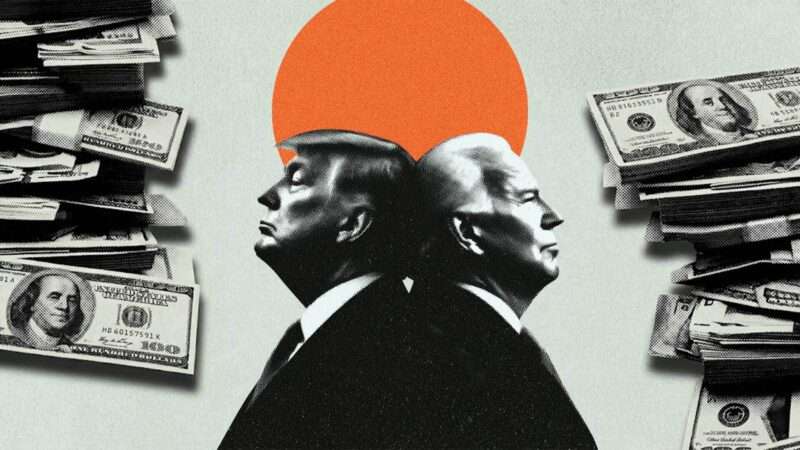
Donald Trump and Joe Biden | Illustration: Eddie Marshall | Midjourney

The 2020s, so far, have been one long and often painful lesson in what happens when policymakers tell economists to shut up and go away.

From the COVID-19 pandemic through Bidenflation and onto the Trump 2.0 trade wars, each successive administration to occupy the White House during this decade has made a critical error by assuming it could ignore economic principles—or simply substitute them for a different set of underlying assumptions. Those errors have been made in different ways and for different reasons, yes, but they share this common characteristic: a belief that economics is optional, and that tradeoffs can be eliminated if your motives are in the right place.

But that is simply not true, as circumstances have shown again and again.

Start with COVID, which is undeniably the defining story of the first half-plus-one-year of the 2020s. When the Trump administration and myriad state and local officials implemented lockdowns under the “15 days to slow the spread” promise in March 2020, it was largely at the behest of public health advisers.

The dominant attitude driving lockdown policies that closed schools, businesses, churches, playgrounds, and more was well articulated by Jon Allsop in the Columbia Journalism Review‘s newsletter. There is “no choice to be made between public health and a healthy economy—because public health is an essential prerequisite of a healthy economy,” he wrote in April 2020 as debate over “reopening” was ongoing.

That all-or-nothing approach reveals how little the economists were involved in the early decisions over COVID. “There are no solutions; only tradeoffs,” is how Thomas Sowell once put it, but during the early months of the pandemic, solutions were overly promised and tradeoffs were routinely ignored. That was a tremendous error.

“At its most basic, economics is about analyzing choices made under constraints. Politicians and government agencies made a vast range of public health decisions this past year that violated principles that good economists take for granted,” wrote Ryan Bourne, an economist with the Cato Institute, in a 2021 review of early COVID policies. “These decisions made the public health and economic welfare impacts of the pandemic worse than they needed to be. In that sense, the poor response to COVID-19 represents a failure to think economically.”

As the pandemic waned, the Biden administration repeated that mistake.

Soon after taking office, President Joe Biden’s team pushed for a “run it hot” approach to economic policy and openly dismissed fears of rising inflation. That came to fruition with the American Rescue Plan, a $1.9 trillion spending package that included $1,400 stimulus checks to households earning as much as $160,000 in joint income.

Larry Summers, a Harvard economist and veteran of the Biden administration, warned in a Washington Post op-ed that the American Rescue Plan would “set off inflationary pressures of a kind we have not seen in a generation.” Other top economists, including a former chairman of the International Monetary Fund, offered similar warnings.

Biden and Democrats in Congress did not listen. The result? Inflation of a kind America had not seen in a generation. The annualized inflation rate hit 9.1 percent in June 2022 and still has not returned to the 2 percent annualized rate that the Federal Reserve regards as its target.

Indeed, inflation has in some ways supplanted COVID as the dominant political narrative of the 2020s. Even though the current inflation level (2.7 percent annualized) is well below that 2022 peak, it is significantly higher than anything Americans experienced during the first two decades of the 21st century. No wonder everyone seems to be mad about how much things cost.

There were consequences to the Biden administration’s “run it hot” economic policy, and ignoring the economists did not make those tradeoffs go away.

The same can now be said for President Donald Trump’s tariffs, which his administration implemented over the objections of many economists. Vice President J.D. Vance took to X in July to declare that “the economics profession doesn’t fully understand tariffs.”

In reality, the tariffs are a huge tax increase—the largest tax increase in more than three decades, according to the Tax Foundation—and the tradeoffs are pretty much exactly what you’d expect to see after a big tax increase: greater revenue for the government (though not as much as Trump routinely claims), and a reduction of private sector productivity.

Trump and his allies promised that tariffs would usher in a “golden age” for American manufacturing. On the contrary, economists warned that tariffs would harm rather than help American manufacturing firms because the majority of all imports are raw materials and intermediate goods that go into making other products.

The proof is in the pudding. Higher taxes on those inputs caused the manufacturing sector to fall into a recession during 2025, and the sector has been shedding jobs. The trade deficit continues to grow. Meanwhile, tariffs have also pushed prices higher.

Economists can be frustrating to advisers in the policymaking process. The impulse to point out the inevitable tradeoffs in any policy can make it seem like their only purpose is to blow holes in the high-minded plans of the nation’s elected officials. But throwing them out of the room does not make foolish ideas more perfect. Six years of dismissing economic reality have not brought us utopia.

If our elected officials are looking for a handy New Year’s resolution for 2026, here’s an idea: Start listening to the economists again.

The post The Big Lesson of the 2020s? Don't Ignore the Economists. appeared first on Reason.com.

from Latest – Reason.com https://ift.tt/dwBhmxD
via IFTTT