Yale Journal on Regulation Symposium on the 20th Anniversary of Kelo v. City of New London

Susette Kelo’s famous “little pink house,” which became a nationally known symbol of the case that bears her name. (Institute for Justice.)


This year saw the twentieth anniversary of Kelo v. City of New London, one of the most controversial property rights decisions in the history of the Supreme Court. Although the Fifth Amendment only permits the taking of private property for “public use,” the Court ruled that the transfer of condemned land to private parties for “economic development” is permitted by the Constitution. Building on earlier decisions such as Berman v. Parker (1954), a closely divided 5-4 majority ruled that virtually any potential benefit to the public qualifies as a “public use.”

The Yale Journal on Regulation sponsored a symposium to mark the occasion, which I organized and co-edited along with legal scholars Eric Claeys (George Mason University) and David Schleicher (Yale). The articles in the symposium are now published and are available online at the journal’s website. Contributors include attorneys on both sides of the Kelo case, and leading takings and property law scholars such as Richard Epstein, Tom Merrill, Maureen Brady, Vicki Been and Yun-Chien Chang, Gerald Dickinson, and more. Eric Claeys and I also contributed articles, in addition to our role as editors.

The other editors and I have written an Introduction for the symposium, which summarizes the significance of Kelo, and provides a brief overview of the symposium articles.

My contribution to the symposium (also available on SSRN), is “Public Use, Exclusionary Zoning, and Democracy.” Here is the abstract:

The twentieth anniversary of Kelo v. City of New London is a good opportunity to consider the broader significance of public use for constitutional theory, and to explore parallels between the “public use” issue at stake in Kelo and another major issue in constitutional property rights under the Takings Clause: exclusionary zoning. This Article takes up that challenge. Part I highlights the strikingly similar history of the two issues. In both cases, there is a strong originalist argument that the policy in question—private-to-private condemnations in one case, exclusionary zoning in the other—violates the property-rights provisions of the Fifth Amendment. But, on both issues, the Supreme Court and federal courts generally have taken a highly deferential approach since the rise of Progressive and New Deal Era skepticism of property rights. Part II outlines reasons why that conventional wisdom is wrong. Judicial deference on both public use and exclusionary zoning has greatly harmed the poor and disadvantaged, particularly racial minorities. Moreover, stronger judicial review can actually further “representation-reinforcement” in two ways: by giving voice to groups excluded from the political process, and by empowering them to “vote with their feet.” Finally, Part III highlights synergies between judicial enforcement of public-use limitations on eminent domain and enforcement of restrictions on exclusionary zoning.

I have also written a second article to mark the 20th anniversary of Kelo. This one was published at the Brennan Center State Court Report,  and focuses on the massive state legislative and judicial reaction to Kelo, and the lessons which can be learned from it.


The post Yale Journal on Regulation Symposium on the 20th Anniversary of Kelo v. City of New London appeared first on Reason.com.

from Latest – Reason.com https://ift.tt/Cm3GQW8
via IFTTT

Cato Institute Looking to Hire an Executive Power Scholar

Cato Institute

The Cato Institute – where I am the Simon Chair in Constitutional Studies (in addition to my primary position at George Mason University) – is looking to hire a full-time executive power scholar. Here is a description of the position:

The Cato Institute seeks a full-time Executive Power Scholar to: 1) conduct original research on the rise, uses, and abuses of executive authority in the United States; and 2) develop reform ideas and proposals in order to reduce presidential and executive branch power back to its proper constitutional limits, in order to restore the separation of powers envisioned by the founders. This position will advance Cato’s mission by producing rigorous scholarship that analyzes constitutional structure, unilateral presidential action, administrative growth, and the separation of powers from a libertarian perspective, emphasizing limited government, individual liberty, and the rule of law.

The projected salary range for this role is $110,000 – $150,000 per year. Compensation is based on the successful candidate’s experience and skills.

More information – including instructions on how to apply – at the link above. Please do not send your applications to me; use the link.

The post Cato Institute Looking to Hire an Executive Power Scholar appeared first on Reason.com.

from Latest – Reason.com https://ift.tt/kDHWMIB
via IFTTT

With Eddington, Hollywood Finally Starts To Reckon With the Madness of 2020


Joaquin Phoenix and Pedro Pascal in "Eddington" | A24

With Trump in office again and a nebulous vibe shift or two fully underway, 2025 sometimes felt more like an aftershock of 2020—a remake or a sequel or some sort of twisted spiritual successor—than its own distinctive year.

Nearly every significant debate in politics and culture, from the woke wars to the streaming wars to the actual wars, can be traced back to that seminal pandemic year, the annus horribilis that tore America, along with much of the rest of the world, apart. 

And no movie better captured the anxieties and agitations of that year than Eddington, Ari Aster’s manic satire of COVID-era madness and the damage it did to our national psyche. I saw dozens of new films in 2025, but this is the one I thought about most, because it’s the first Hollywood film, and maybe the first mass-cultural product that isn’t a podcast or an essay, that really reckoned with what happened in 2020. The pandemic made us paranoid. COVID made us crazy. Tech became even more of an all-purpose mediator for human relationships. And years later, when it was all over, everything was weirder and more insane than ever. 

Eddington dramatizes the way in which COVID caused a kind of mass psychotic break from reality, a cultural cabin fever from which we are all still recovering. It’s the movie of the year, and maybe of this whole cursed decade. 

Part of the movie’s appeal is that it starts with something simple and familiar: a debate about masking that pits haughty rulemakers against ordinary folks. Set in small town New Mexico in the summer of 2020, the film begins as a mild satire of COVID pieties, but quickly raises the stakes. The masking debate somehow merges with debates about crypto, social media, and Black Lives Matter, as a small town election between an incumbent mayor and an anti-masking sheriff takes on increasingly absurd dynamics. Yet the rapid ratcheting up of cultural-political stakes mirrors the real-world escalations of that year, in which politics and the culture war seemed to merge into a giant, ugly blob of undifferentiated anger and polarization, a vortex of political-cultural hysteria that overwhelmed society. There were a lot of specific gripes and complaints, but often it seemed that the real issue was that everyone was mad about everything

The escalation continues in familiar ways until the final third of the film, which devolves into a fever dream of chaos and violence, the culture war as actual war, playing out on the streets of an ordinary American town. It’s a farce, both terrifying and hilarious. And like all good farces, it makes its point through exaggeration.

In its final act, Eddington seems to go off the rails. It becomes bizarre, violent, impossible to reason with or fully understand, a deranged, hallucinatory experience that seems wholly disconnected from on-the-ground reality. What starts as pointed pandemic satire turns into something insane, something that cannot possibly be meant to reflect what’s real. 

That’s the point. The movie’s argument, to the extent that it can be boiled down, is that the pandemic year, and all the social upheaval it wrought, can’t be understood on normal, grounded, realistic terms. What Aster seems to be saying is that 2020 is the year we all went crazy. And the only way to truly look back on that moment is as a kind of collective madness, an era that couldn’t possibly have happened. And yet, somehow, it did. 

The post With <i>Eddington</i>, Hollywood Finally Starts To Reckon With the Madness of 2020 appeared first on Reason.com.

from Latest – Reason.com https://ift.tt/y9cStHx
via IFTTT

Futures Flat On Last Trading Day Of 2025, Silver Slides

Futures Flat On Last Trading Day Of 2025, Silver Slides

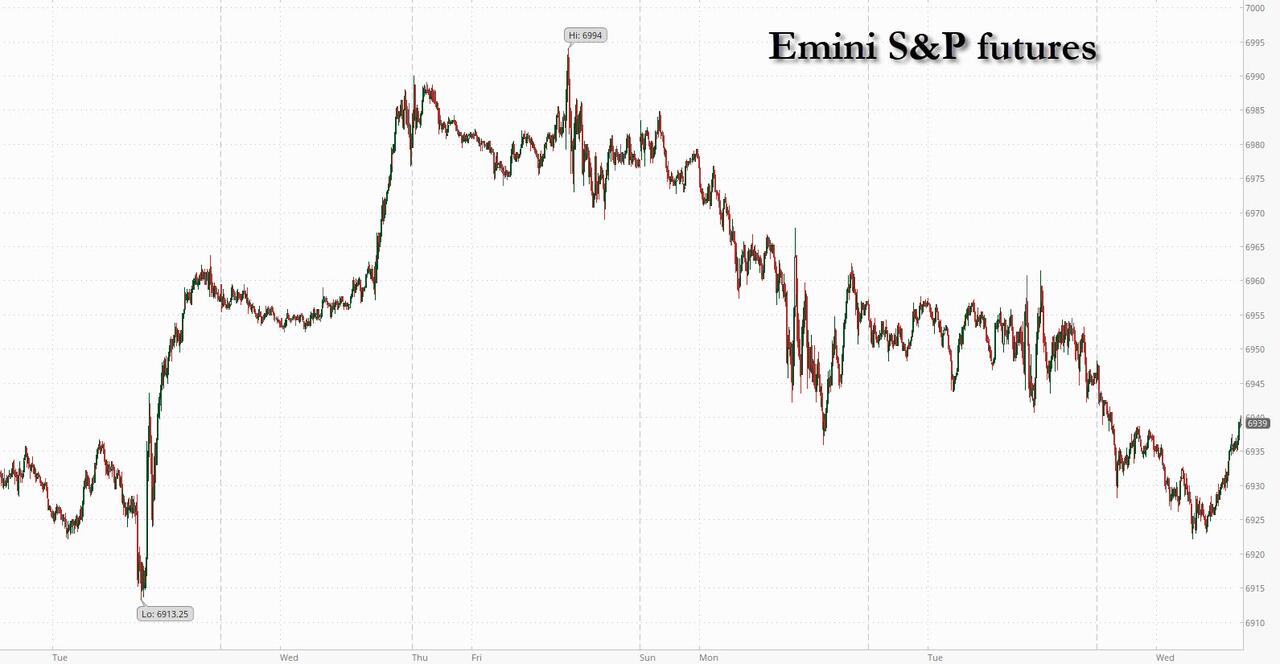
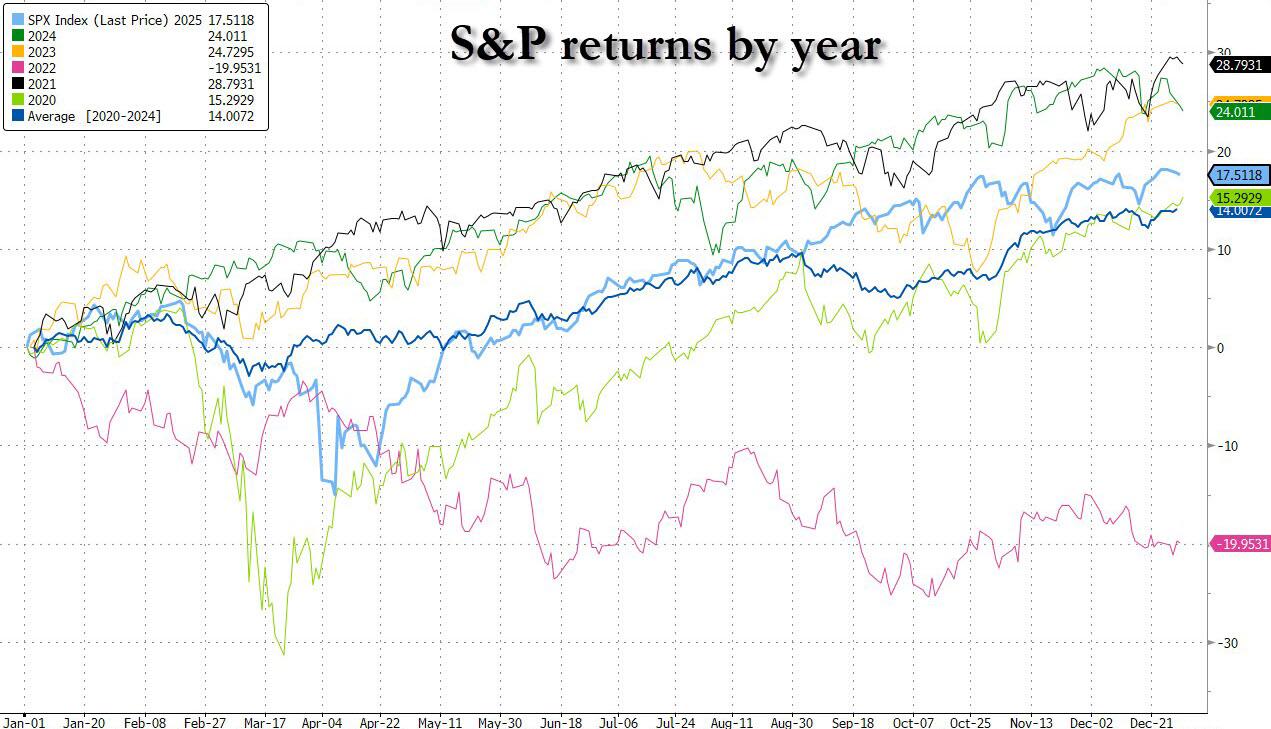
Stocks are ending a third straight year of double-digit gains in subdued fashion as an expected seasonal rally fails to gain traction. Silver’s volatile ride extended to another session, with the metal tumbling after the CME hiked margins for the second time in three days. As of 8:15am ET,  S&P 500 futures fell 0.1% and well off session lows, after a stretch of post-Christmas losses pared the benchmark’s advance for 2025 to 17%, just shy of the 20%+ gains 2021, 2023 and 2024. Nasdaq 100 contracts were down 0.3%.Both indexes have drifted lower for the past three days amid a rotation out of growth and momentum stocks and into value and quality names in seasonally. Silver plunged as a run of price moves of 5% or more entered a fourth day. The dollar is steady as it heads for an annual decline of about 8%, the steepest since 2017. Treasury yields are ticking lower after Tuesday’s FOMC minutes offered nothing to shake expectations rates will be left unchanged when policymakers meet again in January, with further cuts likely later in the year. The only economic data on today’s calendar is the weekly initial claims which printed far below expectations at 199K (est.218K).

In premarket trading, Mag 7 stocks were mostly lower (Nvidia +0.4%, Tesla +0.3%, Microsoft -0.1%, Apple -0.2%, Amazon -0.1%, Meta -0.1%, Alphabet -0.3%). With a 66% year-to-date rally, Alphabet leads the group in 2025.

  • Nike (NKE) is up 2.6% after CEO Elliott Hill reported the purchase of about $1 million in shares.
  • Vanda Pharmaceuticals (VNDA) jumps 21% after the biopharmaceutical company said the US FDA has approved Nereus (tradipitant) for the prevention of vomiting induced by motion.

In corporate news, Warner Bros. Discovery Inc. plans to once again reject a takeover bid from Paramount Skydance Corp., according to people familiar with the company’s thinking. Among the board’s concerns, Paramount has yet to increase its offer, which Warner Bros. earlier rejected as inferior to Netflix’s offer. Michael Burry, the money manager made famous in The Big Short, denied betting against Tesla shares, despite calling the company “ridiculously overvalued” earlier this month. 

Investors have reaped strong returns this year in a market that has been powered by optimism about the vast economic potential of artificial intelligence. Of course, as Bloomberg notes, it hasn’t been a smooth ride, though, with traders weathering swings triggered by US trade policies, geopolitical tension and concern over lofty valuations. And while many expected a Santa rally, the year’s momentum faded in the final days of December, as traders delay big decisions until after the holiday period, having already banked strong returns. The post-Christmas losses pared the S&P’s 2025 advance to 17%, just shy of the 20%+ gains 2021, 2023 and 2024. 

“After an excellent year in equity markets, and with positioning close to highs in late November, portfolio and fund managers may have been closing their bets and realigning them to benchmark,” said Roberto Scholtes, head of strategy at Singular Bank. “Our base case is for the bull run to continue, albeit with more volatility and resulting in mid-single digit returns.”

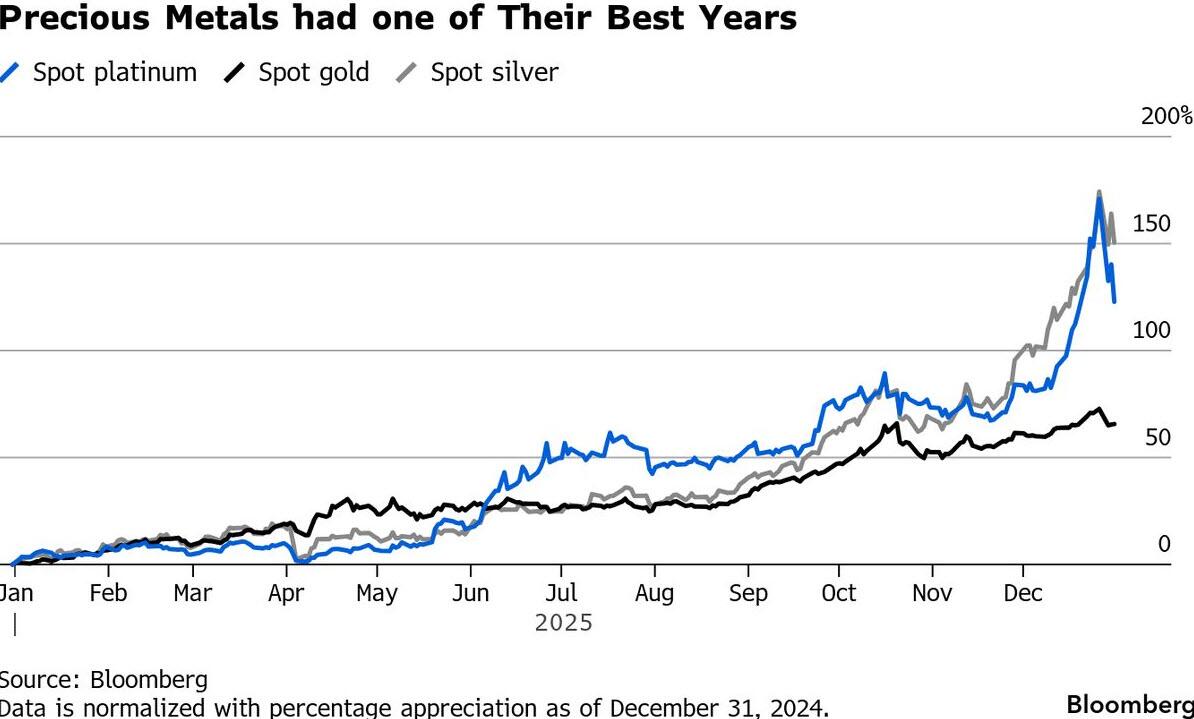
While things remain subdued in equities, silver’s gyrations continue. Wild price swings are prompting CME Group to raise margins on precious-metal futures for the second time in a week. After an almost unstoppable rise, the two metals have recorded a series of swings in December and erased some gains as investors booked profits. Both commodities remain on track for their best year since 1979.

Elsewhere, Xi Jinping said China is set to meet its economic targets for 2025, with growth expected to reach “about 5%” even though in reality it is a fraction of that. China also blasted Western criticism of its most intrusive military drills ever around Taiwan as its armed forces appeared to wrap up the maneuvers.

The end of 2025 also means that Warren Buffett’s famed tenure as CEO of Berkshire Hathaway is officially coming to a close, as the 95-year-old hands over the reins to successor Greg Abel into the new year.

In Europe, the CAC 40 is down 0.6% while the FTSE 100 drops 0.2%, with both indexes set to close early. Bourses in Germany and Italy are shut all day. Mining and technology stocks are leading declines on the Stoxx 600.

Asian equities wrapped up their best year since 2017 on a more hesitant note. Most regional indexes are under pressure, with Hang Seng Tech and ChiNext leading the retreat. Taiex is a bright spot following an almost 1% rally. Several markets are already shut for the year, including Japan and South Korea. 

In FX, the dollar is steady as it heads for an annual decline of about 8%, the steepest since 2017, rattled first by Trump’s tariffs then by Fed rate cuts. The recent advance did little to prevent the greenback from heading toward its worst annual retreat in eight years, with investors saying more declines are coming if the next chief of the Federal Reserve opts for deeper interest-rate cuts than currently expected. The kiwi is the weakest of the G-10 currencies, falling 0.4% against the greenback

In rates, treasuries weakened after of the final economic data release of 2025, with the 10-year yield rising 3 basis point to 4.15% after earlier falling 2bps. Applications for US unemployment unexpectedly tumbled to  just 199K in the week ended Dec. 27, far below estimates of 218K.

Meanwhile, Bitcoin traded near $88,800. The digital currency has settled into a range of roughly $85,000 to $95,000 following a crash in October that has put it on pace for a first annual loss in three years. After kicking off 2025 with a rally that was spurred by optimism about the crypto-friendly policies of the second Trump administration, Bitcoin was hit by the uncertainty surrounding US tariffs.

In commodities, silver drops 6% to around $72/oz after the CME Group said they will raise margins on precious-metal futures for the second time in the space of a week. Gold falls 0.7%. Oil headed for its steepest annual loss since the start of the pandemic in 2020, in a year that has been dominated by steadily rising supplies across the globe. Brent steadied close to $62 a barrel, with traders’ near-term focus on an OPEC+ meeting at the weekend, a bearish US industry report and American policies toward Russia, Iran and Venezuela.

Market Snapshot

  • S&P 500 mini -0.3%
  • Nasdaq 100 mini -0.4%
  • Russell 2000 mini -0.3%
  • Stoxx Europe 600 -0.2%
  • CAC 40 -0.6%
  • 10-year Treasury yield -1 basis point at 4.11%
  • VIX +0.6 points at 14.88
  • Bloomberg Dollar Index little changed at 1204.03
  • euro -0.1% at $1.1733
  • WTI crude +0.3% at $58.14/barrel

Top Overnight News

  • OpenAI Is Paying Employees More Than Any Major Tech Startup in History: WSJ
  • Drugmakers raise US prices on 350 medicines despite pressure from Trump: RTRS
  • Xi Touts China’s AI, Chip Wins In Triumphant New Year’s Speech:  BBG
  • Xi Declares China’s Economy Set to Hit 5% Growth Goal in 2025: BBG
  • From battleships to buildings: Trump’s name is everywhere: RTRS
  • Bankers Are Gearing Up for Another Onslaught of Monster Deals in 2026: WSJ
  • Meta created ‘playbook’ to fend off pressure to crack down on scammers, documents show: RTRS
  • US Virgin Islands sues Meta over ads for scams, dangers to children: RTRS
  • Meta tolerates rampant ad fraud from China to safeguard billions in revenue: RTRS
  • World’s Richest Added a Record $2.2 Trillion in Wealth This Year: BBG
  • Oil Tanker Pursued by U.S. Seems to Claim Russian Protection: WSJ
  • Boston Went Big on Luxury Condos. The Buyers Didn’t Show Up: WSJ
  • Finland Takes Control of Ship Suspected of Undersea Cable Damage: BBG
  • Trump’s Latest Venezuela Tactic: Revealing a Secret Strike to the World: WSJ
  • Palestinian Authority Sparks Fury by Cutting Prisoner Payments: BBG

US Event Calendar

  • 8:30 am: Dec 27 Initial Jobless Claims 199k, est. 218k, prior 214k
  • 8:30 am: Dec 20 Continuing Claims 1866k, est. 1901.74k, prior 1923k

Tyler Durden
Wed, 12/31/2025 – 08:58

via ZeroHedge News https://ift.tt/ryS91ep Tyler Durden

Initial Jobless Claims End 2025 Near Record Lows

Initial Jobless Claims End 2025 Near Record Lows

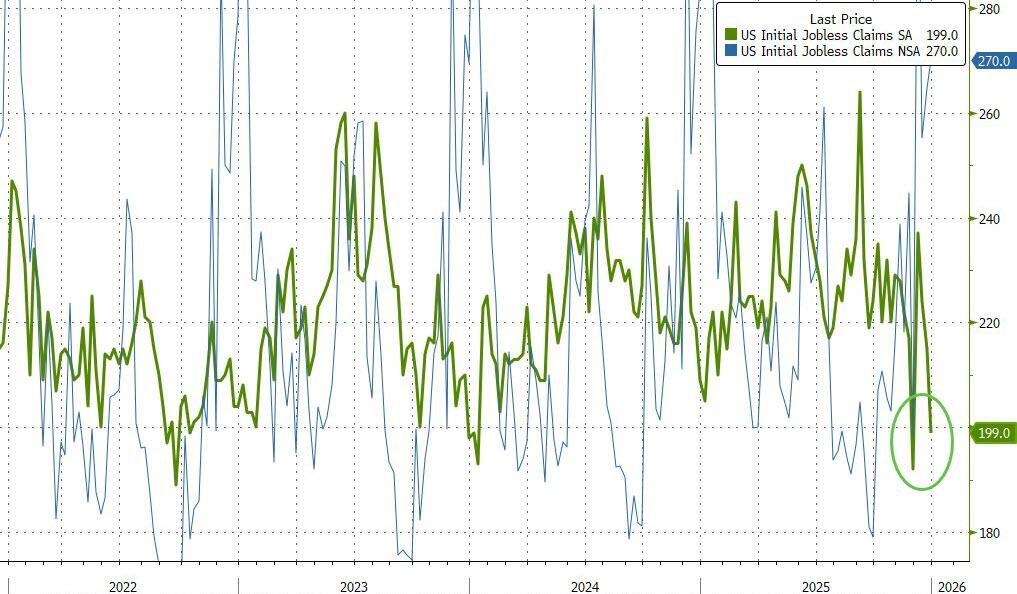
The number of Americans filing for jobless claims for the first time plummeted last week to 199k – the lowest since the Thanksgiving week plunge and pretty much the lowest since

Source: Bloomberg

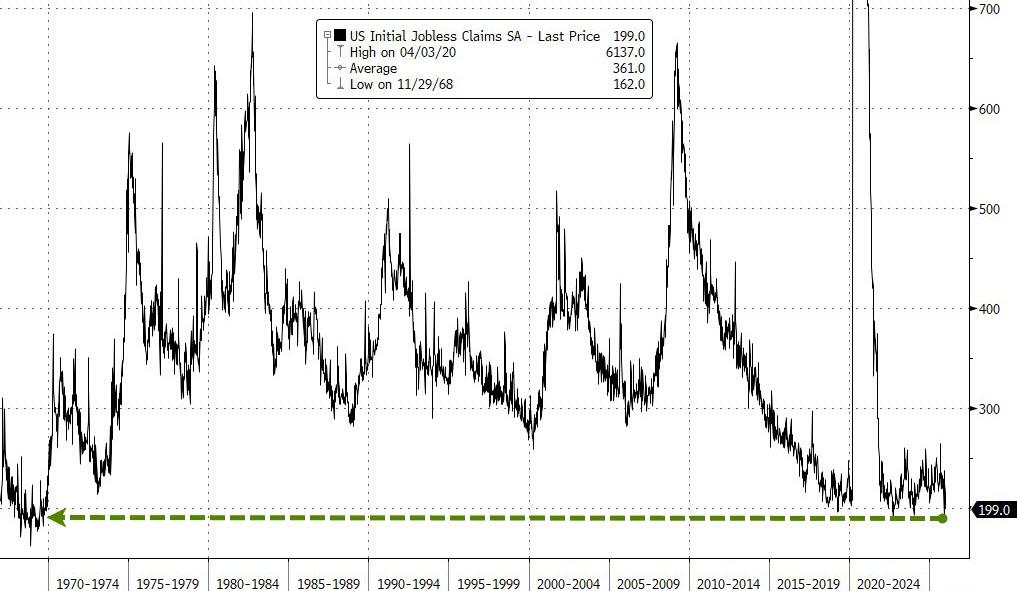
Sub-200k levels are rare and go back to 1969 lows…

Source: Bloomberg

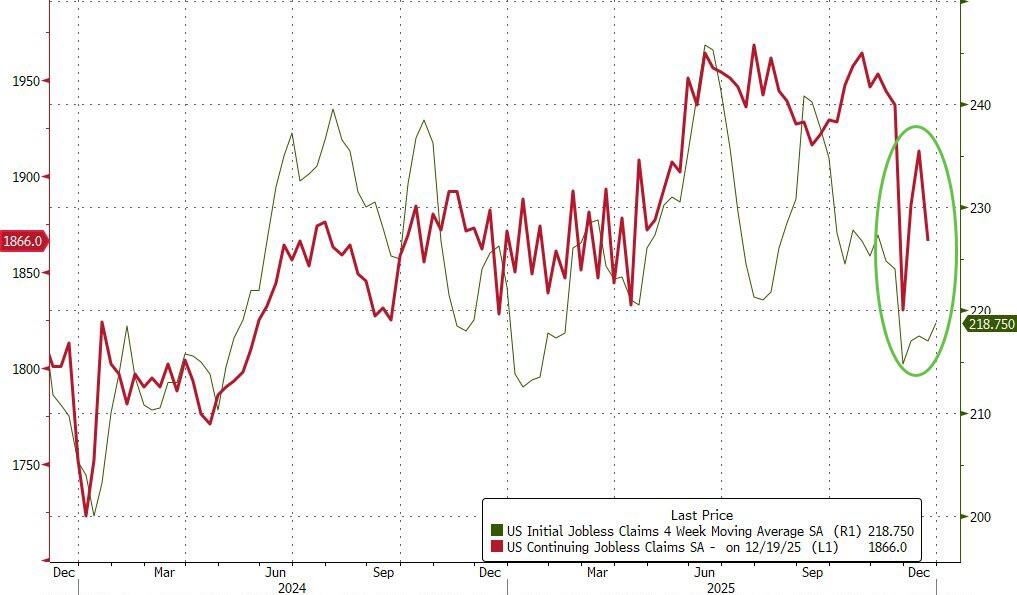
Continuing jobless claims also dipped last week and is below the 1.9 million Maginot Line…

Source: Bloomberg

The ‘no hire, no fire, no quits’ labor market continues.


Tyler Durden
Wed, 12/31/2025 – 08:40

via ZeroHedge News https://ift.tt/icZJhEu Tyler Durden

Michael ‘Big Short’ Burry Reveals He “Is Not Short” Tesla

Michael ‘Big Short’ Burry Reveals He “Is Not Short” Tesla

“Big Short” investor Michael Burry revealed on X that he is not shorting Tesla stock, despite calling Elon Musk’s car, robotics, battery storage, and AI company “ridiculously overvalued” in a separate post.

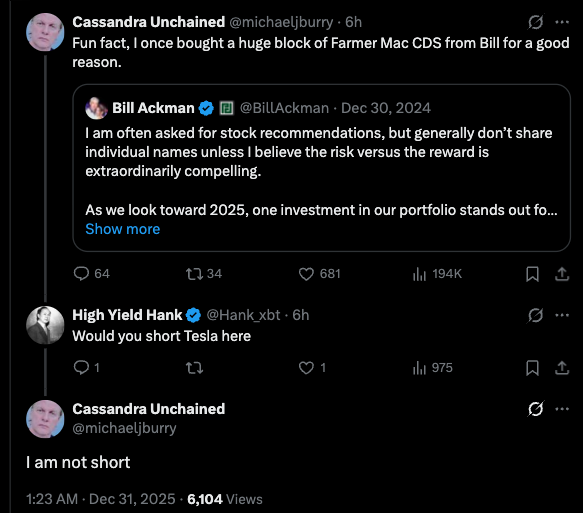
Early Wednesday morning, Burry posted on X about a prior credit default swap trade he made with Bill Ackman. In response, an X user asked, “Would you short Tesla here?”

Burry replied: “I am not short.”

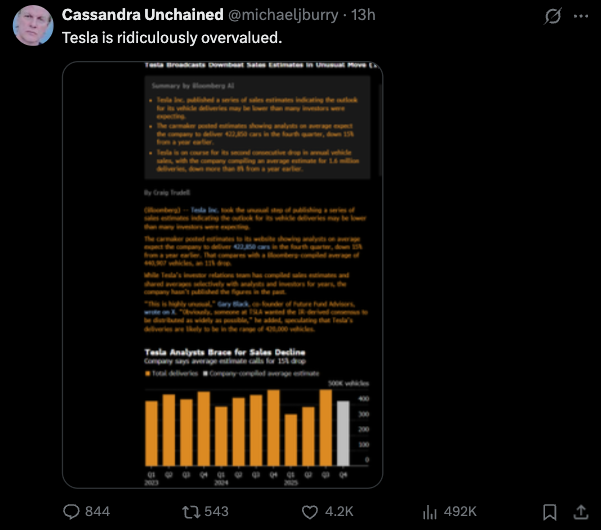
On Tuesday, Burry posted a screenshot on X of a Bloomberg article covering Tesla delivery estimates from sell-side analysts that showed continued gloom. He added, “Tesla is ridiculously overvalued.”

Burry may be correct on valuation, but many investors appear to be looking beyond near-term vehicle deliveries and instead focusing on robotaxis, humanoid robots, AI, and battery storage.

In late November, Burry deregistered his hedge fund, Scion Asset Management, with the Securities and Exchange Commission, moving his trading into stealth mode after criticism from X users.

“I am still running my money and active in markets,” Burry said at the time, later telling a Bloomberg reporter that he was managing capital only for “friends and family.

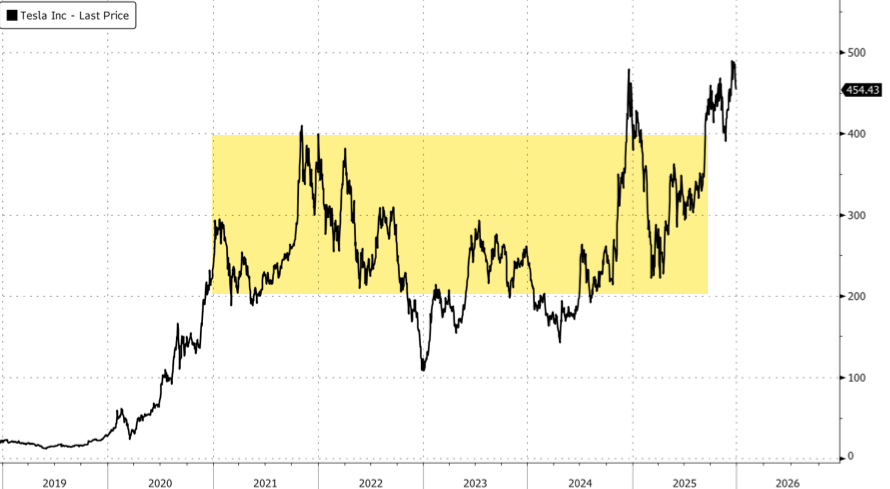
Tesla shares are up 12.5% year to date as of Tuesday’s close. The stock has broken above a four-year lateral trading range, with $400 now the key level to hold.

Recall that Burry previously wrote, “On to much better things Nov 25th,” which, for now, appears to include not shorting Tesla.

Tyler Durden
Wed, 12/31/2025 – 08:25

via ZeroHedge News https://ift.tt/xgTbMEu Tyler Durden

ByteDance Plans $14 Billion Nvidia H200 AI Chip Buying Spree As Computing Demand Soars

ByteDance Plans $14 Billion Nvidia H200 AI Chip Buying Spree As Computing Demand Soars

ByteDance plans to purchase 100 billion yuan ($14 billion) in AI chips in 2026, up from 85 billion yuan in 2025, with the bulk of spending directed toward Nvidia hardware, according to the South China Morning Post. The plan hinges on Beijing approving sales of Nvidia’s H200 GPUs in China. If approval is granted, Nvidia would need to scale up production of the China-tailored H200 with its manufacturing partner, TSMC (Taiwan Semiconductor Manufacturing Company).

The Trump administration recently authorized exports of H200 AI chips to China under a controlled licensing rule, marking a significant shift from prior export curbs. Despite U.S. approval for exports, Beijing has not yet formally approved purchases of H200s by Chinese firms, and reports indicate that access may be restricted or that imports of AI chips may be discouraged to protect its domestic semiconductor industry.

SCMP reports that ByteDance is planning a massive AI capex push, with H200-related spending in the neighborhood of $14 billion. This comes despite the company operating a 1,000-person internal chip design team, which has made progress on a new processor but has not yet matched Nvidia’s performance.

Demand for computing power is surging across TikTok, Douyin, its cloud unit Volcano Engine, and its large language models, driving the need for more advanced chips.

Doubao, ByteDance’s chatbot, now processes more than 50 trillion tokens daily, up from 4 trillion in late 2024, while Volcano Engine serves over 100 enterprise clients and will be a top AI cloud partner for China Central Television’s Spring Festival Gala.

In a separate report, Reuters said Chinese technology companies have shown strong interest in Nvidia’s second-most powerful AI chip and hope shipments can begin before the Lunar New Year.

Reuters also noted that Nvidia holds about 700,000 H200 AI chips in inventory, while Chinese technology firms have ordered more than 2 million units for next year, prompting Nvidia to ask TSMC to increase production.

Beijing now faces a strategic balancing act: ensuring its tech giants use best-in-class chips to compete in the AI race against the West, while simultaneously promoting the adoption of domestic alternatives, including products from Huawei Technologies’ Ascend unit, Moore Threads Technology, MetaX Integrated Circuits, and Cambricon Technologies.

Tyler Durden
Wed, 12/31/2025 – 07:45

via ZeroHedge News https://ift.tt/yh6sXM9 Tyler Durden

Trump Bars 5 Europeans From the U.S. Over Their Censorship Efforts


President Donald Trump and former European Commissioner Thierry Breton | Illustration: Eddie Marshall | Hearing of Commissioner-designate Thierry Breton | Nano Banana

Two days before Christmas, the European Commission—essentially the executive branch of the European Union (E.U.)—protested U.S. travel restrictions against five residents of the bloc. According to U.S. Secretary of State Marco Rubio, the five were sanctioned for “organized efforts to coerce American platforms to censor, demonetize, and suppress American viewpoints they oppose.” Whether the penalties were appropriate is worth a conversation, but there’s no doubt the five played a role in growing efforts by government officials in the E.U.—and elsewhere, including the U.S.—to muzzle views they don’t like.

When “Digital Rules” Mean Global Censorship Efforts

“The European Commission strongly condemns the U.S. decision to impose travel restrictions on five European individuals, including former European Commissioner Thierry Breton,” the European Commission complained in a December 23 statement. “The EU is an open, rules-based single market, with the sovereign right to regulate economic activity in line with our democratic values and international commitments. Our digital rules ensure a safe, fair, and level playing field for all companies, applied fairly and without discrimination.”

Along with Breton, the other sanctioned individuals, according to Under Secretary of State Sarah B. Rogers, are Imran Ahmed, head of the Center for Countering Digital Hate (CCDH); Clare Melford, co-founder of the Global Disinformation Index (GDI); and Anna-Lena von Hodenberg and Josephine Ballon, the co-leaders of HateAid. Those three (nominally—more about that later) nongovernmental organizations pressure tech companies to deplatform people, rank media organizations by their alleged reliability, and use public and legal pressure to narrow the range of “acceptable” speakers and speech.

Despite the European Commission’s claim that its “rules ensure a safe, fair, and level playing field,” the mention of Breton is telling. As the E.U.’s internal market commissioner, Breton waged a personal crusade against ideas he disliked. In 2024, Breton warned X head Elon Musk that his planned online conversation with then–U.S. presidential candidate Donald Trump would be accessible to Europeans. “Therefore, we are monitoring the potential risks in the EU associated with the dissemination of content that may incite violence, hate, and racism in conjunction with major political—or societal—events around the world, including debates and interviews in the context of elections,” Breton sniffed.

Breton went on to caution about discussions of events in the United Kingdom, also not part of the E.U.

‘More Characteristic of an Autocratic Nation Than a Democracy’

In response, a coalition of civil libertarian organizations and individuals wrote: “We are particularly concerned by your attempt to use the [Digital Services Act] to stifle freedom of expression beyond the European Union because of what you call ‘spillovers.’ Warning an online platform that streaming an interview with one of the two key candidates in the United States presidential election may be incompatible with an online safety law is more characteristic of an autocratic nation than a democracy.”

For its part, GDI is nominally private, but has received funding from government sources including the Biden-era U.S. State Department. That funding helped it publish a 2022 report listing Reason among the riskiest U.S. news sources for, in part, publishing “no information regarding authorship attribution”—a laughably false claim. GDI also claimed to be advised by some prominent journalists who had no idea about their supposed affiliation.

CCDH, which leans left and has ties to Britain’s Labour Party, emphasizes deplatforming and attempts to push advertisers away from media platforms it dislikes. HateAid, partially funded by Germany’s government, focuses on lawsuits against speech classified as hateful under European laws.

All three organizations are accused by Secretary of State Marco Rubio of “extraterritorial overreach by foreign censors targeting American speech.” There’s strong evidence to support charges that all five sanctioned individuals are part of efforts to extend Europe’s restrictive rules beyond the E.U.’s borders.

European regulatory spillage is common enough that it is termed “the Brussels Effect.” Basically, Europeans produce nothing in such quantity as they produce red tape, but the European market is so big that it’s easier for companies around the world to implement restrictive E.U. rules which will generally be acceptable elsewhere than to accommodate multiple regulatory environments.

Europe’s Political Class Clings to Power

But as applied to speech controls, the Brussels Effect shows more vigor than Europeans have brought to any other activity in recent years. The E.U. is openly determined to police speech.

Martin Gurri, a Mercatus Center scholar and author of The Revolt of the Public and the Crisis of Authority in the New Millennium, sees the censorship craze as reflecting the panic of political elites losing control over information and their grip on power. Last year he wrote, “The elites are driven entirely by the impulse to control. They detest democracy, which keeps getting in their way, and much prefer a golden ideal they possessively call ‘Our Democracy’—their own rule in perpetuity.”

Sociologist Frank Furedi largely agrees, though instead of “elites” he points his finger at “techno-centrism” which “has no ideological pretension and is entirely focused on its task of preserving its own dominance over the institutions of society.” He believes “centrism has become increasingly intolerant and willing to implement authoritarian and anti-democratic measures to destroy its political opponents.” Furedi adds, “Apart from the European Union, technocratic governance rarely exists in a pure form.”

Both see European censorship as the reaction of a besieged political class trying to maintain control in the face of upstart parties and movements and angry voters. The populists may not have anything better to offer—their ideas are often even worse—but they threaten the powers that be.

We have our own political class, of course. It not only funded GDI but also tried to muzzle dissidents on social media. E.U. officials just have fewer restraints on their authoritarian efforts.

The Trump Administration Should Try Consistency on Free Speech

As mentioned above, though, populists aren’t necessarily better. The Trump administration denied a few censorship-happy Europeans access to the U.S., but it has its own problems with speech. The State Department revoked the visas of foreign students for exercising their right to protest. It also punished law firms associated with its political opponents, threatened to prosecute people who record Immigration and Customs Enforcement (ICE) agents, and insists that broadcast licenses can be conditioned on positive coverage of the president.

It’s encouraging to see the U.S. government stand up to foreign efforts to muzzle Americans. It would be even better if the sanctions represented a much more consistent respect for free speech.

The post Trump Bars 5 Europeans From the U.S. Over Their Censorship Efforts appeared first on Reason.com.

from Latest – Reason.com https://ift.tt/M3ORTEG
via IFTTT

DOE Orders Indiana Coal Units Totaling More Than 950 MW To Run Past Retirement Dates

DOE Orders Indiana Coal Units Totaling More Than 950 MW To Run Past Retirement Dates

By Ethan Howland of UtilityDive

The U.S. Department of Energy on Dec. 23 ordered Northern Indiana Public Service Co., a division of NiSource, and CenterPoint Energy to continue running three coal-fired units in Indiana, totaling more than 950 MW, beyond their planned retirement at the end of the month.

DOE contends that portions of the Midcontinent Independent System Operator face an emergency situation, citing studies by the grid operator and the results of recent capacity auctions that indicate tightening supply conditions.

“The emergency conditions resulting from increasing demand and shortage from accelerated retirement of generation facilities will continue in the near term and are also likely to continue in subsequent years,” DOE said in its 90-day emergency orders to MISO, NIPSCO and CenterPoint.

However, MISO reviewed NIPSCO’s plan to retire the coal-fired units at its Schahfer power plant and CenterPoint’s proposal to shutter its F.B. Culley Unit 2, all of which were scheduled to occur on Dec. 31.

DOE has issued a string of last-minute emergency orders under the Federal Power Act’s Section 202(c) to keep power plants in Michigan, Pennsylvania and Washington from retiring. Those generating units total about 3.1 GW.

The latest emergency orders were issued a day after the Trump administration froze work on five offshore wind farms totaling 7 GW.

The Indiana units must run until March 23, although DOE can extend the orders, as it has done for the Campbell power plant in Michigan and the Eddystone units near Philadelphia.

Citizens Action Coalition of Indiana, a ratepayer advocacy group, contends the DOE orders will drive up electricity bills.

“The federal government’s order to force extremely expensive and unreliable coal units to stay open will result in higher bills for Hoosiers who are already reeling from record-high rate increases in 2025,” Ben Inskeep, CAC program director, said in a statement.

The DOE’s emergency orders for the Campbell power plant are being challenged in federal appeals court by Michigan’s attorney general, Minnesota and Illinois as well as a coalition of advocacy groups led by the Sierra Club and Earthjustice.

In a Dec. 19 court brief in the U.S. Court of Appeals for the District of Columbia Circuit, the advocacy groups said DOE failed to show MISO faces an energy emergency.

Tyler Durden
Wed, 12/31/2025 – 07:20

via ZeroHedge News https://ift.tt/mrnah1T Tyler Durden