DHS Says REAL ID, Which DHS Certifies, Is Too Unreliable To Confirm U.S. Citizenship


Close up of a California REAL ID | Illustration: Eddie Marshall | Rickk6rj | Dreamstime.com | Nano Banana

Only the government could spend 20 years creating a national ID that no one wanted and that apparently doesn’t even work as a national ID.

But that’s what the federal government has accomplished with the REAL ID, which the Department of Homeland Security (DHS) now considers unreliable, even though getting one requires providing proof of citizenship or lawful status in the country.

In a December 11 court filing, Philip Lavoie, the acting assistant special agent in charge of DHS’ Mobile, Alabama, office, stated that, “REAL ID can be unreliable to confirm U.S. citizenship.”

Lavoie’s declaration was in response to a federal civil rights lawsuit filed in October by the Institute for Justice, a public-interest law firm, on behalf of Leo Garcia Venegas, an Alabama construction worker. Venegas was detained twice in May and June during immigration raids on private construction sites, despite being a U.S. citizen. In both instances, Venegas’ lawsuit says, masked federal immigration officers entered the private sites without a warrant and began detaining workers based solely on their apparent ethnicity.

And in both instances officers allegedly retrieved Venegas’ Alabama-issued REAL ID from his pocket but claimed it could be fake. Venegas was kept handcuffed and detained for an hour the first time and “between 20 and 30 minutes” the second time before officers ran his information and released him.

Lavoie’s declaration says that the agents “needed to further verify his U.S. citizenship because each state has its own REAL ID compliance laws, which may provide for the issuance of a REAL ID to an alien and therefore based on HSI Special Agent training and experience, REAL ID can be unreliable to confirm U.S. citizenship.”

It’s the punch line to a bad joke with a 20-year windup. When Congress passed the REAL ID Act in 2005. It was sold as a post-9/11 security measure to create uniform standards for state IDs, including clearly listing citizenship or lawful immigration status. State IDs that conformed to the requirements would be marked with a star. Contrary to the cheeky first sentence of this story, DHS insists that REAL ID is not a national ID system, and that it doesn’t involve a centralized national database. (Civil liberties groups say it amounts to a de facto national ID system anyway.) 

The rub was that REAL IDs would be required for entry to federal property, including, most significantly for the average American, airport security checkpoints. But the law was widely unpopular. There was such low compliance from states that enforcement was delayed seven times over the years, until finally beginning this May.

The project should have been scrapped years ago. America somehow survived two decades of terrorism-free air travel without REAL IDs. As Reason‘s Scott Shackford wrote in 2021, “The government is demanding that Americans give up more of their privacy to the feds, subject themselves to additional inane bureaucracy, and carry around proof that we’re citizens to be able to fly, even though none of that makes us more secure.”

And now we discover that DHS doesn’t even consider the thing proof of citizenship.

In a court filing in response to DHS, the Institute for Justice noted how incredible this position is. “REAL IDs require proof of citizenship or lawful status,” the Institute for Justice wrote. “DHS is the very agency responsible for certifying that REAL IDs, including Alabama’s STAR IDs, satisfy this requirement.”

The law firm argues that DHS’ policy of allowing officers to disregard proof of lawful presence likely violates the Fourth Amendment and DHS’ own regulations.

When asked to comment on Lavoie’s declaration, a DHS spokesperson said in a statement to Reason: “The INA requires aliens and non-citizens in the US to carry immigration documents. Real IDs are not immigration documents—they make identification harder to forge, thwarting criminals and terrorists.”

But of course, Venegas is a U.S. citizen, so he is not required to carry non-existent immigration documents.

DHS’ statement to Reason when Venegas’ lawsuit was first filed insisted that, “What makes someone a target for immigration enforcement is if they are illegally in the U.S.—NOT their skin color, race, or ethnicity.”

The agency never responded to a follow-up question asking why, then, Venegas was targeted.

This is the cynical two-step that the Supreme Court allowed this September when it overturned a ruling by the 9th Circuit Court of Appeals, which found that the Trump administration was likely violating the Fourth Amendment rights of citizens by seizing them based solely on factors such as “apparent race or ethnicity.” 

Justice Brett Kavanaugh released a concurring opinion in which he waved away concerns that allowing such profiling would lead to citizens and legal residents being unduly harassed.

“As for stops of those individuals who are legally in the country, the questioning in those circumstances is typically brief,” Kavanaugh wrote, “and those individuals may promptly go free after making clear to the immigration officers that they are U. S. citizens or otherwise legally in the United States.”

But what the Lavoie declaration makes clear—and what should be remembered every time a new national security boondoggle like the REAL ID is proposed—is that when our Fourth Amendment rights are eroded, there is no evidence or piece of plastic that will suffice to overcome an officer’s “reasonable suspicion” once the government decides you’re a target.

The post DHS Says REAL ID, Which DHS Certifies, Is Too Unreliable To Confirm U.S. Citizenship appeared first on Reason.com.

from Latest – Reason.com https://ift.tt/M4L7P8Y
via IFTTT
Newsom’s Massive Fraud Scandal No One Is Talking About

Newsom’s Massive Fraud Scandal No One Is Talking About

Authored by Matt Margolis via PJMedia.com,

Everybody’s buzzing about that Minnesota Medicaid mess with Gov. Tim Walz. Some are even calling it the largest fraud scandal ever. If only.

Blue-state fraud is undoubtedly a problem, and Walz should be held accountable if he did indeed look the other way. But what happened in the land of 10,000 lakes is tiny compared to the fraud in California under Gavin Newsom.

Heck, it makes Minnesota look like pocket change.

A fresh 92-page bombshell from the California State Auditor lays it all out.

“This latest report was issued by the state auditor, and that’s a nonpartisan position; that state auditor now puts eight state agencies on the high-risk list of agencies to watch out for, for things like fraud and mismanagement as well as waste,” Newsmax correspondent Heather Myers revealed last week.

“Here’s a look at that 92-page report. Newly added to the high-risk list is California’s food stamp program. If the state doesn’t get the improper payments under control, it could cost an extra $2.5 billion. Also on there is the Department of Finance, which was tasked with giving out COVID relief funds. Critics say $32 billion of that was taken by fraudsters. Then there are infrastructure issues like California’s deteriorating dams, and also the high-speed train that’s already cost taxpayers 18 billion without a single section of track complete.”

But wait, there’s more!

Other reports cite $24 billion spent on the homeless issue that critics claim the state lost track of. More recently, there’s a report that says California cell phone users paid a surcharge for years to upgrade the state’s 911 system,” she added.

Tallied all up, California taxpayers lost $70 billion to fraud.

But here’s where things get really interesting. While pressure is on in Minnesota to get to the bottom of the state’s fraud, California seems to be under the radar.

Now get this. Right in the middle of the fraud apocalypse, a new ballot initiative seeks to impose a one-time 10% wealth tax on billionaires’ assets.

“Billionaires are threatening to leave California, and it’s all because of a possible new ballot initiative in the state. It’s a wealth tax. A healthcare labor group is behind this push, calling for a one-time tax on billionaires equal to 10 percent of their assets. And right now, it does not have enough signatures to get on the ballot,” CNN’s Abby Phillip reported Monday.

“These are big numbers, just to let people know what we’re talking about here. Larry Page, for example, he’s worth $258 billion. His estimated tax would be $12 billion. Peter Thiel, worth $27 billion. His estimated tax would be $1.2 billion. That’s not $1.2 in your pocket. It’s billions of dollars. So, I mean, should they or should they not?”

CNN’s Scott Jennings torched the whole scheme; it’s about covering up the fraud.

“And it is not for the public benefit,” he pointed out.

“In California, the state auditor just found $70 billion in fraud going on in the state. The reason they need a wealth tax is to cover up the fraud. The hole in the budget in California is due to fraud. That’s why they’re trying to tax people.” Boom. Panelists flipped out. Jennings doubled down. Why 5%? Why billionaires? Arbitrary envy tax to paper over Sacramento’s black hole. Imagine handing more cash to the clowns who blew $24 billion on tent cities.”

Make no mistake about it, he’s right. Newsom is going to run for president in 2028. Something tells me that $70 billion in fraud on Gavin’s watch is the kind of thing that won’t sit well in a primary, much less the general election.

Tyler Durden
Wed, 12/31/2025 – 11:15

via ZeroHedge News https://ift.tt/Eh0K4Yy Tyler Durden

Oil Heads For Worst Annual Loss Since COVID As US Crude Production Hits Record High

Oil Heads For Worst Annual Loss Since COVID As US Crude Production Hits Record High

Oil futures are gaining in early U.S. trade, but on track to end the year substantially lower.

As Dow Jones reports, the unwinding of OPEC+ output cuts, along with higher non-OPEC production, fueled oversupply concerns in 2025, while U.S. sanctions and geopolitical tensions in the Middle East, Russia-Ukraine and more recently Venezuela led to frequent price spikes.

“The crude supply surplus will acquire greater transparency than was the case through most of the fall period as floating storage gradually finds its way into onshore facilities,” Ritterbusch and Associates says in a note.

But away from the geopolitical chaos, domestic supply and production remain key…

DOE

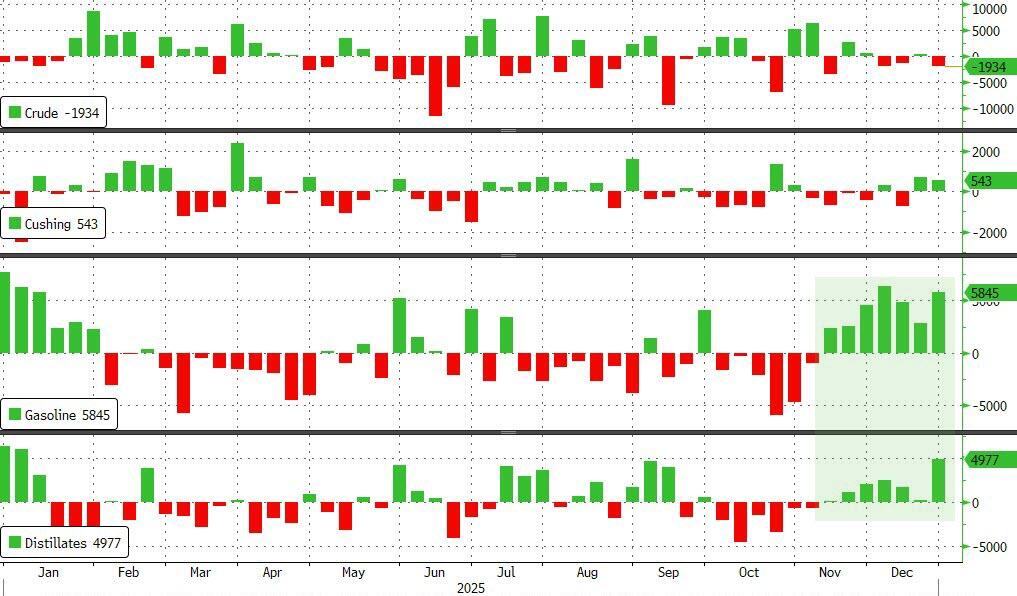
  • Crude -1.934mm

  • Cushing +543k

  • Gasoline +5.845mm

  • Distillates +4.977mm

Crude stocks fell for the 3rd week in the last 4 while product inventories saw their 8th straight weekly build in a row…

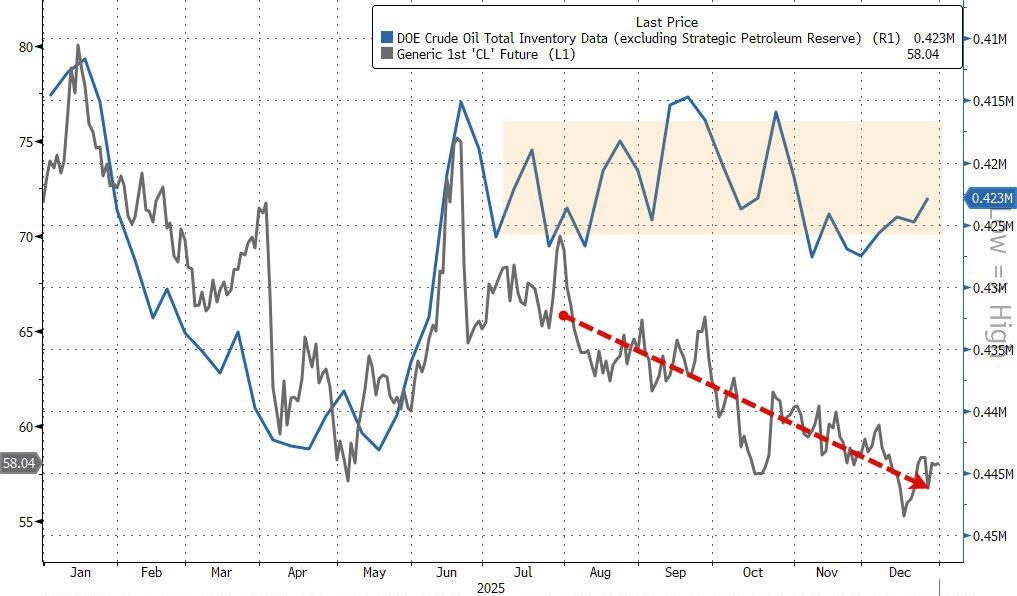
The US Crude Oil Total Inventory (excluding Strategic Petroleum Reserve) fell to 422,888 thousand barrels in the week ending Dec. 26, 2025, lowest since Oct. 31, 2025… decoupling from the crude price…

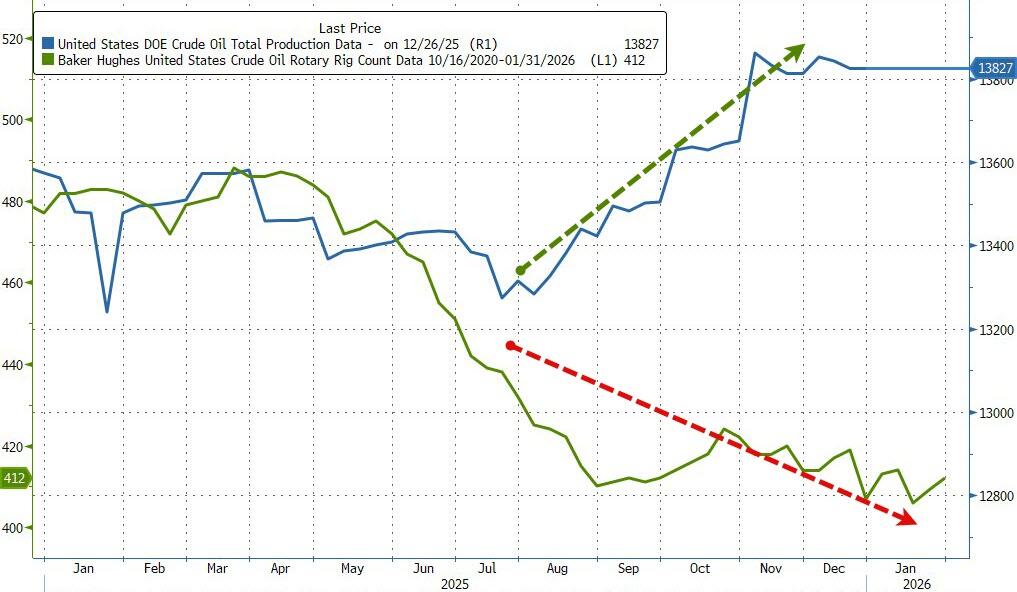
US crude production remains near record highs as the rig count has continued to slide all year…

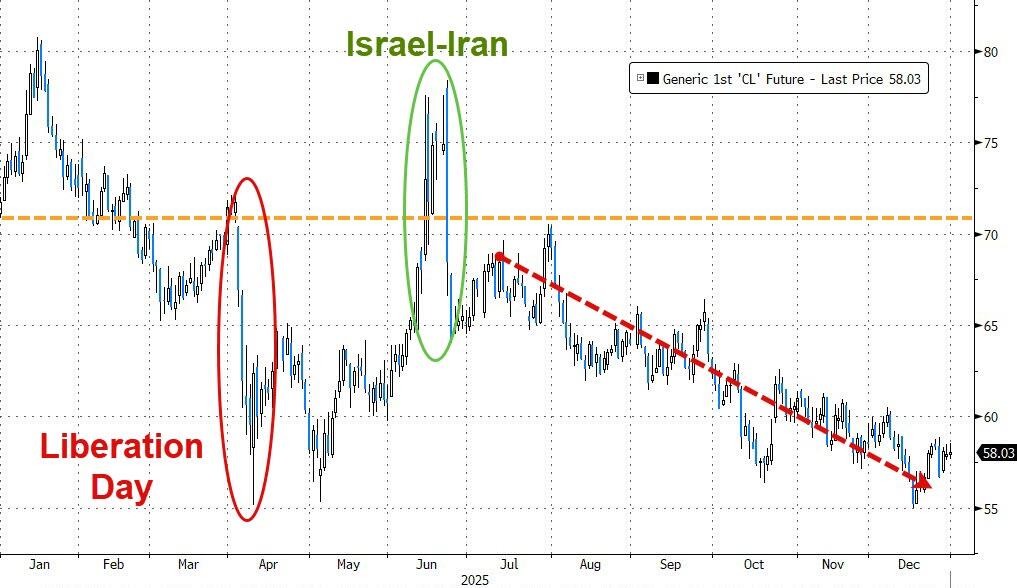
Oil headed for its steepest annual loss since the start of the pandemic in 2020, in a year that has been dominated by geopolitical risks and steadily rising supplies across the globe.

OPEC+ roiled markets earlier this year by reversing its longstanding policy of defending prices and raised output, seeking to reclaim market share as countries including Brazil and Guyana boosted supply and the US pumped at record levels. The producer group is expected to hold off on output hikes during talks this weekend.

A punishing surplus is expected to weigh on prices in 2026 – Global oil markets have been been oversupplied this year.

“The oil market is set to remain oversupplied into 2026, with strong non-OPEC production from the US, Brazil, Guyana and Argentina outpacing uneven global demand,” said Kaynat Chainwala, an analyst at Kotak Securities Ltd. Prices should stay range-bound between $50 and $70, with risks over Venezuelan or Russian supply remaining supportive, she added.

Both the International Energy Agency and the US government see production exceeding consumption by just over 2 million barrels a day in 2025 and that surplus worsening in the coming year.

Tyler Durden
Wed, 12/31/2025 – 11:00

via ZeroHedge News https://ift.tt/WNTFwX6 Tyler Durden

Somali Americans Face Audits For Potential Immigration Fraud

Somali Americans Face Audits For Potential Immigration Fraud

Authored by Kimberley Hayek via The Epoch Times,

The Trump administration is auditing immigration cases involving U.S. citizens of Somali origin to uncover potential fraud that might be grounds for revoking their citizenship, known as denaturalization.

“Under U.S. law, if an individual procures citizenship on a fraudulent basis, that is grounds for denaturalization,” Homeland Security Assistant Secretary Tricia McLaughlin said in a statement reported by Fox News then shared by the White House on social media.

Such denaturalization actions are rare, and the process often lasts years. Data from the Immigrant Legal Resource Center show an average of about 11 cases pursued annually between 1990 and 2017.

Since taking office in January, President Donald Trump has made enforcing immigration laws a priority, including ramped-up deportations, and visa and green card revocations.

Federal authorities have in recent months turned their focus to Minnesota’s Somali population, alleging it is an epicenter for fraud involving millions in federal funds for social services. FBI Director Kash Patel announced Sunday that the bureau has “surged” investigators and resources to Minnesota.

Meanwhile, the U.S. Department of Health and Human Services (HHS) announced Tuesday that it has stopped all child care payments to Minnesota. Nationwide, payments from the department’s Administration for Children and Families “will require a justification and a receipt or photo evidence before we send money to a state.”

The Small Business Administration said it plans to pause funding to the state pending investigation of suspected $430 million in Paycheck Protection Program (PPP) fraud, Administrator Kelly Loeffler posted to X on Dec. 29.

The House Oversight Committee is investigating an alleged cover-up of welfare fraud schemes in the state. HHS Deputy Secretary Jim O’Neill stated the department has “turned off the money spigot.”

Minnesota Gov. Tim Walz responded that his administration has “spent years cracking down on fraudsters” and accused Trump of “politicizing the issue to defund programs that help Minnesotans.”

The Justice Department has charged nearly 100 individuals in Minnesota’s fraud scandal, with 85 percent of Somali descent. Attorney General Pam Bondi credited independent journalist Nick Shirley for assisting in the investigations.

The FBI began deploying resources to Minnesota early in the probe, Patel said, as the White House raised alarms about fraud in the Somali community. Officials made public on Thanksgiving their concerns over ubiquitous scams.

The Labor Department sent a “strike team” to the state to investigate fraud, waste, and abuse. At least seven federal agencies are also involved in the probe.

Trump has denounced Minnesota as “a hub of fraudulent money laundering activity,” and moved to end temporary deportation protections for Somalis, citing gang activities. Reports suggest progressive policies and “Minnesota Nice” culture allowed such fraud to happen.

State lawmakers in Ohio have requested an investigation in their state, warning that similar fraud schemes may exist there, and urging law enforcement to “arrest, prosecute, jail, denaturalize, and deport all Somali fraudsters” in a letter state Rep. Josh Williams (R-Sylvania Twp.) shared with the state Department of Children and Youth on Dec. 30. The letter was signed by at least 40 other lawmakers.

Tyler Durden
Wed, 12/31/2025 – 10:45

via ZeroHedge News https://ift.tt/CMTW2a1 Tyler Durden

Trump Media Shares Pop After Announcing Digital Token Distribution With Crypto.com

Trump Media Shares Pop After Announcing Digital Token Distribution With Crypto.com

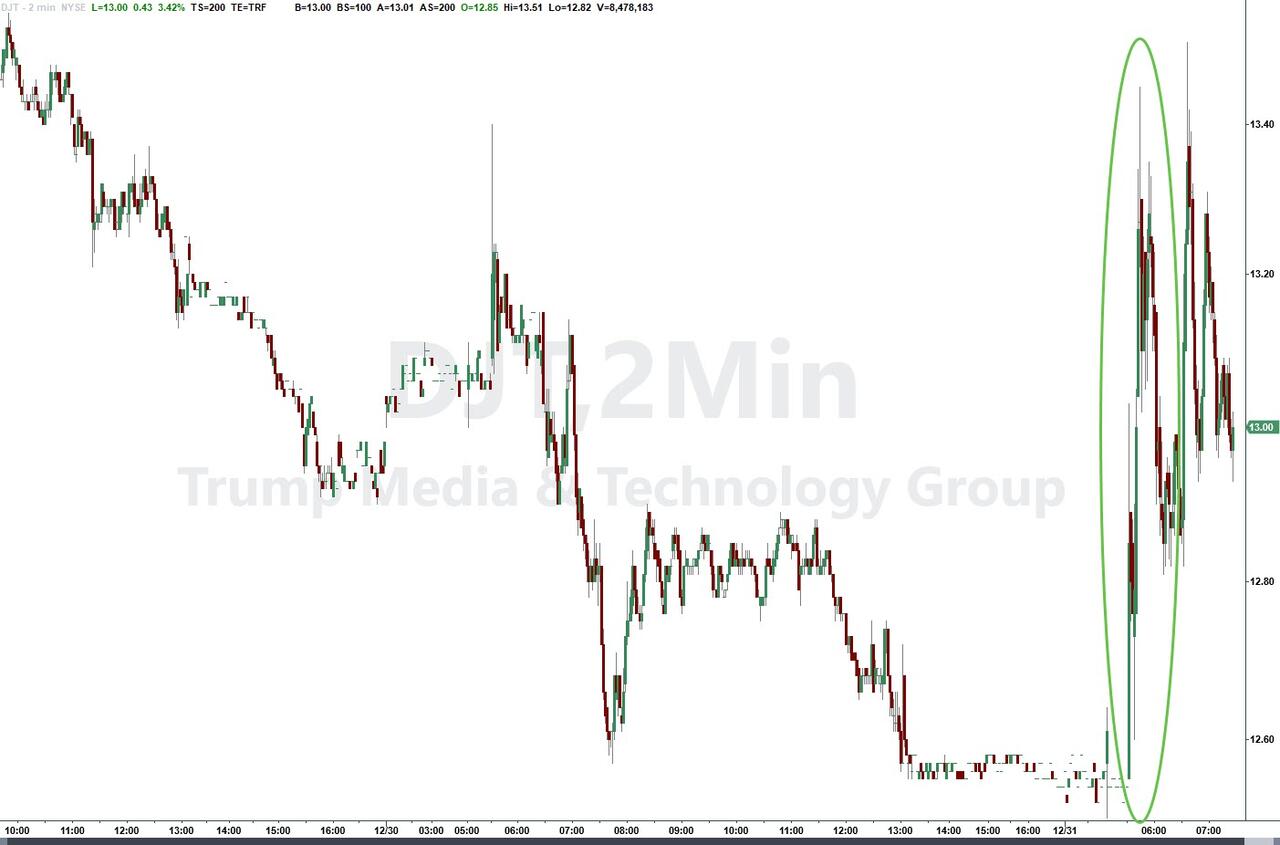
Trump Media shares are volatile this morning, popping before paring gains, after the company announced plans to distribute a new digital token to its shareholders through a partnership with Crypto.com, expanding the company’s push into blockchain-based shareholder engagement.

Under the proposal, each ultimate beneficial owner of DJT stock is expected to become eligible to receive one digital token for every whole share owned, with the distribution anticipated to begin in the near future.

Trump Media indicated that token holders may receive rewards periodically throughout the year, including potential benefits or discounts connected to the company’s products and services such as Truth Social, Truth+, and Truth Predict. Additional details about the distribution structure and timeline are expected to be released in the new year.

Trump Media CEO and Chairman Devin Nunes said the company views the initiative as a new model for shareholder engagement and transparency, citing the advantages of blockchain technology and improving regulatory clarity.

“We look forward to utilizing Crypto.com’s blockchain technology and improving regulatory clarity to implement this first-of-its kind token distribution, reward Trump Media shareholders, and promote fair and transparent markets.”

With this move, Trump Media joins a growing group of public companies that have explored digital tokens as tools for investor engagement. The announcement reflects a broader trend among corporations seeking new ways to ntegrate blockchain technology into mainstream financial markets.

The token initiative adds another layer to the investment narrative surrounding DJT stock, which has remained one of the most closely followed and actively traded names since Trump Media became publicly listed.

By introducing token-based rewards tied directly to equity ownership, the company is offering shareholders potential additional value beyond traditional stock appreciation.

Tyler Durden
Wed, 12/31/2025 – 10:25

via ZeroHedge News https://ift.tt/nQJfZrA Tyler Durden

30 Numbers From 2025 That Are Almost Too Crazy To Believe

30 Numbers From 2025 That Are Almost Too Crazy To Believe

Authored by Michael Snyder via The Economic Collapse blog,

2025 has truly been a historic year. No matter which side of the fence that you are on, nobody can deny that we have witnessed seismic political changes over the last 12 months. Meanwhile, the AI revolution is transforming our lives in ways that we don’t even understand. But despite all of our advanced technology, we can’t stop the endless barrage of natural disasters that has been pummeling us in 2025, and hunger continues to spread all over the globe. Of course war has been a major theme from the very beginning of the year to the very end of the year. Humanity has been facing one major crisis after another, and people are steadily getting angrier and more frustrated.

Our world is changing at a pace that is absolutely breathtaking.  

If you always wanted to live in “interesting” times, you have certainly gotten your wish.  

The following are 30 numbers from 2025 that are almost too crazy to believe…

#1 As 1999 began, a Gallup survey found that 70 percent of Americans were satisfied with how things were going in the United States.  As 2025 ends, only 24 percent of Americans are satisfied with how things are going in the United States.

#2 In 1980, the fact that the U.S. national debt had reached a trillion dollars was a really big deal.  But now our national debt has surpassed the 38 trillion dollar mark and there is seemingly no end in sight.

#3 Globally, the total amount of debt in the world has reached an almost unbelievable total of 337 trillion dollars.

#4 In 2025, more than half of all of the nations on the entire planet were either directly involved in military conflict or were funding it.

#5 At the start of 2025, you could purchase an ounce of silver for about 30 dollars.  As 2025 ends, an ounce of silver will cost you more than 70 dollars.

#6 Crypto investors lost about $800,000,000,000 during the month of November alone.

#7 After all this time, the Department of Justice is claiming that they have just “discovered” a million more Epstein documents.

#8 In 2025, researchers in the United States and South Korea developed a version of the bird flu that has a 100 percent death rate in mammals.

#9 According to the latest National Customer Rage Survey, 77 percent of U.S. consumers say that they have had a product or service problem within the last 12 months.  That is a brand new all-time record high.

#10 Earlier this year, we witnessed 494 earthquakes of magnitude 5.0 or greater within a 30 day period.  That was about 4 times as many earthquakes of magnitude 5.0 or greater than we normally experience in a typical month.

#11 Globally, natural disasters caused a total of $120,000,000,000 in economic damage in 2025.

#12 The number of Americans that are dealing with food insecurity has almost doubled since 2021.

#13 The United Nations is warning that nearly 10 percent of the entire population of the globe is now going to bed hungry each night.

#14 Approximately 1.2 million foreign students are currently attending colleges and universities in the United States.  How many U.S. students have been denied admission in order to make room for those students at our best schools?

#15 In 2019, you could get a cheeseburger at McDonald’s for a dollar.  Today, the average price of a cheeseburger at McDonald’s is $3.15.

#16 Since 2019, the annual income needed to afford a median-priced home in rural U.S. counties has more than doubled.

#17 According to a survey that was conducted by PNC Bank, 67 percent of U.S. workers are now living paycheck to paycheck.

#18 Investopedia has determined that it now takes approximately 5 million dollars to live the American Dream over the course of a lifetime.

#19 One study discovered that approximately 42 percent of Americans that belong to Generation Z have been diagnosed with “anxiety, depression, ADHD, PTSD” or some other mental health condition.

#20 One recent survey found that 70 percent of U.S. adults are currently taking at least one pharmaceutical drug, and nearly a quarter of U.S. adults are currently taking at least four pharmaceutical drugs.

#21 According to the CDC, an American now dies by suicide every 11 minutes.

#22 Approximately 20 percent of high school students in the United States have had a relationship with an AI chatbot.

#23 One recent survey found that almost two-thirds of all church leaders that prepare sermons “use AI tools in their sermon writing process”.

#24 Well over 50 percent of the global population lives in a nation where Christians are being violently persecuted.

#25 U.S. farmers are facing the worst economic downturn that they have experienced in at least 50 years.

#26 The size of the U.S. cattle herd has dropped to the lowest level in about 75 years.

#27 According to Challenger, Gray & Christmas, U.S. employers have announced a grand total of almost 1.2 million job cuts in 2025.

#28 The McKinsey Global Institute is warning that approximately 40 percent of all U.S. workers could potentially be replaced by AI.

#29 In more than 50 percent of the nations on the entire planet, the total fertility rate is now below replacement level.

#30 A recent YouGov survey discovered that nearly half of the U.S. population believes that a nuclear war is likely within the next 10 years.

The pace of global events has accelerated significantly over the past year.

It really does feel like we are building up to some sort of a crescendo.

We are living at a time of a “perfect storm”, and we just keep getting hammered by one crisis after another.

As a result, much of the population has become numb to it all.

Never before in human history have we been subjected to such an emotional overload.

When you are being pulled in so many directions emotionally, it can be really easy to give in to the temptation to go numb.

But I would encourage my readers not to do that.

It is when times are the darkest that light is needed the most.

As things get even darker in 2026, choose to be a light to those around you.

All of human history has been building up to this time, and we get to be here for it.

There is nowhere else that I would rather be than right here, and there is no other time that I would have rather lived than right now.

Don’t let all of the chaos that is going on all around us get you down.

You were born for such a time as this, and now is the time to become everything that you were created to be.

Michael’s new book entitled “10 Prophetic Events That Are Coming Next” is available in paperback and for the Kindle on Amazon.com, and you can subscribe to his Substack newsletter at michaeltsnyder.substack.com.

Tyler Durden
Wed, 12/31/2025 – 09:45

via ZeroHedge News https://ift.tt/4xZ0DHX Tyler Durden

Bondi Vows To Hold Former Officials Accountable For ‘Government Weaponization’

Bondi Vows To Hold Former Officials Accountable For ‘Government Weaponization’

Authored by Jack Phillips via The Epoch Times (emphasis ours),

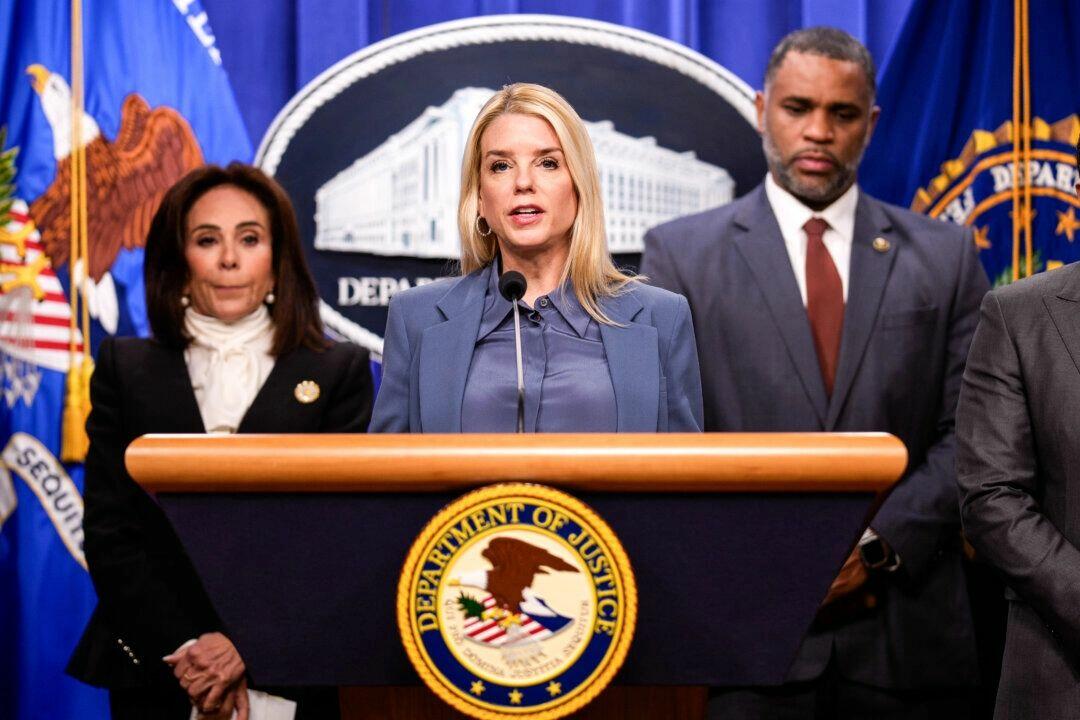
Attorney General Pam Bondi said in a recent interview that she will continue to investigate officials in the Obama and Biden administrations over “government weaponization” after courts tossed federal charges against two high-profile figures.

Attorney General Pam Bondi (C)speaks during a news conference at the Department of Justice in Washington on Dec. 4, 2025. Andrew Harnik/Getty Images

“At my direction, our U.S. Attorneys and federal agents are actively investigating instances of government weaponization nationwide,” Bondi told Just the News in writing in an interview released on Sunday. “This is a ten-year stain on the country committed by high-ranking officials against the American people.”

Bondi then credited President Donald Trump for allowing the Department of Justice (DOJ) to fix what she described as “damage” done to the agency as well as the FBI under previous administrations, saying they used “legal process and operations that were excessive.”

They went so far as to serve search warrants that their own Department and law enforcement officials believed were excessive,” she said.

Her comments appeared to be in reference to evidence showing that some FBI agents did not believe the DOJ had enough evidence to establish probable cause in their search of Trump’s Mar-a-Lago residence in Florida in 2022. Trump was later charged with illegally retaining classified materials before the case was dropped.

Evidence from the DOJ “illustrates that the FBI shielded political figures” under the Biden and Obama administrations “while pursuing conservatives for their beliefs” instead of “protecting Americans from public safety threats,” she told the outlet.

Under Bondi, federal prosecutors have brought cases against former FBI Director James Comey, New York Attorney General Letitia James, and former White House adviser John Bolton. The cases against Comey and James have since been thrown out in court, although the DOJ has sought to revive them.

Democratic critics of the administration have said that the Trump administration is using arguments about the weaponization of the federal government as a means to target Trump’s political enemies.

As an example, House Minority Leader Hakeem Jeffries (D-N.Y.) said in September that the indictment against Comey, which was on charges of making a false statement related to testimony before the Senate Judiciary Committee in 2020, amounted to “malicious prosecution” that has no “basis in law or fact.”

Trump and conservatives have said the DOJ should be more aggressive in prosecuting former officials for various alleged crimes.

Bondi said her “Department of Justice takes government weaponization seriously.”

“That means protecting civil liberties, preventing election interference, and holding bad actors accountable. No one is above the law, even if they think they are,” she said.

Bondi also referred to a letter sent by attorneys of former CIA Director John Brennan, who currently works as an analyst for MSNBC, regarding subpoenas in a grand jury investigation.

“Public reports of a recent letter sent to Cecilia M. Altonaga, the chief judge of the Federal District of Florida, by John Brennan’s defense attorneys, seeking judicial intervention in any legitimate grand jury investigation by the executive branch, shows these bad actors are clearly concerned about their liability and want to preserve a two-tiered justice system: one for them and one for everyone else.

“No more,” she said. 

Tyler Durden
Wed, 12/31/2025 – 09:10

via ZeroHedge News https://ift.tt/oOdVIaG Tyler Durden

Yale Journal on Regulation Symposium on the 20th Anniversary of Kelo v. City of New London

Susette Kelo’s famous “little pink house,” which became a nationally known symbol of the case that bears her name. (Institute for Justice.)


This year saw the twentieth anniversary of Kelo v. City of New London, one of the most controversial property rights decisions in the history of the Supreme Court. Although the Fifth Amendment only permits the taking of private property for “public use,” the Court ruled that the transfer of condemned land to private parties for “economic development” is permitted by the Constitution. Building on earlier decisions such as Berman v. Parker (1954), a closely divided 5-4 majority ruled that virtually any potential benefit to the public qualifies as a “public use.”

The Yale Journal on Regulation sponsored a symposium to mark the occasion, which I organized and co-edited along with legal scholars Eric Claeys (George Mason University) and David Schleicher (Yale). The articles in the symposium are now published and are available online at the journal’s website. Contributors include attorneys on both sides of the Kelo case, and leading takings and property law scholars such as Richard Epstein, Tom Merrill, Maureen Brady, Vicki Been and Yun-Chien Chang, Gerald Dickinson, and more. Eric Claeys and I also contributed articles, in addition to our role as editors.

The other editors and I have written an Introduction for the symposium, which summarizes the significance of Kelo, and provides a brief overview of the symposium articles.

My contribution to the symposium (also available on SSRN), is “Public Use, Exclusionary Zoning, and Democracy.” Here is the abstract:

The twentieth anniversary of Kelo v. City of New London is a good opportunity to consider the broader significance of public use for constitutional theory, and to explore parallels between the “public use” issue at stake in Kelo and another major issue in constitutional property rights under the Takings Clause: exclusionary zoning. This Article takes up that challenge. Part I highlights the strikingly similar history of the two issues. In both cases, there is a strong originalist argument that the policy in question—private-to-private condemnations in one case, exclusionary zoning in the other—violates the property-rights provisions of the Fifth Amendment. But, on both issues, the Supreme Court and federal courts generally have taken a highly deferential approach since the rise of Progressive and New Deal Era skepticism of property rights. Part II outlines reasons why that conventional wisdom is wrong. Judicial deference on both public use and exclusionary zoning has greatly harmed the poor and disadvantaged, particularly racial minorities. Moreover, stronger judicial review can actually further “representation-reinforcement” in two ways: by giving voice to groups excluded from the political process, and by empowering them to “vote with their feet.” Finally, Part III highlights synergies between judicial enforcement of public-use limitations on eminent domain and enforcement of restrictions on exclusionary zoning.

I have also written a second article to mark the 20th anniversary of Kelo. This one was published at the Brennan Center State Court Report,  and focuses on the massive state legislative and judicial reaction to Kelo, and the lessons which can be learned from it.


The post Yale Journal on Regulation Symposium on the 20th Anniversary of Kelo v. City of New London appeared first on Reason.com.

from Latest – Reason.com https://ift.tt/Cm3GQW8
via IFTTT

Cato Institute Looking to Hire an Executive Power Scholar

Cato Institute

The Cato Institute – where I am the Simon Chair in Constitutional Studies (in addition to my primary position at George Mason University) – is looking to hire a full-time executive power scholar. Here is a description of the position:

The Cato Institute seeks a full-time Executive Power Scholar to: 1) conduct original research on the rise, uses, and abuses of executive authority in the United States; and 2) develop reform ideas and proposals in order to reduce presidential and executive branch power back to its proper constitutional limits, in order to restore the separation of powers envisioned by the founders. This position will advance Cato’s mission by producing rigorous scholarship that analyzes constitutional structure, unilateral presidential action, administrative growth, and the separation of powers from a libertarian perspective, emphasizing limited government, individual liberty, and the rule of law.

The projected salary range for this role is $110,000 – $150,000 per year. Compensation is based on the successful candidate’s experience and skills.

More information – including instructions on how to apply – at the link above. Please do not send your applications to me; use the link.

The post Cato Institute Looking to Hire an Executive Power Scholar appeared first on Reason.com.

from Latest – Reason.com https://ift.tt/kDHWMIB
via IFTTT

With Eddington, Hollywood Finally Starts To Reckon With the Madness of 2020


Joaquin Phoenix and Pedro Pascal in "Eddington" | A24

With Trump in office again and a nebulous vibe shift or two fully underway, 2025 sometimes felt more like an aftershock of 2020—a remake or a sequel or some sort of twisted spiritual successor—than its own distinctive year.

Nearly every significant debate in politics and culture, from the woke wars to the streaming wars to the actual wars, can be traced back to that seminal pandemic year, the annus horribilis that tore America, along with much of the rest of the world, apart. 

And no movie better captured the anxieties and agitations of that year than Eddington, Ari Aster’s manic satire of COVID-era madness and the damage it did to our national psyche. I saw dozens of new films in 2025, but this is the one I thought about most, because it’s the first Hollywood film, and maybe the first mass-cultural product that isn’t a podcast or an essay, that really reckoned with what happened in 2020. The pandemic made us paranoid. COVID made us crazy. Tech became even more of an all-purpose mediator for human relationships. And years later, when it was all over, everything was weirder and more insane than ever. 

Eddington dramatizes the way in which COVID caused a kind of mass psychotic break from reality, a cultural cabin fever from which we are all still recovering. It’s the movie of the year, and maybe of this whole cursed decade. 

Part of the movie’s appeal is that it starts with something simple and familiar: a debate about masking that pits haughty rulemakers against ordinary folks. Set in small town New Mexico in the summer of 2020, the film begins as a mild satire of COVID pieties, but quickly raises the stakes. The masking debate somehow merges with debates about crypto, social media, and Black Lives Matter, as a small town election between an incumbent mayor and an anti-masking sheriff takes on increasingly absurd dynamics. Yet the rapid ratcheting up of cultural-political stakes mirrors the real-world escalations of that year, in which politics and the culture war seemed to merge into a giant, ugly blob of undifferentiated anger and polarization, a vortex of political-cultural hysteria that overwhelmed society. There were a lot of specific gripes and complaints, but often it seemed that the real issue was that everyone was mad about everything

The escalation continues in familiar ways until the final third of the film, which devolves into a fever dream of chaos and violence, the culture war as actual war, playing out on the streets of an ordinary American town. It’s a farce, both terrifying and hilarious. And like all good farces, it makes its point through exaggeration.

In its final act, Eddington seems to go off the rails. It becomes bizarre, violent, impossible to reason with or fully understand, a deranged, hallucinatory experience that seems wholly disconnected from on-the-ground reality. What starts as pointed pandemic satire turns into something insane, something that cannot possibly be meant to reflect what’s real. 

That’s the point. The movie’s argument, to the extent that it can be boiled down, is that the pandemic year, and all the social upheaval it wrought, can’t be understood on normal, grounded, realistic terms. What Aster seems to be saying is that 2020 is the year we all went crazy. And the only way to truly look back on that moment is as a kind of collective madness, an era that couldn’t possibly have happened. And yet, somehow, it did. 

The post With <i>Eddington</i>, Hollywood Finally Starts To Reckon With the Madness of 2020 appeared first on Reason.com.

from Latest – Reason.com https://ift.tt/y9cStHx
via IFTTT