Happy New Year, and welcome to the latest edition of the Injustice System newsletter. We have a bit of a conundrum to puzzle over today, so let’s get started.
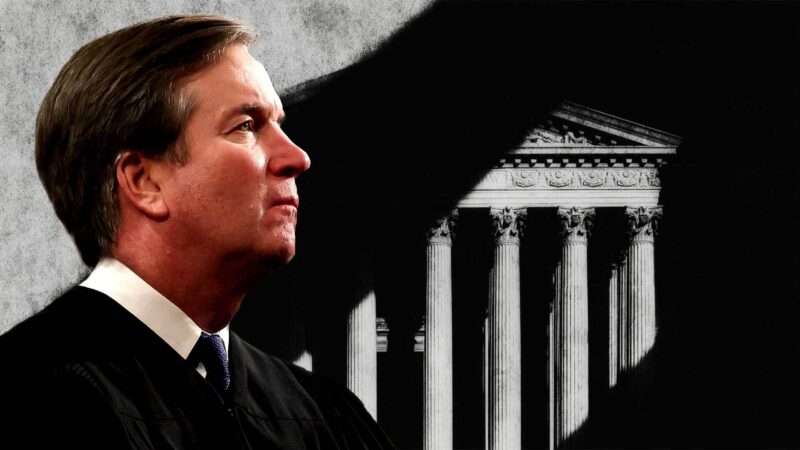
Back in September, the U.S. Supreme Court issued an unsigned emergency order that effectively permitted racial profiling as part of President Donald Trump’s roving immigration crackdowns. Writing in concurrence, Justice Brett Kavanaugh claimed that it was only “common sense” to allow immigration agents to stop people based on such “relevant factors” as their “apparent ethnicity.”
But what about the Fourth Amendment right to be free from unreasonable search and seizure regardless of skin color? What about those U.S. citizens whose “apparent ethnicity” would now land them in the federal dragnet? Was Kavanaugh worried about that?
He did not seem to be worried about that. “As for stops of those individuals who are legally in the country, the questioning in those circumstances is typically brief,” Kavanaugh asserted, “and those individuals may promptly go free after making clear to the immigration officers that they are U.S. citizens or otherwise legally in the United States.”
Now fast-forward to last week. The Supreme Court issued another unsigned emergency order on December 23 in another immigration-related case, except this time Kavanaugh penned a concurrence that approached the issue of rights-violating federal officers quite differently. Here is what Kavanaugh wrote last week:
The State and the Government disagree about whether the immigration officers have violated the Constitution in making certain immigration stops and arrests. The basic constitutional rules governing that dispute are longstanding and clear: The Fourth Amendment requires that immigration stops must be based on reasonable suspicion of illegal presence, stops must be brief, arrests must be based on probable cause, and officers must not employ excessive force. Moreover, the officers must not make interior immigration stops or arrests based on race or ethnicity.
Notice the difference between the two Kavanaugh opinions. In September, Kavanaugh claimed that when a citizen is mistakenly stopped by immigration agents, “the questioning in those circumstances is typically brief” and the citizen “may promptly go free.” In December, however, Kavanaugh stressed that “stops must be brief” and “officers must not make interior immigration stops or arrests based on race or ethnicity.” (Italics added.)
So, after assuring citizens in September that their encounters with immigration agents will be brief and harmless, Kavanaugh is now spelling out for the government what its agents “must” and “must not” do. Put differently, Kavanaugh has stopped reassuring the citizenry that federal agents will obviously obey the Constitution during immigration stops.
It would appear that Kavanaugh has finally come to recognize what has been apparent to some of us all along. Namely, that Trump’s immigration crackdown actively imperils the rights of many U.S. citizens.
Good for Kavanaugh, right? Better late than never? Well, maybe. Because it is also worth noting that Kavanaugh’s December opinion makes no reference to his September opinion. How should we make sense of this mysterious and rather glaring absence or omission?
“It is an old maxim of mine,” the great fictional detective Sherlock Holmes once remarked, “that when you have excluded the impossible, whatever remains, however improbable, must be the truth.”
It seems impossible that these two Kavanaugh opinions are unrelated to each other. So what are we left to conclude about their connection? What is Kavanaugh not saying about the link?
One conceivable conclusion is that Kavanaugh now seeks to walk back his unfortunate past statement without explicitly acknowledging his past misjudgment.
Another conceivable conclusion is that Kavanaugh now hopes to apologize for butchering the Fourth Amendment without doing any actual apologizing. Call it a mea culpa minus the mea.
Needless to say, none of this reflects well on Kavanaugh and his possible motivations. Perhaps we’ll get a more forthright account from him in a future case.
In the February/March 2026 issue of Reason, we explore Mayor-elect Zohran Mamdani’s policy goals and what they mean for New York City. Click here to read the other entries.
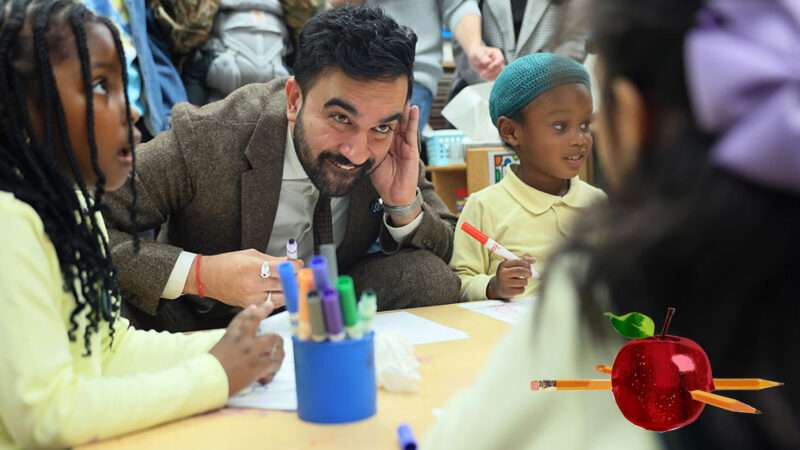
New York Mayor-elect Zohran Mamdani is inheriting a public school system that has made some progress in student learning but is completely dysfunctional in terms of financial stability and operations. And his campaign promises are likely to worsen the system’s flaws.
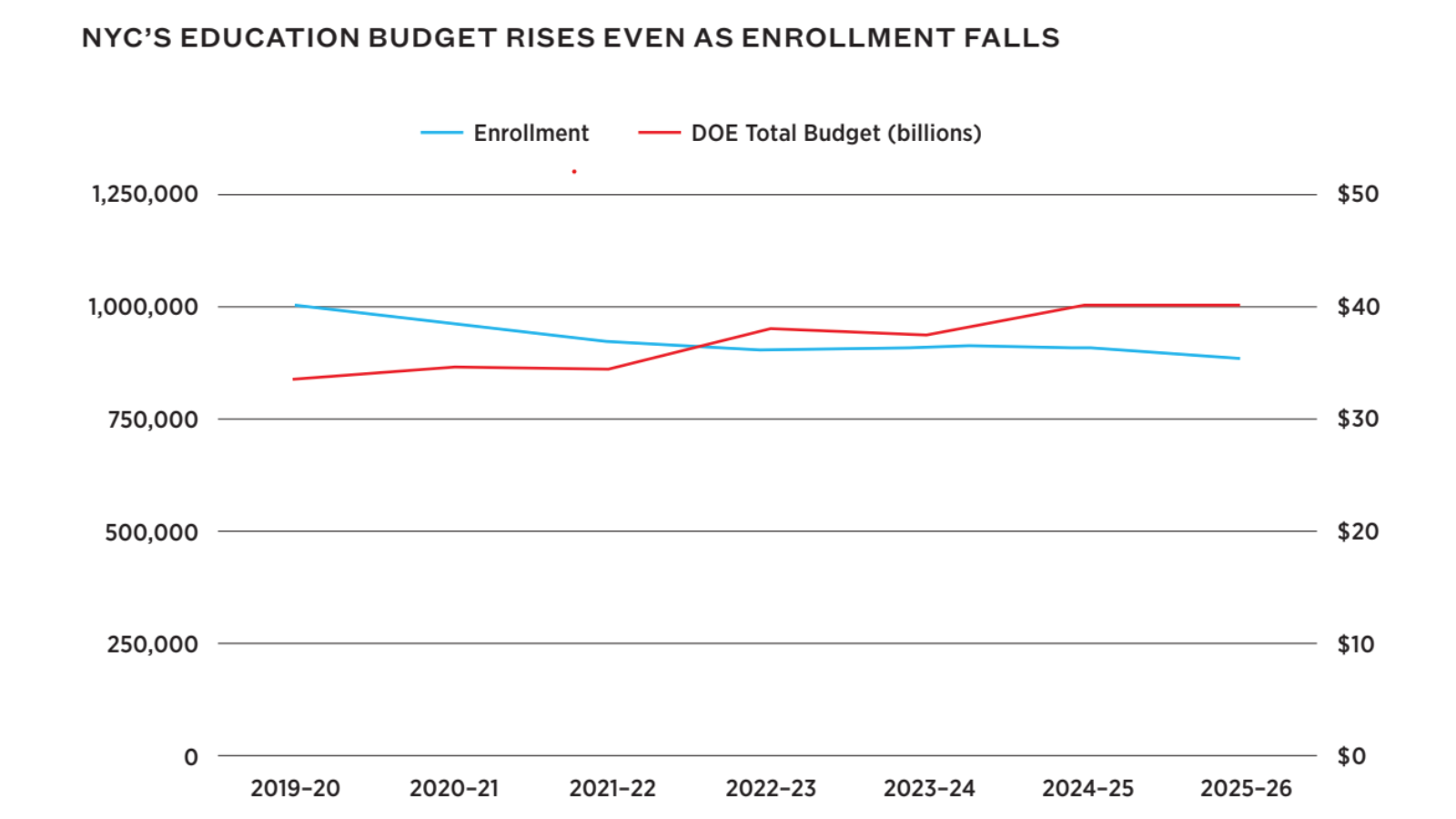
New York City’s public schools once educated more than a million students, but the system’s enrollment has been steadily declining. Since 2020, it has lost 10 percent of its K-12 students. Even with the expansion of pre-K and 3-K programs for young children, the schools are serving 115,000 fewer students than they did seven years ago.
Yet the budget for the city Department of Education (NYC DOE) has greatly increased, rising from $33 billion in 2019 to over $40 billion this year. This disconnect between enrollment and budget has led to the highest per-pupil spending in the nation, which the Citizens Budget Commission estimates will reach $42,000 this year.
New York City Department of Education
The shrinking number of students seems set to continue. Pre-kindergarten applications decreased by 8 percent this school year. In 2020, the New York school system had 59,143 kindergarteners; last year, that number was 55,461.
Because of this loss of students, the number of schools that are too small to remain financially viable has increased. In the 2023–24 school year, there were 80 schools with fewer than 150 students; that number has risen to 112 this year. Mayor Eric Adams closed or merged 16 schools, but he also opened or planned to open 28 new ones. Closing schools is unpopular and requires political will, and Adams showed no appetite for that.
Unfortunately for Mamdani, the schools’ fiscal situation is about to worsen. The class size law passed in Albany in 2022, which Mamdani voted for as a State Assembly member, mandates that New York City schools limit classes to no more than 20 students in kindergarten through third grade, 23 students for grades four through eight, and 25 students for high school classes. To comply with this law, the city will likely need an additional 7,000 to 9,000 teachers. The Independent Budget Office estimates that will cost an additional $1.6 billion to $1.9 billion annually. Mamdani, who was endorsed by the teachers union, has pledged to comply with this mandate regardless of cost.
NYC Reads—But Not As Well as It Should
Adams’ administration did get some good results revamping the city’s early literacy program. In 2023, David Banks, then chancellor of the NYC DOE, launched NYC Reads, a program to ensure that all schools adopt curricula and practices that follow the science of reading. It includes phonics instruction and content-rich lessons to build vocabulary and background knowledge.
Across the nation, states and districts have been rapidly changing how they teach students to read, and some (mostly in the South) are achieving significant success in improving literacy rates. This movement is focused on moving away from curricula that taught children to merely “guess” words based on pictures and other cues. The NYC DOE had been the largest client for Heinemann Publishing, spending over $20 million in the past decade purchasing faulty curricula authored by Lucy Calkins, Irene Fountas, and Gay Su Pinnell; these authors all encouraged such guesswork, without any phonics instruction to teach kids to decode. But since NYC Reads began, the city’s public schools can select one of three curricula that include both phonics instruction and content-rich lessons.
The city has seen gains in English language arts test scores in the past year, increasing the proficiency level on all grade levels by 7.2 percent. Still, more than 40 percent of students in grades three through eight cannot read at grade level. It will take years of concerted effort to change these numbers. And the NYC Reads program is hardly perfect. Twenty-two out of the 32 school districts chose “Into Reading,” a curriculum the education writer Natalie Wexler has faulted for low-quality reading selections and for curricula that are too “scripted.” The Reading League is a respected national organization that reviews curriculum and provides advice and professional training to school districts on reading. Their review of “Into Reading” includes a number of red flags in areas such as practice for spelling, writing assignments, word recognition, and handwriting instruction.
Even the best curriculum won’t work if students don’t take the lessons. Currently, 34.8 percent of New York City students are missing more than 10 percent of school days, including more than 40 percent of kindergartners.
A rational mayor would conclude the system needs to reduce expenses, keep implementing NYC Reads, and tackle chronic absenteeism. Unfortunately, Mamdani’s proposals are likely to have the opposite effect.
Mamdani’s War on Mayoral Control and Gifted and Talented Programs
During the campaign Mamdani spoke little about his plans for the NYC DOE, even though it comprises 40 percent of the city’s budget. His campaign website had only 168 words on education. His main education focus has been on eliminating mayoral control, ending gifted and talented programs, supporting the smaller class size law, and criticizing charter schools.
In 2002, Mayor Michael Bloomberg was granted control of NYC public schools, which previously had been managed via 32 different elected school boards and the NYC DOE. Bloomberg described the previous system as “a rinky-dink candy store” and battled with corruption and patronage. The local boards were so corrupt that the state government passed legislation in 1996 to transfer their power to the schools chancellor. Moreover, it was impossible with the old system to implement any citywide initiative such as NYC Reads since it would require persuading and coordinating 32 different local school boards.
Mayoral control seemed to be doing more than fine. NYC was awarded the Broad Prize for Urban Education for raising education outcomes, especially for minority students, five years after it was implemented. Mayoral control allowed Bloomberg to introduce a number of systemwide initiatives which led to rising graduation rates and student scores across the board. For example, his administration closed a number of low-performing high schools and created new schools—graduation rates increased from 54 percent in 2004 to 80 percent in 2018. But in 2024, the New York State Board of Regents described its results as “mixed,” citing equity concerns and pointing out that parents and community leaders have limited opportunities for input into major education decisions.
Mamdani is actively against mayoral control. His main criticism is that the current system does not allow parents and local communities to have input in school decisions and encourages “a culture of secrecy and patronage at the top.” But the old system had no clear entity or person accountable for academic outcomes, chronic absenteeism, or citywide initiatives such as class size implementation.
The problems with New York schools are serious and demand a serious mayoral response. An NYC DOE survey of families who left public schools shows that the primary reason for their departure is a desire for “more rigorous education than what is possible at NYC public schools.” The most rigorous schools in NYC are the Gifted & Talented (G&T) and Specialized High Schools Admissions Test (SHSAT) schools, yet Mamdani is proposing to eliminate these programs at the kindergarten level.
The city has 86 schools classified as G&T, offering kindergarten seats. Every year 10,000 families apply to these programs, but only 2,500 kindergarteners seats are available at a G&T school or in a different class for gifted students within a school that has a general education program. There is a wide variety in the quality and number of applications to these programs: Some G&T programs are in low-performing schools and are unable to fill all their seats.
Of the 86 schools that house a G&T program, six only offer G&T classes; they are considered the most prestigious. These six schools have only 375 kindergarten seats available, yet receive an average of almost 10 applications per seat. Over 28 percent of the students at these six schools are classified as economically disadvantaged.
While the average school in the system has $22,857 allocated per student (in addition to $12,877 in average central services spending per pupil), these G&T schools receive a far lower $13,444 to $16,808 per student. Thus, they cost on average significantly less than other schools, are highly sought after, and deliver an excellent education to a student body that is almost one-third low-income students.
School
# of kindergarten seats SY 25–26
# of applications for kindergarten SY 25–26
Funds allocated per student SY 24–25 (citywide average is $22,857)
NEST+m
100
942
$14,141
The Anderson School
50
1001
$13,705
TAG (Talented and Gifted School for Young Scholars)
At the high school level, eight schools admit students solely based on their scores from the SHSAT, and 55 percent of their student bodies are low-income. Like the G&T schools, these schools are very efficient: Most SHSAT schools receive approximately 40 percent less than the citywide average per student. These schools consistently rank among the best public high schools in the state.
In October, a Mamdani campaign spokesperson said he plans to eliminate G&T programs in kindergarten, arguing that “identifying academic giftedness at age 4 is difficult to do objectively through any assessment, whether it be tests or teacher nominations.”
Mamdani is hostile to any program that seems to offend his sense of total equality in educational access, no matter how much it improves outcomes for the students in them; in May, Mamdani described SHSAT schools as “one example of systemic issues across our school system—the most segregated in the nation” and expressed support for the 2019 School Diversity Advisory Group report which recommended phasing out all G&T programs and eliminating all objective admission criteria for middle schools and high schools in favor of efforts to make schools more integrated by race and income.
There is some hope that Mamdani’s animus against anything he sees as inequality in education won’t hobble the SHSAT program. In October, his spokesperson said that “Zohran has said on multiple occasions he will keep the SHSAT.” But if Mamdani forces the SHSAT schools to comply with the class size law, these schools would lose effectiveness, because they would have to reduce the number of seats and fewer students would be accepted every year. (A proposed law in the state Senate would create exemptions for G&T and SHSAT from the class size laws.)
In his obsession with educational equality of access, Mamdani has also criticized charter schools. He is opposed to charter schools sharing buildings with regular public schools, and he intends to audit charter school finances. The colocation of charters has created tensions between schools with very different cultures; at the same time, the city’s charter school expansion would not have been possible without this practice, due to the high price of real estate.
Charter schools currently educate more than 150,000 students in New York City; 82.9 percent of them are low-income, and 19.3 have special needs. A 2023 Stanford University Center for Research on Education Outcomes study found that the city’s charter schools are performing well compared both to other cities and to the city’s public district schools. According to that study, students in the city’s charter schools learn the equivalent of an extra 80 days of math instruction compared to those in district schools.
Mamdani’s Anti-Choice Education Agenda
Mamdani’s education plans are contrary to what NYC families want: more school options and more rigorous education. The 10 best elementary public schools in New York, as ranked by U.S. News & World Report, are either G&T or charter schools, which Mamdani is hostile to. He wants to eliminate or stifle the very schools that NYC families actively wish to enroll their children in. While half of the country is moving toward empowering families to choose the best education for their children, allowing public funding to follow those choices, Mamdani wants New York City to move in the opposite direction. His proposals could reduce or eliminate the only public schools that are popular with New York parents and that consistently achieve excellent academic results.
If the city wants to retain students and stabilize enrollment numbers, losing the most desired programs is a terrible choice. Parents have more choices than ever today. It has never been easier to homeschool, with access to learning pods, micro-schools, and online options available across the city. The number of homeschoolers in New York City has grown from 9,000 in 2020 to more than 15,000 in 2024—an increase of more than 68 percent.
The public schools should follow parents’ lead. Close the schools that are underenrolled and that families are not applying for. Expand the schools and programs that are popular and have many applicants. The best public schools happen to also be the most efficient, which would help to lower the per-pupil cost and control the NYC DOE budget. A mayor who keeps this focus and can show results would have a strong track record to run for reelection in four years. But Mamdani’s emphasis on equality over excellence in education will have him bungling one of the mayor’s most important responsibilities.
Betty Boop is one of the most iconic cartoons of the 20th century. A pinup drawn to look like a 1920s flapper, the character debuted nearly a century ago and quickly became a household name: In 1932, just two years after her debut, one newspaper article dubbed Betty Boop “without question…the most popular film personage on the screen today.”
Today, the character enters the public domain, meaning it’s free for anyone to use—but perhaps only as a dog. The bizarre saga illustrates what’s wrong with modern copyright law.
Under the 1998 Sonny Bono Copyright Term Extension Act, creative works are copyrighted until 70 years after the author’s death, and works published between 1924 and 1978 are protected for 95 years. Therefore, anything originally published in 1930 enters the public domain today.
That includes Dizzy Dishes, the six-minute cartoon that featured the first appearance of Betty Boop. The cartoon and the character are now fair game, but the version of the character introduced in Dizzy Dishes was different from the one we know today.
Betty “was dog-like; a singing, dancing hybrid being with huge, droopy Cocker Spaniel-like eyes, a button of a nose and long puppy dog ears that tossed back and forth as she sang and danced,” according to Fleischer Studios, the animation company that created the character. Her appearance changed over time, and she was not fully human until January 1932.
Because of this, the company says it actually still owns the character. In a statement, Fleischer Studios CEO Mark Fleischer said Dizzy Dishes merely featured a “precursor” of Betty Boop, not “the distinctively different and independently protectible expression of the character in use by Fleischer Studios today.”
“While the copyright in the ‘Dizzy Dishes’ cartoon may fall into the public domain in 2026, this does not affect Fleischer Studios’ copyright in the fully developed BETTY BOOP character…[which] will therefore remain in force for some years to come,” Fleischer added.
The estate of Arthur Conan Doyle made a similar argument for over two decades: The majority of Doyle’s works featuring the character of Sherlock Holmes entered the public domain in 1998, but his estate argued the character remained protected until all works were free. Federal courts split the difference, finding the character was in the public domain but specific traits introduced in the later stories were still protected.
As a result, Fleischer Studios likely can’t say it still owns Betty Boop completely, but it can plausibly claim the version with dog ears is the only one now in the public domain, and each subsequent version will only become available when it turns 95 years old.
Of course, when one person or company can hold the exclusive rights to a character for a century or more, what’s another couple of years?
Copyrights lasting multiple generations undermine their entire purpose. Article I, Section 8 of the U.S. Constitution grants Congress the power to set copyright terms “to promote the Progress of Science and useful Arts.” The first U.S. copyright law, passed in 1790, allowed authors to protect their works for up to 28 years.
Congress expanded the length of those terms numerous times since. But it’s hard to argue that such generous protections “promote the Progress of Science and useful Arts.” When Betty Boop debuted in 1930, the longest copyright term was 56 years; her creators clearly found that acceptable, or they wouldn’t have released the cartoon.
It’s difficult to see how protecting a character for 95 years encourages innovation while protecting a nearly identical version for only 93 years does not.
Unlike century-long copyright protections, the public domain actually drives progress and innovation. In 2025, Guillermo del Toro released a well-reviewed adaptation of Mary Shelley’s Frankenstein, and one of the year’s highest-grossing films, Wicked: For Good, was adapted from L. Frank Baum’s The Wizard of Oz series. This year will see new adaptations of King Lear, The Odyssey, and Wuthering Heights. Each one is based on a previous work in the public domain, allowing filmmakers free rein to adapt and interpret.
Russia’s Secretive Hypersonic, Nuclear-Ready Oreshnik Missiles Go Operational In Belarus
Belarus has announced that Russia’s Oreshnik intermediate-range nuclear capable ballistic missile system has been deployed on its territory, though details and specifications – including range – of the projectile remain secretive.
On Tuesday, the Belarusian Ministry of Defense released a video it claims shows the Oreshnik system being deployed inside the country. It featured Russian troops and technicians in a ceremonial flag-raising while stationed in Belarus, along with a convoy of vehicles moving into a field-based firing position before being concealed under camouflage netting.
Accompanying this was the recent emergence of satellite images indicating that Moscow is indeed positioning the nuclear-capable missiles in Belarus.
But questions have been raised as to the precise location of the missile systems, given that the undated published video features only support vehicles and doesn’t appear to including the launch apparatus itself.
Still, the video includes a senior officer informing troops that the systems have officially entered combat duty and references prior routine training and reconnaissance exercises carried out by missile crews.
Russian state media has referenced a precise date for the missile transfer to Belarusian territory, however:
Russian officials have likened its conventional destructive power to that of a low-yield nuclear strike, highlighting its dual strategic and tactical potential. By comparison, Western militaries currently lack a directly equivalent hypersonic MIRV-capable system, giving Oreshnik a unique edge in speed, maneuverability, and multi-target strike capability.
Up to ten systems are slated for deployment in Belarus under an agreement reached between Minsk and Moscow shortly after the missile’s initial combat test.
Belarusian President Alexander Lukashenko announced in a parliamentary address this month that the Oreshnik systems had arrived in Belarus on December 17. Deputy Defense Minister Pavel Muraveyko said last week the combat patrol areas are set and the system is fully operational and ready for use.
Already Belarus plays host to Russian tactical nuclear weapons – though details of this too remain shrouded in mystery and intentioned strategic ambiguity.
EuroNews: “Analysts identified a former airfield near the Russian border as a likely site.”
Russia shows nuclear-capable Oreshnik missile system in Belarus
Russia’s Defence Ministry released the first images of an intermediate-range weapon entering service. Analysts identified a former airfield near the Russian border as a likely site. pic.twitter.com/vkEv6eGP5r
2025 has been a big year for Moscow showcasing its military might and tech. As we reviewed earlier, in a matter of less than a year, Russian scientific know-how came up with four bangers:
1. Oreshnik: hypersonic missile, already tested in the Ukraine battleground.
2. Burevestnik: Or “Stormbringer”, with that nice Deep Purple ring. Nuclear cruise missile with unlimited range.
3. Poseidon: nuclear-powered torpedo, capable of loitering underwater, undetected, for unlimited time; then, at a command, strikes enemy coasts with a nuclear payload, provoking a radioactive tsunami. Largely exceeds the destructive power of the Sarmat, Russia’s largest ICBM.
4. Khabarovsk: nuclear sub. Call him The Messenger of Doom: capable of delivering at least 6 Doomsday-enabling Poseidons.
As for the Oreshnik, it was at a December 2024 meeting with Belarusian President Lukashenko that Putin had first unveiled plans to station Oreshnik missiles in Belarus. He indicated at the time that the deployment would occur in the second half of 2025. There are prior reports saying the hypersonic Oreshnik has already been used against Ukrainian targets to demonstrate Moscow’s ‘shock and awe’ capabilities.
Contrary to what far-right leaders claim, Europe’s greatest challenge is not immigration or “wokeness,” but its own economic and technological backwardness. With productivity growth lagging and innovation increasingly taking place elsewhere, Europe must confront its structural weaknesses or risk falling further behind.
US President Donald Trump’s new National Security Strategy offers a misguided assessment of Europe, long regarded as America’s most reliable ally. Unrestrained immigration and other policies derided by administration officials as “woke,” it warns, could lead to “civilizational erasure” within a few decades.
That argument rests on a fundamental misreading of Europe’s current predicament. While the European Union does face an existential threat, it has little to do with immigration or cultural politics. In fact, the share of foreign-born residents in the United States is slightly higher than in Europe.
The real threat facing Europe lies in its own economic and technological backwardness. Between 2008 and 2023, GDP rose by 87% in the US, compared to just 13.5% in the EU. Over the same period, the EU’s GDP per capita fell from 76.5% of the US level to 50%. Even the poorest US state – Mississippi – has a higher per capita income than that of several major European economies, including France, Italy, and the EU average.
This widening economic gap cannot be explained by demographics. Instead, it reflects stronger productivity growth in the US, largely owing to technological innovation and higher total factor productivity. Today, roughly half of the world’s 50 largest technology firms are American, while only four are European. Over the past five decades, 241 US firms have grown from startups into companies with market capitalizations of at least $10 billion, compared with just 14 in Europe.
These trends raise a critical question: Which countries will lead the industries of the future, and where does Europe fit in? The race for technological leadership now spans a wide range of fields, including AI and machine learning, semiconductor design and production, robotics, quantum computing, fusion energy, fintech, and defense technologies. Europe enters this race at a clear disadvantage.
Whether the US or China currently leads the industries of the future remains open to debate, but most observers agree that it’s essentially a two-horse race, with America still ahead in several key areas. Beyond that, innovation is concentrated in countries like Japan, Taiwan, South Korea, India, and Israel. In Europe, by contrast, innovative activities are largely confined to the United Kingdom, Germany, France, and Switzerland – two of which are not even EU member states.
It is hardly a surprise, then, that while the US and China dominate global technological rankings, Europe finds itself far from the top. And the outlook is anything but reassuring, given that the next wave of innovation is widely expected to be more disruptive than anything we have seen over the past half-century.
The technological gap between the US and Europe can be attributed to several factors.
First, the US has a far deeper and more dynamic ecosystem for financing startups, while Europe still lacks a genuine capital markets union, limiting the scale and speed at which new firms can grow.
Second, Europe is hampered by excessive and fragmented regulation. A US startup can launch a product under a single regulatory framework and immediately access a market of more than 330 million consumers. The EU has a population of roughly 450 million but remains divided among 27 national regulatory regimes. An International Monetary Fund analysis shows that internal market barriers in the EU act like a tariff of around 44% for goods and 110% for services – far higher than the tariff levels the US imposes on most imports.
Third, cultural attitudes toward risk-taking differ sharply. Until relatively recently, a failed entrepreneur in some EU countries (like Italy) could face criminal penalties, while in the US, a tech founder who has never failed is often seen as too risk-averse.
Fourth, the US benefits from a deeply integrated academic-military-industrial complex, while Europe’s chronic underinvestment in defense has weakened its innovation capacity. Technological leaders like the US, China, Israel, and, more recently, Ukraine spend heavily on defense, with military research often producing technologies that have civilian applications.
Despite this, many European political leaders continue to frame higher defense spending as a tradeoff between security and social welfare. In reality, free-riding on US defense spending since the end of World War II has limited the type of innovation that could have generated more of both through higher productivity. Paradoxically, sustaining Europe’s social model will require greater investment in defense, beginning with meeting NATO’s new spending target of 3.5% of GDP.
If Europe allows its technological lag to grow over the coming decades, it risks prolonged stagnation and continued economic decline relative to the US and China. There are, however, reasons for cautious optimism. Increasingly aware that Europe faces an existential challenge, policymakers have begun to advance serious reform proposals. The most notable examples are the two major 2024 reports on EU competitiveness and the single market by former Italian prime ministers Mario Draghi and Enrico Letta, respectively.
Europe also retains considerable strengths, including high-quality human capital, excellent education systems, and world-class research institutions. With the right incentives and regulatory reforms, these assets could support much higher levels of commercial innovation. With a better environment for entrepreneurship, Europe’s high per capita income, large internal market, and elevated savings rates could help unleash a wave of investment.
Crucially, even if Europe never leads in cutting-edge technologies, it could still significantly boost productivity by adopting and adapting American and Chinese innovations. Many of these technologies are general-purpose in character, benefiting both adopters and pioneers.
All of this leaves Europe at an inflection point.
As Ernest Hemingway famously observed, bankruptcy happens “gradually and then suddenly.”
So far, Europe’s technological decline has been gradual. But if it fails to confront its structural weaknesses, today’s slow erosion could give way to a sudden and irreversible loss of economic relevance.
The Minnesota fraud story has become one of the biggest trending topics in quite a while. Nick Shirley, the independent conservative YouTuber who published a 42-minute documentary on the subject, has racked up 2.5 million views in just five days. Commentary on the various aspects of this scandal, from Democratic Gov. Tim Walz’s culpability to Somali immigration and where the money went, has gone insanely viral on social media and YouTube, and cable news is now covering the subject relentlessly.
Shirley has received unending acclaim from conservative commentators—Vice President J.D. Vance implied his work was worthy of a Pulitzer Prize—and a neutral-to-hostile reception from the mainstream media. Outlets like CNN are working to poke holes in some of his specific claims, while acknowledging there is plenty of evidence of fraud throughout the state’s welfare system.
I watched Shirley’s video, and I admit that it left me feeling conflicted. I’m perfectly comfortable with the fact that he’s not a professional or credentialed journalist; journalism is not a priesthood, and anyone who seeks to report the truth can engage in the craft. Great works of investigative journalism have been achieved by amateurs. Consider Guan Heng, the former Chinese citizen who took it upon himself to document the communist government’s atrocities in Uyghur detention camps. In visiting state-funded child care facilities to see if they’re actually enrolling children, Shirley was doing something perfectly valid. Moreover, we all know there is a considerable amount of fraud in state services: Prosecutors have charged nearly 100 people, most of them members of the Somali diaspora, in connection with fake charity schemes, Medicare payments, and child care.
Critics have countered that Shirley’s methods lack rigor and have questioned whether he visited the daycares during their actual hours of operation. His video draws attention to the fact that the front doors of the daycares were locked and no one would let him in, but in an era of mass social panic over school shootings (which are thankfully rarer than most people understand), there is no daycare in the country that would permit a stranger to simply walk right in. Some local reporters have suggested that the reason Shirley didn’t see any kids is because the centers in question had already closed down.
On the other hand, it would be a serious mistake to dismiss what Shirley found, and there’s some genuine confusion over the state of the daycares. Tikki Brown, commissioner of the Minnesota Department of Children, Youth, and Families, explained that numerous childcare facilities had been investigated for serious safety issues, though they continued to receive public funding. One daycare that is featured significantly in Shirley’s video, the Quality Learning Center, was permanently closed the week before he visited it, yet local television reporters spotted children still being dropped off at the center. Moreover, the fact that the name of the center is misspelled on the sign hanging above the door does not inspire great confidence. (Anyone want to enroll their child at the Quality Learing Center?)
This school, in particular, seemed beset with problems. One local report contended that the Quality Learning Center had accrued 95 violations over the course of five years for offenses such as failing to keep hazardous materials away from children and improperly keeping records on who was enrolled. Yet the center continued to receive millions in state funding during that time period.
What’s notable about that local news item, however, is that it was published almost a year ago, on January 28, 2025. As Reason‘s Eric Boehm pointed out in his excellent explainer on the welfare fraud story, conservative complaints that no one in the media paid any attention to the story until now are demonstrably false: Local media has been covering Minnesota child care fraud as far back as 2015.
It is true that the story did not become a topic of national news until conservative writer Christopher Rufo began focusing on it. Since then, however, some large media organizations have done commendable work on the story. The New York Times, for instance, published a devastating report on the fraud that laid the blame very squarely on Walz.
Even so, the welfare fraud story has not exactly attracted wall-to-wall coverage from mainstream media, even though it is obvious that these kinds of schemes are hardly isolated to Minnesota or to the Somali community: Taxpayer dollars are misappropriated, lost, or stolen in blue states and in red states alike. Moreover, Walz’s selection as Vice President Kamala Harris’s running mate in the 2024 presidential election was a perfect opportunity for the national media to follow up on the local fraud reports and make this a big story. For whatever reason, they chose not to.
Conservative media is big and powerful too, though. It’s always a bit rich when we hear Republican commentators complaining that the mainstream media has failed to investigate one news story or another, when conservative and independent media journalists are perfectly capable of looking into this as well. To be sure, there are powerful examples of nonmainstream reporters doing incredible work on a wide variety of underscrutinized topics: Gabe Kaminsky, Matt Taibbi, Ken Klippenstein, and others. Sometimes, their work goes unremarked upon by mainstream media, even when it deserves coverage—and then, when it is covered, the mainstream adopts the “Republicans pounce and or/seize” framing.
If mainstream, establishment national media treated the widespread looting of the public coffers as an urgent crisis that deserved at least as much scrutiny as, say, President Donald Trump’s renovation of the East Wing, this would constitute a profound public service. American taxpayers and news consumers deserve a media class that is highly attuned to government corruption at the federal, state, and local levels.
A Walz Around the Welfare State
For what it’s worth, Walz is doing an absolutely terrible job of reassuring the public that he actually cares about identifying and prosecuting fraud. It’s all well and good to push back against attempts to blame the entire Somali community for perpetrating the fraud, but Walz has a weird habit of shifting accountability by highlighting the criminality of “white men.” If you assert that we should ignore crude racial collectivization and then immediately claim that actually white people are the real problem, you are not helping yourself.
Grounded
But the worst take of the week relating to this story comes from Politico‘s Josh Gerstein, who wrote on X: “At some point, the amateur effort to knock on doors of home daycares intersects with robust stand-your-ground laws.”
At some point, the amateur effort to knock on doors of home daycares intersects with robust stand-your-ground laws
These two things don’t intersect at all. Stand-your-ground laws establish the right of individuals not to retreat from dangerous situations and instead defend themselves, as long as they have the legal right to be there in the first place. You can’t shoot someone just because they knocked on your door; that’s because knocking on someone’s door isn’t placing them in danger.
And a special shoutout to leftist streamer Hasan Piker—who recently returned from a Jane Fonda-style propaganda tour of China—who opined that it was a crime to barge into a daycare with a camera.
idk what kind of fraud somalis in daycares are doing but i think it’s a separate crime to try and storm w a camera into a daycare w kids in it??
Piker apparently didn’t watch the video, either. Shirley knocked on the door: He did not break into the premises of the Quality Learning Center, or any other center.
This Week on Free Media
No Niall Stanage this week, but I am joined by Amber Duke to break down the welfare fraud story, Trump alienating Joe Rogan, and our top entertainment choices of the year. Please subscribe to the Free Media YouTube channel—we’ve got big plans in 2026!
Worth Watching
We spent Christmas in Detroit with my dad, which means rewatching all my family’s favorite Christmas movies: Jim Carey’s How the Grinch Stole Christmas (which I find delightfully weird despite its mixed reception), the Alastair Sim version of A Christmas Carol (a real gem), and It’s a Wonderful Life. That last one has never been my favorite, but apparently Christian Britschgi has thoughts and we plan to address it on FREED UP this week. (Are you watching FREED UP? You should be!)
We also watched the first of the new Dune movies, which my dad likes less than the 1984 version. Talk about a spice-y take! (Get it?)
Happy New Year, and welcome to the latest edition of the Injustice System newsletter. We have a bit of a conundrum to puzzle over today, so let’s get started.
Back in September, the U.S. Supreme Court issued an unsigned emergency order that effectively permitted racial profiling as part of President Donald Trump’s roving immigration crackdowns. Writing in concurrence, Justice Brett Kavanaugh claimed that it was only “common sense” to allow immigration agents to stop people based on such “relevant factors” as their “apparent ethnicity.”
But what about the Fourth Amendment right to be free from unreasonable search and seizure regardless of skin color? What about those U.S. citizens whose “apparent ethnicity” would now land them in the federal dragnet? Was Kavanaugh worried about that?
He did not seem to be worried about that. “As for stops of those individuals who are legally in the country, the questioning in those circumstances is typically brief,” Kavanaugh asserted, “and those individuals may promptly go free after making clear to the immigration officers that they are U.S. citizens or otherwise legally in the United States.”
Now fast-forward to last week. The Supreme Court issued another unsigned emergency order on December 23 in another immigration-related case, except this time Kavanaugh penned a concurrence that approached the issue of rights-violating federal officers quite differently. Here is what Kavanaugh wrote last week:
The State and the Government disagree about whether the immigration officers have violated the Constitution in making certain immigration stops and arrests. The basic constitutional rules governing that dispute are longstanding and clear: The Fourth Amendment requires that immigration stops must be based on reasonable suspicion of illegal presence, stops must be brief, arrests must be based on probable cause, and officers must not employ excessive force. Moreover, the officers must not make interior immigration stops or arrests based on race or ethnicity.
Notice the difference between the two Kavanaugh opinions. In September, Kavanaugh claimed that when a citizen is mistakenly stopped by immigration agents, “the questioning in those circumstances is typically brief” and the citizen “may promptly go free.” In December, however, Kavanaugh stressed that “stops must be brief” and “officers must not make interior immigration stops or arrests based on race or ethnicity.” (Italics added.)
So, after assuring citizens in September that their encounters with immigration agents will be brief and harmless, Kavanaugh is now spelling out for the government what its agents “must” and “must not” do. Put differently, Kavanaugh has stopped reassuring the citizenry that federal agents will obviously obey the Constitution during immigration stops.
It would appear that Kavanaugh has finally come to recognize what has been apparent to some of us all along. Namely, that Trump’s immigration crackdown actively imperils the rights of many U.S. citizens.
Good for Kavanaugh, right? Better late than never? Well, maybe. Because it is also worth noting that Kavanaugh’s December opinion makes no reference to his September opinion. How should we make sense of this mysterious and rather glaring absence or omission?
“It is an old maxim of mine,” the great fictional detective Sherlock Holmes once remarked, “that when you have excluded the impossible, whatever remains, however improbable, must be the truth.”
It seems impossible that these two Kavanaugh opinions are unrelated to each other. So what are we left to conclude about their connection? What is Kavanaugh not saying about the link?
One conceivable conclusion is that Kavanaugh now seeks to walk back his unfortunate past statement without explicitly acknowledging his past misjudgment.
Another conceivable conclusion is that Kavanaugh now hopes to apologize for butchering the Fourth Amendment without doing any actual apologizing. Call it a mea culpa minus the mea.
Needless to say, none of this reflects well on Kavanaugh and his possible motivations. Perhaps we’ll get a more forthright account from him in a future case.
In the February/March 2026 issue of Reason, we explore Mayor-elect Zohran Mamdani’s policy goals and what they mean for New York City. Click here to read the other entries.
New York Mayor-elect Zohran Mamdani is inheriting a public school system that has made some progress in student learning but is completely dysfunctional in terms of financial stability and operations. And his campaign promises are likely to worsen the system’s flaws.
New York City’s public schools once educated more than a million students, but the system’s enrollment has been steadily declining. Since 2020, it has lost 10 percent of its K-12 students. Even with the expansion of pre-K and 3-K programs for young children, the schools are serving 115,000 fewer students than they did seven years ago.
Yet the budget for the city Department of Education (NYC DOE) has greatly increased, rising from $33 billion in 2019 to over $40 billion this year. This disconnect between enrollment and budget has led to the highest per-pupil spending in the nation, which the Citizens Budget Commission estimates will reach $42,000 this year.
New York City Department of Education
The shrinking number of students seems set to continue. Pre-kindergarten applications decreased by 8 percent this school year. In 2020, the New York school system had 59,143 kindergarteners; last year, that number was 55,461.
Because of this loss of students, the number of schools that are too small to remain financially viable has increased. In the 2023–24 school year, there were 80 schools with fewer than 150 students; that number has risen to 112 this year. Mayor Eric Adams closed or merged 16 schools, but he also opened or planned to open 28 new ones. Closing schools is unpopular and requires political will, and Adams showed no appetite for that.
Unfortunately for Mamdani, the schools’ fiscal situation is about to worsen. The class size law passed in Albany in 2022, which Mamdani voted for as a State Assembly member, mandates that New York City schools limit classes to no more than 20 students in kindergarten through third grade, 23 students for grades four through eight, and 25 students for high school classes. To comply with this law, the city will likely need an additional 7,000 to 9,000 teachers. The Independent Budget Office estimates that will cost an additional $1.6 billion to $1.9 billion annually. Mamdani, who was endorsed by the teachers union, has pledged to comply with this mandate regardless of cost.
NYC Reads—But Not As Well as It Should
Adams’ administration did get some good results revamping the city’s early literacy program. In 2023, David Banks, then chancellor of the NYC DOE, launched NYC Reads, a program to ensure that all schools adopt curricula and practices that follow the science of reading. It includes phonics instruction and content-rich lessons to build vocabulary and background knowledge.
Across the nation, states and districts have been rapidly changing how they teach students to read, and some (mostly in the South) are achieving significant success in improving literacy rates. This movement is focused on moving away from curricula that taught children to merely “guess” words based on pictures and other cues. The NYC DOE had been the largest client for Heinemann Publishing, spending over $20 million in the past decade purchasing faulty curricula authored by Lucy Calkins, Irene Fountas, and Gay Su Pinnell; these authors all encouraged such guesswork, without any phonics instruction to teach kids to decode. But since NYC Reads began, the city’s public schools can select one of three curricula that include both phonics instruction and content-rich lessons.
The city has seen gains in English language arts test scores in the past year, increasing the proficiency level on all grade levels by 7.2 percent. Still, more than 40 percent of students in grades three through eight cannot read at grade level. It will take years of concerted effort to change these numbers. And the NYC Reads program is hardly perfect. Twenty-two out of the 32 school districts chose “Into Reading,” a curriculum the education writer Natalie Wexler has faulted for low-quality reading selections and for curricula that are too “scripted.” The Reading League is a respected national organization that reviews curriculum and provides advice and professional training to school districts on reading. Their review of “Into Reading” includes a number of red flags in areas such as practice for spelling, writing assignments, word recognition, and handwriting instruction.
Even the best curriculum won’t work if students don’t take the lessons. Currently, 34.8 percent of New York City students are missing more than 10 percent of school days, including more than 40 percent of kindergartners.
A rational mayor would conclude the system needs to reduce expenses, keep implementing NYC Reads, and tackle chronic absenteeism. Unfortunately, Mamdani’s proposals are likely to have the opposite effect.
Mamdani’s War on Mayoral Control and Gifted and Talented Programs
During the campaign Mamdani spoke little about his plans for the NYC DOE, even though it comprises 40 percent of the city’s budget. His campaign website had only 168 words on education. His main education focus has been on eliminating mayoral control, ending gifted and talented programs, supporting the smaller class size law, and criticizing charter schools.
In 2002, Mayor Michael Bloomberg was granted control of NYC public schools, which previously had been managed via 32 different elected school boards and the NYC DOE. Bloomberg described the previous system as “a rinky-dink candy store” and battled with corruption and patronage. The local boards were so corrupt that the state government passed legislation in 1996 to transfer their power to the schools chancellor. Moreover, it was impossible with the old system to implement any citywide initiative such as NYC Reads since it would require persuading and coordinating 32 different local school boards.
Mayoral control seemed to be doing more than fine. NYC was awarded the Broad Prize for Urban Education for raising education outcomes, especially for minority students, five years after it was implemented. Mayoral control allowed Bloomberg to introduce a number of systemwide initiatives which led to rising graduation rates and student scores across the board. For example, his administration closed a number of low-performing high schools and created new schools—graduation rates increased from 54 percent in 2004 to 80 percent in 2018. But in 2024, the New York State Board of Regents described its results as “mixed,” citing equity concerns and pointing out that parents and community leaders have limited opportunities for input into major education decisions.
Mamdani is actively against mayoral control. His main criticism is that the current system does not allow parents and local communities to have input in school decisions and encourages “a culture of secrecy and patronage at the top.” But the old system had no clear entity or person accountable for academic outcomes, chronic absenteeism, or citywide initiatives such as class size implementation.
The problems with New York schools are serious and demand a serious mayoral response. An NYC DOE survey of families who left public schools shows that the primary reason for their departure is a desire for “more rigorous education than what is possible at NYC public schools.” The most rigorous schools in NYC are the Gifted & Talented (G&T) and Specialized High Schools Admissions Test (SHSAT) schools, yet Mamdani is proposing to eliminate these programs at the kindergarten level.
The city has 86 schools classified as G&T, offering kindergarten seats. Every year 10,000 families apply to these programs, but only 2,500 kindergarteners seats are available at a G&T school or in a different class for gifted students within a school that has a general education program. There is a wide variety in the quality and number of applications to these programs: Some G&T programs are in low-performing schools and are unable to fill all their seats.
Of the 86 schools that house a G&T program, six only offer G&T classes; they are considered the most prestigious. These six schools have only 375 kindergarten seats available, yet receive an average of almost 10 applications per seat. Over 28 percent of the students at these six schools are classified as economically disadvantaged.
While the average school in the system has $22,857 allocated per student (in addition to $12,877 in average central services spending per pupil), these G&T schools receive a far lower $13,444 to $16,808 per student. Thus, they cost on average significantly less than other schools, are highly sought after, and deliver an excellent education to a student body that is almost one-third low-income students.
School
# of kindergarten seats SY 25–26
# of applications for kindergarten SY 25–26
Funds allocated per student SY 24–25 (citywide average is $22,857)
NEST+m
100
942
$14,141
The Anderson School
50
1001
$13,705
TAG (Talented and Gifted School for Young Scholars)
At the high school level, eight schools admit students solely based on their scores from the SHSAT, and 55 percent of their student bodies are low-income. Like the G&T schools, these schools are very efficient: Most SHSAT schools receive approximately 40 percent less than the citywide average per student. These schools consistently rank among the best public high schools in the state.
In October, a Mamdani campaign spokesperson said he plans to eliminate G&T programs in kindergarten, arguing that “identifying academic giftedness at age 4 is difficult to do objectively through any assessment, whether it be tests or teacher nominations.”
Mamdani is hostile to any program that seems to offend his sense of total equality in educational access, no matter how much it improves outcomes for the students in them; in May, Mamdani described SHSAT schools as “one example of systemic issues across our school system—the most segregated in the nation” and expressed support for the 2019 School Diversity Advisory Group report which recommended phasing out all G&T programs and eliminating all objective admission criteria for middle schools and high schools in favor of efforts to make schools more integrated by race and income.
There is some hope that Mamdani’s animus against anything he sees as inequality in education won’t hobble the SHSAT program. In October, his spokesperson said that “Zohran has said on multiple occasions he will keep the SHSAT.” But if Mamdani forces the SHSAT schools to comply with the class size law, these schools would lose effectiveness, because they would have to reduce the number of seats and fewer students would be accepted every year. (A proposed law in the state Senate would create exemptions for G&T and SHSAT from the class size laws.)
In his obsession with educational equality of access, Mamdani has also criticized charter schools. He is opposed to charter schools sharing buildings with regular public schools, and he intends to audit charter school finances. The colocation of charters has created tensions between schools with very different cultures; at the same time, the city’s charter school expansion would not have been possible without this practice, due to the high price of real estate.
Charter schools currently educate more than 150,000 students in New York City; 82.9 percent of them are low-income, and 19.3 have special needs. A 2023 Stanford University Center for Research on Education Outcomes study found that the city’s charter schools are performing well compared both to other cities and to the city’s public district schools. According to that study, students in the city’s charter schools learn the equivalent of an extra 80 days of math instruction compared to those in district schools.
Mamdani’s Anti-Choice Education Agenda
Mamdani’s education plans are contrary to what NYC families want: more school options and more rigorous education. The 10 best elementary public schools in New York, as ranked by U.S. News & World Report, are either G&T or charter schools, which Mamdani is hostile to. He wants to eliminate or stifle the very schools that NYC families actively wish to enroll their children in. While half of the country is moving toward empowering families to choose the best education for their children, allowing public funding to follow those choices, Mamdani wants New York City to move in the opposite direction. His proposals could reduce or eliminate the only public schools that are popular with New York parents and that consistently achieve excellent academic results.
If the city wants to retain students and stabilize enrollment numbers, losing the most desired programs is a terrible choice. Parents have more choices than ever today. It has never been easier to homeschool, with access to learning pods, micro-schools, and online options available across the city. The number of homeschoolers in New York City has grown from 9,000 in 2020 to more than 15,000 in 2024—an increase of more than 68 percent.
The public schools should follow parents’ lead. Close the schools that are underenrolled and that families are not applying for. Expand the schools and programs that are popular and have many applicants. The best public schools happen to also be the most efficient, which would help to lower the per-pupil cost and control the NYC DOE budget. A mayor who keeps this focus and can show results would have a strong track record to run for reelection in four years. But Mamdani’s emphasis on equality over excellence in education will have him bungling one of the mayor’s most important responsibilities.