Having loaded up to the gills with bitcoin, Microstrategy, the company that has become the most popular publicly traded proxy for the cryptocurrency, and whose holdings surpassed $5.4 billion (with 90,859 tokens as of March 1), announced today that it would start spending some of this digital cash hoard, and would pay its four non-employee directors in bitcoin, “marrying management closer to the software maker’s strategy of investing in the largest cryptocurrency”, according to Bloomberg.
Then again, it’s not a pure bitcoin payout: as the 8K reveals, compensation fees for each board member will be based in U.S. dollars and then will merely be converted into Bitcoin during the time of payment. The question is whether the recipient will keep the comp in bitcoin or will immediately convert it back to USD (a move which if leaked would not be viewed favorably by MSTR investors).
The move is the software-analytics developer’s “commitment to Bitcoin given its ability to serve as a store of value,” the Tysons Corner, Virginia-based company said in an 8K filing, as excerpted below:
On April 11, 2021, the Board of Directors (the “Board”) of MicroStrategy Incorporated (the “Company”) modified the compensation arrangements for non-employee directors. Going forward, non-employee directors will receive all fees for their service on the Company’s Board in bitcoin instead of cash. In approving bitcoin as a form of compensation for Board service, the Board cited its commitment to bitcoin given its ability to serve as a store of value, supported by a robust and public open-source architecture, untethered to sovereign monetary policy.
Under this modified arrangement, the amount of Board fees payable to non-employee directors remains unchanged and will be nominally denominated in USD. At the time of payment, the fees will be converted from USD into bitcoin by the payment processor and then deposited into the digital wallet of the applicable non-employee director.
Shares in MicroStrategy were down less than 1% on the session, last trading at $708, and down from an all time high of $1,272.93 hit on February 9. Even so, the stock has surged almost 500% in the past year.
The CEO Michael Saylor has been one of the most vocal corporate advocates of Bitcoin, saying it should be part of any company’s balance sheet. MicroStrategy was one of the first public companies to invest a significant portion of its treasury into the digital currency.
Prosecutors argue that former Minneapolis police officer Derek Chauvin killed George Floyd by pinning him facedown to the pavement for nine and a half minutes, which made it impossible for Floyd to get the oxygen he needed to stay alive. Although that account was reinforced last week by detailed testimony from Chicago pulmonologist Martin Tobin, it is complicated by Hennepin County Chief Medical Examiner Andrew Baker’s autopsy report, which said nothing about asphyxia, instead attributing Floyd’s death to “cardiopulmonary arrest complicating law enforcement subdual, restraint, and neck compression.” But as Baker’s testimony in Chauvin’s murder trial on Friday demonstrated, this distinction matters less than Chauvin’s defenders suggest.
Baker agreed with the defense that Floyd’s heart disease and drug use, both of which were mentioned in the autopsy report, contributed to his death. But Baker said those factors were not “direct causes,” and he reiterated his conclusion that Floyd would have survived the encounter, which happened after he was arrested for using a counterfeit $20 bill to buy cigarettes on May 25, if police had handled the situation differently. “I would still classify it as a homicide today,” Baker said.
Baker said Floyd had an enlarged heart due to hypertension, meaning his heart would have required extra oxygen, and substantially narrowed coronary arteries, meaning they had “a limited ability to deliver” that oxygen to the heart. Floyd also had a low level of methamphetamine in his blood: 19 nanograms per milliliter, which prior testimony indicated is similar to what would be seen in someone who had taken a single prescribed dose of the drug. Without commenting specifically on how methamphetamine affected Floyd, Baker said, “My understanding is that methamphetamine is hard on the heart. It is going to increase heart rate. It is going to increase the work of the heart because it is a stimulant.”
But even allowing for those “contributing causes,” Baker said, his judgment remains that “law enforcement subdual, restraint, and neck compression” played a crucial role in Floyd’s death, which is why he classified it as a homicide. “We apply the term homicide when the actions of other people were involved in an individual’s death,” he explained.
Baker noted that “cardiopulmonary arrest” is “really just fancy medical lingo for ‘the heart and the lungs stopped’—no pulse, no breathing.” He said the phrase “cardiopulmonary arrest complicating law enforcement subdual, restraint, and neck compression” means that Floyd’s heart and lungs stopped functioning in that context. And that “top line” description, he noted, is “the most important thing that precipitated the death.”
In Baker’s view, the use of force against Floyd fatally interacted with his “very severe underlying heart disease.” Here is how Baker described what he thinks happened:
He has a heart that already needs more oxygen than a normal heart by virtue of its size, and it’s limited in its ability to step up, to provide more oxygen when there’s demand, because of the narrowing of his coronary arteries. Now, in the context of an altercation with other people that involves things like physical restraint, that involves things like being held to the ground, that involves things like the pain that you would incur from having your cheek up against the asphalt and an abrasion on your shoulder, those events are going to cause stress hormones to pour out into your body….That adrenaline is…going to ask your heart to beat faster. It’s going to ask your body for more oxygen so that you can get through that altercation. In my opinion, the law enforcement subdual, restraint, and the neck compression [were] just more than Mr. Floyd could take by virtue of those heart conditions.
As to whether breathing difficulty caused by the prolonged prone restraint made it even harder for Floyd to get the oxygen he needed, Baker said, “I would defer to a pulmonologist.” Tobin has exactly the sort of expertise to which Baker alluded, and he concluded that “Floyd died from a low level of oxygen” caused by obstructed breathing, which ultimately “caused his heart to stop.” Tobin said even a perfectly healthy person would have died in these circumstances.
Forensic pathologist Lindsey Thomas, who also testified on Friday, likewise attributed Floyd’s death to inadequate breathing. “Mr. Floyd was in a position, because of the subdual, restraint, and compression, where he was unable to get enough oxygen in to maintain his body functions,” she said.
In all of these accounts, Chauvin’s actions were the but-for cause of Floyd’s death. Whether Floyd died because he could not breathe, as he repeatedly complained while he was pinned to the pavement, or because his heart could not handle the stress of this “altercation,” as Baker suggests, the use of force was the crucial thing that killed him. Baker and the other medical experts agree on that point, even when they differ on the details.
from Latest – Reason.com https://ift.tt/3dbGCgs
via IFTTT
Tailing 10Y Auction Sees Sufficient Demand To Avoid Puke
Shortly after today’s first bond auction, the $58BN in 3Y notes which saw brisk demand at 1130am ET this morning, moment ago the US Treasury held the second coupon sale for the day when it sold $38 billion in a closely watch 9-year 10-month reopening.
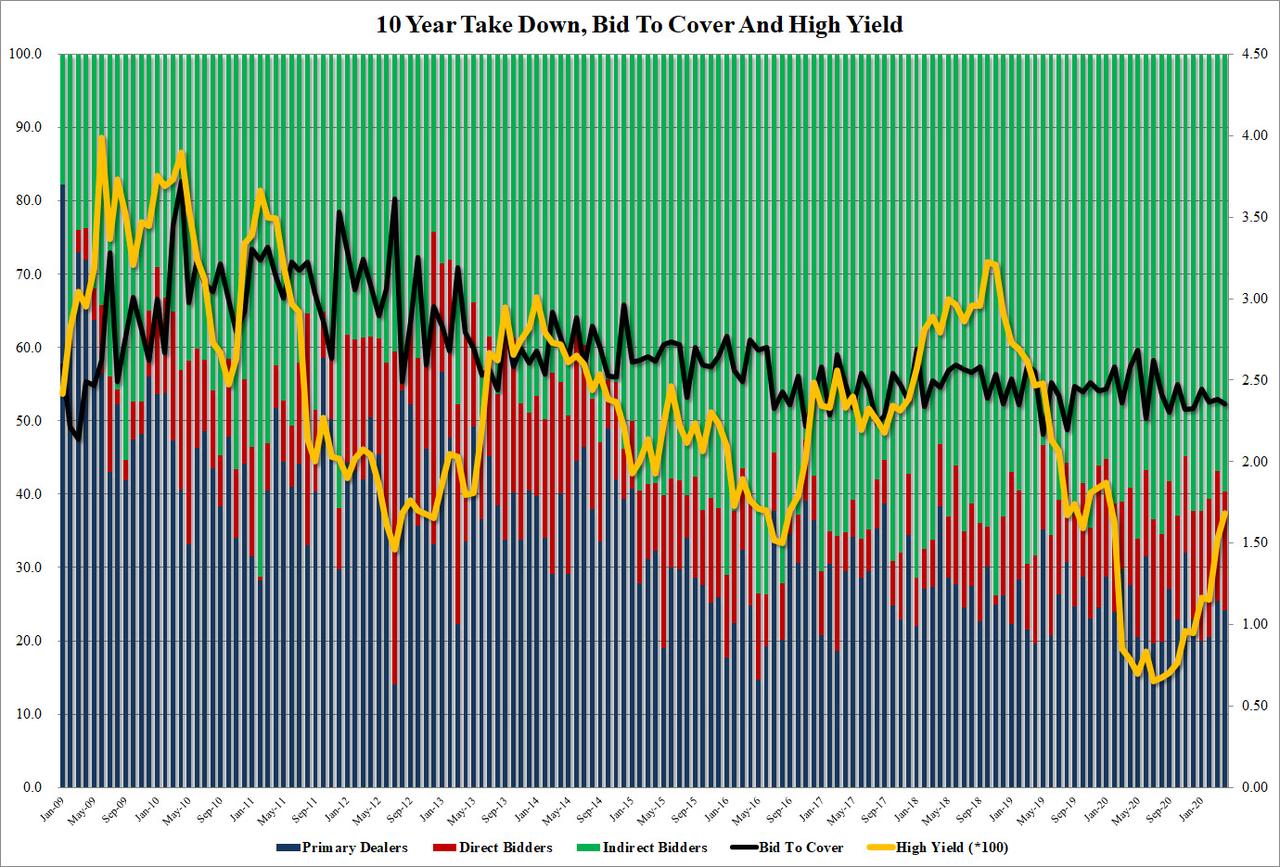
This auction was less enticing to buyers, stopping at a yield of 1.680%, which was the highest since January 2020 and also tailed the When Issued 1.678% by 0.2bps.
The bid-to-cover of 2.36 was in line with recent auctions, which have averaged 2.39 in the past 5 months, if the lowest since December.
The internals were a little better, with Indirects taking down 59.6% of the auction, up from 56.8% and in line with the recent average of 60.0%. And with Directs taking down 16.2%, or the lowest since December as well, Dealers were left holding 24.2%, almost exactly on top of the recent average.
Overall, a mediocre, forgettable auction, however good enough to avoid a market puke, and certainly nowhere close to the devastation unleashed by the catastrophic, infamous 7Y auction at the end of February which started the March bond market turmoil.
A new survey shows many Americans have concerns about interacting with others once the pandemic is over.
“A YouGov poll of more than 4,000 people finds that two in five (39%) Americans say they are very or fairly nervous about the idea of interacting with people socially again,” wrote YouGov data journalist Jamie Ballard.
While the high percentage of Americans expressing angst about socializing after the pandemic comes as a surprise, the breakdown along age groups is even more surprising.
“Among 18-to 24-year-olds, 50 percent say they are nervous about it. A similar number of 25-to 34-year-olds (47 percent) feel the same way,” Ballard wrote.
In other words, nearly half of Americans between 18 and 34 are concerned about returning to a normal social life after the pandemic. In contrast, just 31 percent of those over 55 responded that they are nervous about interacting with people again.
The contrast is noteworthy because it’s widely understood that young people are far less likely to be hospitalized or die from COVID-19. But how less likely?
Our World in Data has a chart breaking down the case fatality rates in South Korea, China, Italy, and Spain. The data show the case fatality rate is about 0.2 percent for people in their 20s and 30s, a tiny fraction compared to people over 60.
Data from the United States tells a similar story.
“The death rate in New York City for adults aged 75 years and older was around 2,344 per 100,000 people as of March 28, 2021,” researcher John Elflein notes at Statista.
That is about 500 times higher than the death rate (5 per 100,000) for people in the 18-to-24 age range.
Nationwide, research from the Heritage Foundation shows that adults aged 25 to 34 account for less than 3,000 of the official 565,000 COVID-related deaths in the United States. Many of these deaths, it should be noted, are linked to comorbidities.
This data should come as no surprise. Nearly a year ago, Stanford University’s Dr. John Ioannidis noted the COVID-19 infection fatality rate is “almost zero” for people under 45.
An Inverse Relationship
All the official data point in the same direction: Young people have the least to fear from COVID-19. Yet the YouGov poll also shows they are the most afraid.
This is odd. As influencers noted on Twitter, the level of comfort people feel in returning to normal life is inversely correlated to their level of actual risk.
This invites an important question: Why are young people more afraid? One obvious answer is young adults might simply be unaware their risk of serious illness is low.
As I recently noted, Americans in general are wildly misinformed about the risk of hospitalization from COVID-19, with roughly a third of Americans believing the chances of being hospitalized with the virus are 50 percent. In actuality, it’s closer to 1 percent.
The reasons for this aren’t hard to find.
Studies have shown that U.S. media essentially created a climate of fear by publishing a flood of negative news in 2020. Indeed, an Ivy League-led study concluded that 91 percent of U.S. articles in major media were negative in tone, nearly double when compared to non-U.S. media. The negative news, the researchers noted, continued even when the pandemic was ebbing and when positive medical breakthroughs were being achieved.
“Stories of increasing COVID-19 cases outnumber stories of decreasing cases by a factor of 5.5 even during periods when new cases are declining,” researchers noted.
Media may only be one part of the equation, however. Digital technology may be another.
‘Young People Less Likely to Die From Covid’
While writing this article, I had to find statistics on the risks of COVID-19 for young adults. To find the information, I did what I normally do: I went to Google and typed in keywords for what I was looking to find—“young people less likely to die from Covid.”
I was expecting to find on top a bunch of articles and research showing that young people have relatively little to fear from the coronavirus. That’s not what happened. Here are the top results I got:
This is a big deal. We live in a digital world, and Google is the biggest search engine on the planet, processing more than 3.5 billion searches every day.
Again, this isn’t to say young people face no risk from COVID-19. But the medical reality is that children and young adults are more likely to die from the seasonal flu, pneumonia, or a car crash than COVID-19.
Clearly, most Americans aren’t aware of this.
The Price of the Disconnect
The YouGov poll results show there is a disconnect between perception and reality when it comes to COVID-19. Unfortunately, this disconnect has real-world consequences.
“Those who overestimate risks to young people or hold an exaggerated sense of risk upon infection are more likely to favor closing schools, restaurants, and other businesses,” the authors of a recent Franklin Templeton/Gallup study concluded.
This is important because these restrictions are quite serious. Closing parts of the economy is no small matter. These actions are associated with numerous unintended consequences—job losses, mental health deterioration, increased global poverty, surging loneliness, health procedures deferred, and more. Meanwhile, the documented benefits of these restrictions remain elusive.
In 2020, we witnessed unprecedented infringements on fundamental civil liberties. And it all stemmed from fear.
Worse, despite the presence of numerous successful vaccines and crashing case numbers, the alarm bells keep sounding.
CDC Director Dr. Rochelle Walensky is warning of “impending doom,” while others warn we must begin planning for a “permanent pandemic.” The New York Times is using Florida, which lifted all pandemic restrictions last summer, as a cautionary tale by using rather tortured analysis.
Considering all this, it’s no surprise that many young people are terrified of the virus. But we’d do well to remember that fear is the pathway to subservience.
“If you want to control someone, all you have to do is to make them feel afraid,” the author Paulo Coelho wrote in “The Devil and Miss Prym.”
It’s time to stop being afraid. And the first step comes through understanding.
Another Massive Explosion Rocks St. Vincent As Hot Ash Rains Down
La Soufriere volcano “continues to erupt explosively and has now begun to generate pyroclastic density currents. Explosions and accompanying ashfall, of similar or larger magnitude, are likely to continue to occur over the next few days,” warned St. Vincent’s emergency management organization (NEMO).
Another eruption seen by @NOAASatellites‘ GOES-16 at #LaSoufriere today. Happened around 8am UTC, 4am local time.
Per @uwiseismic this is associated with a large explosion and Pyroclastic flows. The ash cloud appears to reach approx. 17km (55,000ft) altitude. pic.twitter.com/AWkqxnYBEl
Volcanic lightning generated by La Soufriere earlier this morning. Instead of the separation of charge that you would normally get in a thunderstorm between ice crystals and graupel, you get a separation in charges between colliding ash particles inside the plume. pic.twitter.com/pekTYe8flC
Here are the ashfall forecasts and islands to avoid traveling to.
NEMO continued, “the dome has already been destroyed and ejected. The eruption cloud went into the atmosphere and then collapsed, causing pyroclastic density currents.”
According to the Scientists at SRC: “the domes have already been destroyed and ejected. The eruption cloud went into the atmosphere and then collapsed causing PDCs.” So what we had is an eruption column collapse.#lasoufriereeruption2021#eruptioncolumncollapse
The large explosion at La Soufriere Volcano occurred early Monday morning and could be the biggest one yet. Thousands of people have been evacuated from their homes and placed in shelters. The volcano first erupted on Friday. Cruise ships arrived at the eastern Caribbean island this past weekend, only allowing vaccinated people to leave the island.
“It’s destroying everything in its path,” Erouscilla Joseph, director of the University of the West Indies Seismic Research Center, told The Associated Press. “Anybody who would have not heeded the evacuation, they need to get out immediately.”
Joseph compares the latest explosion to the one in 1902 when 1,600 people died. In total, the volcano has had six eruptions — in 1718, 1812, 1814, 1902/03, 1979, and 2021.
NEMO said explosions and accompanying ashfall of similar or larger magnitude are likely to continue over the next few days.
Richard Robertson, a geology professor at the seismic research center, told NBC on Monday that pyroclastic flows are some of the most dangerous things that could happen at volcanoes like La Soufriere.
He said: “I shudder to think of if any living creatures were on that mountain…” as very few buildings could withstand the force of pyroclastic flows.
Other explosions this weekend led to power cuts and affected water supplies on the islands.
Experts still believe larger volcanic explosions are ahead.
Below is my column in The Hill on President Joe Biden’s Commission on the Supreme Court. While the composition of the makeup of the Commission is now known, the true purpose of the Commission remains in doubt.
While the Commission is likely to make recommendations for “reforms,” the genesis of the Commission was to consider the court packing scheme that was widely discussed during the 2020 presidential election. Biden precisely called court packing a “bone headed” and “terrible, terrible idea.” However, he was not willing to confront extreme voices in his own party and this Commission is the result. The hope of many in Washington is that this Commission will give the Administration cover in setting aside the demands to add new members in the short term to create a liberal majority on the Court. If this largely liberal commission recommends against court packing, Biden and the Democratic leadership could shrug and say “well, we tried.”
The question is whether the Commission will feel the pressure to come up with some alternative substantial recommended change. Over 20 years ago, I recommended the expansion of the Court to 17 or 19 members. However, that recommendation would occur over many years and would not give advocates the short-term majority that they are seeking. That is the difference between reforming and packing the Court. Even a gradual increase would also face considerable opposition in the Senate, particularly out of a lack of trust that a later majority would add a couple of justices and then renege on continued additions to continue to control the majority of the Court. Even former Democratic Majority Leader Harry Reid warned against term limits or seeking to expand the Supreme Court as a dangerous path for Democrats.
Here is the column:
With the establishment of his commission to study the possible packing of the Supreme Court, President Biden has adjoined his name to one of the most inglorious efforts of Franklin Roosevelt. Court packing has long been anathema in the United States, and polls have consistently shown the vast majority of Americans oppose the idea. Biden himself once denounced it as a “boneheaded” idea, but that was back in 1983, when there remained a real space in politics for at least the pretense of principle.
Now Biden and others seem to think the Supreme Court must be canceled for its failure to yield to the demands of our age of rage. Many of us were surprised when he pandered to court packing calls in the 2020 primaries. Some of us have called for expanding the court over a lengthy transitional period, but commentators and some Democrats called for an immediate infusion of new justices to give liberals the controlling majority. Unhappy with conservative rulings, Democrats demanded that the Supreme Court be replaced by a much larger and more reliably liberal body.
Washington already looks like many of our campuses, where opposition of such liberal measures results in isolation and condemnation. Take Justice Stephen Breyer. One would think he would be immune from the mob as one of the most consistently liberal justices in our history. However, this week Breyer warned against any move to expand the Supreme Court. He also rejected the characterization of the current Court as “conservative” or ideologically rigid. Breyer was swiftly denounced by figures like cable news host Mehdi Hasan who called him “naive” and called for his retirement. Demand Justice, a liberal group calling for court packing, had a billboard truck in Washington the next day in the streets of Washington warning “Breyer, retire. Don’t risk your legacy.” Demand Justice once employed White House press secretary Jen Psaki as a communications consultant, and Psaki was on the advisory board of one of its voting projects.
The commission is an ominous sign that Biden may be offering up the last institution immune from our impulsive politics. Its composition also seems to confirm the worst expectations. Indeed, it is a lesson in how to pack a body. The group is technically bipartisan but is far from balanced. Only a handful of the 36 members are considered center-to-right academics. (Even that is still a better showing of intellectual diversity than most of the faculties of the represented schools, which have few if any conservative or libertarian faculty members.) Liberals make up the vast majority on the commission, and some have been outspoken critics of Republicans and the conservative Supreme Court majority.
The commission rapporteur, who is tasked with publishing the final report after 180 days of study about the Supreme Court, is University of Michigan professor Kate Andrias, one of 500 academics who called for the rejection of Brett Kavanaugh. One commission chair, Yale University professor and former Justice Department official Cristina Rodriguez, had also signed the public letter against Kavanaugh. The other commission chair is New York University professor and past White House counsel Bob Bauer.
The commission includes such individuals as Harvard University professor Laurence Tribe, who called Donald Trump a “terrorist” and has a history of personal and vulgar attacks on Senate Minority Leader Mitch McConnell and others, myself included, who maintain views that he opposes. Tribe once ridiculed former Attorney General William Barr for his Catholic faith. The only ire Tribe has drawn from the left, however, was when he referred to the possible selection of an African American like then Senator Kamala Harris to be vice president as mere “cosmetics” for the party.
Tribe has not been subtle about his sudden interest in court packing. After the election he declared, “The time is overdue for a seriously considered plan of action from those of us who believe McConnell and Republicans, abetted by and abetting the Trump movement, have prioritized expansion of their own power over the safeguarding of our American democracy and the protection of the most vulnerable who are among us.”
Another Harvard University professor put it in more direct terms. Michael Klarman declared the refusal of Senate Republicans to confirm Merrick Garland as a justice in 2016 was itself court packing. He said, “Democrats are not initiating this spiral. They are simply responding in kind.” He added that Democrats should not worry about Republicans responding with their own court packing when they return to power. Instead, Klarman insisted, Democrats could change the system with a manufactured liberal majority to ensure that Republicans “will never win another election.”
The only hope is that this commission is so lopsided that it is clearly not intended to be a credible basis for a court packing proposal. While the group has many respected and thoughtful academics, its composition is unlikely to sway many conservatives or even some moderates. Rather, it could be an effort to defuse the left while sentencing the court packing scheme to death by commission, a favorite lethal practice in Washington. Commissions are Washington’s great vast wasteland where controversies are often sent to perish with time and exposure.
The Commission is set to consider a litany of truly looney ideas to prevent the conservative majority from deciding cases, including creating a new specialized court or limiting jurisdiction to remove certain cases from their docket. There are also calls for term limits — a proposal that could trigger potential constitutional questions absent a constitutional amendment. Term and age limits have long been discussed and many argue that (so long as the justices are sent to lower federal court) the limitations do not contravene the life tenure provision of Article III.
If this is the case, the timing is right. The announcement came almost to the day of the anniversary of the 1937 decision where the Supreme Court upheld the constitutionality of a minimum wage bill, breaking the voting bloc against the New Deal. Indeed, Contemporary observers paraphrased Benjamin Franklin to describe the decision as a “switch in time” that saved nine because the shift with the Supreme Court majority was what defused the demands for packing the bench beyond its nine members.
This commission could now be a “switch in time” moment for Biden. The hope is that he does not have the courage to simply repeat his past view that court packing remains a “boneheaded” idea but that he can assemble an overwhelmingly liberal commission to effectively kill the scheme. After all, 180 days is not much time to reinvent the Supreme Court, but it is just enough time to give the pretense of an effort to do so. Unfortunately, that is the closest we get to principled government today. But in this instance, the Commission just may be a “hitch in time” that saves nine.
Taiwan Records Largest Ever Incursion By Chinese Air Force With 25 Planes Monday
China has continued its muscle-flexing exercises near Taiwan on Monday, this time sending an unprecedentedly large group of aircraft to breach Taiwan’s defense zone.
Taiwan’s Defense Ministry has announced that 25 Chinese Air Force planes entered its airspace, which included 18 fighter jets escorting four long-range bombers. It marks the largest ever Chinese aerial incursion since Taiwan began recording and publicly disclosing the data and follows last month’s 20-strong Chinese aircraft incursion.
25 PLA aircraft (Y-8 ASW*2, KJ-500 AEW&C, J-10*4, J-16*14 and H-6K*4) entered #Taiwan’s southwest ADIZ on Apr. 12, 2021. Please check our official website for more information: https://t.co/Lv5b0tXxvFpic.twitter.com/gPG3CKYpf9
— 國防部 Ministry of National Defense, R.O.C. 🇹🇼 (@MoNDefense) April 12, 2021
As is typical in such aggressive Chinese maneuvers near the island, Taiwan said it scrambled its own jets while also issuing radio warnings, and further its military said “air defense missile systems deployed to monitor the activity.”
It’s widely perceived that Beijing’s uptick in such flights, which have become ‘routine’ on a near daily basis, are meant to send a political message warning both secessionist forces in the democratic island as well as their superpower backer the United States.
Monday’s largest ever PLA breach of airspace further comes a day after Biden’s secretary of state Antony Blinken hit out at Beijing over the Taiwan issue, warning it would be a “serious mistake” for anyone to try and change the status quo in the western Pacific via military threats. Of course, that’s precisely the charge Beijing has lately leveled back, claiming it’s Washington which is the one reneging on the ‘One China’ policy.
“What we’ve seen, and what is of real concern to us, is increasingly aggressive actions by the government in Beijing directed at Taiwan, raising tensions in the Straits,” Blinken told NBC’s Meet the Press on Sunday.
For all the noise made over Covid-19, many people might be surprised to find out that it was not the leading cause of death in the U.S. in 2020. It came in third, behind heart disease and cancer, according to a new CDC study. COVID-19 was listed as the underlying cause of 345,323deaths during 2020 and was the third leading underlying cause of death, after heartdisease (690,882 deaths) and cancer (598,932) That is reality in a nutshell.
So Much For The Idea We Are All Going to Die From Covid
This data kinda puts into focus how warped we have become by the fear-mongering fostered upon us. it is difficult to argue with this data. It was lifted from the Provisional Mortality Data — United States, 2020 | MMWR report.
Total deaths in America in 2020, according to the U.S. Centers for Disease Control and Prevention (CDC) came in at2,913,144. Considering that there were 2,845,793 deaths in 2019 and 2,831,836 deaths in 2018, this is not surprising. If you ballpark America’s population at 333 million, 1% of that number is 3.3 million people. While many people find it distressing, the fact is people die. Also, this curse tends to descend upon people that are older. One of my favorite lines comes from a great old gal I knew, when she was 98, she informed me she no longer bought green bananas.
Leave it up to the media to spinning the increase in deaths as proof Covid has devastated our country, such an article appeared on ABC near the end of December. The article hyping the number was titled: “US deaths in 2020 top 3 million,by far most ever counted.” (https://abcnews.go.com/Health/wireStory/us-deaths-2020-top-million-coun…) It went on to say, 2020 will go down as the deadliest year in U.S. history, with deaths topping 3 million for the first time.
Stimulus and Covid-19 attitudes reflect declining math skills. The fact the light simply doesn’t come on in the minds of the majority of people as to how far off course we have traveled is astounding. Much of this could be attributed to the dumbing down of America. Some people consider this a planned effort by the government and those in charge of our general well-being to make the masses more malleable.
The idea of “dumbing down,” is the deliberate oversimplification of intellectual content in education, literature, and cinema, news, video games, and culture. Originated in 1933, the term “dumbing down” was movie-business slang, used by screenplay writers, the idea was to revising things to appeal to those of little education or intelligence”. Dumbing-down varies according to the subject matter, but almost always results in the diminishment of critical thought.
Stupid Much? Yes, It’s Kinda Like This!
It could be argued that modern culture has gone off the rails. This is reflected in programs developed to entertain us. One example is the Beavis and Butt-Head Animated MTV series. It is about two teenage heavy-metal music fans who occasionally do idiotic things because they’re bored. The problem we face is that it is not just children that while away the hours watching this garbage but bone idle adults also waste a great deal of their time engaged in the same activity rather than looking for more productive things to do.
Circling back to the crux of this article, we should be viewing Covid-19 and the size of the stimulus packages through mathematics rather than a prism of emotion. When it comes to the pandemic the general dumbing down of America the nation’s poor math skills comes front and center. Again, settingAmerica’s population at 333 million, 1% of that number is 3.3 million people. It should not come as shocking news that roughly one percent of the population dies each year from old age or disease. As for the cost of this poorly handled pandemic that has led to the devastation of America and caused the national debt to go explode, that is a whole other story.
Using the same population figure as above, every billion dollars spent by the government represents an outlay of $3 for every man, woman, and child in America. This means each trillion dollars spent is equal to $3,333. To keep things simple let’s just go with the six trillion figure, $3,333 times six show a huge $19,998 of new “stimulus” or debt has been created for each of us over the last year. Round this number up by two dollars and multiply it to represent a family of three and we are looking at a mind-blowing $60,000 per family. This is why incomes have risen to an all-time high while tens of millions of workers have sat at home during the lock-downs.
While many of us argue that COVID-19 should not be called a major public health threat anymore and see it as having reached endemic status (like the seasonal flu), the fearmongers with an agenda continue to warn us of future death and chaos. The big threat now being a new variant of SARS-CoV-2 that is, allegedly, now “causing huge problems” in Europe. In a mid-March 2021 while appearing on MSNBC News, National Institutes of Health director Dr. Francis Collins expressed dismay at something that was beginning to happen across America by pointing at Florida, he said:
“Oh my God, Florida, stay out of the bars with your masks off! What are you doing? This is exactly the wrong thing to be doing unless you want to end up where Europe is.”
During the last year, we have lived in a world we could hardly have imagined when all this started. As expected, new variants of this virus are emerging and there will be many new strains in the future. In the same way, the seasonal flu changes and evolves from year to year history indicates as viruses mutate within a population over time, they tend to become more benign. Still, we could ask, why we let things unfold as they have or how this happened? Sadly, most of us know the answer.
While many so-called experts say follow the science, I say, follow the math. Using math as a tool we can shed some logic upon the rather chaotic situation we find ourselves in. It appears much of the world has been blinded by those seeking to implement a “Great Reset” of the global economy, our social structure, and our culture. Entering into this is the squelching of free speech and censorship. All this has gone full tilt and we are under a full-court press to halt any comeback on the part of rational human beings to exert real influence on our future.
Foreign Demand Jumps For 3Y Treasuries As Auction Blitz Begins
It’s an extremely busy week – and day – for Treasury issuance, which sees a $58BN 3-year note sale at 11:30am ET, followed by $38BN 10-year reopening at 1pm ET; and concludes with $24BN 30-year reopening Tuesday in a dramatically abbreviated schedule.
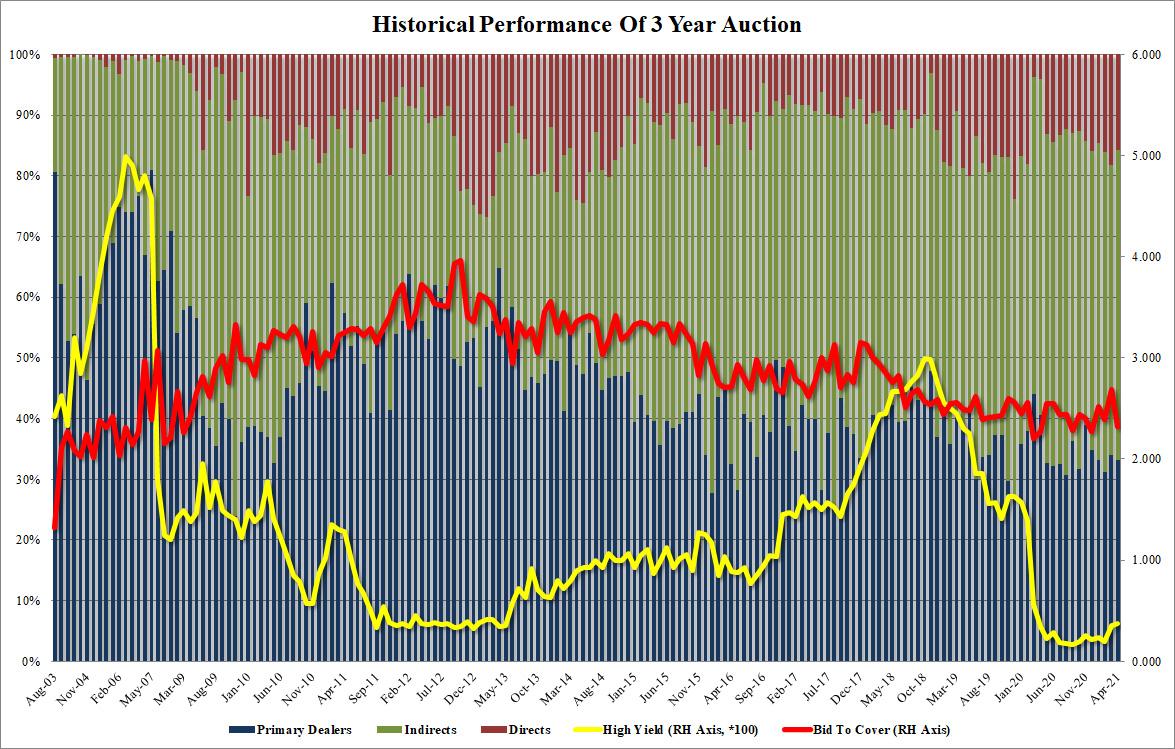
Moments ago, the first of today’s two auctions priced, and anyone who was expecting disappointment can exhale: the sale of $58BN in 3Y paper came out solid, pricing at 0.376%, stopping through the When Issued 0.378% by 0.2bps.
The Bid to Cover was not quite as impressive, sliding to 2.318 from 2.689 and not only below the 6-auction average of 2.452 but the lowest since December’s 2.275.
The internals were more impressive, with Indirect (foreign buyers) interest jumping and taking down 51.1%, up from 47.8% and above the recent average of 51.1. And with Directs taking 15.8%, or the lowest since January’s 14.6%, Dealers were left holding 33.1% of the final takedown, also in line with the six-auction average of 34.0%.
Overall, a solid auction and one which set the stage for today’s much anticipated sale of $38BN in 10Y notes at 1pm.
Sotheby’s auction house – established in 1744 London – is holding its first auction for non-fungible tokens (NFTs) by anonymous artist ‘Pak’ which “scrutinizes our understanding of value.”
“The Fungible” collection by Pak kicks off on Monday at Noon EST, and will end on Wednesday the 14that 1:15 p.m. ET. To participate, bidders need to be on Nifty Gateway, an NFT marketplace operated by the Gemini cryptocurrency exchange founded by the Winklevoss brothers.
By leveraging blockchain technology and non-fungible tokens (NFTs), The Fungible not only provides collectors with novel assurances of scarcity and ownership, but exposes them to the unique features with which technology can endow artwork. Through this collection, Pak scrutinizes our understanding of value. What does value mean, and from where does it derive authority? Core to the collection is the Open Editions, which allow collectors to purchase as many fungible cubes as they wish during the sale period for a fixed price. As the collection reveals itself over the course of the sale, Pak continues to challenge the collector community with this question of value while simultaneously providing a unique journey into and through digital art. -Sotheby’s
According to the auction house, Pak’s “Fungible Cubes” will start at $500 each, and collectors will be able to buy as many ‘cubes’ as they want. Purchasers of fungible cubes will receive an NFT containing Pak’s artwork.
Pak has been involved in digital art for more than two decades, founding the studio Undream and creating an AI called Archillect – designed to create ‘stimulating visual media.’
“I see this collection as the first digitally native mindset of works that’s presented to the traditional art world through a global auction house,” Pak said in a statement released by Sotheby’s, adding “With this kind of a scale, I expect it to play a major cultural role in telling the narrative of the digital world to the traditional world in terms of the medium definition and value creation. People may be able to right click save as a ‘jpeg’ but how would they save as a digital performance?”
Those interested in participating can click here, and will need to create an account on Nifty Gateway.
In the past several months, millions of dollars have been spent collecting rare NFTs. In March, artist Beeple sold an NFT collage for $69.3 million by Sotheby’s rival, Christie’s. That month, Sotheby’s CEO Charles Stewart told CNBC that he decided to hold his first NFT sale with Pak because he’s one of “the most established artists” in the space, adding that NFTs have “staying power.”