No, the Sturgis Motorcycle Rally Didn’t Spawn 250,000 Coronavirus Cases

ddpphotos436013

Here’s what we were told: An August motorcycle rally in Sturgis, South Dakota, helped spread COVID-19 to more than a quarter-million Americans, making it the root of about 20 percent of all new coronavirus cases in the U.S. last month. So said a new white paper from the IZA Institute of Labor Economics, at least. And national news outlets ran with it.

“Sturgis Motorcycle Rally was ‘superspreading event’ that cost public health $12.2 billion,” tweeted The Hill.

“The Sturgis Motorcycle Rally held in South Dakota last month may have caused 250,000 new coronavirus cases,” said NBC News.

“The Sturgis Motorcycle Rally represents a situation where many of the ‘worst-case scenarios’ for superspreading occurred simultaneously,” the researchers write in the new paper, titled “The Contagion Externality of a Superspreading Event: The Sturgis Motorcycle Rally and COVID-19.”

Not so fast. Let’s take a look at what they actually tracked and what’s mere speculation.

According to South Dakota health officials, 124 new cases in the state—including one fatal case—were directly linked to the rally. Overall, COVID-19 cases linked to the Sturgis rally were reported in 11 states as of September 2, to a tune of at least 260 new cases, according to The Washington Post.

There very well may be more cases that have been linked to the early August event, but so far, that’s only 260 confirmed cases—about 0.1 percent of the number the IZA paper offers.

To get to the astronomical number of cases allegedly spread because of the Sturgis Motorcycle Rally, the researchers analyzed “anonymized cellphone data to track the smartphone pings from non-residents and movement of those before and after the event,” notes Newsweek. “The study then linked those who attended and traveled back to their home states, and compared changes in coronavirus trends after the rally’s conclusion.”

Essentially, the researchers assumed that new cases in areas where people went post-rally must have been spread by those rally attendees, despite there being no particular evidence that this was the case. The paper, which has not been peer-reviewed, also failed to account for simultaneous happenings—like schools in South Dakota reopening, among other things—that could have contributed to coronavirus spread in some of the studied areas.

The researchers also assumed a $46,000 treatment price for each person infected to calculate the $12.2 billion public health cost of the event—but this figure would only make sense if every person had a severe case requiring hospitalization.

The results of the IZA paper “do not align with what we know,” South Dakota epidemiologist Joshua Clayton said at a Tuesday news briefing.

The IZA paper “isn’t science; it’s fiction,” Gov. Kristi Noem (R) said.

It’s also good election-time propaganda, apparently. Despite the dubious nature of the IZA study, a range of Democratic consultants and cheerleaders have been using it to condemn President Donald Trump.


FREE MINDS

Yet another piece of GOP stunt legislation takes aim at social media and Section 230.


FREE MARKETS

Regulation alert:

See also: How the FDA Is Saving the Cigarette.


QUICK HITS

  • The Trump administration is reportedly planning to announce more troop withdrawals from Iraq and Afghanistan:

  • The Academy Awards is revising its Oscar eligibility criteria for Best Picture:

  • Department of “War Is Peace”:

from Latest – Reason.com https://ift.tt/3k1wx6h
via IFTTT
JOLTed: US Hiring Unexpectedly Plunges By Most On Record Despite Surge In Job Openings

JOLTed: US Hiring Unexpectedly Plunges By Most On Record Despite Surge In Job Openings

Tyler Durden

Wed, 09/09/2020 – 10:24

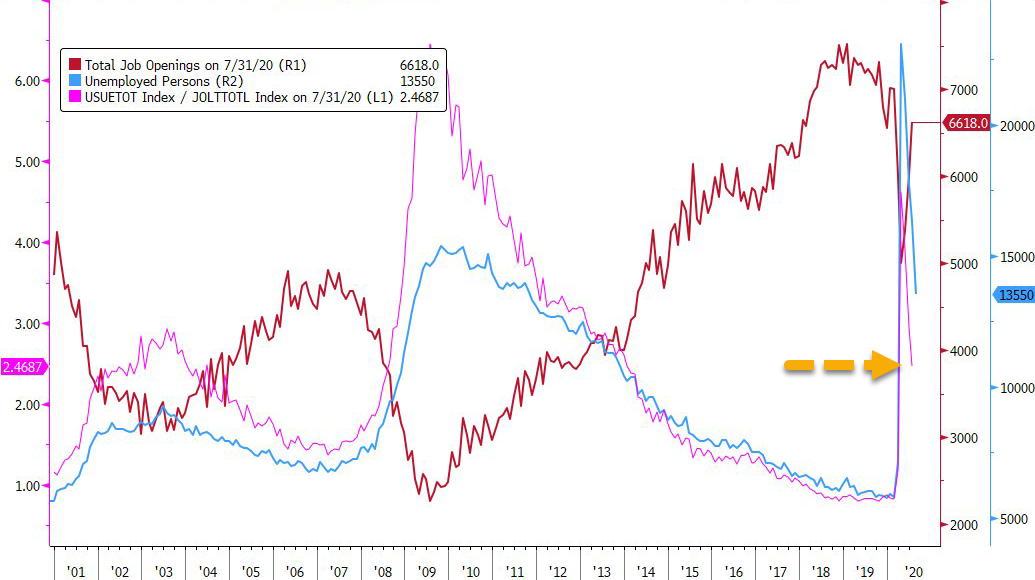
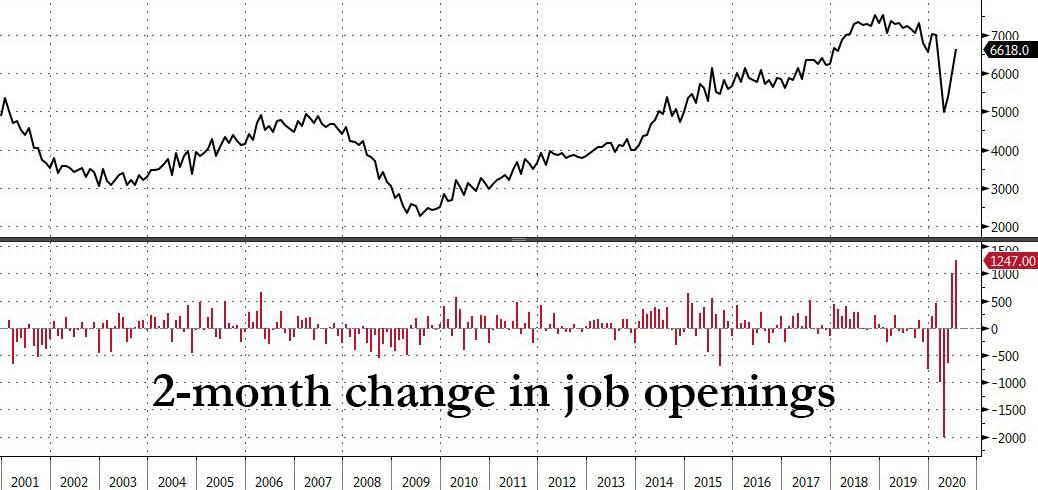
With the BLS’s JOLTs, or job openings and labor turnover survey, coming in with an extra month delay, we already knew that the August jobs data would come in roughly in line with expectations after the record surge in May (if only after the catastrophic April loss of 20MM jobs), and sure enough that’s what the BLS confirmed moments ago when it revealed that in June the number of job openings jumped from a revised 6.001 million (originally 5.889 million) to 6.618 million, smashing expectations 6MM job openings, and at 617K, this was just shy of June’s 630K surge which was the biggest monthly increase since 2015(however, only after plunging by nearly 2 million in March and April). COmbined, the increase in June and July rise in job openingswas the biggest 2-month increase on record.

Job openings rose in a number of industries, with the largest increases in retail trade (+172,000), health care and social assistance (+146,000), and construction (+90,000). The number of job openings increased in the South and Midwest regions.

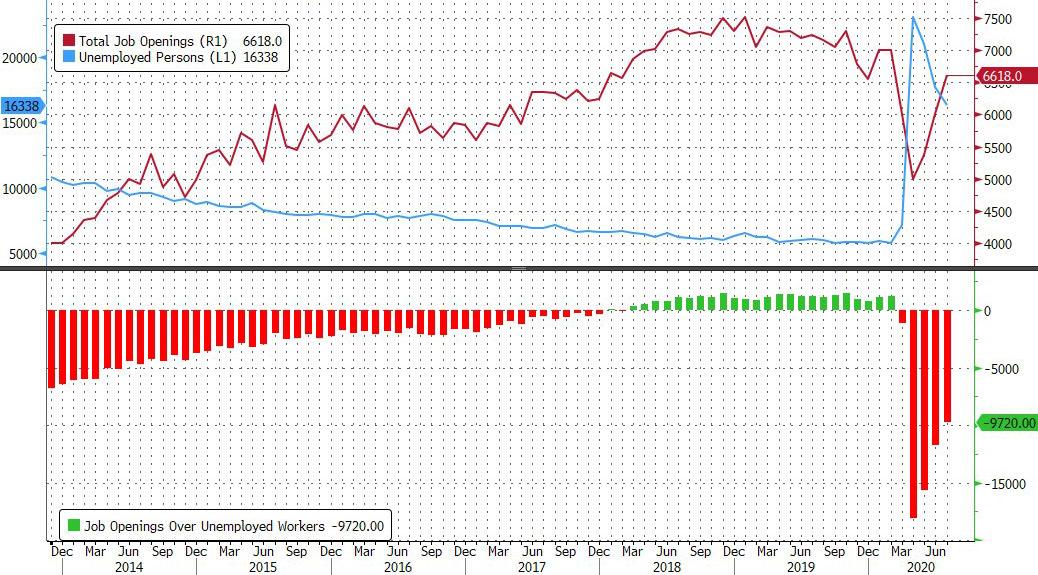
Separately,  we already knew that the series of 24 consecutive months in which there were more job openings than unemployed workers ended with a thud in March, in April it was an absolute doozy with 18 million more unemployed workers than there are job openings, the biggest gap on record. Since then the the gap has closed somewhat, and in July, there were 9.7 million more unemployed than available job openings (after 11.9 million in June).

As a result, there were just over 2.4 unemployed workers for every job opening, down from 3 last month.

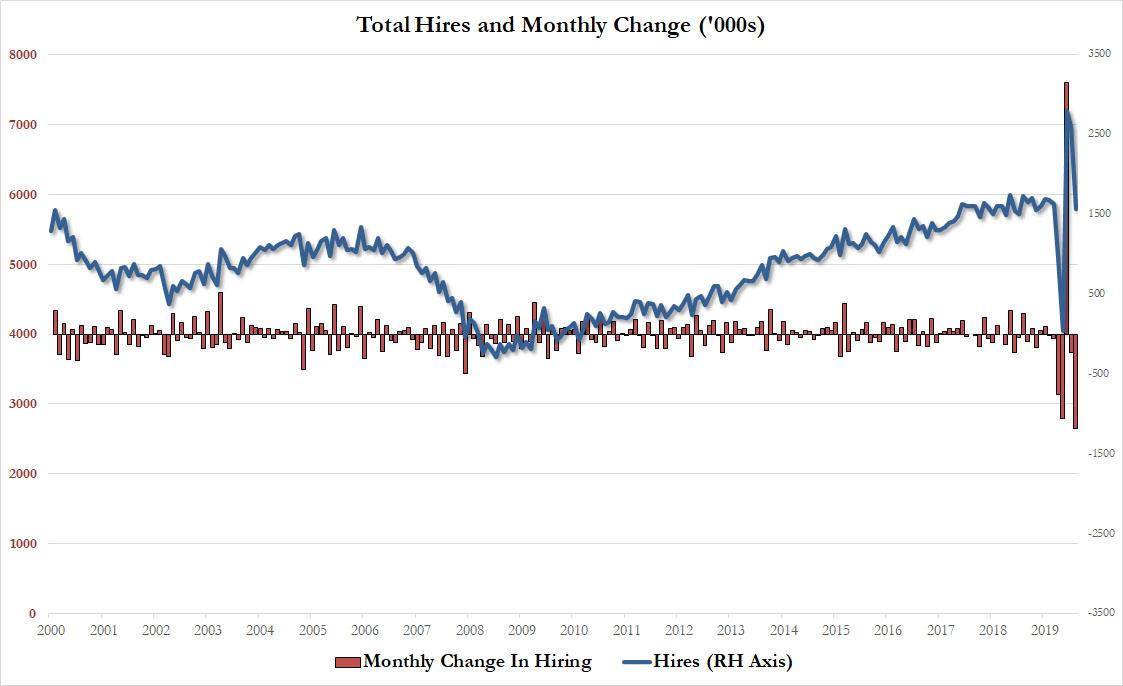
What is remarkable is that even as the number of job openings surged by more than 600K, there was an unexpectedly plunge in hiring, and after the BLS reported of 7 million hires in June, in July this number unexpectedly plunged by a record 1.183 million to just 5.787 million in July, the lowest since April.

This suggest that an odd bifurcation has opened up in the US labor market, where hiring is tumbling even as the number of job openings reverts slowly to pre-crisis levels.

Hires decreased in a number of industries, with the largest fall in accommodation and food services (-599,000), followed by other services (-143,000), and health care and social assistance (-137,000). Hires increased in federal government (+33,000), largely because of Census hiring. Hires also increased in real estate and rental and leasing (+26,000).

As the pace of hiring plunged by the most on record, the number and rate of total separations was little changed at 5.0 million and 3.6 percent, respectively. Total separations increased in retail trade (+112,000) and in state and local government education (+49,000). The number of total separations decreased in durable goods manufacturing (-44,000).

Of these, the number of layoffs and discharges decreased to 1.7 million (-274,000) and 1.2 percent, respectively in July. The layoffs and discharges level decreased in durable goods manufacturing (-40,000), transportation, warehousing, and utilities (-40,000), and wholesale trade (-21,000). The number of layoffs and discharges decreased in the Northeast and South regions.

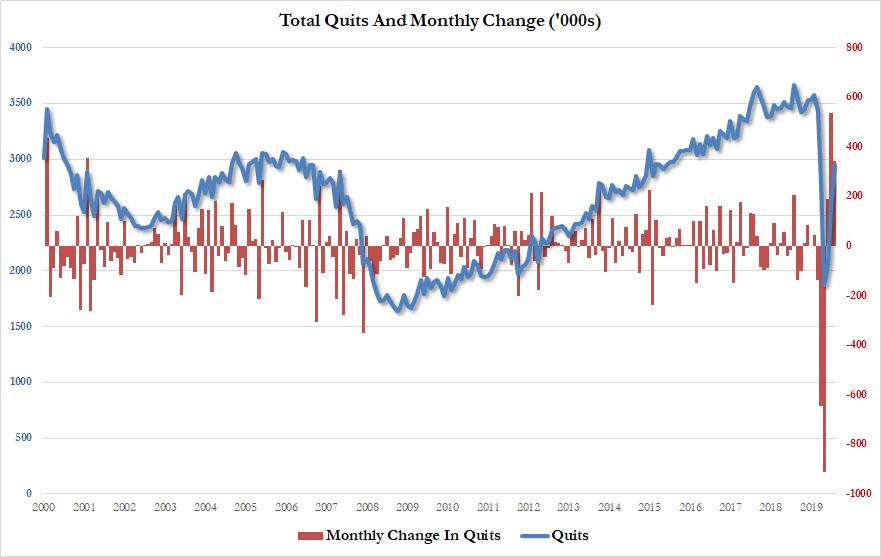
Finally, while not nearly as large as last month’s record increase, the number of people quitting their job continued its sharp increase in yet another indicator of the strong rebound in the labor market. The number and rate of quits – the so-called take this job and shove it indicator – soared to 2.9 million (+344,000) and 2.1 percent, respectively, as Americans felted emboldened enough to quit their current job in hopes or expectations of finding a higher paying job elsewhere. Quits increased in retail trade (+152,000), professional and business services (+98,000), and state and local government education (+35,000). The number of quits increased in the Midwest and West region.

via ZeroHedge News https://ift.tt/3hiUcx3 Tyler Durden

Loonie Gains After Bank Of Canada Leaves Rates/QE Unch (As Expected)

Loonie Gains After Bank Of Canada Leaves Rates/QE Unch (As Expected)

Tyler Durden

Wed, 09/09/2020 – 10:09

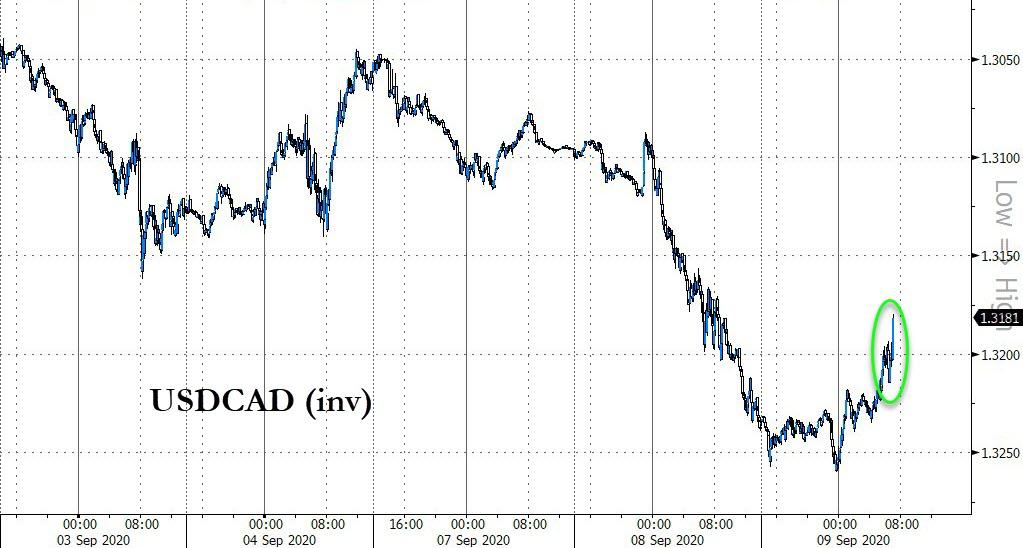
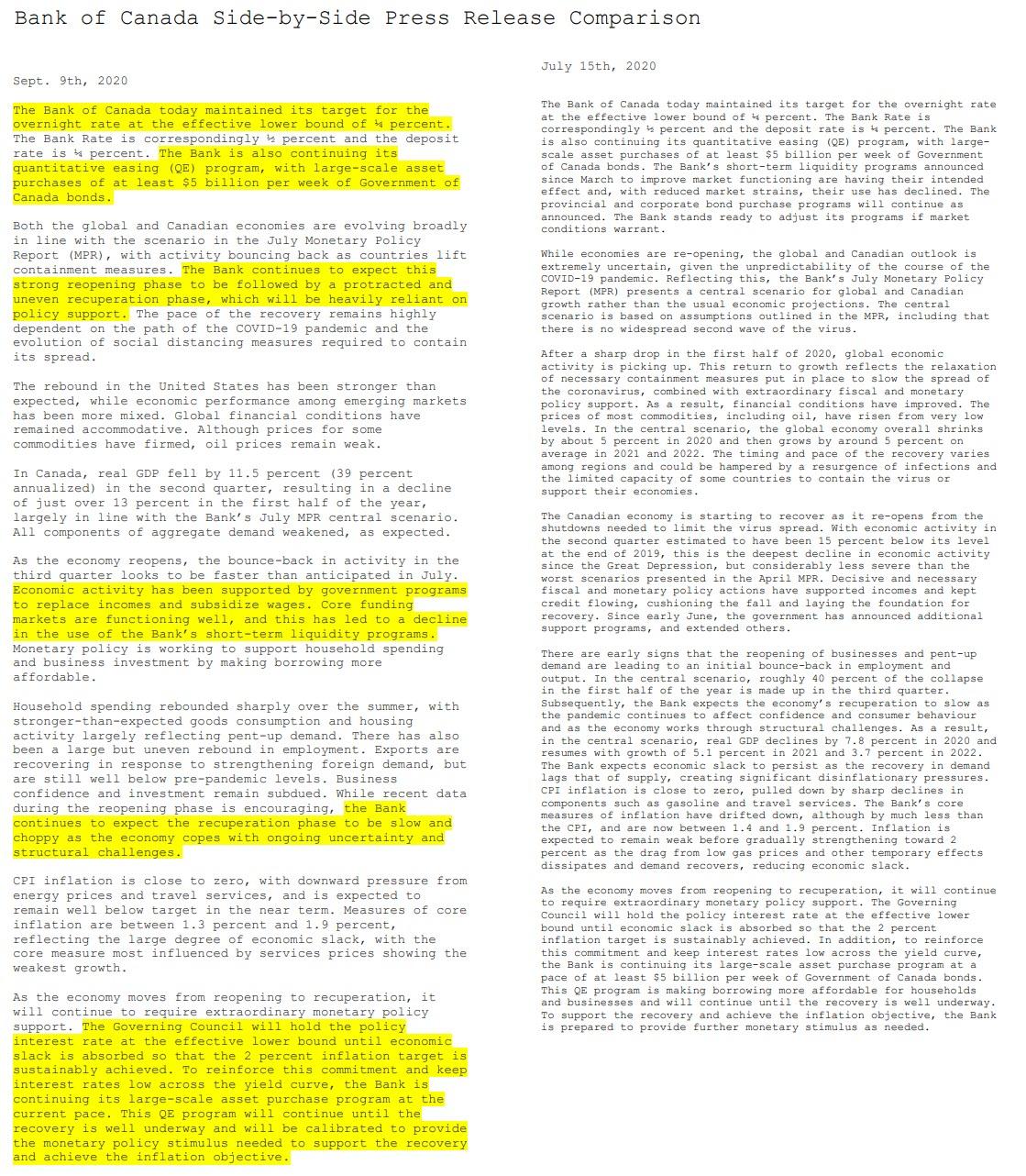
The Bank of Canada left rates unchanged (at 25bps) and left its bond-buying bonanza unchanged at C$5 billion per week – both as expected – and reiterated its forward guidance (as expected), and the Loonie managed to extend its modest gains from a recent drop to three-week lows…

Source: Bloomberg

While BoC acknowledges the bounce-back in activity in third quarter has been faster than anticipated and as such “core funding markets are functioning well, and this has led to a decline in the use of the Bank’s short-term liquidity programs,” it is careful not to hint at any hawkishness, noting that the QE program will continue “until the recovery is well underway and will be calibrated to provide the monetary policy stimulus needed to support the recovery and achieve the inflation objective.”

As the economy moves from reopening to recuperation, it will continue to require extraordinary monetary policy support. The Governing Council will hold the policy interest rate at the effective lower bound until economic slack is absorbed so that the 2 percent inflation target is sustainably achieved.”

Full redline below:

Pledging to keep the policy rate unchanged is “a pretty powerful commitment that they’re likely to reiterate,” Josh Nye, economist at Royal Bank of Canada, said by phone.

via ZeroHedge News https://ift.tt/2Fkwd3z Tyler Durden

President Trump Nominated For Nobel Peace Prize

President Trump Nominated For Nobel Peace Prize

Tyler Durden

Wed, 09/09/2020 – 09:50

Authored by Jannie Taer via SaraACarter.com,

President Donald Trump has been nominated for the Nobel Peace Prize by Christian Tybring-Gjedde, a member of the Norwegian parliament, according to a Fox News exclusive.

“For his merit, I think he has done more trying to create peace between nations than most other Peace Prize nominees,” Tybring-Gjedde, who is also chairman of the Norwegian delegation to the NATO Parliamentary Assembly, told Fox.

In his nomination letter, Tybring-Gjedde said Trump’s leadership has led to a historic deal with Israel and the United Arab Emirates.

The two countries agreed to normalize diplomatic ties on August 13, an accord brokered as a part of the Trump administration’s plan for Middle East peace. Israel and the UAE are expected to sign a formal deal on September 15 at the White House, announced Tuesday.

“As it is expected other Middle Eastern countries will follow in the footsteps of the UAE, this agreement could be a game changer that will turn the Middle East into a region of cooperation and prosperity,” Tybring-Gjedde wrote to the Nobel committee, according to Fox.

He also cited Trump’s “key role in facilitating contact between conflicting parties and … creating new dynamics in other protracted conflicts, such as the Kashmir border dispute between India and Pakistan, and the conflict between North and South Korea, as well as dealing with the nuclear capabilities of North Korea.”

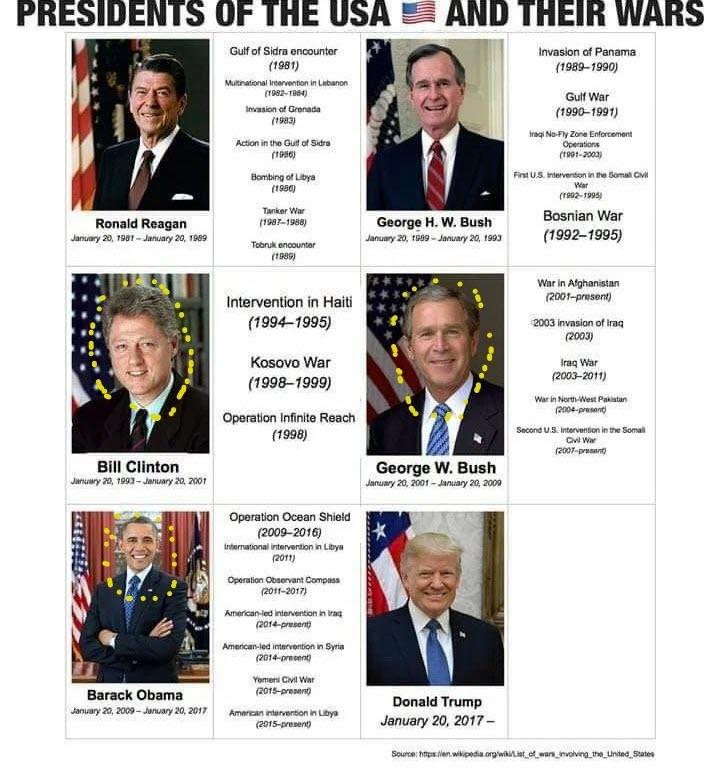
Tybring-Ghedde added praise of Trump’s efforts to avoid costly wars and to end endless wars, writing, “Indeed, Trump has broken a 39-year-old streak of American Presidents either starting a war or bringing the United States into an international armed conflict. The last president to avoid doing so was Peace Prize laureate Jimmy Carter.”

Tybring-Ghedde is a member of the Norway’s populist party, but says he’s “not a big Trump supporter,” yet he believes the President deserves the prize for accomplishing more than his predecessors, like President Barack Obama, who was awarded the honor during his presidency.

“I’m not a big Trump supporter,” he said.

“The committee should look at the facts and judge him on the facts – not on the way he behaves sometimes. The people who have received the Peace Prize in recent years have done much less than Donald Trump. For example, Barack Obama did nothing.”

[ZH: Someone’s about to get #canceled!!]

via ZeroHedge News https://ift.tt/3jUByNQ Tyler Durden

Airlines Beg For Bigger Bailouts Despite ‘Optimistic’ Headlines On US Air Travel Rebound

Airlines Beg For Bigger Bailouts Despite ‘Optimistic’ Headlines On US Air Travel Rebound

Tyler Durden

Wed, 09/09/2020 – 09:35

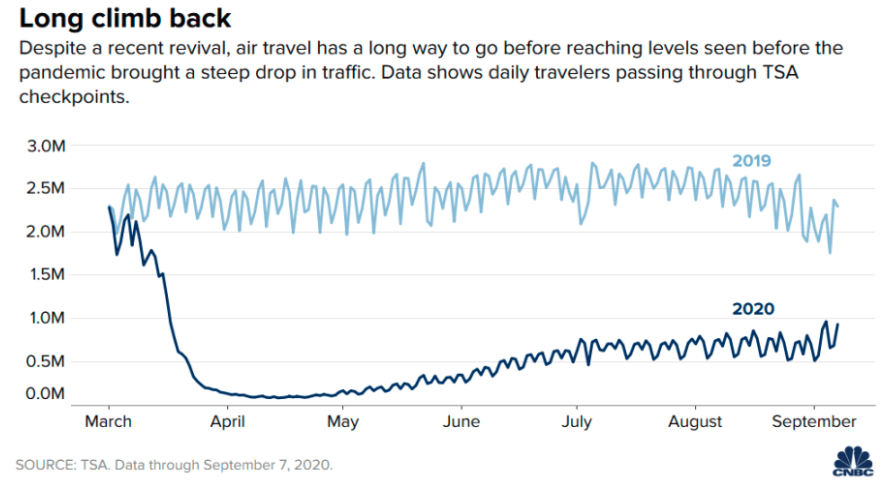
About 3.3 million passengers passed through the Transportation Security Administration’s (TSA) checkpoints over Labor Day weekend, with 968,673 passengers boarding flights on Sept. 4 and 935,000 on Sept. 7. The late summer bump in air travel resulted in most people flying since March 16, or about a six-month high. 

“Passenger volume on the busiest day of the Labor Day weekend was up 30% from the busiest day of the July 4 holiday weekend,” said TSA Administrator David Pekoske, who was quoted by Axios

“This is an encouraging trend for the aviation sector as airports, airlines and TSA work together to ensure a secure and safe travel experience for passengers,” Pekoske said.

However, CNBC points out, from Memorial Day through Labor Day weekend, TSA agents screened 65 million people, down 76% from the 269 million screened over the same period last year.

The latest improvement in air travel is a welcoming sign considering the crash in the travel and tourism industry. However, the overall trend in air travel doesn’t resemble a “V” shaped recovery. A recovery in the airline industry could take a couple of years. 

American Airlines and United Airlines have recently announced new measures to scale back operations, including laying off thousands of jobs ahead of the presidential election in November.

The threat is clear from the press releases – if the industry doesn’t receive another round of cash from the government then further downward pressure would result in additional fleet reductions, new plane cancellations, more layoffs, and or possibly a bankruptcy wave. 

via ZeroHedge News https://ift.tt/3m3KGBN Tyler Durden

No, the Sturgis Motorcycle Rally Didn’t Spawn 250,000 Coronavirus Cases

ddpphotos436013

Here’s what we were told: An August motorcycle rally in Sturgis, South Dakota, helped spread COVID-19 to more than a quarter-million Americans, making it the root of about 20 percent of all new coronavirus cases in the U.S. last month. So said a new white paper from the IZA Institute of Labor Economics, at least. And national news outlets ran with it.

“Sturgis Motorcycle Rally was ‘superspreading event’ that cost public health $12.2 billion,” tweeted The Hill.

“The Sturgis Motorcycle Rally held in South Dakota last month may have caused 250,000 new coronavirus cases,” said NBC News.

“The Sturgis Motorcycle Rally represents a situation where many of the ‘worst-case scenarios’ for superspreading occurred simultaneously,” the researchers write in the new paper, titled “The Contagion Externality of a Superspreading Event: The Sturgis Motorcycle Rally and COVID-19.”

Not so fast. Let’s take a look at what they actually tracked and what’s mere speculation.

According to South Dakota health officials, 124 new cases in the state—including one fatal case—were directly linked to the rally. Overall, COVID-19 cases linked to the Sturgis rally were reported in 11 states as of September 2, to a tune of at least 260 new cases, according to The Washington Post.

There very well may be more cases that have been linked to the early August event, but so far, that’s only 260 confirmed cases—about 0.1 percent of the number the IZA paper offers.

To get to the astronomical number of cases allegedly spread because of the Sturgis Motorcycle Rally, the researchers analyzed “anonymized cellphone data to track the smartphone pings from non-residents and movement of those before and after the event,” notes Newsweek. “The study then linked those who attended and traveled back to their home states, and compared changes in coronavirus trends after the rally’s conclusion.”

Essentially, the researchers assumed that new cases in areas where people went post-rally must have been spread by those rally attendees, despite there being no particular evidence that this was the case. The paper, which has not been peer-reviewed, also failed to account for simultaneous happenings—like schools in South Dakota reopening, among other things—that could have contributed to coronavirus spread in some of the studied areas.

The researchers also assumed a $46,000 treatment price for each person infected to calculate the $12.2 billion public health cost of the event—but this figure would only make sense if every person had a severe case requiring hospitalization.

The results of the IZA paper “do not align with what we know,” South Dakota epidemiologist Joshua Clayton said at a Tuesday news briefing.

The IZA paper “isn’t science; it’s fiction,” Gov. Kristi Noem (R) said.

It’s also good election-time propaganda, apparently. Despite the dubious nature of the IZA study, a range of Democratic consultants and cheerleaders have been using it to condemn President Donald Trump.


FREE MINDS

Yet another piece of GOP stunt legislation takes aim at social media and Section 230.


FREE MARKETS

Regulation alert:

See also: How the FDA Is Saving the Cigarette.


QUICK HITS

  • The Trump administration is reportedly planning to announce more troop withdrawals from Iraq and Afghanistan:

  • The Academy Awards is revising its Oscar eligibility criteria for Best Picture:

  • Department of “War Is Peace”:

from Latest – Reason.com https://ift.tt/3k1wx6h
via IFTTT
“Not The Same Joe”: Former Stenographer Says Biden’s Cognitive Ability Has Declined Significantly

“Not The Same Joe”: Former Stenographer Says Biden’s Cognitive Ability Has Declined Significantly

Tyler Durden

Wed, 09/09/2020 – 09:14

Authored by Paul Joseph Watson via Summit News,

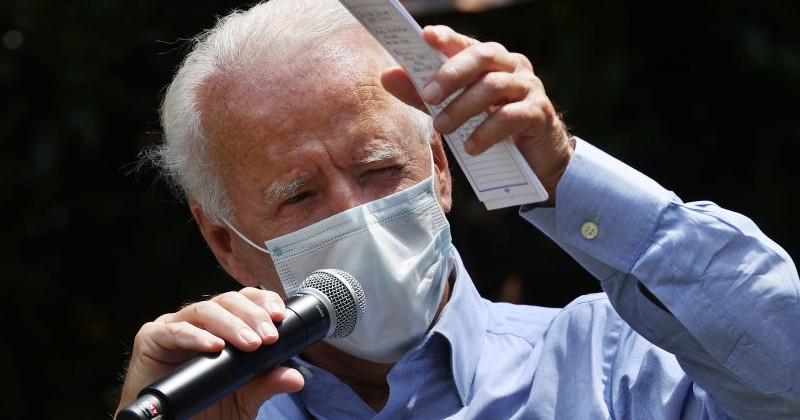
Joe Biden’s former White House stenographer says the presidential candidate’s cognitive functioning and speaking ability has deteriorated significantly in the last few years.

Speaking to the Washington Free Beacon, Mike McCormick, who worked as a White House stenographer for 15 years and with Biden from 2011 to 2017, said the presidential candidate is “not the same Joe Biden.”

“He’s lost a step and he doesn’t seem to have the same mental acuity as he did four years ago,” said McCormick.

“He doesn’t have the energy, he doesn’t have the pace of his speaking…he’s a different guy,” he added.

McCormick noted that Biden seems to get “lost” during interviews and has also lost his ability to smoothly go off script and connect naturally with his audience.

“He’d just make a big joke out of it, and go straight from the hip. And notice, he’s not doing that anymore,” he said. “He read that [Democratic National Committee speech] verbatim … it’s not Joe Biden anymore.”

Biden has slipped up innumerable times during interviews and speeches, leading to charges that the former VP is being kept in a “basement” by his campaign managers so as not to further humiliate himself.

Despite CNN’s Brian Stelter suggesting it was “otherworldly” to question Biden’s mental health, a Rasmussen poll released last month found that 59 per cent of likely voters don’t believe he’ll finish a 4 year term in the White House.

Polls also show that 38 per cent of American voters think Biden has “some form of dementia,” including one in five Democrats.

Biden’s cognitive functioning has repeatedly been called into question, including by White House physician Dr. Ronny Jackson.

“I think that he’s old enough now that he’s having cognitive difficulties and that just happens. It’s part of growing old,” said Jackson.

“If [Trump] goes head-to-head with Joe Biden cognitively, there just wouldn’t be much of an assessment. It will be very one-sided.”

*  *  *

In the age of mass Silicon Valley censorship It is crucial that we stay in touch. I need you to sign up for my free newsletter here. Also, I urgently need your financial support here.

via ZeroHedge News https://ift.tt/3m2k6ZD Tyler Durden

After The Plunge, What’s Next For The Market?

After The Plunge, What’s Next For The Market?

Tyler Durden

Wed, 09/09/2020 – 08:55

Heading into Tuesday’s plunge, there was a veritable cornucopia of excuses (which traders had generously ignored) to resume last week’s deleveraging as investors were already anchored to more tangible market headwinds:

  • Lack of progress on CARES 2.0 (consensus still sees $1.5-$2T getting passed although even Goldman is becoming more skeptical)
  • Gamma reset in megacap Tech due to the SoftBank doxxing (massive upside vol structures should begin to roll off, however)
  • Record equity issuance upcoming ($308BN so far YTD in the US or the 100th %-tile back to 2008)
  • September trading seasonality (see MSZZMOMO SEAG on Bloomberg)
  • Diminishing systematic bid (Morgan Stanley now sees only a few $B of global equities to buy vs prior growth estimates)
  • Diminishing bid from retail (next round of stimulus checks may matter)
  • Elevated HF exposure (nets and gross at the 66th and 89th %-tile per MS PB Content)
  • Mutual fund year-end (will we finally see outflows/profit taking if tax loss selling was pulled forward in August?)
  • Election permutations (Senate races should remain in focus for those in fear of new tax proposals)
  • US-China re-escalation (hence focus on SMIC over the weekend)
  • Setbacks in the reopening (second wave?)

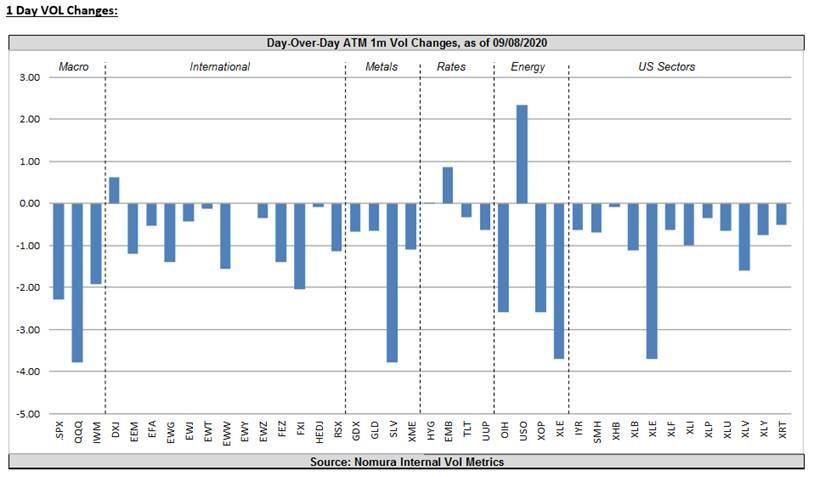
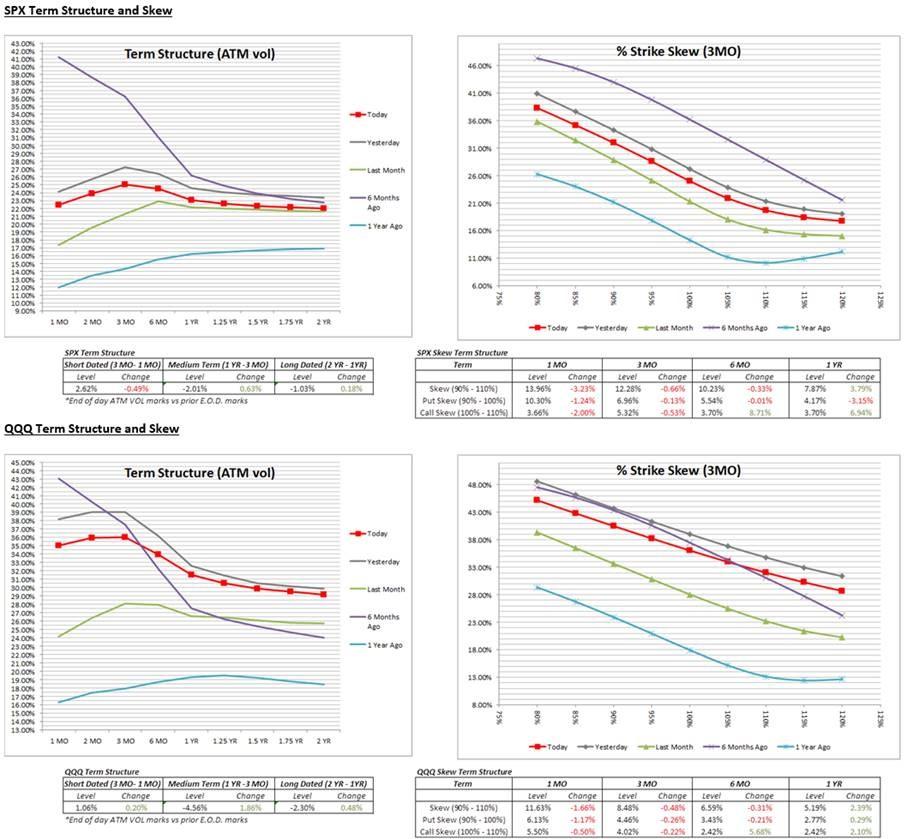
Yet despite Tuesday’s violent sell-off, with vols already massively elevated in the market largely due to the now notorious SoftBank gamma gamble and “riding down the skew” as the market sold off, we saw “enormous pressure on vols” which finished significantly lower across the term structure and across products (incidentally, had SoftBank not been in the market, it is certain that the VIX would have closed far higher). And while flows were generally quiet, Morgan Stanley’s trading desk “did see some accounts coming in to fade the weakness by selling puts, notably in the tech space” suggesting that gamma is close to neutralizing if not there already. 

Confirming these observations from Morgan Stanley, Nomura’s Charlie McElligott adds that “through the course of yesterday’s US Eq session, we began seeing a number of tactical clients take profits in their downside trades and pivot into various “buy the dip” expressions (e.g. selling QQQ Puts, AAPL CS 1x2s, Riskies), playing options for a bounce.”

This, as the Nomura cross-asset strategist points out, “is healthy: vols were finally hit meaningfully lower with term-structure flattening powerfully and Skew smashed on account of the Put Wing coming off sharply” as traders are now playing options for a bounce (SoftBank copycats?)

Which brings us back to Morgan Stanley, which writes that while the Nasdaq tumbled almost 5%, momentum was down just 66 bps, while Tuesday’s outperformance of the 12-month leaders, MSQQUMOL, vs. QQQ, was the largest it has been in more than 2 years (1.8%).

As the bank further notes, “the expectation is that Momentum should be down more, given Tech’s sell-off and in light of the spike in volatility from the Long leg of Momentum the last month. However, it is not uncommon for Momentum to be higher during large QQQ sell-offs. Over the last 2 years, Momentum has been positive more than half the time QQQs were down -3% or more.”

The underperformance of QQQs to Momentum, and other expensive, growth proxies, is the combination of 3 things:

  1. Underperformance of mega-cap Tech
  2. Energy lagging and other net underweight skew in MSZZMOMO
  3. The rally in re-opening oriented trades

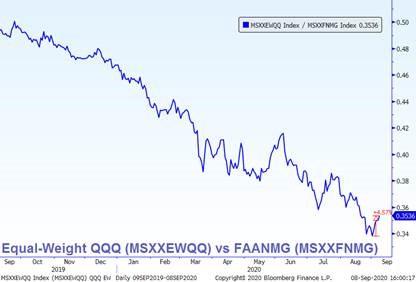
In other words, not only is SPX underperforming IWM, but it’s the large cap Tech really driving the move in QQQs. Of the -4.7% move in QQQ today, FAANMG + TSLA are responsible for 65% of the move. Their combined weight in QQQs is ~50%.  Meanwhile, these same names are just 5.5% of the MSQQUMOL index, which limits their impact on the broader Momentum factor. The increased volatility of these mega-caps shows up in the chart below. Equal-Weight QQQs (MSXXEWQQ) has outperformed FANG+ by 4.5% the last week after a 1y of consistent underperformance.

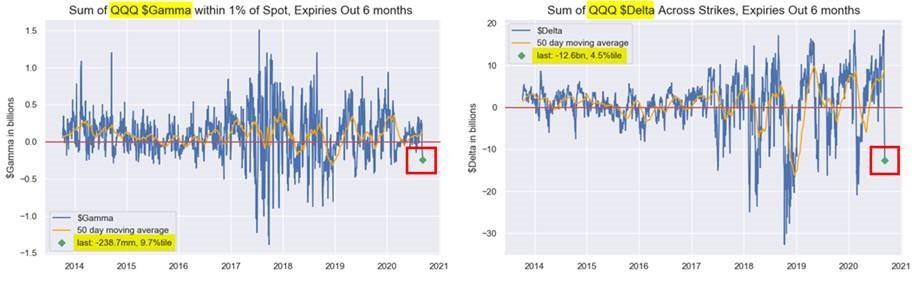
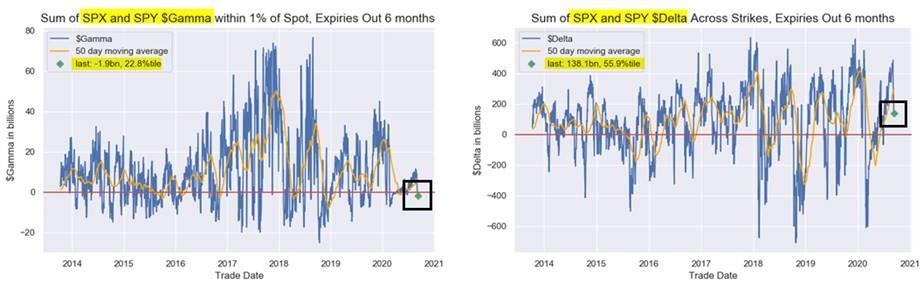
Aside from mechanistic kneejerk reactions, McElligott then adds that we are now seeing the “right kind of washout” movement in Nasdaq dealer Gamma and Delta, which as first observed yesterday, was “absolutely shattered” into negative territory and extreme (low) rank: as shown below, Gamma is now -$238.7mm tumbling to just the 9.7 percentile, while Delta is -$12.6B at just 4.5 percentile. In other words we have gone from one delta extreme to another.

Away from the Nasdaq, greek action is much more sane across broader markets too, with McElligott noting that for consolidated SPX/SPY options dealer Gamma has also turned negative at -$1.9B and 22.8%ile with Delta $138.1B, totally middling at 55.9%ile.

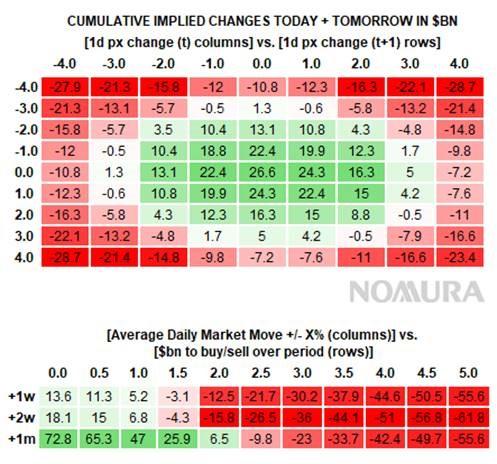
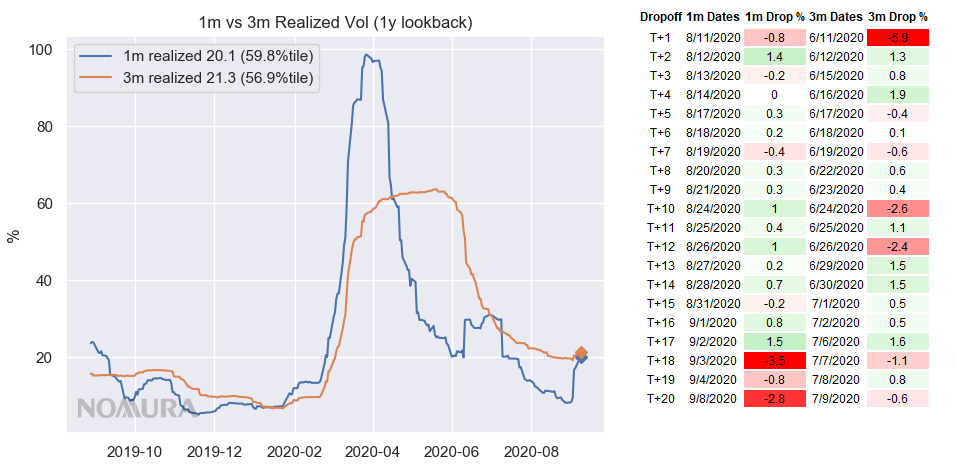
Picking up on last week’s note from Goldman pointing out the massive spread between realized and implied vol (which was largely a byproduct of SoftBank’s action), the Nomura strategist observes that this “tug of war” on the Vol Control “flow sequencing” is going to be a close call “because 1m realized is rapidly catching up to 3m realized—and as we look at the max of the two, this will matter the near-term fate of their exposure maintenance.”

This is important for vol targeting funds such as CTAs and risk parity in determining what they end up doing next, and according to Nomura, currently 3m realized vol remains the primary vol-control input, “and despite yesterday’s VC strategy selling and likely incremental follow-through today, the drop-off of the 6/11/20 -5.9% SPX day from the 3m realized lookback window, we would expect to see a large mechanical releveraging off the removal of that point alone, with very large buying imminently (tomorrow).”

That said, Charlie hedges by pointing out that after this imminent “buy” and its residual impact, “the recent violent adjustment higher in realized (catching up to implieds) will likely mean that we should expect that this recent 3-4m “latent bid” in futures from VC strats likely turns into at least a medium-term supply source thereafter (selling futures to lower exposure vs tgt) and especially if the 1m overtakes the 3m” unless in a reversal of the moves seen in August, we see vols correct lower quickly with market consistently “higher” again, which however even with the SoftBank effect now off the table, seems somewhat unlikely due to the nature of election proximity and likelihood that vol dealer risk toleranace will continue shrinking into the event risk, resulting in “increasingly erratic pricing and likely sticky tails at the very least.”

Vol control funds aside, McElligott concludes that “it is particularly critical” that we see the Nasdaq leading the charge today where we are already up some solidly in futures, while WTI has also stopped its “brutal bleed” from yesterday as discussed earlier.

But perhaps the most important catalyst for what comes next is that despite the 3-day tumble, megacap proxies held key levels (AMZN @ $3150, PYPL @ $185), re-opening beta was squeezed alongside stay at home (LYFT +4%, EB +4% vs ROKU +2%, PTON +6%) and broader sell pressure was generally uninspiring (QQQ traded $25B notionally vs ~$70B last Thursday and Friday combined).

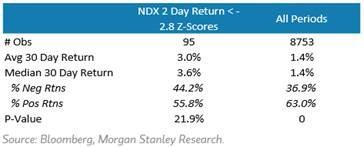
Finally, if one goes simply by historical evidence, here is a snapshot courtesy of Morgan Stanley of what has happened in the past after notable Nasdaq selloffs. As the Gen-Zers on Robinhood would say, BTFD.


via ZeroHedge News https://ift.tt/3m5veVS Tyler Durden

EUR Spikes On ECB Optimism Headlines

EUR Spikes On ECB Optimism Headlines

Tyler Durden

Wed, 09/09/2020 – 08:54

Bloomberg reports that, according to euro-area officials familiar with the discussions, tomorrow’s ECB statement will show some European Central Bank policy makers have become more confident in their forecasts for the region’s economic recovery, potentially reducing the need for more monetary stimulus this year.

GDP for this year will be revised up, one person said, with private consumption in particular doing much better than expected.

The headline alone was enough to send EURUSD up 60 pips…

Source: Bloomberg

…because, as algos may not realize, The ECB has been so ‘accurate’ in its forecasts historically?

As a reminder, a week ago we warned of the possibility of a big EUR drop (which it did, helped by comments from European Central Bank chief economist Philip Lane) and it now seems like ECB members want to jawbone it back up?

Source: Bloomberg

However, Bloomberg somewhat buries the lead by noting that the officials also said that in their view additional monetary support beyond the current 1.35 trillion-euro ($1.6 trillion) emergency bond-buying program doesn’t appear warranted from the current perspective, though that could change.

via ZeroHedge News https://ift.tt/2ZldGLn Tyler Durden

Blain: It Might Wobble Into A Crash As “Cataclysm Of Long-Denied Bad News” Hits Market

Blain: It Might Wobble Into A Crash As “Cataclysm Of Long-Denied Bad News” Hits Market

Tyler Durden

Wed, 09/09/2020 – 08:30

Authored by Bill Blain via MorningPorridge.com,

Correction, Or What?

“If it smells like, tastes like, and looks like, then it probably is…”

It feels the current correction is going deeper. It might even wobble into a crash. A cataclysm of long-denied bad news is hitting the market; rising pandemic infections (but death rates way down), renewed social distancing rules – no more than 6 people together in the UK, and a string of negative corporate news. Markets are likely to suffer more bad news as October marks rising unemployment and ongoing pandemic misery.  

On the other hand – central banks can’t afford a market crash, and Donald Trump can’t either. The American’s look poised to push another stimulus package and the Fed will do what the Fed has to do.. Will it work..? I suspect there is something more fundamental going on the hive mind of the market… but more of that later this week.. Yep… I’ve got an idea..and its not just trying to explain how MMT might work.

Did you know today is World Electric Vehicle Day? Nope? Me neither. But its very Apt. 

This morning Boeing and British Airways got lucky – their bad news is buried behind the long-anticipated conflagration of Tesla. As Tesla stages a $100 bln cap rout, the tech rot is spreading fast – pulling down Softbank y’day as the implications of its option-whale investment strategy sank in. It must have hurt the Saudi’s to discover the chaps they thought were new economy tech geniuses are actually just a shower of stock market gamblers. 

Its only seven days since I last warned about Tesla in a post called “Irrational is rational”. I was questioning the hype around Tesla’s “Battery Day” later this month, and the irrationality of a company that produces less than 1% of the world’s autos and has never made any real profit selling cars, being worth more than the rest. I also raised the issue of stock sales by long-term holder Bailie Gifford. 

My timing was lucky but sublime. The following day the stock’s speculative tumble began. Looks like it was Tesla’s non-inclusion in the S&P, the revelations about Softbank ramping via options, or maybe it was their cheeky little $5 bln capital raise at the very top of the market… but the stock is now down 34% – back to where it was in mid-August. Which is still 8x its price this time last year! 

Regular readers will know I’m not of fan of Elon Musk. But let me try and describe what’s going to happen in a non-partisan manner. It’s not going bust, and it won’t default, but there are massive risks swirling around Tesla. My call is Tesla down 34% is not a correctionThat pop you heard was the sound of the Tesla bubble bursting. 

I will be bombarded by troll-mails explaining in barely literate terms what an idiot I am. The fanboys will tell me Tesla is going to $5000. Stop. Credit where credit is due: Tesla relaunched/created the EV market and makes good cars. It’s just not worth $300 bln. Its fair value – including a premium for what its achieved – is a fraction of its current market cap. 

The fact that Tesla’s massively overhyped bubble has now popped generates enhanced risks and downside momentum of their own making. If Tesla stock doesn’t stabilise quickly, the downside problems could swiftly cascade, accelerating the downward price into, perhaps, a death-spiral. 

The realisation the stock was massively inflated will have serious implications for its current market cachet and sales. If the price tumbles – who will want to be seen driving one out the showroom? (Maybe I’ll buy one in the hope it becomes the DeLorean of the future?) The other car makers are launching their EV and Hybrid competitors – they might be inferior and have a lower range, but buyers know they will be there next year. So will Tesla.. but the damage is done.

Troubles for Tesla will not come singly – but in mighty battalions. 

When the firm’s market cap is down to a more sober $40 bln (which is where it was last year), maybe it’s leadership in battery tech, the value of the data its acquired and marshalled for autonomous driving, and owning 20% of the growing EV market, might make it interesting as an expensive acquisition or as a partnership backdoor into EVs and meeting CO2 emission targets. Regulatory credits have underlain the bubble. It’s been the sales of credits which have enabled the company to declare a profit despite loss making car sales. They could be Tesla’s most valuable asset. 

Yesterday’s $2bln deal GM struck with Nikola (the EV and Hydrogen fuel-cell truck maker that hasn’t yet built a vehicle) is one way forward. $2 bln buys GM 11% of the company and access to its future regulatory credits as it builds the new Badger truck. The deal will pay for itself in the credits alone. GM and Nikola stock surged as Tesla plummeted.  GM gets a seat at the EV table and Nikola’s board.

The $5 bln equity Tesla just raised should ensure its solvency though its coming existential crisis… but for one further major issue… 

My big big problem with Tesla is Corporate Governance– the most important of the ESG criteria. Tesla is Elon Musk, and he’s a looper. If I was a risk manager concerned about how my investment committee is going judge me on a possible 90% tumble in Tesla’s stock down to a notional fair value, I might be concerned how Musk ever passed Governance and suitability tests.

Musk’s loose cannon comments and twitterstorms on the SEC, his abuse of markets and individuals who’ve crossed him is well known. On the other hand, his unique-Musk-ness got Tesla to where it is today. Without him, Tesla will be perceived as nothing, but his style certainly won’t fit any future partnership. Any future investment thesis on Tesla should include taking Elon out of his stratospheric option package. 

A bigger risk may be more immediate; Musk losing interest, declaring his brief tenure as one of the richest men on the planet means he is done… and will now focus on linking his brain to a laptop, drilling tunnels under cities, or maybe launching himself to Mars. Good luck to him. 

The bottom line… what’s the upside for Tesla from here? 

I might be wrong, and I’ve been declaring Tesla a bubble for 2 years… but even a stopped clock is right twice a day.. 2 years ago I put WeWork, Telsa and HSBC on my crisis list. I added Boeing to the list last year. 1 Gone, 3 down but not yet out. Let’s see. 

Meanwhile.. 

Aviation – things get worse for Boeing as B-787 Dreamliners are grounded after dangerous construction defects are discovered.. Even more interesting was a significant number of IAG shareholders staging a revolt over management pay. Outgoing IAG chief Willie Walsh took home a miserable £3.2 mm last year. 

A mate of mine, a pilot flying one of BA’s vintage airplanes till the pandemic saw him binned a few months ago, is now a delivery driver for a supermarket chain. He’s not the only one – a West-End theatre director joined alongside him the same day. He says he’s never been happier. 

via ZeroHedge News https://ift.tt/2GNqsfz Tyler Durden