Bad Breadth

Bad Breadth

Tyler Durden

Wed, 07/22/2020 – 13:45

Via Dana Lyons’ Tumblr,

Monday’s market breadth was historically poor given the performance in the major averages.

Like a breath mint for halitosis, sometimes the performance in the popular, cap-weighted stock averages can mask underlying weakness in the overall market breadth (i.e., advancing vs. declining stocks). As such, market conditions may not be quite as robust as the indices would suggest. Monday’s action was a good example of that as market breadth was historically poor given the performance of the large-cap indices. To wit:

On Monday, the cap-weighted large-cap S&P 500 (SPX) gained 0.84%. Despite that solid gain, the broad NYSE Composite actually closed slightly down on the day as there were more declining issues than advancers on the exchange. In the 55 years of data in our database, that is just the 4th time – and the first in 40 years – that the SPX has gained that much on a day that the NYSE was down.

Relaxing the parameters a bit, we dove a little deeper into the data and identified all days during that period that saw the SPX gain at least 0.55%, while within 12% of a 52-week high, when the NYSE closed down on the day. This chart shows all 9 such days in the past 55 years.
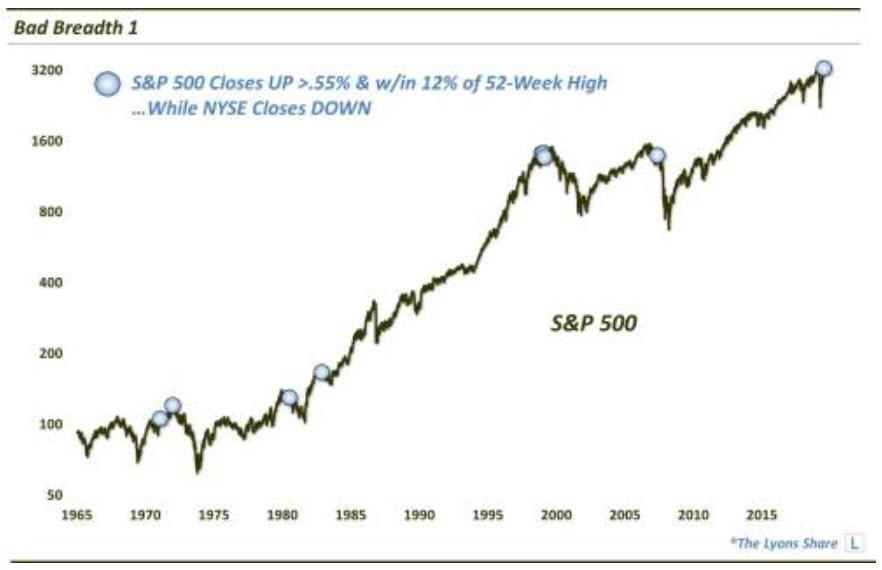
As you can see, several of the previous incidents occurred at quite inauspicious times in the market – including near cyclical peaks in 1973, 1980, 2000 and 2008. History does not have to repeat, but these are not exactly optimistic precedents.

Another example of the disparity between the performance of the popular large-cap averages and those broader indices on Monday can be seen in a comparison between the large-cap Nasdaq 100 (NDX) and the Russell 2000 (RUT) small-cap index. Specifically, the NDX closed up nearly 3% on Monday to a new all-time high. On the flip side, the RUT actually closed down on the day by 0.36%. The only other date in our 30 years of data on the 2 indices that saw this combination of behavior was the 1st day of the millennium (also not a great time to be buying stocks).
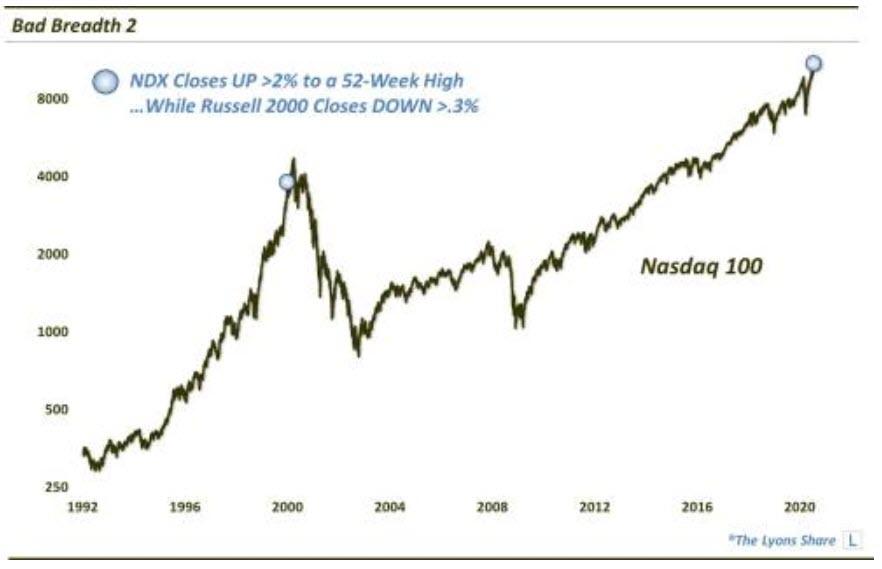
So, what is the takeaway here? Is the stock market doomed? Well, we wouldn’t put a ton of stock into a 1-day phenomenon, despite the ominous precedents. There are certainly more important factors that go into our investment decision-making process, namely our objective, quantitative models. However, this is another among a growing collection of red flags – and it will definitely garner more attention from us should this pattern of “bad breadth” continue.

*  *  *

How much “stock” are we putting into this data point? How is it impacting out investment posture? If you’re interested in an “all-access” pass to all of our charts, research — and investment moves — please check out our site, The Lyons Share. You can follow our investment process and posture every day — including insights into what we’re looking to buy and sell and when. Thanks for reading!

via ZeroHedge News https://ift.tt/2WLoyRr Tyler Durden
Senate GOP Weighs Short-Term Extension For Unemployment Aid While Lawmakers Fight Over Stimulus

Senate GOP Weighs Short-Term Extension For Unemployment Aid While Lawmakers Fight Over Stimulus

Tyler Durden

Wed, 07/22/2020 – 13:25

With a $2.5 trillion gulf between Republican and Democratic stimulus packages – and ongoing negotiations between the White House and Senate GOP over issues such as a payroll tax cut favored by President Trump, chances of a successful negotiation happening anytime soon are fleeting at best – and will most likely continue beyond when the $600 weekly unemployment carved out under the Cares Act is set to lapse at the end of the month.

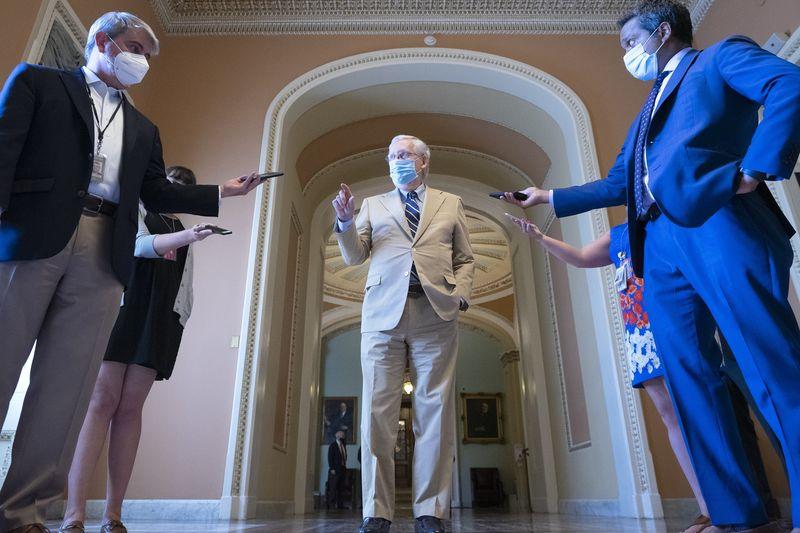
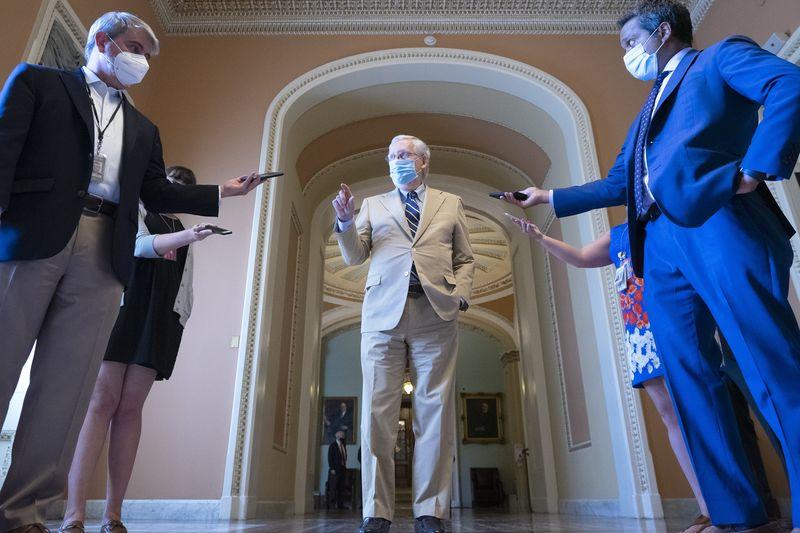
Mitch McConnell speaks at the U.S. Capitol. Photographer: Stefani Reynolds/Bloomberg

Notably, the Republicans are aiming for a $1 trillion stimulus package, while Democrats have a $3.5 trillion price tag on theirs.

In order to address what will undoubtedly be a protracted negotiation, lawmakers are considering a side-deal which would extend the unemployment bonus, according to Bloomberg.

While Republicans have criticized the $2,400 per month stipend as a disincentive to seek work, the plan to extend the benefits has drawn the support of GOP Senators, including Marco Rubio (R-FL), who acknowledged that lawmakers are considering the plan. That said, the size and scope of any extension is currently unknown.

Both parties also support extending supplemental unemployment benefits. Some Republicans have floated the idea of structuring it so that unemployment insurance replaces 70% to 75% of previous wages rather than the flat $600 per week boost to state benefits in the last stimulus. But others, including Finance Committee Chairman Chuck Grassley of Iowa, have insisted that the solution has to be simple enough for the states to easily implement. –Bloomberg Tax

Not in favor of the extension is House Majority Leader Steny Hoyer (D-MD), who said “I would prefer not to see a short-term extension,” adding that he wants “to give people the security they are not going to be let down and fall through the cracks in September and October.”

Meanwhile, the White House has softened its tone regarding a mandatory payroll tax holiday, though on Tuesday Press Secretary Kayleigh McEnany said that President Trump is still in favor of the measures.

Chief of Staff Mark Meadows echoed this sentiment, saying in a Tuesday statement on Capitol Hill: “I don’t know that in any negotiation that there are red lines, but there are certainly high priorities and it will remain a very high priority for the president.

Meadows and Treasury Secretary Steven Mnuchin are returning to the Capitol Wednesday after an initial round of talks with Senate Republicans ended without a clear outline or any lessening of GOP resistance to President Donald Trump’s desire for a payroll tax holiday. –Bloomberg

Also on Tuesday, Senate Majority Leader Mitch McConnell (R-KY) outlined some of his own priorities – namely extending the PPP loan program for small businesses, as well as another round of direct payments to individuals.

via ZeroHedge News https://ift.tt/2CXapcW Tyler Durden

20Y Treasury Prices At Record Low Yield Amid Relentless Demand For Duration

20Y Treasury Prices At Record Low Yield Amid Relentless Demand For Duration

Tyler Durden

Wed, 07/22/2020 – 13:14

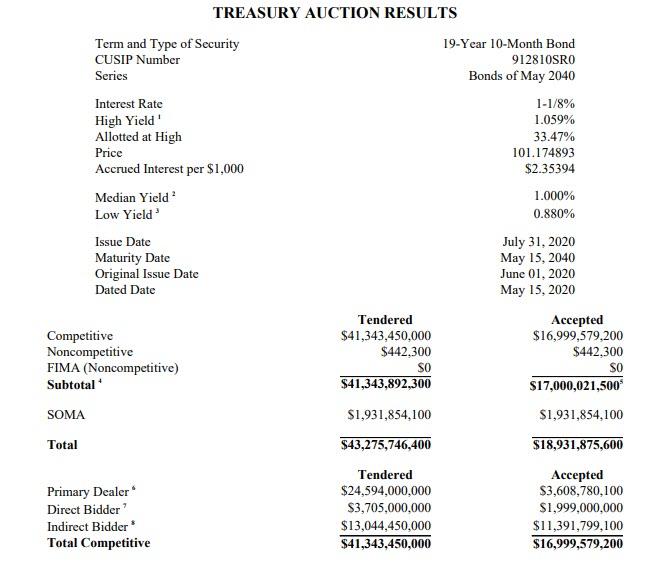
Two months after the first 20Y auction in 34 years priced at a yield of 1.22% amid surprisingly strong demand, moments ago the Treasury sold its third batch of the recently restarted 20Y Treasury in the form of a $17 billion reopening (19-years-10-months) of the original Cusip (SR0), which priced at a high yield of 1.059%, far below last month’s 1.314%, yet tailing modestly to the 1.050% When Issued.

The auction metrics are as follows:

  • Bid to Cover: 2.43x compared to 2.63x last month and below the 2.53x in the inaugural, May auction.
  • Indirects: 67.0%, well above both June’s 61.6% and May’s 60.7%
  • Directs: 11.8%, a bit drop from the 16.5% in June, and also below May’s 14.7%
  • Dealers: 21.2%, almost unchanged from last month’s 21.9%.

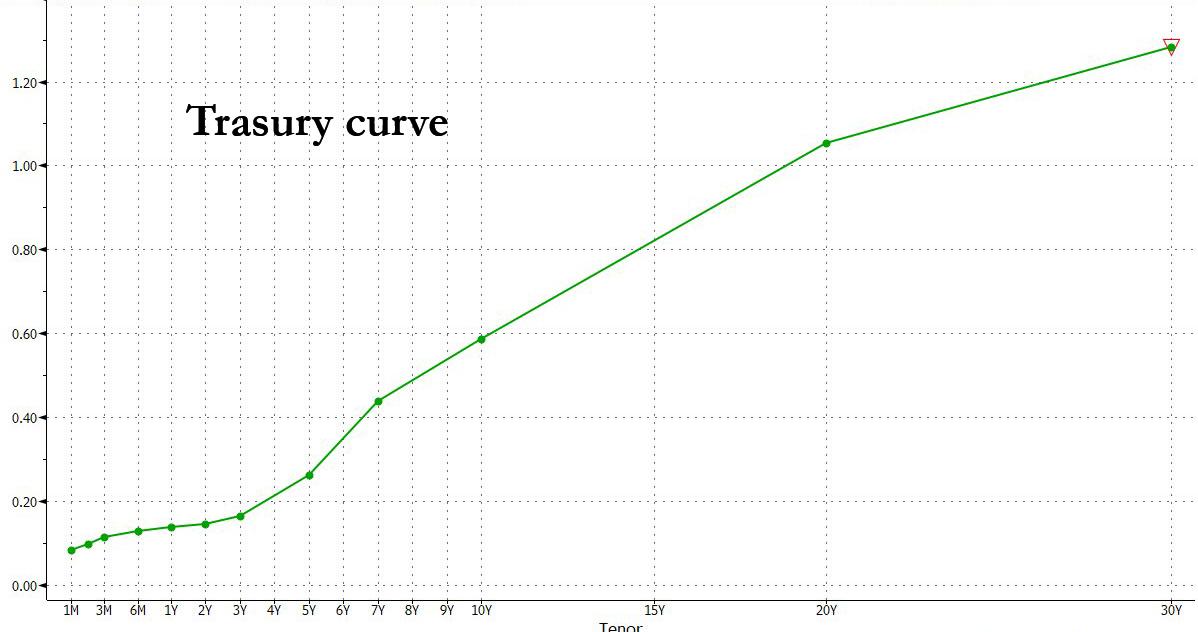
One possible reason for the modest tail is that the curve has been rallying, with 10Y trading below 0.59%, just shy of all time lows, thus providing little opportunity for concession.

Of course, since there is just one auction in recent history to compare today’s auction to, superficially the auction was quite strong, although one look at the curve shows that the 20Y is somewhat “kinky” on the curve.

via ZeroHedge News https://ift.tt/39hjObx Tyler Durden

Following The Bitcoin: How The Twitter-Hackers Are Cashing-Out

Following The Bitcoin: How The Twitter-Hackers Are Cashing-Out

Tyler Durden

Wed, 07/22/2020 – 13:05

Authored by Will Heasman via Decrypto.co,

In brief

  • Ciphertrace is tracking the stolen Bitcoin from the Twitter hack last week.

  • Hackers have shifted the funds through coin mixers, exchanges, and gambling sites to obscure its movement.

  • With the community’s eyes on the funds, it’s going to be difficult to cash out.

Last week hackers hijacked Twitter, taking control of the accounts of several high-profile individuals. But rather than start World War 3, they elected to run a simple Bitcoin scam – swindling a total of 12.5 Bitcoin ($120,000). 

Now, the Bitcoin is on the move, and here’s how the hackers are trying to escape with their spoils.

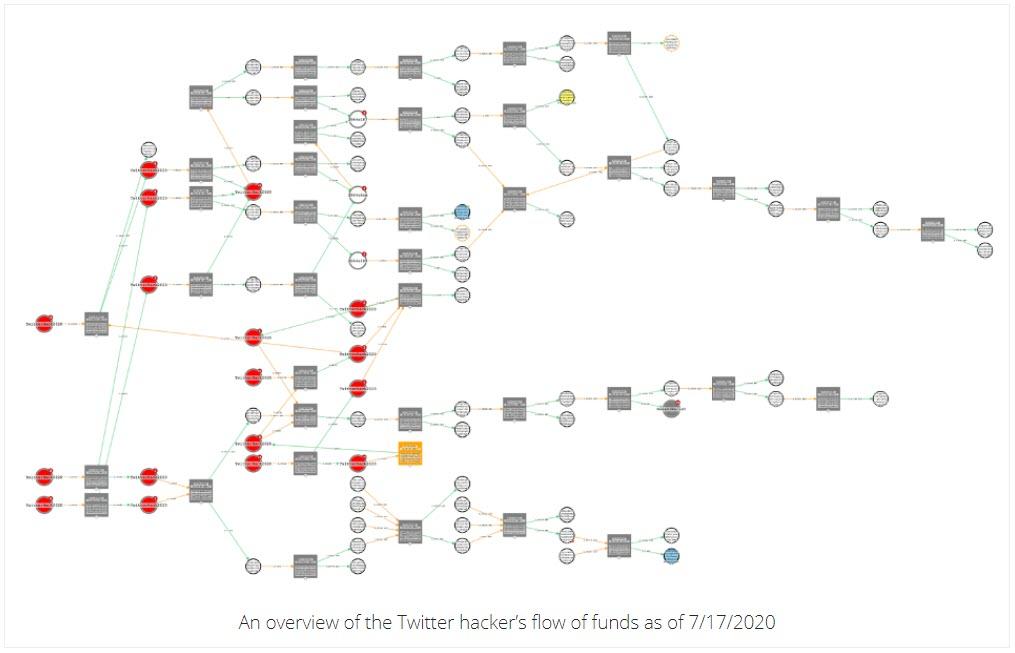
According to blockchain analytics firm Ciphertrace, the hackers are using a combination of Bitcoin mixing services, gambling sites, exchanges—and even defunct addresses—in an attempt to both hide the money and turn it into other currency.

The first port of call was a Bitcoin mixing service. These let people swap their Bitcoin for someone else’s Bitcoin—while obscuring the identities of both parties. They’re often used to “clean” stolen Bitcoin.

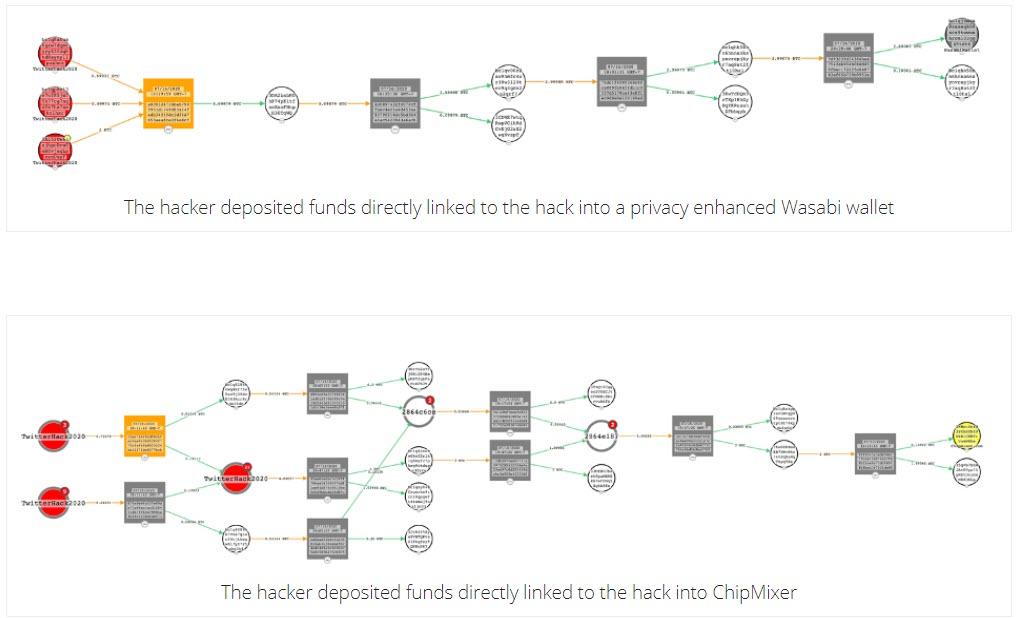
On July 16, one day after the hack, attackers sent 2.89 Bitcoin (roughly 22.5% of the total haul) to Wasabi—a privacy-centric Bitcoin wallet with a built-in mixer. It’s a very effective way of stopping any observers from following the money trail.

A day later, a further 0.1022 BTC moved into another Bitcoin obfuscator, Chipmixer. Ciphertrace was unable to follow the Bitcoin any further.

Ciphertrace tracked the scammed funds to two coin mixers. Image: Ciphertrace

Over the next few days, Ciphertrace tracked piecemeal amounts of the rest of the scammed funds to peer-to-peer exchanges and gambling sites. Just over 1 Bitcoin—roughly 8.5% of the Twitter plunder—was sent to an unnamed Singapore-based crypto exchange.

Ciphertrace’s overview of the Twitter hacker’s flow of stolen Bitcoin. Image: Ciphertrace

An unspecified portion of Bitcoin then traveled to an inactive Binance cold wallet.

“CipherTrace believes that this transaction was not made to cash out funds, but rather to troll,” reads the reports. The idea being that the hackers know the funds are being watched and they just want to confuse or infuriate anyone watching.

Who hacked Twitter?

Per a report from the New York Times, contrary to conspiracies of elaborate schemings from a rival nation, the hack was purportedly initiated by a group of youths. The alleged adolescent attackers told the Times how they managed to gain access via information left on Twitter’s internal Slack channel.

Since then the person, known as Kirk, who had the access to Twitter has since disappeared. 

via ZeroHedge News https://ift.tt/2ZObnBl Tyler Durden

United Airlines Defers Plane Deliveries To Beyond 2022 As Air Travel Remains Muted

United Airlines Defers Plane Deliveries To Beyond 2022 As Air Travel Remains Muted

Tyler Durden

Wed, 07/22/2020 – 12:50

United Airlines Holdings Inc. said Wednesday morning, all new aircraft deliveries due in 2022 have been deferred as air travel for the next several years will remain depressed. The Chicago-based company also said 32,000 employees have volunteered for a temporary leave of absence.

Earlier in the morning, United Airlines’ CEO Scott Kirby told CNBC that estimated sales would not recover in a V-shaped formation until there’s a proven vaccine for COVID-19. 

“Our guess is that revenue will get to about 50% of what it was in 2019 in a pre-vaccine world,” Kirby told CNBC. Once we get past a vaccine and it is widely distributed, we will quickly recover towards 100%, but our guess is we are going to plateau at 50% until we get to a vaccine.”

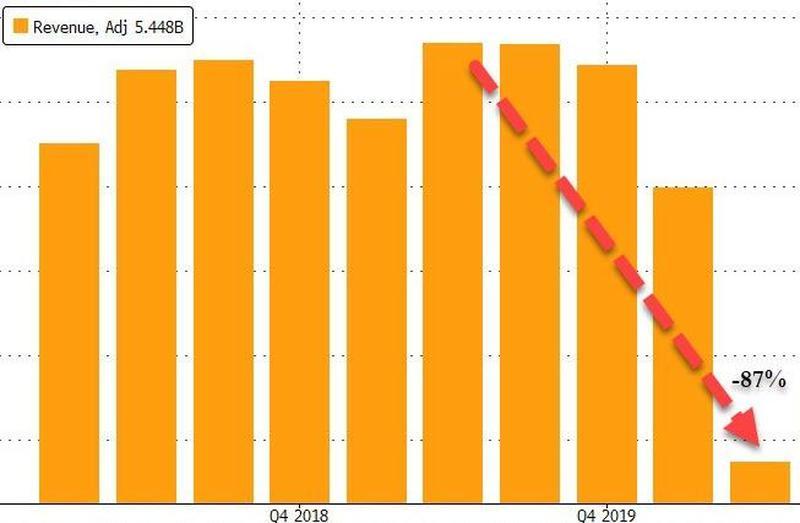
On Tuesday, the airliner reported revenues of $1.48 billion in 2Q20, an 87% crash from $11.4 billion during the same time last year. It said capacity in 3Q would be down 65% compared with the same quarter a year ago.

In early July, United Airlines warned 36,000 employees were at risk of losing their jobs in October when the federal payroll stimulus expires. 

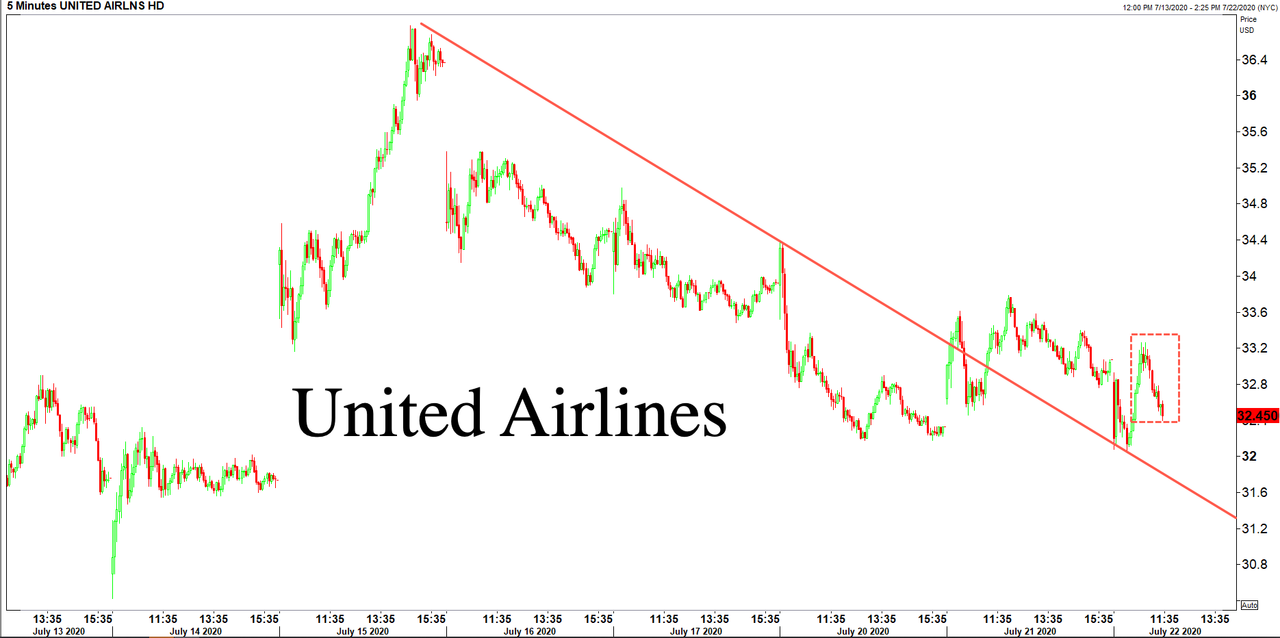
Shares of United Airlines slid nearly -2% on Wednesday. 

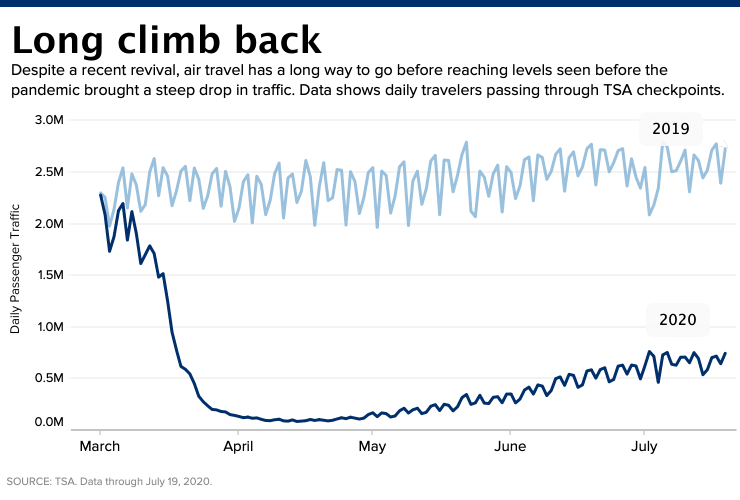
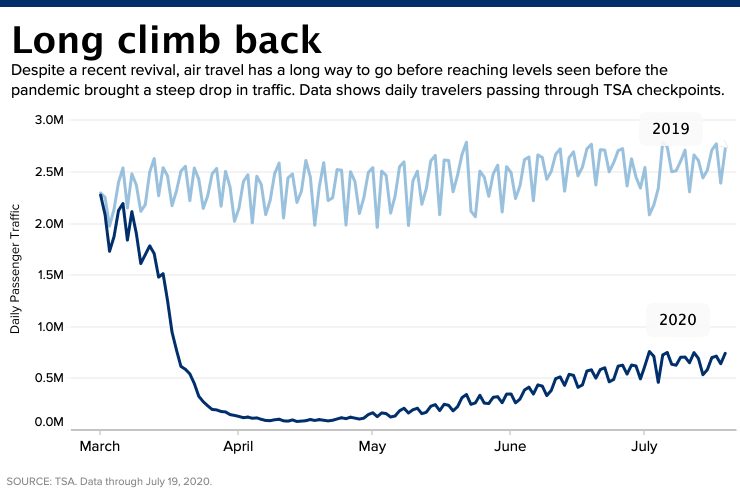
On Monday, the Transportation Security Administration (TSA) published new passenger data from US airports, showing the first slump in weekly air travel since April. 

h/t CNBC 

United Airlines’ deferment of planes due in 2022 suggests the travel and tourism industry will remain muted for a couple of years. It also implies there’s no V-shaped recovery in the economy this year

via ZeroHedge News https://ift.tt/3hphu52 Tyler Durden

Is Tesla’s Model 3 Price Cut In China Indicative Of A “Significant” Demand Problem

Is Tesla’s Model 3 Price Cut In China Indicative Of A “Significant” Demand Problem

Tyler Durden

Wed, 07/22/2020 – 12:35

Submitted by Gordon L Johnson of GLJ Research

TESLA PRICE CUT ALERT: TSLA Cut the Price on its Model 3 LR MIC by -6.1% Last Night; the Company Appears to Have a “Significant” Demand Problem in its Key “Growth” Market (i.e., China)

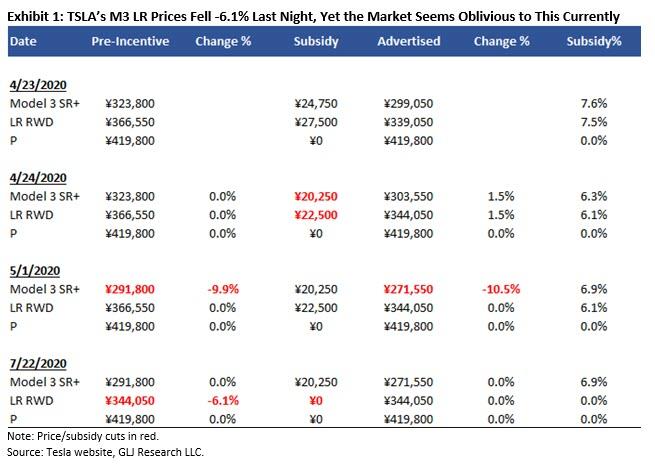
WHAT’S THE NEWS? Yesterday morning, the price on TSLA’s website for its Model 3 Long-Range (“LR”) made-in-China (“MIC”) car was ¥344,050, which included a Chinese subsidy of ¥20,250 (i.e., see the asterisk for the Model 3 SR+ MIC car and Model 3 Performance MIC car here) – the asterisk that denoted the ¥20,250 subsidy for TLSA’s M3 LR MIC car was removed this morning, but the ¥344,050 price to the consumer remained, meaning TSLA “ate” the removal of the subsidy by the Chinese government.

Stated differently, the price TSLA was collecting on each Model 3 LR MIC sold as of yesterday was ¥366,550 (i.e., the listed price to the consumer of ¥344,050 + the Chinese subsidy of ¥20,250 = ¥366,550). However, today, the price TSLA is collecting on each Model 3 LR MIC sold is ¥344,050, or -6.1% less than it was collecting yesterday (Ex. 1).

In short, we glean three key takeaways from the above developments, including:

  1. This will be a significant drag on TSLA’s 3Q20 margins (although we haven’t seen any media outlets yet cover this [material] development to the company’s forward outlook);
  2. In addition to TSLA’s production exceeding deliveries in 2Q20 by 3.673K cars (Ex. 2) – showing demand is less than what it produced – as well as its cars appearing in a liquidation channel at fire sale prices in China yesterday (link), this morning TSLA cut the price for its most popular car by -6.1% — as our readers are well aware, today’s price cut follows the 5/1/20 -9.9% price cut TSLA implemented for its M3 SR+ car; at risk of stating the obvious, we believe TSLA has a major demand problem in the market that nearly 100% of pundits deem its “growth opportunity”; and
  3. For the Wall Street “investors” simply looking at TSLA’s perpetual pictures/renderings of its yet-to-be-built plants to support their growth projections (every auto-maker has plants, and does not call them “giga” even though they produce more cars in roughly two weeks than TSLA does all year), as well as E. Musk’s tweets, and not focusing on the actual company fundamentals, we now see elevated risk to TSLA’s automotive results disappointing Consensus.

CONCLUSION. While we expect TSLA to report a profit today after the close, demand for its cars in China, when taking the aggregate of the above into consideration, is in free-fall. In short, were this consensus thinking among the many professional investors who currently own TSLA’s stock, we believe the optimism currently underpinning the company’s current outlook would quickly turn to concern. While we continue to be cast in the media as “TSLA’s biggest bears”, we are simply producing real-time fundamental analysis on the company, rather than touting a product 1-20yrs out – i.e., cybertruck, semi, roadster, robotaxis, nuralink, etc. – that E. Musk is tweeting about (as many of our peers on the sell-side seem to do incessantly).

While TSLA’s stock is currently detached from reality, and thus a dangerous short, as investors are forced to re-focus on fundamentals (i.e., after S&P 500 inclusion), and do “real work” on the actual outlook for the products (i.e., cars) TSLA currently sells, we see outsized risk to TSLA’s share price coming under intense selling pressure – i.e., when investors realize what they actually own in TSLA.

via ZeroHedge News https://ift.tt/2E9qwVw Tyler Durden

It’s Getting Harder and Harder to Distinguish Satire from Earnest Wokeness

I’ve reprinted it below, in all it’s glory. After widespread ridicule, the Museum has apparently disowned the graphic, but likely not the ideology behind it. To add a perhaps superfluous comment, the notion that the U.S., spread across thousands of miles with multiple ethnic and religious groups and subgroups, has a single “white culture” should strike anyone with even a slight acquaintance with anthropology or sociology as inherently ridiculous. Which is not to take away from the ridiculousness of how that white culture is described.

from Latest – Reason.com https://ift.tt/32ILEfx
via IFTTT

Senate Committee Unanimously Votes To Bar TikTok From Devices Issued To Federal Employees

Senate Committee Unanimously Votes To Bar TikTok From Devices Issued To Federal Employees

Tyler Durden

Wed, 07/22/2020 – 12:20

Just hours after Washington’s order to shutter a Chinese consulate in Houston triggered a panicked document fire on the building’s balcony, the Senate’s Homeland Security Committee voted unanimously on Wednesday to approve a bill (put forth by Missouri Sen Josh Hawley) barring the social media app TikTok from being installed on smartphones used by federal employees on federally-issued devices.

Sen. Hawley

TikTok’s Chinese ownership and explosive popularity in the US have led to several companies to reportedly bar employees from installing the app on corporate-issued devices, due to fears – so far mostly unsubstantiated – that Beijing is using the app for widespread spying and data collection, Reuters reports.

In a statement from his press office, Hawley said that many federal agencies have already recognized the threat posed by TikTok.

The White House has discussed banning the app outright (something that has been ruled out for being too controversial) and the DoJ and FTC have launched investigations into data privacy abuses involving children.

Oh, and WSJ published this bizarre story about the app promoting American teens for pledging fealty to Beijing.

via ZeroHedge News https://ift.tt/30IuTi2 Tyler Durden

New Poll Shows More White Americans Now Oppose Black Lives Matter Than Support

New Poll Shows More White Americans Now Oppose Black Lives Matter Than Support

Tyler Durden

Wed, 07/22/2020 – 12:05

Authored by Paul Joseph Watson via Summit News,

After enjoying a surge in support following the death of George Floyd, a new polls reveals that a majority of white Americans now oppose the Black Lives Matter movement.

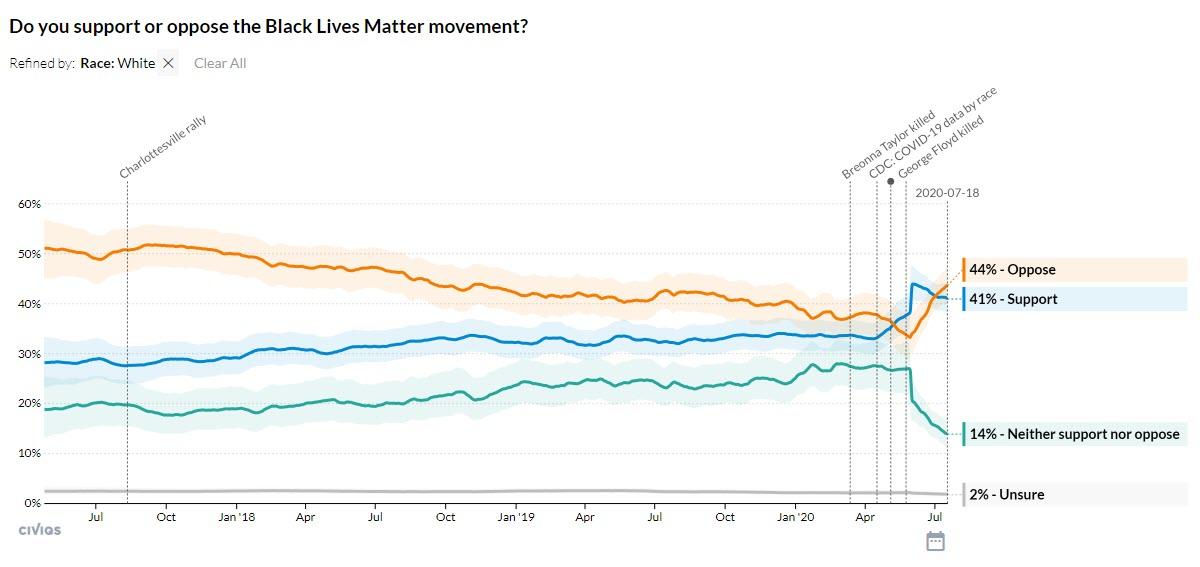
The survey, conducted by Civiqs, shows that in early June, 44 per cent of white Americans supported BLM and 34 per cent opposed it.

However, those numbers have now changed, with 41 per cent supporting BLM and 44 per cent opposing the movement.

Source: Civiqs.com

“This is a return to normalcy more than anything,” commented one Twitter user in response to the poll.

Source: Civiqs.com

The flip in support has no doubt been fueled by almost two months of rioting, looting and statues being torn down across America.

Despite the public now turning against the movement, giant corporations continue to virtue signal in support of BLM, although Red Bull bucked that trend by firing two directors who had tried to pressure the company to take a pro-BLM stance.

The founders of BLM openly state that the movement is about overthrowing capitalism, the “patriarchy” and western enlightenment ideals in general.

While many leftists would support that, it seems as though the majority of Americans don’t.

*  *  *

There is a war on free speech. Without your support, my voice will be silenced. Please sign up for the free newsletter here. Donate to me on SubscribeStar here. Support my sponsor – Turbo Force – a supercharged boost of clean energy without the comedown.

via ZeroHedge News https://ift.tt/2WI7XxR Tyler Durden

House Passes Defense Bill Renaming Confederate Bases, Setting Up Showdown With Trump

House Passes Defense Bill Renaming Confederate Bases, Setting Up Showdown With Trump

Tyler Durden

Wed, 07/22/2020 – 11:45

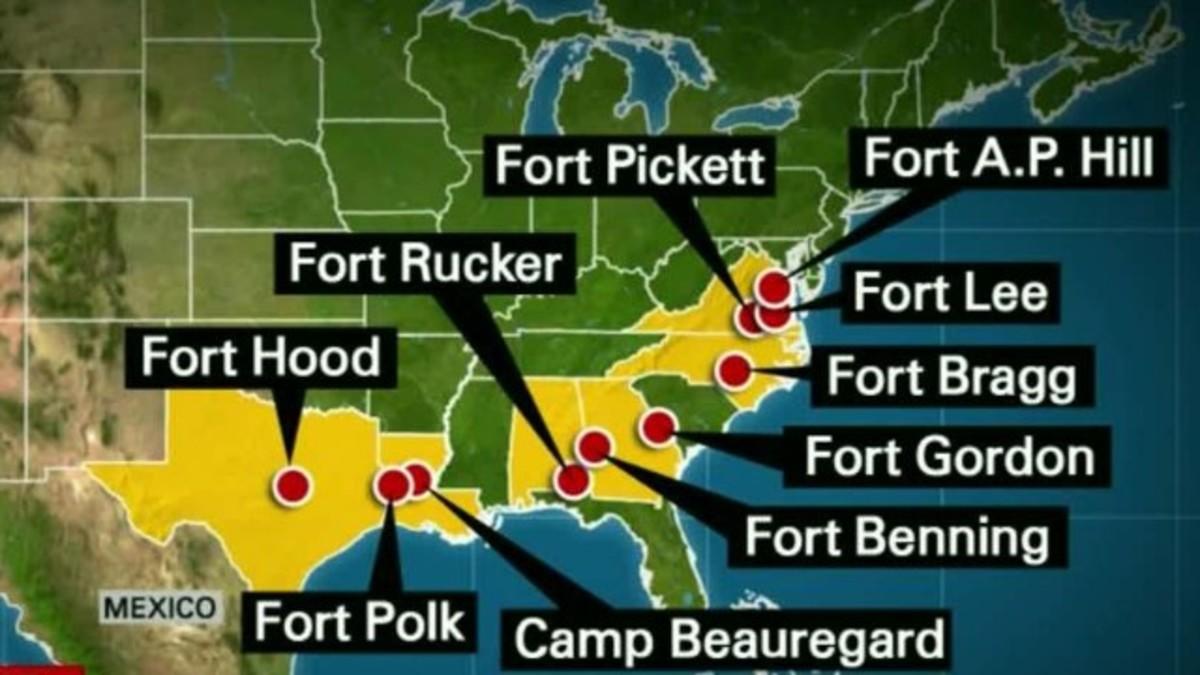
Who would have thought that in 2020 famous Army base names like Fort Hood or Fort Bragg might hold up America’s central and crucial defense spending bill?

On Tuesday President Trump said he would veto this year’s National Defense Authorization Act (NDAA) if it strips Confederate names from military bases. The issue which would see iconic longtime base names ditched for their Confederate ‘taint’ became front and center after months of George Floyd and Black Lives Matter protests rocked the nation. 

AP file image

This after the House passed it Tuesday in a 295-125 vote. The White House subsequently warned in a statement: “President Trump has been clear in his opposition to politically motivated attempts like this to rewrite history and to displace the enduring legacy of the American Revolution with a new left-wing cultural revolution,” according to Politico.

Another provision Trump reportedly objects to is limiting spending on Afghanistan, which he’s previously expressed a strong desire to pull out of, and what’s seen as other Democrat-led attempts to curb his authority. 

The current $740 billion is considered “must pass” legislation given it sets next year’s policy and spending for the Department of Defense, including pay for troops and defense hardware and combat gear acquisitions. 

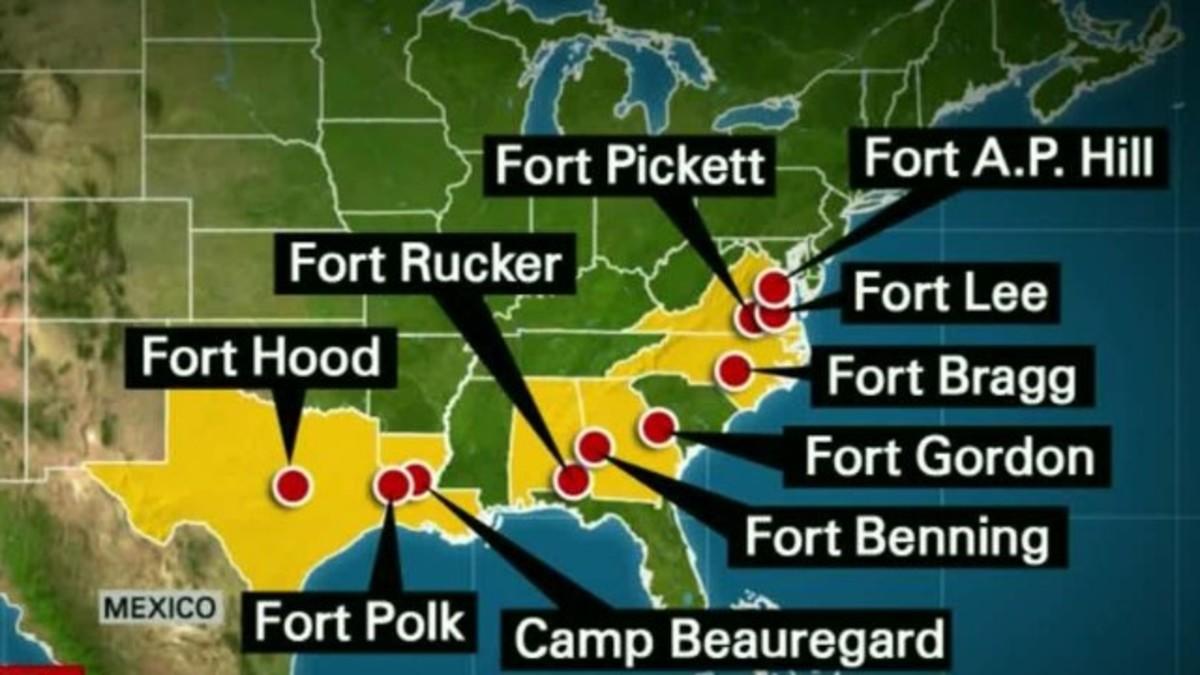
The Army has 10 Confederate-named bases in 6 Southern states. CNN/screenshot

Another interesting debate is centered in the Pentagon’s controversial program to transfer military-grade equipment to local civilian police departments, greater scrutiny of which came in the wake of George Floyd protests.

The Senate defeated an amendment which would have blocked the program. 

via ZeroHedge News https://ift.tt/2E6s5mZ Tyler Durden