David Koch, R.I.P.

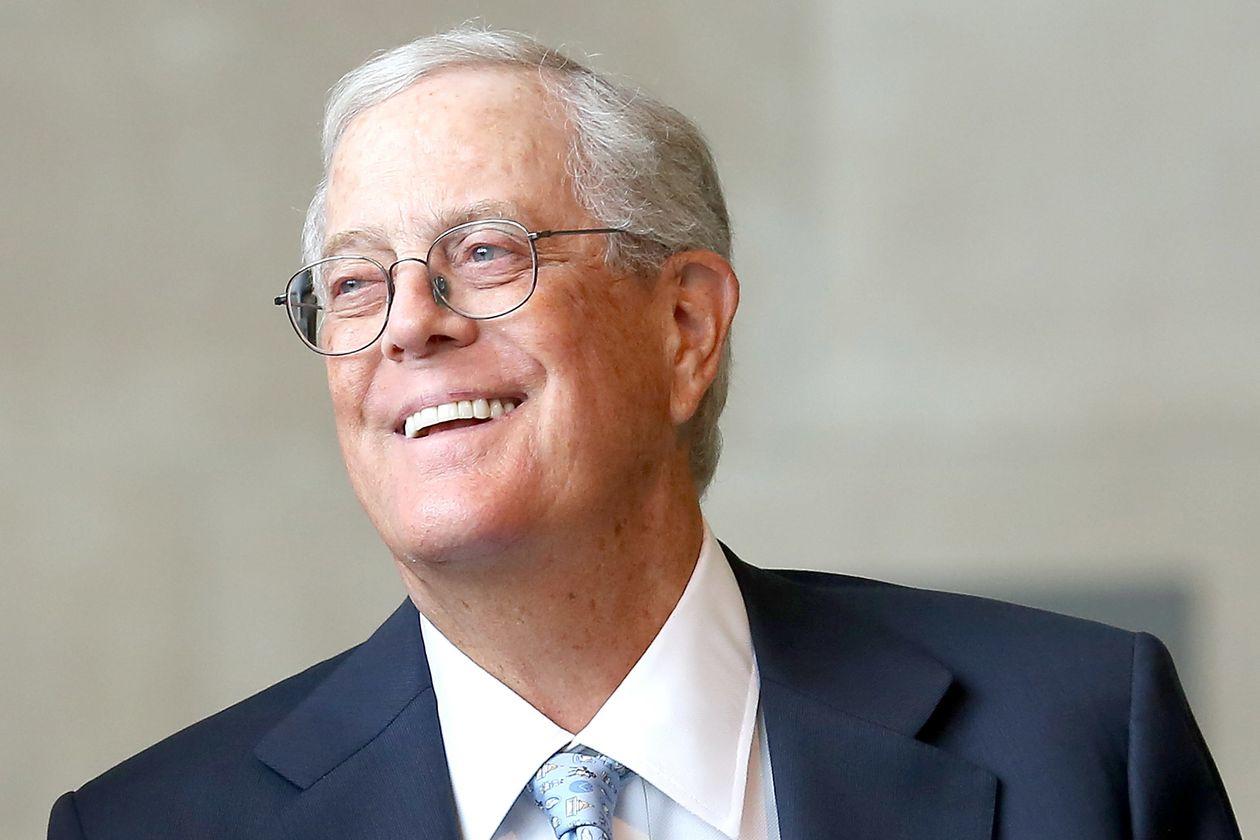
David Koch, who along with his brother Charles ran one of America’s most prominent political giving machines, has died at age 79.

Koch was one of four children of the oil industrialist Fred Koch, and along with his older brother Charles he became one of America’s richest men through the growth of the family business. Due to the brothers’ funding of political causes and candidates, the Kochs became betes noir of the American left. (Koch was for 36 years a trustee of the Reason Foundation, which publishes Reason magazine.) Often incorrectly described as a conservative or a Republican, David Koch was a lifelong libertarian whose work and giving reflected the values of free enterprise and limited government.

Born in Wichita in 1940, Koch earned undergraduate and graduate degrees in chemical engineering from MIT, where he also excelled in basketball. After working for outside companies from 1963 to 1970, including a stint at the management consulting firm Arthur D. Little, Koch began working in the family business in 1970 as a technical service manager at the subsidiary Koch Engineering for a salary of $16,000. He rose to be president of the division, and he went on to serve in various capacities in the set of privately owned family businesses, including president of Koch Engineering and Executive Vice President of Koch Industries. He retired officially last year because of his fading health.

In a 2005 interview for my book Radicals for Capitalism, Koch told me his father taught him that “big government was bad, and impositions of government controls on our lives and our economic fortunes was not good.” In the mid-1960s, with encouragement from Charles, he attended the Freedom School, an early libertarian educational institution run by Robert LeFevre, whose variety of libertarianism rejected both political activism and violence, even in self-defense. While LeFevre was one of their earliest exposures to the organized libertarian movement, both brothers denied that they ever embraced his entire package of ideas. As they began financing, working with, and guiding libertarian institutions in the 1970s, their activism involved support and promotion for the pro-market Austrian school of economics exemplified by Ludwig von Mises and F.A. Hayek. Libertarian educational institutions, think tanks, legal action groups, grassroots activism, magazines, criminal justice reform efforts, and student groups all received largess and guidance from the Koch brothers from the 1970s through the present.

In the 1980 presidential campaign, when recently imposed campaign finance restrictions hobbled third parties’ abilities to fundraise by severely limiting how much any single donor could give, David Koch took advantage of the fact that the rules allowed candidates themselves to self-finance as they wished: He became the Libertarian Party’s vice presidential nominee. He and running mate Ed Clark got more than 1 percent of the vote, a party record that would go unbroken until 2016.

Koch told New York magazine during that campaign that he’d been excited by the previous Libertarian presidential run by Roger MacBride, saying the party was “advocating all the things I believed in. [MacBride] wanted less government and taxes and was talking about repealing all these victimless-crime laws that had accumulated on the books. I have friends who smoke pot. I know many homosexuals. It’s ridiculous to treat them as criminals—and here was someone running for president, saying just that.”

After winning the vice presidential nomination, Koch told the assembled Libertarian delegates that the party’s members “represent the best hope for human freedom since the American revolution” and that “as a businessman, who’s run a successful company, who’s had to deal with the harassment and ridiculous interference of government in the affairs of my business….I can be particularly effective at communicating the libertarian ideas and concepts to the businessman.” Koch listed the run as his “proudest achievement” in a 1987 MIT alumni newsletter.

In 1984 Koch co-founded Citizens for a Sound Economy, a free market advocacy and research organization that later split into FreedomWorks and Americans for Prosperity, both prominent players in 21st century Republican and libertarian circles in the pre-Trump age (though Koch was only directly involved with the latter). Koch continued to donate and to often serve on the boards of market-oriented advocacy groups, and the political operation funded and managed by him and Charles became notorious in the Obama age as the supposedly sinister face of money in politics.

As was his way, Koch mostly declined to participate in public controversies over his political beliefs or funding. But as he told me in that 2005 interview, he had come to see political philanthropy as finding “aggressive salesmen” who understand that you can have the best product in the world but if you aren’t finding consumers to buy it, you need to do whatever it takes to sell it, including spending “staggering sums on advertising and promotion” in the mold of Proctor & Gamble. You have to find talented people with good ideas, and try different approaches, to help generate political and philosophical change.

Koch was an inveterate experimenter in that process, to the great benefit of many libertarian institutions—he told me he’d been on as many as 20 boards at a time.

The vast bulk of Koch’s philanthropy was not political. It included hundreds of millions of dollars for cancer research (he was diagnosed with prostate cancer in 1992) and major arts and sciences institutions, museums, schools, and public television, with much of his institutional philanthropy centered in New York City, his home for decades.

He is survived by his wife Julia and their three children.

from Latest – Reason.com https://ift.tt/2Mzuh9L
via IFTTT
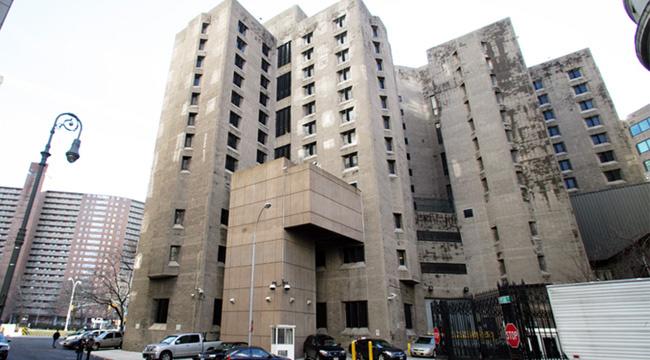
Grand Jury Subpoenas Issued For Up To 20 Officers At NYC Prison Where Epstein Died

Up to twenty employees at the Manhattan Metropolitan Correctional Facility (MMC) where Jeffrey Epstein died have been subpoenaed in connection with the wealthy pedophile’s unbelievable suicide.

Federal investigators obtained the grand jury subpoenaes while trying to understand what exactly happened leading up to Epstein’s suicide in what CNN reports to be “a new and significant phase in what appears to be a criminal investigation into the workers responsible for Epstein’s detention.”

Epstein was found hanged in his cell in the early morning hours nearly two weeks ago. The multimillionaire financier was awaiting trial on charges that he’d run a sex trafficking ring involving underage girls.

The suicide of one of highest-profile federal inmates was said to have deeply angered top officials at the Justice Department, and investigators with the FBI and the Justice Department’s Inspector General’s Office have been probing the circumstances that led up to it. –CNN

On Wednesday, Attorney General William Barr said that several witnesses “were not cooperative,” and had “required having union representatives and lawyers before we could schedule interviews.” Barr has ordered the FBI and the Justice Department’s inspector general to probe Epstein’s August 10 suicide. Also under review is a prior attempt from July 23 in which Epstein reportedly told his lawyers that then-cellmate Nicholas Tartaglione “roughed him up.” 

Tartaglione has denied hurting Epstein, and recently asked a judge to transfer him out of MCC and into another prison after reportedly receiving death threats from guards – including that there would be a “price to pay” if he talks about Epstein’s death. 

Investigators are reportedly focusing on two guards tasked with watching Epstein, who have both been placed on leave in the wake of Epstein’s death. The official story is that they fell asleep on the job. There are also reports that the guards falsified records to show they had checked on Epstein every 30 minutes as required – which, if true could expose them to criminal charges. 

In the days since Epstein’s death, reports of mistakes and mismanagement behind the walls of the hulking Manhattan facility have emerged.

Barr has cited “serious irregularities” and a “failure to adequately secure” Epstein by the jail, and has in recent days overhauled the leadership there and at the Bureau of Prisons in Washington. –CNN

Prosecutors hope to learn from the lieutenants in charge of Epstein’s cell block what exactly happened the night he died; whether guards properly conducted their rounds to check on prisoners, and how work was handed off between shifts. 

“The fact that this is a grand jury investigation means that they are investigating a specific crime. It tells me that it’s something more than just ‘Let’s pick up the pieces and do a report’ like an inspector general would normally do,” said former federal prosecutor Elie Honig. 

The 66-year-old Epstein, who had not been checked for hours before his death, was found unresponsive in his cell after being taken off suicide watch days earlier. He reportedly tied a bedsheet to the top of a bunk bed and swan dove with enough force to break a bone in his neck. 

via ZeroHedge News https://ift.tt/2PkRNt0 Tyler Durden

David Koch, R.I.P.

David Koch, who along with his brother Charles ran one of America’s most prominent political giving machines, has died at age 79.

Koch was one of four children of the oil industrialist Fred Koch, and along with his older brother Charles he became one of America’s richest men through the growth of the family business. Due to the brothers’ funding of political causes and candidates, the Kochs became betes noir of the American left. (Koch was for 36 years a trustee of the Reason Foundation, which publishes Reason magazine.) Often incorrectly described as a conservative or a Republican, David Koch was a lifelong libertarian whose work and giving reflected the values of free enterprise and limited government.

Born in Wichita in 1940, Koch earned undergraduate and graduate degrees in chemical engineering from MIT, where he also excelled in basketball. After working for outside companies from 1963 to 1970, including a stint at the management consulting firm Arthur D. Little, Koch began working in the family business in 1970 as a technical service manager at the subsidiary Koch Engineering for a salary of $16,000. He rose to be president of the division, and he went on to serve in various capacities in the set of privately owned family businesses, including president of Koch Engineering and Executive Vice President of Koch Industries. He retired officially last year because of his fading health.

In a 2005 interview for my book Radicals for Capitalism, Koch told me his father taught him that “big government was bad, and impositions of government controls on our lives and our economic fortunes was not good.” In the mid-1960s, with encouragement from Charles, he attended the Freedom School, an early libertarian educational institution run by Robert LeFevre, whose variety of libertarianism rejected both political activism and violence, even in self-defense. While LeFevre was one of their earliest exposures to the organized libertarian movement, both brothers denied that they ever embraced his entire package of ideas. As they began financing, working with, and guiding libertarian institutions in the 1970s, their activism involved support and promotion for the pro-market Austrian school of economics exemplified by Ludwig von Mises and F.A. Hayek. Libertarian educational institutions, think tanks, legal action groups, grassroots activism, magazines, criminal justice reform efforts, and student groups all received largess and guidance from the Koch brothers from the 1970s through the present.

In the 1980 presidential campaign, when recently imposed campaign finance restrictions hobbled third parties’ abilities to fundraise by severely limiting how much any single donor could give, David Koch took advantage of the fact that the rules allowed candidates themselves to self-finance as they wished: He became the Libertarian Party’s vice presidential nominee. He and running mate Ed Clark got more than 1 percent of the vote, a party record that would go unbroken until 2016.

Koch told New York magazine during that campaign that he’d been excited by the previous Libertarian presidential run by Roger MacBride, saying the party was “advocating all the things I believed in. [MacBride] wanted less government and taxes and was talking about repealing all these victimless-crime laws that had accumulated on the books. I have friends who smoke pot. I know many homosexuals. It’s ridiculous to treat them as criminals—and here was someone running for president, saying just that.”

After winning the vice presidential nomination, Koch told the assembled Libertarian delegates that the party’s members “represent the best hope for human freedom since the American revolution” and that “as a businessman, who’s run a successful company, who’s had to deal with the harassment and ridiculous interference of government in the affairs of my business….I can be particularly effective at communicating the libertarian ideas and concepts to the businessman.” Koch listed the run as his “proudest achievement” in a 1987 MIT alumni newsletter.

In 1984 Koch co-founded Citizens for a Sound Economy, a free market advocacy and research organization that later split into FreedomWorks and Americans for Prosperity, both prominent players in 21st century Republican and libertarian circles in the pre-Trump age (though Koch was only directly involved with the latter). Koch continued to donate and to often serve on the boards of market-oriented advocacy groups, and the political operation funded and managed by him and Charles became notorious in the Obama age as the supposedly sinister face of money in politics.

As was his way, Koch mostly declined to participate in public controversies over his political beliefs or funding. But as he told me in that 2005 interview, he had come to see political philanthropy as finding “aggressive salesmen” who understand that you can have the best product in the world but if you aren’t finding consumers to buy it, you need to do whatever it takes to sell it, including spending “staggering sums on advertising and promotion” in the mold of Proctor & Gamble. You have to find talented people with good ideas, and try different approaches, to help generate political and philosophical change.

Koch was an inveterate experimenter in that process, to the great benefit of many libertarian institutions—he told me he’d been on as many as 20 boards at a time.

The vast bulk of Koch’s philanthropy was not political. It included hundreds of millions of dollars for cancer research (he was diagnosed with prostate cancer in 1992) and major arts and sciences institutions, museums, schools, and public television, with much of his institutional philanthropy centered in New York City, his home for decades.

He is survived by his wife Julia and their three children.

from Latest – Reason.com https://ift.tt/2Mzuh9L
via IFTTT

Your Last Minute Jackson Hole Preview: Powell In Turmoil

While we shared an extended preview of Jerome Powell’s Jackson Hole speech overnight, which in light of the latest trade war development which saw China impose tariffs on another $75BN in US goods, may have to be rewritten as an even more forceful response from Trump is now virtually assured, here is a summary snapshot of what Wall Street expects from today’s main financial event.

As we noted yesterday, following surprisingly hawkish comments from Philly Fed president Harker, Kansas City President Esther George and Boston Fed president Eric Rosengren, all of whom voiced their opposition to additional cuts, the market-implied odds of a 50bps rate cut in September has tumbled to just 2% as of this afternoon, down from 41% a week ago, resulting in yet another inversion in the 2s10s curve as 2Y Treasury yields spiked.

If anything, Thursday’s hawkish tone was a reminder that it is premature to expect a signal on the size of the Fed’s September move something which the market desperately wants; In fact, as Morgan Stanley writes, Powell will certainly choose to maintain flexibility on size by reminding us the Fed “will act as appropriate to sustain the expansion.”

Furthermore, there’s been no gathering since the July FOMC, the few policymakers who have since spoken publicly have either been surprisingly hawkish, or have underscored that there is no pressing need to take additional action… and there’s still more data to get through ahead of the next meeting.

Key risks: As Morgan Stanley’s Ellen Zentner writes, watch for the use of “somewhat” when Powell is describing further adjustments. Investors may associate the word “somewhat” with 25bp. Acknowledgment that downside risks have increased with no characterization of “somewhat” could be taken as confirmation that it is likely the Fed makes a larger cut in September, although that now appears unlikely.

Some additional details courtesy of RanSquawk.

The theme of the economic symposium at Jackson Hole this year is “Challenges to monetary policy”, the same as in 1999. The theme is broad enough to cover the task of bringing inflation to target (policy framework related themes), the challenge of central bank independence, and of course of administering monetary policy at a time of heightened global trade risks and softening global growth.

The Jackson Hole presentation schedule, released late on Thursday, reveals that neither Kuroda nor Draghi would be present, and instead Mark Carney is the only other prominent fixture on today’s calendar, delivering the Luncheon Address at 2pm ET. Another notable, if very confused, central banker present will be RBA governor Philip Lowe, who will headline a Saturday morning panel.

There are also geopolitical themes that the Fed will need to navigate (US/China is the obvious one, but also Japan and South Korea, while the Fed has noted Brexit risks in the past, which seem to be resurfacing again now). Concerns around
these themes are now manifesting themselves in the yield curve, where recent inversions portend recessions ahead, leaving the Fed facing arguments that it is either is behind the curve, or does not have the tool set to tackle the issues it faces. Given that a cocktail of these issues have been keeping a lid on inflationary pressures, the messaging from Fed officials will set the stage for the 18th September FOMC, where the market is pricing 30bps of easing (implying a cut is fully priced, and there is some probability of a 50bps move).

Amid the market turmoil, and dovish actions by many global central banks, the Fed may emphasize that QT is over, and Fed policy is now accommodative; the market may be especially attuned for any insight on the magnitude of a rate cut, while 50bps is still a scenario on some bank desks; some of the dovish elements have dismissed the notion of a single 50bps rate cut in the past (see Bullard, who has not signalled any panic about the risk sell-off/yield curve inversion, preferring to judge the data, while noting it has been coming in decent recently). More generally, it may be an opportunity  for central bank officials to calm the market after its recent rout (the full agenda is not released until the day before the event gets underway, however, the event is usually attended by bigwigs from other major central banks too). One criticism the Fed and ECB faced after their respective July policy meetings was the lack of clarity – with the two dissents on the FOMC, and Draghi clearly unable to have the GC unanimously back his views on looser policy made in the run up to the meeting.

Some desks have said they would prefer Fed Vice Chair Clarida and FOMC Vice Chair Williams to attend and make remarks, both of whose messaging may be more distinct than that of Chair Powell’s was after the July FOMC, and despite the criticisms levelled at Williams recently, both of those are also able to provide more academic insight than Powell might be capable.

via ZeroHedge News https://ift.tt/33Y83Ur Tyler Durden

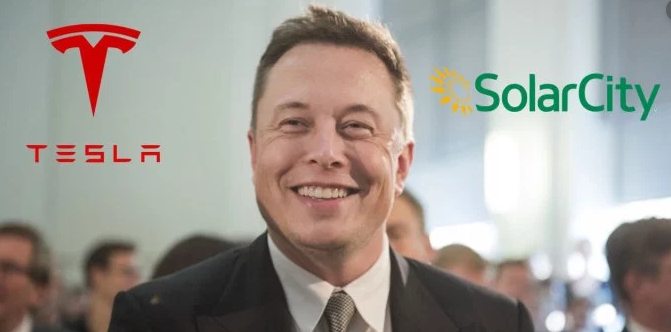
Tesla’s Secret Spontaneously Combusting Solar Panel Cover Up

The cover-up is on.

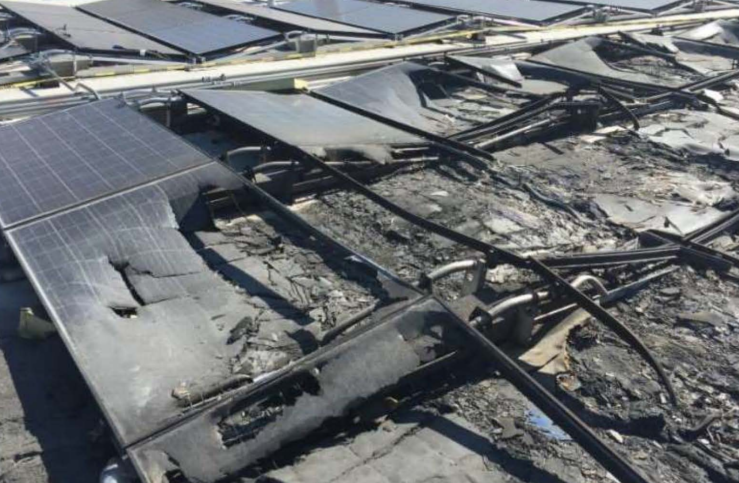
Just days ago, we highlighted Walmart filing a lawsuit against Tesla due to the company’s solar panels spontaneously combusting on top of Walmart stores nationwide. Now, details of the cover-up that Tesla tried to put into place back in 2018 have leaked out and made an ugly story for Tesla – being sued by Walmart – into an even uglier one.

In the summer of 2018, Tesla initiated a massive undertaking called “Project Titan”, which had the purpose of replacing faulty solar panel parts across the United States, according to Business Insider. The parts in question are connectors — Amphenol H4 connectors — and SolarEdge optimizers, two pieces of the panel that are responsible for regulating the flow of energy and heat.

The main job of these parts? Making sure that as much power goes through the panel as possible without overheating, which can then lead to – you guessed it – fire.

Tesla even confirmed that the cover up was taking place. A company spokesperson said: “A portion of SolarCity-installed modules and optimizers from various manufacturers were made with H4 connectors from Amphenol, a part that was commonly used across the industry at the time.”

The same spokesperson went on to say that Tesla only found that a “small number” of the connectors had failures: “Over the past year, less than 1% of sites with this connector have exhibited any abnormal behavior. Tesla honors our commitments to our customers, who expect their solar installations to reliably generate clean, low-cost energy for their contract term of 10-20 years. This campaign to replace any faulty connectors at these sites is Tesla fulfilling that commitment.”

…talk about a line that might make it into an amended complaint, should Walmart file one. 

These parts were then “quarantined” as a part of the project, only to be either reworked and put back on roofs or scrapped. Business Insider claims that a document showed 120,000 parts that needed to be quarantined across the US, but Tesla disputes this number. Instead, Tesla called Project Titan “a remediation effort to limit any impact the connector may have had, even though we are not aware of any equipment manufacturer or regulator that has determined any substantial hazard exists.”

Walmart had been a customer of Solar City’s since 2010. Walmart’s complaint alleges that Tesla failed to manage and maintain solar panels on hundreds of roofs across the United States, in breach of the company’s agreement.

Walmart claims that this negligence resulted in fires on seven roofs in states from Ohio to California. Walmart also claimed that de-energizing the solar panels didn’t stop them from catching fire:

“In November 2018, Walmart discovered that yet another fire had occurred at a Walmart store in Yuba City, California-even though the solar panels at this store had been de-energized since June 2018. Wires on the store’s rooftop were still sparking at the time that Walmart discovered the fire and could have ignited more extensive flames, with potentially devastating consequences.”

In March 2018, there was a fire on the roof of a Walmart with solar panels installed in Beavercreek, Ohio. The fire caused the store to close for eight days and, a month after it happened, Tesla still couldn’t figure out what to do about it. The solar panel model that needed to be replaced wasn’t in stock and the company didn’t know how to replace the damaged unit on the roof.

Ordering of all the parts necessary to execute “Project Titan” – including ladders, tool belts and replacement parts – all happened in staggered fashion. In December 2018, 188 trucks were sent out in almost 50 cities to change faulty connectors and optimizers. In April 2019, Tesla was still trying to “fine tune” its procedures. The company even made an announcement in early April directing repair teams to use refurbished parts to replace damaged optimizers and connectors.

One former employer stated:

“That’s how all this goes — we fix stuff as it comes out. There is no planning ahead — there are too many fires to put out. Pun intended.”

Walmart claims that Tesla only inspected 29 of more than 240 sites with Tesla solar roofs on them up until the day of the lawsuit. However, on Thursday night , it looks as though Musk may have been doing even more damage control, as the two companies released a joint statement regarding the lawsuit:

“Walmart and Tesla look forward to addressing all issues and re-energizing Tesla solar installations at Walmart stores, once all parties are certain that all concerns have been addressed.”

“Together, we look forward to perusing our mutual goal of a sustainable energy future,” the statement continued. “Above all else, both companies want each and every system to operate reliably, efficiently, and safely.”

Did Tesla just realize how horrifying the optics of the situation were? If so, the question becomes: what did Tesla offer one of the world’s largest retailers as a concession in order to get them to play ball and release a statement like this?

We’d love to say that we “can’t wait to find out”, but given the fact that the massive solar panel disaster with one of Solar City’s most well known customers was never disclosed or filed in an 8-K, we’re not holding out hope.

via ZeroHedge News https://ift.tt/2L3AuYf Tyler Durden

Billionaire David Koch Dies At 79

David Koch, the conservative billionaire, activist and philanthropist, who gave more than $1 billion to charitable causes but was best known for using his money to reshape U.S. politics has died at the age of 79.

David, together with his brother, Charles, co-owned Koch Industries, a Nebraska-based energy and chemical company, since 1983. David stepped down from running the Koch organization last year due to declining health. A longtime New York resident, Koch was until retirement in June 2018 an executive vice president of the family company.

The Koch brothers are perhaps best known for building a massive conservative network of donors for organizations that work to mobilize voters and sway elected officials in support of libertarian-leaning economic policies.

In a prepared obit, the WSJ notes that “Koch, whose net worth of about $50.5 billion tied him with his brother as the world’s 11th-richest person in Forbes magazine rankings, gained most of his wealth from a 42% stake in Wichita, Kan.-based Koch Industries Inc., which has interests ranging from oil to beef to paper and is the second-largest closely held U.S. company.”

Some more details from the WSJ:

Though he was a liberal on social issues like abortion and same-sex marriage, Mr. Koch used his fortune to support conservative causes that favor lowering taxes, free trade and fewer regulations. He was the Libertarian Party’s 1980 vice-presidential candidate.

With his surviving older brother Charles Koch, the chairman and chief executive of Koch Industries, Mr. Koch created a network composed of like-minded wealthy donors brought together to back conservative causes.

They were credited with helping finance the limited-government Tea Party movement that helped Republicans win control of the House in 2010 during President Obama’s first term.

Their support of conservative causes became a lightning rod for Democrats, raising the ire of then-Sen. Harry Reid of Nevada, who in 2014 called Mr. Koch and his brother “un-American” and accused them of “trying to buy America” through campaign cash.

As the WSJ further notes, Megadonors such as the Kochs were able to grow their influence after the Supreme Court’s 2010 Citizens United decision, which allowed unlimited spending, both directly and indirectly, by outside groups

Diagnosed with prostate cancer in 1992, Koch had in recent years suffered from deteriorating health, according to the letter announcing his retirement from business and political activities. Over decades, Mr. Koch funneled some of his largest donations to cancer research, most notably to Memorial Sloan Kettering Cancer Center in Manhattan and to his alma mater, the Massachusetts Institute of Technology in Cambridge, Mass., for the founding of the Koch Institute for Integrative Cancer Research.

Koch attributed his philanthropy to a near-death experience in 1991, when an airplane he was in collided with another at Los Angeles International Airport. Mr. Koch was able to escape the smoke-filled plane, while more than 30 others were killed in the collision. Speaking about the crash in a 2014 television interview, Mr. Koch said, “I felt that the good Lord was sitting on my shoulder and that he helped save my life because he wanted me to do good works and become a good citizen.”

Born in Wichita on May 3, 1940, Koch attended public schools in his hometown before attending the prestigious Deerfield Academy in Deerfield, Mass. Mr. Koch earned his bachelor’s and master’s degrees in chemical engineering from MIT.

In addition to his brother Charles, Mr. Koch is survived by his three children; wife, Julia; twin brother, William Koch, and brother, Frederick Koch.

via ZeroHedge News https://ift.tt/2MADC16 Tyler Durden

Dead Meat In Jackson Hole

Authored by MN Gordon via EconomicPrism.com,

If there are any virtues of debt instruments with negative yields we’ve yet to realize them.  Certainly, we understand that as bond yields fall, bond prices rise, and bond investors are rewarded with capital appreciation.  But when capital’s appreciating as a consequence of negative yields, we suspect there’s something fundamentally wrong with the capital itself.

Capital markets, as we’ve always understood them, are centered around lenders buying debt – such as a bond – at a yield that compensates for the risk of default over a contracted duration.  The acceptance of negative yield is an abstraction that violates the form and function that capital markets are built on.  In fact, negative interest rates undermine the foundational business model of banking in general.

How can banks loan money if they’re not compensated for the risk that some loans will go bad?  And if banks can only loan money at a loss, why loan money at all?  If there’s no profit motive, what’s the point?

There’s currently about $17 trillion in combined government and corporate negative yielding debt in existence.  The European Central Bank and the Bank of Japan, with policies of mass money debasement that far exceed those of the Federal Reserve, are the primary culprits.  Their fake money and fake interest rates have produced fake capital markets.

In effect, Negative Interest Rate Policy (NIRP) destroys a commercial banks ability to build capital and offset losses.  In other words, NIRP destroys commercial banks.  By extension, NIRP via central banks leads to the implied nationalization of commercial banks.

Japan and Europe are already past the point of no return.  President Trump beats on Fed Chair Jay Powell practically every day to go negative.  Will he acquiesce?  In truth, he doesn’t have a choice…

Roadkill

In western Wyoming, between the Teton Mountain Range and the Gros Ventre Range, sits a high altitude mountain valley.  The near vertical slopes used by Davy Jackson and other 19th century fur trappers to enter the valley from the north and east gave the sensation of entering a hole.  The name stuck.

The conditions are harsh along the Jackson Hole valley floor.  Radiational cooling, where low lying cold air from the snow covered ground plunges the temperature as the air migrates down the valley.  This cooling effect, an effect similar to negative yielding debt, has produced temperatures of negative 66 degrees Fahrenheit.

However, for a brief period each year, the conditions in Jackson Hole are near perfect.  In late summer, the valley’s paradise.  Still, perfect conditions do not mean all is perfect in Jackson Hole.

On Sunday night, for example, resident Gale Wilson took a photo of a moose and her calf near Highway 390 and the Snake River.  When she stepped outside on Monday morning she was greeted by the dead calf’s body.  “It just ruined my day,” said Roosevelt.

Unfortunately, moose roadkill has become such a common occurrence along this stretch of Highway 390 that Mark Gocke, with the local Game & Fish, has lost track of how many moose have died.  To better square up the runaway roadkill, Mr. Gocke’s hard at work – or, perhaps, hardly working – on an official tally.  He may need to add several new entries to his log before the weekend’s over…

Dead Meat in Jackson Hole

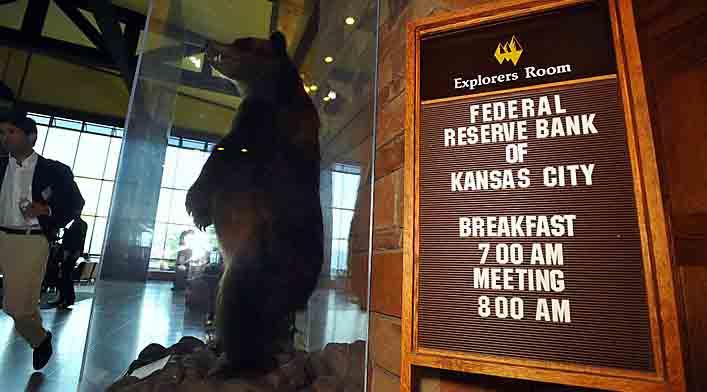
This Thursday through Saturday, for the 37th consecutive year, the Kansas City Federal Reserve is hosting its economic symposium in Jackson Hole.  Central bankers from the Federal Reserve have descended upon the valley like 19th century fur trappers.  Who they bill their expense reports to is a question that’s better not asked.

At the time of this writing, Fed Chair Powell has yet to give his speech.  There are many things he could say.  There is little that he will say.  There are things he definitely won’t say.

For example, Powell won’t say that the world’s central banks are tripping and stumbling as they race to out-stoopid one another.  Nor will he say that locking in a guaranteed loss on bonds that are held to maturity is a terrible way for investors and pension funds to meet their long-term liabilities.  Or that sometime over the next decade retirees will be eviscerated.  He won’t say any of that…

Powell also won’t say that the Federal Reserve’s days are numbered.  That the central bank’s obsolete and one crisis away from its own destruction.  That it has cannibalized the nation’s time and treasure, transferring individual wealth to Washington for Washington’s ends.

Powell certainly won’t say that he may very well be the last Chair of the Federal Reserve.  That the economic model of the 20th century is over.  That increased issuances of debt no longer translates into increased economic growth.  That the Fed merely provokes wild asset price swings, negative yielding bonds, casino style speculation, and epic bubbles and busts.  And that with full knowledge of this, he’ll still take the nation into the hole of negative yields.

Indeed, the rash of moose kills in Jackson Hole is acutely instructive.  The central bankers are dead meat.  And they know it.

via ZeroHedge News https://ift.tt/33Se6cV Tyler Durden

When Governments Act on Fear and Panic, Injustice Is Often the Result

There was a saying, which sprung from the French Revolution and was used during the Russian Revolution: “No enemies on the Left.” It was the idea that left-wing revolutionaries should moderate their criticism of anyone on their side of the aisle, no matter what type of extremism they embraced. During the Cold War, conservatives rightly mocked liberals who hedged about the evils of communism. They struggled to condemn anyone to their Left.

Last week, I wrote about the apparent re-emergence of white nationalist thinking. Some mass shooters (El Paso, Pittsburgh, Charleston) seem to subscribe to a white-supremacist ideology, based on their alleged manifestos and police statements. Judging by the reactions to some of the latest shootings, there’s a similar philosophy at work: “No enemies on the Right.” Everyone condemns the killers, of course, but people hem and haw about the far-right danger.

My column simply called for a recognition of the problem—and the use of existing laws to deal with self-radicalizing white supremacists who break the law. It’s the same solution I embraced after the 9-11 terrorist attacks, and after home-grown killers with an alleged Islamic radical viewpoint murdered Americans in a couple of shooting sprees. Facing the issue and using the vast law-enforcement tools already at our government’s disposal beats emotion-driven approaches that curtail our civil liberties.

Unfortunately, there are many pitfalls even with using those existing tools. As analysis of the latest shootings subsided, another news story has grabbed attention here in northern California. It offers warnings about what happens when fear and emotion rule the day—and when our government seems driven more by panic than justice. It’s from the small Central Valley city of Lodi, but has nationwide implications.

In late July, U.S. District Judge Garland E. Burrell Jr. vacated the conviction and 24-year sentence for a suspect in a 2006 terrorism case. Burrell was the judge who oversaw the trial of Lodi cherry picker Hamid Hayat, who was accused of training in a Pakistani terrorism camp. The feds argued that he allegedly gained weapons and explosives training that used President George W. Bush as a target, according to newspaper reports. This had the makings of a sensational case.

In January, a different federal judge, Deborah Barnes, called for the sentence to be overturned based in part on the inexperience of Hayat’s attorney and the government’s failure to consider exonerating evidence. She heard “new testimony from witnesses who said, Hayat, a California native, never had time to receive terror training while visiting relatives and getting married in his ancestral village in Pakistan,” according to a Sacramento Bee report.

In a 2018 hearing that re-examined aspects of that controversial case, Hayat’s attorney alleged that the FBI coerced a confession, “that the training camp he supposedly visited was not even open at the time … and that alibi witnesses who could prove his innocence were not produced at the original trial,” according to the newspaper. Here’s the best spin to put on this injustice: Our system still is willing to examine evidence years after a case is closed.

In hindsight, the whole matter is so unseemly. The New York Times chaptered-and-versed some of the problems. One former FBI agent watched the testimony and said “it’s the sorriest interrogation, the sorriest confession, I’ve ever seen.” (False or coerced confessions are not unusual, but comprise more than a third of the nation’s murder exonerations, according to recent studies.)

Meanwhile, newspaper headlines announced the government’s dismantling of an apparent terror cell is a tranquil city in wine country. The director of national intelligence, it noted, told Congress that, “A network of Islamic extremists in Lodi, California, for example, maintained connections with Pakistani militant groups, recruited United States citizens.”

Except that there was no network. Hayat was the only scalp the FBI could secure, although the agency investigated (but never filed charges) possible immigration violations against local imams. If the Hayat case seemed dubious, it wasn’t an outlier.

As LA Weekly reported at the time of the trial in 2006, “The Bush administration claims that more than 400 people have been charged with terrorism-related crimes in the post-September 11 era, and that 228 have been convicted. But the vast majority of these cases have involved minor crimes not directly related to terrorism, such as immigration violations.” The feds can appeal Burrell’s decision, but after 14 years in prison, Hayat has a good chance of finally being freed. It’s unclear how many of those other cases were re-examined.

None of us should minimize potential terror threats, from whatever swamp they might emerge. But our government has plenty of power to investigate and prosecute potential miscreants. Yes, we should all recognize that there are enemies on our Left and Right. But before calling for new governmental powers, we should remember the Lodi case and what happens when emotion rules and the government overplays its hand.

This column was first published in the Orange County Register.

from Latest – Reason.com https://ift.tt/2MzCHOn
via IFTTT

Futures Plunge After China Announces Retaliatory Tariffs On Another $75BN In US Goods

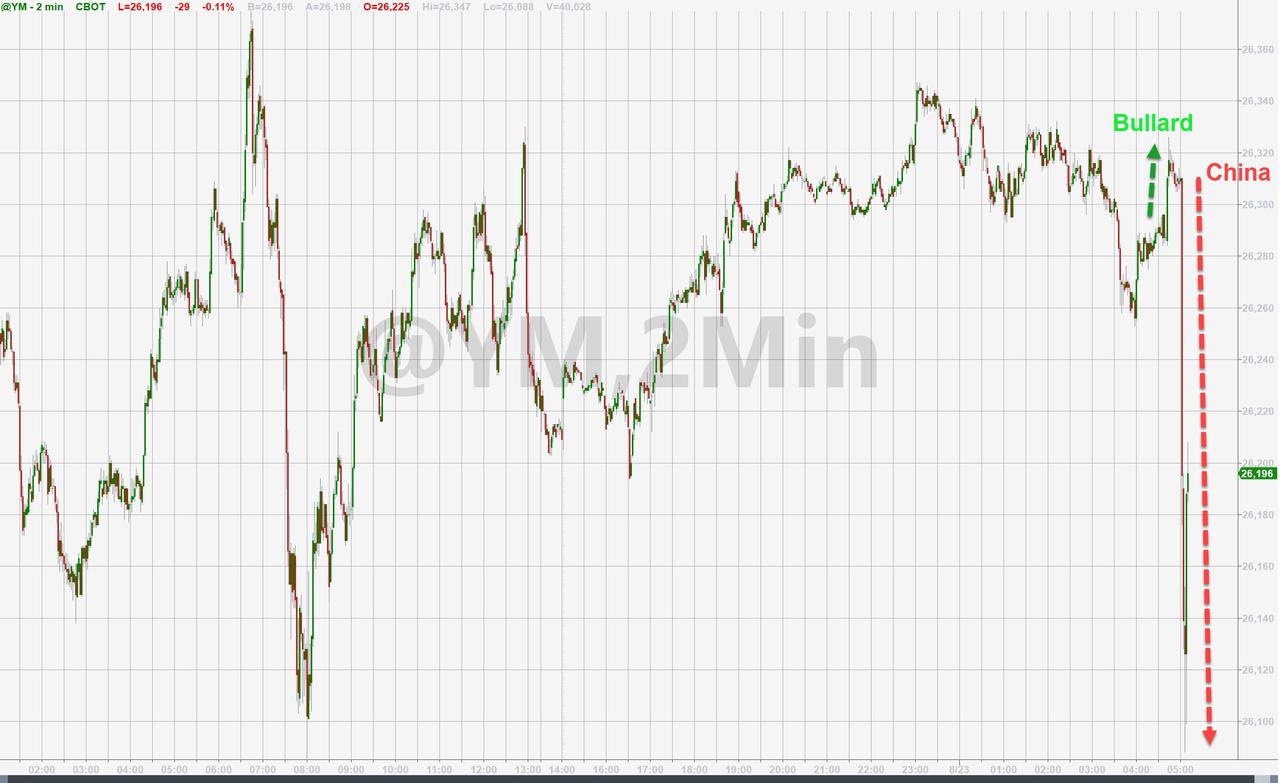
Just over an hour after the Global Times’ Hu Xijing warned that China would announce retaliatory tariffs on certain US products, adding that “China has ammunition to fight back”, that’s precisely what happened when China’s Ministry of Finance said in statement posted on website late Friday that it would levy retaliatory tariffs on another $75BN in US goods with rates anywhere between 5 and 10%, with the tariffs set to be implemented in two batches, one at midnight on Sept 1 and another at midnight on Dec 15.

Additionally, China said it would resume 25% tariffs on US autos.

The full Golgle-translated statement from the Ministry of Finance is below:

August 15, 2019, the US government announced that it would impose a 10% tariff on approximately US$300 billion of goods imported from China, which will be implemented in two batches from September 1 and December 15, 2019. The US measures have led to the continuous escalation of Sino-US economic and trade frictions, which have greatly harmed the interests of China, the United States and other countries, and have also seriously threatened the multilateral trading system and the principle of free trade.

In response to the above measures by the US, China was forced to take countermeasures. According to the “Customs Law of the People’s Republic of China”, “The Foreign Trade Law of the People’s Republic of China”, “Regulations on Import and Export Tariffs of the People’s Republic of China” and other basic laws and principles of international law, the State Council’s Customs Tariff Commission decided to produce 5078 originating in the United States. The tax items, about 75 billion US dollars of goods, plus 10%, 5% tariffs, in two batches from 12:01 on September 1, 2019, 12:01 on December 15 implementation.

Customs Tariff Commission of the State Council will continue to carry out the elimination of tariffed goods from the United States and Canada. In the list of 75 billion US dollars of goods, the excluded goods subject to review and approval, according to the exclusion method, do not levy the tariffs imposed by me for the anti-US 301 measures; the products that are not included in the first two batches of the scope of application for exclusion will be included in the third The scope of the batch can be applied for exclusion, and the application method will be announced separately.

s adoption of tariff-adding measures is a forced move to deal with US unilateralism and trade protectionism. The Chinese side once again reiterated that for China and the United States, cooperation is the only correct choice, and a win-win situation can lead to a better future. It is hoped that China and the United States will respect each other with mutual respect, mutual equality, words and trust, and words and deeds, resolve differences in a mutually acceptable way, and actively build a balanced, inclusive and win-win new Sino-US economic and trade order, and jointly safeguard and promote Reform and improve the multilateral trading system and promote mutually beneficial and win-win cooperation with other countries in the world.

The news sent US equity futures tumbling…

… and US 10Y yield sharply lower.

Meanwhile over in Jackson Hole:

via ZeroHedge News https://ift.tt/2Z8iPbI Tyler Durden

Beijing Enraged After US Navy Ship Sails Through Taiwan Strait

With the 70th anniversary of the founding of the CPC looming, and Beijing staking out a more aggressive trade stance Friday morning by threatening retaliatory tariffs, the US picked the best – or worst – time to provoke Beijing, when a Navy ship sailed through the Taiwan Strait in the Navy’s latest “freedom of navigation” operation, or ‘freeop’ on Friday.

As CNA points out, Washington has actually increased its antagonistic operations in the Taiwan Strait as tensions with Beijing have soared this year, and Friday’s mission risks stoking tensions even further, as Beijing has warned international powers not to interfere in its relationship with Taiwan, or risk provoking Beijing’s wrath.

Yet interfering is precisely what the US has done, and earlier this month, Beijing denounced the sale of $2.2 billion in weapons to Taiwan by the US. Beijing has been ramping up pressure to assert its sovereignty over the island, which it considers a wayward province.

Commander Reann Mommsen, a spokeswoman for the US Navy’s Seventh Fleet, said the operation in the 111-mile wide waterway separating Taiwan from China “demonstrates the US commitment to a free and open Indo-Pacific.”

Mommsen identified the ship as the Green Bay, an amphibious transport dock ship, hinting at a possible marine transport to the controversial island. Typically, these missions are carried out using destroyer-class ships.

Taiwan’s Defense Ministry said in a statement that the island’s military had a full grasp of the situation in the Strait and closely monitored it. Washington has no formal ties with Taiwan, but the US is bound by law to help defend the island nation should it be attacked. The US is also its primary source of arms.

via ZeroHedge News https://ift.tt/2NqZYBJ Tyler Durden