We Need to Shut Them Down…

We Need to Shut Them Down…

Authored by Robert Wright via The American Institute for Economic Research,

We need to shut them down… Governments that is.

At least the ones that cannot pay their bills because of unnecessary economic lockdown orders.

I have tried just about everything in these pages to induce politicians to see that they are pushing the worst policies since at least the New Deal and are not going to get reelected if they continue their lockdown policies, which could end in bloody revolt if the power or another essential system goes out

I’ve also tried to induce Americans to sue for their freedom on both civil and Constitutional grounds. I’ve tried to stir their patriotism, and to shame them into rising above the status of mindless test subjects or medieval peasants. I’ve tried to get “Progressives” to see that they can’t have both Social Security and government health insurance simultaneously without increasing the probability of future fiascos. 

I have also proffered two separate ways out of this messone recently implicitly endorsed by Elon Musk, and another that no self-respecting social scientist could dispute. And I suggested that COVID-19 life insurance would help Americans to face death more like their brave ancestors, or younger selves, did at Woodstock.

But oh the powers that be, be a mighty whale some doth call Leviathan, with the magical power of creating something out of nothing, or rather, like the Wizard of Oz, appearing to create something out of nothing! So the money doth spew forth from the whale’s blow hole in mighty bursts to assuage and calm those who might wish it ill. And worked so far it has.

That the beast might spew forth again, some state and local governments complain of pecuniary distress. But to satiate their greed for power and lucre will be our undoing. The best that our ship’s captain, Ishmael Trump, can do right now is to make clear that state and local governments that remain locked down shall never hear “Thar she blows!”

The penultimate power, before resorting to the harpoon, be the power of the purse, an old expression not so much about money per se as the real resources that money can command. Typically tyrants try to seize resources to strengthen their tyranny. Today, we are faced with tyrants who are deliberately destroying resources despite ample evidence from Sweden and the five free states that they need not do so to successfully slow the spread of the novel coronavirus.

In fact, as I predicted, the New York Times-Columbia “we are all going to get COVID and die” model has been way off, even in the five free states. South Dakota’s cases and deaths, for example, are about 7 percent of those predicted and some counties expected to be overrun by now haven’t had any reported cases, most of which have occurred in Minnehaha and Lincoln counties, which share parts of Sioux Falls, the state’s eastern metropolis of 190,000. A big hunk of those cases stemmed from the infamous but super essential Smithfield pork processing plant.

I do not have a ready explanation for why places that imposed less extreme mandatory restrictions have fared about as well on “flattening the curve” as those that have locked down. It could be self-selection but Stockholm and Omaha are real cities, not one stop sign hamlets, and even there infections and deaths have not run rampant

Something like the Peltzman Effect could be at play, meaning that people in free areas take fewer unnecessary risks because they know that they may be interacting with infected people while the poor souls in locked down areas assume, often wrongly, that they can crowd into a Walmart because everybody is on lock down and the government is “doing something,” even if that something is utterly irrational, like keeping beaches open while closing beach parking lots. That bit of brilliance had Floridians parking in the lots of shuttered businesses across A1A and then congregating at the few crosswalks!

In fact, in retrospect, a 99 percent 3-week shelter-in-place for everyone (except COVID-19 HCPs and first responders) for any reason except dire emergency (and I don’t mean the dog needing to defecate) would have been preferable to what has evolved. A simple stay law deferring all debts for three weeks would have been far preferable to seemingly endless bailouts. 

That approach would have been unconstitutional too, and people would have died, but America would have been rid of COVID-19 by early April and thereafter could have concentrated on border controls and testing/tracing a la South Korea for any new outbreaks. The economy would have experienced a shock but one that it would already be rebounding from because of the certainty of the policy. That “nuclear” option is now off the table as we are too weak to suffer such a shock now.

For whatever reason, many governments persist in destroying resources and fundamental liberties on the basis of a debunked epidemiological model.

The national government should actively intercede, as it did to protect Americans’ rights during the Civil War and Civil Rights Movement, neither of which were very civil. But even if it doesn’t want to interfere with states’ rights today, under no circumstances should it FUND their oppression.

Verily, I believe any attempt to do so will lead to a tax revolt, probably of the quiet variety at first.

There is just no way Americans in the free states are going to fund the continued subjugation of their fellow Americans in California, Michigan, and elsewhere, which have essentially been invaded and occupied by their own governments

But what then shall the poor state and municipal governments do? Obviously, they need to lift most economic restrictions so that taxes again begin to flow in. And they also need to cut their “nonessential” workers, which is essentially most of them. In the short term anyway, we need courts and police officers and other first responders. (Ultimately, we do not need any of them but this is no time for novelty, even if we have rich comparative and historical examples from which to draw.) But teachers, recorders, prothonotaries, and all sorts of other bureaucrats need to be furloughed immediately. (If you think that many will then join the ranks of protesters, you’re starting to understand the power of the purse! They can arrest some protestors, but not all of them, especially with their budgets so tight.)

There is no reason to exclude national government employees from furloughs either. The bailouts and other forms of hush money already paid out has to be repaid somehow, through higher taxes or lower expenditures. Why do we need parts of the SEC if no corporations are issuing securities? What good is the EPA if factories are shuttered? The USDA if meat processors are closed? What does the Department of Education do even in normal times? Surely most of the Department of the Interior can be let go. 

Is furloughing 75 percent of government workers a draconian suggestion? Absolutely, but why shouldn’t government employees suffer along with the rest of us? You can’t expect civvies to bear all the burden of flattening an already pretty flat curve indefinitely. Plus, unlike the private sector, which is all “essential” or it wouldn’t exist, we know from budget battle government shutdowns that much of the national government is nonessential. Life goes on, and some think improves, without it. 

The nonpartisan Congressional Budget Office (CBO) estimated the deadweight loss of the 35-day partial federal government shutdown in early 2019 at only $3 billion. We will be lucky to get out of the current mess for $3 trillion in deadweight losses.

Governments messed up by botching testing, then not stopping the spread of the virus when it was still manageable, then did so again by shutting down too much of the economy for too long to cover their incompetence, and now they want to be rewarded with continued nonessential employment, and the forced redistribution of wealth from all Americans to Constitution-smashing state governments? Where is the last straw?


Tyler Durden

Sat, 05/02/2020 – 18:50

via ZeroHedge News https://ift.tt/2WjAZTN Tyler Durden

Andy Hall Says “Unlikely” We See Negative WTI Again, But Doubtful On “V-Shaped” Recovery In Oil

Andy Hall Says “Unlikely” We See Negative WTI Again, But Doubtful On “V-Shaped” Recovery In Oil

Longtime oil investor Andy Hall says he thinks it is “unlikely” that we ever wind up seeing negative WTI pricing again, calling the move in the commodity “pretty shocking” in a Bloomberg TV interview on Friday. 

The main question, he contends, is whether or not the industry is going to see a “V” shape recovery from here. And he doesn’t seem to be confident that it’s going to be anytime soon.

“How quickly are people going to go back to their prime behavior, I mean, maybe in some respects the answer is never,” Hall said, talking about a potential recovery. Instead, Hall says he sees a major recalibration of demand for oil globally.

“There’s a thought now with production being shut in, rig counts falling, investment in future supply being reduced, that we’re potentially setting ourselves up for a potential future supply shock, but all this production is not going away, it’s all potentially there, and can be brought back fairly rapidly,” he continued.

He then urged investors away from oil: “Personally, I think there are better ways to invest one’s money than trying to predict these chaotic movements.”

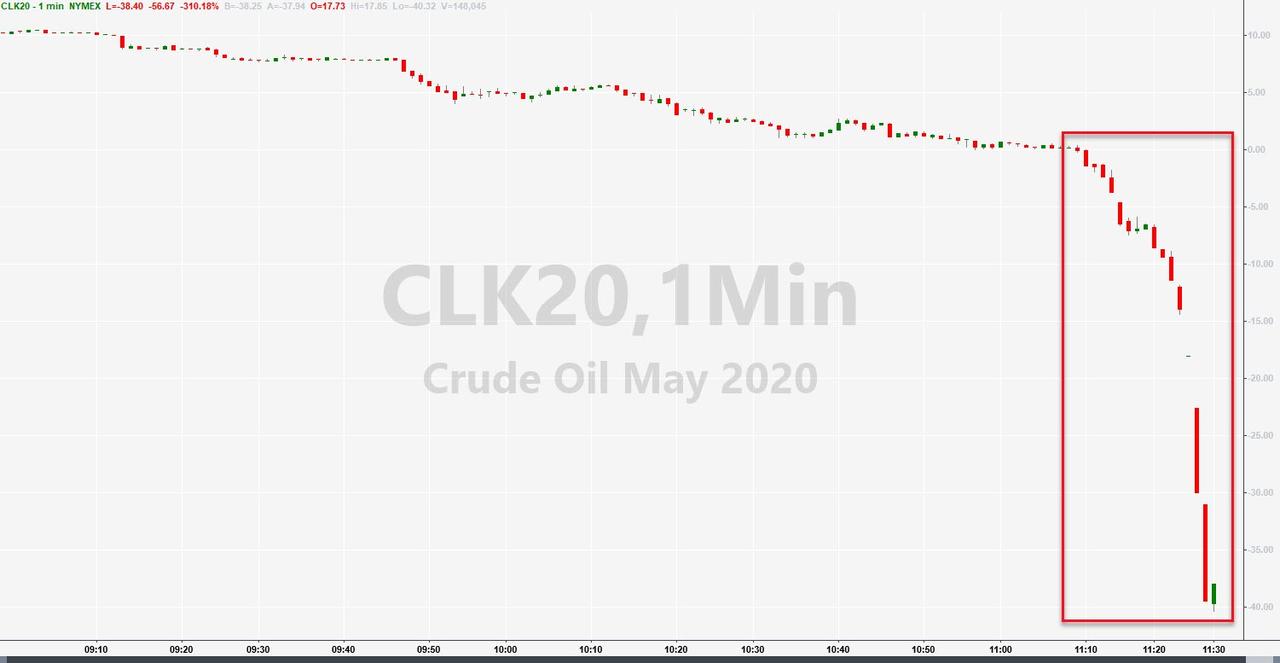
Recall, on April 20, the May WTI contract made history after it settled at negative $37.63. On the same day, the June contract finished the day down 18%.

We took the time on April 20 to explain why we thought the negative oil prices had happened in the first place.

“This happens when a physical futures contract find no buyers close to or at expiry,” we wrote. 

A physical contract such as the NYMEX WTI has a delivery point at Cushing, OK, & date, in this occurrence May.  So people who hold the contract at the end of the trading window have to take physical delivery of the oil they bought on the futures market.  This is very rare.

It means that in the last few days of the futures trading cycle, (which is tomorrow for this one) speculative or paper futures positions start rolling over to the next contract. This is normally a pretty undramatic affair.

What is happening today is trades or speculators who had bought the contract are finding themselves unable to resell it, and have no storage booked to get delivered the crude in Cushing, OK, where the delivery is specified in the contract.

This means that all the storage in Cushing is booked, and there is no price they can pay to store it, or they are totally inexperienced in this game and are caught holding a contract they did not understand the full physical aspect of as the time clock expires.

You can watch Hall’s interview with Bloomberg here:


Tyler Durden

Sat, 05/02/2020 – 18:25

via ZeroHedge News https://ift.tt/2zMFnCY Tyler Durden

Sixth Circuit Temporarily Blocks Kentucky Governor’s Limit on Drive-In Church Services

The court also suggests the limit on in-person church services may be invalid, but concludes that the matter should be considered further by the trial court—rather than by this emergency appeal—given “the 24 hours the plaintiffs have given us with this case.” Here’s the heart of the opinion in Maryville Baptist Church v. Beshear, handed down by Judges Sutton, McKeague, and Nalbandian:

Maryville Baptist Church and its pastor, Dr. Jack Roberts, appeal the district court’s order denying their emergency motion for a temporary restraining order. The Church claims that the district court’s order effectively denied their motion for a preliminary injunction to stop Governor Andy Beshear and other Commonwealth officials from enforcing and applying two COVID-19 orders.

The orders, according to the Church, prohibit its members from gathering for drive-in and in-person worship services regardless of whether they meet or exceed the social distancing and hygiene guidelines in place for permitted commercial and other non-religious activities. The Church moves for an injunction pending appeal, which the Attorney General supports as amicus curiae. The Governor opposes the motion.

Governor Beshear issued two pertinent COVID-19 orders. The first order, issued on March 19, prohibits “[a]ll mass gatherings,” “including, but not limited to, community, civic, public, leisure, faith-based, or sporting events.” It excepts “normal operations at airports, bus and train stations, … shopping malls and centers,” and “typical office environments, factories, or retail or grocery stores where large numbers of people are present, but maintain appropriate social distancing.”

The second order, issued on March 25, requires organizations that are not “life-sustaining” to close. According to the order, religious organizations are not “life-sustaining” organizations, except when they function as charities by providing “food, shelter, and social services.” Laundromats, accounting services, law firms, hardware stores, and many other entities count as life-sustaining.

On April 12, Maryville Baptist Church held a drive-in Easter service. Congregants parked their cars in the church’s parking lot and listened to a sermon over a loudspeaker. Kentucky State Police arrived in the parking lot and issued notices to the congregants that their attendance at the drive-in service amounted to a criminal act. The officers recorded congregants’ license plate numbers and sent letters to vehicle owners requiring them to self-quarantine for 14 days or be subject to further sanction….

The Church is likely to succeed on its state and federal claims, especially with respect to the ban’s application to drive-in services. Start with the claim under Commonwealth law—Kentucky’s Religious Freedom Restoration Act. “Government shall not substantially burden” a person’s “right to act … in a manner motivated by a sincerely held religious belief,” it guarantees, “unless the government proves by clear and convincing evidence” that it “has used the least restrictive means” to further “a compelling governmental interest in infringing the specific act.”

The point of the law is to exercise an authority every State has: to provide more protection for religious liberties at the state level than the U.S. Constitution provides at the national level. In this instance, the purpose of the Kentucky RFRA is to provide more protection than the free-exercise guarantee of the First Amendment, as interpreted by Employment Division v. Smith (1990). The Kentucky requirements parallel in large measure the RFRAs enacted by other States and one enacted by Congress, all of which share the goal of imposing strict scrutiny on laws that burden sincerely motivated religious practices.

Application of this test requires little elaboration in most respects. The Governor’s actions substantially burden the congregants’ sincerely held religious practices—and plainly so. Religion motivates the worship services. And no one disputes the Church’s sincerity. Orders prohibiting religious gatherings, enforced by police officers telling congregants they violated a criminal law and by officers taking down license plate numbers, amount to a significant burden on worship gatherings. At the same time, the Governor has a compelling interest in preventing the spread of a novel, highly contagious, sometimes fatal virus. All accept these conclusions.

The likelihood-of-success inquiry instead turns on whether Governor Beshear’s orders were “the least restrictive means” of achieving these public health interests. That’s a difficult hill to climb, and it was never meant to be anything less.

The way the orders treat comparable religious and non-religious activities suggests that they do not amount to the least restrictive way of regulating the churches. The orders permit uninterrupted functioning of “typical office environments,” which presumably includes business meetings. How are in-person meetings with social distancing any different from drive-in church services with social distancing? Kentucky permits the meetings and bans the services, even though the open-air services would seem to present a lower health risk.

The orders likewise permit parking in parking lots with no limit on the number of cars or the length of time they are there so long as they are not listening to a church service. On the same Easter Sunday that police officers informed congregants they were violating criminal laws by sitting in their cars in a parking lot, hundreds of cars were parked in grocery store parking lots less than a mile from the church. The orders permit big-lot parking for secular purposes, just not for religious purposes. All in all, the Governor did not narrowly tailor the order’s impact on religious exercise.

In responding to the state and federal claims, the Governor denies that the ban applies to drive-in worship services, and the district court seemed to think so as well. But that is not what the Governor’s orders say. By their terms, they apply to “[a]ll mass gatherings,” “including, but not limited to, … faith-based … events.” In deciding to open up faith-based events on May 20, and to permit other events before then such as car washes and dog grooming, the Governor did not say that drive-in services are exempt. And that is not what the Governor has done anyway. Consistent with the Governor’s threats on Good Friday, state troopers came to the Church’s Easter service, told congregants that they were in violation of a criminal law, and took down the license plate numbers of everyone there, whether they had participated in a drive-in or in-person service.

The Governor’s orders also likely “prohibit[] the free exercise” of “religion” in violation of the First and Fourteenth Amendments, especially with respect to drive-in services. On the one hand, a generally applicable law that incidentally burdens religious practices usually will be upheld. On the other hand, a law that discriminates against religious practices usually will be invalidated unless the law “is justified by a compelling interest and is narrowly tailored to advance that interest.”

Discriminatory laws come in many forms. Outright bans on religious activity alone obviously count. So do general bans that cover religious activity when there are exceptions for comparable secular activities. As a rule of thumb, the more exceptions to a prohibition, the less likely it will count as a generally applicable, non-discriminatory law….

The Governor’s orders have several potential hallmarks of discrimination. One is that they prohibit “faith-based” mass gatherings by name. But this does not suffice by itself to show that the Governor singled out faith groups for disparate treatment. The order lists many other group activities, and we accept the Governor’s submission that he needed to mention faith groups by name because there are many of them, they meet regularly, and their ubiquity poses material risks of contagion.

The real question goes to exceptions. The Governor insists at the outset that there are “no exceptions at all.” But that is word play. The orders allow “life-sustaining” operations and don’t include worship services in that definition. And many of the serial exemptions for secular activities pose comparable public health risks to worship services. For example: The exception for “life-sustaining” businesses allows law firms, laundromats, liquor stores, and gun shops to continue to operate so long as they follow social-distancing and other health-related precautions. But the orders do not permit soul-sustaining group services of faith organizations, even if the groups adhere to all the public health guidelines required of essential services and even when they meet outdoors.

We don’t doubt the Governor’s sincerity in trying to do his level best to lessen the spread of the virus or his authority to protect the Commonwealth’s citizens. And we agree that no one, whether a person of faith or not,hasaright”toexposethecommunity…tocommunicabledisease.”

But restrictions inexplicably applied to one group and exempted from another do little to further these goals and do much to burden religious freedom. Assuming all of the same precautions are taken, why is it safe to wait in a car for a liquor store to open but dangerous to wait in a car to hear morning prayers? Why can someone safely walk down a grocery store aisle but not a pew? And why can someone safely interact with a brave deliverywoman but not with a stoic minister? The Commonwealth has no good answers. While the law may take periodic naps during a pandemic, we will not let it sleep through one.

Sure, the Church might use Zoom services or the like, as so many places of worship have decided to do over the last two months. But who is to say that every member of the congregation has access to the necessary technology to make that work? Or to say that every member of the congregation must see it as an adequate substitute for what it means when “two or three gather in my Name.” Matthew 18:20. As individuals, we have some sympathy for [Ohio] Governor DeWine’s approach—to allow places of worship in Ohio to hold services but then to admonish them all (we assume) that it’s “not Christian” to hold in-person services during a pandemic. But this is not about sympathy. And it’s exactly what the federal courts are not to judge—how individuals comply with their own faith as they see it.

Keep in mind that the Church and Dr. Roberts do not seek to insulate themselves from the Commonwealth’s general public health guidelines. They simply wish to incorporate them into their worship services.

They are willing to practice social distancing. They are willing to follow any hygiene requirements. They are not asking to share a chalice. The Governor has offered no good reason so far for refusing to trust the congregants who promise to use care in worship in just the same way it trusts accountants, lawyers, and laundromat workers to do the same. If any group fails, as assuredly some groups have failed in the past, the Governor is free to enforce the social- distancing rules against them for that reason.

The Governor claims, and the district court seemed to think so too, that the explanation for these groups of people to be in the same area—intentional worship—distinguishes them from groups of people in a parking lot or a retail store or an airport or some other place where the orders allow many people to be. We doubt that the reason a group of people go to one place has anything to do with it. Risks of contagion turn on social interaction in close quarters; the virus does not care why they are there. So long as that is the case, why do the orders permit people who practice social distancing and good hygiene in one place but not another? If the problem is numbers, and risks that grow with greater numbers, then there is a straightforward remedy: limit the number of people who can attend a service at one time….

Preliminary injunctions in constitutional cases often turn on likelihood of success on the merits, usually making it unnecessary to dwell on [other] factors. That’s true here with respect to the ban on drive-in worship services….

The balance is more difficult when it comes to in-person services. Allowance for drive-in services this Sunday mitigates some harm to the congregants and the Church. In view of the fast- moving pace of this litigation and in view of the lack of additional input from the district court, whether of a fact-finding dimension or not, we are inclined not to extend the injunction to in- person services at this point.

We realize that this falls short of everything the Church has asked for and much of what it wants. But that is all we are comfortable doing after the 24 hours the plaintiffs have given us with this case. In the near term, we urge the district court to prioritize resolution of the claims in view of the looming May 20 date and for the Governor and plaintiffs to consider acceptable alternatives. The breadth of the ban on religious services, together with a haven for numerous secular exceptions, should give pause to anyone who prizes religious freedom. But it’s not always easy to decide what is Caesar’s and what is God’s—and that’s assuredly true in the context of a pandemic.

from Latest – Reason.com https://ift.tt/2KT4CFZ
via IFTTT

Is the Takings Clause a “self-executing” waiver of sovereign immunity?

Last week I posed a question: “can a plaintiff seek compensation for an unconstitutional taking, without relying on the Tucker Act’s jurisdiction–if not under the Takings Clause, perhaps under some theory of tort.” This post will shed some light on this question, though I still have not yet reached a firm conclusion. And the fifth post in my bump stock series will, alas, have to await further consideration (See Parts IIIIII, and IV).

As a general matter, the federal government cannot be sued for damages without its consent. Congress has waived its immunity through several statutes. For example, the Federal Torts Claims Act provides a limited waiver of sovereign immunity for certain types of torts. And the Supreme Court has also implied certain waivers of sovereign immunity. Through so-called Bivens claims, plaintiffs can seek monetary damages for violations of the Fourth and Fifth Amendment. But the Supreme Court has held that there is no waiver of sovereign immunity for suits based on other provisions of the Bill of Rights, such as the Eighth Amendment. And in recent years, the Supreme Court has put the brakes on future Bivens claims. This much is straightforward doctrine.

But what about the Takings Clause? It is the only provision of the Bill of Rights that clearly states landowners are entitled to monetary damages: “nor shall private property be taken for public use, without just compensation.” Is the Takings Clause a self-executing waiver of sovereign immunity?

In traditional eminent domain questions, the issue of sovereign immunity is irrelevant. Why? The government initiates a condemnation proceeding against a landowner. In other words, a private landowner does not need to sue the federal government. But there is another common type of takings case, known as an inverse condemnation suit. Here, the government regulates a person’s property, but insists there is no taking. Then, the landowner sues the federal government, alleges a violation of the Takings Clause, and seeks “just compensation.”

Congress has enacted two relevant statutes that purport to waive sovereign immunity for inverse condemnation suits. First, the Tucker Act gives the Court of Federal Claims jurisdiction to hear takings claims against the federal government where the property is worth more $10,000. It provides, in part:

The United States Court of Federal Claims shall have jurisdiction to render judgment upon any claim against the United States founded either upon the Constitution, or any Act of Congress or any regulation of an executive department, or upon any express or implied contract with the United States, or for liquidated or unliquidated damages in cases not sounding in tort

The Tucker Act does not expressly mention takings, but claims under the Fifth Amendment are “founded . . . upon the Constitution.” (They also “arise under the Constitution.”) The Court of Federal Claims is an Article I court: the judges serve for fifteen year terms, and there are no jury trials. Second, the Little Tucker Act gives all federal district courts jurisdiction to hear takings claims against the federal government where the property is worth less than $10,000. It provides, in part:

The district courts shall have original jurisdiction, concurrent with the United States Court of Federal Claims . . .

Any other civil action or claim against the United States, not exceeding $10,000 in amount, founded either upon the Constitution, or any Act of Congress, or any regulation of an executive department, or upon any express or implied contract with the United States, or for liquidated or unliquidated damages in cases not sounding in tort, except that the district courts shall not have jurisdiction of any civil action or claim against the United States founded upon any express or implied contract with the United States or for liquidated or unliquidated damages in cases not sounding in tort which are subject to sections 7104(b)(1) and 7107(a)(1) of title 41

These cases are heard by Article III judges, but jury trials are not permitted. Under both statutes, appeals are heard by the U.S. Court of Appeals for the Federal Circuit, an Article III court. (Fun fact: John Randolph Tucker, the namesake of the Tucker Act, was the grandson of St. George Tucker.)

Can a plaintiff seek compensation for an unconstitutional taking, without relying on the Tucker Act’s jurisdiction? I think this question has not been squarely resolved by the Supreme Court. The Supreme Court denied certiorari on a closely-related question in 2018. Brott v. U.S. presented this question: “Can the federal government take private property and deny the owner the ability to vindicate his constitutional right to be justly compensated in an Article III Court with trial by jury?”

In Brott, the Plaintiffs filed an inverse condemnation suit against the government in federal district court, but requested more than $10,000. They also requested a jury trial. The complaint cited Section 1331 federal question jurisdiction. They acknowledged the Little Tucker Act did not support their claim, because the amount in controversy was more than $10,000. Therefore, they argued that the “action is founded upon the Constitution” itself. That is, “arising under” jurisdiction through 28 U.S.C. § 1331. It provides:

The district courts shall have original jurisdiction of all civil actions arising under the Constitution, laws, or treaties of the United States.

And the Plaintiffs claimed that the Little Tucker Act itself was unconstitutional:

In the Tucker Act and Little Tucker Act, 28 U.S.C. §§1346 and 1491, Congress vested the Court of Federal Claims with exclusive jurisdiction to hear all claims against the United States “founded upon the Constitution” where the amount in controversy exceeds $10,000. To the extent Congress created the Court of Federal Claims as an Article I legislative court free of Article III’s requirements and vested the Court of Federal Claims with jurisdiction to hear claims “founded upon the Constitution” these provisions are unconstitutional.

The District Court rejected their claims, as did the Sixth Circuit. The Court found that it lacked subject matter jurisdiction over takings claims, even though takings claims “arise under the Constitution.”

28 U.S.C. § 1331 (1976), the general federal question provision, does not provide a jurisdictional basis on these facts. The Fifth Amendment “taking” claim “arises under the Constitution,” and a remedy for a violation of this provision arguably does not require a waiver of sovereign immunity. However, a number of cases indicate that Congress has made the Court of Claims the exclusive and an adequate forum for the Fifth Amendment claims, at least those over $10,000. We conclude that 28 U.S.C. § 1346(a)(2) [the Little Tucker Act] expressly limits the district court’s jurisdiction over these types of claims against the government to those not exceeding $10,000 in amount and that to utilize the court’s federal question or pendent jurisdiction as to the Fifth Amendment claim would override the express policy of Congress embodied in the Tucker Act. Lenoir v. Porters Creek Watershed Dist., 586 F.2d 1081, 1088 (6th Cir. 1978).

The Circuit Court also held that the general grant of jurisdiction in Section 1331 does not trump “the Little Tucker Act’s specific and limited grant of jurisdiction.” As best as I can tell, the Supreme Court has never addressed this question concerning Section 1331. I will address it at the end of this post.

Next, the Circuit Court found that “Congress may also decline to waive sovereign immunity, or it may withdraw or modify its consent to suit, even if the right at issue is drawn from the Constitution.” In other words, Congress needs to waive its sovereign immunity, even where the federal government “takes” private property. The Fifth Amendment, therefore, is not a self-executing waiver of sovereign immunity. The Court explained, “Sovereign immunity, however, does not distinguish between congressionally created entitlements and constitutionally created rights.”

The landowners countered that an explicit waiver is not necessary for the Takings Clause:

Nevertheless, the landowners argue that an explicit waiver is unnecessary here because the Fifth Amendment right to just compensation is a “self-executing” right and the right to compensation itself contains a waiver of sovereign immunity. The Supreme Court has indeed referred to the Fifth Amendment right to just compensation as “self-executing.” First English Evangelical Lutheran Church of Glendale v. County of Los Angeles, 482 U.S. 304, 315 (1987). The Supreme Court has explained that a Fifth Amendment takings claim is self-executing and grounded in the Constitution, such that additional “[s]tatutory recognition was not necessary.” Id. (quoting Jacobs v. United States, 290 U.S. 13, 16 (1933)); see United States v. Dickinson, 331 U.S. 745, 748 (1947).

But the Sixth Circuit rejects this argument:

However, the fact that the Fifth Amendment creates a “right to recover just compensation,” First English, 482 U.S. at 315 (quoting Jacobs, 290 U.S. at 16), does not mean that the United States has waived sovereign immunity such that the right may be enforced by suit for money damages. See Minnesota v. United States, 305 U.S. 382, 388 (1939) (“[I]t rests with Congress to determine not only whether the United States may be sued, but in what courts the suit may be brought.”).

Here is the full quote from First English:

[A] landowner is entitled to bring an action in inverse condemnation as a result of the “self–executing character of the constitutional provision with respect to compensation” ***. As noted in Justice Brennan’s dissent in San Diego Gas, it has been established at least since Jacobs [v. United States, 290 U.S. 13 (1933)] that claims for just compensation are grounded in the Constitution itself *** Jacobs *** does not stand alone, for the Court has frequently repeated the view that, in the event of a taking, the compensation remedy is required by the Constitution.

in his Webster v. Doe dissent (1988), Justice Scalia also seemed to reject the self-executing argument the landowners advanced:

The doctrine of sovereign immunity—not repealed by the Constitution, but to the contrary at least partly reaffirmed as to the States by the Eleventh Amendment— is a monument to the principle that some constitutional claims can go unheard. No one would suggest that, if Congress had not passed the Tucker Act, 28 U.S.C. § 1491(a)(1), the courts would be able to order disbursements from the Treasury to pay for property taken under lawful authority (and subsequently destroyed) without just compensation.

The Circuit Court then explained there are two requirements for a waiver of sovereign immunity:

The United States argues that a waiver of sovereign immunity typically requires two things: [1] the existence of a right and [2] provision of a judicial remedy. The Fifth Amendment details a broad right to compensation, but it does not provide a means to enforce that right. Courts must look to other sources (such as the Tucker Act and the Little Tucker Act) to determine how the right to compensation is to be enforced. . . . The Tucker Act’s waiver of sovereign immunity, therefore, is a necessary ingredient for just-compensation claims brought against the United States.

The Sixth Circuit also relied on history:

First, the landowners have cited no case in which the Fifth Amendment has been found to provide litigants with the right to sue the government for money damages in federal district court.

(I’ll address this historical argument later in the post).

The Sixth Circuit also held that “The landowners’ compensation claims are public-right claims. These are claims made by private individuals against the government in connection with the performance of a historical and constitutional function of the legislative branch, namely, the control and payment of money from the treasury.” (The public rights doctrine is very, very messy, and I will table it here).

Brott and the other landowners filed a cert petition. The petitioners argued that there is no need for a statutory waiver of sovereign immunity:

While a statutory waiver of sovereign immunity may be necessary to enforce a congressionally-created entitlement, this does not apply when the right being enforced is founded upon the Constitution itself. . . .

Because the right to just compensation arises directly from the Constitution, Congress cannot abrogate this right by statute. See Jacobs, 290 U.S. at 17 (“the right to just compensation could not be taken away by statute or be qualified by the omission of a provision for interest”) (citing Seaboard Air Line Ry. Co. v. United States, 261 U.S. 299, 306 (1923), and Phelps, 274 U.S. at 343-44).

The Solicitor General opposed certiorari. The government stated that Congress is under no obligation to give the courts jurisdiction to hear takings cases:

In 1855, Congress established the Court of Claims “to relieve the pressure created by the volume of private bills.” Mitchell, 463 U.S. at 212-213. The court’s jurisdiction did not, however, extend to constitutional claims. “Most property owners” seeking compensation for asserted takings were thus “left to petition Congress for private relief, but Congress was neither compelled to act, nor to act favorably.” 2 Wilson Cowen et al., The United States Court of Claims: A History 45 (1978) (Cowen). As a result, “many owners had suffered the misfortune of holding a legal right for which there was no enforceable legal remedy.” Ibid. That situation led this Court to observe that “[i]t is to be regretted that Congress has made no provision by any general law for ascertaining and paying th[e] just compensation” owed for takings of private property by the United States. Langford v. United States, 101 U.S. 341, 343 (1880).

I am not sure Langford is directly on point. The Court’s discussion of “just compensation” is more limited than the government suggests. Here is the full passage:

The other point is one which requires more delicate handling. We are not prepared to deny that when the government of the United States, by such formal proceedings as are necessary to bind it, takes for public use, as for an arsenal, custom-house, or fort, land to which it asserts no claim of title, but admits the ownership to be private or individual, there arises an implied obligation to pay the owner its just value. It is to be regretted that Congress has made no provision by any general law for ascertaining and paying this just compensation. And we are not called on to decide that when the *344 government, acting by the forms which are sufficient to bind it, recognizes that fact that it is taking private property for public use, the compensation may not be recovered in the Court of Claims. On this point we decide nothing.

The SG cites Langford to describe the state of the law before the Tucker Act was enacted. But Langford was decided after the Tucker Act was enacted. Indeed, the appeal arose from the Court of Claims. I don’t think this nuanced statement concerned sovereign immunity and the Takings Clause more broadly. I think this statement concerned the very precise fact pattern at issue in Langford. Here, property owners sued the federal government in the Court of Claims”to recover for the use and occupation of certain lands and buildings.” And they advanced an implied contract theory that is referenced in the text of the Tucker Act. In any event, the Court doesn’t resolve this issue. “On this point we decide nothing.”

The SG also looked to history:

It was not until 1887 that Congress enacted the Tucker Act, waiving sovereign immunity and conferring on the Court of Claims jurisdiction to hear cases “founded upon the Constitution.” Act of Mar. 3, 1887, ch. 359, 24 Stat. 505; see Mitchell, 463 U.S. at 214; Cowen 45-46. Thus, for the first century of our Nation’s history, claims seeking compensation for asserted takings by the United States were resolved by Congress— not by the courts.

The Sixth Circuit made a similar point. I’m not sure this history helps as much as the government suggests. Until 1875, there was no federal question jurisdiction. (It existed for a brief period after the Federalists enact the Judiciary Act of 1801, also known as the Midnight Judges Bill.) The only way to get into federal court was through diversity jurisdiction. The Tucker Act was enacted in 1887. And federal question jurisdiction (what became Section 1331) was created two years prior in 1875. It is unsurprising that there were no claims for takings based on federal question for the first nine decades after ratification.

I see here a parallel to Hans v. Louisiana. The Eleventh Amendment made it impossible for a citizen of one state to sue another state in federal court. The text, at least, left open the question of whether a citizen could sue his own state in federal court. But until Congress created federal question jurisdiction, it was impossible for a citizen of one state to sue his own state in federal court. The only path to federal court was diversity jurisdiction. In 1875, Congress creates the federal question statute. Fast-forward to 1890. The Supreme Court decides Hans v. Louisiana. It holds that a citizen of Louisiana cannot sue the state of Louisiana. Here, the Supreme Court finally had an opportunity to address a question that was not resolved by the text of the Eleventh Amendment. (Or was it?) Indeed, it took nearly 15 years for the Supreme Court to address this question after the federal question jurisdiction was restored.

By way of comparison, two years after federal question jurisdiction was reimposed, Congress enacts the Tucker Act, which expressly waived sovereign immunity for takings claims. It is unsurprising during this two year gap, the Supreme Court did not have occasion to decide if the Takings Clause, by itself, effects a waiver of sovereign immunity.

Perhaps the most relevant case is U.S. v. Lee (1882). In this famous case, Robert E. Lee’s son challenged the federal governments seizure of the land in Virginia that would become Arlington National Cemetery. The Solicitor General argued that Lee, as well as Larson v. Domestic & Foreign Commerce Corp, precludes Brott’s claims.

Petitioners’ “celebrated example” (Pet. 36) vividly illustrates their error. Petitioners correctly note (ibid.) that, in United States v. Lee, 106 U.S. 196 (1882), Robert E. Lee’s son brought a suit challenging the United States’ seizure of the land that became Arlington National Cemetery. But it was neither a suit seeking just compensation nor one brought against the United States. Instead, it was an “ejectment” action brought against individual federal officers under state law and seeking “to recover possession” of the land. Id. at 197- 198; see id. at 210 (“The case before us is a suit against Strong and Kaufman as individuals, to recover possession of property.”). The Court in Lee recognized that Lee’s son could not have sought compensation from the United States. Id. at 222. And this Court has since reaffirmed that, when “[t]he Lee case was decided in 1882,” “there clearly was no remedy available by which he could have obtained compensation for the taking of his land.” Larson v. Domestic & Foreign Commerce Corp., 337 U.S. 682, 697 n.17 (1949).

Here is the relevant passage from Lee. It doesn’t say exactly what the SG argued:

Another consideration is, that since the United States cannot be made a defendant to a suit concerning its property, and no judgment in any suit against an individual who has possession or control of such property can bind or conclude the government, as is decided by this court in the case of Carr v. United States, already referred to, the government is always at liberty, notwithstanding any such judgment, to avail itself of all the remedies which the law allows to every person, natural or artificial, for the vindication and assertion of its rights.

Here, I think “its” modifies “United States.” This passage does not concern a landowner suing the federal government for regulating the landowners property. The facts of Lee are tortured, but it did not begin as a suit against the federal government; it originated as a state court action in ejectment against federal officials. I need to study the posture more closely.

And here is the passage from Larson:

The Court thus assumed that if title had been in the plaintiff the taking of the property by the defendants would be a taking without just compensation and, therefore, an unconstitutional action. FN17

FN17: The Lee case was decided in 1882. At that time there clearly was no remedy available by which he could have obtained compensation for the taking of his land. Whether compensation could be obtained today in such a case is, of course, not the issue here.

Later, the government cited this passage again, in an inaccurate way:

The Court thus recognized that, before the Tucker Act, “there clearly was no remedy available” for a property owner seeking compensation for a taking. Larson, 337 U.S. at 697 n.17

Lee was not talking about the world before the Tucker Act. By 1882, the Tucker Act was created, and the Court of Claims existed. That court had jurisdiction over takings claims against the federal government. I think the Larson Court was describing the fairly intricate facts of Lee’s case, for which there was no remedy. I don’t take that footnote to be saying anything at all about the Takings Clause, in general. I welcome corrections. Lee and Larson are somewhat enigmatic decisions. But the SG’s argument is not the best reading of those cases.

The Solicitor General offered a very different reading of First English.

First English thus concluded that the Fifth Amendment is self-executing in that it creates a right to compensation for a taking. But “the fact that the Fifth Amendment creates a ‘right to recover just compensation,’ does not mean that the United States has waived sovereign immunity such that the right may be enforced by suit for money damages.” Pet. App. 13a (quoting First English, 482 U.S. at 315) (citation omitted). To recover money damages against the United States, a plaintiff must identify both a waiver of sovereign immunity and a “substantive right enforceable against the United States for money damages.” Mitchell, 463 U.S. at 216 (citations omitted); see Pet. App. 14a. The Tucker Act waives sovereign immunity, but does not create any substantive rights. Mitchell, 463 U.S. at 216. Instead, “[a] substantive right must be found in some other source of law, such as ‘the Constitution, or any Act of Congress.’ ” Ibid. (quoting 28 U.S.C. 1491).

First English makes clear that the Fifth Amendment creates a substantive “right to recover just compensation for property taken by the United States” that may be enforced under the Tucker Act without further congressional action. 482 U.S. at 315 (citation omitted) cf. Mitchell, 463 U.S. at 216 (“Not every claim invoking the Constitution * * * is cognizable under the Tucker Act.”). But First English did not involve a suit against the United States, and the Court did not discuss—much less overrule—the century’s worth of precedent establishing that the Tucker Act’s waiver of sovereign immunity is a necessary precondition to suits seeking just compensation from the United States.

In other words, the Fifth Amendment does not, by itself, get you into federal court to sue.

Let’s revisit the discussion from Maine Maine Community Health Options v. United States. that occasioned my original post. Justice Sotomayor wrote in a footnote:

By the dissent’s contrary suggestion, not only is a mandatory statutory obligation to pay meaningless, so too is a constitutional one. After all, the Constitution did not “expressly create . . . a right of action,” post, at 3, when it mandated “just compensation” for Government takings of private property for public use, Amdt. 5; see also First English Evangelical Lutheran Church of Glendale v. County of Los Angeles, 482 U. S. 304, 315–316 (1987). Although there is no express cause of action under the Takings Clause, aggrieved owners can sue through the Tucker Act under our case law. E.g., Ruckelshaus v. Monsanto Co., 467 U. S. 986, 1016– 1017 (1984) (citing United States v. Causby, 328 U. S. 256, 267 (1946)).

The emphasized sentence purports to resolve the issue that was not resolved in Lee and Larson. This sentence also conflicts with language in First English. But it does conform with Justice Scalia’s dissent in Webster. How should we treat this sentence? First, this issue was not at all relevant to Maine. It was not briefed. The plaintiffs in that case brought suit under the Tucker Act. They did not assert a claim under the Fifth Amendment. I tend to think the Supreme Court does not resolve important constitutional questions in passing, without any consideration. I am not even sure what “express cause of action” means. The Court here didn’t discuss Section 1331 federal question jurisdiction or sovereign immunity. I am loathe to ever label a sentence in a SCOTUS decision as dicta, but this is it. The Court does not quietly resolve longstanding constitutional questions, on which cert petitions were previously denied, in such a slapdash fashion.

Going forward, I think there are two important questions that remain unresolved. First, can plaintiffs bring a takings suit against the federal government under Section 1331, without relying on the Little Tucker Act? That is, can Section 1331’s grant of general jurisdiction co-exist with the Little Tucker Act’s grant of specific jurisdiction. Second, assuming the federal district court has jurisdiction under Section 1331, is the Takings Clause a “self-executing” waiver of sovereign immunity?

Professor James W. Ely and the Mountain States Legal Foundation submitted an amicus brief in Brott. They framed these two questions precisely:

This Court has repeatedly emphasized the principle that the Just Compensation Clause is self-executing. E.g., First English Evangelical Lutheran Church v. Cnty. of Los Angeles, 482 U.S. 304, 314 (1987); San Diego Gas & Elec. Co. v. City of San Diego, 450 U.S. 621, 654 (1981) (Brennan, J., dissenting); United States v. Clarke, 445 U.S. 253, 257 (1980); Jacobs v. United States, 290 U.S. 13, 15 (1933). Thus, contrary to the judgment below, the district court had jurisdiction over this case under 28 U.S.C. § 1331. In fact, a waiver of sovereign immunity for just compensation claims is not only unnecessary, but duplicitous.

The Supreme Court addressed the first question, albeit indirectly in Duke Power Co. v. Carolina Environmental Study Group, Inc. (1978). The question presented was whether “whether Congress may, consistent with the Constitution, impose a limitation on liability for nuclear accidents resulting from the operation of private nuclear power plants licensed by the Federal Government.” This case did not squarely present the question of whether the federal courts have jurisdiction to hear Takings Claims under Section 1331. But the Court addressed this issue.

The majority, per Chief Justice Burger, stated that a takings claim can be brought under Section 1331 federal question jurisdiction:

In light of prior decisions, for example, Bivens v. Six Unknown Fed. Narcotics Agents, 403 U. S. 388 (1971) and Hagans v. Lavine, supra, as well as the general admonition that “where federally protected rights have been invaded . . . courts will be alert to adjust their remedies so as to grant the necessary relief,” Bell v. Hood, supra, at 684, we conclude that appellees’ allegations are sufficient to sustain jurisdiction under § 1331 (a).

(The citation to Bivens is a bit of a throwback. The better answer is that the text of the Fifth Amendment itself speaks of monetary damages. There is no reason to rely on implied remedies.)

In dissent, then-Justice Rehnquist disagrees. He states that federal district courts lack jurisdiction under Section 1331 for takings claims. They could only rely on the Little Tucker Act, which imposes a jurisdictional limit of $10,000.

The District Court does have jurisdiction to consider claims of taking under the [Little] Tucker Act, 28 U. S. C. § 1346 (a) (2) (1976 ed.), where the amount in controversy does not exceed $10,000.

The majority responds to Rehnquist in a footnote:

MR. JUSTICE REHNQUIST suggests that appellees’ “taking” claim will not support jurisdiction under § 1331 (a), but instead that such a claim can be adjudicated only in the Court of Claims under the Tucker Act, 28 U. S. C. § 1491 (1976 ed.). We disagree.

But the Court doesn’t actually say that all takings claims can be brought under 1331 jurisdiction. The Court hedges a bit:

Appellees are not seeking compensation for a taking, a claim properly brought in the Court of Claims, but are now requesting a declaratory judgment that since the Price-Anderson Act does not provide advance assurance of adequate compensation in the event of a taking, it is unconstitutional….While the Declaratory Judgment Act does not expand our jurisdiction, it expands the scope of available remedies. Here it allows individuals threatened with a taking to seek a declaration of the constitutionality of the disputed governmental action before potentially uncompensable damages are sustained.

(This point confused me; jurisdiction for a declaratory judgment can be sought under 28 U.S.C. 2201. The Court really doesn’t explain the interaction of 1331 and 2201.

Rehnquist raises this point in his dissent:

Nor does the fact that appellees seek only declaratory relief under the Declaratory Judgment Act, 28 U. S. C. § 2201 (1976 ed.), support a different result. This Court has held that the well-pleaded complaint rule applied in Mottley is fully applicable in cases seeking only declaratory relief, because the Declaratory Judgment Act merely expands the remedies available in the district courts without expanding their jurisdiction.

In any event, Rehnquist reads the majority’s opinion quite broadly:

The Court concludes, ante, at 71 n. 15, although appellees do not so contend, that their taking claim is cognizable under 28 U. S. C. § 1331 (a) (1976 ed.), which grants jurisdiction to the district courts where the suit “arises under the Constitution.”

Then, Rehnquist draws the natural implication from the majority’s opinion:

To conclude that § 1331 embraces a “taking” claim makes the Tucker Act largely superfluous, cf. United States v. Testan, 424 U. S. 392, 404 (1976), and will permit the district courts to consider claims of over $10,000 which previously could only be litigated in the Court of Claims. Richardson v. Morris, 409 U. S. 464 (1973). Such a significant expansion of the jurisdiction of the district courts should not be accomplished without the benefit of arguments and briefing.

Rehnquist here presages Scalia’s dissent from Webster v. Doe. I read the Duke majority the same way Rehnquist did. Federal Courts can exercise Section 1331 jurisdiction over takings claims, irrespective of the Declaratory Judgment Act wrinkles.

One last point. The Little Tucker Act and Section 1331 can be read harmoniously. The former waives sovereign immunity for a wide range claims against the federal government; for example, disputes over of governmental contracts. There is no express constitutional provision that waives sovereign immunity for contract disputes with the federal government. (The Contracts Clause only applies to states.) The Tucker Act was not needed to waive sovereign immunity for Takings Claim; that waiver was self-executed by the 5th Amendment itself. A dispute over a government contracts would “arise under” federal law for purposes of Section 1331. But there is no waiver of sovereign immunity for that claim, absent the Tucker Act. The Tucker Act no doubt created a convenient and specialized forum to litigate takings cases, but Section 1331 provides the requisite jurisdiction for takings claims.

I’ll address this issue further in a future writing.

from Latest – Reason.com https://ift.tt/2Wj76TA
via IFTTT

Sixth Circuit Temporarily Blocks Kentucky Governor’s Limit on Drive-In Church Services

The court also suggests the limit on in-person church services may be invalid, but concludes that the matter should be considered further by the trial court—rather than by this emergency appeal—given “the 24 hours the plaintiffs have given us with this case.” Here’s the heart of the opinion in Maryville Baptist Church v. Beshear, handed down by Judges Sutton, McKeague, and Nalbandian:

Maryville Baptist Church and its pastor, Dr. Jack Roberts, appeal the district court’s order denying their emergency motion for a temporary restraining order. The Church claims that the district court’s order effectively denied their motion for a preliminary injunction to stop Governor Andy Beshear and other Commonwealth officials from enforcing and applying two COVID-19 orders.

The orders, according to the Church, prohibit its members from gathering for drive-in and in-person worship services regardless of whether they meet or exceed the social distancing and hygiene guidelines in place for permitted commercial and other non-religious activities. The Church moves for an injunction pending appeal, which the Attorney General supports as amicus curiae. The Governor opposes the motion.

Governor Beshear issued two pertinent COVID-19 orders. The first order, issued on March 19, prohibits “[a]ll mass gatherings,” “including, but not limited to, community, civic, public, leisure, faith-based, or sporting events.” It excepts “normal operations at airports, bus and train stations, … shopping malls and centers,” and “typical office environments, factories, or retail or grocery stores where large numbers of people are present, but maintain appropriate social distancing.”

The second order, issued on March 25, requires organizations that are not “life-sustaining” to close. According to the order, religious organizations are not “life-sustaining” organizations, except when they function as charities by providing “food, shelter, and social services.” Laundromats, accounting services, law firms, hardware stores, and many other entities count as life-sustaining.

On April 12, Maryville Baptist Church held a drive-in Easter service. Congregants parked their cars in the church’s parking lot and listened to a sermon over a loudspeaker. Kentucky State Police arrived in the parking lot and issued notices to the congregants that their attendance at the drive-in service amounted to a criminal act. The officers recorded congregants’ license plate numbers and sent letters to vehicle owners requiring them to self-quarantine for 14 days or be subject to further sanction….

The Church is likely to succeed on its state and federal claims, especially with respect to the ban’s application to drive-in services. Start with the claim under Commonwealth law—Kentucky’s Religious Freedom Restoration Act. “Government shall not substantially burden” a person’s “right to act … in a manner motivated by a sincerely held religious belief,” it guarantees, “unless the government proves by clear and convincing evidence” that it “has used the least restrictive means” to further “a compelling governmental interest in infringing the specific act.”

The point of the law is to exercise an authority every State has: to provide more protection for religious liberties at the state level than the U.S. Constitution provides at the national level. In this instance, the purpose of the Kentucky RFRA is to provide more protection than the free-exercise guarantee of the First Amendment, as interpreted by Employment Division v. Smith (1990). The Kentucky requirements parallel in large measure the RFRAs enacted by other States and one enacted by Congress, all of which share the goal of imposing strict scrutiny on laws that burden sincerely motivated religious practices.

Application of this test requires little elaboration in most respects. The Governor’s actions substantially burden the congregants’ sincerely held religious practices—and plainly so. Religion motivates the worship services. And no one disputes the Church’s sincerity. Orders prohibiting religious gatherings, enforced by police officers telling congregants they violated a criminal law and by officers taking down license plate numbers, amount to a significant burden on worship gatherings. At the same time, the Governor has a compelling interest in preventing the spread of a novel, highly contagious, sometimes fatal virus. All accept these conclusions.

The likelihood-of-success inquiry instead turns on whether Governor Beshear’s orders were “the least restrictive means” of achieving these public health interests. That’s a difficult hill to climb, and it was never meant to be anything less.

The way the orders treat comparable religious and non-religious activities suggests that they do not amount to the least restrictive way of regulating the churches. The orders permit uninterrupted functioning of “typical office environments,” which presumably includes business meetings. How are in-person meetings with social distancing any different from drive-in church services with social distancing? Kentucky permits the meetings and bans the services, even though the open-air services would seem to present a lower health risk.

The orders likewise permit parking in parking lots with no limit on the number of cars or the length of time they are there so long as they are not listening to a church service. On the same Easter Sunday that police officers informed congregants they were violating criminal laws by sitting in their cars in a parking lot, hundreds of cars were parked in grocery store parking lots less than a mile from the church. The orders permit big-lot parking for secular purposes, just not for religious purposes. All in all, the Governor did not narrowly tailor the order’s impact on religious exercise.

In responding to the state and federal claims, the Governor denies that the ban applies to drive-in worship services, and the district court seemed to think so as well. But that is not what the Governor’s orders say. By their terms, they apply to “[a]ll mass gatherings,” “including, but not limited to, … faith-based … events.” In deciding to open up faith-based events on May 20, and to permit other events before then such as car washes and dog grooming, the Governor did not say that drive-in services are exempt. And that is not what the Governor has done anyway. Consistent with the Governor’s threats on Good Friday, state troopers came to the Church’s Easter service, told congregants that they were in violation of a criminal law, and took down the license plate numbers of everyone there, whether they had participated in a drive-in or in-person service.

The Governor’s orders also likely “prohibit[] the free exercise” of “religion” in violation of the First and Fourteenth Amendments, especially with respect to drive-in services. On the one hand, a generally applicable law that incidentally burdens religious practices usually will be upheld. On the other hand, a law that discriminates against religious practices usually will be invalidated unless the law “is justified by a compelling interest and is narrowly tailored to advance that interest.”

Discriminatory laws come in many forms. Outright bans on religious activity alone obviously count. So do general bans that cover religious activity when there are exceptions for comparable secular activities. As a rule of thumb, the more exceptions to a prohibition, the less likely it will count as a generally applicable, non-discriminatory law….

The Governor’s orders have several potential hallmarks of discrimination. One is that they prohibit “faith-based” mass gatherings by name. But this does not suffice by itself to show that the Governor singled out faith groups for disparate treatment. The order lists many other group activities, and we accept the Governor’s submission that he needed to mention faith groups by name because there are many of them, they meet regularly, and their ubiquity poses material risks of contagion.

The real question goes to exceptions. The Governor insists at the outset that there are “no exceptions at all.” But that is word play. The orders allow “life-sustaining” operations and don’t include worship services in that definition. And many of the serial exemptions for secular activities pose comparable public health risks to worship services. For example: The exception for “life-sustaining” businesses allows law firms, laundromats, liquor stores, and gun shops to continue to operate so long as they follow social-distancing and other health-related precautions. But the orders do not permit soul-sustaining group services of faith organizations, even if the groups adhere to all the public health guidelines required of essential services and even when they meet outdoors.

We don’t doubt the Governor’s sincerity in trying to do his level best to lessen the spread of the virus or his authority to protect the Commonwealth’s citizens. And we agree that no one, whether a person of faith or not,hasaright”toexposethecommunity…tocommunicabledisease.”

But restrictions inexplicably applied to one group and exempted from another do little to further these goals and do much to burden religious freedom. Assuming all of the same precautions are taken, why is it safe to wait in a car for a liquor store to open but dangerous to wait in a car to hear morning prayers? Why can someone safely walk down a grocery store aisle but not a pew? And why can someone safely interact with a brave deliverywoman but not with a stoic minister? The Commonwealth has no good answers. While the law may take periodic naps during a pandemic, we will not let it sleep through one.

Sure, the Church might use Zoom services or the like, as so many places of worship have decided to do over the last two months. But who is to say that every member of the congregation has access to the necessary technology to make that work? Or to say that every member of the congregation must see it as an adequate substitute for what it means when “two or three gather in my Name.” Matthew 18:20. As individuals, we have some sympathy for [Ohio] Governor DeWine’s approach—to allow places of worship in Ohio to hold services but then to admonish them all (we assume) that it’s “not Christian” to hold in-person services during a pandemic. But this is not about sympathy. And it’s exactly what the federal courts are not to judge—how individuals comply with their own faith as they see it.

Keep in mind that the Church and Dr. Roberts do not seek to insulate themselves from the Commonwealth’s general public health guidelines. They simply wish to incorporate them into their worship services.

They are willing to practice social distancing. They are willing to follow any hygiene requirements. They are not asking to share a chalice. The Governor has offered no good reason so far for refusing to trust the congregants who promise to use care in worship in just the same way it trusts accountants, lawyers, and laundromat workers to do the same. If any group fails, as assuredly some groups have failed in the past, the Governor is free to enforce the social- distancing rules against them for that reason.

The Governor claims, and the district court seemed to think so too, that the explanation for these groups of people to be in the same area—intentional worship—distinguishes them from groups of people in a parking lot or a retail store or an airport or some other place where the orders allow many people to be. We doubt that the reason a group of people go to one place has anything to do with it. Risks of contagion turn on social interaction in close quarters; the virus does not care why they are there. So long as that is the case, why do the orders permit people who practice social distancing and good hygiene in one place but not another? If the problem is numbers, and risks that grow with greater numbers, then there is a straightforward remedy: limit the number of people who can attend a service at one time….

Preliminary injunctions in constitutional cases often turn on likelihood of success on the merits, usually making it unnecessary to dwell on [other] factors. That’s true here with respect to the ban on drive-in worship services….

The balance is more difficult when it comes to in-person services. Allowance for drive-in services this Sunday mitigates some harm to the congregants and the Church. In view of the fast- moving pace of this litigation and in view of the lack of additional input from the district court, whether of a fact-finding dimension or not, we are inclined not to extend the injunction to in- person services at this point.

We realize that this falls short of everything the Church has asked for and much of what it wants. But that is all we are comfortable doing after the 24 hours the plaintiffs have given us with this case. In the near term, we urge the district court to prioritize resolution of the claims in view of the looming May 20 date and for the Governor and plaintiffs to consider acceptable alternatives. The breadth of the ban on religious services, together with a haven for numerous secular exceptions, should give pause to anyone who prizes religious freedom. But it’s not always easy to decide what is Caesar’s and what is God’s—and that’s assuredly true in the context of a pandemic.

from Latest – Reason.com https://ift.tt/2KT4CFZ
via IFTTT

What Caused The New York Vs. London Gold Price Spread And Why It Persists

What Caused The New York Vs. London Gold Price Spread And Why It Persists

Written by Jan Nieuwenhuijs for Voima Insight,

The spread between the New York futures and London spot gold price was initially caused by logistics and manufacturing constraints, and likely persists because of credit restrictions.

If you read into the economics of commodities, much of it is about geography. The Corona crisis and its effects on global aviation has disrupted large shipments of gold, and created price discrepancies geographically. Normally, bullion is transported in passenger planes, but as those have stopped flying, there is more friction in bullion logistics. Partially, this created the spread between the futures gold price in New York and the London spot price. In my view, the spread persists because arbitragers don’t have enough access to funding, and demand in New York remains elevated.

How it Started

On March 14, 2020, President Trump started curbing passenger flights between Europe and the US. Including those from Switzerland, where the four largest gold refineries of the world are located. This didn’t happen in isolation. Passenger flights all over the world were being curbed. One of the most important airports in London—home of the largest gold spot market by trading volume—is Heathrow. Since March 10, 2020, arrivals at Heathrow started declining from 600 flights per day, to 250 two weeks later.

On March 23, 2020, three refineries in Switzerland where temporarily shut down due to the coronavirus. Reuters reported:

Three of the world’s largest gold refineries said on Monday they had suspended production in Switzerland for at least a week after local authorities ordered the closure of non-essential industry to curtail the spread of the coronavirus.

The refineries – Valcambi, Argor-Heraeus and PAMP – are in the Swiss canton of Ticino bordering Italy, where the virus has killed more than 5,000 people in Europe’s worst outbreak.

Normally, airlines transporting gold and refineries manufacturing small bars from big bars, or vice versa, keep the price of gold products across the globe in sync. If supply and demand for gold in one region is out of whack relative to another, arbitragers step in (buy low, sell high). But with planes not flying and refinery capacity crippled, everything changed.

Making delivery at the New York futures market, the COMEX, wasn’t that simple anymore. As we all know, shorts and longs on the COMEX are mostly naked. They either don’t have the metal to make delivery (shorts), or don’t have the money to take delivery (longs). In normal circumstances this isn’t a problem because neither shorts or longs are interested in physical delivery. They trade futures to hedge themselves or speculate. However, when sourcing small bars from Switzerland—only 100-ounce and kilobars are eligible for delivery of the most commonly traded COMEX futures contract—became “more difficult,” the shorts became nervous.

Likely, after the refineries closed, shorts wanted to close their positions as soon as possible to avoid making delivery. Closing a short position is done by buying long futures to offset one’s position. These trades were driving up the price in New York, and the spread was born.

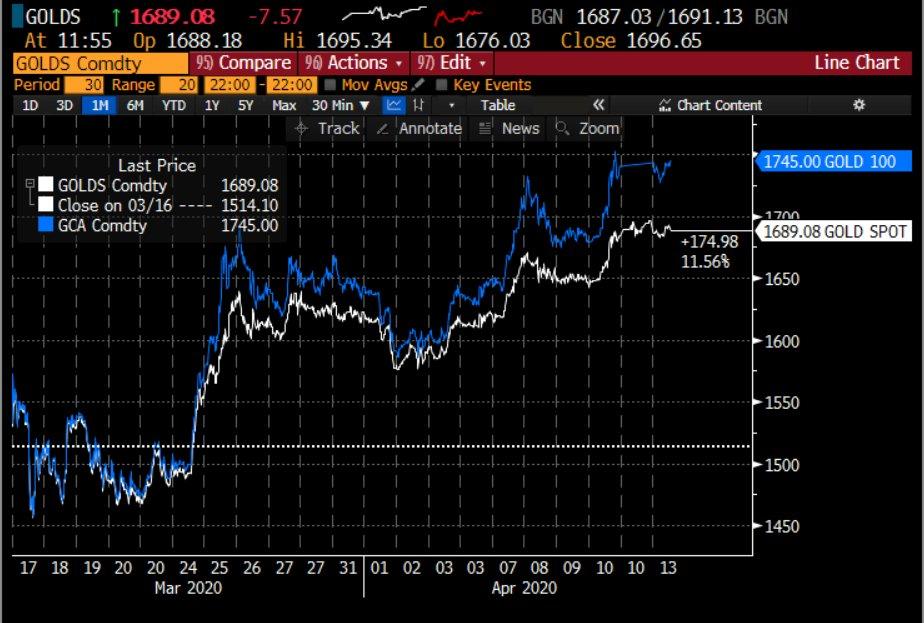
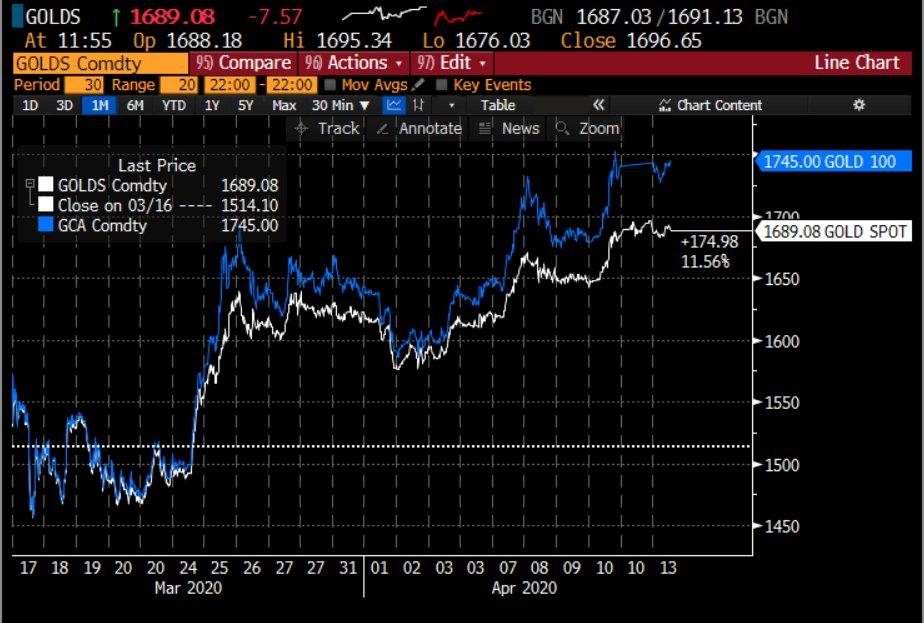
The white line is London spot, blue is New York futures. Normally, the spread is close to $1.5 dollars; on March 25, 2020, the spread was $60 dollars per troy ounce.

Usually, such a spread is closed by arbitragers (often banks). They buy spot (London) and sell futures (New York) until the gap is closed. If necessary, these arbitragers hold their position until maturity of the futures contracts, and make delivery to lock in their profit. But because flights were cancelled and refineries were shut down, the “arb” was risky and the spread didn’t close.

Bullion Banks Losing Money Through EFPs

Bullion banks often have a long spot position in London and are short futures on the COMEX. When a refinery in Switzerland, for example, casts big bars (400-ounce) and sells them to a bullion bank in London, the bank hedges itself on the COMEX. This makes the bank long spot and short futures.

Exchange For Physical” (EFP) is an OTC swap. On the COMEX website it reads:

Exchange For Physical (EFP) allows traders to switch Gold futures positions to and from physical [spot], unallocated accounts. Quoted as dollar basis, relative the current futures prices, EFP is a key component in pricing OTC spot gold.

(The London Bullion Market is an OTC market.)

An EFP is usually a swap between a futures and a spot position. In banking jargon the word “EFP” also refers to, (i) having a position in both markets, and (ii) the spread in general (because the price of the EFP is equal to the difference in price between New York futures and London spot). A bullion bank that is “short EFP” is long spot and short futures.

As mentioned, banks are most of the time short EFP. When the spread widened their short EFP starting bleeding. To avoid further losses, some banks “were forced to cover,” which added fuel to the fire. (It can also be the banks themselves started the spread to widen.) Many banks suffered severe losses.

Currently, most refineries in Switzerland have reopened. So, why does the spread persist? After all, arbitragers can hire planes to transport gold to wherever. On April 30, 2020, the spread was still $15 dollars per troy ounce.

Because I couldn’t figure this out myself, I asked John Reade, Chief Market Strategist of the World Gold Council, and Ole Hansen, Head of Commodity Strategy at Saxo Bank, for their views.

Reade wrote me:

I guess for two reasons: firstly, banks and traders probably still have large EFP positions that they haven’t been able to cover. And secondly, I doubt that risk officers and banks are prepared to allow large EFP positions to be run, so the usual arbitragers of this market cannot add to their positions, flattening the spread.

Which is in line with what Hansen wrote me:

While COMEX has now allowed the delivery of 400oz bars (the most popular bar size in London) and raised spot positions limits the problem has not gone away. This means that the mechanism that should balance the gold market still isn’t functioning correctly despite improving underlying physical conditions.

Market makers [banks] have suffered major losses last month and as they tend to natural short the EFP (long OTC, short futures) the risk appetite and ability to drive it back to neutral has for now been disrupted.

Banks lost so much money, they are cautious not to lose more. They don’t access funds to close the spread.

Conclusion

Generally, just the threat of delivery keeps markets in line as well. Any trader that sees an arbitrage opportunity can take position without the intention of making/taking delivery, in the knowledge that New York futures and London spot will converge. Now this certainty doesn’t prevail, traders are cautious. If they take positions but the spread widens, they lose.

Another reason why the spread can persist, is because of strong demand in New York. Speculators that reckon the price of gold will go up will buy long futures, increasing the spread. Normally, this type of demand is smoothly translated into the spot market by arbitragers without increasing the spread. But not now.

In a nutshell, I think that logistics and credit restrictions prevent the spread to close. However, if anyone has a better analysis please comment below.

Addendum

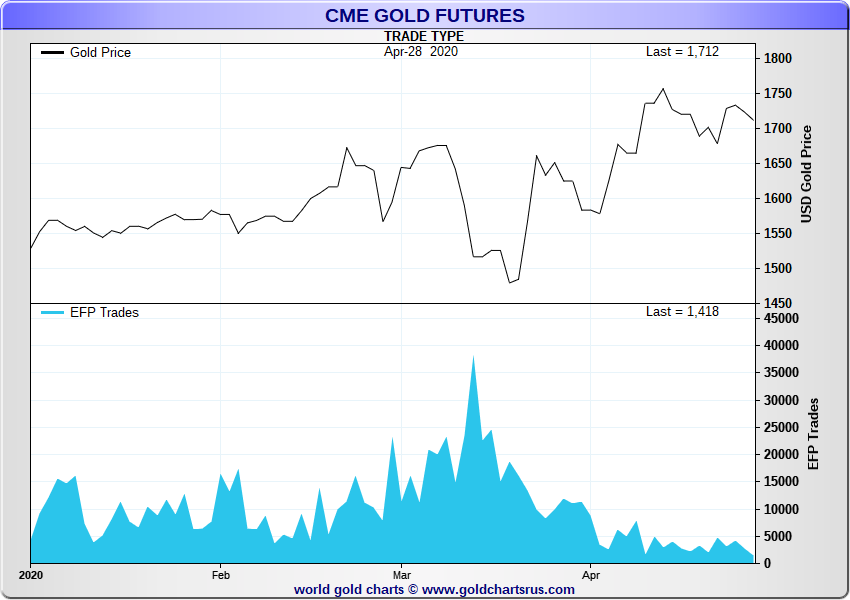
It can be, as John Reade wrote me, “banks and traders probably still have large EFP positions that they haven’t been able to cover.” I noticed on Nick Laird’s website Goldchartrus.com that EFP volume cleared through CME’s ClearPort is decreasing since early March, to levels not seen in a long time.

Perhaps this is a reflection of a market that is slowly trying to heal itself. Perhaps when all losses have been crystalized, banks, or other financial entities with sufficient firepower to hire planes etc., will close the spread.

Another possibility is that when the new COMEX futures contract—that can be delivered in 400-ounce bars—becomes active, the spread closes. At the time of writing, the open interest of this contract is virtually zero. Time will tell.


Tyler Durden

Sat, 05/02/2020 – 18:00

via ZeroHedge News https://ift.tt/2VUkP4a Tyler Durden

“The Whole Thing’s A Farce” – ‘Conspiracy Theories’ Thrive As Texans Flock Back To Shopping Malls

“The Whole Thing’s A Farce” – ‘Conspiracy Theories’ Thrive As Texans Flock Back To Shopping Malls

Texas is the largest US state to allow a substantial number of retailers and other businesses to reopen for the first time on Friday, even as many of the state’s Democratic big-city mayors urged residents and business owners to ignore the governor’s advice.

To try and get a sense of how the beating heart of Texas retail – the Barton Creek Square in Austin – was faring during its first day back in business, the dogged reporters at the Texas Tribune ventured out to the capital city’s biggest mall to commiserate with shoppers bold enough to risk infection over a pair of sneakers, as the TT piece put it.

What the reporters found was hardly surprising: stores barely managing to meet the 25% max-capacity threshold set by the governor, a threshold at which most businesses simply cannot operate profitably. As a result, only a handful of Barton Creek’s smaller stores were open; all of the mall’s anchor tenants – department stores that have been particularly hard hit by the downturn – remained closed.

By the time the mall opened at 11am local time yesterday, lines of shoppers had formed, with everyone standing six feet apart, and lines forming outside stores allowing only a handful of shoppers to enter at a time.

Most of the patrons were there to shop, it seemed – little things mostly; shoes, swimsuits etc. At least one told the TT that she was just out to get some exercise. They ranged from young couples to older singletons.

No temperature-checkers were present when the doors opened; no masks, nor sanitizing wipes, were handed out. Shoppers were basically left to look after themselves

John Whitton and Marina Oneill stood by their car outside wearing face masks – Oneill’s a DIY mask made by her roommate from a bra cup – waiting to buy a swimsuit (for Oneill) and shoes (for Whitton).

“I think I’m going to buy a pair of skate shoes and take it back to 2002,” Whitton said.

One thing that caught our attention: the surprising number of individuals interviewed by the TT to expressed doubt about the virus (one called the outbreak “a farce”) or endorsed some other conspiratorially-oriented view.

By 10:58, a line had formed outside an entrance adjacent to the Cheesecake Factory. Patrons, many wearing masks, kept a 6-foot distance from one another, aided by blue tape pressed onto the concrete to direct them where to stand.

The line included an avid mall-walker hoping to exercise away from the Texas heat, a mother whose young kids — each no older than 10 — all wore face masks and an Austin-area teacher convinced the coronavirus was cooked up by President Donald Trump, Russia’s President Vladimir Putin and North Korean leader Kim Jong-un.

Though most customers wore masks, as mandated by law, only a handful of patrons wore gloves.

Shoppers were antsy. Resigned, too.

“I think it’s all a big farce. I believe there’s a virus, but we have bird flu and pneumonia and I’ve had several shots,” said Charlene Franz, 65, who came to the mall to fix the cracked screen on her Cricket cellphone and return a broken pair of sunglasses purchased from Loft.

Friday was the first day that shopping malls, restaurants, retail outlets and movie theaters were allowed to reopen in Texas after being closed since the beginning of April. According to Gov Abbot’s order, stores can open, but must limit occupancy to 25% of capacity.

As several mall employees eagerly told the TT (speaking anonymously for fear of losing their jobs), the governor’s order was actually making it harder on most small businesses, as they’re essentially being forced to operate at a loss, and employees are being called back in to work, despite the fact that both the business and the employees were probably better served with the ‘PPP’ loan-to-grant scheme and of course the beefed-up unemployment checks that, combined with the stimulus, have left many hourly workers with more in their pocket than they would otherwise have.

It’s just something to think about: Why would anybody want to push for a reopening if it would only seal the fate of thousands of small businesses?

Some employees returned to work reluctantly. A 42-year-old who helps operate two phone kiosks at Barton Creek said there’s “no use” reopening the mall at only a 25% occupancy.

“None of the businesses can survive on 25% business,” said the employee, who spoke under the condition of anonymity because he wasn’t licensed by the mall to talk to the press.

“All the major stores are closed. We get business when people come to the major stores, and then it all flows and comes to the kiosk,” he said. “We do want to get back to work, but the governor should’ve waited until we were at 50-75% so we have a chance to survive or not open at all.”

Remember, if small businesses don’t make enough money after reopening, they’re going to need to shut down again – but this time, it might be forever.

Yanick Almeida, 23, who works as a jeweler at one of the mall’s kiosks, said the business usually takes in several thousand dollars on a typical Friday.

“That was before corona,” he said. Around noon, he hadn’t made a single sale.

“If we don’t make any money, we’re going to have to shut down,” he said. “But I don’t think we’re going to go anywhere because we’ve been shut down for about two months, and so far we’re still good.”

It’s worth wondering: Who benefits from the wholesale destruction of small business (or, in this case, the death of American malls, and the implosion of any securities backed by their debt)?

Who benefits?


Tyler Durden

Sat, 05/02/2020 – 17:35

via ZeroHedge News https://ift.tt/2StwYL4 Tyler Durden

Fauci Links & Virus-Lab Leaks: Newsweek Report Raises Urgent, Important Questions

Fauci Links & Virus-Lab Leaks: Newsweek Report Raises Urgent, Important Questions

Via PeakProsperity.com,

One of the more acutely-asked questions since the covid-19 pandemic broke out has been: Is the virus man-made?

Debate on the matter has been wild and furious. After much investigation, Chris is now weighing in on the heels of an explosive Newsweek report.

Newsweek reveals that as recently as last year, the US funded scientists at the Wuhan Institute of Virology focused on conducting ‘gain of function’ research on bat coronaviruses.

The source of that funding?

The National Institute for Allergy and Infectious Disease, headed by… (drumroll please)… Dr Anthony Fauci, lead medical expert for America’s Covid-19 presidential task force.

Now, this doesn’t mean the virus was lab-engineered as a bio-weapon. But it does suggest a naturally-occuring bat virus could have been artificially accelerated along certain vectors.

Of course, this raises an awfully lot of urgent and important questions:

So far, Fauci has not commented on the Newsweek report. You can be certain we will be keeping close tabs on developments from here…

*  *  *

Don’t forget to get your free download of Peak Prosperity’s book Prosper!. Given its relevance to preparing for any kind of crisis, pandemic or otherwise, Chris and Adam are now making it available to the world for free. To get your own copy, click here.


Tyler Durden

Sat, 05/02/2020 – 17:10

via ZeroHedge News https://ift.tt/2VXWdYs Tyler Durden

Here Is Hugh Hendry’s 3-Step Plan To Save The World From Financial Collapse

Here Is Hugh Hendry’s 3-Step Plan To Save The World From Financial Collapse

It’s official: despite still technically retired in St Barts where he is a “luxury real-estate, mentor, advisor, paddle-surfer” according to his twitter profile, last week’s markets tweetstorm appears to have awoken if not the investing, then at least the analytical “primal urge” in the Scottish investor, who ran the Eclectica macro hedge fund for 15 years until he shuttered it in September 2017 (his farewell letter can be found is here) disgusted with how broken and impossible to navigate capital markets had become as a result of central bank intervention.

And in case it wasn’t clear that after a three year hiatus Hendry suddenly finds himself having much more to say, late on Friday the macro investor followed up last week’s “inaugural” commentary with another massive tweetstorm (Hugh: it may be easier to just write a blog post or alternatively, send it here and we will post it), spanning hundreds of tweets, discussing – in far more whimsical, if typically Hendrian terms – what is arguably the most important concept: when does money printing become inflationary (i.e., the catalyst that will make David Einhorn’s long-term forecast correct).

But first, as a reminder last Friday, Hugh Hendry reverted to his investor roots, discussing the fate of gold and the dollar in the helicopter money regime, what it would take for the S&P to hit 10,000, whether the entire VIX regime is now inverted due to central bank backstops, and asks the “two key questions”: are we transcending from a bull market in fear to a bull market in WTF!? And will QE infinity differ from its previous vintages by driving risk asset volatility levels higher??

Hendry also touches on an old favorite topic, namely hyperinflation, a thesis which he thinks “needs stock prices to fall further and vol to rise in the conventional manner.”  But his most topical observation is what are the core criteria that will allow MMT – i.e., that fusion of the Fed and Treasury known as “helicopter money”…

you can print as many dollars as you damn well please, as long as the yield curve doesn’t steepen and the dollar doesn’t rally precipitously…you’re good to go and MMT is dope.

… as the alternative is game over. As usual, his stream of consciousness answers, right or wrong, were fascinating and could be read in their entirety here.

Fast forward one week later when we got “part two” from the Scottish investor – perhaps best known for his 2010 full-frontal assault on Jeffrey Sachs and the immortal words “I recommend you panic“, when Hendry explained accurately why the current central planning takeover would lead to much more pain in the future…

“Let’s purge this system of its rottenness. Let’s take on a recession. It’s going to be tough, people are gonna lose their jobs. They are going to lose their jobs anyway. We can spread this over 20 years, or we can get rid of it over 3 years.

… something which was clearly correct now that we are 10 years through Hendry’s 20 year forecast, and as we can observe in real time, to keep the system from imploding due to the accumulated “rottenness”, the Fed was forced to inject and backstop a record $12 trillion in just a few short weeks.

Below is the full stream of twitter consciousness which as expected is just as disjointed, as it is insightful, and every bit the Hugh Hendry we had grown to admire (and periodically criticize, especially after his odd “conversion” phase) over the past decade.

In it, Hendry – and this is our best attempt at actually grasping what he is trying to say – proposes a 3 Step mechanism for fixing the broken world, one which revolves around the following i) undoing capital limitations that would enable banks to lend much more aggressively while phasing away concerns about “moral hazard” and the great bank bailout of 2008; ii) end negative rates and force positive rates across the globe; and iii) “reintroduce central bank Window Guidance” giving banks a quota for their loan book and a targeted growth rate.

Now, we don’t necessarily agree with Hendry’s proposal – after all there is now so much debt in the world that artificially hiking rates far above r-star (which according to Deutsche Bank is now -1% in the US so one can imagine what it is in Europe and Japan) would lead to an immediate and catastrophic collapse in bond prices. On the other hand with central banks now monetizing virtually all securities, and bond markets no longer signaling anything, one would not have an incentive to sell bonds even if yields were to spike – since central banks would backstop everything. And so, in a perverted way Hendry’s proposal may actually work.

On the other hand, and we will discuss this later, there also needs to be loan demand instead of just supply. And the fact that the government’s PPP program is not based on loans at all but forgiveable grants, is precisely what there has been over $600BN in demand for the Paycheck Protection Program. If these funding facilities were structured as plain vanillla loans at slightly punitive rates (to invoke Bagehot), there would be virtually no demand and none of the money the government and Fed had created would flow through to the economy.

Long story, short, for there to be loan demand in the future, loans may all have to be structured as grants, which is possible for a government that can just print money but is impossible for banks which obviously can only take so many loan losses.

In any case, the reality is that the current status quo is also completely unsustainable – as the recent bailout of everything has shown – and so it may be that trying anything would be better than merely enforcing the same broken policies that have led the entire world to the edge of hyper(deflationary/inflationary) collapse.

And with that, without further ado, here is Hugh Hendry’s 3-step plan to save the world, as tweeted late on a Friday night..

We’ve never seen the phenomenon of simultaneously higher equity prices and a shift higher in the VIX curve without a state of hyperinflation; except at the start of Abenomics for 1-2 months in 2012 and maybe now…

But it’s a HUGE ask to imagine that April’s moves in VIX and SPX, allied to promises of further gigantic central bank printing, will prove a precursor to runaway inflation. But heck, let’s give it a go…

Crudely put, it seems more likely that this 2020 helicopter money is simply filling the great landfill dump left behind by the furloughing of the global labour market this year; that the CBs have replaced the normal monetisation that would emanate from an active labour force.

What might deliver a tipping point – where bank printing outweighs every other factor and we experience runaway prices? Clue: the answer is always in what I don’t write.

I’m going to attempt this thought exercise tonight

But first, let’s look at the abysmal chart of French bank lending

If you have the 50y data series, please share. But it kind of looks like a GOLD/SPX chart from the 1990s. Right? Hey to a man with a hammer, everything looks like a nail

Loans were expanding @ < 2pc p.a. before the pandemic. Looking forward, I think they are going to take off; or rather, this is an absolute requisite if we are to stave of the march to serfdom and prevent political extremists attaining the highest offices of government

But having lost so much precious time dithering, we may have to experience runaway prices as the quid pro quo. Hey! Shit happens. I really can’t imagine a scenario where a Hank Reardon saves the day. Can You?

Ok hold that thought! Cause first we got to remember that before this calamity, Macron, decided to shake up France’s overly generous state pension system. Quelle bêtise.

Imagine, we’ve had a 50y cycle that allocated more and more of the economic spoils to creditors and a FRENCH President just announced an attack on the proletariat. Hold on! Wait a minute? It’s like handing the DJ a cassette player…

But then this is the country that elected the ultra-leftie Mitterrand as President of the First Republique and he invited the Communist Party to join his government at the beginning of this cycle in 1981. I mean 1931 and the guy is a forward-thinking master of the universe but 1981 with the proletariat in it’s ascendancy and downtrodden creditors having retreated to the ghettos? It’s like a bully who can only find his courage in a crowd.

As contrarian signals go the French are a perfect indicator of where we are in the 50y cycle of wealth redistribution. The last adopter surely must always be the President of the Republique. Right?  After 50y of this we all know that you only fight when the economy is set to boom.

The global dream of an endless arc of rising economic prosperity is in jeopardy and this is no longer happening. Since the GFC, our Wesley Mouch type policymakers have consistently “mouched” their way through the manual of how to remedy an economy made vulnerable from a shock

It didn’t have to be like this.

The valedictory sound of “mission complete” first sounded along this bureaucratic blunder-path to radicalism when, and for good reason, they bought private debts at way above face value through regimes such as TARP I & II

Normally a sure-fire thing way to restore vitality to a devastated post-shock economy. Helpful. Relevant. On point. Courageous. I loved this!

But no bank-boom; no huge lift in GDP.

Again, and for good, sound reasons, they declared, “mission complete”, when they really went for it and  loaded up on radicalism and opted to return huge flows of money to the private sector. Subterfuge for sure but QE enabled the banks to make significant profits – the classic market cornering -where your independent, some might say lawless, central bank buys with the objective of creating a Hunt Brothers’ Bubble in Treasuries where private banks invest heavily.

Controversial to many for sure but no complaints from me. I give them an A+ for this exemplary move. But bank boom? Explosive GDP growth? Nada…So 2 textbook steps forward but little payback. What gives?

They have been undone by a collective failure to grasp the principle that GDP growth rates are determined by the momentum, the mojo, the VELOCITY, if you will, that only comes from an expansion of private sector bank balance sheets.

And hence my deliberate omission from earlier. Changes in money supply equal changes in central bank plus commercial bank assets. But moral hazard busted this equation…

In the frenzy of fear and recriminations that was 2008-9, centrist parties whimsically determined that as taxpayers were not responsible for the GFC (really?) then they – the State – did not have a mandate to foot the recovery bill. Caution: Ideology Alert!

As a consequence, it became preordained that all of the rise in the money supply had to come from the expansion in public or central bank balance sheets. A great depression averted but at the cost of economic dynamism. Bash them banks all you want but no loan growth begets no loan growth begets a fossilising economy were GDP can’t grow nowhere near damn fast enough to right ‘em wrongs.

Japan anyone?

All the central bank money printing in the world isn’t going to generate runaway prices if private sector banks are not expanding credit!!

So what has to happen?

It is not difficult to nudge the economy back into action. Ideology brought us here. Drop the dogma and we recover. Heck there’s even a manual residing somewhere in every government treasury department that explains exactly how to do it. Otherwise, appoint HughHendryOfficial to advise your sovereign Treasury and I promise that my team and I will generate “dynamic” GDP growth. Just tell me the number you desire cause I’m your supplier.

Step I: First things first, on the first day of my appointment, I’m going to ditch this moral hazard nonsense and rescind the longest suicide note in economic history a.k.a., Basel III: International Regulatory Framework for Bank Supervision.

Let me read directly from the macro manual. Rule no.1 clearly stipulates that accounting changes should be introduced to improve bank profitability which will beget more capital strength and more risk appetite; vigorous loan growth will ensue. I scream, you scream, we all need ice-cream! These bozos implemented the reverse!!!

However, it’s just possible that the legacy of the pandemic a.k.a the phantom menace, may allow scope to reverse this idiotic regulation; let’s hope so.

Step II, I’m going to reverse negative official interest rates in Europe and Japan. I’m not smart enough to understand everything. But I watch, listen and I try to improve. And those voices in my head keep telling me that those neg rates are counter-productive. How else do you explain the disparate performance of US banks vs. their Japanese and European cousins? Can someone chart and share this please? So I’m gonna raise rates folks; Volker, anybody?

Shorn of ideology deflation can be averted.

But  to return to the future we most likely have to visit the past. To conceive of this, I want you to try the following mental exercise. Think of a glossy Steve Jobs, promo video showcasing not the latest iphone but instead the economic milestones of the last 50 years.

Volker raising rates to tame inflation, quantitative restriction of the money supply, independent CBs, less powerful unions, liberalisation of the capital account, no unemployment, rising profits, risk taking, entrepreneurship, dynamic economies, the liberation of billions from the tyranny of state planning…

Done that? OK, now I want you to replay that same movie but only in reverse, and in slow motion, with interest rates being cut to negative, with market rates determined by the public sector, with the loss of CB independence, with quantitative expansions of the money supply. With less and less risk taking and lower rates of prosperity, less technology breakthroughs, less free markets and more government-set prices. An economy where everyone is on the payroll of the State.

It’s a dirty business but who ya gonna call? If it’s HughHendryOfficial then…

Step III will see us quietly, and without pomp or ceremony, reintroduce central bank Window Guidance whereby commercial banks will be given a quota for their loan book and a targeted growth rate.

The Princes of the Yen describes this technique well. The political imperative in Japan in the late 1980s was to stoke a domestic boom to deflect international pressure from the US regarding the Japanese trade surplus. Japan’s commercial banks grew their risk assets by 15pc pa between 1986 and 1989 and everything boomed.

Normally the circuit breaker is you and me. It’s we who work out the unsustainable nature of a fiat directed bank loan expansion. It is we who see the tower of riskier and riskier loans and its power to generate reflexively even riskier loans and huge unproductive investment.

Because, You & Me, we see things differently. It is us who head to the exit first and that’s why it’s You & Me who are going to live forever!

Sorry, I digress, where were we? The ensuing currency crisis. It usually puts a brake on the expansion. However, Japan, with a capital account of more than $200bn, rivalling the firepower of the IMF at the time, had no currency crisis; you want to pick a fight with a monster?

The hammer when it fell was simply an ideological change by the policymakers. Revolted by “les noveaux riches” and with a titanic battle of egos raging between MoF and the BoJ, policymakers chose to reverse their loan program. And, lacking a bid, risk assets crashed. It wasn’t about super sky high equity valuations. It was simply a change in bureaucratic ideology…damn dogmas.

Anyway, put me in charge of the ECB and I’ll deliver 3pc GDP growth across the continent by 2023ish; it will be easy. I’ll raise official policy rates, abolish Basel III and by re-introducing window guidance, I can command that European banks expand their balance sheets by 10pc.

Failure will be punishable by loss of quota. You wanna misbehave?

Not convinced? I hear you: the macro community are going to see a bozzo like me coming from miles away. Rapid private sector bank lending, riskier and riskier lending, debt fuelled asset purchases, bubbles – the €uro will plummet, and my German paymasters will kick me out.

Or will they? Is it inevitable that the €uro crashes under this scenario? I don’t think so because the U.S. Treasury has my back. Bitch!

Remember they promised to stop at nothing to prevent a sharp deflationary rise in the external value of the $. And so, like my brethren at the BoJ, so many years ago, I think I‘ve got job security. Just don’t re-introduce moral-hazard cause I’m the guy who’s gonna take you higher

I know you think this is fanciful, and for sure I won’t argue, but hear me out just a little longer. I promise I’m nearing the end. Let’s talk about me. Like the film, The Truman Show, I’m an investor living inside my investment. Weird, huh?

To the un-initiated, my Vol @ the End of the World Trade is to own client financed, one-of-a-kind, real estate on the tiny island of St Barts, funded by €uro matched, fixed, 20-year money at 2 or less percent. Recently my phone has never stopped ringing. It’s my French bank; they called to ask whether I wanted to defer my payments for 6 months? Those friendly officials from the French government are keen to help-out. God bless them…of course, I accepted their generosity.

Last week, same thing. It transpired that officials from the Treasury had put their heads together and come up with another great idea. They could propose an interest-only 5y loan equivalent to 20pc of my outstanding debt. Is that something I might be interested in? You sure bet!

The political centre ground is collapsing under a systematic ideological failure to forgive the banks. The malaise of the banking sector is preventing the cyclical propensity of GDP to rebound and deliver prosperity to the many.

Centrists must resolve their own moral hazard or face extinction. Make Banks Great (again)! Give me a call at hughhendryofficial

Or we’re destined to remain trapped in the serfdom of perpetual deflation

So there you have it:


dd


d


d


d


Tyler Durden

Sat, 05/02/2020 – 16:45

via ZeroHedge News https://ift.tt/3d6r5LZ Tyler Durden

The Freedom Of Individuals Still Matters – Even If COVID Warriors Say It Doesn’t

The Freedom Of Individuals Still Matters – Even If COVID Warriors Say It Doesn’t

Authored by Patrick Barron via The Mises Institute,

From 2009 to 2012, I taught an introductory course in Austrian school economics at the University of Iowa. On the first day of class, I would tell my students that the Austrian school would change the way they looked at the world, not just from an economic perspective, but from an overall life perspective.

Nothing would ever appear to be the same again.

They would learn to think for themselves and would not fall prey to all the propaganda from government, the mainstream news media, and poorly thought out opinions of friends and acquaintances.

Of course, that does not make one the most popular person at a cocktail party!

Methodological Individualism vs. Collectivism

I would explain that economic science falls within the overall science of human action. All action is individual, subjective, and purposeful. Ludwig von Mises used the phrase methodological individualism to explain the basis of what can be known about economics in particular and human action in general. It is the individual, and not the group, that attempts to achieve a higher level of satisfaction as he perceives it at any point in time. Of course, these “preferences” are subjective, meaning that they undoubtedly are different for different people and are subject to constant change within the individual himself.

(Consider the subjective desire for a glass of water after mowing the lawn on a hot day. At that point in time a cool glass of water ranks very highly on a person’s individual preference scale, but drops down the scale once the thirst is satisfied. Others may not be satisfied with a glass of water; perhaps only a cold beer or a lemonade will do.)

There is no such thing as “group” human action, such as Americans chose to sell stock last weekFrenchmen like to go to the Riviera in August, or Germany declared war on America on December 11, 1941. Some individual Americans may have sold stock last week, and some individual Frenchmen go to the Riviera each August, and certain people controlling the German government passed a resolution declaring war on America on December 11, 1941. Aggregates do not act; only individuals act.

Collective action is a fallacy, as Ludwig von Mises explained. At first this seems strange, but upon further reflection it becomes self-evident and many bogus statements are dethroned. For example, the mainstream media is noted for headlines such as “Americans Are Fearful of the Coronavirus.” This is a meaningless statement, since there is no such entity as “Americans,” only individual people who live in America. The fear of catching the coronavirus that is attributed to Americans in general ranges individually, from so afraid that one will not leave one’s home to hardly any fear at all.

The Problem with Government Restrictions

Since all action is individual, purposeful, and subjective, in the case of a crisis it is impossible for government to take collective action that would not be coercive to almost everyone.

The coronavirus is a case in point. At the present time (April 16, 2020), forty-one of the fifty US states have declared some form of what is called a “lockdown.” Supposedly “nonessential” businesses must remain closed, and there are various restrictions on the movement and interaction of the populace.

The stated purpose in all cases is to “stop the spread” of the virus.

Yet there is no way for a government bureaucrat to know which purchases and which businesses are truly “essential.”  The individual himself must decide what action he will or will not take in order to both avoid catching the disease AND satisfy his other preferences, such as keeping a roof over his head and feeding his family. If it were the preference of all people to isolate themselves, close their businesses, not patronize businesses, refuse to show up for work, or refuse to socialize with their friends and neighbors, then the government would not need to implement any of these measures. The only conclusion to be drawn is that the state-imposed restrictions are violations of the preferences of many individuals. Since it is only the individual who acts purposefully and not groups, government restrictions upon these individuals are illogical and cannot be justified.

Man Is an End and Never a Means to an End

Suppressing the spread or lethality of the virus is a result of individual human action and is not an end in itself that justifies using man as a means. Immanuel Kant expressed it best in his humanity principle, i.e., that man is an end and must never be treated as a means to an end. Individuals have different preferences, and only the individual may determine what is and is not in his own best interest.

An individual who desires to keep his business open will deal only with others who individually desire to patronize his business. The business owner and his customers may take whatever protective actions they deem mutually appropriate.

No one is forced to patronize a business that he believes is not taking appropriate safety measures, and business owners may require customers to take some sort of protective action in order to obtain their goods or services.

All individuals have expressed their preferences, as only each may determine for himself. This is fully consistent with Kant’s humanity principle and Austrian economic science’s recognition that society advances through social cooperation via the division of labor. In other words, there can be no such thing as a collective goal as set by government. Government is composed only of individuals expressing their own preferences. But each individual expresses his own preference through cooperative interaction with other individuals.

No one, not even government, may ethically force people to act against their preferences. This is a violation of Kant’s categorical imperative, that each person should act only as if his action should be a universal law.

In other words, everyone should always and everywhere obey the Golden Rule.


Tyler Durden

Sat, 05/02/2020 – 16:20

via ZeroHedge News https://ift.tt/3d7Mpk1 Tyler Durden