“The Dam Has Burst”: Why David Einhorn Thinks The Coronavirus Shock Will Lead To Soaring Inflation

“The Dam Has Burst”: Why David Einhorn Thinks The Coronavirus Shock Will Lead To Soaring Inflation

One of the bizarre aspects of the global depression resulting from the coordinated shutdown of most world economies due to the coronavius pandemic, is that we have experience a collapse in both aggregate supply and demand which, almost absurdly, has kept equilibrium prices relatively unchanged (except in the infamous case of oil where due to storage space limitations, the prompt WTI contract traded as far negative as -$40 on April 20. As a result, the biggest challenge facing economists is deciding if what comes next after the coronavirus pandemic is conquered, is inflation – as trillions in central bank and government stimulus lead to a far faster rebound in demand, or if the early surge in supply overwhelms demand and leads to a deflationary crash similar to what was seen in oil.

While the majority of economists and strategists, even contrarian types, are confident what comes next is even more deflation – and why not according to 10Y breakevens there will barely be any inflation for the next decade…

… one financial luminary who disagrees is David Einhorn who, when not feuding with Elon Musk on an almost daily basis now, believes that the economic shock from the coronavirus will turn out to be inflationary as he explains in his latest letter to investors.

But before we get into the gist of it, first we lay out his take on where we are now, and how we got here, namely the events leading to the global corona crisis, and the official response:

A global pandemic. It’s just sad. It’s sad seeing people get sick. Some recover, others do not. It is sad to mourn friends who have passed, and sadder still for their families who are not able to say goodbye at the hospital or hold a proper funeral. It is sad seeing people lose their jobs or live with the uncertainty that they soon may. Some jobs will come back, but others won’t. As hard as it has been watching the virus cut a swath of suffering through our hometown of New York, we can only imagine how much worse it must be in countries that do not have a viable choice to shut down their economies to limit the spread of the disease.

Our leaders are faced with a menu of only bad options: allow the disease to spread, or ruin the economy. There is a continuum of trade-offs. On balance, the decision in the U.S. has been to slow the spread of the disease at the expense of the economy, but to try to socialize as much of the cost as possible. We don’t have an economic crisis because of the health crisis; the economic crisis is a product of how we have chosen to react to the pandemic. In the last crisis, we socialized the financial sector risk by bailing out the banks that were deemed too big to fail. The result from that intervention was more than a decade-long recovery, fueled by increasing financial leverage, with the expectation that the government would ultimately assume the risks. And the authorities did so confidently; in June 2017, then Fed Chair Yellen declared that she didn’t believe there would be another financial crisis “in our lifetimes.” We found it cringe-worthy when she said it.

We were told that the emergency measures were temporary. After a decade of easy monetary policy, the Fed, under Chairman Powell, delicately began to unwind some of the emergency measures. Wall Street responded to Chairman Powell’s first courageous steps negatively and President Trump criticized him vociferously.

President Trump is a businessman, and in business, the best credit gets the lowest interest rate. President Trump translated that principle to the sovereign debt market: in President Trump’s view, if the U.S. is the best credit, it should have the lowest rates. The President misapprehends how government debt works. High real interest rates are the sign of a strong economy. They reflect attractive investment opportunities that can earn attractive returns Zero (or negative) real interest rates reflect a weak economy with poor investment opportunities, and difficulty servicing its debts.

In late 2018, Chairman Powell caved to the pressure: he did not have the Volcker-like stomach to absorb blame for the economic slowdown that might have followed a normalization of monetary policy. Instead, he went back to Jelly Donut monetary policy, where the sugar rush drove a final burst of a stock market rally, which lasted until the pandemic – an exogenous event.

Even prior to this crisis, our leaders had reached bipartisan agreement that deficits do not matter. The only real debate had become who to tax and how much to spend. The arguments are generally politically-motivated: tax the other party’s constituents while cutting taxes for your own constituents, and spend money to benefit your own constituents, while trying to withhold money from the other party’s constituents. The outcome of this dynamic has amounted to both guns and butter – and low taxes. Pre-crisis, the Congressional Budget Office (CBO) projected a 2020 deficit of $1 trillion, or 4.6% of GDP, despite record low unemployment. Cyclically adjusted, this very loose fiscal policy matched the Jelly Donut monetary policy.

The pandemic is not anyone’s fault (outside of China). And it stands to reason that policymakers are now doing “whatever it takes” to shelter the population from both the health and economic fallout. Since it’s been agreed that deficits don’t matter, there really is no limit. Debts will be forborne or forgiven and money will shower from the sky. Similarly, monetary policy is in all-out crisis mode. Whatever the traditional rules were, each week we see new evidence that they were made to be broken. Creditors will be protected from losses and money will be printed in whatever quantities are needed to support the fiscal needs.

President Truman once quipped, “It’s a recession when your neighbor loses his job; it’s a depression when you lose yours.” Every business is “essential” for the people who work there. Pausing the economy except for government-determined “essential” businesses has caused a recession/depression.

Having laid out where we are, Einhorn next takes a stab at what happens next. And since Einhorn has for years warned about the dire terminal consequences of what he dubbed the “jelly donut” policy a decade ago, it is hardly a surprise that he expects recent events to only accelerate the coming inflationary climax: 

The economy is now faced with simultaneous supply and demand shocks. There is much debate as to whether the shocks are inflationary or deflationary. The deflationists point to the loss of income and the collapsing price of oil. The problem with using oil as a proxy for inflation is that the price of oil is suffering mostly from a demand shock, while the supply of oil is unaffected. Oil wells continue to flow, while demand for transportation has collapsed. Oil is not alone. For any good or service where the supply isn’t cut to the lower demand, prices will fall.

Even so, in a broader sense, we believe the economic shock will turn out to be inflationary. People (and businesses) who aren’t working are no longer supplying goods or services. The social response of replacing most or all of the lost income sustains demand (or, if temporarily hoarded as savings, creates pent-up demand). Although both supply and demand are falling, supply is falling more.

The CBO now projects that the budget deficit will be 18% of GDP in 2020 and over 10% in 2021. This takes into account the estimated effects of all pandemic-related legislation enacted through April 24, but not the effect of any potential further stimulus.

The year “2020” could come to stand for a 20% deficit and 20% unemployment. The country is consuming more than it is producing – our combined private plus public savings rate is negative. The private sector cannot finance this level of government spending without further crowding out private sector investments and driving up interest rates. Historically, the U.S. has turned to its trade partners, particularly China, to finance its debts.

However, China’s economy is already under pressure. Here in the U.S., there is widespread discussion of reducing our dependence on Chinese supply chains, and the chorus of voices blaming China for the pandemic is growing louder. The lawsuits have already started, and it wouldn’t shock us if President Trump were to suggest using the debt we owe the Chinese to make restitution. All told, it is unlikely the Chinese will finance U.S. government deficits on this go-round.

These large deficits can only be financed by the Fed through the creation of new money.

Which brings us to the punchline: inflation is coming next, gradually at first – just like bankruptcy to loosely quote Hemingway – then suddenly:

The inflation is unlikely to appear immediately. Opportunistic price-gouging on toilet paper, hand sanitizer, milk, rice and potatoes is not a signal of broad inflation. However, a country that consumes much more than it produces, financed by ongoing money creation, will have more money chasing fewer goods and services. Once the initial shock wears off and the recovery begins, the inflation will begin to show up – and it probably won’t be limited to the share prices of money-losing “story” stocks.

The deflationists point to Japan as the obvious counter-example. However, Japan never ran these kinds of annual deficits, never had a large negative public plus private national savings rate, and never grew its money supply this quickly.

Now that the political fiscal dam has burst, the authorities have no incentive to slow the support. Stimulus packages 1, 2 and 3 will likely be followed by 4, 5, 6… The Fed will create money (and attempt to suppress interest rates) to support the economy.

Making matters worse, inflation from monetizing global debt and deficit will be a global phenomenon.

The U.S. is not alone – it’s a global pandemic and a global response. We expect inflation on a global basis. We expect policymakers to target and applaud mid-single digit inflation, which, combined with interest rate suppression, will be the only way to outgrow the mounting debts.

Incidentally, Einhorn is not alone in expecting inflation. One month ago, Morgan Stanley’s Michael Wilson flipped from bear to bull for the very same reason; and just like Einhorn, Wilson predicts that the coming inflation trend “will be slow at first and then accelerate quickly.”

We believe inflationary pressures may be building more than appreciated given the massive targeted fiscal stimulus, in conjunction with other ongoing trends in populism, nationalism, de-globalization and a worldwide pushback to the US dollar as the only reserve currency.

As these inflationary pressures become more apparent, we suspect nominal and real interest rates can rise more than the consensus believes as market participants begin to demand a greater term premium. A materially weaker US dollar would accentuate such a new trend. As is usual with new trends that go against the consensus, they tend to be slow at first and then accelerate quickly, which is why it’s imperative to be thinking about them before they happen.

So then what happens then as things “get tricky” and inflation accelerates further? That’s when it will be the turn of one particular asset class to shine: gold.

It might get tricky a few years from now if inflation accelerates further. The Fed has demonstrated it doesn’t have the stomach to slow the economy by reigning in policy. We believe the implied negative real interest rates are bullish for gold and for unlevered real assets with pricing power (home prices will rise, while leveraged commercial real estate will fall from lack of demand).

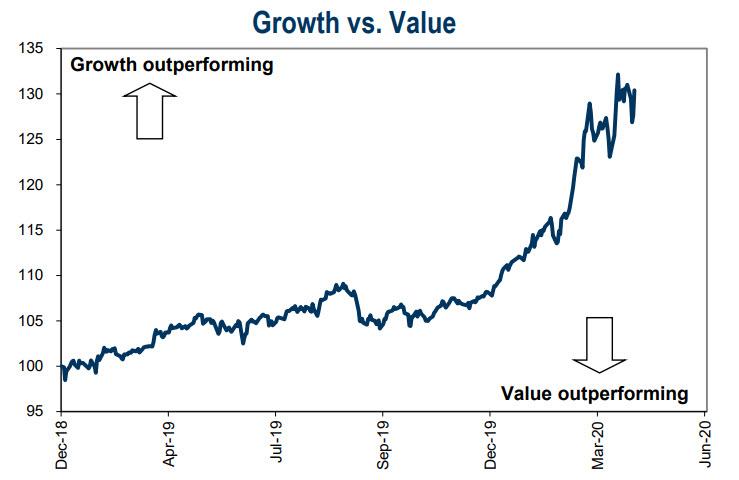
What does this mean for Greenlight’s portfolio – which as we will show in a subsequent post have had a rather tough time at it in recent years – and Einhorn’s steadfast bet on value stocks while shorting growth, “story” names? 

We have been asked many times what will cause the pendulum to shift. According to Mr. Lapthorne, cheap value stocks, not growth stocks, have historically led us out of a recession. If true, then a reversal should materialize, and we believe our performance is likely to turn. There is a decent chance that our gold-backed fund will have an even stronger result.

Whether or not the inflation point is here remains to be seen, but one thing is certain: the divergence between value and growth has never been greater.
For those who believe that it’s time for Einhorn’s fate to finally change and for the former hedge fund wunderkind to strike it out of the park, we have good news – Greenlight is now accepting new capital.

For most of the last 20 years, our funds have been closed for new investment. Over the past few years, we’ve had redemptions and the Partnerships have become smaller. A year ago, we opened for new investment, but made no real attempt to market the Partnerships. That is about to change. We think it’s a good time to invest in Greenlight. We know it will take a strong stomach to overlook our recent performance, and we recognize that some of you may need to see proof of a turn first. That said, we have not felt as optimistic about the opportunity set ahead of us since the depths of the 2008 financial crisis.


Tyler Durden

Sat, 05/02/2020 – 15:55

via ZeroHedge News https://ift.tt/3feWUnN Tyler Durden
David Stockman On The Fed’s Destruction Of Financial Markets & What It Means For You

David Stockman On The Fed’s Destruction Of Financial Markets & What It Means For You

Via InternationalMan.com,

International Man:

Decades of money printing have created enormous distortions in the market. It seems that the coronavirus popped the Everything Bubble. Where do you see the stock market going?

David Stockman:

I’d say it’s going in a new direction, and it’s not up year after year, month after month, day after day.

It’s not going to be a world where buying the dip is a no-brainer thing to do.

I think the stock market was insanely valued when the S&P 500 peaked at 3,380 on February 19th.

It has got a long way yet to correct.

Who knows what earnings are going to be?

No one knows how long these lockdowns will last.

You look at the news flow every day, and it’s like a massive political arm-wrestling match between the White House and the Democratic governors and mayors.

I’m sure in their minds, these local and state politicians, think they’re serving the public good and protecting the safety and lives of their citizens. But, the fact is, back in the unstated regions of their brains, they’re focused on taking down the US economy, which was Trump’s only claim to reelection.

I think when push comes to shove in the great human struggle of things in our political system, this lockdown lunacy is going to be prolonged far longer than you can imagine, and the economic loss is going to be staggering.

Even the Wall Street brokers now—Goldman Sachs and the rest of them—are projecting a 25 to 30% GDP collapse on an annualized basis in Q2.

Just a few days ago, they were all expecting this to be one and done, and that in the next quarter it’ll level out—but that view is fading very fast.

We have a hand-to-mouth economy. By that, I mean no business could afford cashflow interruption because they had levered their balance sheet to the hilt or had spent most of their cashflow available to buy back their stock.

So, once you start these chain reactions, you have incredibly vulnerable business balance sheets in America that collectively have $16 trillion of debt.

I’m not talking about banks or financial institutions now—just operating businesses.

That’s not to mention American households—half of them don’t even have $300 to last a week or two.

Overwhelmingly, 90% of the households in America have been told that they’re the Energizer spending bunny of American economics, and if you don’t have enough wages this week, borrow some money on your credit card and just keep on spending.

This has created a hand-to-mouth economy that has no immunities—if you want to use that metaphor in an economic sense. It cannot cope, and it has no antibodies to fight back against the interruption of paychecks and cash flow.

There is going to be broken furniture everywhere as it filters through an economy that is sitting with $74 trillion of public and private debt on its back. That’s how much we have today.

People need to focus on this fact, that we thought we had a warning back when the great financial crisis occurred in 2008 when Lehman Brothers went bankrupt, the Great Recession, all that.

At the time, there was $52 trillion of debt in the economy, and people said that we’re living beyond our means—we need to learn some lessons here and repair the excesses.

Well, that never happened. We’ve added $22–23 trillion of debt since then. Therefore, the economy is now even more fragile, even more vulnerable to any kind of dislocation.

Now, what we’re getting is the mother of all dislocations. It’s happening so fast and severely that it’s off the charts.

You can look at any of the so-called incoming indicators that everybody constantly jaws about on bubble vision on CNBC, and you will see that the last two data points are literally off the charts. The Empire State Index was out recently, and it’s down to -70, against a base of zero, and it usually says +20, 30, or 40.

Never has anything like this been recorded. We have an economy that’s going to implode in the next four or five months. Earnings are going to drop tremendously.

It’s going to be a question of whether the markets can convince themselves to “do the Rip Van Winkle thing, go to sleep on earnings for the next year, and start discounting 2022 earnings,” or something.

I don’t think that’s going to work this time. I believe there is going to be a real loss of confidence because the Fed has no dry powder.

The market will likely work its way down in irregular, violent, volatile moves. It will go up for a few days and then experience a big correction, and up for a few more days, another big correction.

The S&P 500 ought to be valued at 1,500 or 1,600, which is way the hell below where it is today—and far below where it was at the peak of almost 3,400.

What I’m saying is, the market that never stops rising has finally met its match.

The patented “buy the dip” mantra is going to keep the thing alive for a few more months until the last robo-machine and day trader has his brains blown out after they bought the dip one more time and then got monkey-hammered by another reversal.

That’s where I think we’re heading.

International Man:

The Federal Reserve’s unprecedented bailout of everyone and everything seems to have no end. What do you think the consequences of this will be?

David Stockman:

I think what people must get their minds around is that this is happening with such warp speed: job losses, cash flow, GDP, the federal budget.

What the Fed has done is more off the charts than anything we’ve seen yet.

In early March, the balance sheet of the Fed was at $4.2 trillion—after they gave up on quantitative tightening (QT) and normalizing the balance sheet—which they promised to do when Ben Bernanke took it to these high levels after the great recession.

Recently, that number was $6.2 trillion.

In merely 30 days, they printed $2 trillion of additional balance sheet or doubled the first trillion. That’s the level first achieved in September 2008—and had taken the Fed 94 years to create from the days that it opened its doors.

I calculated it: that’s about 35,000 days it took the Fed to get the first $1 trillion of balance sheet.

These madmen and women in the Eccles Building, it took them 30 days to create twice the amount of balance sheet that it took during those first 95 years of the Fed.

What does this mean?

It means that they’re destroying the financial markets as we know them.

There’s no interest rate left. They’re pushing everything close to zero through this massive intervention and buying everything in sight directly or indirectly. That includes commercial paper, municipal bonds, investment-grade corporates, fallen angels, so to speak—that’s just a backdoor way into junk. They’re buying ETFs—the bond ETFs.

It’s only a matter of time before they’re going to be in there, hand over fist, buying stocks.

Janet Yellen and all the rest of them are saying, “Well, maybe they need that additional power.”

How can you have capitalism when you have no capital markets?

It’s that simple. The Fed destroyed it.

The consequence will be massive speculation, malinvestment, and keeping all the zombies alive.

For instance, the high yield market had a significant dislocation recently—where yields soared from 5% to 10% or more—which was an effort by Mr. Market to say that there are a lot of borrowers out there that aren’t solvent. They’re going to have to meet their maker in Chapter 11.

So, what is the Fed trying to do?

It’s trying to prevent any of that from happening. The Fed wants to keep everybody that has borrowed up to their eyeballs alive.

Therefore, it means that the economy will become weaker, more stagnant, and more inefficiency-ridden with time.

If you don’t have the cleansing process of creative disruption, if you don’t allow the price of capital to reflect risk and reward, if you don’t permit failures to be eliminated and liquidated, you’re going to have either a sclerotic economy like Italy or England or even worse, a Soviet economy, if you carry this far enough.

Frankly, I think the right phrase for the Eccles Building and the twelve people on the FOMC is the “Monetary Politburo.” They’re trying to control every movement in the entire economic system through the domination of financial asset prices and pegging of interest rates across the whole yield curve.

It is madness.

Where it will lead is very hard to say. Obviously, not to anything good.

It is so off the charts, and ludicrous relative to anything anybody thought even ten years ago, certainly twenty or thirty years ago. It’s difficult to imagine how bad it is going to get, but it’s going to get pretty bad.

International Man:

Those are some great points. Where do you see the future of the US dollar?

David Stockman:

To paraphrase Winston Churchill about democracy, the US dollar is the worst currency imaginable—except for all the other currencies in the world.

In other words, all the central banks are doing the same thing the Fed is doing, only worse. It’s a race to the bottom.

The European Central Bank cut its policy rate to even deeper subzero, which is just crazy.

The Bank of Japan might as well just buy a paper mill and print paper until there are no trees left in Japan.

In the case of the US dollar, the traditional idea is that we’re going to destroy the currency. That’s true if the rest of the world is prudent.

We don’t have a Weimar Republic 1923 situation where they were trying, in the UK and certainly in New York, and the Bank of France, to restore sound money—prewar money. They failed, but they were attempting to restore sound money and a gold standard currency.

Germany was a basket case economically; they were paying reparations and started up their printing press. There was massive capital outflow, they imported inflation, which then fed upon itself, and the whole wheelbarrow full of money thing happened.

That was inflation in one country when the rest of the world was trying to pursue relatively sound money.

By contrast, today, we have monetary inflation in all countries. So you look at the dollar, and you look at what the other central banks are doing, the dollar is the cleanest dirty shirt in the laundry. It’s probably going to get stronger, not weaker in the FX markets.

But that doesn’t mean that we’re out of the woods.

It only means that the central banks of the world collectively—which have already taken their balance sheets from $2 trillion in the late 1990s to over $25 trillion—are printing money at such a rate that they’re likely to bring down the entire world monetary system. Not simply the US dollar.

International Man:

How will the Fed’s actions affect savers and retirees?

David Stockman:

The essence of it is that the Fed policy is criminal—just flat out criminal—in terms of its impact on savers and retirees on a fixed income.

There is no interest rate left unless you want to speculate in junk bonds. Why should a 78-year-old be speculating in junk bonds to pay for rent or put food on the table?

It is criminal.

That’s what this whole financial repression, zero interest rate, or subzero interest rate policy is doing. It’s hurting tens of millions of people who’ve tried to save and be prudent and not live hand to mouth.

If something like COVID-19 comes along, or an earthquake depending on where you live, or just a bad spell of health affecting your family, you need something to fall back on.

How can people save today when you get nothing?

Take somebody who worked in the steel mill 40 years, who was able to scratch and save and defer gratification. Let’s just say he came up with $300,000 of lifetime savings. He’s now retired. He needs to keep it liquid, but he’s earning less interest income per week than one cappuccino at Starbucks on a lifetime worth of savings.

That’s so evil.

You may ask these central bankers, “Well, what about the savers?” These idiots say that there is too much in savings.

Well, let’s look around right now.

Why do we have a $2.3 trillion bailout? Why are we giving helicopter money to upwards of 180 million people—who are going to get that $1,200 check?

Why are we bailing out small businesses left and right to have them preserve jobs?

Why are we doing all of that if there’s an excess of savings in the world?

In reality, there is no excess. It’s complete nonsense.

The idea that the central bank is there to subsidize, coddle, and bail out the borrower and savage the saver is just fundamentally wrong and goes right to the heart of why we’re in such big trouble.

*  *  *

The amount of money the that is being pumped into every corner of the economy by the Federal Reserve is unprecedented. The consequences of which could be crippling to the the average person. That’s precisely why NY Times best-selling author Doug Casey and his team just released a free PDF report on how to survive and thrive an economic collapse. It reveals how it will all play out and what you can do about it. Click here to download it now.


Tyler Durden

Sat, 05/02/2020 – 15:30

via ZeroHedge News https://ift.tt/3dc73zs Tyler Durden

Is Administrative Law Immoral?

In the latest issue of National Review, I review Richard Epstein’s latest book, The Dubious Morality of Modern Administrative Law.

Here’s a taste of my review:

In 2014, Columbia Law School professor Philip Hamburger posed the question “Is administrative law unlawful?” in a book of that title. Now Hamburger’s New York neighbor Professor Richard Epstein, of New York University Law School, asks whether modern administrative law is immoral. Both answer in the affirmative.

Although framing their inquiries in different ways, both Hamburger and Epstein question whether contemporary administrative law is consistent with the rule of law. This is not an idle question. The laws that govern many individuals’ lives and livelihoods are the product not of the legislature but of administrative agencies exercising delegated power with inconsistent legal or political accountability. . . .

Drawing upon Lon Fuller’s classic treatise The Morality of Law, Epstein considers whether modern administrative law satisfies Fuller’s prescriptions for a moral legal order. And as Epstein’s title suggests, this is a dubious proposition: “Fuller’s steely insistence on legal coherence, clarity, and consistency, coupled with his strong condemnation of retroactive laws, does not mesh with modern administrative law.” This is quite a problem, for the features Fuller identified were not merely advisory, but “the minimum requisites for the rule of law.” Insofar as modern administrative law violates these principles, it is, in one sense, immoral and needs to be reformed.

The full review is here.


from Latest – Reason.com https://ift.tt/3fdeJ6v
via IFTTT

Is Administrative Law Immoral?

In the latest issue of National Review, I review Richard Epstein’s latest book, The Dubious Morality of Modern Administrative Law.

Here’s a taste of my review:

In 2014, Columbia Law School professor Philip Hamburger posed the question “Is administrative law unlawful?” in a book of that title. Now Hamburger’s New York neighbor Professor Richard Epstein, of New York University Law School, asks whether modern administrative law is immoral. Both answer in the affirmative.

Although framing their inquiries in different ways, both Hamburger and Epstein question whether contemporary administrative law is consistent with the rule of law. This is not an idle question. The laws that govern many individuals’ lives and livelihoods are the product not of the legislature but of administrative agencies exercising delegated power with inconsistent legal or political accountability. . . .

Drawing upon Lon Fuller’s classic treatise The Morality of Law, Epstein considers whether modern administrative law satisfies Fuller’s prescriptions for a moral legal order. And as Epstein’s title suggests, this is a dubious proposition: “Fuller’s steely insistence on legal coherence, clarity, and consistency, coupled with his strong condemnation of retroactive laws, does not mesh with modern administrative law.” This is quite a problem, for the features Fuller identified were not merely advisory, but “the minimum requisites for the rule of law.” Insofar as modern administrative law violates these principles, it is, in one sense, immoral and needs to be reformed.

The full review is here.


from Latest – Reason.com https://ift.tt/3fdeJ6v
via IFTTT

NYPD Dispatches 1,000 Cops To Stop New Yorkers From Barbecuing On Saturday

NYPD Dispatches 1,000 Cops To Stop New Yorkers From Barbecuing On Saturday

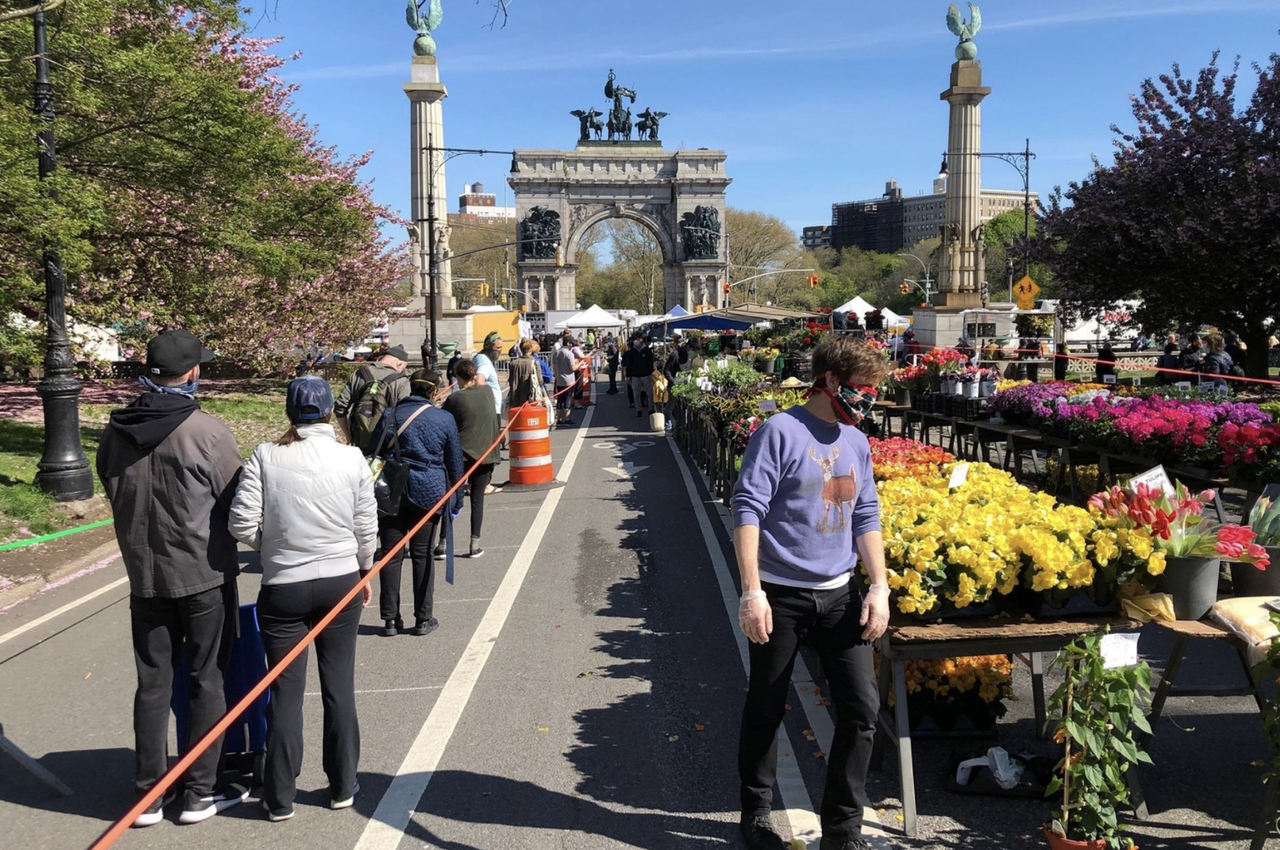
As shell-shocked New Yorkers venture outside to try and enjoy a little time in the sun, the NYPD is dispatching 1,000 officers whose sole responsibility on Saturday will be enforcing the city’s social-distancing rules, even as surveillance data released by the governor on Saturday suggested that 1/5th of New Yorkers have already been exposed and developed antibodies.

The move comes after Mayor de Blasio threatened to sic the NYPD on ultra-orthodox Jews in Williamsburg, who gathered for the funeral of a rabbi late last month. De Blasio was slammed by community advocates for what they said was unfair targeting of the Jews.

And how to we solve issues of alleged discrimination in 21st Century America? That’s right – we ensure the entire population is subjected to that same discriminatory behavior, however ridiculous that might be.

NYPD officers – many of whom have already contracted the virus themselves – have the power to issue summonses and even make arrests if they encounter individuals who flagrantly or repeatedly flout the social distancing rules.

“This is the nicest weather we’ve seen this year; we encourage people to come out and enjoy this weather,” Terence Monahan, Chief of Department for the New York Police Department, told NBC News. But “You cannot gather; you cannot barbecue. We’re going to give you a summons. There’s been enough warnings.”

Monahan said the NYPD would have bike teams and mounted units on horseback throughout the parks, as well as aviation units working to spot “problem areas” (i.e. the Jews in Brooklyn and New Yorkers across the 5 boroughs who rush to gather an impromptu barbecue on a nice day).

Officers won’t issue summonses to those who aren’t wearing masks; instead, they will carry packs of clothe masks to distribute.

Monahan said he hopes his officers won’t need to issue summonses, but the NYPD has encountered no shortage of stubborn noncompliant individuals.

“The vast majority of times people have complied,” Monahan told NBC News. “But there’s been some people who think they can do whatever they want. They endanger my cops; they endanger each other.”

Lt. Adam Mellusi, a patrol commander in the Bronx, said his squad – consisting of a dozen officers on bikes – will be issuing summonses if they find “large-scale barbecues and drinking.”

He added that most New Yorkers support the patrols and “have actually thanked us for being out here.”

Somehow, we doubt most communities of native New Yorkers, who take the tradition of springtime barbecuing more seriously than Brooklyn hipster transplants, will be thanking the officers who write them a $300 ticket, or a court summons, for standing too close to their brother-in-law.


Tyler Durden

Sat, 05/02/2020 – 15:05

via ZeroHedge News https://ift.tt/2VUz3lC Tyler Durden

Von Greyerz: The World Will Never Be The Same

Von Greyerz: The World Will Never Be The Same

Via GoldSwitzerland.com,

In this interview Egon von Greyerz explains to Paul Eberhart of SilverDoctors that the combination of the Coronavirus and the coming economic depression will change the world forever.

We are now going towards a hyperinflationary depression that will eventually lead to a deflationary depression

The next couple of years will not be a pretty picture and many people will suffer.

It has been too easy with governments and central banks printing money that has given an illusory high standard of living.

But the world will now discover that printed money has no value and that you can’t solve a debt problem with more debt. 

Although times will be hard, there are always opportunities for people who are willing to work hard. As long as you don’t depend on worthless printed money and bankrupt governments. 

Egon’s message has been consistent for 20 years. The risks in the world are unprecedented due to the massive debt and asset bubbles and wealth preservation in the form of physical gold and silver is essential. Gold and silver are dramatically undervalued and very soon it will be impossible to buy precious metals at these prices. 

Other areas covered by Egon and Paul:

  • Every single hyperinflationary event in history came as a result of the debasement of currency

  • Disconnect between paper market vs physical market in oil and gold

  • Why you shouldn’t buy gold ETFs

  • How does real estate compare to gold and silver?

Watch this interview to learn the answers to these questions and more.


Tyler Durden

Sat, 05/02/2020 – 14:40

via ZeroHedge News https://ift.tt/3aVX0NB Tyler Durden

Democrats Slammed Over Biden-Kavanaugh Double Standard

Democrats Slammed Over Biden-Kavanaugh Double Standard

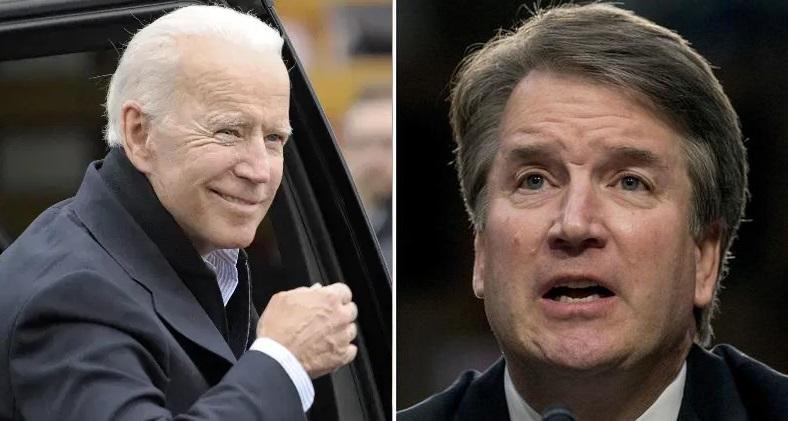
With Joe Biden facing a sexual assault accusation from a former staffer who not only remembers the date, location, and who she told – and that there was penetration, Democrats who condemned Supreme Court Justice Brett Kavanaugh over allegations which were devoid of the same level of specificity have come under fire for their utter silence, or defense, of Biden.

Both Biden and Kavanaugh have faced decades-old charges that first became public at critical junctures in their pursuit of high political office.

Top Democrats who were on the front lines demanding justice for Christine Blasey Ford during the Kavanaugh hearings have rushed to defend Biden, saying they do not believe the allegations made against him by Tara Reade.

And while the news media printed salacious new allegations against Kavanaugh before vetting the accusers or their claims, media outlets have approached Reade’s allegations with extreme caution. –The Hill

Indeed, the standard of “believe all women” set by Democrats themselves has been utterly abandoned, highlighting what a giant virtue signal it was in the first place.

“There is a clear double standard between how the media and Democrats treated Dr. Christine Blasey Ford’s allegations versus Tara Reade’s allegations,” said Mike Davis, president of the Article III Project, which advised the Senate on Kavanaugh’s nomination.

“It was stunning to see Democrats say they believed Joe Biden even before he’d spoken a word about this,” he added. “And the media instantly and breathlessly reported on all of the allegations against Justice Kavanaugh, which resulted in three criminal referrals against accusers for conspiracy to lie to Congress.”

In stark contrast to Biden’s accuser, top Democrats demanded that Kavanaugh remove himself from consideration to the Supreme Court  – participating in Capitol Hill protests and fundraising off the hearings which became a key issue for liberals ahead of the 2018 midterms in which Democrats won back the house, notes The Hill.

Privately, some Democrats are now lamenting the standard they set in 2018, saying it has backfired now that Biden has been accused.

We set up a standard we can’t live by. No one likes to discuss it but it’s the reality,” said one Democratic strategist who requested anonymity to talk candidly. “It looks terrible for him and for the party. You can’t say you believe women and then take it all back because it doesn’t apply to you.”

Blasey Ford accused Kavanaugh of assaulting her in the early 1980s when they were both in high school. Reade accused Biden of assaulting her in the early 1990s when she worked in his Senate office.

Biden and Kavanaugh have both strenuously denied the allegations against them. –The Hill

In 2018, Biden said that if a woman comes forth “in the glaring lights of focus,” you’ve got to “start off with the presumption that at least the essense of what she is talking about is real.

When asked by MSNBC‘s Mika Brzezinski on Friday if all women are to be believed “unless it pertains to you,” Biden said that women should be “given the benefitt of the doubt,” and should “start off with the presumption they’re telling the truth.”

BUT

“Then you have to look at the circumstances and the facts,” Biden continued – with a giant caveat absent from his Kavanaugh condemnation. “And the facts in this case do not exist. They never happened, and there’s so many inconsistencies in what has been said in this case. So yes, look at the facts and I assure you it did not happen, period. Period.”

Meanwhile, the MSM’s coverage of Kavanaugh is coming under new scrutiny, as several allegations with virtually no evidence were breathlessly promoted – including an allegation of gang rape made by Michael Avenatti client Julie Swetnick, which resulted in a criminal referral for conspiracy to lie to Congress.

With Reade, however, most of the MSM waited a full three weeks after her March 25 accusation to even cover the story.

In fact, the only outlet that would have Reade on is Fox News, where she will appear on Sunday to address her claims. Reade, a Democrat, told New York Times media critic Ben Smith that she wanted to avoid the outlet over concerns that it would make her allegations appear political, but that she was left with no option after other cable ad broadcast outlets refused to reach out.

“Absolutely there’s been a disparity in the way the media has approached these two cases,” said Boston University professor Tobe Berkovitz, who specializes in political communications. “The burden of proof has not been the same. And granted, right now you have COVID-19 as the story that is always going to be the lead, but you’d think after that you’d see more about Reade’s allegations. It just hasn’t been a big story.”

Meanwhile, President Trump and other Republicans have called out the left over their diametrically opposed coverage of the accusations.

“I look at the double standard,” Trump said on Friday, “You look at Biden and nobody even wants to bring up the subject.”

Meanwhile, the left is now engaging in the very ‘whataboutism’ they said was off limits in political debate:

MSNBC anchor Nicolle Wallace said it’s a double standard for Republicans to try and create an “equal playing field” between Trump and Biden, when Trump has been accused by many more women.

The right isn’t running an intellectually honest operation to get to the bottom of whether Tara Reade was victimized,” Wallace said. “The right is running a smear campaign against Joe Biden.”

The Trump campaign released a new digital ad accusing Democrats of hypocrisy on the issue. The National Republican Congressional Committee released scores of press releases on Friday highlighting remarks from vulnerable Democrats who demanded Kavanaugh step aside but have been quiet about the allegations against Biden. –The Hill

“It’s a bit of a Pandora’s Box we opened on this one,” one Democratic fundraiser told The Hill. “A perfect trap and we stepped right into it.


Tyler Durden

Sat, 05/02/2020 – 14:15

via ZeroHedge News https://ift.tt/2YpC4vS Tyler Durden

“Sell In May” Might Be A Good Risk Strategy This Year

“Sell In May” Might Be A Good Risk Strategy This Year

Authored by Lance Roberts via RealInvestmentAdvice.com,

Biggest Rally Since 1974

Could “Sell In May” be a good risk strategy this year? Maybe, considering we asked a simple question last week: “Is the bear market rally over?” 

“That’s the question we have been discussing over the last few weeks. So far, most of it has played out much as expected by turning previous ‘selling panic’ into a ‘buying rush,’ and convincing a vast majority of investors the ‘bull market is back.’” 

Just as we have seen in previous “bear market” bounces, the gains for April were quite stunning with stocks putting in the best one-month advance since 1974.

These exceedingly large bounces usually occur during bear markets. Unfortunately, in many cases, the majority of those big one-month advances are followed by negative returns.

Timing, as they say, is everything.

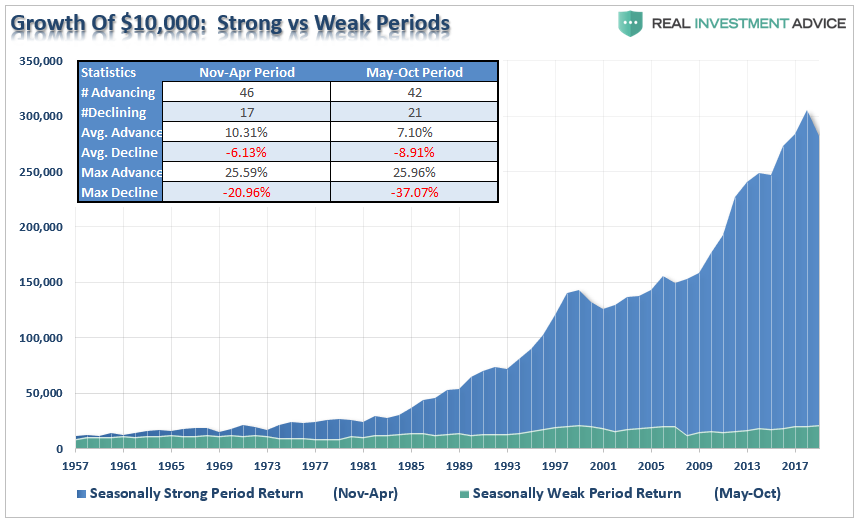
Sell In May

My colleague, Jeffrey Hirsch from Stocktraders Almanac, recently penned:

“Despite the sell-off on the last day of April, the Best Six Months has ended on a positive note, registering the best month in decades and the best April since the Great Depression.”

Currently, the primary signal has not crossed into negative territory yet but seems to be heading in that direction. It won’t take but a couple of more days of falling, or stagnating markets, to trigger that signal.

While not every “summer period” is negative, the long-term history of investing during the summer months is not stellar.

However, the adage “Sell in May” may be more appropriate this year given the state of the actual economy, earnings risk, and a potential revaluation of markets, the odds of a weak summer period has risen markedly. (This is particularly the case as we head into the Presidential election and trade tensions with China are heating up.)

Managing The Risk

Jeff continues:

“The massive rally has surely been impressive and a welcome change from the carnage we experienced in February and March. April 2020 has been the best month since January 1987 for DJIA and S&P 500, and the best April since 1938.

But April’s huge move was not enough to put the Best Six Months (November-April) in the black, and that concerns us. The DJIA was down 10.0% for this Best Six Months period, which ended today, and the S&P 500 lost 4.1%.

When the market is down during the “Best Six Months,” it’s an indication that there are more powerful forces than seasonality at work, and when the bullish season is over, those forces may really have their say.”

Following the first back-to-back down Best Six Months since 1973-1974, the market hit a secular bear market low in March 2009. The market made a similar secular bear market bottom in August 1982, which began in 1966. Of course, that bottom came after the infamous 1980s double-dip recession.

Our concern here is that this time around, we’ve only just begun.”

The Risk Starts In May

We can’t disagree with that statement. While there are many hoping that the worst of the economic data is now behind us, I highly suspect it isn’t. As noted in this week’s #MacroView:

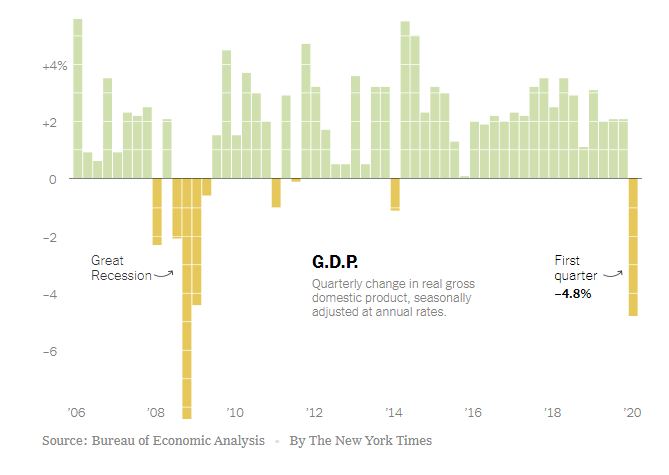
“The negative 4.8% decline in GDP in the first quarter was stunning. Importantly, that reading only encapsulated the impact of the economic “shutdown” in that last two weeks of the quarter. Such suggests, considering the entire month of April (1/3rd of the quarter) was a wash, the numbers will worse next quarter.”

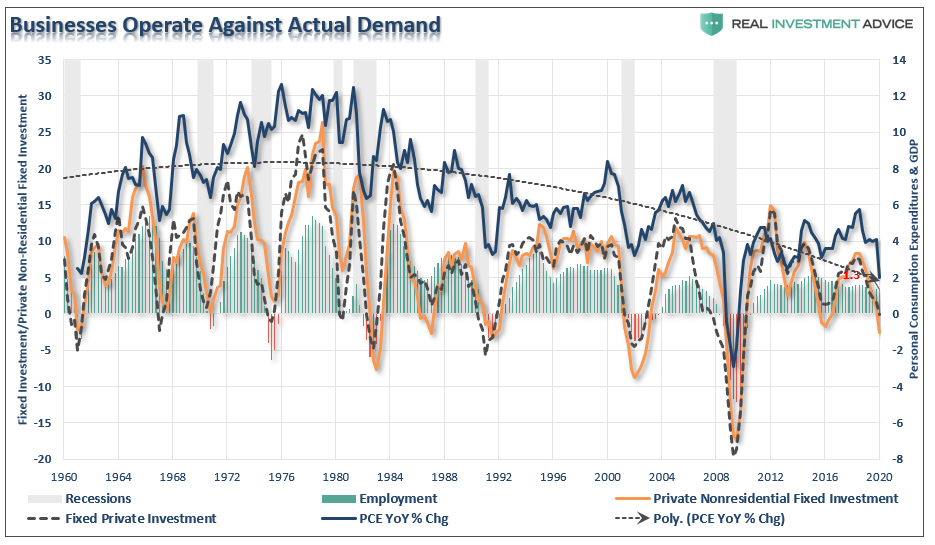
There is a negative feedback loop between employment and consumption. As unemployment rises, consumption falls due to a lack of income. Since businesses operate based on demand for goods and services, the correlation between PCE, fixed investment, and employment is high.”

“Despite the reopening of the economy, businesses will not immediately return to full operational activity, until consumption returns to more normal levels. Such a recovery is likely going to frustrate policy-makers and the Fed.”

It isn’t just the economic data that is going to be horrid over the next few months, but earnings will likely be just as bad.

Earnings can not live in isolation from the economy.

So goes earnings, so goes the market.

“Sell In May” Starts With Overbought Risk

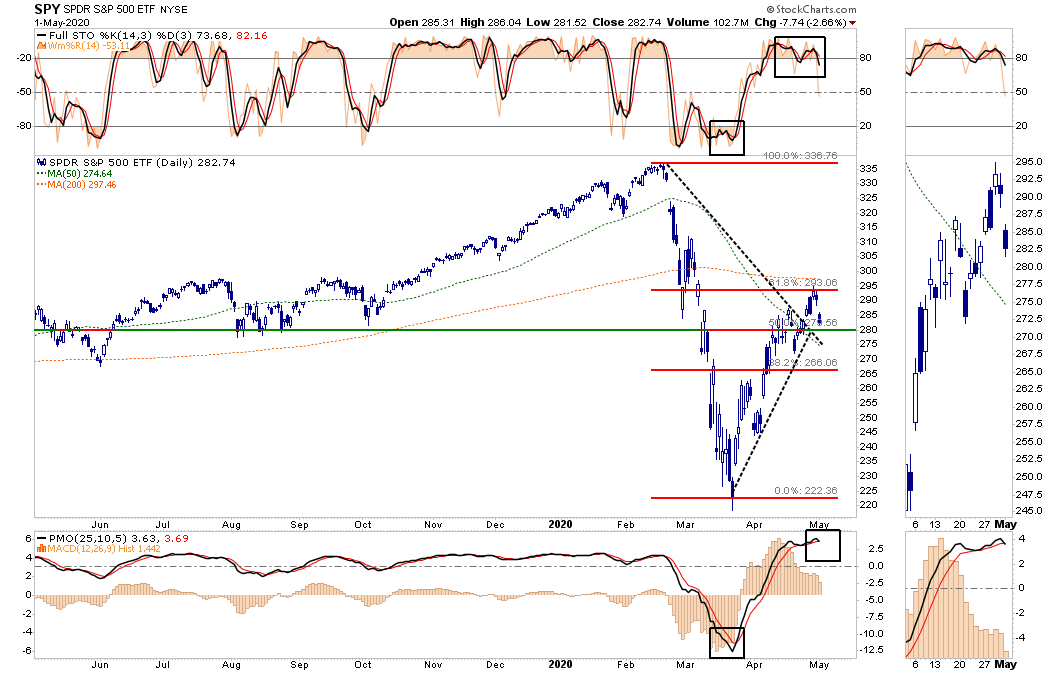
In the short-term, the markets remain incredibly overbought and extended after the run from the lows.

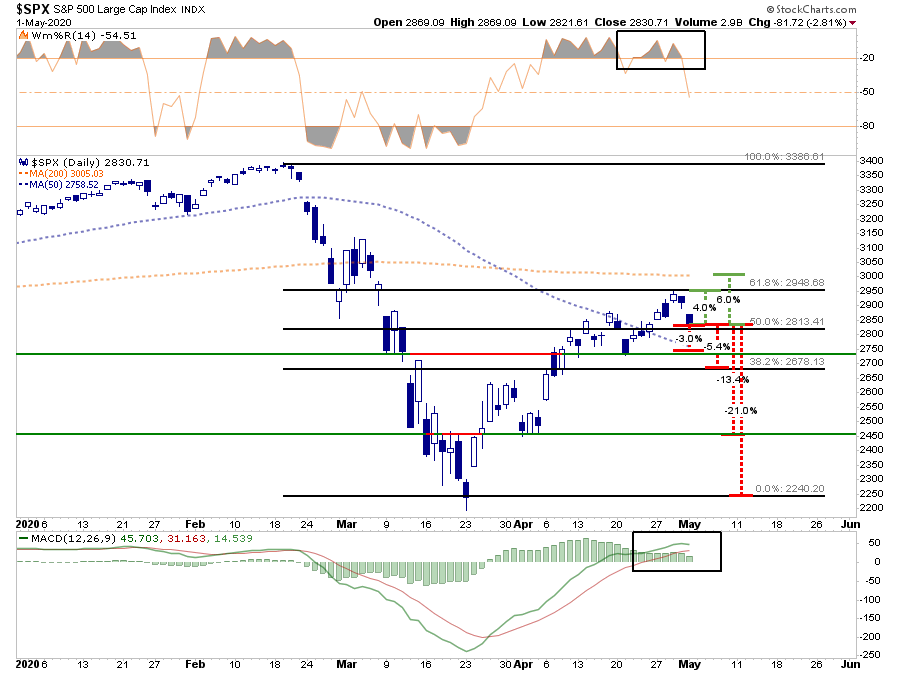
Previously, I discussed that markets had gone from extremely oversold, to extremely overbought during April. This sharp advance pushed the S&P 500 back to its 61.8% retracement level, where it failed on Friday.

While the sell-off on Friday did trigger an initial sell-signal, a further decline on Monday will trigger the primary sell-signal in the lower panel. Such would coincide with a break below 2800, and signal the start of a deeper corrective process.

There is currently a lot of “bullishness” built up in the markets, so investors will likely buy dips for now. However, it won’t take long for investors to remember March and head for the exits much sooner this time. So, be careful.

Reversions happen fast.

A Risky Game Of Hope

As we discussed with our RIAPro Subscribers (30-day Risk-Free Trial) last week, our colleague Jeffrey Marcus made some salient comments about investor’s “risky game of hope.”

“The table shows EPS growth for U.S. companies that have so far reported the 1st quarter. 20% of U.S. companies have reported so far.”

“There is only one-month of Covid-19 effect in the 1st quarter. Earnings growth from all 993 companies is -12%, but the price reaction to bad EPS has been stellar. The one-day price reaction to EPS on the day of release is in the lower right quadrant of the table.

As TPA has discussed in previous World Snapshots, the positive price action to negative news is a good sign. The problem is that EPS growth is down 12% with only one-month of the Covid-19 effect. Importantly, this is only 20% of stocks having weighed in; one has to wonder why?

The answer has to be that investors have an awful lot of hope in the power of the FED to keep the tire with a large hole inflated and as the man who taught me how to trade told me, ‘Hope is a bad investment strategy.’”

“Sell In May” Risk Outweighs Reward

What this all suggests is that “risk” still outweighs the potential “reward” of being aggressively invested in the markets.

With Friday’s sell-off, the risk/reward ranges remain unfavorable for the “Sell In May” period.

  • -3.0% to 50-dma vs. 4% to the 61.8% retracement.  Risk/reward equally balanced.

  • -5.4% to the 38.2% retracement vs. 6% to the 200-dma. Risk/reward equally balanced.

  • -13.4% to the April 1st lows vs. 4-6% higher. Risk/reward out of favor.

  • -21.0% to the March 23rd low: Risk/reward extremely out of favor.

The risk of a downside retracement as we head into summer months outweighs the upside currently. Importantly, this does NOT mean the markets can’t rally to all-time highs. It is possible, just not probable, and as investors, we must weigh our outcomes.

While we are discussing “Selling in May,” such doesn’t mean we are sitting in cash. We continue to remain long our reduced equity exposure and have been buying undervalued opportunities over the last few weeks. However, we are also balancing that equity exposure with offsetting hedges and a larger than average level of cash. We also continue to increase our duration in our bond portfolios as we expect interest rates will head toward ZERO this summer.

As my friend Victor Adair reminded me this week:

“Investors tend to buy the most at the top and the least at the bottom.” – Bob Farrell.

While it’s no guarantee, “Sell In May” just might be a good “risk strategy” to employ this year in particular.


Tyler Durden

Sat, 05/02/2020 – 13:50

via ZeroHedge News https://ift.tt/2VVOZnr Tyler Durden

Watch: Militia In Michigan And Beachgoers In California Protest Quarantines

Watch: Militia In Michigan And Beachgoers In California Protest Quarantines

Americans are revolting against two Democratic-run states, that is Michigan and California, late last week, as they call for each respective state government to lift quarantine orders. We must note, anti-quarantine protests have been seen in many states, but the two to focus on at the moment are the ones mentioned above. 

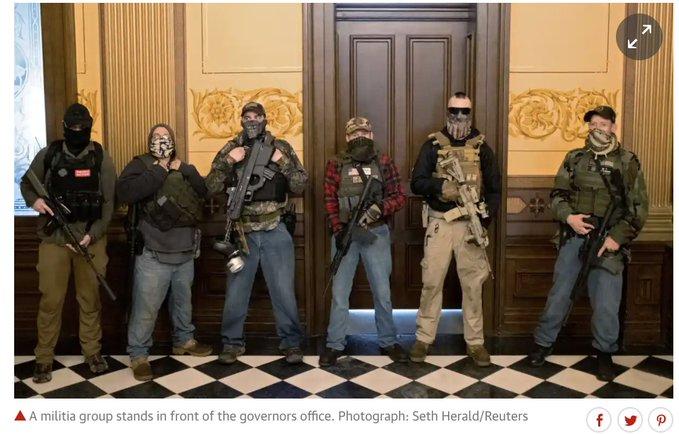
On Thursday, hundreds of protesters, some armed with assault-style rifles and various types of body armor and additional magazines, gathered at Michigan’s state Capitol in Lansing to object Gov. Gretchen Whitmer’s request to extend emergency powers to combat COVID-19.

The protest appeared to be much larger than the one held on April 16, a member of the Trump administration organized that. It was called “Operation Gridlock,” with the attempt to jam streets around the state Capitol building to pressure Whitner to reopen state. 

According to Reuters, the latest demonstration was called “American Patriot Rally,” which saw mostly Trump supporters, several militia groups, and other people who wanted Whitmer to reopen the economy because of the economic devastation caused by lockdowns.

Michigan State Police allowed one hundred protesters to enter the Capitol building, where some carried anti-quarantine signs, others carried long guns, and everyone had their temperature taken by authorities along with the required masks.

On April 21, we reported how “Pennsylvania Militia” rolled up in a demilitarized military vehicle to the Pennsylvania State Capitol Complex in Harrisburg, packed with people wielding guns for an anti-quarantine protest. 

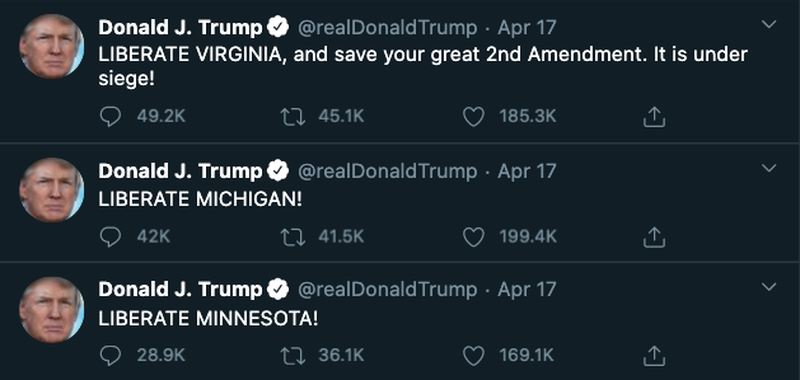
Anti-quarantine rallies were sparked after President Trump around mid-April tweeted: “LIBERATE MICHIGAN!,” “LIBERATE MINNESOTA!,” and “LIBERATE VIRGINIA, and save your great 2nd Amendment. It is under siege!”

Some states have begun to partially reopen economies after protesters created headaches in the last several weeks for state governments. Some states, including Georgia, Oklahoma, South Carolina, and Ohio, have made efforts to reopen their economies partially. This comes after an unprecedented crash in the US economy and more than 30 million unemployed in six weeks.

Another protest developed on Friday, this time it was thousands of beachgoers in California, who were fed up with Gov. Gavin Newsom’s decision to close all state beaches and parks. We noted the protest unfolded on Friday afternoon/evening at Huntington Beach. Here are more videos of large crowds:

While it might make sense to reopen an economy to avoid an extended downturn in the economy, the trade-off is that it could spark a second coronavirus wave and trigger a nasty double-dip depression, eliminating the prospects for a V-shaped recovery


Tyler Durden

Sat, 05/02/2020 – 13:25

via ZeroHedge News https://ift.tt/3bWQ5VD Tyler Durden

Trump Signs Executive Order Shielding Nation’s Power Grid From Attack 

Trump Signs Executive Order Shielding Nation’s Power Grid From Attack 

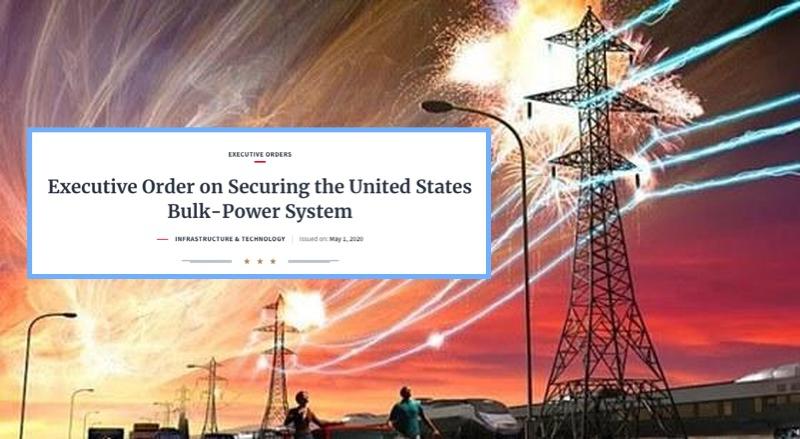
President Trump on Friday signed the Executive Order on Securing the United States Bulk-Power System over threats foreign adversaries could exploit vulnerabilities in the nation’s power supply network. 

The executive order identifies emerging threats by America’s adversaries as they could be plotting attacks. The order establishes a task force to defend the power grid from attacks and interlinks various governmental agencies to share vital information about the network. It also prohibits the use of equipment for the power grid that is manufactured by a foreign adversary.

“I, DONALD J. TRUMP, President of the United States of America, find that foreign adversaries are increasingly creating and exploiting vulnerabilities in the United States bulk-power system, which provides the electricity that supports our national defense, vital emergency services, critical infrastructure, economy, and way of life,” the order reads. 

President Trump notes in the order that power grids are a target for those “seeking to commit malicious acts,” specifically pointing out that “malicious cyber activities” are significant risks to the economy. 

“The bulk-power system is a target of those seeking to commit malicious acts against the United States and its people, including malicious cyber activities, because a successful attack on our bulk-power system would present significant risks to our economy, human health and safety, and would render the United States less capable of acting in defense of itself and its allies.

“I further find that the unrestricted acquisition or use in the United States of bulk-power system electric equipment designed, developed, manufactured, or supplied by persons owned by, controlled by, or subject to the jurisdiction or direction of foreign adversaries augments the ability of foreign adversaries to create and exploit vulnerabilities in bulk-power system electric equipment, with potentially catastrophic effects.” 

The signing of the order comes as the US economy has crashed, triggered by a pandemic that led to lockdowns across the country. In six weeks, 30 million folks have lost their jobs, as it appears, at this moment, America’s adversaries could find an opportunity to strike. 

Secretary of Energy Dan Brouillette praised the executive order and President Trump’s efforts to secure the grid, saying in a Department of Energy press release on Friday that it would “greatly diminish the ability of foreign adversaries to target our critical electric infrastructure.”

“Today, President Trump demonstrated bold leadership to protect America’s bulk-power system and ensure the safety and prosperity of all Americans,” said Brouillette. “It is imperative that the bulk-power system be secured against exploitation and attacks by foreign threats.  This Executive Order will greatly diminish the ability of foreign adversaries to target our critical electric infrastructure.”

The order gives Brouillette and his agency the task of identifying equipment in the power grid that poses a danger. 

The Office of Cybersecurity, Energy Security, and Emergency Response tweeted Friday that it “stands ready to work with its partners to secure” the grid and protect it from “malicious actors.”

We have outlined that America’s power grid “was never built with attacks in mind, it has plenty of vulnerabilities.” 

“Everything from malware cyber-attacks, to geomagnetic storms, to nuclear detonations in the atmosphere above the US, even sophisticated electronic weapons from Russia and China – all these threaten to shut down our grid and sow chaos.” 

And with pandemic and economic crash currently sending the country into turmoil, the executive order suggests emerging threats are fast developing by adversaries could be preparing to strike. 


Tyler Durden

Sat, 05/02/2020 – 12:35

via ZeroHedge News https://ift.tt/2WmllXs Tyler Durden